
An early-stage SaaS company’s B2B pricing strategy should start with the dollar value the product delivers to customers. An enterprise customer called Vitalii Sydorenko’s LOOQME “cheap, so it can’t be better” and kept it as a backup. LOOQME then tripled its price, starting with new customers. Value-based pricing gives founders the margin to fund an in-house product team.
What is the right B2B pricing strategy for an early-stage SaaS company?
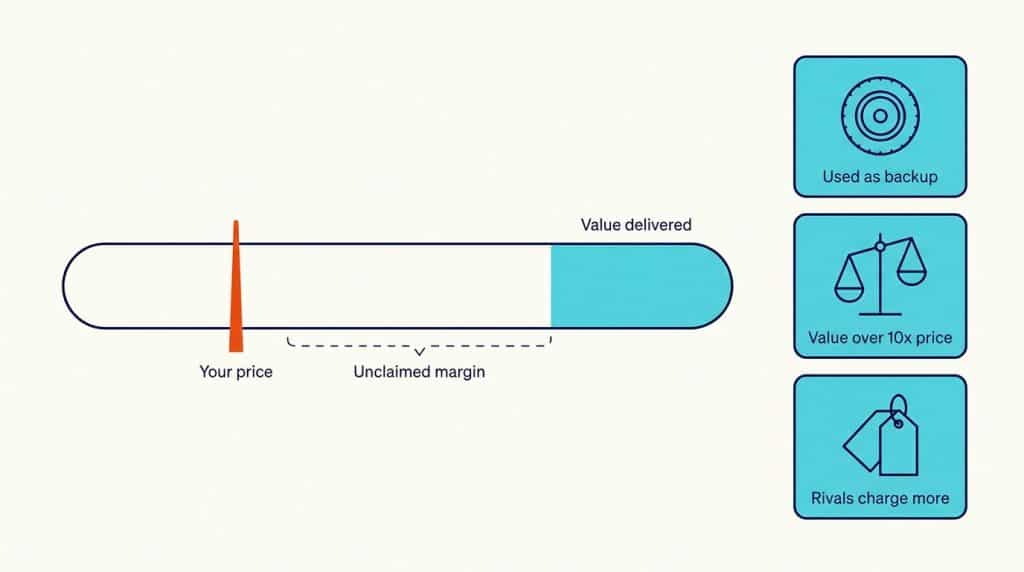
Price from the dollar value you deliver, and watch for three signals that you are too cheap. Buyers treat you as a backup tool, and the value you deliver exceeds 10x your price. Competitors also charge more for the same or less. LOOQME, a Ukrainian media monitoring tool, tripled its price after spotting the first and third.
About Vitalii Sydorenko
Vitalii Sydorenko is CEO of Gearheart and Beyond the Wow. He co-founded LOOQME, a media monitoring platform that grew into one of Ukraine’s top tools without outside investors. He later tripled LOOQME’s price after a buyer called it cheap. Founders who set their first SaaS pricing strategy by undercutting competitors hope volume will follow.
When deals stall, or buyers treat the product as second best, few trace the problem back to the price. Sydorenko has also closed a funded startup, Jiffsy, and reviewed startups for a venture capital fund. His experience at LOOQME shows what a B2B pricing strategy built on measured value looks like in practice.
Watch the Episode
Table of Contents
What is a B2B pricing strategy, and why start from value?
A B2B pricing strategy is how a company decides what to charge other businesses. It also sets how that price changes over time. Its core choice is the anchor: your costs, your competitors, or the value your customer receives. LOOQME, Vitalii Sydorenko’s media monitoring platform, began with the first two and later tripled its price.
The right anchor for an early-stage SaaS company is the dollar value the customer receives.
Vitalii Sydorenko set LOOQME’s first price by reading competitor prices and going lower. He now describes his younger self as “young and stupid” about pricing.
| Pricing anchor | What sets the price | Risk for an early-stage SaaS |
|---|---|---|
| Cost-plus | Your costs plus a margin | Ignores what the outcome is worth to the buyer |
| Competitor-based | Rival prices, usually undercut | Can signal a lower tier than your product deserves |
| Value-based | The dollar outcome the customer gets | Harder to calculate, so founders skip it |
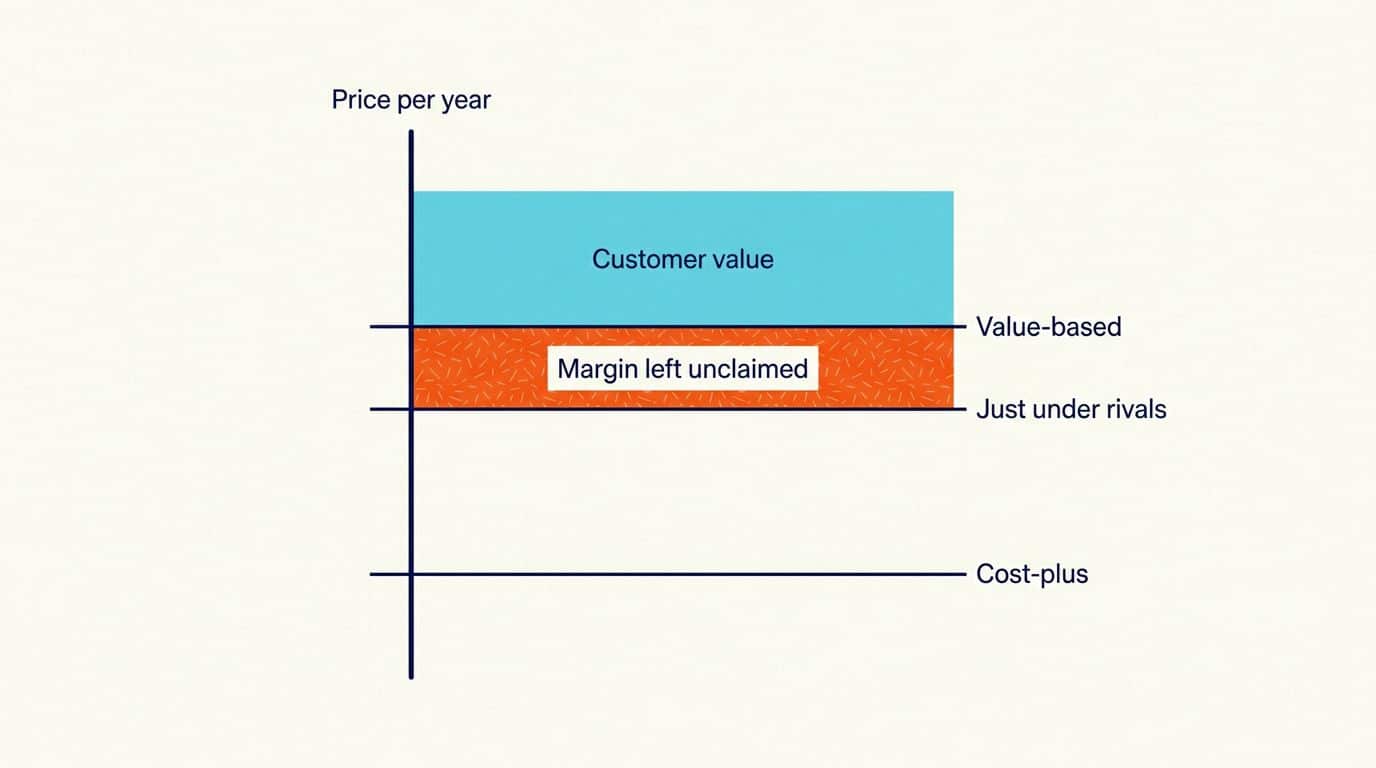
LOOQME’s first price combined cost-plus and competitor-based pricing. Sydorenko explains that the team took its costs and checked competitor prices. It then set a price below them, leaving some margin.
Sydorenko assumed a cheaper product would make every buyer choose LOOQME.
Value-based pricing starts with the customer’s economic outcome. Packaging choices such as tiered, per-seat, and usage-based pricing then build on that anchor. Sproutworth’s guide to SaaS pricing models covers those mechanics.
Intuition still drives many of these choices. Sales Benchmark Index surveyed 321 SaaS pricing leaders for its 2025 State of SaaS Pricing report. It found that 48% make critical decisions on intuition alone.
McKinsey’s pricing research shows price is the largest profit lever most companies control. Michael Marn, Eric Roegner, and Craig Zawada made the case in McKinsey Quarterly in 2003. A 1 percent price rise with stable volumes would generate an 8 percent increase in operating profits. For a founder who undercuts by default, every unclaimed price point is margin the product team never sees.
Signal 1: Buyers treat you as the backup tool
A low B2B price can signal to enterprise buyers that your product is the risky choice. At an industry event, an enterprise client told Vitalii Sydorenko it ran LOOQME alongside a competitor that, by his estimate, cost about three times more. LOOQME was cheap, so the buyer thought it couldn’t be better. The client kept LOOQME only to check that the expensive tool was not missing any mentions.
Sydorenko was sure LOOQME’s product was stronger at the time. In media monitoring, though, a missed mention can hurt a brand, so buyers pay for confidence. A low price signaled to them that LOOQME was the riskier choice.
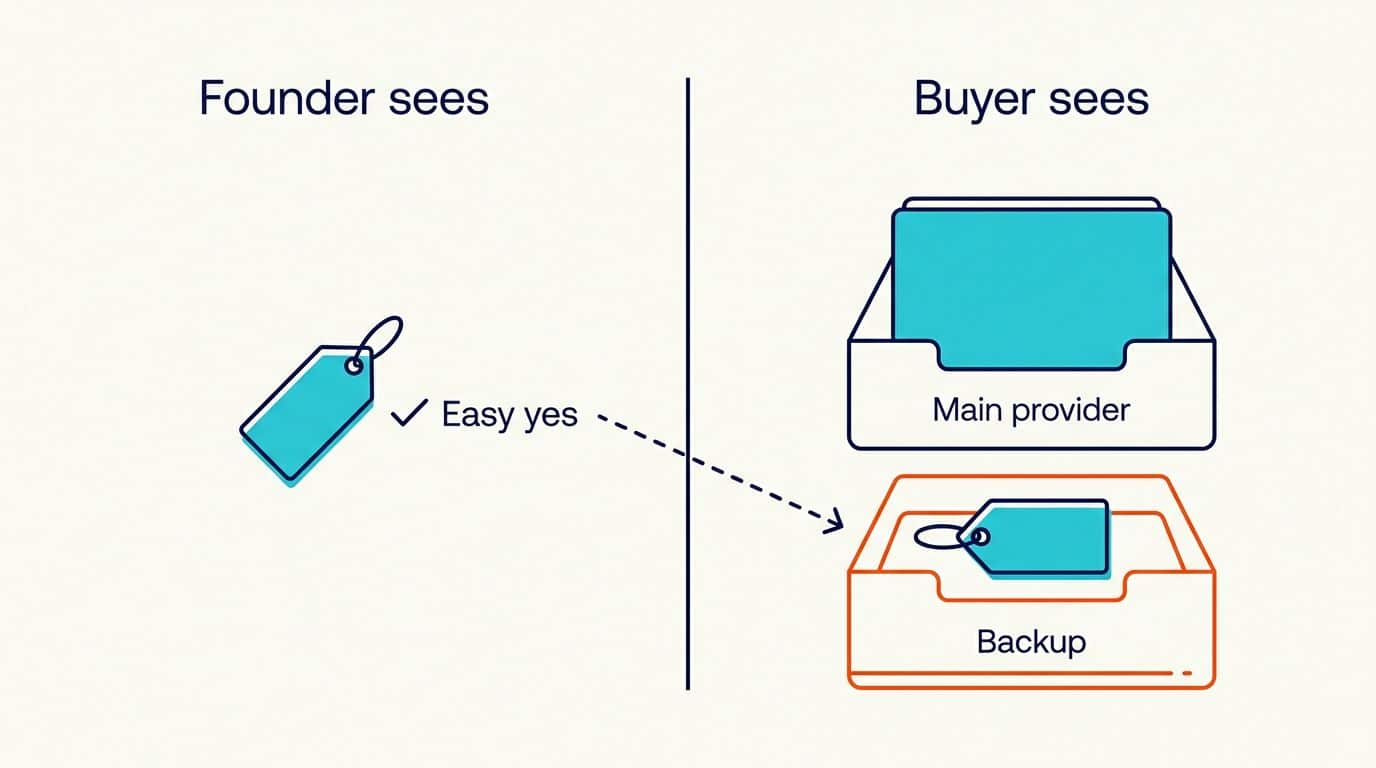
Sydorenko’s conclusion from that conversation reshaped how he sees pricing. Sometimes a low price does not read as “worth a try”. In his words, it reads as “Oh, they are cheap, it means they are bad.”
Sydorenko’s experience points to a practical test for any B2B pricing strategy. Ask customers how they use your product.
Listen for words like second opinion, backup, or sanity check. They mean your price signals a lower tier than your product deserves.
Akshay Rao and Kent Monroe reviewed the research on price and perceived quality in 1989. They found the effect of price on perceived quality “moderately large and statistically significant”. Enterprise buyers pay to avoid costly misses, as LOOQME’s media monitoring clients did. For them, a low price can push the better product into a backup role.
Signal 2: Your product delivers far more than 10x its price
Customers should get roughly 10x the value they pay. Vitalii Sydorenko’s pricing rule fits in one line. In his words, “the value of a service you are receiving should be bigger than the money you pay.” In B2B, he argues, you can calculate that value.
Time and outcomes both convert into dollars.
Sydorenko uses a common benchmark to guide a B2B pricing strategy. Delivered value of around ten times the price marks a great product at a fair price. He is clear that no single formula fits every company.
The arithmetic is easy to see in Beyond the Wow’s first offer. It is a two-hour session for $500. It can end with Sydorenko advising a founder not to build at all.
Picture a founder with $20,000 set aside for an MVP built the wrong way. Avoiding that loss for $500 is a 40x return. The fee also credits the founder if they go on to build with the studio.
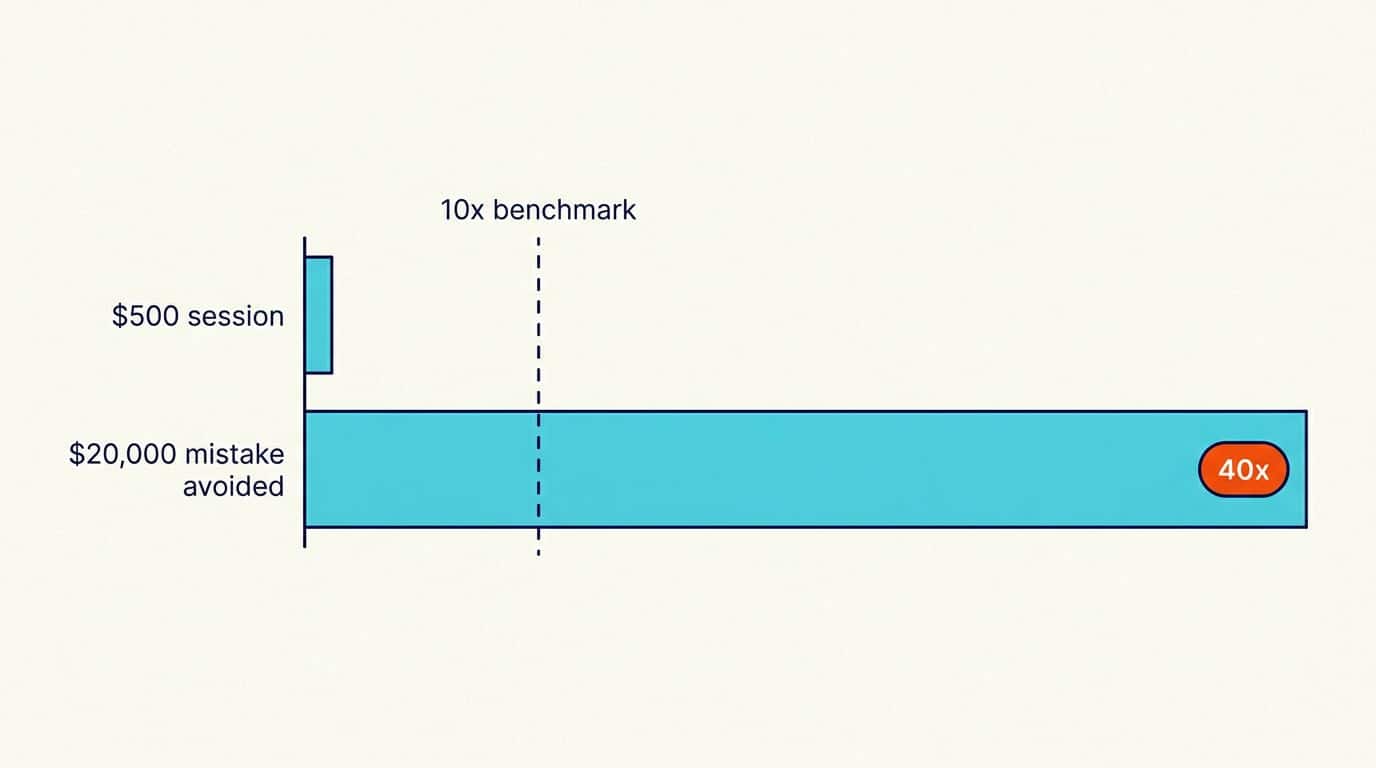
Sydorenko recommends calculating value in dollars, and the method is simple:
- List the outcomes a customer gets from your product in a year.
- Put a dollar figure on each one, converting hours saved into salary cost.
- Divide the total by your annual price.
By the 10x benchmark, a ratio well above 10x suggests room to raise your price. A ratio well below it suggests the product needs more value before any increase will hold.
The 10x value rule holds that customers should receive about ten times the value they pay. SaaS consultant Lincoln Murphy published it on Sixteen Ventures in 2012. Stripe offers a B2B example: a buyer accepts a $100,000 annual contract because the software replaces $500,000 in labor costs. Vitalii Sydorenko applies the same test at Beyond the Wow, pricing a $500 session against a $20,000 MVP mistake.
Signal 3: Competitors charge more for the same or less
If rivals charge more for the same or less, your price is too low. Vitalii Sydorenko says founders should know their competitors better than anyone, including their own customers. That means honestly comparing what each rival delivers and charges.
At LOOQME, the comparison was lopsided. Enterprise clients such as McDonald’s and Samsung paid LOOQME a few hundred dollars a month.
Sydorenko notes that sum was easy for a large brand to afford. Meanwhile, a rival he rated as weaker charged several times more.
Switching costs further strengthened LOOQME’s position. Sydorenko explains that large companies often run a tender to choose a new provider. His clients had already done that and knew the market well.
The signal also works in reverse. If customers can easily switch to rivals that match or beat you, Sydorenko would not raise the price. He would first ask how to bring more value than those competitors.
The competitor check therefore filters any B2B pricing strategy. In Sydorenko’s framing, higher rival prices plus high switching costs point to an increase. Equal rivals plus low switching costs point to product work first, the same trap Sproutworth describes in competing on price.
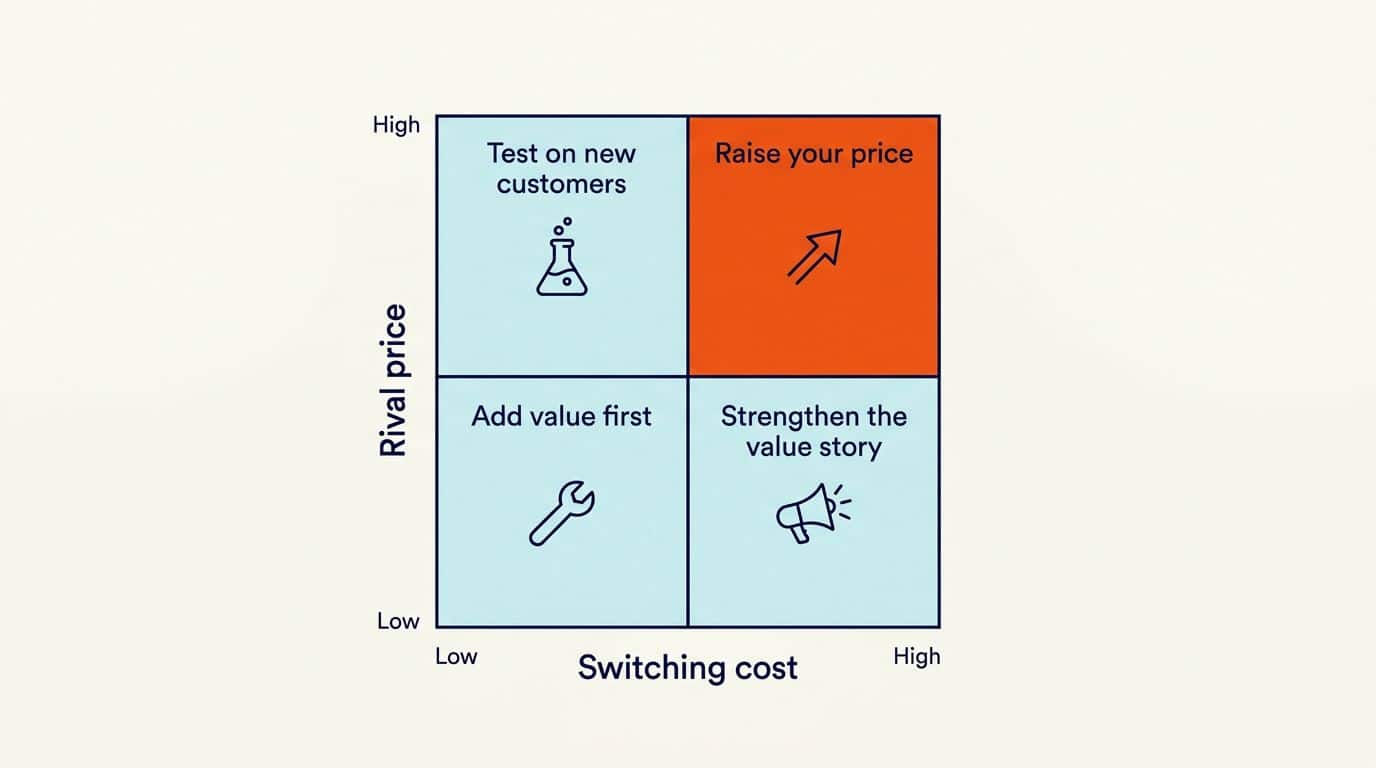
| Signal | Test question | What to do |
|---|---|---|
| Buyers treat you as the backup tool | How do customers describe their use of your product? | Reposition and test a higher price on new customers |
| Value far exceeds 10x the price | What dollar outcome does a customer get in a year? | Raise the price toward the value you deliver |
| Competitors charge more for the same or less | Would a buyer pay a rival more for equal or weaker results? | Raise the price if switching costs are high |
How to build a B2B pricing strategy in five steps
Build a B2B pricing strategy in five steps. Measure the value you deliver, check competitors, choose a value anchor, test on new customers, and match onboarding to price. Price from measured value, then test the new price on new customers first. These five steps come from Vitalii Sydorenko’s experience at LOOQME, Gearheart, and Beyond the Wow.
- Calculate the value you deliver. Put a dollar figure on each customer outcome, including hours saved. Sydorenko calls this the one action every founder should take this week.
- Map competitors and switching costs. Compare what rivals deliver and charge, then judge how hard it is for customers to leave. Sydorenko notes that enterprise buyers often need a tender to switch, which protects a justified increase.
- Choose a value anchor and a fallback package. Set the main price against delivered value. Keep a smaller, cheaper package, as LOOQME did, so price-sensitive customers can switch down.
- Test the new price on new customers. With private pricing, quote different prices to prospects. With public pricing, change it for new customers and track conversion rate and revenue.
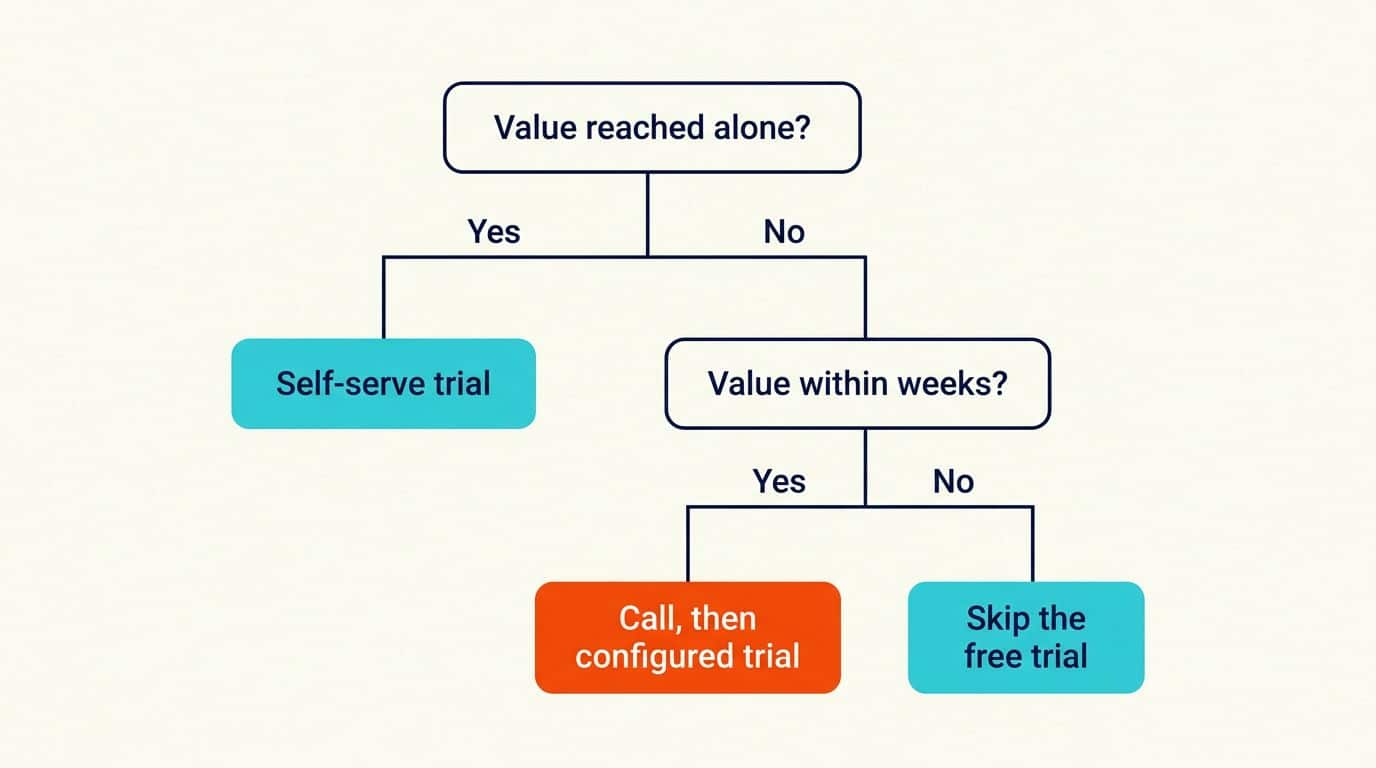
- Match onboarding to the price. If buyers cannot reach value alone, run a short call and pre-configure the trial. If value takes months, skip the free trial. At LOOQME, a call plus a pre-configured trial worked better than open sign-ups.
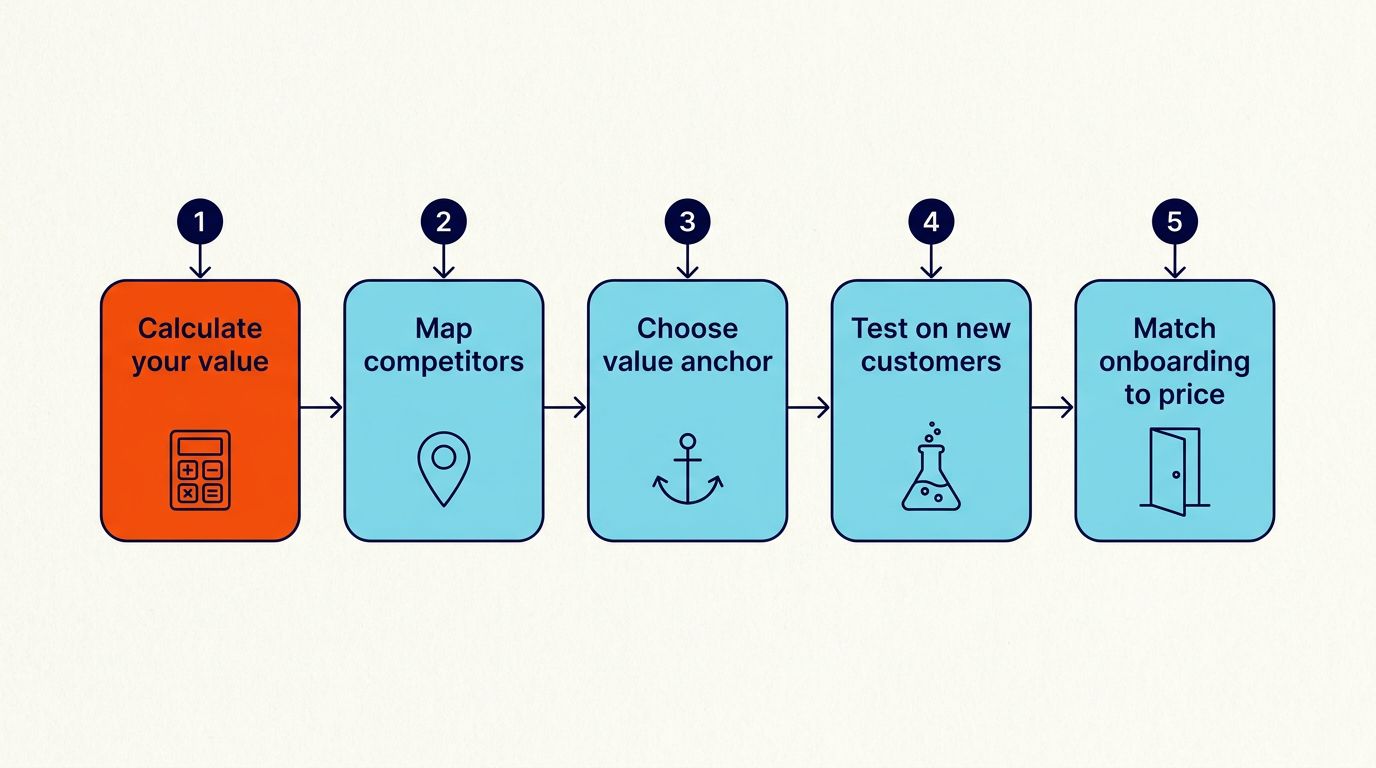
The order of these steps matters. Sydorenko’s LOOQME story shows that higher prices land when value is measured, alternatives are known, and buyers see results early.
How to raise prices without losing existing B2B customers
Raise prices on new customers first and on existing customers at renewal. LOOQME tripled its price within a couple of months of an enterprise buyer calling it cheap. Vitalii Sydorenko says there was no secret sauce behind the rollout, only a clear sequence.
New customers paid the new price straight away. Existing customers kept their contracted price until renewal, and those on shorter contracts moved sooner.
Each customer also had an option other than leaving. LOOQME kept a smaller, cheaper package, so anyone who wanted to hold their spend could switch down instead.
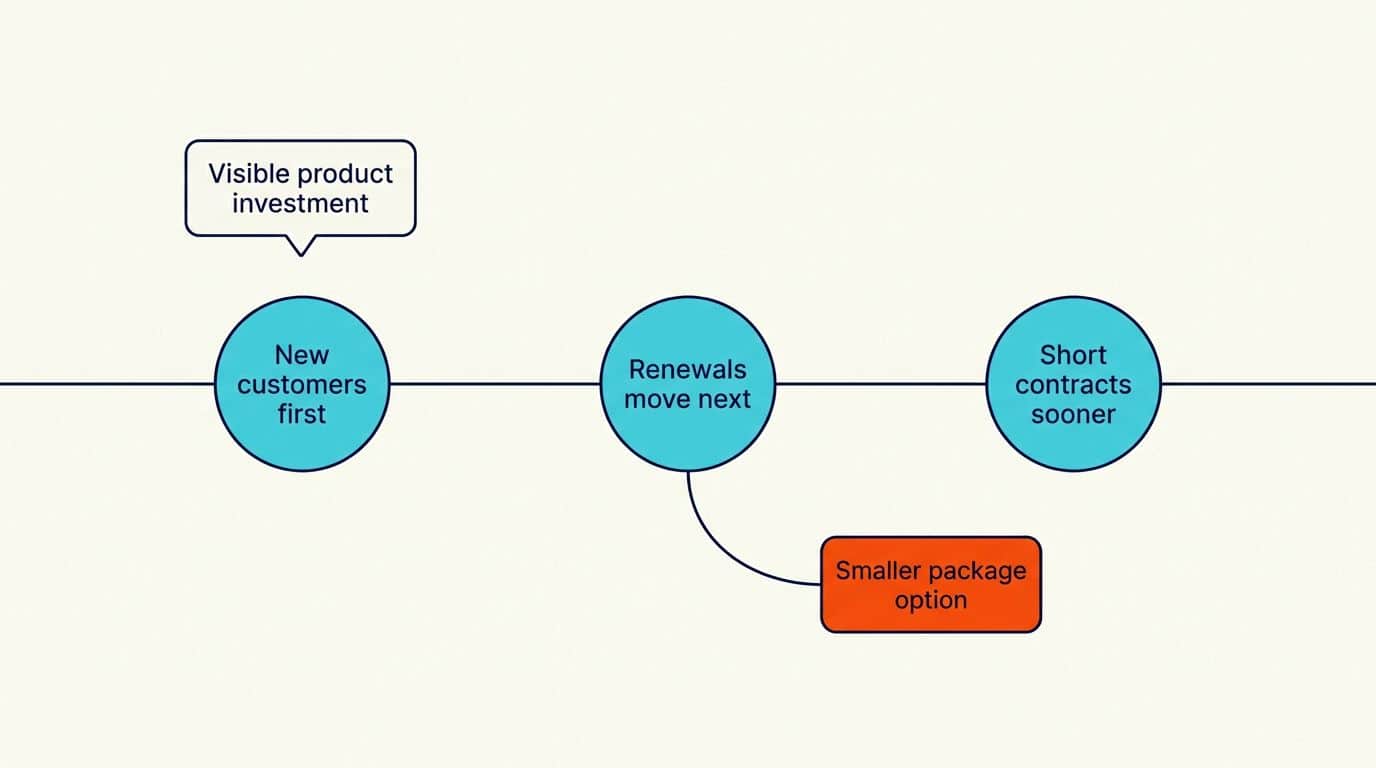
The message explained the increase through what customers could already see. LOOQME ran an in-house development team that shipped improvements month after month. Sydorenko told customers the old price could not sustain that pace.
In our conversation, I asked whether the hassle of switching explained why customers stayed. Sydorenko agreed, then added a second reason: LOOQME had underpriced the product all along.
The venture firm CRV backs the same direction. Founders should “start high and keep raising until you start losing a meaningful share of deals based solely on price.”
Price changes are routine in SaaS, and a B2B pricing strategy should plan for them. Stripe reports that in 2024, over 94% of B2B SaaS pricing leaders revised their pricing at least once a year.
For founders without contracts to lean on, Sydorenko suggests two safer tests. Both protect existing revenue while the new price proves itself.
With private pricing, quote different prices to different prospects and watch the reactions. With public pricing, change it only for new customers, then track conversion rate and revenue.
Monetizely, a SaaS pricing consultancy, recommends three to six months’ notice for significant price changes. It also advises grandfathering or phasing in increases above 15 – 20 percent. LOOQME’s tripled price followed the same logic. New customers moved first, existing customers moved at renewal, and a smaller package protected anyone watching their spend.
Free trial or sales call first? Your onboarding decides the price you realize
Start with a free trial only when buyers can reach value alone inside it. Otherwise, run a short sales call first. A self-serve trial that buyers cannot set up lowers paid conversions. LOOQME’s free trial results looked like growth at first. Once the team built self-serve onboarding, anyone could start a seven-day trial without a call. Trial sign-ups rose, while paid conversions fell below their earlier level.
Vitalii Sydorenko’s team then studied what trial users actually did. Trial users added one or two keywords with the wrong search query. They received irrelevant results, missed real news, and never saw the product’s value.
The setup was the root cause. A media monitoring query needs search-engine syntax, and as Sydorenko puts it, “we expected non-technical people to do technical action”. Junk queries also cost LOOQME computing power, because common words triggered huge volumes of mentions.
LOOQME went back to a sales call first. On the call, the team asked what each lead wanted to monitor, then pre-configured the trial in minutes. Buyers saw value from day one, so more of them stayed.
Sydorenko’s test for matching a sales motion to your B2B pricing strategy has three parts:
- Business model: can your customer lifetime value carry the cost of people running demos?
- Setup difficulty: watch a real customer set the product up without help.
- Time to value: if value takes one or two months to appear, a free trial does not make sense.
Before any call, buyers can still learn what the product does. Sydorenko points to content, tip emails during a trial, and webinars that show many leads the same thing at once. Sproutworth’s pre-sale content playbook covers how B2B CEOs build that trust.
Close, the sales CRM company, recommends a 14-day trial as the baseline for most B2B SaaS products. It argues that prospects rarely use the full period. Vitalii Sydorenko adds a condition: LOOQME’s buyers could not reach value alone in any trial. For them, a short call and a pre-configured trial worked better.
Why pricing blind spots start inside your own bubble
Vitalii Sydorenko faced LOOQME’s too-cheap price, its failed self-serve trial, and Gearheart’s one-client problem. When asked what they shared, he answered in one word: bubble. Each time, the team stopped hearing people outside it. In his view, that is how a B2B pricing strategy ends up set without outside evidence.
When Sydorenko gave that answer, I told him mine would have been close. In all three cases, the fix is a conversation that lets you see your product’s value through a customer’s eyes.
Gearheart is the software studio his brother built over about ten years. There, one star client became most of the business for a couple of years.
The client’s founder previously exited for over $100 million, and the team’s energy followed that product. Agency sales slowed, and when funding tightened, the client cut part of Gearheart’s team in one day.
Validation is a sales process, so sell before you build.
The fix he now teaches founders at Beyond the Wow is to sell before you build. In his words, validation “is a sales process”.
Sell the service manually or show a clickable prototype. Three to five paying or waitlisted customers are enough to justify an MVP.
Parakeeto, in its guidance for agencies, describes client concentration as a large revenue share from one client. It puts that share at often 25% or more. Gearheart, now led by Vitalii Sydorenko, had to build a sales function fast once its dominant client cut spend.
Frequently Asked Questions
What is a B2B pricing strategy?
A B2B pricing strategy is how a company sets and adjusts what it charges other businesses. It chooses an anchor: costs, competitor prices, or the value the customer receives. Vitalii Sydorenko argues value-based pricing suits B2B products because buyers can calculate the time and money saved. Undercutting left LOOQME’s margin unclaimed until it tripled its price.
How do I know if my SaaS price is too low?
A SaaS price is too low when three signals appear together. Buyers treat the product as a backup, and its delivered value far exceeds 10x the price. Competitors also charge more for the same or less. At LOOQME, Vitalii Sydorenko saw the first signal: an enterprise client called the tool cheap and unlikely to be better.
How much notice should existing customers get before a price increase?
Existing B2B customers should get notice that respects their contract terms. SaaS pricing consultancy Monetizely calls three to six months typical for significant changes. Vitalii Sydorenko’s company LOOQME applied its tripled price to new customers immediately. Contracted customers moved at renewal, and a smaller, cheaper package stayed available for anyone who wanted to keep their spend.
How long should a B2B SaaS free trial be?
A B2B SaaS free trial should last as long as a buyer needs to see real value. Close, the sales CRM company, recommends 14 days for most products. Vitalii Sydorenko argues that when value takes one or two months to appear, a free trial makes little sense. A short sales call and a pre-configured account work better.
How is B2B pricing different from B2C pricing?
B2B pricing differs from B2C pricing because business buyers judge price against return on investment, not personal preference. Stripe gives an example: a company accepts a $100,000 annual contract because the software replaces $500,000 in labor costs. B2B deals also involve contracts, renewals, and negotiation, so price changes usually land at renewal rather than overnight.
What are the main types of B2B pricing strategies?
The main types of B2B pricing strategies are cost-plus, competitor-based, and value-based pricing. Cost-plus adds a margin to your costs, and competitor-based pricing follows rival prices, often by undercutting them. Value-based pricing sets the price from the economic outcome the customer receives. Packaging models such as tiered, per-user, and usage-based pricing then sit on top of that anchor.
What to check before your next pricing decision
At the end of our conversation, I put it to Vitalii Sydorenko this way. Your price, the way you let people try your product, and who pays your bills all send signals. Most founders never check what those signals say.
LOOQME’s story shows a price sends its signal before a buyer ever opens the product. An enterprise client read LOOQME’s low price as a warning and kept a weaker, pricier tool as its main provider.
For B2B tech founders, undercutting can cost them the enterprise deals they meant to win. LOOQME’s trial users who never reached value never paid, whatever the price. And as Gearheart learned, a team focused on one large client stops hearing the rest of the market.
The common fix is to measure before you set the price. That is where a B2B pricing strategy should start. Put a dollar figure on what your product delivers, then compare it with your price.
Sproutworth‘s newsletter strategy service helps B2B tech founders teach buyers their product’s value before the first sales call.
What would your largest customer say your product is worth, and how far is that from what they pay?
Related links
- Connect with Vitalii Sydorenko on LinkedIn
- Check out Gearheart
- Check out Beyond the Wow
Related resources
- AI pricing models, on charging for the costs your product removes
- Land and expand strategy, on growing revenue from the customers you already have
- B2B newsletter examples, for campaigns that teach buyers value before a sales call
Some topics we explore in this episode
- How low pricing can undermine trust
- What happens when you triple prices overnight
- Value-based pricing in B2B SaaS
- Smart ways to test price increases
- What causes sales to be achieved? Free trials versus high-touch onboarding.
- Turning customer education into higher conversions
- Real lessons from a startup failure
- The hidden danger of relying on one big client
- What actually works in B2B lead generation today
- Proving product demand before you build
Listen to the episode
Subscribe to & Review the Predictable B2B Success Podcast
Thanks for tuning into this week’s Predictable B2B Podcast episode! If our interviews have helped your business journey, please visit Apple Podcasts, subscribe, and leave an honest review.
Your reviews and feedback will help me keep delivering great, helpful content and reach even more amazing founders and executives like you!
