
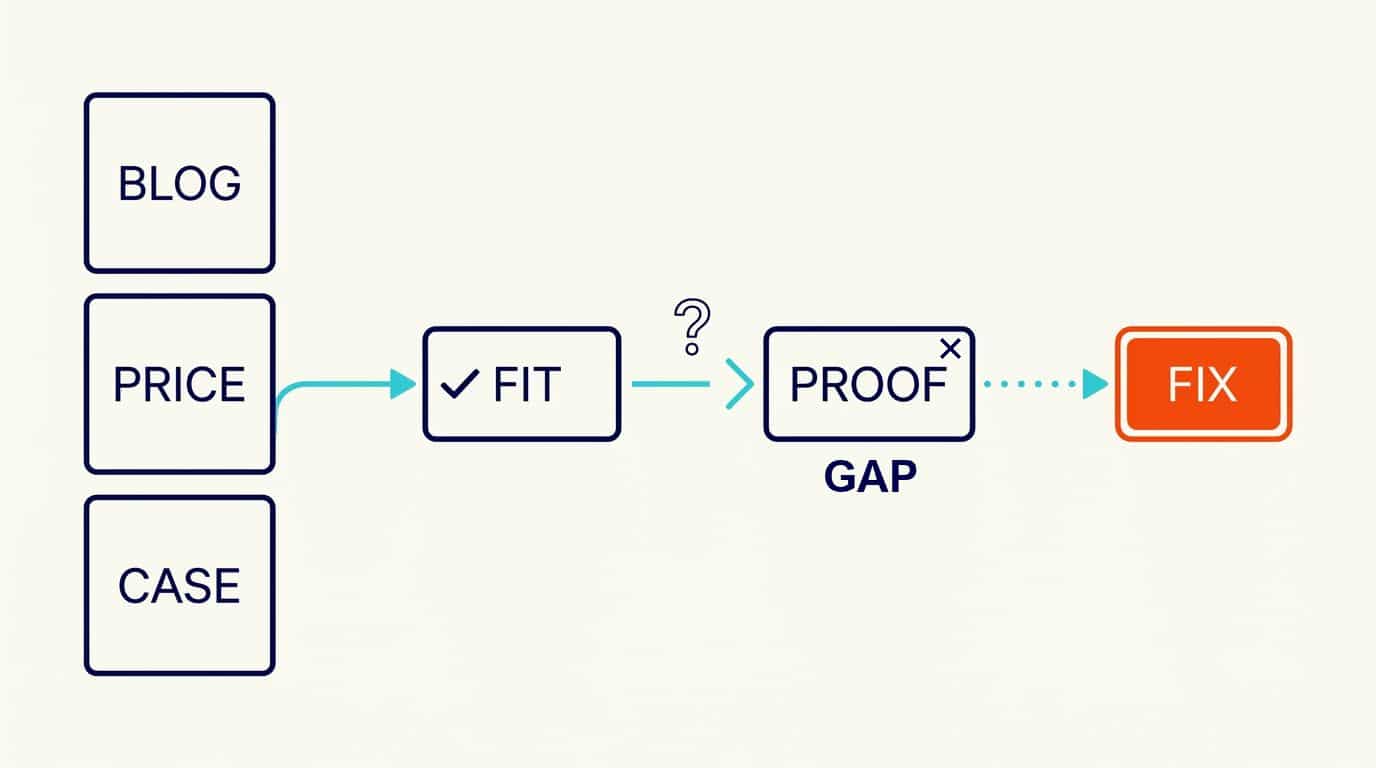
B2B SaaS content audit for Series A companies identifies assets that help qualified buyers and those that waste budget. It checks measurement, maps each asset to the current ICP and buyer questions, then weighs observable deal activity. Check tracking first; then repair buyer-critical pages before commissioning more top-of-funnel posts. The output is a clear, prioritized 90-day action roadmap to refresh, consolidate, redistribute, or create content without mistaking traffic for revenue.
A Series A team can have a full publishing calendar and still lack answers to the questions sales hears every week. Sales-question gaps call for a B2B SaaS content strategy grounded in buyer conversations.
The audit below treats each asset as a possible contribution to a buying decision. It does not pretend every touchpoint can be attributed or that every low-traffic page should be deleted.
Last updated: October 21, 2026.
Why should a Series A team audit content before scaling production?
Run a B2B SaaS content audit for Series A before increasing the publishing budget. Bessemer Venture Partners recommends that Series A/B SaaS companies demonstrate a repeatable sales cycle and consider sales-cycle length, lifetime value, and net revenue retention. The audit tests whether existing assets help buyers through the questions and sales stages behind those measures, rather than merely adding sessions to a dashboard.
Funding changes the content question. At seed, the team may publish to explain a problem and test positioning.
After a Series A, a company may sell to a larger buying committee and face more evaluation-stage objections. A blog library written for early adopters can miss the security, integration, and implementation questions those buyers ask.
An audit begins with one commercial question: Is the constraint qualified demand, conversion from interest to opportunity, progress through evaluation, or retention? Pick one as the primary lens. If all four become equal priorities, the audit cannot identify which investment comes first.
Do not assume every funded company has enough published material or CRM history for a page-level revenue analysis. If the library is small or deal volume is thin, use interviews with sales and customers, search queries, and a handful of representative opportunities.
State the evidence limit. A sensible decision based on limited observations is better than a precise-looking score with no trustworthy inputs.
How do you test whether content data is trustworthy?
Influenced pipeline records an interaction; it does not prove the interaction caused the deal. A B2B SaaS content audit for Series A tests the measurement chain before judging individual pages. HubSpot’s attribution documentation distinguishes contact-create, deal-create, and deal-revenue reports. Verify original-source fields, consistent UTMs, contact-to-account and contact-to-deal associations, and shared lifecycle-stage definitions before ranking pages by pipeline.
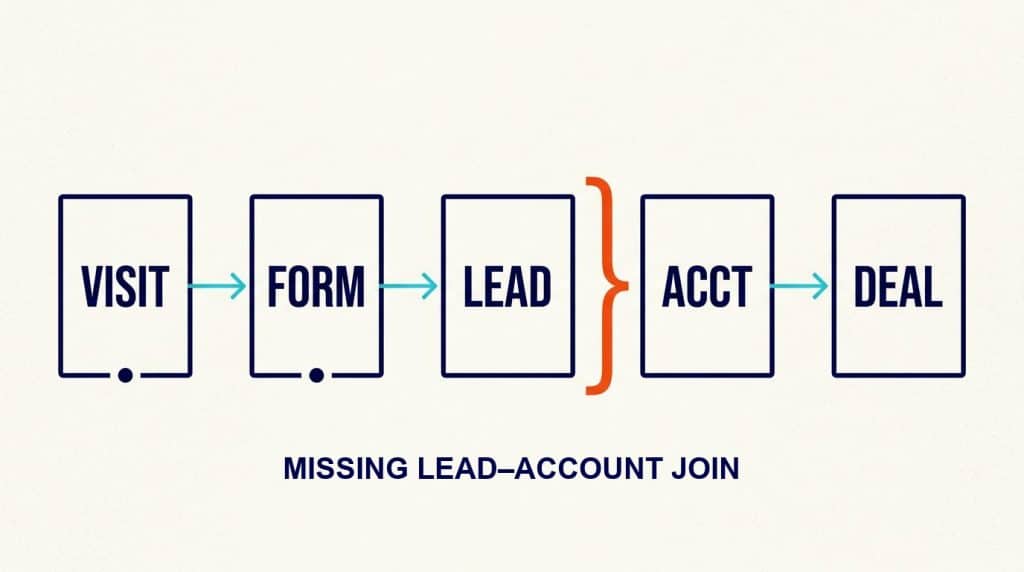
Begin with a small sample of recent opportunities. Trace the first recorded visit, form submission, CRM contact, account association, and deal creation.
Look for missing source fields, duplicate contacts, imported leads labeled as organic, and pageviews assigned to the wrong person. If those records are unreliable, page-level pipeline rankings will be unreliable too.
Define three different measures before using them:
- Content-sourced opportunity: The first observable qualifying touchpoint was an owned content asset under the team’s documented definition.
- Content-influenced opportunity: A contact associated with an opportunity engaged with content before a specified deal milestone. Influence is an observation, not proof of causation.
- Sales-used content: A seller deliberately shared an asset to answer an objection or move an evaluation forward, whether or not analytics recorded a visit.
Do not add sourced and influenced values together. The same opportunity can appear in both sets.
Do not call every pageview an incremental contribution to revenue. Review a few opportunities manually with sales before building a dashboard that everyone trusts by default.
Dark social and forwarded links leave gaps. A prospect may read a colleague’s screenshot, a founder’s LinkedIn post, or a sales email without creating a clean website trail.
Ask new opportunities how they heard about the company and record the answer alongside instrumented data. The aim is better decisions, not an impossible claim of perfect attribution.
In my interview with Jeff Dolan, CEO of Wavve, he described routing podcast links through a stat counter. He said it still captured only a fraction of the influence he believed the content had. That is Dolan’s reported experiment, not a measured result from a Sproutworth client.
Dolan’s account of untracked podcast influence supports a narrow practice for a Series A content audit: record observable interactions and ask buyers what reached them outside tracked channels. His podcast-link experiment does not justify inflating influenced revenue with a guessed percentage.
What should the measurement checklist verify?
A B2B SaaS content audit for Series A requires reliable contact-to-opportunity records before scoring individual assets. Verify one complete journey before calculating page-level influence. Compare a recent opportunity’s form submission, contact, account, and deal records against website and CRM events. If the records disagree, repair the joins before scoring assets. The goal is a budget decision with known evidence limits, not a claim of perfect attribution.
Use this short field-level check with the marketing and revenue-operations owners:
- Landing-page URL and original source: Was the first recorded page retained after a form submission or later site visit?
- UTM fields: Did source, medium, campaign, and content values survive the form-to-CRM transfer without overwriting the original source?
- Contact-to-account association: Does the individual belong to the correct company, including when several stakeholders engage?
- Contact-to-deal association: Can the team identify which interactions occurred before deal creation and which occurred after?
- Lifecycle timestamps: Are first touch, lead conversion, opportunity creation, and stage changes captured consistently?
- Sales use: Do sellers record assets shared during evaluation, even when the buyer never clicks a tracked link?
Record each field as reliable, repairable, or unavailable. Do not turn an unavailable field into a zero contribution.
Where CRM history is incomplete, pair the surviving data with call notes and a direct question to the sales team. A small audit can still prioritize a pricing-page rewrite or a missing implementation guide without pretending it measured causality.
What belongs in a B2B SaaS content audit for Series A?
An audit inventory is incomplete if it ignores the pages buyers use during evaluation. A Series A B2B SaaS content audit covers more than indexed blog URLs. Kalungi’s SaaS audit guide includes lead magnets, calls to action, testimonials, and sales enablement. Add product, pricing, integration, security, implementation, and help pages where they exist. Give each asset an owner and a buyer question.
Make the inventory useful enough for decisions without turning it into a data-collection project. Record the asset URL or location, format, target ICP, buyer role, product promise, buying stage, intended next action, last substantive update, and known owner. Add search metrics only for pages where discovery through search is actually a goal.
A comparison page and a founder essay cannot pass the same performance test. The comparison page may help a small set of high-intent accounts choose a vendor. The essay may establish a point of view, earn references, and start conversations months earlier.
A technical implementation guide may reduce friction after the contract is signed. Separate asset jobs before comparing results.
For each asset in a B2B SaaS content audit for Series A, ask sales which real buyer question it answers. Pull objections from call notes, lost-deal reviews, security requests, and implementation conversations. If the material answers a question nobody asks, decide whether it addresses a new market opportunity or simply survived from an old positioning exercise.
Do not retire a page because it has few visits. Check backlinks, internal links, assisted journeys, and whether sales or customer success uses it.
Animalz’s strategic content audit starts with the problem the business needs to solve, then selects data points that will guide the decision. A low-traffic page that resolves a late-stage concern can earn its place.
When I interviewed Emilia Chagas, co-founder of Content Tools, she urged teams to inventory their work before creating more. An inventory prevents duplicate work, mixed signals, and cluttered URLs. Her point came from her content-strategy practice, not from a Sproutworth audit of a Series A client. Apply it here by recording each asset’s buyer question and intended next step before commissioning another page on the same topic.
How do you score assets for pipeline relevance and action?
A B2B SaaS content audit for Series A uses a scorecard that separates evidence from judgment. Give each asset a plain-language assessment of ICP fit, buyer question, commercial intent, search visibility, conversion path, sales use, and measurement confidence. A score is not a universal benchmark: a Series A company selling to enterprise security teams should not copy the weighting of a self-serve tool. Use the score to discuss trade-offs, then record one action and one owner.
| Dimension | Evidence to inspect | Decision question |
|---|---|---|
| ICP and product fit | Current customer profile, product claims, and page copy | Does this asset attract or assist the accounts we now want? |
| Buyer and sales relevance | Calls, objection notes, win/loss reviews, seller reuse | Does it answer a live question in evaluation? |
| Search and AI visibility | Search Console queries, indexing, cited or referenced pages | Can the intended buyer discover and understand it? |
| Commercial path | CTA, internal links, demo or trial journey | Is the next useful step clear? |
| Opportunity evidence | Associated contacts, sourced and influenced opportunities | What did we observe, and how confident are we? |
| Maintenance and differentiation | Subject-matter owner, claims, original evidence | Is the asset distinct and safe to keep current? |
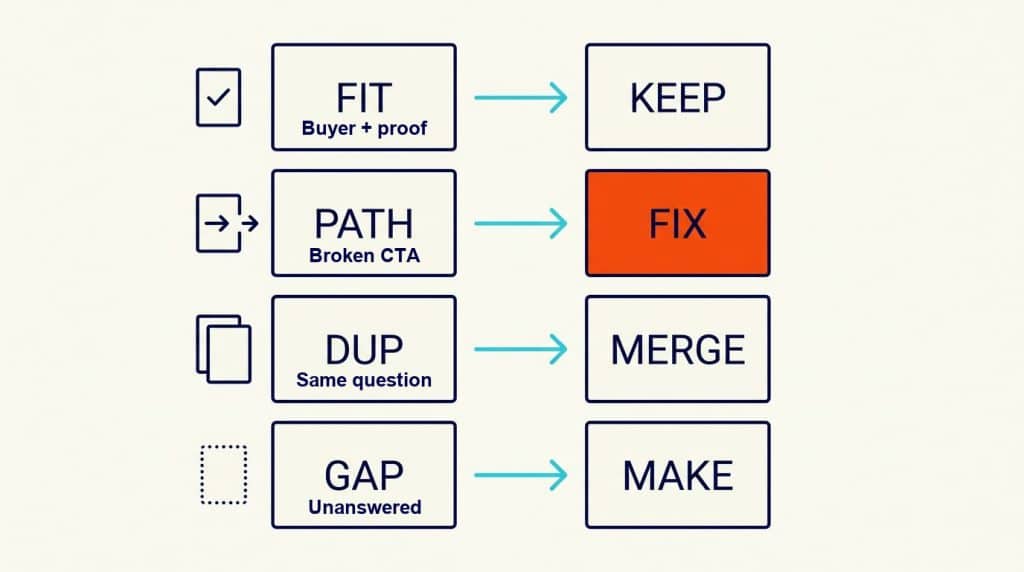
A page with strong ICP fit and weak search performance may need a distribution plan, not a rewrite. A page ranking well for the wrong audience may need a change of target or a consolidation.
A valuable page with an unclear CTA may need a conversion-path fix. The proposed action should follow the diagnosed failure, not a canned list of SEO tasks.
Include AI visibility as an observation, not a promise that markup will force citations. Google’s guidance on AI features says ordinary Search eligibility and useful, accessible content are the foundation; it does not prescribe special AI-only schema.
Test a fixed set of buyer questions across relevant answer engines. Record when the brand appears and which pages support those answers. Treat results as a snapshot.
Ask whether the company owns evidence competitors cannot easily reproduce. Product usage patterns, customer interviews, and implementation lessons can strengthen assets that otherwise repeat the same advice as every vendor.
Do not publish private customer data without permission. Originality only creates an advantage when the underlying claim can be explained and defended.
What does a page-level audit decision look like?
The asset’s job determines the fix; traffic alone cannot tell a Series A team what to fund. A B2B SaaS content audit for Series A checks the buyer task and blocking failure before assigning an action. The following examples are hypothetical, not Sproutworth client results. A pricing page, legacy category article, and seller-used security guide may require three different fixes. Use actual CRM and sales evidence before making a real decision.
| Hypothetical asset | What the audit finds | Action and reason |
|---|---|---|
| Pricing page | Qualified prospects arrive, but the page hides implementation requirements they ask sales about. | Repair the decision path: answer implementation questions and make the next evaluation step clear. |
| Legacy category article | Search visits come from an old ICP, while two posts answer nearly the same question. | Consolidate or retarget: protect useful links, then remove the overlap. |
| Security guide | Few organic visits, but sellers repeatedly share it with evaluating accounts. | Maintain and refresh: low search volume does not erase its role in deals. |
In the Series A content-audit scorecard, record each observation beside its source. A seller’s report of repeated use is useful evidence, but it is not identical to an attributed opportunity. A Search Console query shows discoverability, not buyer qualification.
A CRM interaction shows association, not that the content caused the deal. Keeping those distinctions visible prevents a neat scoring table from concealing weak evidence.
Which changes should go into the first 90 days?
A 90-day audit roadmap assigns owners and review dates to page-level fixes. A B2B SaaS content audit for Series A should select the highest-confidence fixes that answer current buyer questions or repair conversion failures. Assign each action an owner, expected commercial mechanism, effort, leading signal, and review date. The output is an executable work queue, not a guaranteed return.
Use the following action set:
- Maintain: Leave an asset intact when its claim, audience, and job remain valid; set a review date.
- Refresh: Update a useful asset whose examples, positioning, or product details are stale.
- Consolidate: Merge overlapping pages when two assets compete for the same question; protect relevant redirects and links.
- Redistribute: Put an already-useful asset into sales follow-up, founder LinkedIn, email, and partner conversations.
- Repair the path: Improve a page’s internal link, next step, or proof where qualified readers have nowhere useful to go.
- Create: Write a missing comparison, integration, objection-handling, or use-case asset only when there is evidence of demand.
- Retire: Remove genuinely obsolete material only after checking links, historic conversions, and appropriate redirects.
In the first month, a B2B SaaS content audit for Series A should establish measurement definitions, review a sample of opportunities, and identify the most costly content gaps. The second should repair high-intent assets and put neglected material into the hands of sales.
In days 61–90, compare leading indicators with the original content diagnosis, then decide whether a larger production program is warranted. These are planning stages, not promised performance milestones.
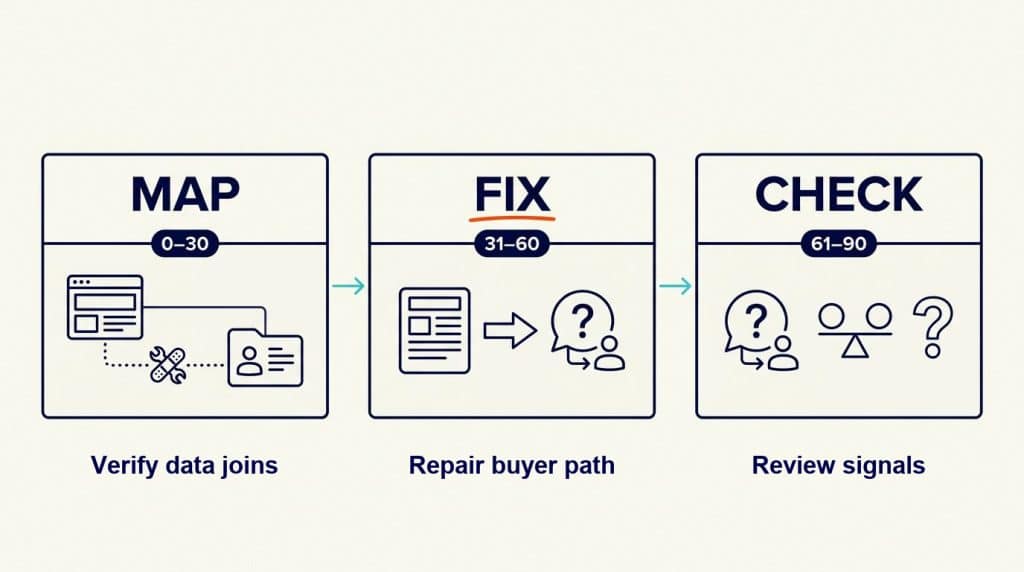
If pricing and implementation answers are missing, another top-of-funnel guide will not solve the buyer’s immediate concern. A content audit should prioritize those decision-stage repairs before new production.
After pricing and implementation paths answer current buyer questions, a stronger editorial pipeline has a useful destination for qualified demand.
Should the team run the audit in-house or hire a specialist?
Bring in a specialist when the team needs an independent diagnosis of its content investment. A team can run a B2B SaaS content audit for Series A in-house when its revenue records are reliable and someone can assess buyer intent without defending the old plan. Outside help is useful when data needs repair or a neutral reviewer can challenge a costly assumption. Both paths require sales calls, product input, and agreed CRM definitions.
Ask a prospective provider for a sample deliverable with page-level evidence, owner, recommended action, and reason. Ask how the provider handles missing attribution and conflicting stakeholder accounts. Test its judgment on a sales-used page with little traffic and a page attracting the wrong buyer. Those questions reveal whether the work is a decision framework or merely a crawl export.
When the content library is lean, a B2B SaaS content audit for Series A can start with a limited sample of high-intent pages and representative deals rather than a sitewide inventory. If the company has changed its ICP, acquired another product, or inherited duplicate content, a broader independent review may be warranted. Scope the engagement around the business question, not a fixed number of URLs.
Do not present an unverified forecast as an audit outcome. A useful deliverable names the likely commercial mechanism for each fix and says what the evidence cannot establish. The company can then approve a small set of changes, measure what happens, and expand the work only if the initial diagnosis proves useful.
Frequently Asked Questions
A Series A content audit works when its scope matches the company’s actual sales motion and available evidence. The following questions clarify what to measure, when to act, and where a content team should avoid false precision. They also separate an editorial cleanup from an audit of the buyer journey and its handoffs to sales.
When should a Series A SaaS company run a content audit?
Run a B2B SaaS content audit for Series A before increasing content spend, changing ICP, entering a new segment, or rebuilding the website. A quarterly spot-check can catch messaging drift, while a deeper review is appropriate when the sales motion changes. Choose the review cadence to match the sales motion and available evidence. If the library is small, audit representative assets and sales questions rather than inventorying every URL.
Can a content audit prove which pages caused a deal?
No. Attribution reports record interactions under a chosen model; they do not, on their own, prove what would have happened without the content. Separate sourced and influenced opportunities, inspect CRM associations, and interview sellers and buyers. Report uncertainty explicitly when journeys include untracked sharing or when the sample contains too few deals for page-level conclusions.
Should low-traffic content be deleted?
Not automatically. A security answer, implementation guide, or comparison page may matter to a small number of valuable accounts. Check its sales use, backlinks, accuracy, and role in an evaluation before removing it. If the topic still matters but the page is weak, refresh or consolidate it with a relevant redirect. Traffic is one signal, not a verdict.
What makes this different from an SEO audit?
An SEO audit tests discovery, crawlability, indexing, and search performance. A B2B SaaS content audit for Series A asks whether the right buyers see the right claims and whether sales uses the material. It also checks whether pages support evaluation and appear in observable opportunity journeys. Keep the SEO findings, but connect them to a buyer decision and a business action.
Which tools does a Series A content audit actually need?
A Series A content audit can start with Google Search Console, site analytics, and the CRM, then add a crawl and keyword tool where needed. Technotize’s B2B SaaS audit framework names these data sources in its operator workflow. Join them around a buyer question and opportunity record; do not buy more tools before fixing missing source and account associations.
What should the final content audit deliverable contain?
For a B2B SaaS content audit for Series A, the final deliverable should pair a page-level decision log with a 90-day work queue. For each asset, record its intended buyer, evidence source, confidence, recommended action, owner, and review date. Scalerrs’ SaaS audit guide provides a decision matrix and template; adapt those columns to your actual sales motion rather than copying a universal score.
Does a Series A team need an AI visibility audit too?
Include AI answers when buyers use them to research the category, but do not make AI visibility the only score. Check crawlable source pages, original evidence, and a fixed set of relevant buyer prompts. Record date and engine because answers change. Google says its AI features use the familiar foundations of Search; a special AI schema is not a substitute for useful content.
Related Resources
Sproutworth’s content-planning, ROI, and buyer-research resources address decisions after a Series A audit. Use the planning guide to turn findings into a program and the ROI guide to define measurement. The Sproutworth approach page explains how buyer research shapes the work that follows. Each serves a different purpose from this Series A diagnostic.
- Content Marketing Plan: The 11-Step B2B Framework: Build the execution plan after prioritizing fixes.
- B2B Content Marketing ROI: A Measurement Framework for Funded Founders: Define cost, attribution windows, and revenue measures.
- How Sproutworth Builds Pipeline Authority: See how buyer research informs the content and channel choices after an audit.
The decision to make before publishing another post
A B2B SaaS content audit for Series A should tell the team which existing asset most helps or blocks the next buyer decision. Start with the measurement chain, then assess ICP fit and sales relevance. Fund a short set of repairs with named owners. If the evidence is thin, say so and use customer conversations to guide the first fixes. Publish more only after the current library has a job and a path to pipeline.
Pick one decision to test this week: take the most common objection from recent sales calls and find the asset meant to answer it. If that asset is missing, unclear, or hard for sellers to find, assign an owner and a revision date. Record the next buyer signal before approving another batch of posts.
A B2B SaaS content audit for Series A should end with a clear investment decision. Preserve what works, repair what should work, and stop funding content that serves neither the buyer nor the business. Sproutworth’s buyer-research approach starts with that decision before drafting anything new.
