
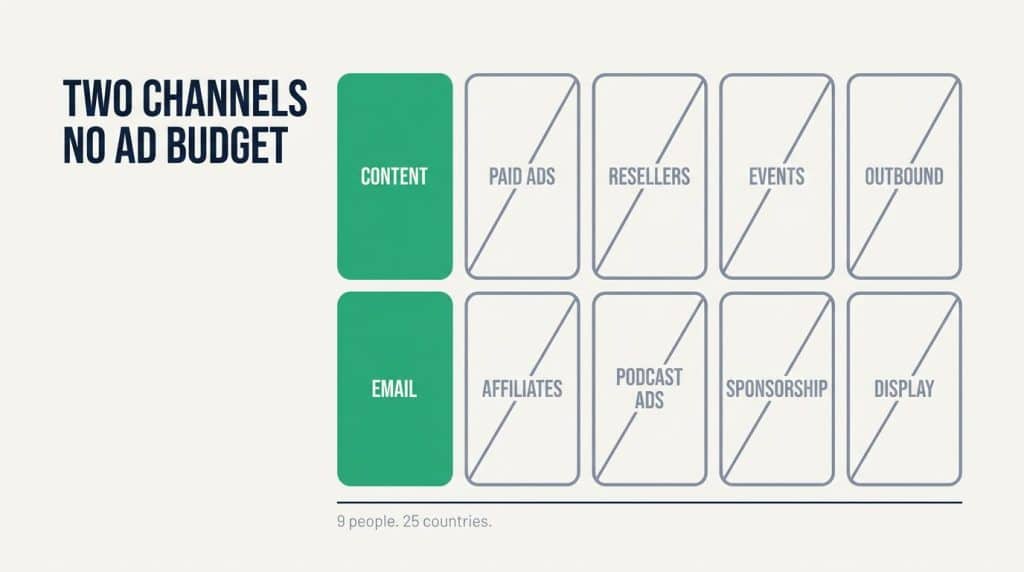
B2B SaaS marketing without an ad budget works by subtraction. Varun Jain runs ComplyJet on two channels, content and email, and refuses paid ads, resellers, and venture capital. Jain puts category leaders’ ad spend at $50,000 to $100,000 a month. ComplyJet’s real ceiling is $5,000 to $10,000, so he killed the channel outright. Nine people now serve customers in about 25 countries, with three straight quarters of profitable growth.
How does a bootstrapped B2B SaaS company do marketing without a paid ads budget?
ComplyJet runs two channels, content and email, and buys no advertising at all. Varun Jain puts category leader ad spend at $50,000 to $100,000 monthly against his ceiling of $5,000 to $10,000. Jain funds a channel only when it runs at the 99th percentile of the best agencies.
Table of Contents
About Varun Jain
Varun Jain is co-founder and chief executive of ComplyJet. The platform helps early-stage software companies earn security certifications such as SOC 2. ComplyJet has posted three consecutive quarters of profitable growth without institutional capital.
Most founders I interview answer slow growth by adding channels. Jain subtracted instead, drawing on fifteen years in entrepreneurial settings.
Before ComplyJet, he worked the Lehman Brothers trading floor in Tokyo during the collapse. He later ran product at Myntra and sold enterprise AI at Instabase to large banks. Nine people now serve customers in about 25 countries, at a $5,000 annual price published on the website.
Watch the Episode
You Cannot Be World-Class at Ten Things
A small B2B SaaS company cannot be excellent at ten channels at once, so ComplyJet runs two. Varun Jain has been part of roughly 100 companies as an investor or advisor, and says most winners got there on one or two channels, one product, one segment. Massive companies do everything, but they earned that breadth after they won.
“A lot of founders take the wrong lesson from that, thinking that they also need to replicate that, especially at an early stage,” Jain says.
The arithmetic stops most of them first. I put it to Jain that ComplyJet runs on less than five percent of the resources its funded competitors command, and he agreed. Copying a ten-channel playbook on that budget spreads nine people impossibly thin.
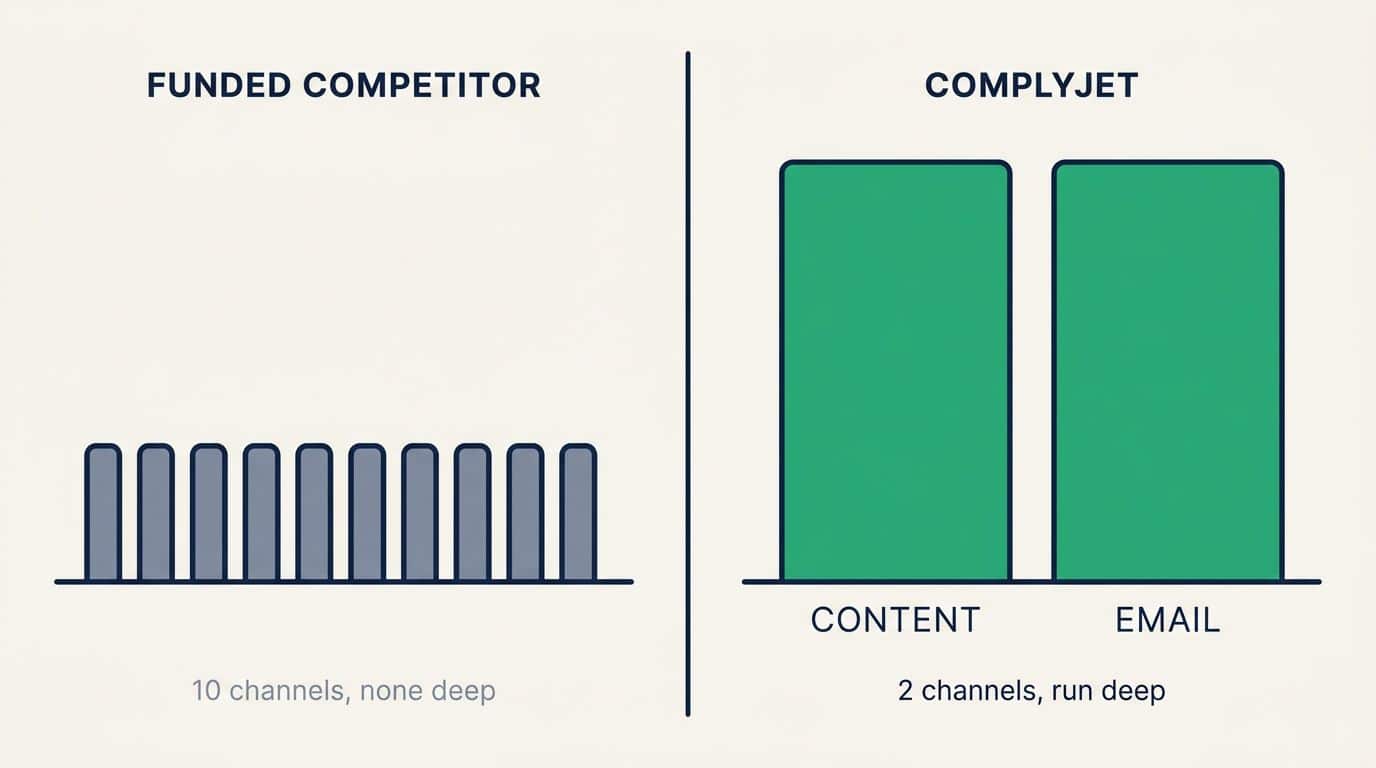
The real damage is worse than thin coverage. “You become mediocre for everyone when you are trying to do too many things at the same time,” Jain says. Mediocre marketing wins nobody’s loyalty, so nothing compounds.
Jain wants the reverse outcome for ComplyJet. Being loved by ten customers opens the door to a hundred and then a thousand. Those ten cheerleaders bring the rest, which is why Jain states the choice plainly.
“We do not believe that we have a right to sit at the table unless we are world-class, and we believe that we can be world-class at only one thing, and therefore, we have decided to become a one-trick pony and nothing else.”
Across 500-plus Predictable B2B Success episodes, I have watched founders add a fifth channel to fix a first. Subtraction is the rarer move, and the founders I see compound are the ones making it.
What B2B SaaS Marketing Looks Like When Paid Is Off the Table
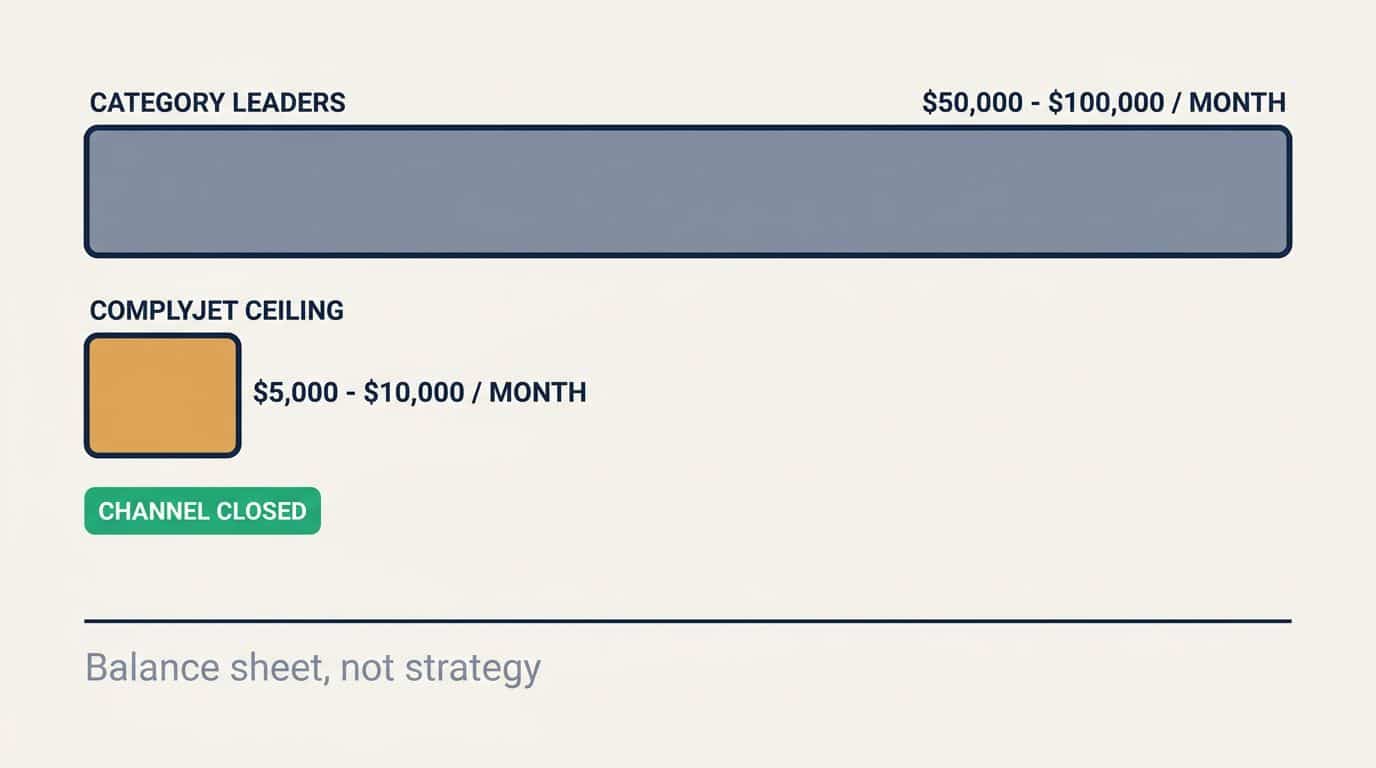
B2B SaaS marketing without a paid budget starts as a balance sheet constraint rather than a strategic preference. Varun Jain, ComplyJet’s co-founder and CEO, has written that category leaders spend $50,000 to $100,000 a month on ads. He says his own real ceiling is $5,000 to $10,000. ComplyJet ran that smaller test, read the data, and killed the channel.
Jain’s own phrasing is blunt: “That’s not a strategy problem, it’s a balance sheet problem.” The arithmetic settles the question before strategy gets a vote. By Jain’s figures, a company at a tenth of the leaders’ monthly spend isn’t getting the same attention.
What replaced paid at ComplyJet is content and email, run as owned assets that compound. Jain says both channels still have massive room to grow. Neither one charges him per click.
Running the small version anyway is the expensive mistake, and Jain’s own test is the evidence. He says the early results showed how much paid work it would take before it returned as much as content already did. That work would borrow the attention of the only team he has.
Jain ran the experiment before closing it rather than assuming the answer. He read the data, then shut the channel down.
I see the opposite pattern constantly in funded B2B tech companies at seed and Series A. They run a token ad budget because the board expects a line item. In the ones I work with, that spend is too small to compound and too large to ignore.
The Test a Channel Must Pass Before It Earns Budget
Varun Jain benchmarks a marketing channel against the 99th percentile agency globally, not against ComplyJet’s own last quarter. Jain rates ComplyJet’s content engine and email marketing below the 75th percentile, even while both produce pipeline. Until those two channels reach the 99th percentile, no third channel at ComplyJet earns budget or team attention.
Jain says many founders get happy with a channel the moment it shows returns. Instead, he measures ComplyJet’s two channels against the best agencies in the world.
“Are we running an operation which is at the ninety-ninth percentile of an email marketing agency or an content agency out there in the world? I don’t believe that we are even at like seventy-fifth percentile today, even though like they are working well for us at small scale.”
Jain names the gate a “right to win” and applies it before any spend. He declines to fund a channel where ComplyJet holds no structural advantage.
Three conditions must hold before a new channel gets attention:
- The two existing channels have run out of measurable room to grow.
- ComplyJet has a right to win on the new channel, not just a budget for it.
- The decision stays cheap to unwind, since Jain revisits the channel mix every quarter.
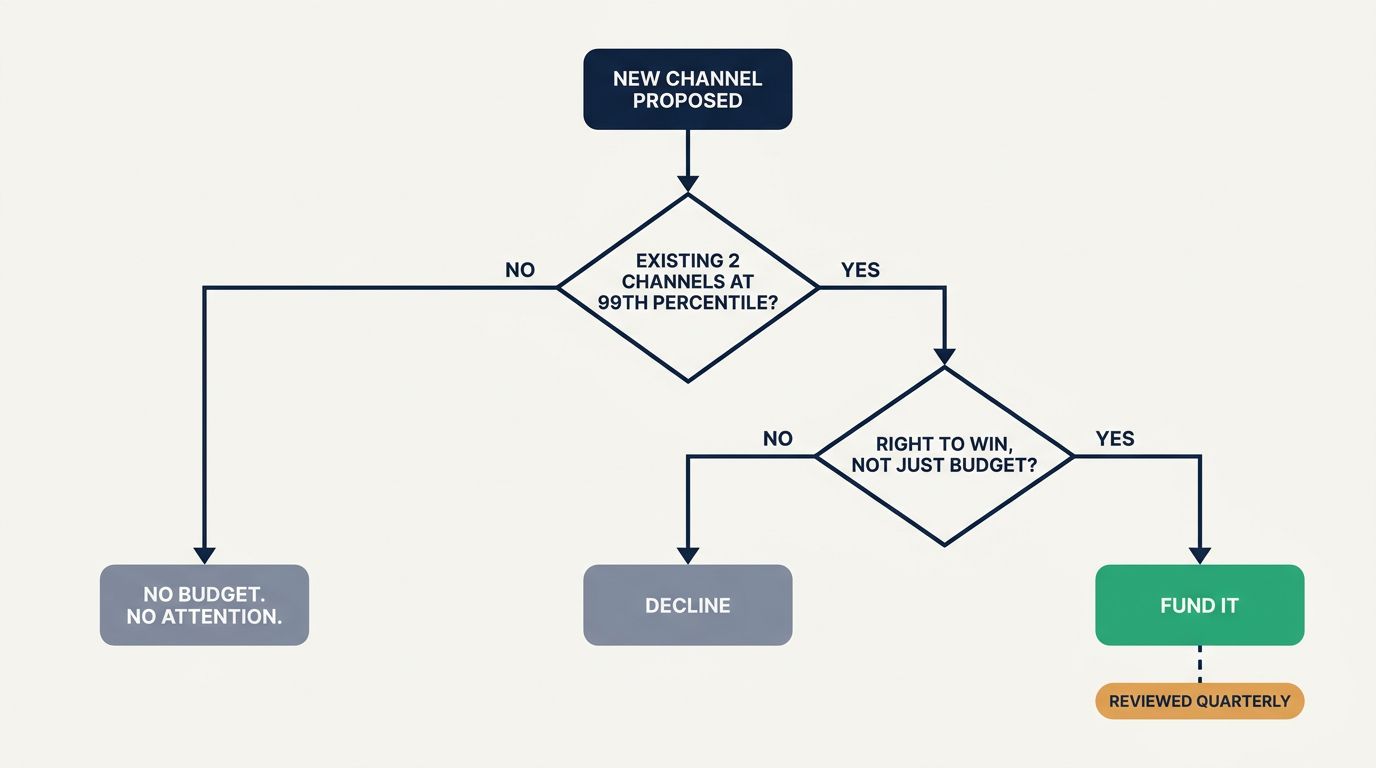
The data closed paid advertising, and ideology played no part. ComplyJet ran the $5,000 to $10,000 test first. Jain says that test put paid well behind content.
I ask seed-to-Series C founders for their B2B SaaS marketing channel list and get one straight away. I then ask for the written criteria that would cut a channel, and almost nobody has one.
Why ComplyJet Refuses Channel Partners
ComplyJet refuses channel partners because reselling through service firms contradicts its own promise, co-founder and CEO Varun Jain says. Service firms sell compliance as work too complex to handle alone. ComplyJet sells software simple enough to run self-serve, a position Jain calls orthogonal to a service firm’s purpose. Accepting those partnerships would have raised revenue while diminishing ComplyJet’s core proposition, he says.
Channel partners are a standard distribution route in B2B SaaS marketing, and ComplyJet keeps turning them down. Jain says many service firms have wanted to partner with the company. They already managed security and compliance programs for client companies and wanted a platform underneath that works.
ComplyJet explored several of those conversations and then closed them. The conflict sits in what each side must tell a buyer.
“We believe that this job can be made so simple that the software is essentially self-serve. And a service firm tells a company that this is so complex that you can’t figure it out and you need our help to doing that.”
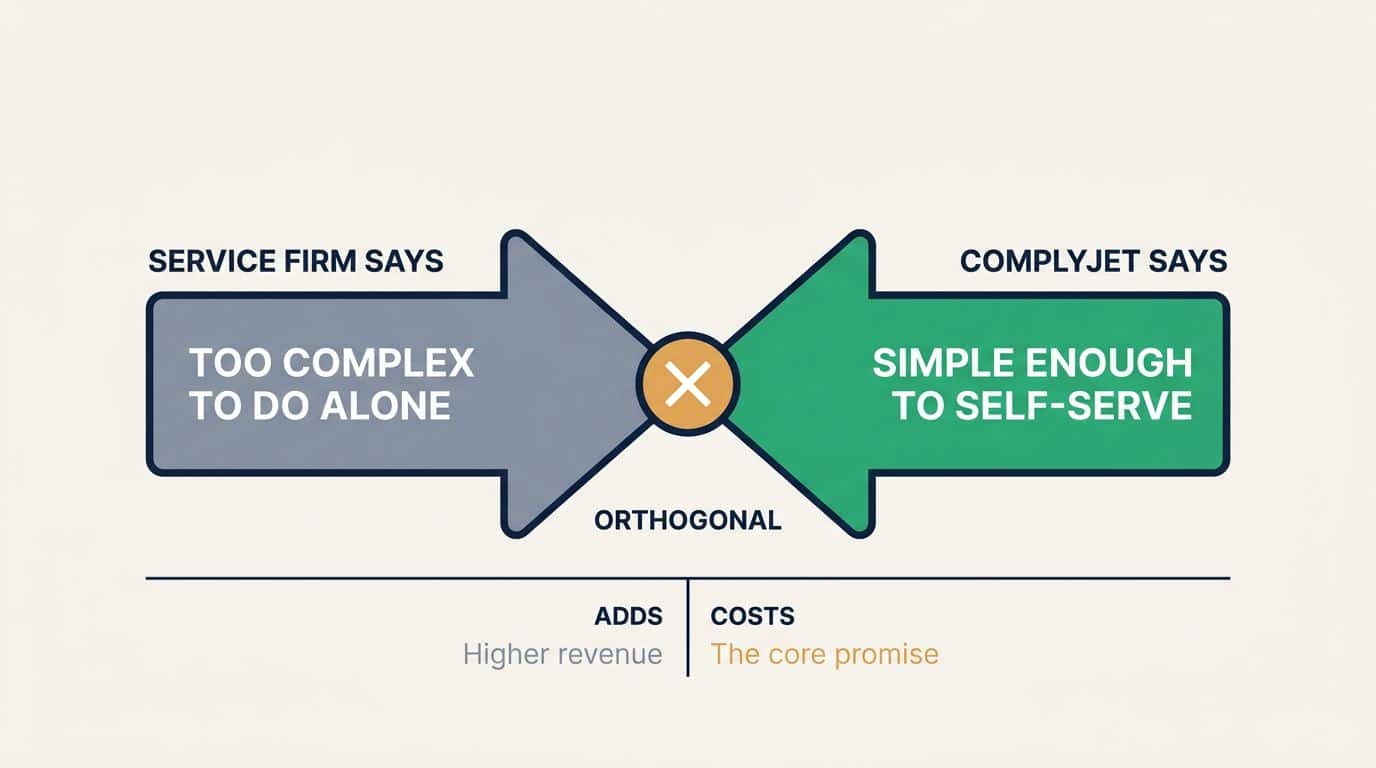
ComplyJet built the opposite of a partner channel. Jain says the company gears itself to enable customer teams and help them solve things themselves. Documentation and direct help became the delivery model.
Jain does not pretend the refusal was free. “We could have been sitting on a higher revenue number if we hadn’t done that,” he says. He treats the lost distribution as the price of keeping the proposition intact.
The $50,000 Deal That Would Have Slowed Everything Down
Varun Jain, ComplyJet’s co-founder and CEO, turned down a deal worth more than $50,000. The buyer was a North American utility company with more than 3,000 people. Meeting its needs across several security certifications would have required redirecting the engineering roadmap for about two months. Jain says the deal would have slowed engineering, sales, and customer success velocity.
Jain says the interest was genuine and the utility’s team found the platform encouraging. They wanted a few different security certifications, and their complex needs justified the high ACV.
Velocity is the unit Jain counts in. One large customer reshaping the roadmap slows the engineers, then the sellers, then the customer success team. Three functions pay for one signature.
“For me, the opportunity cost of that decision was so clear that it was a very easy decision to say no to. […] And I forgot about it almost immediately that this is the right thing and it did not hurt at all.”
Jain calls the pull upmarket enterprise anti-gravity, and it shapes B2B SaaS marketing choices. Larger customers carry much higher dollar value, so software companies keep climbing. Jain says refusing them is unpopular, and that ComplyJet makes that choice daily.
The team initially asked why they could not take such deals. Jain did not settle it by authority.
He put three metrics in front of the sellers at the weekly sales review. Those are deal count, average deal value, and time to close.
Sellers watching those numbers stopped arguing. I once watched a Series A founder have the identical disagreement with his account executives. He ended it by changing their compensation, not by repeating the strategy.
Can Content Alone Reach 1,000 Customers?
Content marketing alone has never publicly taken a B2B software company to 1,000 customers. Predictable B2B Success host Vinay Koshy searched for a week before interviewing ComplyJet CEO Varun Jain and found no documented case. Kit, Zapier and Ahrefs each ran affiliate, partner or video programs alongside their content. Jain says ComplyJet is not an ideological cult and stays open to adding a channel.
The usual B2B SaaS marketing exemplars all added something. Ahrefs publishes heavily on YouTube and turns up at conferences. Kit, formerly ConvertKit, pays affiliates 50% for twelve months.
Zapier runs a partner program too. Jain did not dispute the pattern when I put it to him.
“We are not ideological cult. We do not, have anything against other channels which have worked for other people.”
Jain believes content and email get ComplyJet to a thousand customers on their own. He expects his marketing team to keep arguing for more. “I’m open to being changing my mind before we reach thousand customers,” he says.
The sharper challenge sits inside his own company. Co-founder Upendra posted in May last year about turning up at startup events three times a week. By Upendra’s account, that single strategy produced 50-plus qualified sales opportunities a month.
Upendra said it converted at twice the rate of everything else. Twelve months later, Jain wrote that content is the only channel a startup has not seen commoditized.
The absence of a precedent cuts both ways. No playbook exists to copy, so ComplyJet is running an experiment rather than following one. Jain accepts that framing and keeps the channel mix under quarterly review. That review is what stops a principled position from hardening into a stuck one.
Jain’s answer is about sequencing, not doctrine. ComplyJet’s content engine would not deliver meetings in year one, so events carried the load. Jain says events hit a natural ceiling as you narrow the segment, while content compounds.
What Replaces an Ad Budget: Trust Mechanics
ComplyJet replaces advertising spend with trust mechanics that cost nothing to run. Varun Jain, ComplyJet’s co-founder and CEO, says prospects ask one question of a nine-person unfunded vendor: will you be around in a few years’ time? A free trial, customer reference calls and public advice against his own sale answer it.
Switching costs drive that question for buyers. Jain says buyers spend a long time integrating a compliance platform. Choosing wrong is expensive, so they probe financial resilience first.
Refusing institutional capital made that harder, Jain says. A few million in the bank would reassure prospects. Instead, he points to profitability, and sometimes shares his financial auditors’ opinion with prospects.
ComplyJet’s second answer is a free trial straight from the website. Jain says nobody else in his industry offers one without a sales conversation. Engineers in particular sign up for it.
Reference calls carry the third answer. ComplyJet offers to introduce prospects to existing customers. Often the prospect never takes the call.
“But when they see that we are comfortable making that introduction for them to have a candid chat, that is enough for them to move forward, which I find very interesting, that what they are really looking for is, are we confident in introducing them to somebody and sometimes not the conversation itself.”
Jain posts Reddit advice under his own company name, telling founders they may not need a certification at all. Those founders come back when they need it, and they refer others.
“In a time when all software looks the same, all marketing sounds the same, that actual advice, you know, can cut through all the noise.”
I rarely see founders at seed and Series A put this in a B2B SaaS marketing plan. A funded competitor carrying a quota cannot copy it. Telling a qualified prospect to walk away breaks that month’s number.
The Numbers That Tell You the Strategy Is Working
ComplyJet reviews three sales metrics every week: deals closed in the period, average deal value, and time to close. Co-founder and CEO Varun Jain says the team is fanatical about the third. ComplyJet has cut its time to close by more than half. Its win rate on qualified opportunities ran above 50% last quarter, and average deal value has risen.
Jain starts that clock at the first conversation, not when a deal becomes a qualified opportunity. He says the team has run the process roughly five hundred times, which tightened its revenue operations.
“The metric should be telling you about what business you are running. Your choices should show up in those metrics, otherwise you are looking at the wrong numbers.”
The wider market has been traveling the other way. Ebsta and Pavilion’s 2023 B2B Sales Benchmark Report analyzed more than three million deals. It found sales cycles lengthened 32% from 2021 to 2022, with stakeholders per deal rising to 10.
ComplyJet is only about two years old and did not trade through that benchmark window. Jain’s numbers show direction of travel, not a matched comparison. Ebsta and Pavilion’s 2024 update covers 4.2 million opportunities.
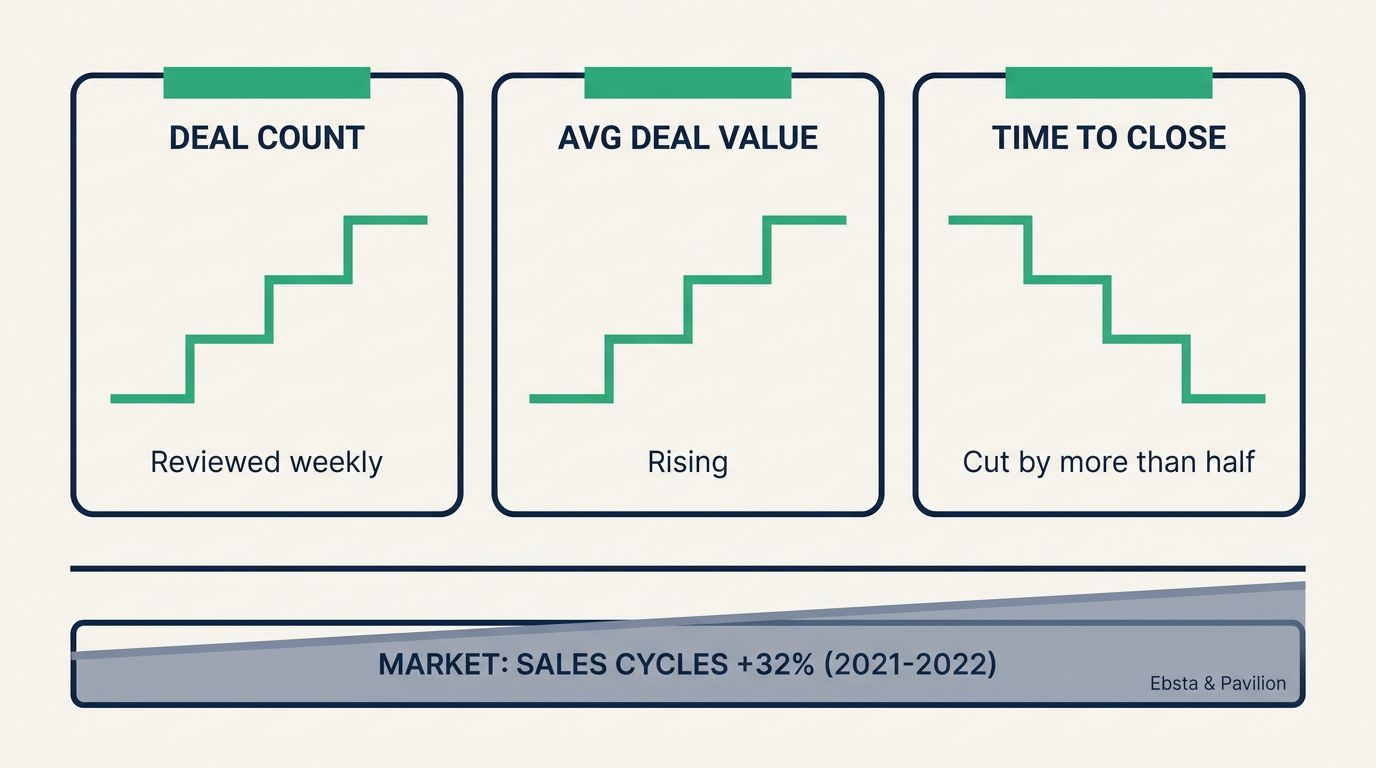
Jain attributes the gains to removing friction rather than selling harder. ComplyJet’s sales process makes five choices:
- Publishes its pricing on the website.
- Offers a free trial with no sales conversation.
- Sells one plan with everything included.
- Refuses to discount its published price.
- Says no early when a prospect is a poor fit.
I ask founders which number their B2B SaaS marketing choices should move. Jain has three, and checks them weekly.
💡 CEO Takeaway
- Count your channels, then ask which one would survive a 99th-percentile benchmark. If the answer is none, the problem is focus, not budget, and I see it constantly at seed and Series A.
- Price the cost of yes before the revenue of yes. A $50,000 deal that costs two months of roadmap is not a $50,000 deal.
- Refuse the channel that contradicts your promise, no matter how free the distribution looks.
- Check that your choices show up in three numbers. Deal count, average deal value, time to close.
- Leave the friction that requires human judgment in place. Jain refuses to automate anything that needs expert opinion, even though it is technically easy, because removing that friction hollows out what customers are buying.
Frequently Asked Questions
What is a good marketing strategy for B2B SaaS?
Varun Jain runs ComplyJet’s B2B SaaS marketing on content and email alone, and reviews that mix every quarter. A good strategy names the few channels a company can run better than rivals, then removes the rest. Jain rates both channels below the 75th percentile of the best agencies, so no third channel earns budget. Depth beats coverage when nine people serve customers in about 25 countries.
Which marketing channels should a small B2B SaaS company invest in?
Small B2B SaaS companies should fund the channels they own outright, which for ComplyJet means content and email. Varun Jain applies one test: the company must have a right to win on a new channel, not just a budget for it. Jain ran a $5,000 to $10,000 monthly ads experiment, read the data, and shut it down. Owned channels compound, while rented attention stops the moment you stop paying.
Should a bootstrapped SaaS company run paid ads on a small budget?
Bootstrapped SaaS companies rarely gain from a token ad budget, and ComplyJet’s own numbers explain why. Category leaders spend $50,000 to $100,000 a month, Varun Jain says, against his own ceiling of $5,000 to $10,000. Jain calls that a balance sheet problem rather than a strategy problem. A small budget buys too little reach to teach the team anything, while consuming the attention of nine people.
How do you decide when to add a new marketing channel?
Varun Jain adds a marketing channel only when the existing ones run out of measurable room to grow. Jain benchmarks ComplyJet’s content and email against the 99th percentile agency worldwide, and rates both below the 75th today. Working at small scale does not count as finished. Jain also revisits the channel mix each quarter, which keeps the decision cheap to reverse if the evidence changes.
Why would a SaaS company turn down a large enterprise deal?
SaaS companies turn down large enterprise deals when serving one buyer slows every other function. Varun Jain refused a $50,000-plus deal from a 3,000-person North American utility. Meeting its certification needs would have redirected ComplyJet’s engineering roadmap for two months. Jain counts velocity across engineering, sales, and customer success. His sellers accepted the decision once weekly numbers on deal count, deal value, and time to close held up.
Does a two-channel strategy break as the customer base grows?
A two-channel strategy holds at scale in ComplyJet’s case, and support load is the reason Varun Jain gives. Customer audit dates sit across the calendar. Rising customer numbers therefore smooth the workload into a curve rather than spikes. Jain says that makes capacity planning predictable. ComplyJet targets a 10- to 15-minute support SLA and keeps founders on the support rota. Jain expects those SLAs to improve as it scales.
What are examples of B2B SaaS?
B2B SaaS examples include Zapier for workflow automation, Ahrefs for SEO, Instabase for enterprise AI, and ComplyJet for compliance. Each sells subscription software to other companies, not consumers. ComplyJet, run by Varun Jain, publishes a $5,000 annual price and a free trial for startups pursuing SOC 2. Nine people serve its customers across about 25 countries. Buyer type and recurring pricing separate B2B SaaS from consumer software.
Decide What a Customer Costs to Serve Before You Set a Price
Varun Jain worked out what a customer costs ComplyJet to serve before he set a price. He then cut everything that could not survive that number. Out went paid advertising, reseller partners, enterprise deals, discounting, and venture capital, plus two government security certifications. I put that reading to Jain in the episode, and he agreed. Before starting, he ran more than 100 cold calls with strangers to learn how buyers make these choices.
For founders between seed and Series C, the sequence matters more than any single refusal. Working out cost to serve first is what turned each later B2B SaaS marketing decision at ComplyJet into a defensible subtraction. I watch founders who learn it after scaling make the same cuts under duress, and their boards read it as retreat.
Jain expects buyers’ AI agents to interrogate sellers’ trust centers directly. He is building an MCP for the ComplyJet platform so machines can read its answers. Resisting that direction, he says, is foolish. As agents do the reading, they’ll find founders already publishing under their own name. Building that content engine is the ghostwriting work I do at Sproutworth.
Related Resources
- B2B Content Marketing That Drives Pipeline
- B2B Digital Marketing Strategy: The FTE Framework That Drives Predictable Growth
- How to Build Trust in B2B Sales When Buyers Don’t Trust the Category
- Content That Earns Trust: A B2B CEO’s Pre-Sale Playbook
- 7 B2B Lead Gen Tactics Funded Tech CEOs Are Using in 2026
Related Links
Some topics we explore in this episode
- What was the reason why Varun Jain risked everything by subtracting products, channels, and segments rather than adding more?
- What does a marketing channel need to prove to ComplyJet before it is scaled? Do experiments and data suffice?
- What is the result when you choose to reject large enterprise contracts in order to concentrate on speed and efficiency?
- How ComplyJet handles sudden spikes in support demand, and can it maintain its well-known quick responses at scale?
- How can transparent pricing and careful use of AI maintain strong gross margins even if there is no funding?
- What is it about ComplyJet’s sales cycle that is shorter when others in the industry are seeing theirs lengthen, and how are they maintaining high deal conversion rates?
- What is the real cause of customer churn in the SaaS sector when it comes to early-stage customers, and why doesn’t Varun Jain pursue every dollar?
- How can a nine-person software company win the trust of large enterprises in a sector built on credibility?
- Isn’t the future of B2B security buying already upon us, with AI handling trust and compliance negotiations rather than people?
Listen to the episode
Subscribe to & Review the Predictable B2B Success Podcast
Thanks for tuning into this week’s Predictable B2B Podcast episode! If our interviews have helped your business journey, please visit Apple Podcasts, subscribe to the show, and leave an honest review.
Your reviews and feedback will help me keep delivering great, helpful content and reach even more amazing founders and executives like you!
