
A land and expand strategy means selling a deliberately narrow first product, then growing revenue within that account over time. Russ Hawkins, CEO of Agilence, runs one that targets 20% growth from existing customers. His rule is architectural: the core product ingests 6 datasets. Any use case needing a 7th becomes a priced recurring module. For B2B founders, that turns expansion from a sales hope into a product decision.
What is a land and expand strategy, and how do you run one?
A land and expand strategy lands small, then expands through priced modules rather than negotiated upsells. Agilence funds the expand half with a customer success team at 14% to 15% of revenue and 30% of headcount. It runs against a 95% retention target. The team that renews the account sells the next module.
About Russ Hawkins
Russ Hawkins is President and CEO of Agilence, a loss prevention software company serving retail, grocery, and restaurant chains. He’s been chief executive of 3 technology companies and founded none of them. He’s held the Agilence seat since 2007, after selling Paragon Networks in 2003 and SilverStorm Technologies in 2006. The B2B software CEOs I talk with mostly leave expansion to whoever is in the room at renewal. Hawkins built it into the product architecture instead. His experience at Agilence shows what the expand half actually costs to run.
Watch the Episode
What Is a Land and Expand Strategy, and Where Do Most Companies Stall?
The land and expand model sells a narrow first product. It’s priced and scoped to clear procurement fast. Revenue then grows inside the account through further purchases.
Most of the founders I work with treat expansion as a relationship outcome. The account matures, trust builds, and someone eventually asks for more budget. That’s hope with a calendar invite attached.
DealHub puts the odds on an existing customer at 60% to 70%, against 5% to 20% for a new prospect. The mechanism is where most playbooks go quiet.
Hawkins runs Agilence, whose software serves 200+ retail, grocery, and restaurant chains. The average Agilence customer operates around 600 locations. He targets roughly 20% growth from customers who already bought.
The 20% target holds because the product architecture is built for expansion. Each sale follows a rule, not a negotiation.
A land and expand strategy grows revenue inside existing accounts instead of chasing new logos. Selling to a current customer converts at 60% to 70% against 5% to 20% for a new prospect, per DealHub. Russ Hawkins, CEO of Agilence, targets 20% of growth from an installed base of 200+ chains averaging 600 locations each.
The Rule That Decides What Belongs in the Core Product
Hawkins draws the line at data, not at features.
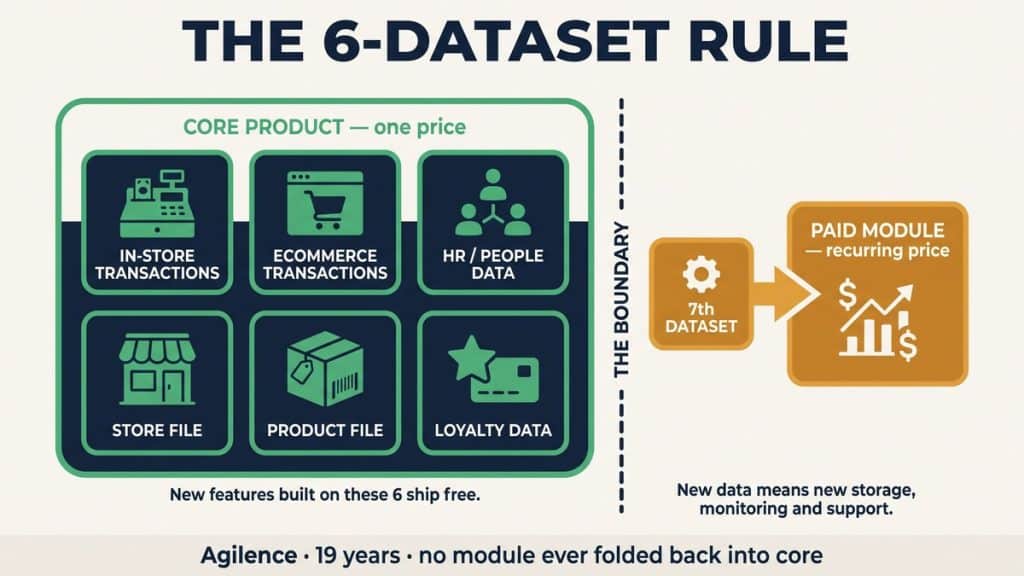
Agilence’s core product ingests 6 datasets. They are the bricks-and-mortar and eCommerce transaction logs, HR data, the store file, the product file, and loyalty data.
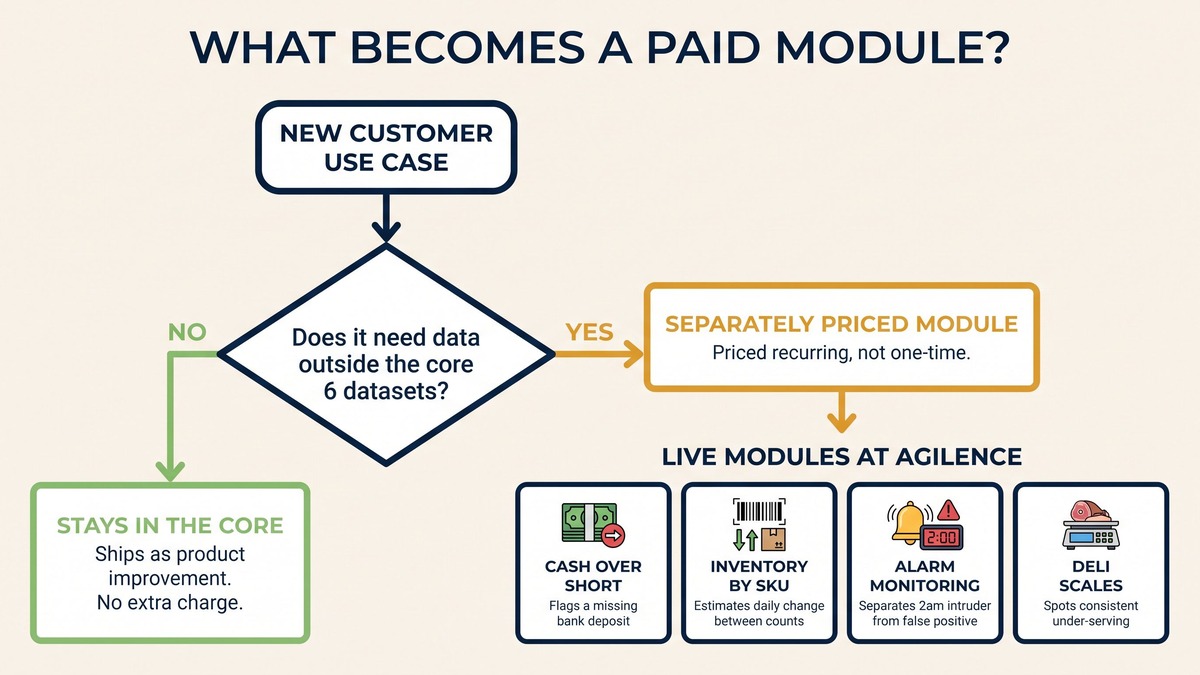
A use case that needs a 7th dataset becomes a separately priced module.
Hawkins argues the rule does work that most pricing committees never finish. It ends the argument about whether a feature is core enough. Sales gets a sentence the customer can check.
The rule also survives contact with engineering. New functionality inside the existing 6 datasets ships as product improvement. New data brings fresh ingestion work, ongoing monitoring, a wider support surface, and another invoice line.
In 19 years, Hawkins has never folded a module back into the core. The closest he came was eCommerce data, which Agilence now scopes upfront at the point of sale.
Live modules include cash over short. That module reconciles till receipts with bank deposits and flags missing deposits for investigation.
Another module estimates daily inventory change by SKU between physical counts. A third monitors alarm frequency and separates a 2 am intruder from an afternoon false positive.
Grocery chains buy a module that watches deli scales. A deli employee consistently serving under half a pound is a coaching conversation, Hawkins explains. The scale data is what surfaces it.
Agilence decides what belongs in its core product by counting datasets. The core ingests 6: bricks-and-mortar transactions, eCommerce transactions, HR data, the store file, the product file, and loyalty data. Any use case requiring a 7th dataset becomes a separately priced recurring module. Russ Hawkins has applied the rule for 19 years without folding a module back.
How to Implement a Land and Expand Strategy in 6 Steps
Agilence runs these 6 steps in order, and each step sets up the next.
- Hawkins starts the sequence by landing narrow. Agilence scopes and prices its first product to clear procurement quickly, before a purchase turns political. The land half stays a small decision by design.
- The boundary comes next, and Agilence draws it at the dataset level. The core ingests 6, so a customer can check the edge of their agreement without asking sales. Hawkins prefers a line the buyer can verify over one his team argues about internally.
- Proof on the core comes before any module pitch. Agilence introduces a module only after the core product has delivered a result the customer can point to. Hawkins sells the next use case against evidence the buyer already owns.
- The expansion capacity gets built before the expansion quota. Hawkins puts consultative account managers inside the customer success organization rather than in a separate upsell team. The people who renew the account introduce the next module.
- Pricing then tracks the data a use case needs. Each new use case carries a recurring price when it brings a new feed. Hawkins charges that way because Agilence stores and monitors the feed permanently.
- The last step watches the leading signals. Hawkins reads an account that has stopped buying modules as one that has stopped finding use cases. That surfaces well before the renewal conversation does.
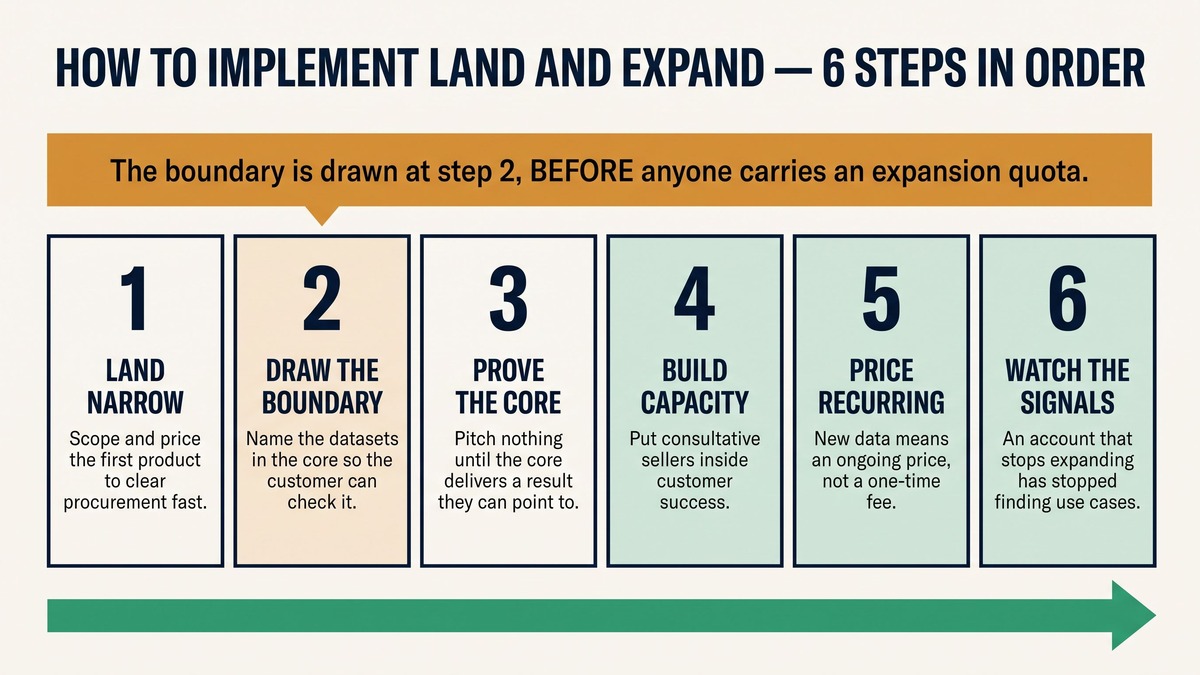
Implementing a land and expand strategy runs in a fixed order at Agilence. Russ Hawkins lands a narrow first product, then names the 6 datasets that define the core. Agilence proves value on that core before pitching any priced module. Consultative account managers sit inside customer success, so expansion capacity exists before anyone carries an expansion quota.
Why Expansion Modules Carry Recurring Pricing
Agilence used to charge a one-time fee for bringing in extra data. Hawkins reversed it.
The reasoning is cost. A new data feed arrives and then stays. Agilence stores it, monitors it, checks it for corruption, and staffs people to answer questions.
Hawkins notes that monitoring additional feeds requires ongoing customer success work. The cost base rises permanently, so a one-time fee prices a permanent obligation as a single event.
Recurring versus one-time pricing decides whether the expansion counts at all. A one-off bump lands in a quarter and leaves.
Hawkins prices modules recurring for that reason: only a recurring line lifts net revenue retention into the next year’s base.
The land and expand playbooks I read treat expansion as a closed event: a bigger tier, another seat block. Almost none ask whether it adds a durable line.
Customers have mostly accepted the change. Hawkins says some ask for discounts or for the module free, and Agilence evaluates those case by case.
The module conversation works like selling the original product: name the value, name the ongoing cost, agree on a price.
Expansion modules should carry recurring pricing when they require new data. Agilence originally charged a one-time fee for additional data feeds and reversed the policy. New feeds create permanent storage, monitoring, and support costs, so Russ Hawkins prices them as recurring modules. Only recurring expansion lifts net revenue retention into the following year’s base.
What Does a Land and Expand Engine Cost to Run?
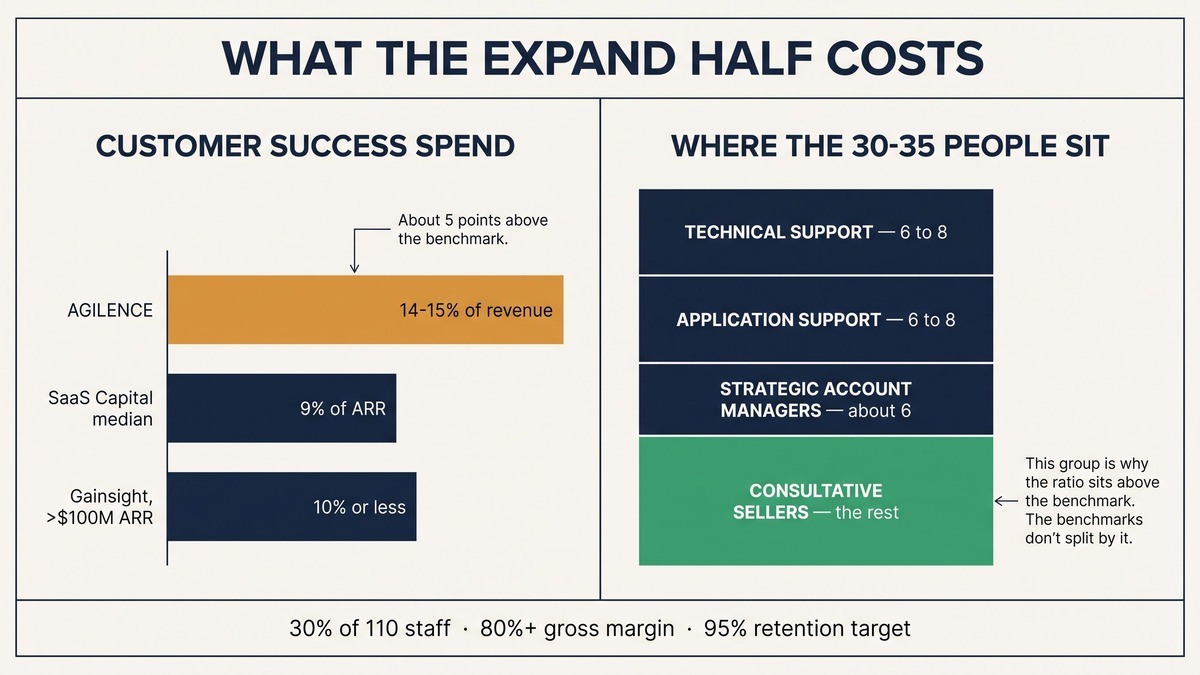
Hawkins funds the expand half at 14% to 15% of top-line revenue. Roughly 30% of Agilence’s 110 people sit in customer success.
The published benchmarks sit well below Agilence’s ratio. SaaS Capital’s 2026 spending report puts median customer success and support spend at 9% of ARR. Gainsight’s planning benchmarks have most companies above $100M ARR at or under 10%.
Agilence runs about 5 points above the median, against gross margins above 80% and a 95% retention target.
Agilence’s extra customer success spend buys a team that sells. Hawkins splits roughly 30 to 35 people across 4 functions rather than one undifferentiated pool.
Technical support takes 6 to 8 people: whether files arrived, whether they’re corrupted, how to fix them when they are. A similar number handle application support, working through specific use cases alongside customers.
Around 6 strategic account managers advise on how the customer organizes analysts, investigators, and interviewers. The fourth group consists of consultative salespeople who introduce modules into accounts already running the core.
The consultative sales group is why Agilence’s ratio sits above the benchmark. Neither SaaS Capital nor Gainsight splits its benchmark by whether customer success carries an expansion number. Agilence’s customer success team carries one.
Against the published benchmarks, the difference shows up as much in role as in size.
| Benchmark source | Customer success spend | Carries an expansion number? |
|---|---|---|
| Agilence (Russ Hawkins) | 14% to 15% of revenue, 30% of 110 staff | Yes |
| SaaS Capital, 2026 median | 9% of ARR | Not split out |
| Gainsight, companies above $100M ARR | At or under 10% | Not split out |
Hawkins also runs open office hours. His team hosts a peer forum called the water cooler, where customers answer each other directly.
On a $1M account, the customer success structure costs roughly $140,000 a year.
Agilence spends 14% to 15% of top-line revenue on customer success, with 30% of its 110 employees in the function. SaaS Capital’s 2026 benchmarks put median customer success and support spend at 9% of ARR. Russ Hawkins runs above the benchmark because his customer success organization tracks both expansion and retention.
Which 5 Signals Say an Account Will Churn Before It Expands?
Hawkins tracks 5 leading signals: product usage, question volume, leadership change, customer finances, and competitor presence.
The counterintuitive signal is question volume. Fewer inbound questions read like satisfaction. Hawkins treats it as a warning.
Customers who aren’t using the product don’t ask about it. Agilence watches inquiry counts alongside usage as a paired signal.
Product usage comes first: user counts, login frequency, how much activity each account generates. Question volume comes second, read as a decline rather than a rise.
Third is a leadership change at the customer. A new asset protection director may arrive with a relationship to a competitor. That’s a live risk, whatever the health score says.
Fourth is the customer’s own financial performance. A retailer in trouble cuts software before it cuts stores.
Fifth is a customer asking about functionality they’ve clearly heard about somewhere else. Hawkins reads that as evidence a competitor is already in the account.
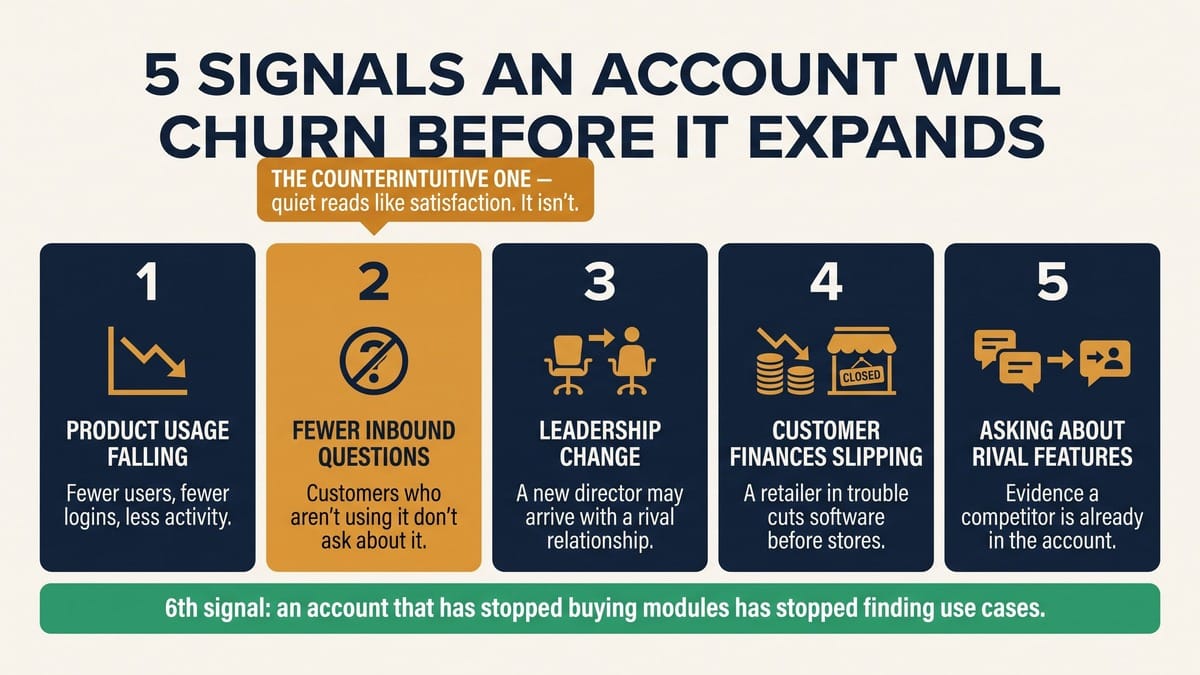
The 5-signal model throws off a corollary. An account that has stopped buying modules has stopped finding new use cases. That usually surfaces before the renewal conversation does.
At 200 customers, the Agilence staff who know the accounts run this by hand, without a churn prediction platform.
Five signals predict B2B churn before the customer raises it. Russ Hawkins watches usage, inbound questions, leadership changes, customer financial health, and questions about rival functionality. He reads declining questions as a warning, because customers who aren’t using a product don’t ask about it.
Why Private Equity Cares About Your Land and Expand Strategy
Private equity buyers pay for growth that comes from inside the installed base, Hawkins says. Cuadrilla Capital bought Agilence in 2021. Hawkins describes the governance change bluntly.
Before the deal, he had 5 venture investors accumulated over roughly a decade. Each entered at a different valuation with a different liquidity horizon. Managing them took about 25% of his time.
After the deal, he had one board voice. Board management now takes close to none of his week.
“So the day before day one, I had five bosses with five different sets of objectives based on when they invested in the company,” Hawkins recalls.
The trade for one board voice is debt on the balance sheet. He describes the typical structure as roughly half equity and half borrowing the company then services. Agilence could carry it because the business had become self-funding.
Revenue and margin covered development, customer success, and sales without another raise.
Hawkins says net revenue retention is the lever Cuadrilla pulled hardest. At Agilence’s 80%+ gross margin, expansion revenue drops almost straight through to enterprise value.
A company growing 20% inside its installed base has already proved what a buyer is modeling. A company growing only by adding logos has to keep paying for that growth.
Hawkins’s own advice to a Series B CEO is to stay off the raise as long as cash flow allows.
“VCs and private equity firms, they’re not your friends,” he states. “They’re not here to be your buddies. They’re here to make money.”
Private equity buyers underwrite net revenue retention. That makes a working land and expand strategy a valuation lever, not just a growth tactic. Cuadrilla Capital acquired Agilence in 2021, replacing 5 venture investors with one board voice. Hawkins’s board-management time fell from 25% of the week to near zero.
How to Introduce a Paid Module Without a Backlash
A clear boundary prevents backlash when a new charge appears. The dangerous reaction is “wasn’t this already included?”
The objection comes from a product boundary the customer cannot locate. A customer who can’t tell where the core product ends has no defense against a new charge. The module feels like a paywall over something they thought they owned.
The 6-dataset rule removes the ambiguity in advance. A customer can look at their own feeds and work out what sits inside their existing agreement.
Hawkins says most customers have been fine with it. Agilence explains that the module carries ongoing work, with data to store, monitor, and keep accurate. The price reflects that ongoing work.
Hawkins treats the conversation as a sale rather than an amendment. The company names the value of the new capability and the cost of delivering it. Then it negotiates as it would on any new product.
Timing matters too, so Agilence introduces modules through account managers already inside the relationship. The timing follows a result the core product has already delivered.
The proof-of-concept trap is what makes that sequence necessary. Agilence once ran a free proof of concept for a regional grocer and found $4M in benefit. The grocer thanked them and declined to buy.
Hawkins’s reading is that value landing before a customer can absorb it doesn’t convert. The grocer said the findings already exceeded what they could act on.
Agilence introduces a paid module without backlash by making the boundary checkable before the charge arrives. The 6-dataset rule lets a customer see what already sits inside their agreement. Russ Hawkins then times the module to follow a result the core product has delivered. A free Agilence proof of concept found $4M in benefit for one grocer, which still didn’t convert.
Frequently Asked Questions
What is a land and expand strategy?
A land and expand strategy sells a small, fast-to-approve first product, then grows revenue inside that account through further purchases. Russ Hawkins of Agilence targets roughly 20% of growth from existing customers by packaging new use cases as priced modules. Each module is priced recurring, so the expansion lifts net revenue retention instead of landing as a one-time bump.
What is the difference between the land phase and the expand phase?
The land phase sells a narrow first product priced and scoped to clear procurement fast. The expand phase grows revenue inside that account through further purchases, and at Agilence those arrive as priced modules. DealHub puts the odds of selling an existing customer at 60% to 70%, against 5% to 20% for a prospect. Russ Hawkins runs the expand phase through the same team that renews the account.
How do you build a land and expand strategy?
Russ Hawkins builds the boundary before the quota. At Agilence, the core product’s dataset count settles what a customer already owns, so later charges stay checkable. Expansion capacity gets hired into customer success before anyone carries an expansion target. The module pitch then waits for a result the core product has already produced.
How do you measure land and expand success?
Russ Hawkins tracks 3 numbers at Agilence. Roughly 20% of growth comes from existing customers, against a 95% customer retention target. Net revenue retention is the third number, and recurring modules are what lift it. Hawkins reads an account that has stopped buying modules as one that has stopped finding use cases.
When should a SaaS feature be a paid add-on instead of part of the core product?
A feature should be a paid add-on when it needs data the core product doesn’t already ingest. Agilence’s core takes 6 datasets, and any use case requiring a 7th becomes a separately priced module. Functionality built on the existing 6 stays free, and the customer can check the boundary themselves. Agilence has applied the rule for 19 years without folding a module back.
How much should a B2B SaaS company spend on customer success?
SaaS Capital’s 2026 benchmarks put median customer success and support spend at 9% of ARR. Gainsight shows most companies above $100M ARR at or under 10%. Agilence runs at 14% to 15% of revenue, with 30% of headcount in the function. Its customer success team also sells expansion modules, which most benchmark data doesn’t separate out.
What retention rate should a land and expand strategy support?
Agilence runs its land and expand engine against a 95% customer retention target. Russ Hawkins pairs that with net revenue retention, which a private equity buyer underwrites. Expansion arrives at Agilence’s gross margin of above 80%, so each recurring module lifts enterprise value efficiently. Cuadrilla Capital pulled that lever hardest after acquiring the company in 2021.
What are the signs a B2B customer is about to churn?
Five signals show up first: falling product usage, falling inbound question volume, and a leadership change at the customer. The last two are the customer’s own financial trouble and questions about functionality they’ve heard about elsewhere. Russ Hawkins reads a drop in questions as a warning, not a good sign. Customers who aren’t using a product stop asking about it.
Why does a land and expand strategy matter to private equity buyers?
Russ Hawkins says net revenue retention is the lever a private equity buyer pulls hardest. Expansion revenue arrives at the product’s gross margin. At Agilence, that sits above 80%, so it converts efficiently into enterprise value. A company already growing 20% inside its base has evidence for the growth a buyer is modeling.
Turning Expansion Into a System
The thread running through Hawkins’s 19 years at Agilence is that expansion revenue follows structure.
The 6-dataset rule decides what gets priced. Recurring pricing makes the expansion count toward retention, and a customer success team at 30% of headcount does the selling.
The 5 leading signals catch the accounts about to stop. Each piece is checkable, which is what separates an expansion engine from an aspiration.
The order matters more than the specifics. The companies I work with usually try the expand half first, with a quota and a deck. Then they wonder why the conversations feel like a shakedown.
Hawkins built the boundary first and let selling follow.
For Hawkins, net revenue retention is the number a buyer underwrites. A rule he’s run for 19 years is what makes that number legible.
This is the work I do at Sproutworth for funded B2B tech companies. I turn the operating knowledge a founder already carries into content the right buyers find.
The founders who draw the boundary before they set the quota are the ones to watch. Their land and expand strategy is a system before it is a target. Their net revenue retention survives the next diligence process.
Related Resources
- Customer-Led Growth: How to Operationalize Customer Obsession
- How to Pick B2B Marketing KPIs That Powerfully Drive Growth
- The Profitable Growth Strategy That Took $0 to $8M With No Debt or VC
Related Links
Some topics we explore in this episode
- The facts about retail shrink and why industry myths persist.
- How Agilence tackles invisible losses like employee theft and errors.
- Unexpected insights from interviewing competitors.
- The difficulties involved in moving from hardware to SaaS and in selecting cloud partners.
- What truly enables a business to be scalable and what prevents growth.
- How to demonstrate return on investment when industry data is not trustworthy.
- Rethinking customer success to increase retention and loyalty.
- The process of turning software into modules: lessons concerning upselling and pricing.
- Introducing AI to an established product without disrupting what’s already working.
- The actual effect of switching from venture capital to private equity.
Listen to the episode
Subscribe to & Review the Predictable B2B Success Podcast
Thanks for tuning into this week’s Predictable B2B Podcast episode! If our interviews have helped your business journey, please visit Apple Podcasts, subscribe to the show, and leave an honest review.
Your reviews and feedback will help me keep delivering great, helpful content and reach even more amazing founders and executives like you!
