
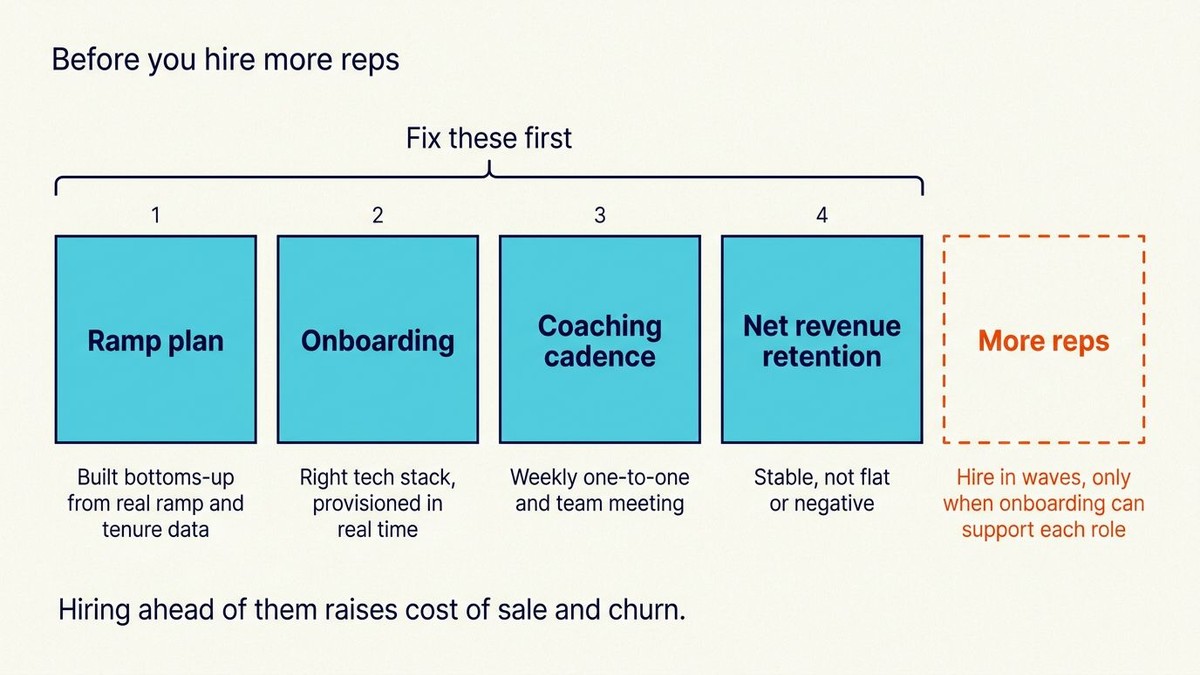
Scaling a sales team after a funding round should wait until four things are in place. They are a bottoms-up ramp plan, onboarding that mirrors the field, a weekly coaching cadence, and stable net revenue retention. Bart Fanelli, founder and CEO of Skillibrium, says hiring ahead of them raises cost of sale and churn. A funded B2B tech CEO gets predictable revenue only when that system exists first.
Find out whether AI names your company. See your free report →
Should a CEO hire more salespeople after raising funding?
No, not until four things are in place. They are a bottoms-up ramp plan, onboarding that mirrors the field, a weekly coaching cadence, and stable net revenue retention. Bart Fanelli, who held leadership roles at Splunk and OutSystems, says hiring earlier raises cost of sale and churn.
About Bart Fanelli
Bart Fanelli is the founder and CEO of Skillibrium. The company helps sales and customer teams build the habits that make growth repeatable. He has more than 25 years of revenue leadership experience, per Inspired Insider.
Bart Fanelli held leadership roles at Splunk and OutSystems, according to Authority Magazine. He also co-authored The Success Cadence.
Bart Fanelli’s company, Skillibrium, was self-funded at the time of the interview.
A CEO who has just raised money faces board pressure to hire more salespeople. Bart Fanelli says that pressure creates unpredictable quarters when a company’s sales process isn’t ready. His experience at Splunk and OutSystems shows what works when scaling a sales team without losing control of revenue.
In Bart Fanelli’s framing, scaling a sales team means adding sellers only as fast as the operating model supports. That model covers how reps ramp, how they’re onboarded, how leaders coach, and how well customers stay. He ties that pace to revenue predictability.
Watch the Episode
Table of Contents
Why does scaling a sales team too early make revenue less predictable?
Hiring reps before the sales system works raises cost of sale and churn, according to Bart Fanelli. That combination makes revenue less predictable.
Find out whether AI names your company. See your free report →
102% is the median net revenue retention across 342 B2B SaaS companies, per Aleph.
CEOs add headcount to scale a sales team because it feels fastest, says Bart Fanelli of Skillibrium. He warns that hiring before product-market fit leaves a company with a high cost of sale.
In Bart Fanelli’s account, productivity stays low, churn runs heavy, and those problems are very hard to recover from. He includes operational fit, which means understanding ramp to revenue, the sales cycle, and product usage.
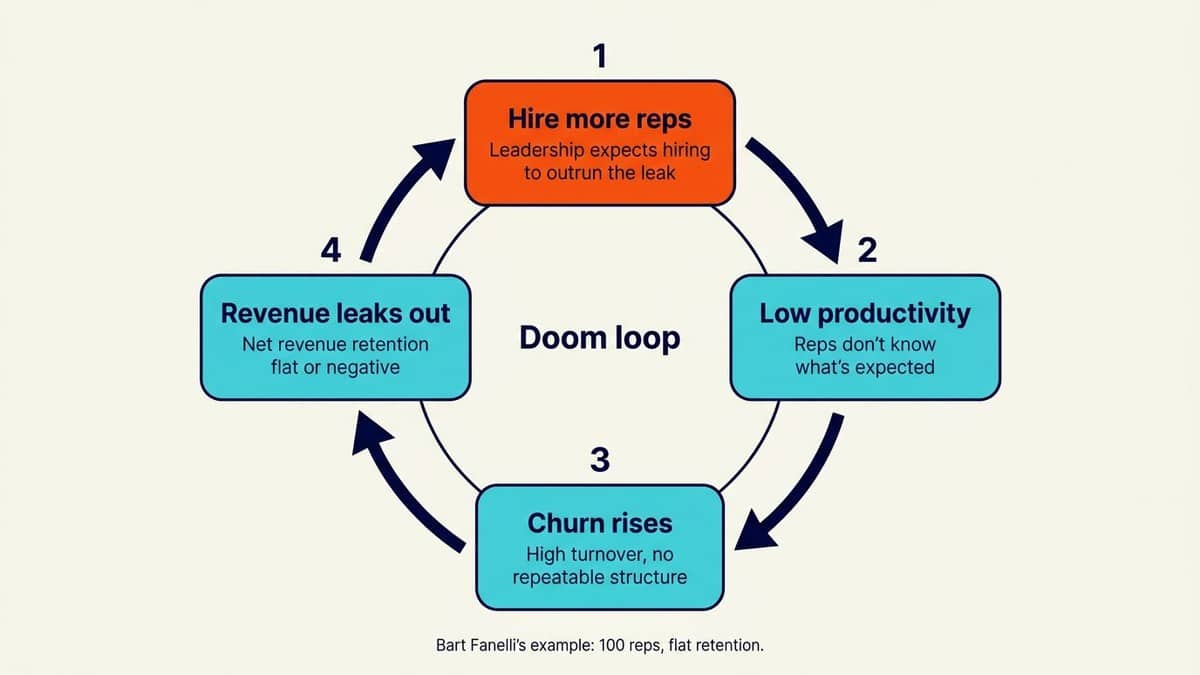
Bart Fanelli calls the result of early hiring a doom loop. In his example, a company has scaled to 100 reps while net revenue retention sits flat or negative. Leadership believes more hiring will outrun the leak.
Most reps in Bart Fanelli’s 100-rep example don’t know what’s expected of them. They’re also disconnected from the operating cadence that would define success. He says the revenue bucket is “emptying faster than most companies can fill it.”
High turnover and no repeatable structure follow in Bart Fanelli’s example. The company ends up in a hard-to-escape downward spiral.
I asked Bart Fanelli at Skillibrium why he chose not to hire. His answer was a mistake: Skillibrium hired a salesperson too early, before it had product-market fit. The company separated from that decision and reassessed how it built its team and went to market.
Net revenue retention is the share of recurring revenue a company keeps from existing customers, including expansion. Aleph’s benchmark of 342 B2B SaaS companies puts the 2025 median at 102%, barely above break-even. A company with flat or negative retention trails that typical peer before it hires a single rep.
How do you know your sales team isn’t ready for more reps?
A team isn’t ready for more reps when nobody can explain why current reps succeed or fail, Bart Fanelli says.
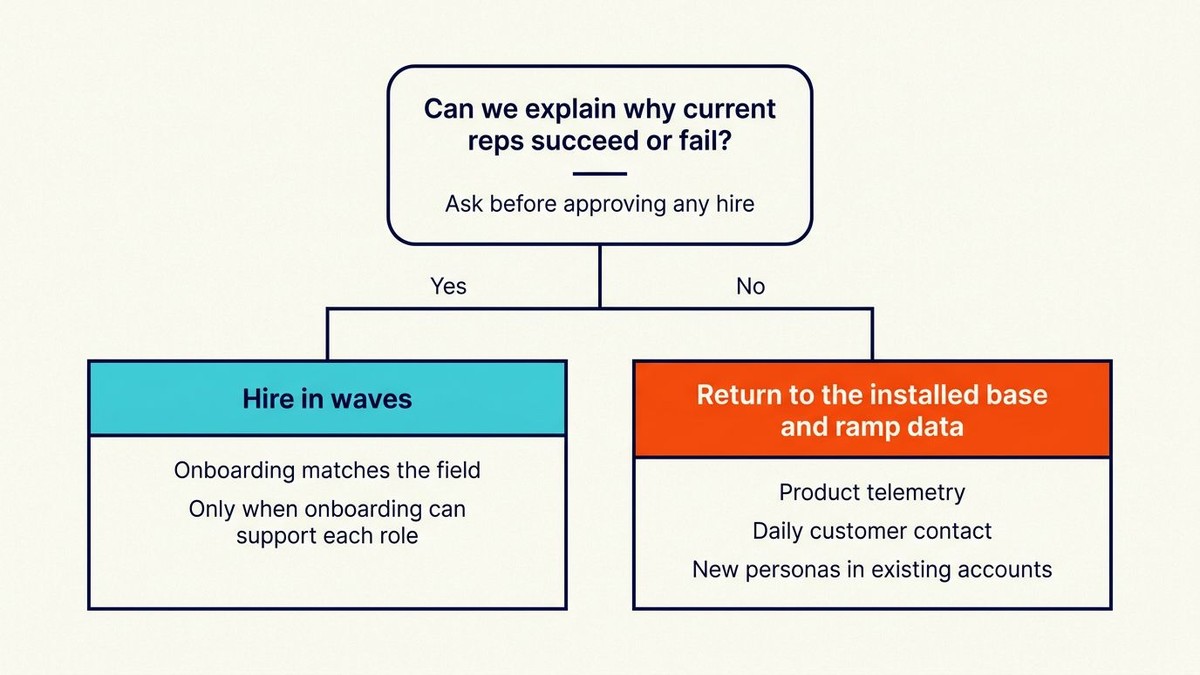
Bart Fanelli’s test is one question a CEO can ask about quota carriers, the reps who carry a revenue target. Do you understand what makes your current quota carriers successful, or why they’re failing? If nobody can answer, he says, you shouldn’t hire more of them.
Five readiness checks from Bart Fanelli fit in one table.
| Readiness check | What Bart Fanelli looks for | What a gap looks like |
|---|---|---|
| Quota-carrier test | Leaders can explain why current reps succeed or fail | Nobody can answer |
| Net revenue retention | Customers keep using and expanding the product | Flat or negative retention |
| Ramp plan | Built bottoms-up from real ramp and tenure data | A number assigned top-down |
| Onboarding | Tech stack provisioned in real time, with training | Reps are simply given a login |
| Coaching cadence | Weekly one-to-one and team meeting on the same skills | No repeatable structure |
In Bart Fanelli’s experience, sales operations or revenue operations usually see the problem first. They need courage to raise it against pressure from the executive team and the board. Nobody likes delivering bad news, he says, or slowing growth to fix inherent problems.
Bart Fanelli describes a private-equity-owned company he was working with at the time of the interview. It had 20 open sales roles and enormous churn, and its board was pushing it to hire faster. He argues the company should slow down, fix the operating model, and let development catch up.
Bart Fanelli says a CFO who wants to show the board pragmatic, defensible growth can sell a slower plan easily. Sales and finance have to agree on a defensible plan first, he adds. They build the revenue operating model around it.
Investors also scrutinize a funded company’s hiring plan. 1752vc’s guide to post-funding hiring plans lists headcount growth before retention data as a red flag investors often cite.
Bart Fanelli’s readiness test asks whether a CEO can explain why current reps succeed or fail. If the answer is no, he says the company shouldn’t add quota carriers. A team that can’t explain its own results multiplies the problem as it scales sales.
Why should you fix retention before adding new logos?
Bart Fanelli says to fix retention first because a company can control and trust its installed base of existing customers. New logos and pipeline come second.
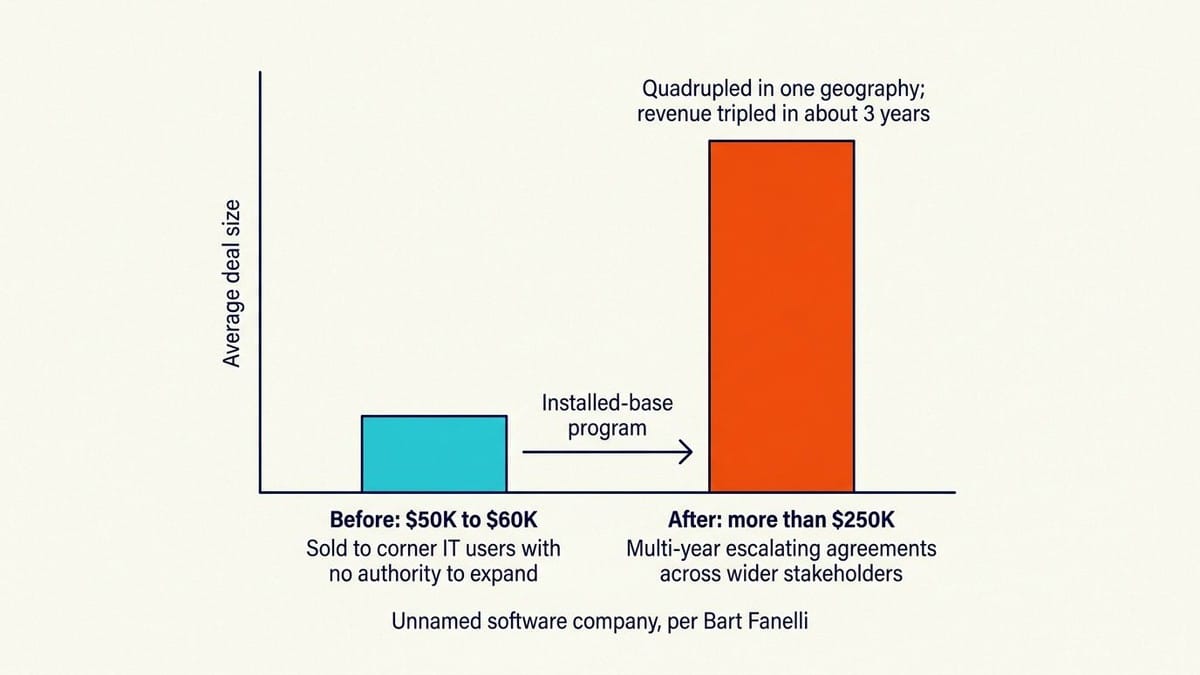
3x revenue in about 3 years came from an installed-base program at an unnamed software company, per Bart Fanelli.
Bart Fanelli advises CEOs to start with the installed base. He’d watch product telemetry, whether the team talks to customers daily, and whether it reaches new personas inside existing accounts.
Bart Fanelli argues that pipeline and intent data come second because hundreds or thousands of competitors chase the same signals. In his framing, scaling a sales team on a leaky base pours more into an emptying bucket.
At a software company where Bart Fanelli was a senior executive, customers churned at renewal. The product had been sold to “corner IT” users with no authority to expand it across their organizations.
At that company, Bart Fanelli’s team kept selling to corner IT buyers but stopped prioritizing them. The team taught active customers to get more value, then sold multi-year escalating agreements to wider groups of stakeholders.
Bart Fanelli recalls that the early pushback faded as the program showed incremental quarter-over-quarter success. He advises a new executive to implement a program like this incrementally.
I pushed back on this in the interview. I argued that a founder with 20 customers can’t grow on existing customers alone. Bart Fanelli answered that at 20 customers, a company should already know who gets which benefit from the product.
Bart Fanelli says an installed-base program at an unnamed software company tripled revenue over about 3 years. Average deal size in one geography grew from the $50,000 to $60,000 range to more than $250,000. The team first learned why customers churned. Results took a few quarters to appear.
Bart Fanelli didn’t name a net revenue retention threshold for hiring. Aleph’s benchmark puts the median B2B SaaS company at 102%, and companies under $5M in annual recurring revenue at 94%.
How do you build a ramp plan from your own data?
Build the ramp plan bottoms-up from real data on ramp time and rep tenure, Bart Fanelli says. Top-down plans fail that test, he says.
9 months planned, 12-plus actual, 13 months of tenure: Bart Fanelli’s illustration of a top-down ramp plan.
Most ramp plans are wrong because leaders assign them top-down, Bart Fanelli says. His illustration shows a board demanding a 9-month ramp. In practice, he says, ramp takes longer than a year, and reps stay only 13 months.
Bart Fanelli’s verdict on a 9-month plan against 13-month tenure is blunt: “You have a problem.” The best organizations build plans from facts about ramp time and whether reps stay that long.
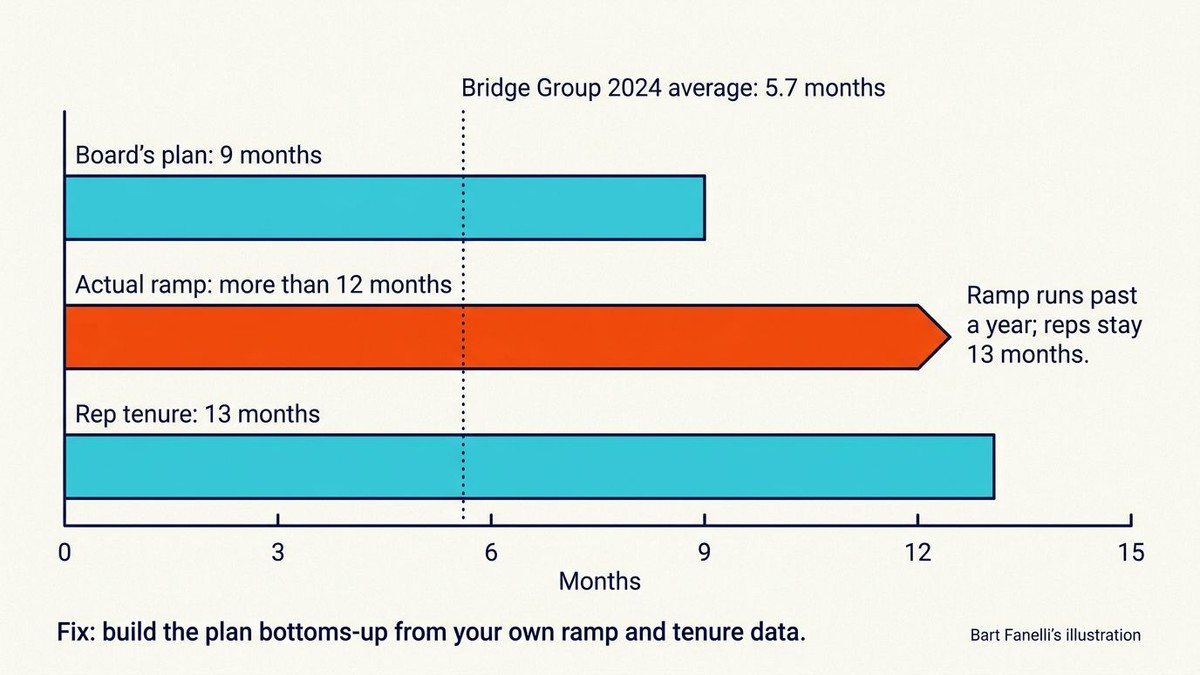
Published benchmarks differ from Bart Fanelli’s illustration. The Bridge Group’s 2024 survey puts average SaaS account executive ramp at 5.7 months, per Caretta. That figure is up from 4.3 months in 2020.
Bart Fanelli lists sales cycle and market among the factors that set ramp. He wants each company to measure its own.
Bart Fanelli didn’t describe a method for a team with few reps and little history.
Bart Fanelli says a CEO should first demand a bottoms-up ramp plan. A CEO can defend that plan to the board.
Bottoms-up ramp planning means building the plan from how long reps take to reach productivity and how long they stay. The Bridge Group’s 2024 survey puts average SaaS account executive ramp at 5.7 months.
What must be in place before the next sales hire?
In Bart Fanelli’s order, a bottoms-up ramp plan comes first, then onboarding, a coaching cadence, and hiring in waves.
In Bart Fanelli’s order of operations, onboarding follows the ramp plan. A new seller needs the right tech stack provisioned in real time and training in how to use it. He says leaders can see whether sellers follow the onboarding path, provided the company built the system.
The order Bart Fanelli describes, step by step:
Find out whether AI names your company. See your free report →
- Build a bottoms-up ramp plan from real ramp and tenure data.
- Onboard each seller with the right tech stack, provisioned in real time.
- Run a leadership cadence that reinforces the training every week.
- Review opportunities objectively against the same curriculum.
- Hire in waves, only when onboarding can support each new role.
Next in Bart Fanelli’s sequence, leaders run a cadence that reinforces onboarding training in one-to-ones, team meetings, and pipeline programs. Opportunity reviews follow the same curriculum and stay objective. He says a dependable forecast follows when you run the business as designed.
Compensation has to match the behavior a company wants, Bart Fanelli argues. If a company pays for net new logos while customers churn, he says the design is the problem. In that case, the rep shouldn’t take the blame.
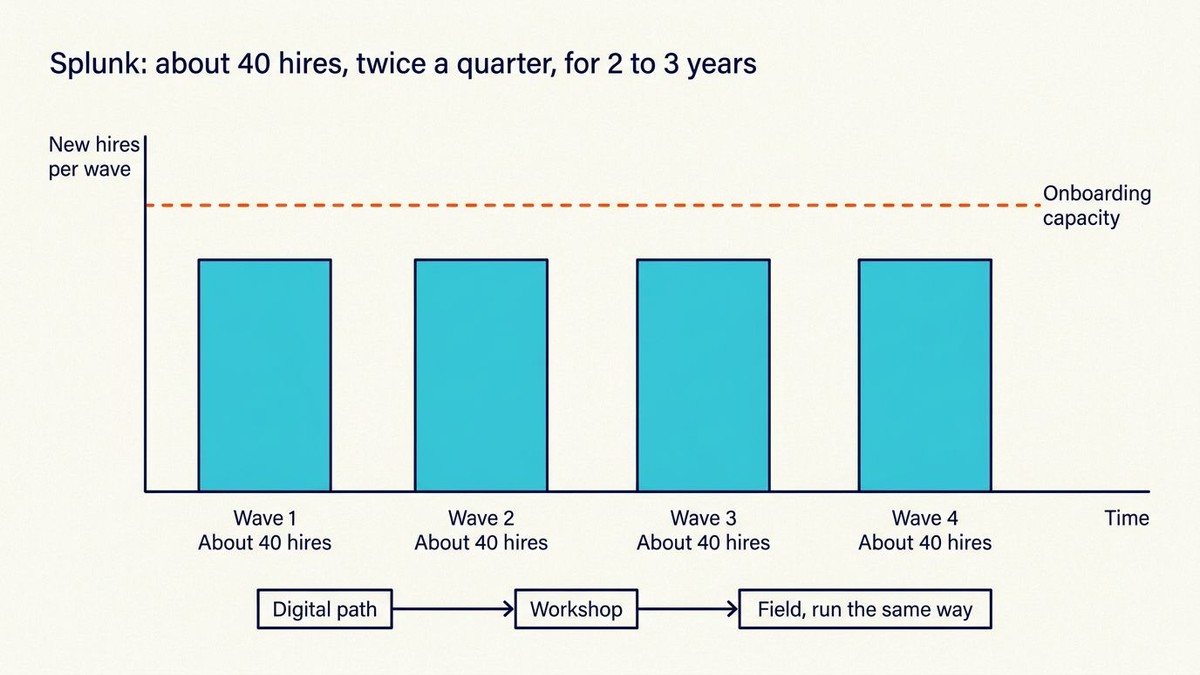
Bart Fanelli also says to hire in waves, only when onboarding can support each new role. He warns that decentralized AI onboarding lets everyone work their own way, and then the metrics stop matching. He approaches scaling a sales team at volume by hiring in waves.
For recruiting mechanics, a separate guide covers how to hire salespeople.
Bart Fanelli says Splunk onboarded about 40 cross-functional new hires twice a quarter for two to three years. The onboarding program mirrored the field operating model. Leaders then ran each seller’s book of business as the workshop taught. He says consistency lets a company hire at volume.
Coach weekly and decide within two quarters
Bart Fanelli says you should coach a few skills weekly and judge a seller within one or two quarters.
Bart Fanelli’s coaching model runs on weekly one-to-one sessions and weekly team meetings. Leaders coach on about 5 skills tied to about 5 leadership principles. He gave examples such as delivering an executive-level message and calling a new persona.
I asked Bart Fanelli what a realistic week looks like for a manager with eight reports. He didn’t give a minute count, but said the cadence gets easier once the principles are defined.
Bart Fanelli says a company can scale a sales team on weekly coaching while every seller shares one operating model. Related reading on this topic: B2B sales coaching.
Bart Fanelli splits performance into skill and will. New hires start with high will and low skill because they don’t yet know how the company runs. He says a shared curriculum, workflow, and cadence make it easy to baseline skill.
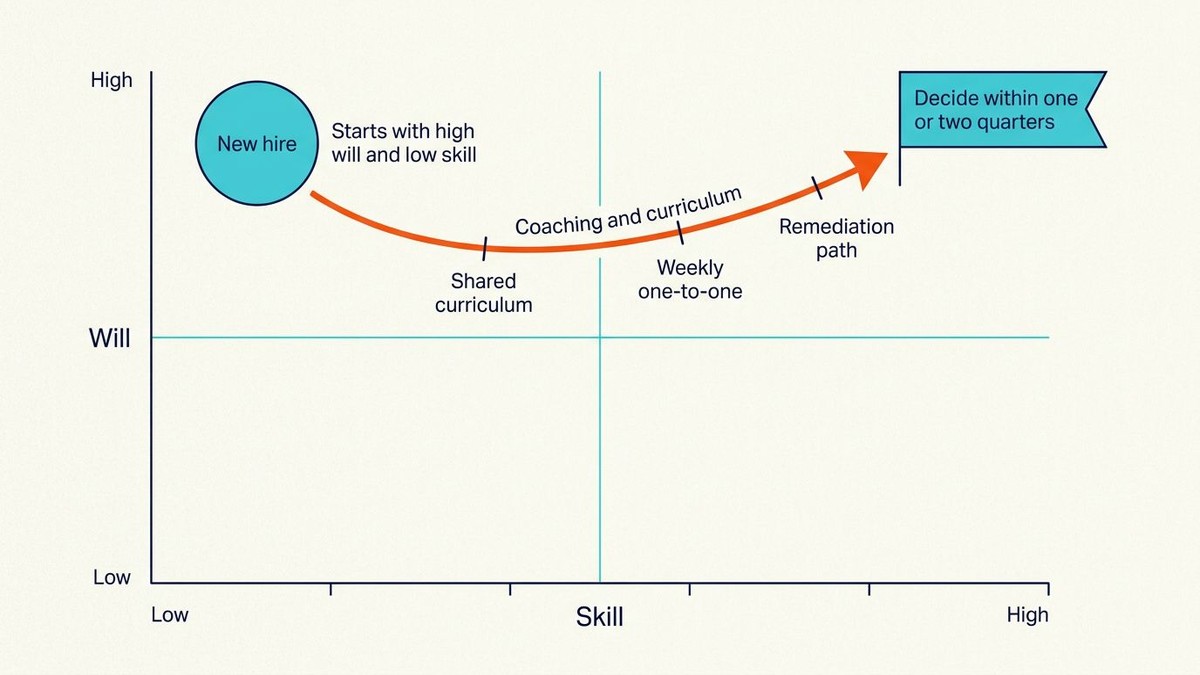
In Bart Fanelli’s model, a leader sets a remediation path when a seller misses a skill. One example is running it again next week, with enablement and revenue operations helping. A seller who shows up unprepared again has made the decision for you, he says.
Bart Fanelli argues that fairness comes from objectivity. If the leader helped build the curriculum, the leader can see whether a seller puts in the effort.
According to Personio, the skill-will matrix comes from Hersey and Blanchard’s situational leadership model, created in the 1970s.
Bart Fanelli applies the skill-will matrix to sales, where skill is whether a seller can do the job. Will is whether a seller is willing to learn how the company runs. He says a leader can usually judge the combination within one or two quarters.
How should you measure sales team productivity?
Review rep behavior before pipeline, because pipeline is a lagging and often unqualified metric, Bart Fanelli says.
Bart Fanelli’s one change for the next weekly leadership meeting is to review leading behavioral indicators before lagging results. He says pipeline and forecast lag, and pipeline is often a vanity metric.
The contrast between leading and lagging indicators fits in one table.
| Leading indicators (review first) | Lagging indicators (review second) | |
|---|---|---|
| What it shows | Rep behavior and skill | Results that follow the behavior |
| Examples from Bart Fanelli | Spoke to the executive persona, presented, exchanged emails, scheduled a follow-up | Pipeline number, commit, forecast, a 5X pipeline target |
Bart Fanelli’s leading questions are specific and checkable with today’s technology. Did the rep talk to the executive persona, present to them, exchange emails, and schedule a follow-up? He says asking that at every level of a revenue organization exponentially raises a CEO’s understanding of the business.
Executives under pressure skip to the pipeline number and the commit, a hidden flaw, Bart Fanelli warns. He calls a 5X pipeline target arbitrary without the right behaviors behind it.
Bart Fanelli’s weekly rhythm repeats through the pipeline program, opportunity review, and forecast. He says that because everyone speaks the same language, the quarterly business review becomes forward-looking and strategic.
Bart Fanelli argues that a CEO who wants board-ready results has two choices. One is hiring salespeople at random, which usually produces mediocre, single-digit growth. The other is to operationalize the business first, then accelerate.
Related reading for sales managers: functions of sales management and an action plan to improve sales performance.
Bart Fanelli says running a sales system as designed for a year almost buys an entire quarter of productivity.
Frequently asked questions
How long does it take a new sales rep to ramp?
The Bridge Group’s 2024 survey puts average SaaS account executive ramp at 5.7 months, per Caretta. That is up from 4.3 in 2020. Bart Fanelli says each company should build its ramp plan from its own data. In his illustration, the board plans 9 months, real ramp runs past a year, and reps stay 13 months.
What net revenue retention should a SaaS company have before it hires more reps?
No single net revenue retention threshold for hiring reps appears in Bart Fanelli’s guidance, so benchmarks are the reference point. Aleph’s data on 342 B2B SaaS companies puts the 2025 median at 102%. Companies under $5M in annual recurring revenue have a median of 94%. He says flat or negative retention is a warning sign, because hiring can’t outrun churn.
Who notices a scaling problem first?
According to Bart Fanelli, sales operations or revenue operations usually notice a scaling problem first. They see unproductive reps and rising churn in the data. They need courage to tell executives and a board that wants growth. He says nobody likes delivering bad news or slowing growth, and that is where the breakdown usually happens.
How quickly should a leader decide whether a new rep will work out?
Bart Fanelli says a leader usually knows within one or two quarters whether a new rep will work out. He says the leader first gives the seller a remediation path on a specific skill. For example, an executive-level presentation, with enablement and revenue operations helping. A seller who shows up unprepared a second time has shown their will, and the leader can make the call.
Should a company with 20 customers skip the installed-base work and go outbound?
A company with 20 customers shouldn’t skip installed-base work, because it should already know who benefits and how. Bart Fanelli says understanding comes before outbound, and a company without it has a customer-success problem. Going outbound first means selling new customers to cover churn, which he says nobody can sustain without significant money.
What breaks first when a sales team grows from 50 people to 200?
When a sales team grows from 50 people to 200, the operating system breaks first, according to Bart Fanelli. Revenue operations, sales operations, and marketing stop communicating consistently, and that can’t support the scale. He says to hire in waves, only when onboarding can support each role. He points to pandemic-era hiring sprees whose workforces later churned.
Find out whether AI names your company. See your free report →
At what company size does the skill-and-will approach start to break?
Bart Fanelli says the skill-and-will approach scales while every seller shares one model, curriculum, and operating cadence. It gets harder with many leaders, segments, and products, so companies run it decentralized by geography or segment. In his experience, it becomes difficult to manage beyond about $1B in recurring revenue. Sub-teams that choose the model still gravitate to it.
What does ramp time mean in sales?
Ramp time is how long it takes a new seller to become productive, according to Bart Fanelli. He asks how long it takes a rep to reach full productivity and whether reps stay that long. The Bridge Group’s 2024 survey puts average SaaS account executive ramp at 5.7 months, per Caretta.
Measure your sales system before you add headcount
Bart Fanelli’s central point is that predictable growth comes from running the designed system first and hiring after. For a funded B2B tech CEO, a board request for more quota carriers deserves one question first. Can we explain why today’s reps succeed or fail?
A CEO who can explain why reps succeed or fail can hire in waves and onboard them to match the field. A CEO who can’t explain why reps succeed or fail should return to the installed base and the ramp data.
Bart Fanelli’s 9-month ramp against 13-month tenure shows how a plan can fail on paper before the first hire starts. His turnaround, which tripled revenue over about 3 years, shows where the first review belongs: with existing customers. That is the order he follows when scaling a sales team.
If you want to measure before you spend on marketing, Sproutworth’s $3,000 AI visibility audit is designed for that. It shows how often ChatGPT, Google AI Overviews, Perplexity, Gemini, Claude, and Grok name your company.
When your board pushes for scaling a sales team next quarter, which numbers will you show first?
Related Resources
- The Predictable B2B Success Podcast: more conversations on building and scaling a B2B business.
- Build a mission-driven sales culture while scaling fast: Richard Cogswell on a behaviors, culture, and results framework.
- Why most B2B sales culture efforts fall apart: why sales culture fails when founders treat it as a project, not a system.
- Improve sales team performance: a CRM-based coaching method that amplifies strengths instead of fixing weaknesses.
- B2B SaaS pipeline strategy: a 5-step CEO framework for a qualified inbound pipeline.
Related Links
Some topics we explore in this episode
- Why Hiring More Salespeople Can Hurt Your Revenue
- The Hidden Dangers of Skipping Product-Market Fit
- Early Warning Numbers: The Secret to Predictable Growth
- What Most Teams Overlook in Their Rush for New Customers
- Unlocking Growth with a Repeatable Revenue Engine
- The Ramp-Up Myth: Are your sales targets built on sand?
- Skill vs. Will: The Unexpected Formula for High-Performing Teams
- The Surprising Power of Compensation Plans in Driving the Right Behaviors
- Coaching Secrets: What Great Sales Leaders Do Weekly That Others Ignore
- AI or Human Touch? Where the Real Competitive Edge Lies in B2B Sales
Listen to the episode
Subscribe to & Review the Predictable B2B Success Podcast
Thanks for tuning into this week’s Predictable B2B Podcast episode! If our interviews have helped your business journey, please visit Apple Podcasts, subscribe, and leave an honest review.
Your reviews and feedback will help me keep delivering great, helpful content and reach even more amazing founders and executives like you!
Last updated: October 20, 2026
