
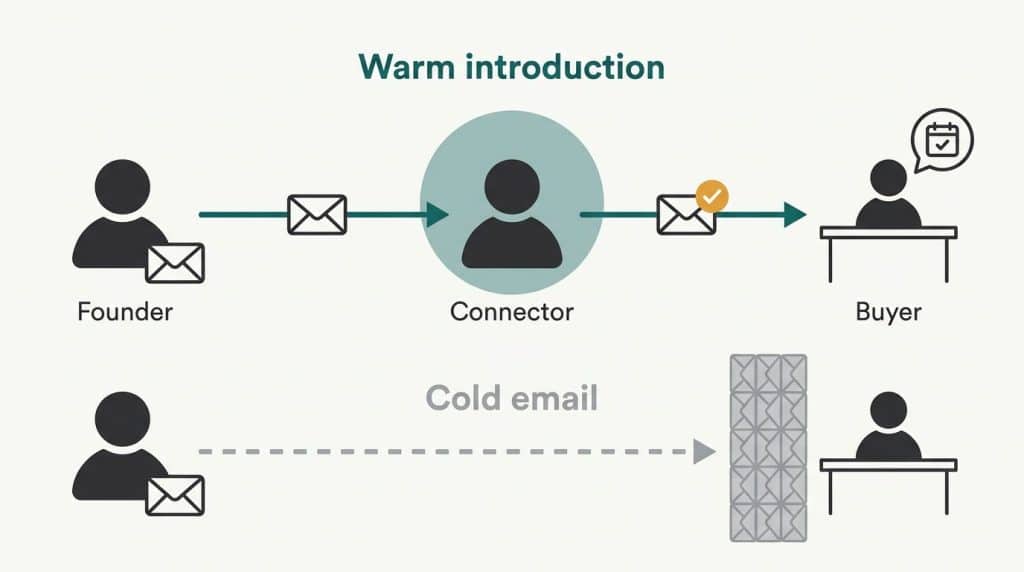
A warm introduction means a mutual contact who knows a buyer and vouches for you, usually by forwarding your short email. In Commsor’s 2026 Warm Intro Gap Report, 77.8% of sales leaders said their teams could drive revenue without cold outbound. Yet only 18% run introductions as a reliable system. For B2B tech founders, closing that gap puts the founder’s network to work on tier-one deals.
Last updated: October 19, 2026
What is a warm introduction in B2B sales?
A warm introduction is a referral from someone the buyer already trusts. The buyer takes the meeting knowing why to listen. Olivier Roth of The Swarm says most people know only 10 to 15% of their LinkedIn connections. Useful intros therefore come from a short list of real relationships.
About Olivier Roth
Olivier Roth is Co-Founder and CGO at The Swarm, a relationship data company. The Swarm maps who a team, its investors, and its customers already know. In July 2026, after five years of building that data, The Swarm announced it was acquiring Commsor. Commsor helped define the warm-intro category. Roth notes that early-stage CEOs often closed the first customers themselves. Yet founders’ networks still live in their heads and inboxes, not in the sales process. Roth maps networks for early-stage startups and large enterprises. His work shows how to turn a warm introduction from an occasional favor into a repeatable pipeline source.
Watch the episode
Table of Contents
Why do warm introductions beat cold outreach without replacing it?
Warm introductions win on fit, while cold outreach wins on volume, according to Olivier Roth of The Swarm. Strong teams run both. Sales teams now need about 1,400 emails, calls, and messages to get one deal into the pipeline. Commsor’s 2026 Warm Intro Gap Report says that figure has grown fivefold in five years.
In the same Commsor survey, 77.8% of sales leaders said their teams could keep driving revenue without cold outbound.
Roth, Co-Founder and CGO of The Swarm, frames the difference as volume against fit. “Cold email is a numbers game,” he says. In his view, intros are a quality game played on fewer, bigger accounts.
| Cold outreach | Warm introduction | |
|---|---|---|
| How it reaches the buyer | A message from someone they have never heard of | A note forwarded by someone they already trust |
| Effort to book a meeting | About 1,400 touches per pipeline deal (Commsor, 2026) | 40.2% of sales leaders say intros book a meeting in one or two touches (Commsor, 2026) |
| Best suited to | Broad lists, self-serve and product-led deals | Tier-one and tier-two accounts, enterprise deals |
| How Roth describes it | “A numbers game” | A quality game |
| Who runs it | SDRs and sequencing tools | The CEO as champion, the first sales hire as operator |
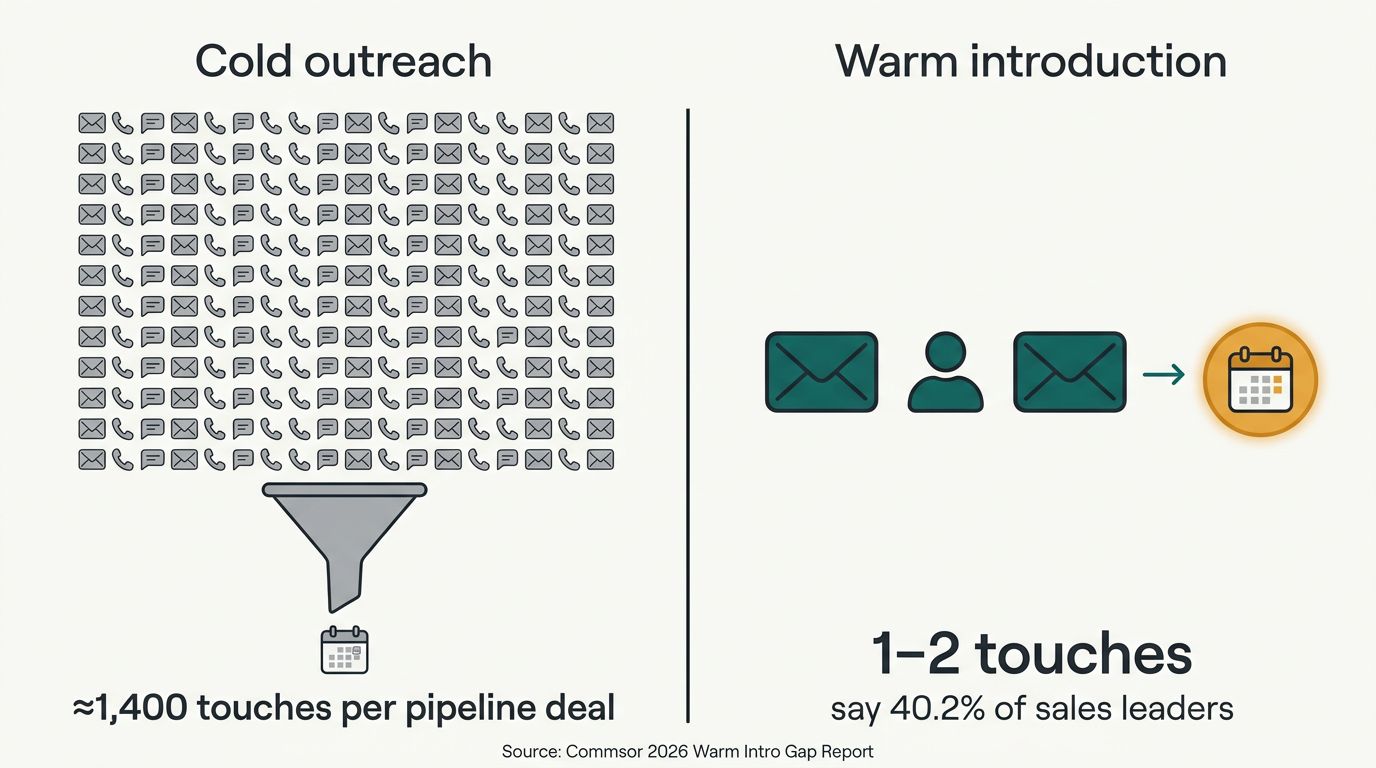
Roth keeps multichannel cold outreach in the mix and narrows intros to the accounts that matter most. He suggests taking the top 1,000 companies from a 30,000-company list and checking each for an intro path first. If one intro leads to a $1 million deal, he argues, the return is obvious.
Roth’s sharper point is that relationship data improves every channel. When an inbound lead arrives from a company like Stripe, he suggests checking for shared investors or colleagues first. He has also discussed adding a “connectivity score” to lead scoring with a Fortune 500 team.
In June, my guest argued that cold email, phone, and LinkedIn together book four times more meetings than one channel. After this conversation with Roth, I think that guest was only half right.
Roth claims intros that take the meeting convert to paying customers about three times better than inbound leads. That figure is his field observation, not a published benchmark.
Commsor’s 2026 Warm Intro Gap Report surveyed 1,305 sales and go-to-market leaders. It found 77.8% believe their teams could drive revenue without cold outbound. It also found that one pipeline deal now takes about 1,400 outbound touches, five times more than it did five years ago. Olivier Roth of The Swarm recommends warm introductions for tier-one accounts while outbound covers the rest.
Why most teams still don’t run warm introductions as a system
Most teams still don’t run warm introductions as a system because no one owns the work, according to Olivier Roth of The Swarm. Commsor’s 2026 Warm Intro Gap Report found only 18% of teams have a reliable system for getting intros. The same report found 66.8% of sellers cite a fear of asking.
In Roth’s view, revenue operations usually buys data, sales wants something plug-and-play, and the CEO holds the relationships. As Roth puts it, “There is no budget line item for warm intros yet.”
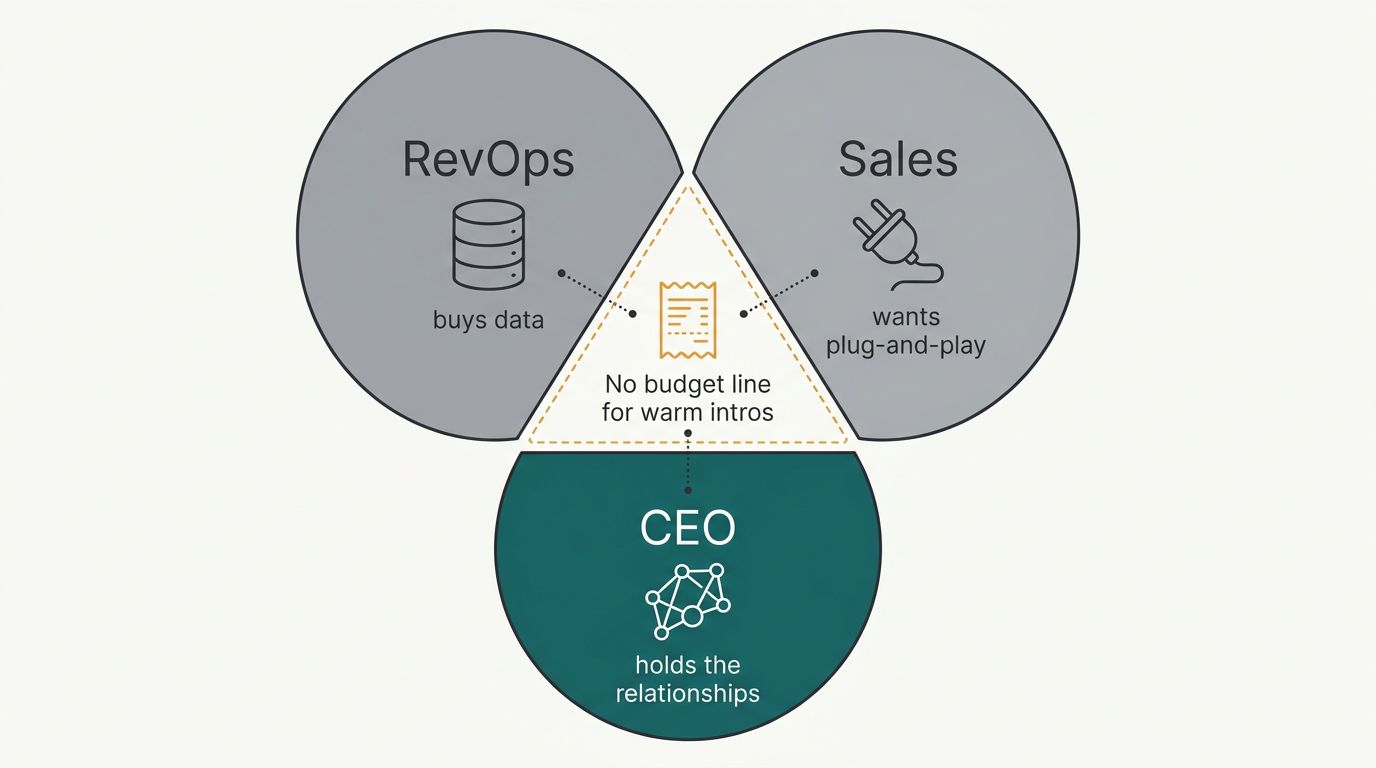
Roth also explains why the LinkedIn-mutuals approach stalls. He estimates people know only 10 to 15% of their LinkedIn connections. Ask your investors for intros through mutuals every month, he says, and you bother 10 people to get one.
Commsor founder Mac Reddin, now an advisor to The Swarm, suggested flipping the ask. Connectors would see a short list of people they likely know and pre-approve the intros they are happy to make. Roth calls it a strong hypothesis. It has not been tested at scale yet.
Commsor’s 2026 Warm Intro Gap Report found that only 18% of sales teams have a reliable system for warm intros. It also found that 66.8% of sellers cite fear as a barrier to asking. Olivier Roth of The Swarm says ownership is the real gap, because no budget line exists for warm intros yet.
How to get more warm introductions in 3 steps
Founders can get more warm introductions in three steps without buying software, according to Olivier Roth of The Swarm. First, list your top 300 connectors, starting with happy customers. Second, send each connector one batched ask, then a forwardable email per yes. Third, put 20 target accounts in every investor update. Each step runs on tools founders already use: LinkedIn, email, and the investor update.
Step 1: List your top 300 connectors, starting with happy customers
Olivier Roth’s most overlooked connector group is the one founders talk to every week: happy customers. He calls them “the best source of intros.” They have used your product and know peers with the same problem. Roth recommends a first list of about 300 connectors across customers, team, investors, advisors, and referral partners.
Roth defines a connector as anyone who knows your company and wants it to succeed. By that definition, he says, even a one-person company has hundreds. Yet founders who start on The Swarm typically add about 30, while a revenue operations lead adds around 1,000.
The five connector groups Roth names are:
- Happy customers of more than a year, plus the champions and admins who use the product
- Your team, including the sales team
- Investors
- Advisors
- Referral partners
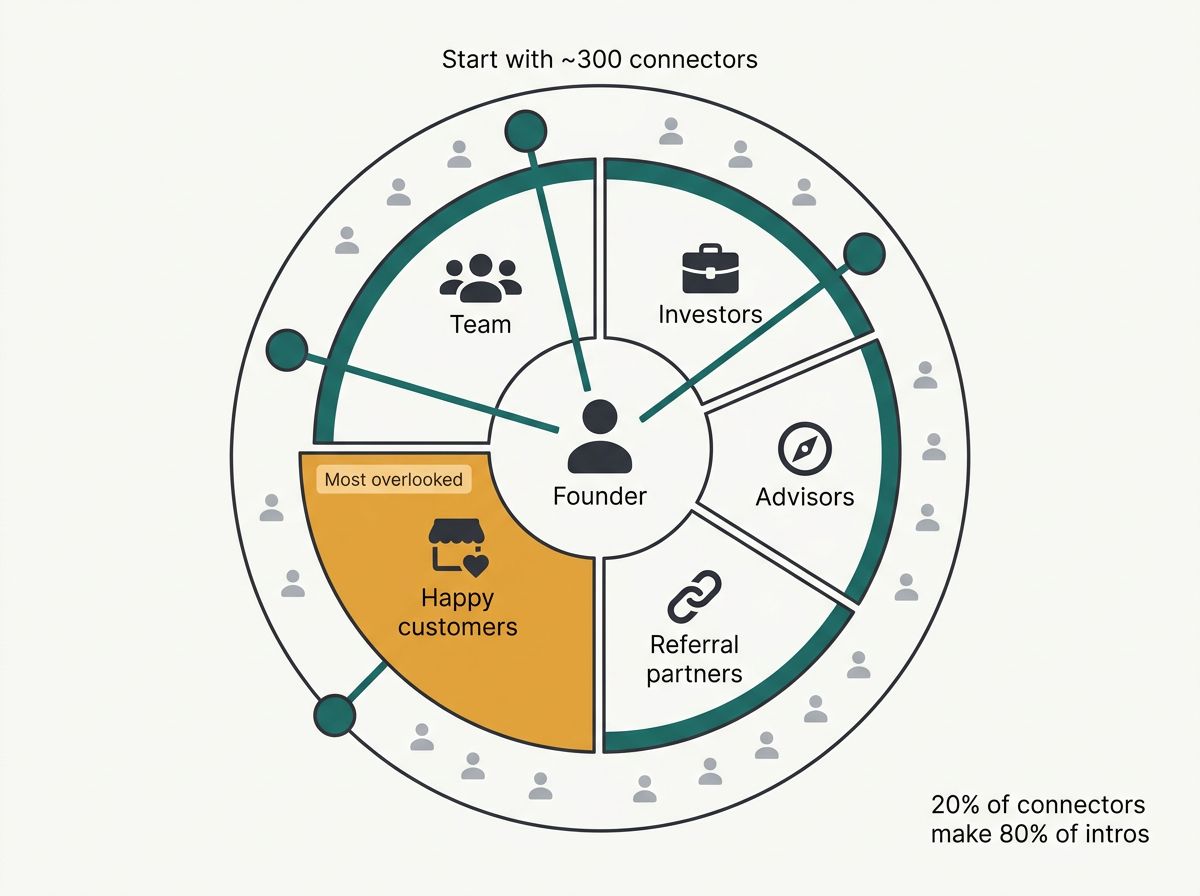
Boomerang suggests starting with your team and investors before Series A. It adds customers once you have 10 to 50 of them.
You can build this warm introduction list without software. Roth suggests downloading your LinkedIn archive, which includes your full message history. An AI tool such as ChatGPT can then rank contacts by two-way messaging, and you keep roughly the top 10%.
Roth also brings customer success into the rollout, since that team already talks to customers every week. In his view, customer success managers know which accounts are happy enough to refer.
Expect a skew. Roth says 80% of intros come from 20% of connectors. Over time, prune the people who never respond and double down on those super-connectors.
Software earns its place once the manual list works. The Swarm maps connections from public data, plus LinkedIn and email for connectors who opt in. It then scores how likely each connector is to know a prospect, Roth says. Asks then go only to strong ties.
The upper limit goes well beyond 300 connectors. Roth describes one customer that wanted to add 25,000 connectors from its go-to-market community.
For a first pass, Roth’s advice is simpler: list your top 100 across partners, investors, advisors, customers, and friends. Then note who you have not caught up with lately.
Step 2: Send one batched ask, then a forwardable email per yes
Olivier Roth advises asking a connector about several people in a single email. Send one note with five names and a line of context each, instead of five separate requests. The connector replies with the names they can help with.
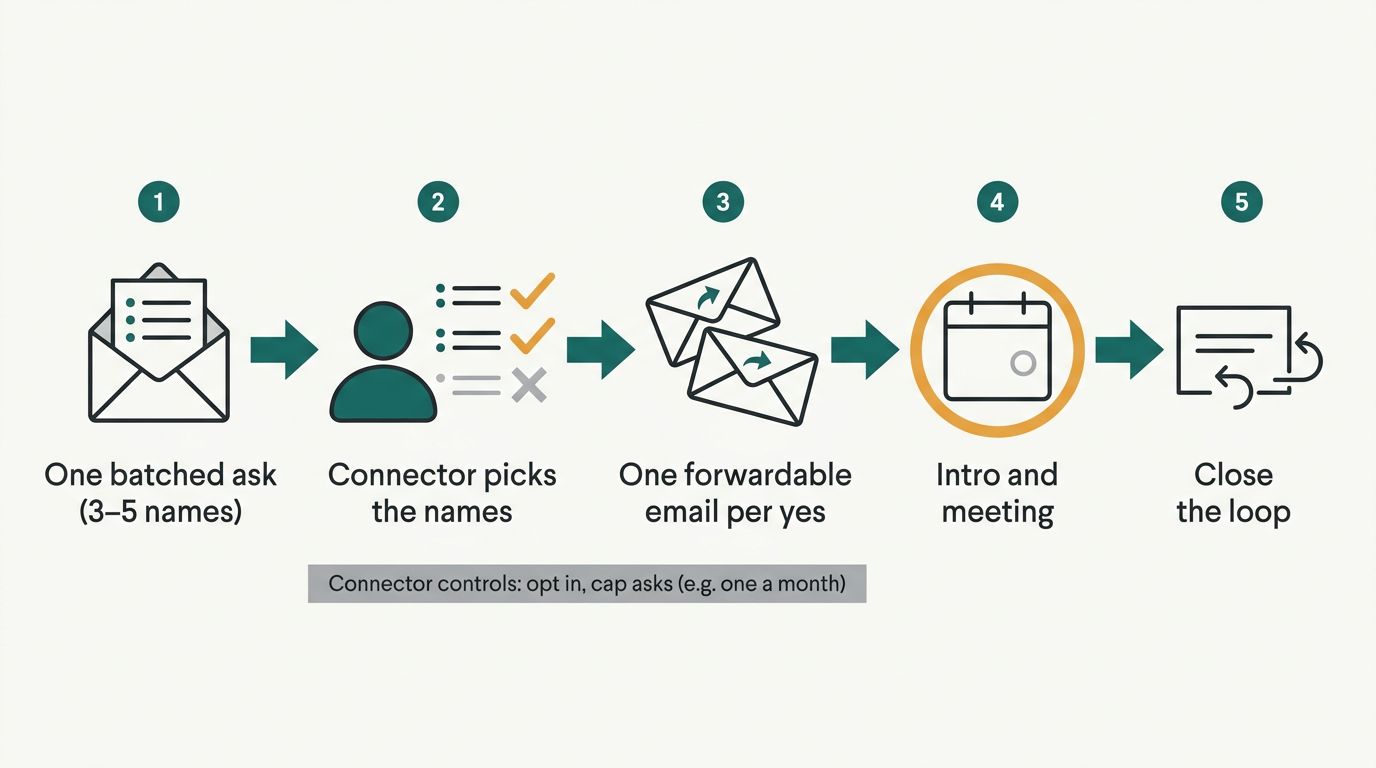
If an investor replies that they can introduce you to John and Sarah, Roth recommends two emails, one per person. Each is short, forwardable, and personalized to that prospect’s company.
Roth’s example of the context line reads: “John’s company is in cybersecurity. Nine of our 10 customers are in cybersecurity.”
Here is a template built on Roth’s two-stage method:
The batched ask, sent to the connector
Subject: Three intros worth 10 minutes?
Hi [Name], we’re focused on [segment] this quarter. You may know people at these three companies:
1. [Company A]: [Prospect], [one-line reason they’d care]
2. [Company B]: [Prospect], [one-line reason]
3. [Company C]: [Prospect], [one-line reason]If any feel right, reply with the names and I’ll send a short note you can forward. No pressure on any of them.
The forwardable note, one per yes
Subject: [Your company] and [Prospect’s company]
Hi [Prospect], [Connector] suggested we talk. [Your company] helps [ICP] achieve [outcome], and [specific reason this matters to their company]. Would 20 minutes in the next two weeks work?
Roth’s two-stage format lets a connector forward the note without rewriting a word. Roth says many people don’t know how to ask for an intro, and this format removes the guesswork.
Roth prefers email to LinkedIn for one practical reason: email can be forwarded in one click. If a connector has to copy and paste, he says, the ask stalls. Introhive’s guide adds a double opt-in, where the connector checks with the prospect before introducing you.
When Roth described this, I thought of a hotel concierge who makes things happen through a trusted network. The connector’s experience matters as much as the ask. Roth says connectors should be able to opt in or out and cap requests.
Connectors should also choose whether to share LinkedIn, email, or both. In Roth’s example, an investor would accept at most one email a month.
Roth adds that a request should never be the first time a connector hears from you. Keep the relationship warm well before any warm introduction request lands in their inbox.
Roth also likes one senior person to announce the intro program first. A CRO or VP of sales can tell connectors they are piloting intro requests on behalf of the revenue team. That call, he says, sets expectations before the first monthly ask arrives.
Step 3: Put 20 target accounts in every investor update
Olivier Roth’s simplest no-software tactic is to add a target list to the investor update you already send. Each month, name the 20 companies you most want to reach and ask your investors who knows someone there. Roth says people scan the list from memory and reply with names founders never expected.
For a pilot group of connectors, Roth goes further. He suggests emailing them your key account list, such as your top 500 ICP accounts. Tell each person they made your top list, and invite them into the pilot by name.
Keep the list to deals where an introduction changes the outcome. A self-serve, product-led sale like a small Stripe account closes fine without one, Roth notes. A warm introduction pays off most on an enterprise deal worth millions, reached through an investor or customer.
The cadence of the target-account ask matters as much as the list. Roth recommends monthly or quarterly, whichever suits your investors, so the ask becomes a habit rather than a favor. Each cycle, swap in the next 20 companies on your target list.
Who should own warm introductions in a 20-50 person startup?
Olivier Roth’s answer is the first sales hire, working with the CEO. The CEO has the most connections and the least time, and often closed the early customers personally. So the CEO acts as champion while someone else runs the process.
Roth says that the operator needs a 360-degree view of the company and comfort with process, data, and people. The role can sit in sales or customer success. He notes that some VC firms now hire a dedicated head of network, a role still rare at startups.
At larger companies, Roth sees a C-level champion as essential. At Klarna, he says, the CEO joined the shared Slack channel himself and asked for API access.
Without a C-level champion, Roth says, the demo goes to revenue operations and stalls because no budget owns it. Roth wants top-down rules of engagement and communication before any rollout.
Roth’s process includes a weekly rhythm with four tasks. Refresh the target list, send batched asks to connectors, and follow up on open requests. Then log each intro in the CRM with the person who made it.
How do you measure warm introductions after 30 days?
Founders should measure warm introductions against a baseline, according to Olivier Roth of The Swarm. He compares last month’s intros, this month’s intros, and the pipeline they created. Count last month’s intros before the first ask, so the 30-day comparison means something. Roth says he would be surprised if 30 days of asking produced zero pipeline.
Roth’s tracking rule covers every deal that comes from an intro. Each one gets a deal source of “intro” and a named referrer in the CRM. HubSpot, Attio, and Clarify can all hold this, he says.
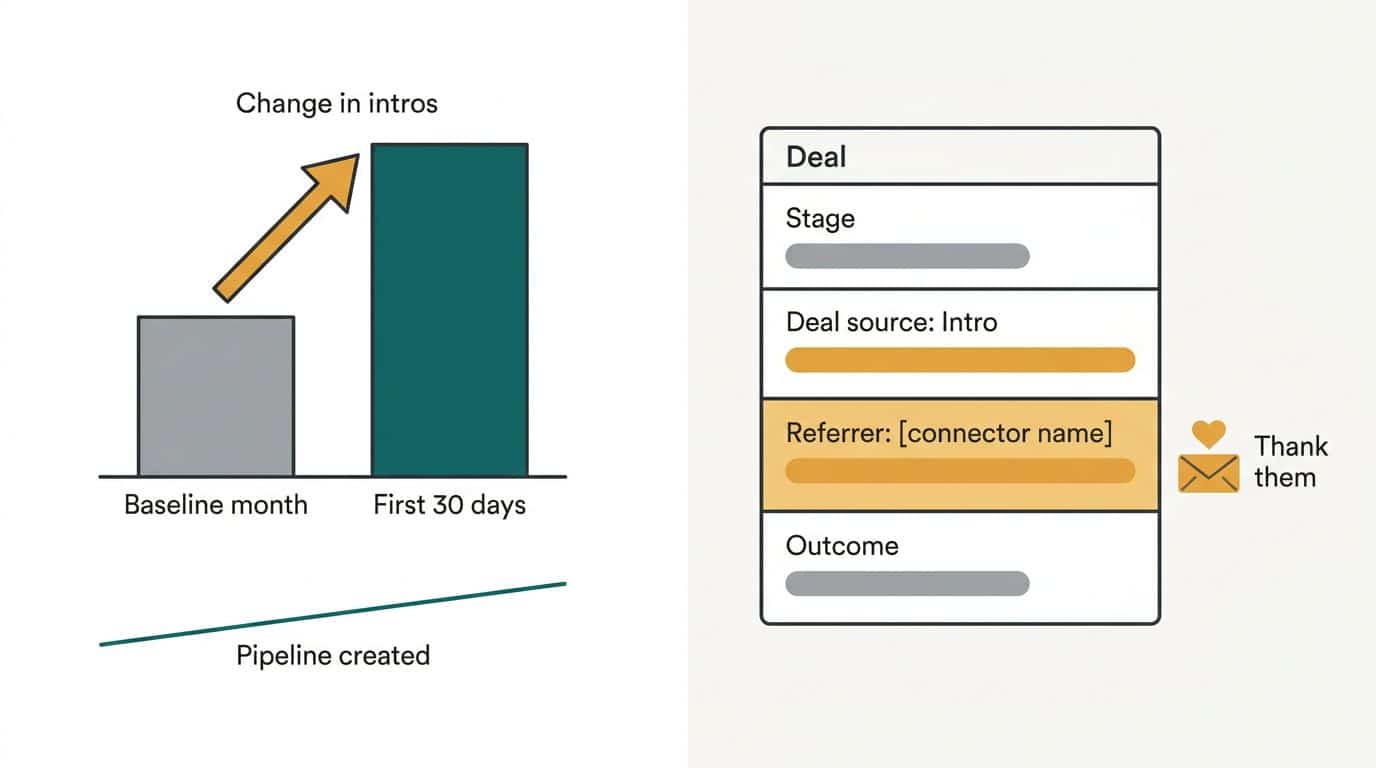
A CRM record with source and referrer lets you compare intros against other channels. It also tells you whom to thank when a deal closes.
Close the loop with every connector. Roth suggests telling them what the intro became and thanking them. The thank-you can range from a bottle of whiskey to Super Bowl tickets.
Roth matches incentives to the person who made the intro, and keeps intros from investors and founder friends unpaid.
A formal referral partner under contract can earn a revenue share, Roth says. One company he spoke with has 500 such partners.
Olivier Roth of The Swarm measures warm introductions against a pre-launch baseline. After 30 days, he compares the change in intros and pipeline. He logs every deal in the CRM with an intro source and a named referrer. Commsor’s 2026 Warm Intro Gap Report found that 82.4% of sales leaders say deals from warm intros close faster.
Frequently Asked Questions
What does warm introduction mean?
A warm introduction means a mutual contact who knows both people connects them and vouches for one of them. In B2B sales, the connector is usually an investor, advisor, customer, or colleague who knows the buyer. Commsor’s 2026 Warm Intro Gap Report found 40.2% of sales leaders say intros book meetings in one or two touches.
How do you write a warm introduction email?
Write a short, forwardable email the connector can send without editing. Olivier Roth of The Swarm recommends emailing the connector a list of several names first. Then write one personalized note for each name they accept. Each note should give one specific reason to talk. Send it by email, since LinkedIn messages are hard to forward.
What is the difference between a cold intro and a warm intro?
A cold intro reaches someone who has never heard of you. A warm intro arrives through a person they already trust. Commsor’s 2026 Warm Intro Gap Report found one pipeline deal now takes about 1,400 outbound touches. The same report found 82.4% of sales leaders say deals from warm intros close faster than other deals.
Should you pay people for warm introductions?
Payment depends on who makes the introduction. Olivier Roth of The Swarm keeps intros from investors and founder friends unpaid. He thanks them instead, for example with a gift after a meaningful deal. In Roth’s view, formal referral partners who sign an agreement can earn a revenue share or commission. He points to recruiting referral bonuses as the familiar precedent.
Do warm introductions work for early-stage startups with small networks?
Warm introductions work for early-stage startups because even a one-person company has hundreds of potential connectors. Olivier Roth of The Swarm says founders usually list only about 30 and should start closer to 300. He recommends adding happy customers alongside investors and advisors. Over time, he prunes toward the 20% of connectors who make most intros.
What are some good email introductions?
A good introduction email names both people, explains in one sentence why they should talk, and makes saying no easy. Olivier Roth of The Swarm prefers a specific reason over a general one. For example, note that most of your customers share the prospect’s industry. Keep it short enough to forward in one click, with a clear next step.
How do you introduce two people by email?
To introduce two people by email, first check that both want the connection. Introhive calls this check a double opt-in. Then send one short note naming each person and why they should talk. Olivier Roth of The Swarm adds that the person asking should write that context for you to forward.
Give your network a reason to hear from you before you ask
Olivier Roth’s work at The Swarm shows that warm introductions fail on ownership long before they fail on technology. In Commsor’s 2026 Warm Intro Gap Report, 77.8% of sales leaders said their teams could manage without cold outbound. Yet only 18% run intros as a system.
For B2B tech founders, the first move is a list of 100 to 300 connectors. A CEO champions the asks, and a first sales hire runs them every week. Happy customers belong at the top of that list. Every intro belongs in the CRM with the name of the person who made it.
Roth’s quieter lesson is that connectors respond to founders they hear from regularly. A monthly investor update with 20 target accounts works because the relationship was warm before the ask arrived. Investors, advisors, and customers should know what you are building long before you ask them for an intro. If you want to keep that network close, Sproutworth’s newsletter strategy is designed for founders who need a regular CEO newsletter.
Cold outreach needs more touches every year. Founders who build a habit of warm introductions now will reach their best accounts first.
Related resources
- Olivier Roth on LinkedIn
- The Swarm, Olivier Roth’s company (two-week free trial)
Related Links
- B2B lead generation tactics funded tech CEOs are using in 2026
- Land and expand strategy: growth without new logos
- B2B LinkedIn marketing strategy for qualified pipeline
- B2B SaaS marketing with two channels and no ad budget
Some topics we explore in this episode
- Warm intros vs cold outreach: the surprising truth about why companies still use cold outreach and what’s stopping them from making more warm introductions.
- Startup Wars: The Swarm vs Commsor: How The Swarm outmaneuvered a better-funded competitor in the race to own the introductions market.
- Integrations that actually get used: why embedding your intro tools into the existing sales workflow is a game changer.
- The hidden fear in sales teams: why most reps are terrified to ask for an introduction and what can be done about it.
- Profitability over hyper-growth: how running lean gives founders more control and why that matters in a market full of SaaS startups.
- Building a network effect: discovering the hidden connections within your company, your partners and your customers to massively accelerate growth.
- Culture eats technology. The real barrier to warm intro adoption is not software; it’s change management.
- Inside Success Stories: Lessons from companies that radically improved their results through the systematic introduction of new things.
- Getting Connectors to say yes: what makes someone excited or annoyed about making the introduction (and some clever incentive ideas).
- AI and the future of sales relationships: how AI can uncover the real relationship ‘gold mines’ without necessarily losing the human element.
Listen to the episode
Subscribe to & Review the Predictable B2B Success Podcast
Thanks for tuning into this week’s Predictable B2B Podcast episode! If our interviews have helped your business journey, please visit Apple Podcasts, subscribe, and leave an honest review.
Your reviews and feedback will help me keep delivering great, helpful content and reach even more amazing founders and executives like you!
