
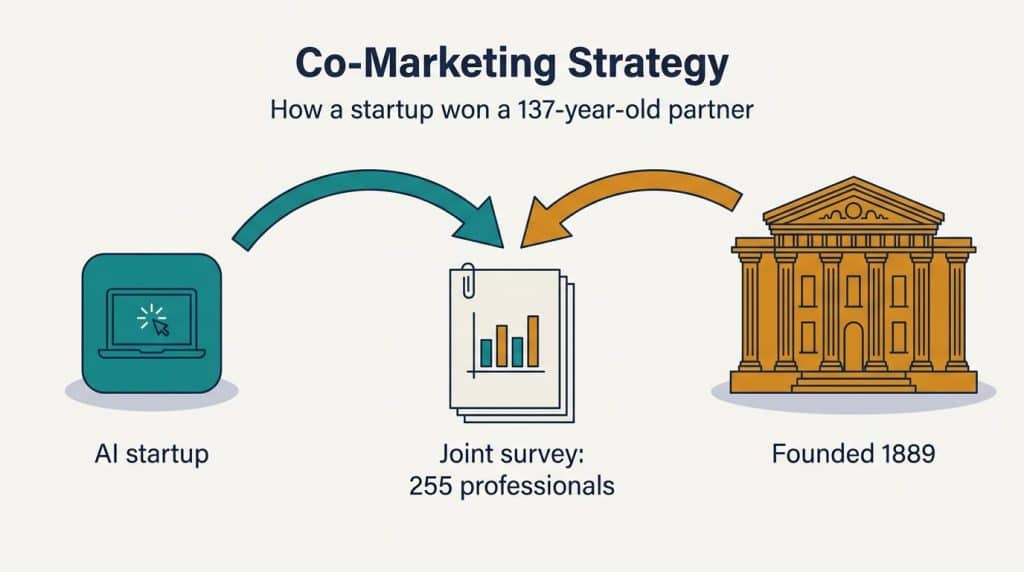
Co-marketing strategy between a startup and an established company works when the startup gives first and pitches what the partner wants. DealGround, an AI startup for property brokers, reported fixes to First American’s data week after week, then proposed a joint survey of 255 industry professionals. First American, founded in 1889, got proof it was becoming a data company. DealGround got a 137-year-old co-author and, says co-founder Dan Mosher, a 50% week-over-week jump in adoption.
How can a startup run a co-marketing strategy with a large established company?
A startup’s co-marketing strategy should begin with two questions: what does the partner care about, and what does the startup care about? Then propose one asset that serves both. AI startup DealGround proposed a joint survey to First American, which wanted to be seen as a data company. DealGround wanted a bigger brand beside it on the press release.
About Dan Mosher
Dan Mosher is CEO and co-founder of DealGround. Its AI platform helps commercial real estate brokers find out who owns a building and how likely the owner is to sell.
At Postmates, he led the merchant team while merchant fee revenue grew from $6 million to $80 million between 2017 and 2020.
Young B2B companies face a credibility problem: buyers doubt they will still exist next year. Dan tackled it by getting First American, a property data company founded in 1889, to co-publish research with DealGround. His experience shows what a co-marketing strategy with an incumbent looks like when it works.
I interviewed Dan on the Predictable B2B Success podcast, which has passed 500 episodes. I asked him what DealGround offered First American and what it had to prove first.
Watch the episode
Table of Contents
What is a co-marketing strategy for a startup?
A co-marketing strategy is a plan for two companies to create one asset and promote it to both audiences. The pages ranking for this term, from Text’s partner program to Rinehart Marketing’s small-business tips, assume similar-sized partners. Dan Mosher’s experience at DealGround points the other way: a startup’s best partner may have been founded in the 1800s.
Dan traces the pull to buyer doubt. In commercial real estate, he explains, new vendors “come and go every month, every couple of months.” Buyers start with one question: “how do you separate the wheat from the chaff?”
DealGround had little track record of its own, so Dan borrowed standing. DealGround co-published research with First American, a public property data company founded in 1889.
DealGround’s case fits a wider pattern. Dave Chaffey says partnering with firms like HubSpot gave Smart Insights “the benefit of associating with larger, better known companies.”
Startups selling alongside a giant report the same lift. “In the first year of the partnership, our AWS Co-Sell revenue increased 5x,” Local Measure CEO Jonathan Barouch says in an AWS startup guide.
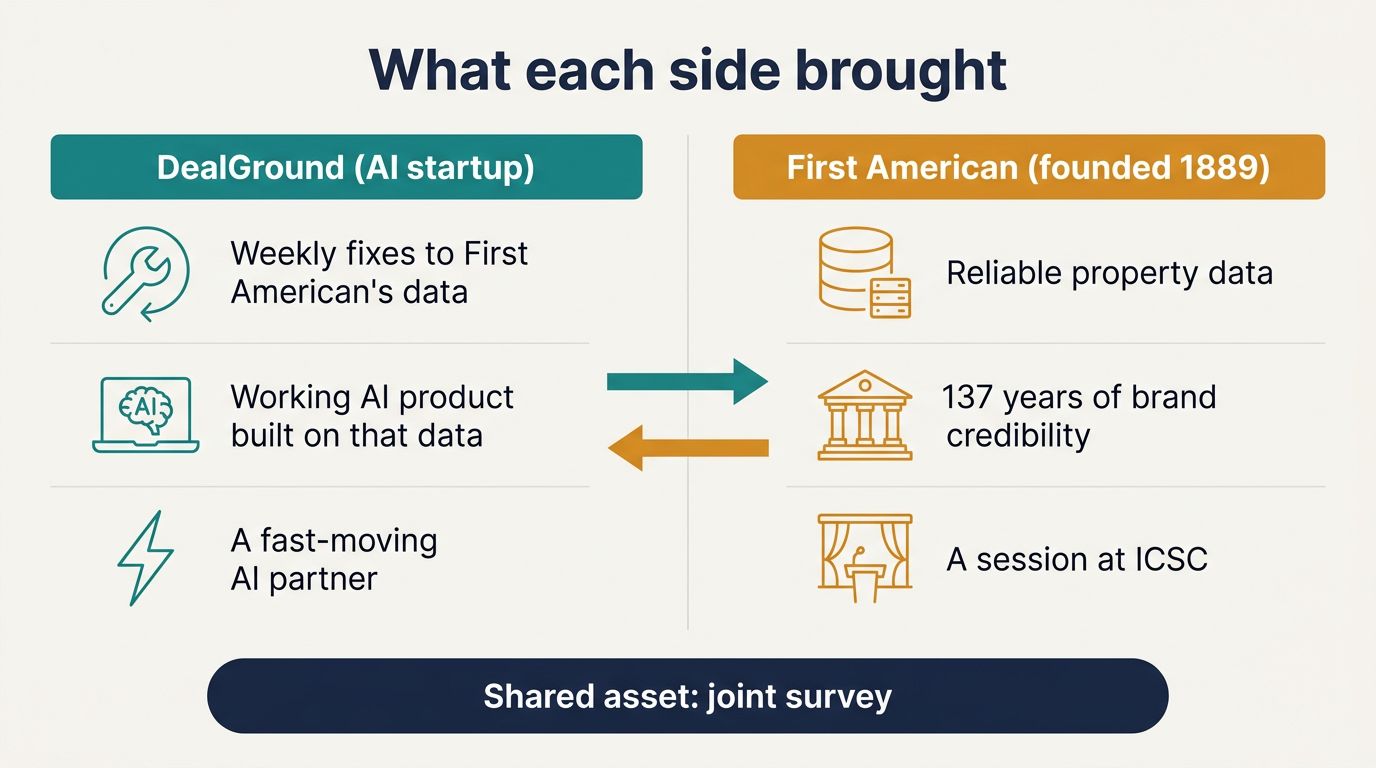
Dan describes the pairing as each side bringing what the other lacked. DealGround was “at the tip of the spear of AI.” First American brought “their deep pocket of data and the reliability of their data.”
Co-marketing is one type of partner marketing. Partner marketing also covers referral, reseller, and technology partnerships, which Sproutworth’s guide to B2B partner marketing maps in full. This article stays with one version: a young startup and a much older partner.
Why would an established company co-market with a startup?
As Dan Mosher tells it, First American wanted proof of where its data was heading. A young AI company could supply that proof.
Dan saw that the 137-year-old company was reshaping its identity. “They even tried to position themselves away from First American Title to First American Data,” he notes.
First American’s data business has its own name. First American Data & Analytics, one of the largest US providers of property data, co-produced the research with DealGround.
“They wanna be known as a data company,” Dan explains. “And we saw that positioning, and we agreed with it.”
DealGround’s pitch cast First American’s data as “the underlying fabric” of DealGround’s product. Dan says the framing addressed a doubt buyers already held about AI tools: whether the underlying data was accurate.
Dan is candid about what gave DealGround its pull. First American, he says, wanted “to be associated with us to a certain extent.” It wanted to sit beside AI companies “that are moving aggressively,” and Dan built DealGround’s co-marketing strategy around that wish.
First American co-marketed with DealGround, an AI startup for commercial real estate brokers. The partnership supported First American’s shift from title company to data company. DealGround CEO Dan Mosher says First American wanted to be associated with fast-moving AI companies. DealGround offered a working AI product built on First American’s data, which showed that data in action.
How to run a startup co-marketing strategy in 5 steps
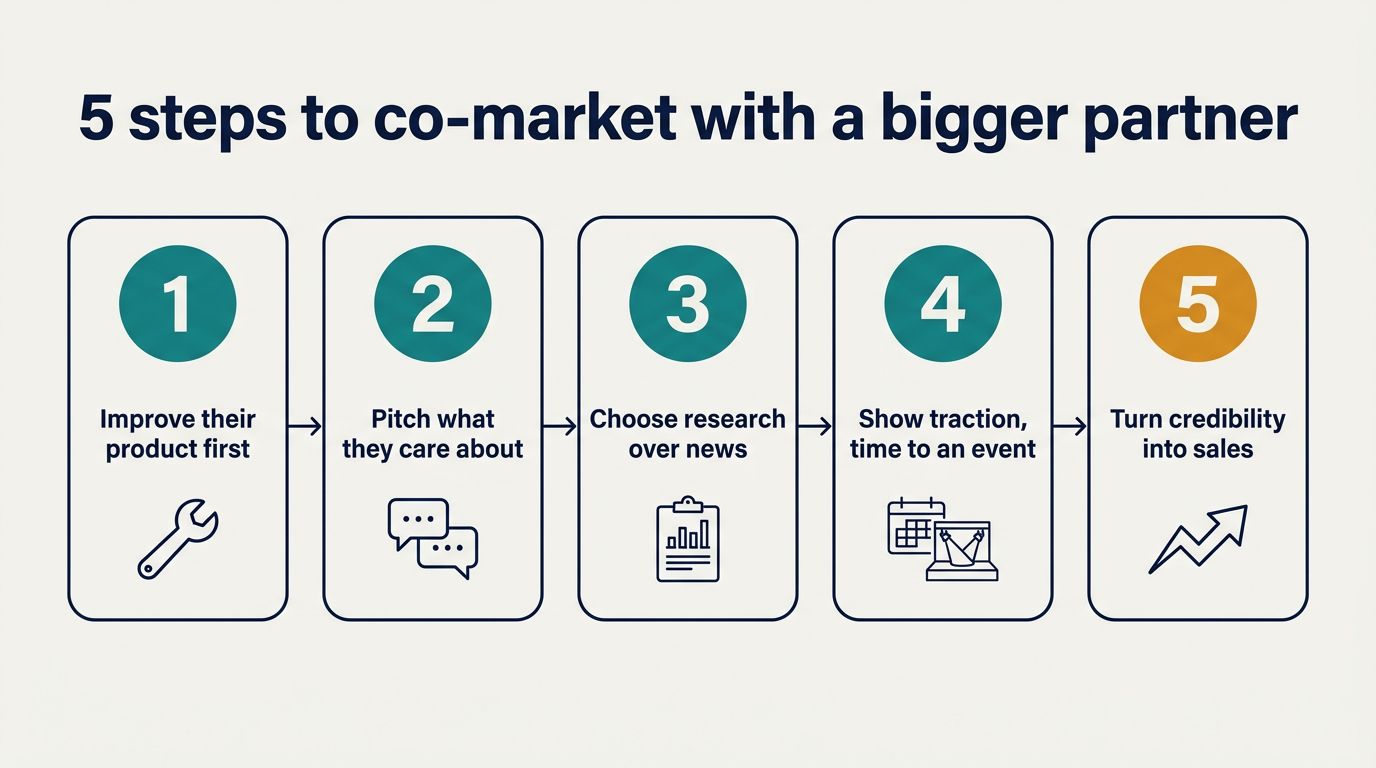
A startup co-markets with an established company by helping it first, then pitching one asset both sides want. Dan Mosher’s sequence at DealGround starts with weekly data fixes for First American and ends with a joint survey of 255 professionals on a conference stage.
Step 1: Earn the right to pitch by improving the partner’s product
DealGround licensed First American’s title data after comparing providers, including Chicago Title. Dan picked First American for its accuracy and its reliable bulk updates.
In Sproutworth’s view, that makes a practical partner test: choose an incumbent whose product you already use and can improve. At that point, DealGround was “just one of their thousands of customers.”
DealGround changed the relationship with a weekly habit. When DealGround found errors in First American’s data, it sent First American the exact fix.
Dan calls title data “the ballast that sits at the bottom of the boat.” Fixing it made DealGround useful to First American.
“Hey, this needs to be fixed,” Dan recalls. “So you’re building credibility.”
Step 2: Pitch what the partner cares about, then what you care about
Dan runs a two-question test before any pitch. “You have to think about what do they care about and what do we care about?” he says.
DealGround wanted its name on a press release beside a bigger company. First American wanted to be seen alongside fast-moving AI companies, and a joint survey served both aims.
Step 3: Choose research over a product announcement
DealGround planned a big announcement for ICSC in Las Vegas. Dan chose research over product news. “Product announcements don’t necessarily get the same type of pickup as an interesting survey,” he explains.
The DealGround survey topic came from Dan Mosher’s conversations with customers. “I could tell by talking to customers that adoption was not as deep as people had suspected.” He pitched a survey of First American’s customers “to really understand where they are in the AI adoption cycle.”
In Sproutworth’s view, original research is one of the quickest ways to build a reputation for expertise.
Step 4: Bring proof of traction and time the release to an event
When I asked Dan what First American needed before saying yes, he said usage. DealGround’s proof was usage First American could already see.
Dan points to “the number of queries” and how often DealGround pulled First American’s data. “They needed to see some grounding that there was tangible progress,” he notes.
DealGround’s timing helped too, because First American already had an in-person session booked at ICSC. The survey came out just before the May conference and became “a key part” of First American’s session there.
Step 5: Turn borrowed credibility into sales
When I asked Dan what the study did for sales, he went straight to adoption. He says the launch lifted DealGround’s adoption 50% week over week. He adds that the survey still sends traffic: “I can still see the traffic even to this day.”
Dan keeps DealGround’s credibility intact in sales calls. He shows the strongest feature early: “Try to get to that aha moment as fast as possible in the demo.” He also tells prospects the tool won’t be right every time, then invites a 100-property test against a competitor.
DealGround’s co-marketing strategy with First American produced a reported 50% week-over-week jump in adoption. Dan Mosher, DealGround’s CEO, says the joint survey launched just before ICSC in May 2026. Dan says the survey still drives traffic. Dan says it let DealGround “punch above your weight” and show it was “gonna be here for a while.”
What did the DealGround and First American survey find?
The DealGround and First American survey’s headline finding was uncomfortable for anyone selling AI, DealGround included. Only 5% of commercial real estate professionals trust AI enough to influence real deal decisions. Yet 66% use it weekly or daily, according to the First American release. Sproutworth’s piece on enterprise AI adoption covers why AI use stalls.
First American Data & Analytics and DealGround fielded the survey online between March 31 and April 8, 2026. It reached 255 professionals across brokerage, lending, development, and asset management. The results were published on May 12, 2026.
| Finding | Share of respondents |
|---|---|
| Use AI weekly or daily | 66% |
| VP-level and above who use AI weekly or daily | 75.9% |
| Use AI for support only, kept out of decisions | 53.3% |
| Trust AI enough to influence real deal decisions | 5% |
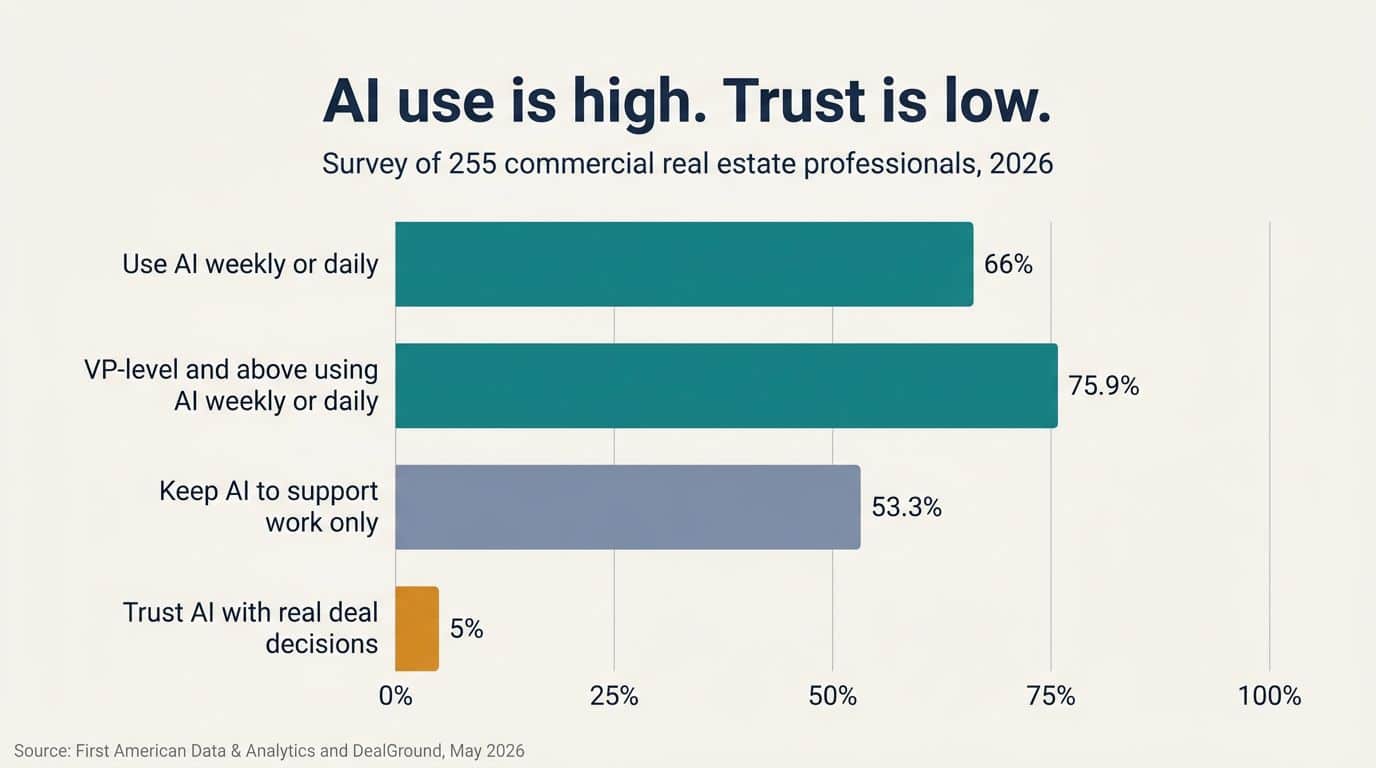
The DealGround and First American survey still served both sides of the co-marketing strategy. Matt Key, vice president of property data at First American Data & Analytics, framed the gap as a data-quality issue. “Professionals are using AI, but only if the outputs are verifiable and the data is reliable,” he said.
Dan says First American expected the survey to “harken back to the strengths” it already had. DealGround co-commissioned the survey, so read the figures with that in mind.
The DealGround and First American survey of 255 commercial real estate professionals found a wide trust gap in May 2026. Of respondents, 66% use AI weekly or daily, but only 5% trust it with real deal decisions. Another 53.3% use AI only to support work. First American’s Matt Key tied the gap to verifiable, reliable data.
Which co-marketing formats work best for a startup?
In Sproutworth’s view, the format that lasts longest is the one a third party can cite. DealGround’s survey fits that test, and Dan Mosher says it still draws traffic. By that test, a webinar or newsletter swap ranks low.
The table below is Sproutworth’s editorial view for a startup partnering with a larger company. It rates each co-marketing strategy format by credibility lift and shelf life.
| Format | What the startup brings | Credibility lift | Shelf life |
|---|---|---|---|
| Joint survey or research report | Survey design, analysis, a fresh question | High: citable by press and AI engines | Months to years |
| Conference session with the partner | Speaker, data, demo | High in the room, limited outside it | Days |
| Partnership announcement | Product work | Medium: proves the relationship exists | Weeks |
| Co-hosted webinar | Speaker, topic, promotion | Medium | Weeks |
| Co-authored guide or ebook | Most of the writing | Medium | Months |
| Newsletter or social swap | Audience access | Low | Days |
DealGround stacked two of these formats. The survey supplied the citable asset.
First American’s in-person session at ICSC gave it a stage. Dan calls the survey “a key part of that conference session.”
How do you keep co-branded research credible?
In Sproutworth’s view, the least flattering number in the DealGround and First American survey did the most for its credibility. Only 5% of respondents trusted AI with real deal decisions, and both partners published that figure anyway.
Co-branded research can also tilt toward the partner’s story. Dan Mosher admits First American agreed partly because the survey would “yield results that fit into their narrative.” Research bent to a predetermined answer reads as advertising.
The published release shows three safeguards. It states the method: an online survey of 255 professionals, fielded March 31 to April 8, 2026. It puts the trust gap in its headline.
The First American release also names both commissioning companies, so readers can weigh the source. Any co-marketing strategy built on research needs that disclosure.
Put the terms in writing before launch. The U.S. Chamber of Commerce puts it plainly: “Ensure your co-marketing strategy is in writing to keep both sides honest.”
The effort in a startup-incumbent partnership is also lopsided. Dan describes DealGround reporting data fixes to First American “every day, every week” before any pitch.
Co-branded research stays credible when partners publish the method, report unflattering numbers, and disclose who paid. The DealGround and First American survey named its sample of 255 and its fielding dates. It also led with a finding uncomfortable for AI vendors: only 5% trust AI with real decisions. Dan Mosher says First American still expected results that fit its narrative.
Frequently asked questions
Can you give me an example of co-marketing?
DealGround and First American ran a research-based co-marketing campaign. DealGround, an AI startup for property brokers, co-published a survey of 255 industry professionals with First American, a property data company founded in 1889. The survey launched just before the ICSC conference in May 2026. DealGround co-founder Dan Mosher says adoption then rose 50% week over week.
What should a startup offer a larger partner in a co-marketing deal?
A startup should offer something the larger partner wants but cannot produce alone, such as proof that it is innovating. DealGround CEO Dan Mosher offered First American a working AI product built on First American’s own data. That supported First American’s shift toward being known as a data company. DealGround also said it fixed First American’s data before pitching.
What does a startup need before pitching an established company?
A startup needs visible traction and an existing working relationship before pitching. First American could already see how many queries DealGround, an AI startup, ran on its data. DealGround CEO Dan Mosher says First American “needed to see some grounding that there was tangible progress” before agreeing to a joint survey.
What is the difference between co-marketing and partner marketing?
Partner marketing is the umbrella term for revenue-driving partnerships, including referral, reseller, affiliate, and technology partnerships. Co-marketing is one type, where two companies jointly create and promote a single asset, such as a survey, webinar, or report. A co-marketing strategy usually centers on one launch, while a partner program can run for years.
How do you measure whether a co-marketing campaign worked?
Measure the change in your core adoption or pipeline metric in the weeks after launch, then track how long the asset keeps producing. AI startup DealGround tracked adoption week over week and saw a 50% rise after its survey with First American came out. CEO Dan Mosher says he can still see the survey sending traffic to DealGround.
Is co-branding legal?
Yes, co-branding is legal when both companies agree in writing how each brand may be used. FindLaw notes that a company licensing its trademark must set quality-control rules. It also advises stating in the contract who owns co-branded material, because joint ownership creates unclear duties. Have a lawyer review any co-marketing agreement before launch.
What are the 5 main marketing strategies?
No single official list of five exists. American Public University lists seven core strategies: inbound, outbound, content, search engine, social media, influencer, and guerrilla marketing. Co-marketing is a partnership tactic that can feed several at once. DealGround’s joint survey with First American produced content, press coverage, and a conference session from one asset.
What is the 3-3-3 rule for marketing?
The 3-3-3 rule has no single standard definition. RSI describes it as three audiences, three messages, and three channels. Blockchain-Ads gives another version: three seconds to catch attention, three minutes to earn trust, and three follow-ups. Either version helps co-marketing partners agree on whom they target, what they say, and where they launch.
Give your future partner a better product before you ask for its name
Dan Mosher’s co-marketing strategy shows that a startup earns an incumbent’s name by improving the incumbent’s product first. DealGround reported fixes to First American’s data every week, then pitched a survey that served First American’s own story.
For a funded B2B founder, that changes the order of operations. Start by finding the partner’s public priority, such as First American’s move from title to data. Then find a problem you can fix for it before you ask for anything.
The choice of co-marketing asset matters. Dan chose research over a product announcement because it travels further, and the survey still drives traffic to DealGround. The uncomfortable 5% trust figure made the work more credible, even for an AI vendor.
If you want research that journalists and AI engines cite, Sproutworth’s digital PR service builds original research campaigns for funded B2B tech companies.
Which larger company in your market wants buyers to see it differently, and what could you fix for it?
Related links
- How to Master Technology Partnerships to Drive Growth
- Do Customer Surveys Help or Hinder Your Content Marketing Efforts?
- DealGround
- First American and DealGround survey release
- Connect with Dan on LinkedIn
Related Resources
- Digital PR Strategy for B2B Tech Startups: The Founder’s Playbook
- How to Build Trust in B2B Sales When Buyers Don’t Trust the Category
- Content That Earns Trust: A B2B CEO’s Pre-Sale Playbook
- How to Sell AI When Buyers Aren’t Ready and Still Win
- Why AI Projects Fail: 95% of Pilots Deliver No Return
- Referral Partnerships: How to Scale Referral Relationships For Growth And 7 Figure Returns
Some topics we explore in this episode
- Why B2B buyers use but rarely trust AI and what flips the switch
- The double standard: Human error vs. AI mistakes in business decisions
- How AI hype sabotages adoption and how to set expectations that build trust
- Where commercial real estate agents actually waste the most time
- Turning product demos into “aha” moments that change hardened minds
- Walking the privacy line: When valuable data becomes “too personal”
- Leveraging strategic partnerships to punch above your startup’s weight
- Accuracy promises: How to win deals without overpromising on AI
- Why startups fail when tech builds for industries they don’t understand
- The first 90 days: How smart leaders validate ideas before leaving their day job
Listen to the episode
Subscribe to & Review the Predictable B2B Success Podcast
Thanks for tuning into this week’s Predictable B2B Podcast episode! If our interviews have helped your business journey, please visit Apple Podcasts, subscribe, and leave an honest review.
Your reviews and feedback will help me keep delivering great, helpful content and reach even more amazing founders and executives like you!
