
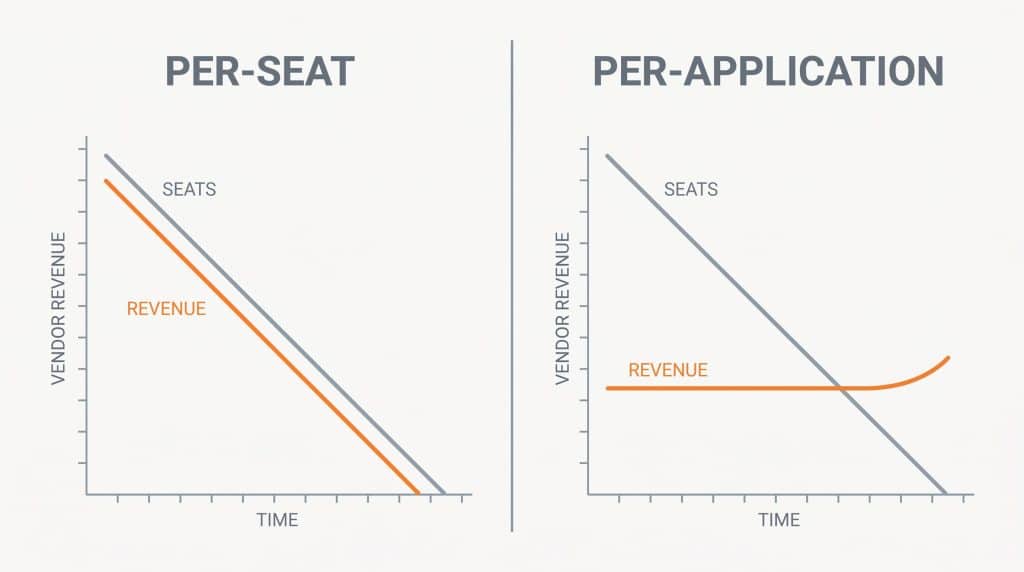
AI pricing models replace the seat with a unit that grows as headcount falls: applications, usage, or outcomes. Appvance charges $150,000 a year for up to five applications, with unlimited tests and users. Its customers’ costs scale with applications rather than with people. Salesforce now runs three Agentforce models at once. For B2B tech founders, the choice determines whether revenue rises or falls when the product works.
What replaces per-seat pricing for AI software?
Three units replace the seat: applications, usage, and outcomes. The selection rule is to price against whatever grows when your customer’s headcount shrinks. Kevin Surace moved Appvance to application-based pricing for that reason. A testing customer’s cost tracks applications run, never testers employed.
About Kevin Surace
Kevin Surace is CEO and CTO of Appvance and CEO of Token. He filed the patents behind the first voice assistant in the 1990s. Apple, Amazon, and Google later licensed that technology. He has since repriced an AI-native software company in a category where competitors still sell on a per-seat basis. Most B2B software founders know their per-seat model is failing and cannot name what should replace it. The same gap shows up in enterprise AI adoption, where licenses outnumber daily users. Surace has already run that experiment on a live customer base. His answer to AI pricing models contradicts what most vendors tell the market.
Watch the Episode
Table of Contents
Why AI Pricing Models Break the Per-Seat Contract
An AI vendor billing per seat has bet against its own product. Kevin Surace puts the contradiction plainly. The buyer will not pay for seats they no longer use, and the vendor is working to remove them.
That leaves revenue tied to the one number the product exists to reduce. Surace calls the position untenable for any company describing itself as AI-first. “If you make your pricing model seats, you’re in real trouble,” he says.
The margin damage arrives before the revenue damage. GitHub Copilot averaged a $20 monthly loss per user against a $10 subscription. Wall Street Journal reporting, cited by TSIA, documented that gap.
Heavy users consumed two to three times their seat fee in inference compute. Seat pricing had assumed the next customer cost roughly nothing to serve. Compute now scales with every use, while the value delivered does not scale with headcount.
Surace sees the same pattern in professional services. Wipro and Tata historically billed by the hour and added people to grow an account. Buyers now bid the project as a fixed number, and expect 80% off the old price.
The test Surace applies to any vendor is simple, and it runs both ways. A vendor selling more seats every month is not running real AI. Real AI, in his account, would eliminate those seats rather than add them.
Per-seat pricing fails for AI-native software because both the vendor and the customer want the seat count to decline. Kevin Surace, CEO of Appvance, argues that a company whose product removes headcount cannot tie its revenue to headcount. GitHub Copilot’s reported $20 monthly loss per $10 user shows the margin side of the same break.
The Three Units Replacing the Seat
Appvance lists a fixed price of $150,000 a year for up to five applications. The listing on AWS Marketplace states that adding users or running more tests does not change it. Unlimited tests across UI and API layers are included.
Surace describes the unit choice as the bigger move than the price itself. He changed what he charges for rather than how much he charges. The number remained legible to a finance team, but its meaning changed.
That is the clearest published example of the first replacement unit. Surace moved to application-based pricing because his customer’s cost is tied to applications. A company managing 82 applications knows what 82 means to its budget.
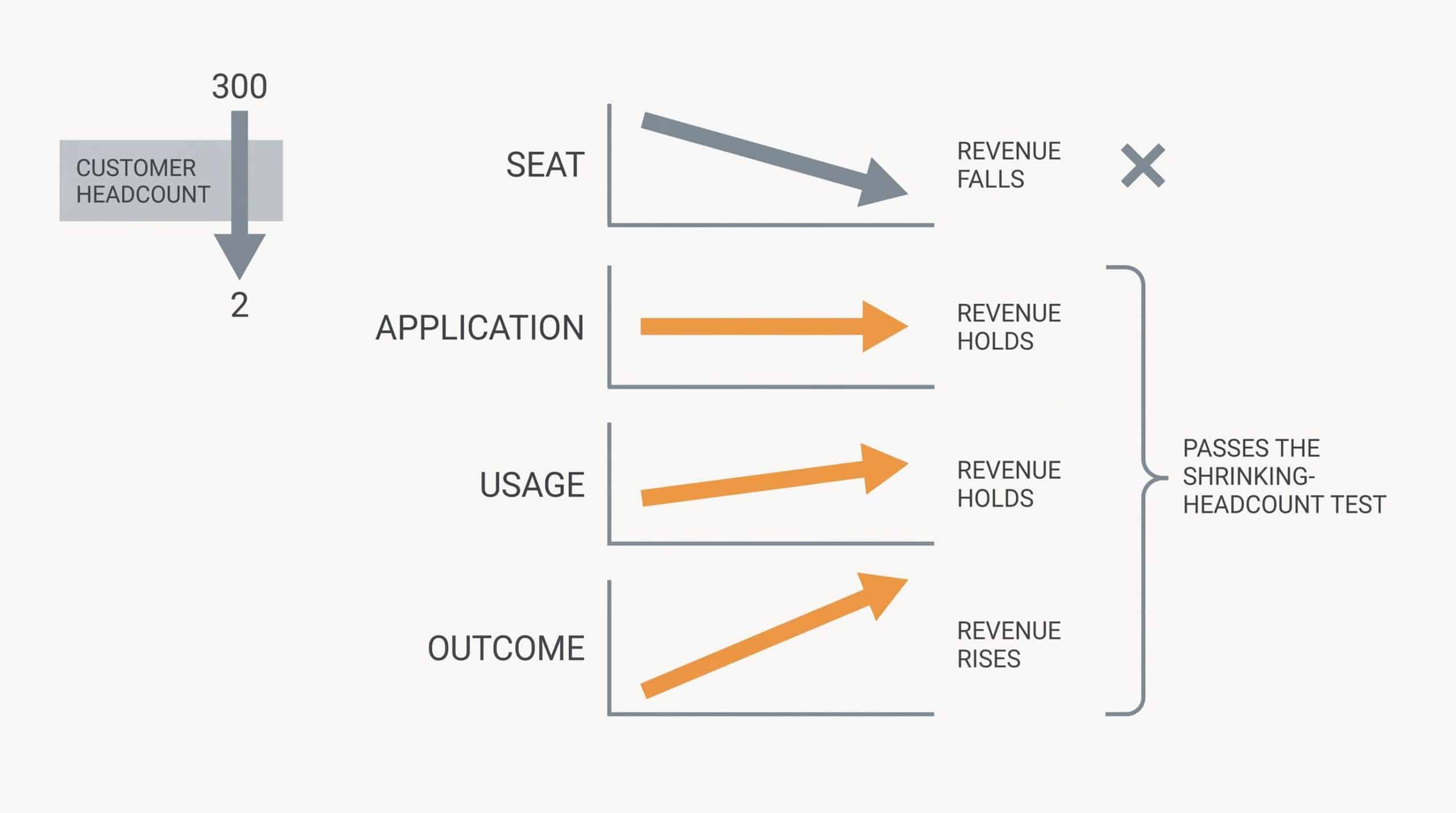
Test seats stopped describing anything real. Surace argues that a platform doing its job needs one or two people where 300 once sat. Charging per seat would price the product against its own purpose.
The second replacement unit is usage. Surace runs it alongside applications for customers with uneven activity. Some run heavily on one application for a quarter and barely touch it afterward.
Usage pricing requires a margin model the vendor owns. Surace measures tokens and server consumption, then prices a margin on top. He is explicit that the vendor carries the cost of supporting what it built.
The third unit is outcomes, where payment follows a delivered result. Sierra and Zendesk both publish outcome-based terms for AI agents. Surace treats outcomes as real but harder, because someone has to arbitrate whether the outcome happened.
A single rule connects all three units. Call it the shrinking-headcount test: price against the unit that grows when your customer’s headcount shrinks. Surace never names the rule, but it is the logic he applies, and applications, tokens, and outcomes all pass it while seats fail by construction.
| Unit | What it tracks | When it breaks | Fits |
|---|---|---|---|
| Seat | Number of users | Product reduces headcount | Tools that add users |
| Application | Scope covered | Scope stays flat while usage climbs | Platforms with defined estates |
| Usage or token | Consumption | Costs move faster than price | Uneven or bursty workloads |
| Outcome | Delivered result | Attribution is disputed | Measurable, auditable results |
Only the seat row fails the shrinking-headcount test. That is the whole argument in one line.
AI pricing models replace the seat with three units: applications, usage, and outcomes. Appvance publishes $150,000 per year for up to five applications on AWS Marketplace, with unlimited tests and users. The selection rule Kevin Surace applies is to price against whatever grows when the customer’s headcount shrinks.
Charge More for Cutting Their Costs
Surace claims that most pricing advice is inverted. A vendor that reduces a customer’s costs should capture more revenue, not less. The reasoning runs through where the customer’s money actually goes.
“See, if I drive down their costs, I should actually be able to charge more, not less,” Surace says.
He describes the per-seat alternative as self-defeating. Halving a customer’s seats halves the vendor’s revenue in one stroke.
Surace puts the cost structure plainly. “All your costs are not my software,” he says. “Your costs are your people.”
Every page currently ranking for AI pricing models frames the shift as a matter of protection. Stripe, Zuora, Orb, and TSIA all describe moving off seats as a way to defend margin. Surace treats the same move as an opportunity to raise price.
The difference matters at the negotiating table. A vendor defending margin asks the buyer to accept a change that helps the vendor. A vendor capturing value asks the buyer to share savings the buyer can measure itself.
Surace applies this when preparing customers for a repricing. He tells them the new model aligns with how they think about their business. He also tells them it aligns with the vendor’s efforts to drive their costs down.
Surace concedes the model has to be sold rather than announced. He advises telling customers well ahead that new pricing is coming for 2027.
Kevin Surace argues that a software vendor reducing its customers’ costs should charge more rather than less. His reasoning is that the customer’s largest expense is people, not software. A per-seat vendor that halves a customer’s headcount also halves its own revenue. That rewards the vendor least when it delivers most.
What Happens to Revenue in the Transition Year?
Salesforce did not replace its pricing model; it added to it. Agentforce launched at $2 per conversation in October 2024. Flex Credits at $0.10 per action followed in May 2025.
Per-user licenses from $125 a month arrived later that year, and all three still run. SaaStr’s analysis notes that customers self-select into the model matching how they want to buy.
The largest company in the category chose parallel tracks over a cutover. Surace runs the same structure at Appvance. He describes a dual strategy where a customer can still buy by seat if that is how they work.
Customers using the AI capability switch to usage- or application-based pricing instead. The selection rule is not based solely on customer preference. Surace ties the track to whether the product is actively reducing that customer’s headcount.
A customer whose seat count is falling cannot stay on seat pricing. The vendor would lose revenue precisely as the product succeeded. That is the outcome the dual structure exists to prevent.
This is the part of the shift that ranking content skips. Only Salesforce Ventures covers migration among the pages ranking for AI pricing models, in five brief steps. No model shows what happens to reported revenue while the base is split.
Surace is direct about the discomfort. Annual license revenue received in a single payment becomes monthly revenue received over 12 months. He says SaaS companies relying on that yearly inflow will have to work it out.
Salesforce operates three Agentforce pricing models simultaneously. They are $2 per conversation, $0.10 per action, and per-user licenses from $125 monthly. The transition off per-seat pricing runs as parallel tracks rather than a cutover. Kevin Surace uses the same dual structure at Appvance.
Why Your Competitor Cannot Follow You
Surace argues that some incumbents are structurally unable to copy the move. The constraint is the business model, not the technology.
He points to Tricentis, whose Tosca product is built around a test recorder. GTCR invested $1.33 billion in the company at a $4.5 billion valuation in November 2024. Gartner rates it a leader in the category.
Surace’s argument is that the revenue is the problem. Tricentis sells test seats, and it sells most of them through global system integrators. Wipro and Tata resell those seats as part of larger engagements.
A seatless model removes the product from both sides of that channel. The vendor loses seat revenue, and the integrator loses the staffing revenue associated with it. Neither party has an incentive to move first.
Surace describes where he thinks quality assurance lands within five years. Code generation and testing are automated, and a loop runs continuously between them. He says there is no room for a test seat in that picture.
His forecast for Tricentis is explicit, and he flags it as his own bet rather than a projection.
“So yes, they did 500 million in 2025. What about 2026? … ‘Cause it’s not gonna be 700.”
Kevin Surace argues that incumbents whose revenue is seat-based cannot adopt seatless pricing without collapsing their own channel. Tricentis received a $1.33 billion investment from GTCR at a $4.5 billion valuation in November 2024. It sells test seats largely through global system integrators. Removing the seat removes revenue from the vendor and its resellers at once.
Why the CIO Says Yes and the Manager Says No
A seatless price can only be sold to the person who does not own the seats. Surace states this as a rule for AI products generally. He says these products can only be sold to C-level executives.
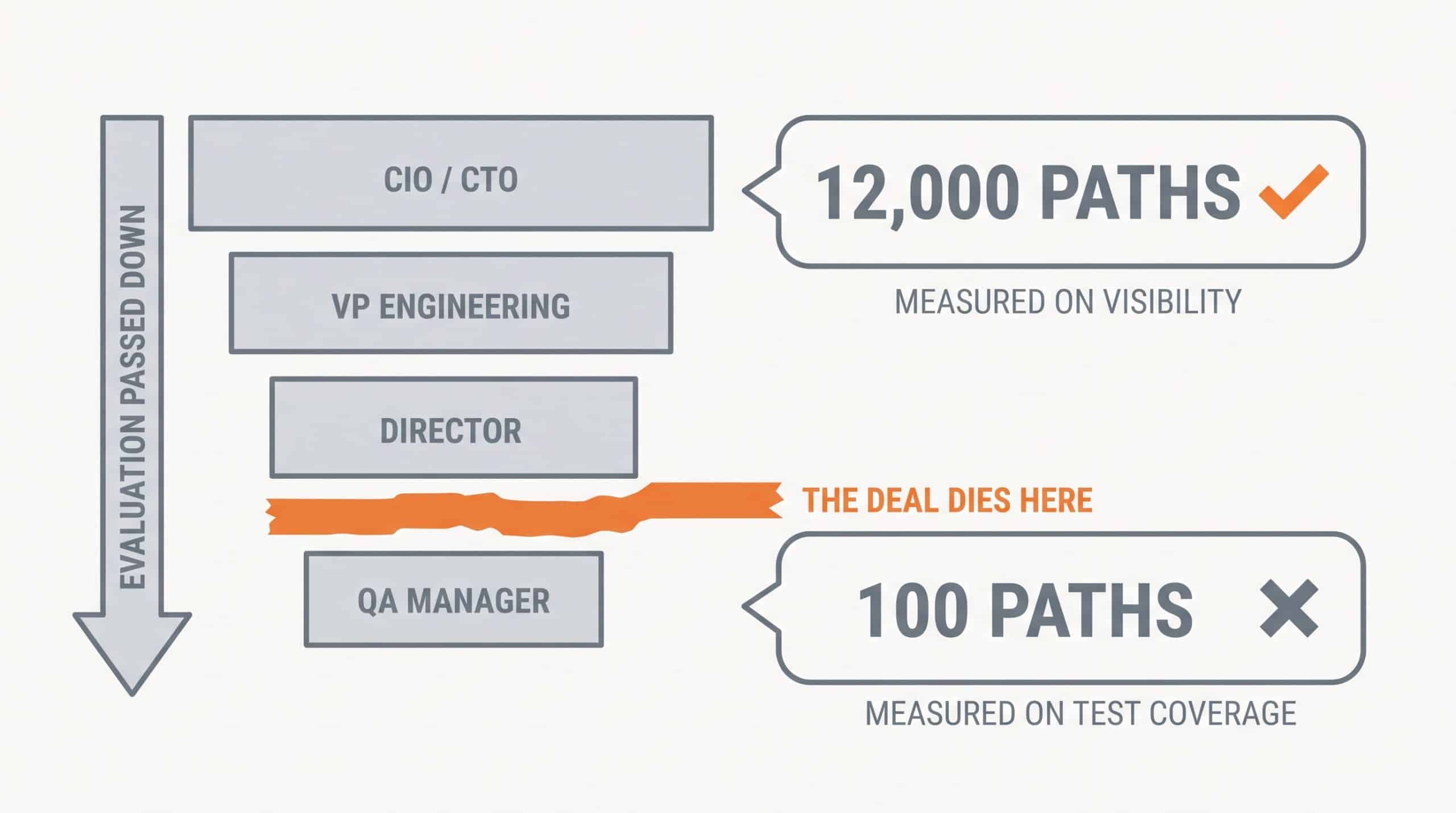
The objection he meets is not technical. Chief information officers ask what happens to their team. Below that level, the same product is reported back as broken.
Surace describes the referral pattern that kills deals. A vice president hands the evaluation down to a director. The director passes it to a manager, who passes it to the team.
The verdict comes back as “doesn’t work at all.” In one case, Surace inspected the scripts himself and found lines added by hand. He says the syntax made the human authorship obvious.
Independent research points in the same direction. Writer and Workplace Intelligence surveyed 2,400 workers and published the results in April 2026. They found 29% of employees admit to undermining their employer’s AI strategy.
Job security was among the leading reasons those employees gave. Surace frames the incentive gap as a single question with two answers.
Ask a chief information officer whether they want 12,000 paths covered or 100, and they choose 12,000. Ask a quality assurance manager the same question, and they choose 100.
He is careful not to blame the manager. The industry was built around permanently scarce budget and headcount, so minimizing scope was rational. A manager bonused on 100 paths gains nothing from finding bugs in the other 11,900.
Kevin Surace reports that AI adoption stalls below the C-suite rather than at it. He has found lines inserted by hand into AI-generated test scripts to make them fail. A 2026 survey by Writer and Workplace Intelligence found 29% of employees admit to undermining their employer’s AI strategy. It surveyed 2,400 workers across the US, UK, and Europe.
How Do You Tell Real AI From Repackaged?
Surace names three questions a buyer should ask any vendor. The first two are which specific models they use, and how they use them.
The third question is the one that separates products. It asks how that use drives productivity or better outcomes in the buyer’s own environment. Surace has measured co-pilot tools bolted onto existing platforms.
Adding a co-pilot to Selenium increased productivity by a few percent. Surace argues the bar should be an order of magnitude higher. He attributes the threshold to Peter Diamandis while hedging the attribution.
A 20% gain can be achieved through other means, such as process optimization. Surace argues no finance leader will pay a premium for that. He recommends deploying where the multiple is visible and measurable within three months.
The buyer-side test has a seller-side mirror. A vendor whose seat count grows every month is selling something other than real AI. Surace treats rising seats as evidence against the product.
Kevin Surace recommends three diligence questions for AI vendors. Ask which models they use, how they use them, and how that use produces a measurable gain. He applies a roughly tenfold improvement threshold, attributed to Peter Diamandis. A 20% gain can be achieved by other means and does not justify a premium.
Frequently Asked Questions
What are AI pricing models?
AI pricing models are the units a software vendor charges for, rather than per user. The main ones are usage- or token-based, application- or entity-based, outcome-based, and hybrid combinations. Vendors move away from per-seat pricing because AI reduces customer headcount, so seat-linked revenue falls as the product succeeds. Kevin Surace calls the seat a unit that both sides now want reduced.
How do you price software when your product reduces the customer’s headcount?
Price against a unit that grows as headcount shrinks. Kevin Surace uses applications at Appvance, which charges $150,000 per year for up to 5 applications with unlimited users. The customer’s highest cost is people rather than software. A vendor removing headcount can therefore justify a higher price, not a lower one.
What are the 7 types of pricing strategies?
The commonly cited pricing strategies are cost-plus, value-based, competitive, penetration, skimming, freemium, and dynamic pricing. For AI software, the working set narrows to seat-based, usage or token-based, activity-based, output-based, outcome-based, and hybrid. Surace argues that the seat-based option is no longer valid. He runs application-based pricing at Appvance, which sits inside the entity-based family.
Should you drop per-seat pricing entirely?
Not immediately, and Surace does not recommend it. He runs a dual model instead. He keeps a seat-based option for customers who buy that way, while AI users move to usage or application-based pricing. Salesforce operates three Agentforce models concurrently for the same reason. The track a customer sits on depends on whether the product is cutting their headcount.
How can you tell whether a vendor’s AI is real or repackaged?
Ask which models they use, how they use them, and how that use produces a measurable gain. If the answer describes a co-pilot delivering incremental percentage gains, the AI is an add-on. The bar to clear is roughly tenfold. A vendor whose seat count rises every month is a second signal.
What is the 30% rule in AI?
The term is used inconsistently and has no authoritative definition. In pricing discussions, it usually refers to holding roughly 30% gross margin headroom above inference and compute costs, so a usage-based price survives model cost swings. Treat any single stated version with caution. Surace’s own guidance is to model tokens and server usage, then price a margin you own.
Related Resources
- Enterprise AI Adoption: 1,000 Seats, One Daily Login
- Vertical AI: What You Sell When the Model Costs Cents
- Competing on Price? The Deal Was Lost Six Months Earlier
Related Links
- Check out Appvance
- Check out Token
- Get a copy of Kevin’s book: The Joy–Success Cycle: The Science-Backed Path to Fulfillment and Peak Performance
- Connect with Kevin on LinkedIn
Conclusion
The pricing question resolves into one rule. Price against the unit that grows when your customer’s headcount shrinks. That is the only unit paying you more as your product works better.
Surace’s Monday morning sequence is short. Develop a pricing policy that is not per seat, then tell customers you are looking at new models for 2027.
Check whether competitors have repriced already, because the answer tells you whether you are ahead or behind. Use AI to gather that pricing data and to model options that do not crater revenue.
The harder part is not the model. It is explaining the change to a market, a board, and a customer base who bought something else last year. That is a story problem before it is a billing problem. Sproutworth builds that case for founders through ghostwriting and thought leadership.
The vendors rebuilding their AI pricing models now are setting terms their competitors will inherit. Within two years, the seat may read the way the billable hour already reads. It describes the supplier’s cost rather than the buyer’s value. Which one does your price actually track?
Some topics we explore in this episode include:
- Why moving away from per-seat pricing is essential to future-proof your business.
- How to implement outcome or usage-based models: Pricing based on measurable business value or actual use can better align your offerings with customer needs.
- How AI can automate QA: Leveraging AI reduces manual work and costs in software testing while increasing efficiency.
- How to deal with resistance from an organization: Study the methods for managing and overcoming fear-driven opposition from those teams affected by automation.
- To win the support of executives: Focus on executive leaders to accelerate acceptance of transformative AI solutions.
- How to distinguish true AI from “AI washing”: Use practical questions to identify genuine AI products versus imitators.
- Set a benchmark for productivity equal to ten times the current level: make sure that investments in AI result in significant and measurable improvements by setting a goal of achieving a tenfold increase.
- Leveraging the Right Market Timing: Know when the market is ready for your innovation so you don’t launch it too early or too late.
- Embracing Next-Generation Interfaces: Plan for future product positioning by considering AI-powered, natural-language, or on-demand interfaces.
- Practical steps for SaaS founders to develop and implement new pricing strategies that capture customer value and protect revenue by incorporating customer feedback.
Listen to the episode
Subscribe to & Review the Predictable B2B Success Podcast
Thanks for tuning into this week’s Predictable B2B Podcast episode! If the information from our interviews has helped your business journey, please visit Apple Podcasts, subscribe to the show, and leave us an honest review.
Your reviews and feedback will not only help me continue to deliver great, helpful content but also help me reach even more amazing founders and executives like you!
