B2B brand messaging is the documented system your company uses to explain what it does, who it’s for, and why it wins. Emblaze research found 54.5% average misalignment between how sellers describe a problem and how buyers actually experience it. That gap is where deals stall and cycles lengthen. This guide covers the complete framework: how to build it from customer research, and how to operationalize it across every team that speaks to buyers.
For seed-to-Series C tech companies, weak messaging is the most common reason sales cycles stall. When your CEO says one thing, your homepage says another, and your sales reps go off-script, buyers can’t tell what you do. They don’t stick around to figure it out.
A messaging framework gives every team member one source of truth. Sales reps use it. Content references it. The CEO quotes it on podcasts. Deals close faster because buyers understand what they’re buying before the demo ends.
This guide gives you the structure, the decisions, and the examples that matter at seed through Series C. It covers what the framework contains, how to build it from customer research, and how to operationalize it across every team that speaks to buyers. Updated July 2026 to include current research on B2B buyer behavior and messaging consistency. If you’re building a B2B content strategy alongside your messaging work, start here first. Messaging defines what your content says. Content is just the expression of it.
Why Most B2B Tech Companies Get Their Messaging Wrong
The most common mistake in B2B tech messaging is building it around the product instead of the buyer’s problem. Technical founders default to describing capabilities: architecture, integrations, throughput. Buyers want to know what those capabilities mean for their specific situation. When the gap between how you describe your product and how buyers experience their problem is 54.5% on average, that translation failure is costing you deals before the second call.
Technical founders default to describing capabilities. Buyers want to know what those capabilities mean for them. Here’s the gap in practice.
A founder says: “Our platform uses real-time ML inference to surface anomalies across distributed data pipelines.”
A buyer hears: “I have no idea if this solves my problem.”
What that buyer is actually thinking: “We’re losing 2 hours a day to data quality issues that my team can’t catch until they hit production. Can you fix that?”
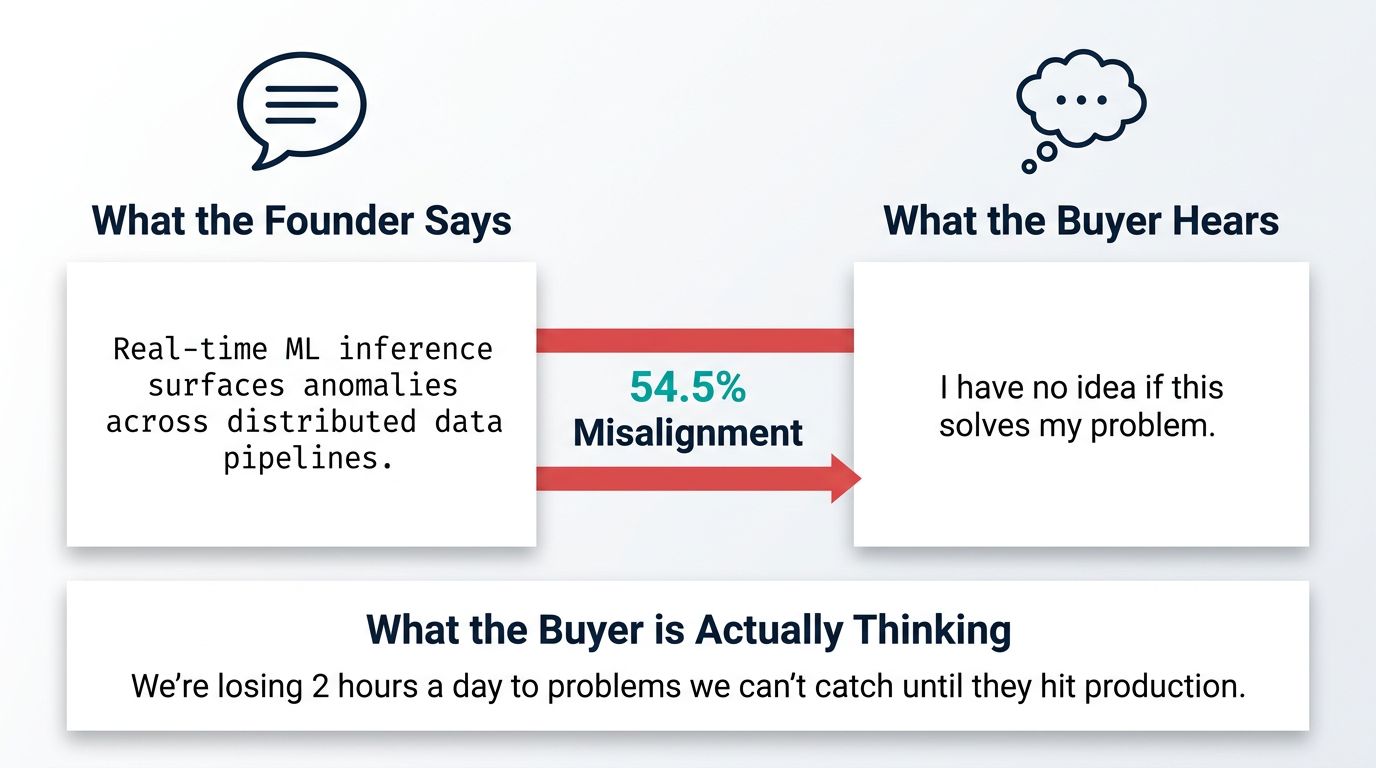
Every strong B2B message starts with the buyer’s problem, not the product’s features.
The translation gap is real. B2B buyers make emotionally informed decisions and then justify them rationally. Messaging that leads with features forces buyers to do the translation work themselves. Most won’t bother.
Research from Emblaze found:
54.5% average misalignment between how sellers describe a problem and how buyers actually experience it.
That 54.5% gap is where B2B deals stall.
Gartner data shows the typical B2B purchase involves 6 to 10 decision-makers, each with different priorities and different objections. One message built for one person loses everyone else in the room.
Three things kill B2B tech messaging specifically:
- Feature language instead of outcome language. “Automated workflow orchestration” is a feature. “Ship data pipelines in hours instead of weeks” is an outcome.
- One message for every buyer. A CFO and a VP of Engineering evaluating the same tool care about completely different things. The CFO wants ROI and risk reduction. The VP wants developer productivity and integrations.
- No defined alternative. Great messaging always names what the buyer would do without you. That’s often not a competitor. It’s spreadsheets, manual processes, or duct-taped tools.
How Does B2B Brand Messaging Differ from B2C?
B2B and B2C messaging share a goal (move a buyer from awareness to purchase), but they differ in almost every other dimension. B2C wins one person in a short cycle with emotional resonance. B2B must win 6 to 10 stakeholders across a buying committee over months, where the primary emotion is career risk, not personal desire, and where your internal champion has to re-sell your message without you in the room.
In B2C, one person makes the purchase decision. The message needs to win one person’s attention, trigger an emotional response, and convert. The buying cycle is short, and the stakes are personal.
In B2B, the average complex purchase involves 8.2 stakeholders, each with different priorities, different objections, and different success criteria. The buying cycle can span months. The stakes are organizational, which means the emotional driver is career risk rather than personal satisfaction.
B2B messaging must win multiple decision-makers simultaneously. B2C messaging must win one.
Here’s what that changes in practice:
| Dimension | B2C Messaging | B2B Messaging |
|---|---|---|
| Decision-makers | 1 | 6–10 average |
| Primary emotion | Desire, aspiration | Risk reduction, career safety |
| Buying cycle | Hours to days | Weeks to months |
| Proof requirements | Social proof, reviews | Case studies, ROI data, references |
| Tone | Personal, aspirational | Professional, outcome-focused |
| Content goal | Trigger purchase | Build confidence across the committee |
B2B messaging also needs to survive internal champion selling. The person you convinced in the first call has to go back and sell the purchase internally. Your message needs to be simple enough that they can carry it accurately without a sales rep in the room.
6sense’s 2025 Buyer Experience Report found that 94% of buying groups rank their vendor shortlist before ever contacting sales. Your brand messaging does the first job. The sales rep does the second.
Working with B2B tech founders from seed through Series C, the most common gap I see is messaging built for one decision-maker. The person who responds enthusiastically to the demo is rarely the person who controls the budget.
According to Marq’s brand consistency research, companies with consistent brand presentation can see revenue increases of up to 33%. In B2B, where internal champions are re-presenting your message to at least 5 colleagues, message consistency isn’t a branding nice-to-have. It’s a sales function.
What Should a B2B Brand Messaging Framework Include?
A B2B brand messaging framework includes 5 core components arranged in a hierarchy, from your universal value proposition to audience-specific proof points. It’s not a tagline and a value prop sentence. It’s a structured document that cascades from a single central idea down to what specific buyers in your buying committee actually need to hear at each stage of the decision.
Component 1: Category Frame
The category frame is the market context your company operates in. It answers a single question: what category does your company belong to, and how do you define that category to your advantage?
Instead of “we’re a CRM,” you might say “we’re a revenue intelligence platform for outbound-led sales teams.” The category frame is the foundation of your brand positioning and shapes every evaluation criterion before buyers engage your sales team.
Component 2: Core Value Proposition
One to two sentences stating what you do, who you do it for, and what outcome they get. Keep it outcome-first.
“We help B2B SaaS sales teams book 30% more qualified meetings by replacing manual prospecting with AI-driven signal monitoring” beats “AI-powered sales prospecting software.”
The formula: who you help + the problem you solve + the specific outcome + the mechanism that produces it. This becomes your positioning statement: the internal single source of truth from which all external copy is derived.
Component 3: Key Differentiators
Two to four points that explain what you do that alternatives don’t. Each should follow this pattern: “Unlike [alternative], we [specific difference] so that [buyer benefit].”
The alternative should be what buyers actually compare you to. For most early-stage B2B tech companies, that’s spreadsheets, manual processes, or duct-taped point solutions. Not your direct competitors.
Component 4: Proof Points
Unsubstantiated claims don’t build credibility. They increase buyer skepticism.
For every differentiator, you need at least one piece of supporting evidence: a customer stat, a case study outcome, or a benchmark. “Our customers reduce time-to-insight by 40% in the first 90 days” is a proof point. “We deliver fast insights” is not.
Component 5: Audience-Specific Variants
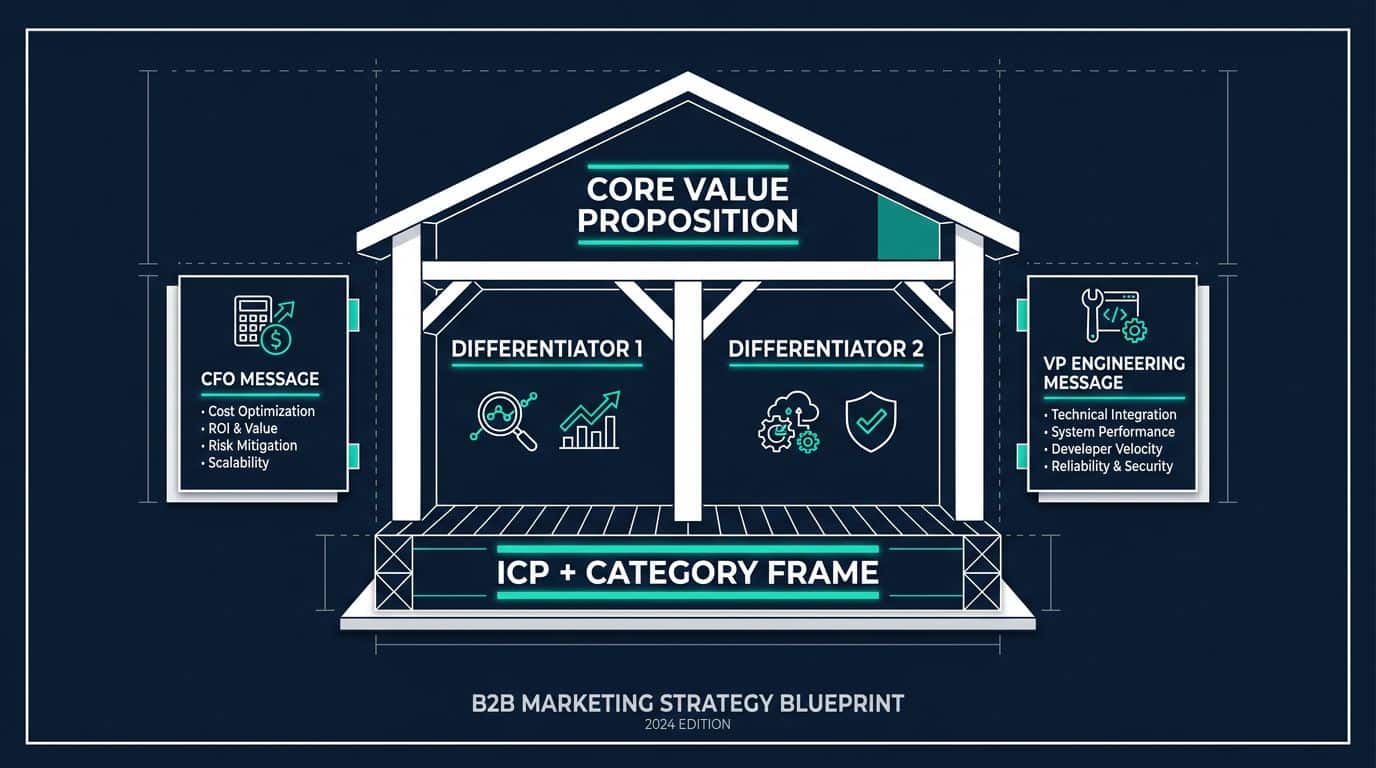
The roof of your Messaging House is universal. The walls are tailored. A technical buyer gets proof points anchored in implementation speed and integration depth. An economic buyer gets ROI and risk framing.
Write each variant from scratch using the same core idea. Don’t add or remove bullet points from a master list. That produces watered-down messages that feel generic to everyone.
The Messaging House: Your One-Page Framework

The Messaging House is the structural tool that makes the hierarchy explicit and keeps every team member aligned.
The roof: Your core value proposition. The single sentence that captures what you do and why it matters. Every message in the house must be consistent with this.
The pillars: Two to four message pillars, each anchored in a key differentiator. Each pillar has a headline statement, 2 to 3 supporting proof points, and at least one customer example.
The foundation: Your ICP definition, your category frame, and the villain you’re solving for. This is the “why it matters” context that everything else rests on.
The rooms: Audience-specific message variants. One room for each distinct buyer type in your typical deal.
The value of this structure is that it makes the hierarchy visible. The roof is fixed; the rooms flex. Don’t rewrite the roof for every audience. Adapt the room.
When I build messaging frameworks with B2B tech founders, the component that gets cut most often is the category frame. That’s almost always the wrong call. Without a defined category, every other message lands in a vacuum and buyers default to the familiar incumbent.
How to Build Your B2B Brand Messaging: A Step-by-Step Process
A complete B2B brand messaging framework takes 4 to 6 weeks to build properly. The 5 steps below, done in order, produce messaging that holds up in live sales conversations and survives the internal champion selling test (your buyer has to re-present your message to 5 colleagues without a sales rep in the room).
Skipping to the writing phase without research produces messaging that everyone inside the company agrees on, but no buyer responds to. The research phase is where the actual messaging lives. The writing phase surfaces it.
Step 1: Interview your best customers
Don’t start with internal workshops. Start with customer conversations.
Talk to 5 to 7 customers who represent your ideal profile. Ask:
- What were you doing before you found us?
- What problem were you actually trying to solve?
- How do you describe what we do when you explain us to someone else?
- What would you have lost if you hadn’t found us?
The fourth question, “what would you have lost without us,” is the most important. The buyer’s answer is your value proposition in their own words.
Step 2: Identify the villain
Every strong B2B message has a villain. Not a competitor. The villain is the condition, pattern, or status quo that’s holding your buyer back.
For a revenue intelligence platform, the villain might be: “You’re flying blind on pipeline health because your CRM data is always out of date.”
For a data observability tool: “Your team is doing manual QA checks that break at scale and catch problems too late.”
The villain in B2B messaging is the status quo, not a competitor.
Naming the villain gives buyers permission to feel the pain they’ve been normalizing. It also differentiates you from any competitor making vague claims about being “better.”
Step 3: Write the old way vs. new way contrast

The old-way vs. new-way contrast is the single most effective structure in B2B tech messaging. It requires you to articulate specifically what life looks like without your product versus with it.
Keep it specific.
Old way: “Sales reps spend 45 minutes building prospect lists each morning by switching between LinkedIn, ZoomInfo, and their CRM.”
New way: “Sales reps open one dashboard and see a prioritized list of warm prospects who have shown buying signals in the last 24 hours.”
The old way vs. new way contrast does more work than any tagline.
Step 4: Draft your core message
Combine the villain, the outcome, and your differentiator into a 2 to 3 sentence core message.
Run it through this test: can someone who has never heard of your company read this sentence and understand exactly who you help, what problem you solve, and what they get? If not, revise.
Step 5: Create audience variants
Map the buying committee roles who touch your deal. For most B2B SaaS companies at seed to Series C, this includes the economic buyer (usually CEO or VP), the technical evaluator, and the end user.
Write a short message block for each role anchored in their specific concerns. These are your buyer personas: documented representations of the real people in your buying committee, mapped to the specific language that moves each of them. A VP of Engineering and a CFO should receive messages that sound like they come from the same company while addressing entirely different priorities.
B2B Brand Messaging Examples That Work
The most effective B2B brand messages don’t describe what a product does. They name the category the buyer wants to inhabit. The clearest proof of this comes from companies that made a deliberate, documented shift away from feature language: Slack, Notion, and Gong each made that shift and built category-defining positions that competitors couldn’t easily undercut.
Slack built its growth on one line: “Where work happens.” They didn’t say “a messaging and collaboration tool.” They named the category they owned.
Notion could have said “a note-taking and project management app.” Instead: “The connected workspace where better, faster work happens.” Outcome-first, category-defining.
Gong could have said “call recording software.” They said “the revenue intelligence platform.” They defined a new category and owned it. Gong’s category creation story is worth studying: they didn’t compete in an existing category with better features. They renamed the problem and led with it.
None of these companies lead with features. Each names a desired future state or a category the buyer wants to belong to.
Strong B2B messaging names the category a buyer wants to inhabit. Weak messaging describes features they have to interpret.

What this means for a Series A SaaS company: you don’t need a one-line tagline that works for everyone. You need a message that works for your best-fit buyer at the right stage of the buyer journey. Cold prospects need category-level messaging. Warm prospects need differentiator-level messaging. Buyers in evaluation need proof-point-level messaging.
A fintech infrastructure company with 10 enterprise clients needs messaging that speaks to the VP of Engineering at a bank. Not to the general market. The narrower the message, the stronger the resonance with the right buyer.
When I audit early-stage B2B brands, the ones with the clearest positioning have almost always gone through a deliberate category-naming exercise. They stopped trying to appeal to everyone and picked the category where they could credibly be first.
How to Test Whether Your B2B Brand Messaging Is Working
Your brand messaging is working when sales reps use it consistently without improvising, buyers can accurately repeat what you do after an initial conversation, and win rates trend up over 60 to 90 days. These 3 signals are measurable. Most companies skip the measurement step entirely, which means they never know whether a messaging change is responsible for pipeline improvements or incidental to them.
Most companies skip this step. They write a framework, put it on a slide, and assume it’s done. Messaging isn’t done until it produces a measurable behavior change.
The blank page test: Ask a new sales hire to write a 2-sentence pitch after reading your messaging doc. If they produce something close to your core message, the document is clear. If they produce something different, the document isn’t doing its job.
The rep test: Listen to 10 sales calls. Count how many times reps use villain language, the old-way/new-way contrast, and core differentiators. If they’re not using the framework, it either hasn’t been trained or doesn’t resonate.
The homepage test: Put your homepage headline in front of 5 people who represent your ideal customer. Ask them to explain what the company does after 30 seconds. If 3 out of 5 can’t do it accurately, rewrite.
The win/loss signal: When you win deals, ask customers why they chose you. When you lose, ask prospects why they went elsewhere. The patterns reveal whether your actual differentiation matches what your messaging claims.
When sales reps consistently go off-script, the messaging isn’t working.
Aligning Your Brand Messaging Across Teams
A messaging document that sits in a shared Google Drive is not a messaging strategy. The real work is operationalizing it: getting sales reps to use the villain language in discovery calls, getting content to trace every piece back to a message pillar, and getting the CEO to say the same 3-sentence core message in every public appearance. Alignment is a function of training and accountability, not documentation.
Marketing alignment: Every content piece should trace back to a message pillar. Before writing a blog post or running an ad, answer: which pillar does this reinforce, and which buyer segment does this reach? B2B content strategy for seed-to-Series C tech companies starts with the messaging framework. Content created outside the framework fragments your brand.
Sales alignment: Reps need the villain language, the old-way vs. new-way contrast, and the proof points internalized. Not memorized verbatim. Internalized. That means training, not just documentation. Role-play the message in discovery calls. Listen back and give specific feedback.
Brand voice: The brand voice is the tone layer on top of your messaging framework. It’s how your message sounds across every channel. For B2B tech companies, the most effective brand voice is direct, specific, and grounded in outcomes rather than aspirations.
CEO alignment: If the CEO is on a podcast saying one thing and the website says another, buyers notice. The CEO’s language in external interviews is often the most visible expression of your messaging. Brief your CEO on the core message before any public appearance.
Customer success alignment: The handoff from sales to CS is where messaging consistency most often breaks. CS teams default to technical onboarding language. The buyer who signed on the basis of a business outcome promise needs to hear that outcome language reinforced during onboarding.
The internal test: Ask 3 people from different functions to describe your company in one sentence. If the answers are significantly different, you have an alignment problem. That problem shows up externally as a fragmented brand.
In practice, CEO alignment breaks down first and fastest. A founder who goes off-message in one podcast interview can undo months of consistent marketing. The fix is simple: brief the CEO on the 3-sentence core message before any public appearance, not after.
Common B2B Brand Messaging Mistakes (And How to Fix Them)
Most B2B brand messaging fails for one of five reasons: it’s written for internal audiences instead of buyers, it lists features instead of outcomes, it makes claims without proof, it’s built from internal consensus rather than customer research, or it’s treated as a one-time deliverable rather than a living system. Each mistake is fixable once you can name it.
Mistake 1: Writing for the press release, not the buyer
Press release language is passive, feature-rich, and designed to sound impressive. Buyer language is specific, outcome-oriented, and designed to feel relevant. If your homepage headline reads like a press release, rewrite it from the buyer’s perspective.
Mistake 2: Treating differentiation as a list of features
“We integrate with 200+ tools” is a feature. “Your team can keep using the tools they already trust without a 6-month migration project” is a differentiator framed as a buyer benefit. The list of integrations is evidence. The buyer benefit is the message.
Mistake 3: Skipping the proof
Every claim needs support. If you say you reduce time-to-value, show what “reduced time-to-value” looks like in a customer’s numbers. Unsubstantiated claims increase buyer skepticism rather than building credibility.
Mistake 4: Building internal consensus before talking to buyers
Internal alignment workshops produce messaging that everyone inside the company agrees on. That’s not the same as messaging buyers respond to. Talk to buyers first. Build internal consensus around what they told you.
Mistake 5: Setting the framework once and not revisiting it
Markets move. Your competitive set shifts. Your ICP sharpens as you close more deals. Messaging that was accurate at seed may be wrong by Series A. Build a review rhythm into your marketing calendar. B2B content marketing strategy requires messaging that evolves with your market position.
When to Update or Rebuild Your B2B Brand Messaging
Plan for a full messaging review every 12 to 18 months, but don’t wait for the calendar if the signals appear first. The triggers that tell you messaging has stopped working are more reliable than any review cycle: when sales reps consistently improvise and win anyway, your messaging isn’t their problem. It’s yours. When early-stage pipeline churn rises, your message is attracting the wrong buyers.
The specific triggers that signal your messaging isn’t working:
- Sales reps consistently go off-script and win deals anyway (your messaging is wrong, not your reps)
- Early-stage pipeline churn is rising (buyers aren’t qualifying in the way you expected)
- You’re entering a new segment or adding a product line (your category frame may need to expand)
- A competitor is winning deals with significantly different language (the conversation has shifted)
- Your competitive set has changed (you’re now compared against different alternatives)
When you hit one of these triggers, the question is whether to rebuild or refresh.
A refresh means updating proof points, tightening language, and adding new audience variants. It takes 2 to 3 weeks. A rebuild means starting the customer interview process from scratch. It takes 4 to 6 weeks.
Rebuild when the villain has changed. Refresh when the proof points have aged.
The rule: if your fundamental understanding of the buyer’s problem has changed, rebuild. If the problem is the same but your evidence and language need updating, refresh. Quarterly, run the internal test. Annually, run the full customer interview cycle.
The teams that handle messaging transitions best treat the rebuild like a product launch. They re-run customer interviews, present findings to the full GTM team, and train on the new framework before any public-facing language changes.
FAQ: B2B Brand Messaging
What is the difference between brand messaging and a value proposition?
Your value proposition is one component of your brand messaging framework. It’s the headline statement of what you do and why it matters. Brand messaging is the full system: value proposition, differentiators, proof points, audience variants, and category frame. The value proposition is the roof. Brand messaging is the whole house.
How long should it take to build a B2B brand messaging framework?
4 to 6 weeks for a first version, done properly. That includes 5 to 7 customer interviews (2 weeks), an analysis and drafting phase (1 to 2 weeks), and an internal review round (1 week). Companies that compress this into a 2-hour workshop produce documents that don’t hold up in practice.
Can a seed-stage startup have real brand messaging?
Yes. Getting messaging right early is one of the highest-return activities at seed. A clear message accelerates sales cycles, makes hiring easier, and gives your content a foundation to build on. You don’t need 10 years of case studies. You need one clear, specific story about who you help and what they get.
What is the biggest sign that B2B brand messaging isn’t working?
Sales reps going off-script is the clearest signal. When reps consistently improvise their pitch instead of using the messaging, the message either doesn’t resonate with buyers or isn’t practical to use in a live conversation. Both are fixable, but you have to diagnose which one first.
How does B2B brand messaging differ from B2C?
B2B messaging must win 6 to 10 decision-makers across a months-long buying cycle. B2C messaging wins one person in a short cycle. B2B messages need to survive internal champion selling, address career-risk emotions rather than personal desires, and provide evidence types like ROI data and case studies rather than social proof and reviews.
What is a Messaging House in B2B marketing?
A Messaging House is a structured document that organizes brand messages in a hierarchy: from your universal value proposition at the top to audience-specific proof points at the bottom. The roof contains what’s always true about your company. The rooms contain variations that speak to different buyer types, stages, and channels.
Should B2B brand messaging be public or internal?
The messaging framework itself is an internal document. The expressions of it, including website copy, sales decks, and content, are public. You don’t publish your Messaging House. You use it to brief everyone who creates external communications so those communications stay consistent.
How do you measure the effectiveness of B2B brand messaging?
Track 3 things: win rates (do you win more deals after implementing the framework?), sales cycle length (does the buying conversation shorten when reps use the message consistently?), and message recall (can buyers accurately repeat what you do after an initial conversation?). These are more reliable indicators than vanity metrics like traffic or ad engagement.
What role does content play in B2B brand messaging?
Content is the expression of your brand messaging, not the message itself. The framework tells you what to say. Content is how you say it across different channels, formats, and buyer stages. Without a messaging framework first, content fragments. Each piece reflects whoever wrote it rather than a consistent brand position.
What are the most common B2B brand messaging frameworks?
The most widely used are the Messaging House, StoryBrand, and the Value Proposition Canvas. The Messaging House organizes messages in a hierarchy from value proposition to audience variants. StoryBrand positions the brand as guide and the customer as hero. The Value Proposition Canvas maps product capabilities to customer jobs-to-be-done. Each serves a distinct purpose: Messaging House for internal alignment, StoryBrand for narrative clarity, Value Proposition Canvas for ICP fit validation.
B2B brand messaging is a business function, not a creative exercise.
For seed to Series C tech companies, the framework you build now shapes how buyers perceive you, how fast deals close, and whether your sales team can execute consistently at scale. The core work is simpler than most companies make it: start with buyer conversations, name the villain, contrast the old way with the new way, and build a hierarchy from a universal value proposition down to audience-specific proof points. Then operationalize it across every team that speaks to buyers.
If you want help diagnosing why your messaging isn’t working, or building a framework from scratch, Sproutworth works with B2B tech companies at seed through Series C to create messaging that drives predictable pipeline. The approach connects content and messaging directly to revenue outcomes, not brand awareness metrics.
The version of your b2b brand messaging that exists today isn’t your final answer. It’s the foundation everything else is built on. Get it right, and every downstream activity gets measurably easier: content, sales, hiring, and fundraising all compound on a clear foundation.
Related Resources
Going deeper on B2B content and positioning: