
Founder-led marketing is a strategy in which the founder becomes the voice that educates a market before it starts buying. Christian Espinosa used it to build Blue Goat Cyber, which sells medical device cybersecurity that most founders ignore until the FDA rejects their submission. He gives away more than 20 free tools, tests every channel against attributable revenue, and plans on three to five years to build a B2B pipeline.
What is founder-led marketing, and how does it create demand for a product buyers aren’t searching for?
Founder-led marketing creates demand for an unsearched product when the founder personally teaches the market why the problem matters before anyone is shopping. Christian Espinosa of Blue Goat Cyber uses a podcast, LinkedIn, and free no-signup tools. He holds each channel to traceable revenue: a $50,000 event must return $500,000, and his LinkedIn ads produced zero attributable clients.
About Christian Espinosa
Christian Espinosa is the founder and CEO of Blue Goat Cyber. His firm has supported more than 275 FDA submissions with no outside funding. Before that, he built Alpine Security and sold it to Cerberus Sentinel in December 2020.
A preventative product makes demand creation unusually hard. The buyer does not feel the pain until a crisis, so ads and cold outreach struggle to land.
Espinosa sells medical device cybersecurity to medtech founders who often believe it can wait until the week before submission. His experience shows how a founder builds demand when nobody is searching for what you sell.
Watch the Episode
Table of Contents
What Is Founder-Led Marketing When 95% of Buyers Aren’t Looking?
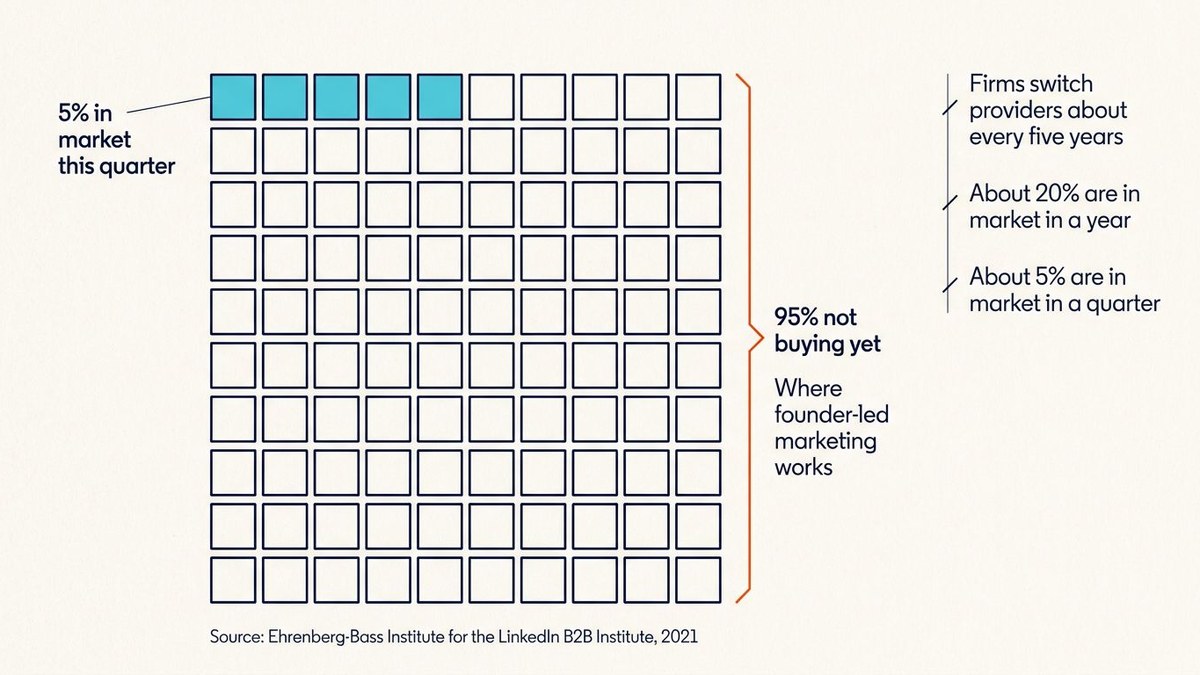
Founder-led marketing makes the founder the main voice teaching a market before it buys. Ehrenberg-Bass Institute research for LinkedIn, published in 2021, finds that only about 5% of business buyers are in market each quarter. Firms switch providers roughly every five years. For products buyers do not know they need, the founder’s job is to reach the other 95% first.
Most of your future customers will not buy this quarter. That is the strongest argument for putting the founder out front.
Professor John Dawes of the Ehrenberg-Bass Institute published research on this in 2021. He found that firms change providers roughly every five years. That leaves only about 5% of business buyers in market in any given quarter.
Founder-led content is a form of B2B thought leadership in which the founder’s own voice carries the education. That voice travels through posts, a podcast, talks, and tools. The goal is to be known and trusted before a buyer starts looking.
The 2025 Edelman-LinkedIn B2B Thought Leadership Impact Report surveyed 1,934 executives. It found 64% of US hidden decision-makers trust thought leadership more than marketing materials when judging a firm’s capabilities. Hidden decision-makers are stakeholders who influence a purchase without being the main users of what is bought.
For a preventative product, almost the whole market sits in the 95% not currently buying. Christian Espinosa sells medical device cybersecurity to medtech founders. He says many don’t realize they need it until the FDA sends back their submission.
The FDA’s premarket cybersecurity guidance, revised in February 2026, sets out the cybersecurity documentation it expects. When I researched this episode, cybersecurity almost never came up in the forums where medical device founders discuss what is hard.
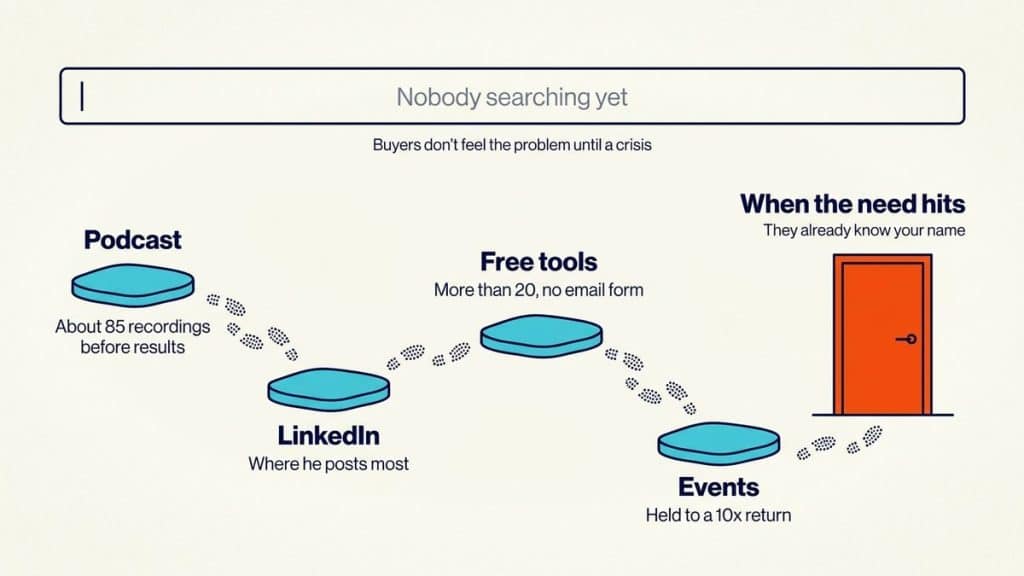
In Christian Espinosa’s experience, medtech founders are not searching for a security partner in year three. They are building their device, so a vendor pitch at that point lands on nobody. Espinosa teaches first through his podcast, LinkedIn posts, and free tools, so his name is familiar when the crisis arrives.
Rule 1: Your Real Competitor Is “We’ll Deal With It Later”
The hardest rival for a preventative product is a belief, and it has no sales team. Christian Espinosa hears it from founders four years into building a medical device. They tell him they are not ready for cybersecurity yet. In his experience, many treat it as a checkbox to tick the week before an FDA submission.
Christian Espinosa says other vendors are rarely his problem. “I would say it’s not really my competitors that are the challenge, it’s the naivety about cybersecurity,” he explains.
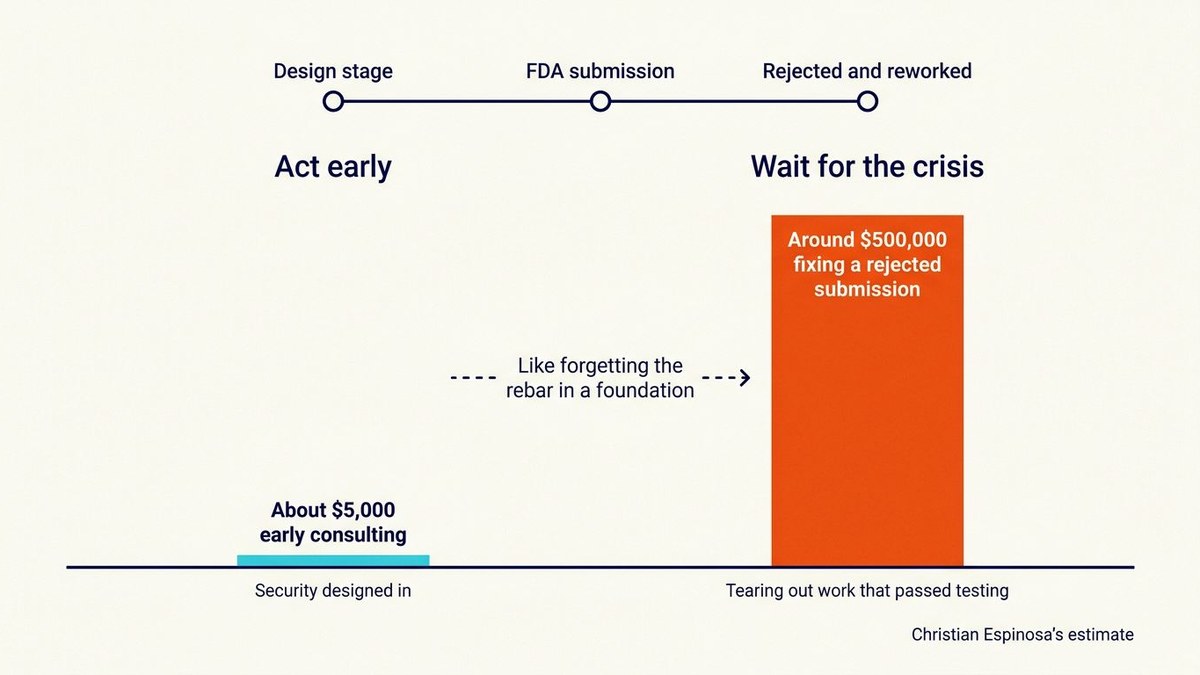
The belief that security can wait is expensive to fix late. Espinosa compares it to pouring a house foundation and forgetting the rebar. Security has to be designed in, so retrofitting it means tearing out work that already passed testing.
Espinosa puts the cost of waiting in numbers a founder can feel. By his estimate, a company could spend about $5,000 on early consulting. Skip it, and the same company could spend around $500,000 fixing a rejected submission.
Blue Goat Cyber turns the cost-of-waiting argument into a tool. Its free cost-of-delay calculator converts each week of submission slip into lost revenue and resubmission cost.
I put it to Espinosa that the calculator’s output is a figure a champion carries into a budget meeting. He confirmed that was the intent.
Espinosa’s lesson on the cost of waiting travels well beyond medtech. His content makes waiting feel costly in the buyer’s own numbers. Only then does a pitch have somewhere to land.
Rule 2: Give Your Best Tools Away Without an Email Form
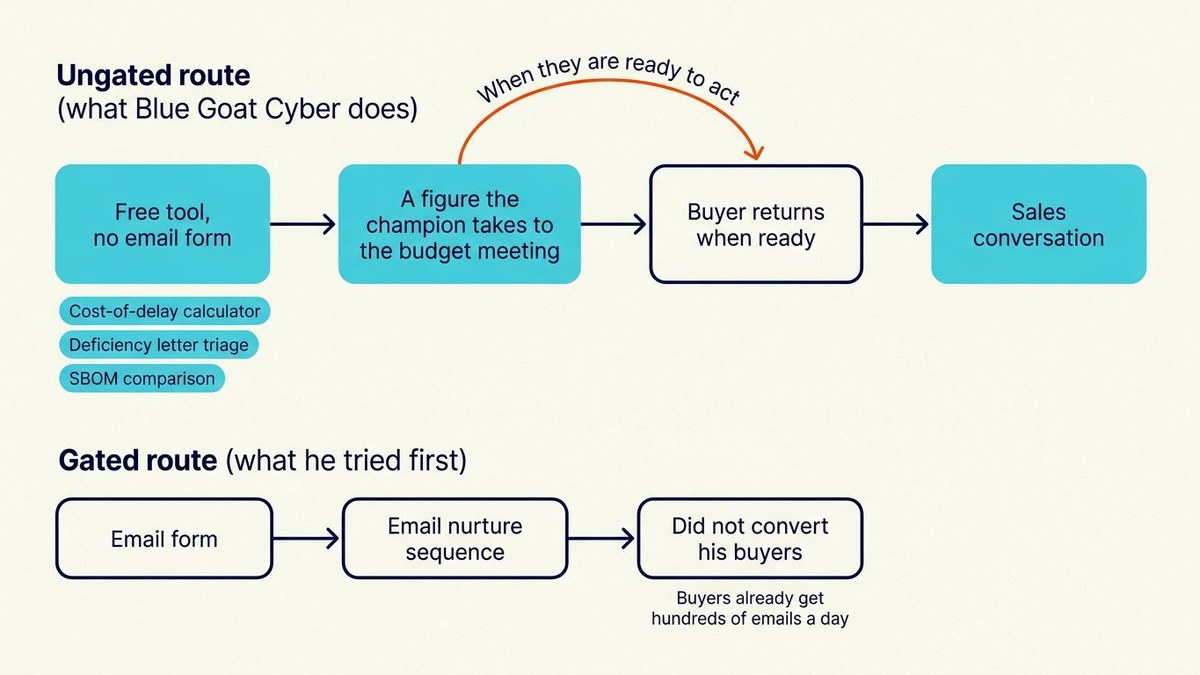
Blue Goat Cyber publishes more than 20 free interactive tools for medical device teams, and none requires an email address. The tools cover premarket scoping, software bills of materials, threat modeling, and submission packaging. Founder Christian Espinosa removed the forms because email nurture after a form fill did not convert for his buyers. In his experience, buyers come back to the tools when they are ready to act.
Blue Goat Cyber’s most useful sales assets never ask for an email address.
Blue Goat Cyber’s tools page lists more than 20 free calculators, scorers, and generators. The page calls them no-signup tools, and the homepage says no sales call is required.
Christian Espinosa tried gated content and email nurture first. In his experience, enrolling someone in an email campaign after a form fill did not work. “My philosophy is to attract our prospects, not try to chase them,” he says.
Espinosa’s case for ungated tools starts with the buyer’s inbox. Most of his buyers are CEOs, CTOs, and founders at smaller medtech companies. Espinosa estimates he gets 400 emails a day himself, and he assumes his buyers do too.
Blue Goat Cyber’s tools answer real questions when a buyer is stuck. One triages an FDA deficiency letter pasted into it. Another compares software bills of materials, and a third estimates the cost of a delayed submission.
Espinosa applied the same thinking to decision-stage search. When I searched two of his competitors by name, a Blue Goat Cyber page of vendor questions came first. Espinosa says the intent is to help founders choose well, even when they choose someone else.
Espinosa does not claim gating is always wrong. He concedes some content can justify a form, but his default for building trust is open.
Rule 3: Hold Every Channel to Revenue You Can Trace
Christian Espinosa, founder of Blue Goat Cyber, holds brand spend to a 10x attribution rule. An event costing $50,000 must be directly traceable to $500,000 in revenue, or it is not worth repeating. His team asks every new client how they found the firm and logs the answer in the CRM. That record lets a bootstrapped founder compare podcasts, events, and partners on actual clients won.
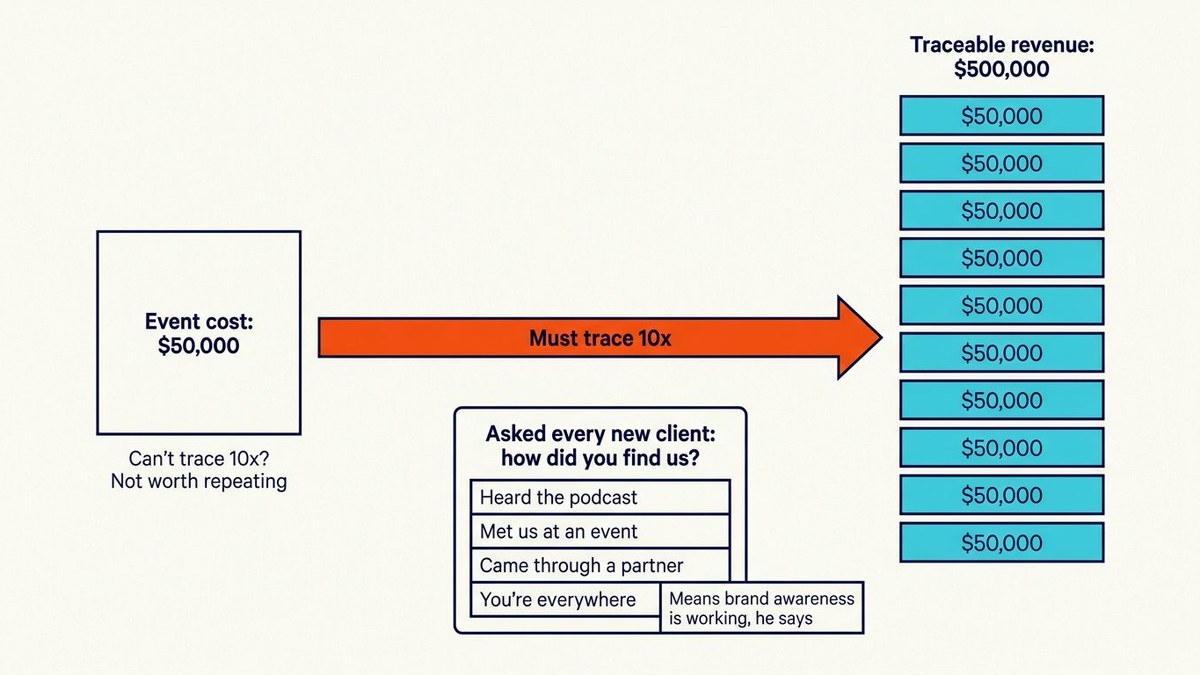
The 10x ratio is Espinosa’s rule for event spend, and he chases the same attribution for every other channel.
When I asked which channels run on faith, Espinosa told me he tries to run nothing on faith. Blue Goat Cyber asks every new client how they found the company and records the answer in its CRM. Espinosa can then match his podcast costs and time to the clients who arrived through it.
Espinosa is honest about the gaps in self-reported attribution. Not every buyer can say how they found you, and some just say Blue Goat Cyber is “everywhere”. “Everywhere is not a good metric for me, but it means our brand awareness is at least working,” Espinosa says.
The tension between awareness and attribution sits at the center of any founder’s brand work. Espinosa admits brand work is harder to attribute. In practice, he traces what he can and reads “everywhere” as a sign that awareness is working.
Espinosa’s 10x rule also tells him what to stop. He says events, the podcast, and partners all bring clients. He’d cut advertising first, since his LinkedIn ads brought no client he could trace.
Rule 4: Cut Paid Ads Before You Cut Founder Content
Christian Espinosa spent heavily on LinkedIn ads and found “not a single” client he could attribute to them. YouTube and Instagram ads did not work for him either. When I asked Espinosa what he would cut if his marketing spend halved, he named advertising first.
Espinosa would rather his brand, client referrals, and organic search carry the load. Today he still pays for Google Ads, partly because competitors bid on the Blue Goat Cyber name.
Espinosa’s explanation for the failed ads is about what the product demands. Blue Goat Cyber sells an expensive service that many buyers do not yet understand. In Espinosa’s view, buyers need education and trust before any message about the offer can land.
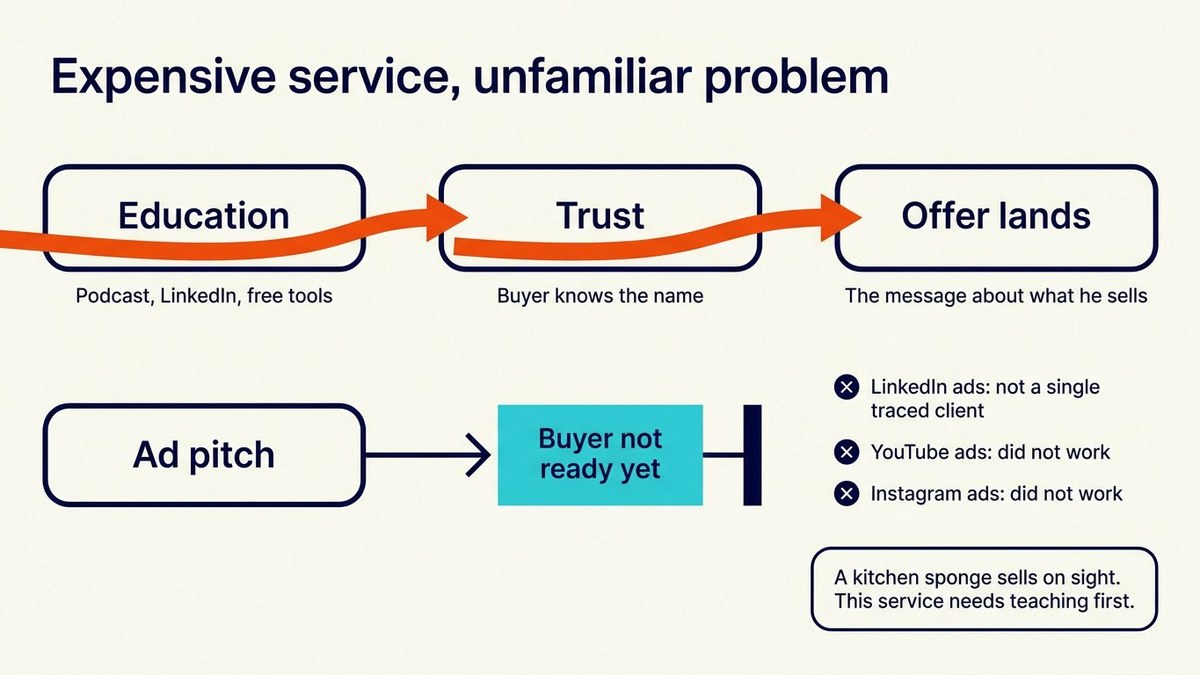
Espinosa contrasts Blue Goat Cyber’s service with a kitchen sponge, a product every household already knows it needs. He says a complex service needs a longer path: teaching first, then the offer. He says it’s more complex than pitching all the time and running ads.
Treat Espinosa’s ad results as one founder’s evidence, and test them against your own numbers. For a preventative, high-ticket offer, his results argue for funding the founder’s own voice before paid social. He says he has paid for dozens of things he expected to work but didn’t.
Rule 5: How Long Does Founder-Led Marketing Take to Produce Pipeline?
Founder-led marketing produces pipeline on a three-to-five-year horizon. Christian Espinosa’s podcast only began showing results after about 85 recordings. His events took a couple of years to build recognition. In 2021, the LinkedIn B2B Institute found that 95% of B2B marketers expect significant sales within two weeks.
Had Espinosa judged his podcast at episode five, he says, he would have quit before building the foundation.
Espinosa’s rule of thumb on timing comes from his podcast and events. In Espinosa’s words, “we as humans grossly overestimate what we can do in one year.” People also “grossly underestimate what we can do in three to five,” he adds. He plans budget and energy on that longer horizon.
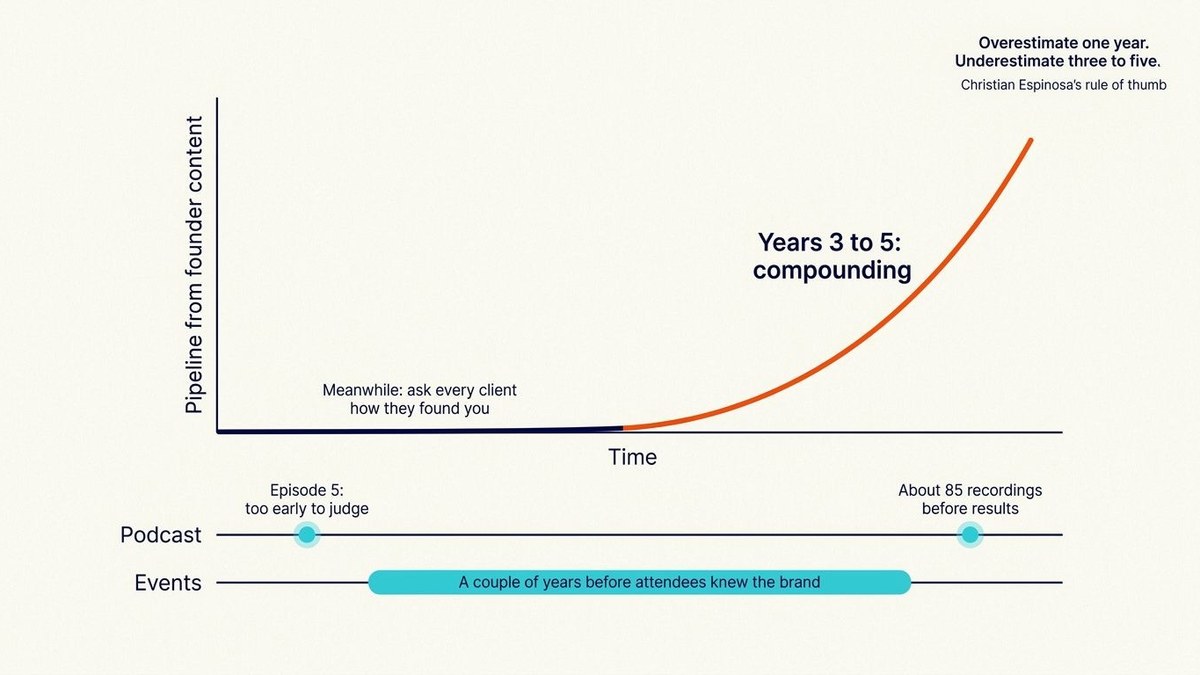
I’ve hosted more than 500 episodes of Predictable B2B Success, and the compounding he describes only shows up over years.
Most B2B marketers expect results far sooner. Peter Weinberg and Jon Lombardo of the LinkedIn B2B Institute surveyed marketers on this in 2021. They report that 95% expect significant sales within the first two weeks of a campaign.
Expecting sales within weeks is how founders quit too early. Espinosa’s answer for the meantime is attribution: ask every client where they came from and watch which channels start appearing. Prospects who say Blue Goat Cyber is everywhere show awareness building before revenue does.
Espinosa’s advice is to treat founder content as a multi-year asset. Set the horizon, protect the budget, and judge each channel against traced clients as the years pass.
What Does a Founder-Led Marketing System Look Like in Practice?
Christian Espinosa’s system keeps the channels that teach buyers and holds each one to clients he can trace. By his account, paid social is the part that did not work. LinkedIn is where Espinosa produces the most content, and some of it argues positions he knows are unpopular.
Founders building a LinkedIn habit can start with a LinkedIn content strategy built for B2B founders. Espinosa’s podcast, master classes, webinars, and events build the same foundation over years.
The table lists the channels Espinosa named in our conversation and what he reported about each.
| Channel | What he reported | Status |
|---|---|---|
| Podcast | About 85 recordings before results; he tracks its cost, time, and clients | Kept |
| LinkedIn posts | Where he produces the most content | Kept |
| Free no-signup tools | Built to attract prospects rather than chase them | Kept |
| Master classes and webinars | Take years to build recognition, like events | Kept |
| Events | Must return 10 times their cost in traceable revenue | Kept, held to 10x |
| Partners | Clients from partners are tracked; misaligned partners were dropped | Kept selectively |
| Website SEO and client referrals | Should carry enough demand that ads are unnecessary | Kept, to grow |
| Google Ads | Competitors bid on the Blue Goat Cyber name | Running; first cut if budget halves |
| LinkedIn ads | “Not a single” attributable client | Did not work |
| YouTube and Instagram ads | Did not work either | Did not work |
| Email nurture after a form fill | Did not convert his buyers | Replaced by ungated tools |
Every channel Espinosa kept teaches the buyer something before any pitch. Each one is judged by asking clients how they found the firm. In his account, the failures were paid placements aimed at buyers who did not yet understand the service.
Espinosa’s system is the practical shape of founder-led marketing for a product nobody searches for. Teaching channels stay, and each keeps its place only as long as clients trace back to it.
When Should a Founder Hand Marketing Off?
Hand off marketing execution only after processes, KPIs, and checks are in place, and keep the voice. Christian Espinosa’s hardest founder lesson was letting go too fast. While scaling, he promoted someone quickly to free up his own time, and it went badly. He calls it paying “the dumb tax”, and he has paid it more than once.
Espinosa says his pattern was stepping away before building checks to verify the work. Looking back over ten years of decisions, one finding stood out. “Every time my gut said to get rid of somebody, or they were in the wrong position, it was right.”
Espinosa’s process before promoting anyone now has four steps:
- Understand the person’s strengths, weaknesses, and trustworthiness.
- Put processes in place.
- Set KPIs and define roles and responsibilities.
- Keep verifying the work after the handover.
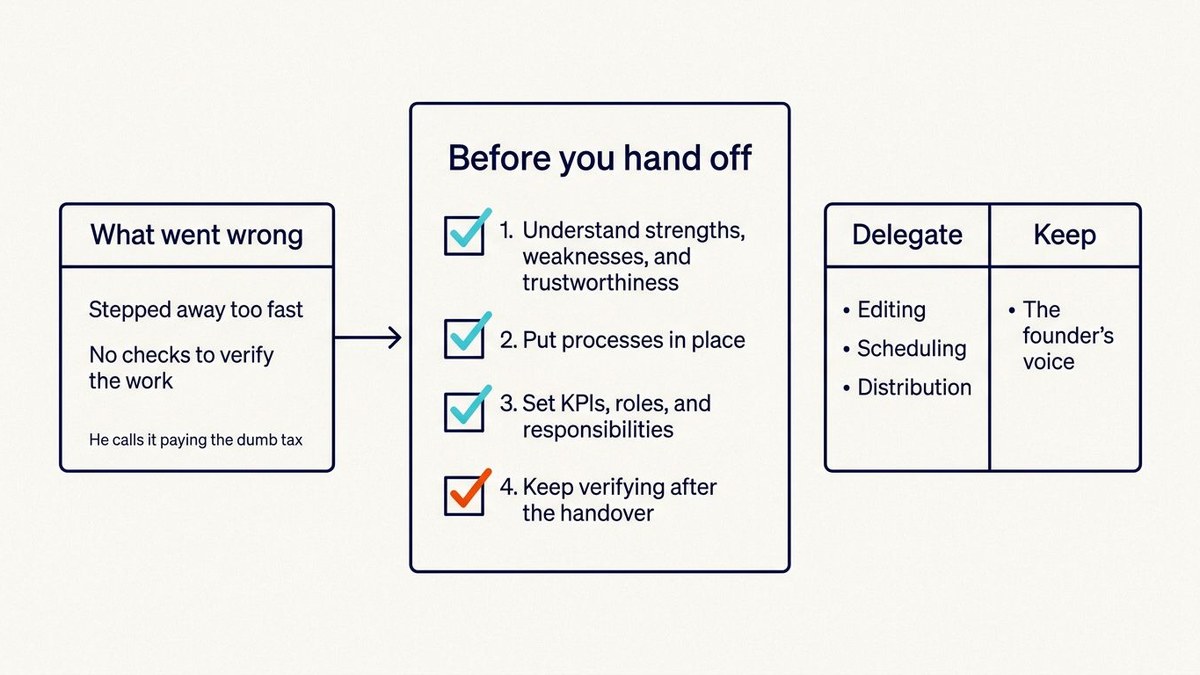
Espinosa recently promoted someone with years in the business, and still checks the work. He admits he has a habit of assuming work is handled when it isn’t, so he is building checks into the process.
Our read is to delegate execution before voice. Editing, scheduling, and distribution can move to a team with KPIs attached. The founder’s perspective, the reason buyers trust the content, has to stay recognizably the founder’s.
Frequently Asked Questions
What is founder-led marketing?
Founder-led marketing is a strategy in which a company’s founder becomes the primary voice that educates its market. The founder shares expertise through LinkedIn posts, a podcast, talks, and free tools. The aim is to build trust before buyers start shopping. In a 2025 Edelman-LinkedIn study, 64% of US hidden B2B decision-makers trusted thought leadership more than marketing materials.
What is founder-led sales, and how is it different?
Founder-led sales means the founder personally runs sales conversations and closes deals. Founder-led marketing creates the demand that feeds those conversations. A single founder can run both at once. Christian Espinosa, CEO of Blue Goat Cyber, still handles much of his firm’s sales while also hosting its podcast and posting on LinkedIn.
How long does founder-led marketing take to produce pipeline?
Founder-led marketing takes years to produce reliable pipeline. Christian Espinosa’s podcast only began showing results after about 85 recordings, and his events took a couple of years to build recognition. He argues founders overestimate what they can do in one year and underestimate three to five. Budgets should be planned on that longer horizon.
Should B2B founders gate their content behind email forms?
B2B founders building trust should default to ungated content and gate only where a form adds value for the buyer. Blue Goat Cyber offers more than 20 free tools with no signup required, including a cost-of-delay calculator. Founder Christian Espinosa found that email nurture after form fills did not convert his buyers, who already receive hundreds of emails a day.
Do LinkedIn ads work for high-ticket B2B services?
In Christian Espinosa’s experience, LinkedIn ads don’t work for complex, high-ticket B2B services that buyers don’t yet understand. Espinosa, CEO of Blue Goat Cyber, reports that his LinkedIn ads produced no client he could attribute to them. YouTube and Instagram ads also failed for him. He now puts founder content and education ahead of paid social.
Build Demand Before Your Buyer Knows They Need You
Christian Espinosa’s experience shows that founder-led marketing wins when the founder treats patience and attribution as the same discipline. He teaches the market for years, gives away more than 20 useful tools, and still asks every client where they came from.
For B2B tech founders selling something preventative, treating patience and attribution as one discipline changes the job description. Your real competitor is a buyer who believes the problem can wait. Espinosa’s LinkedIn ads did not win a single client he could trace.
The founder’s voice, repeated across a podcast, LinkedIn, and free tools, is what makes the problem feel urgent before the crisis does.
Espinosa’s approach also changes how you judge progress. Espinosa’s podcast needed about 85 recordings before it showed results, and he still holds every event to a 10x return. Those two habits keep a long-horizon strategy honest.
Keeping a founder’s voice consistent while running the company is hard. Sproutworth’s founder ghostwriting service is designed for B2B tech CEOs who have the expertise but not the hours.
Founders who start founder-led marketing now will be the familiar name when their buyers finally go looking.
Related Resources
- Thought leadership strategy template for B2B CEOs: a planning template for the founder’s point of view.
- CEO content strategy: how a CEO’s content builds B2B pipeline.
- Personal branding for business owners: building the founder profile behind the content.
- B2B demand generation strategy: turning awareness into pipeline without burning runway.
Related Links
- Christian Espinosa on LinkedIn: where he says he posts most.
- Christian Espinosa’s profile at Blue Goat Cyber: his background and role.
- Blue Goat Cyber’s free tools: no-signup calculators and generators for medical device teams.
Some topics we explore in this episode
- An invisible threat that few startups discuss: why is cybersecurity omitted from the vast majority of medtech failure post-mortems, and might your industry be ignoring a similar risk?
- The demand for things that no one is actually buying: how do you promote a solution for CEOs who don’t (at this stage) think they need it? Learn unorthodox methods to build awareness and create urgency.
- What really occurs when essential compliance work is delayed until the 11th hour? Regulatory surprises that cause product launches to fail
- Can you carry out bold positioning campaigns without losing sight of your company’s values?
- Why will some customers pay 20 times as much in a commodity market, and how can you design your offerings so that competitors can’t realistically match them?
- Security (or indeed any technical service): could the actual value lie in the paperwork that goes uncredited?
- How failing to address security early can blow up your timeline: a real account of thousands of vulnerabilities discovered right before launch. When is your ‘oh no’ moment?
- Should you assess risk based on what matters most to your customers, or are you merely following industry dogma?
- Can offering your best tools for free generate more leads than lead magnets and email campaigns?
- What would you do differently if you had trusted the wrong people to be promoted, or if you realized that your highly praised exit had, in fact, not been a success?
Listen to the episode
Subscribe to & Review the Predictable B2B Success Podcast
Thanks for tuning into this week’s Predictable B2B Podcast episode! If our interviews have helped your business journey, please visit Apple Podcasts, subscribe to the show, and leave an honest review.
Your reviews and feedback will help me keep delivering great, helpful content and reach even more amazing founders and executives like you!
