
Real-time marketing B2B lets B2B tech companies engage buyers at the exact moment of relevance — using live intent signals, trending industry events, and AI-driven personalization to shorten sales cycles and beat slower competitors to the conversation. For seed-to-Series-C teams, it’s one of the highest-ROI marketing tactics available precisely because most B2B brands still rely on static campaigns.
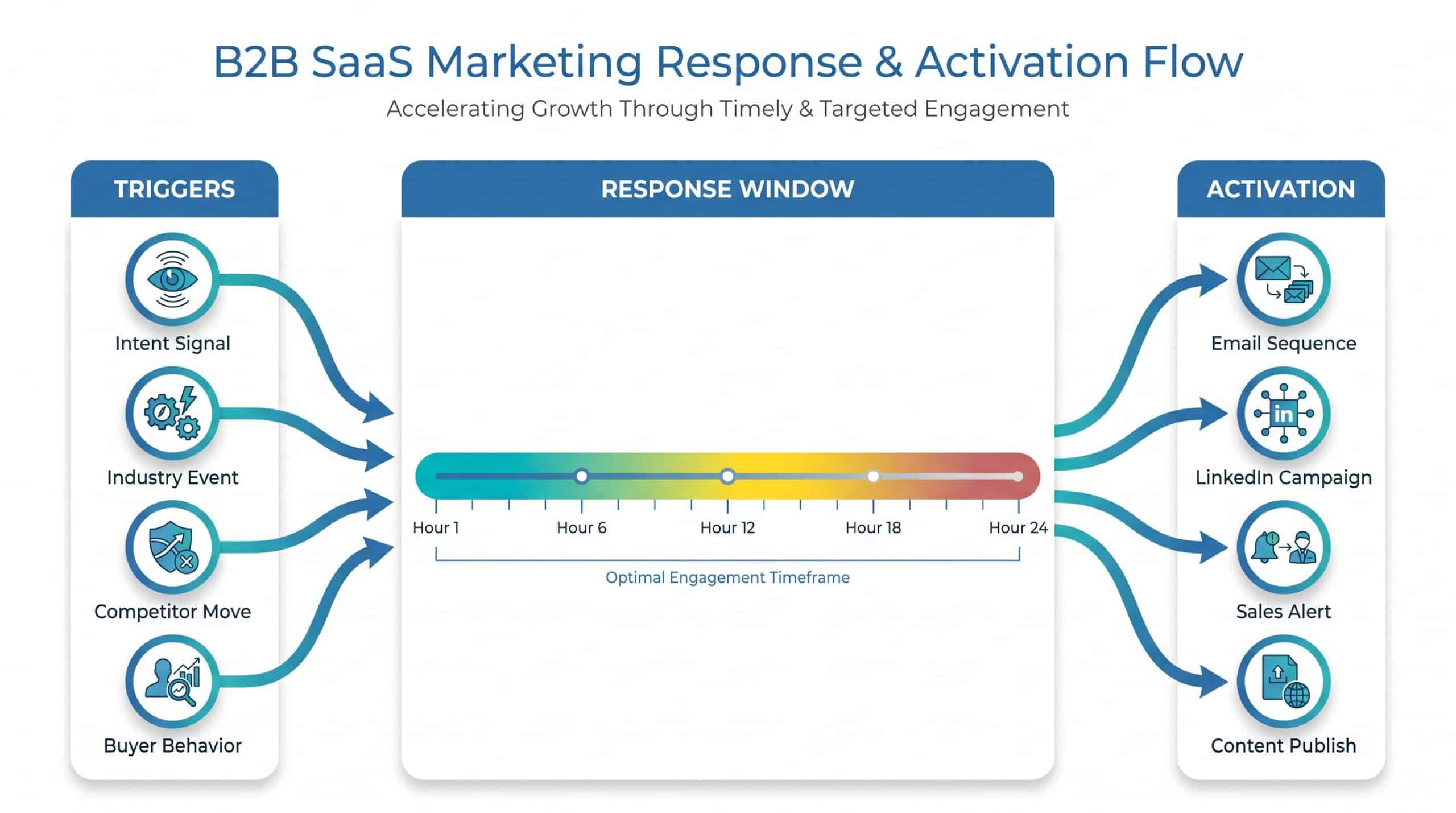
Real-time marketing is the practice of responding to live events, buyer signals, or trending topics to deliver relevant content or outreach at the moment of highest impact. In B2B, this means tracking intent data, industry news, and account-level signals — then activating campaigns, content, or sales motions within hours rather than weeks.
Introduction
Most B2B tech companies build their marketing calendar three months in advance. That’s not inherently wrong — but it means they’re always speaking to their former buyers, not who they are right now.
Buyers change. Their priorities shift when a competitor launches a new product, when a regulatory update drops, when their industry makes headlines. The B2B brands that win the conversation in those moments build pipeline faster than those waiting for the next scheduled nurture email.
That’s the premise of real-time marketing B2B strategy — and it’s more achievable than it sounds.
Table of Contents
What Is Real-Time Marketing?
Real-time marketing (RTM) is the strategy of responding to current events, buyer signals, or trending topics with timely and relevant messaging — rather than pre-scheduled campaigns.
In a B2B context, this doesn’t mean reacting to sports scores. It means:
- A prospect visits your pricing page three times in 48 hours → your sales team gets an alert and a personalized message goes out within the hour
- A major industry analyst publishes a report critical of your category → you publish a response post the same day
- A competitor announces a pricing hike → you activate a comparison campaign targeting their customer base within 24 hours
Direct Answer: What Makes Real-Time Marketing “Real-Time”?
Real-time marketing becomes real-time when the time between trigger and response is measured in hours, not weeks. The trigger can be a buyer behavior (visiting a page, downloading a resource, opening a specific email), a market event (industry news, competitor announcement, regulatory change), or a social signal (trending hashtag, executive post, viral industry thread). The faster the response, the higher the relevance — and relevance drives conversion.
Why Real-Time Marketing Matters for B2B Tech CEOs
Static marketing campaigns decay. A whitepaper published in Q1 loses relevance by Q3. A nurture sequence built around last year’s pain points misses buyers whose priorities shifted after a market correction or a new competitor entrant.
B2B buyers don’t stop gathering information between your scheduled sends. They’re researching constantly — talking to peers on LinkedIn, reading Reddit threads, asking AI tools for recommendations. Real-time marketing B2B tactics let you be present in those moments of active research.
Three reasons RTM delivers outsized returns for B2B tech:
1. Longer sales cycles mean more decision windows. Enterprise B2B deals take 6–18 months. Within that window, there are dozens of inflection points — board reviews, competitive evaluations, budget conversations — where a well-timed piece of content can accelerate the deal. RTM helps you hit those moments.
2. The buying committee is always changing. New stakeholders join B2B evaluations mid-process. The champion you’ve been nurturing may need to brief a CFO who’s never heard of your company. Real-time signals (like a LinkedIn post from that CFO asking about your category) give you a window to reach them.
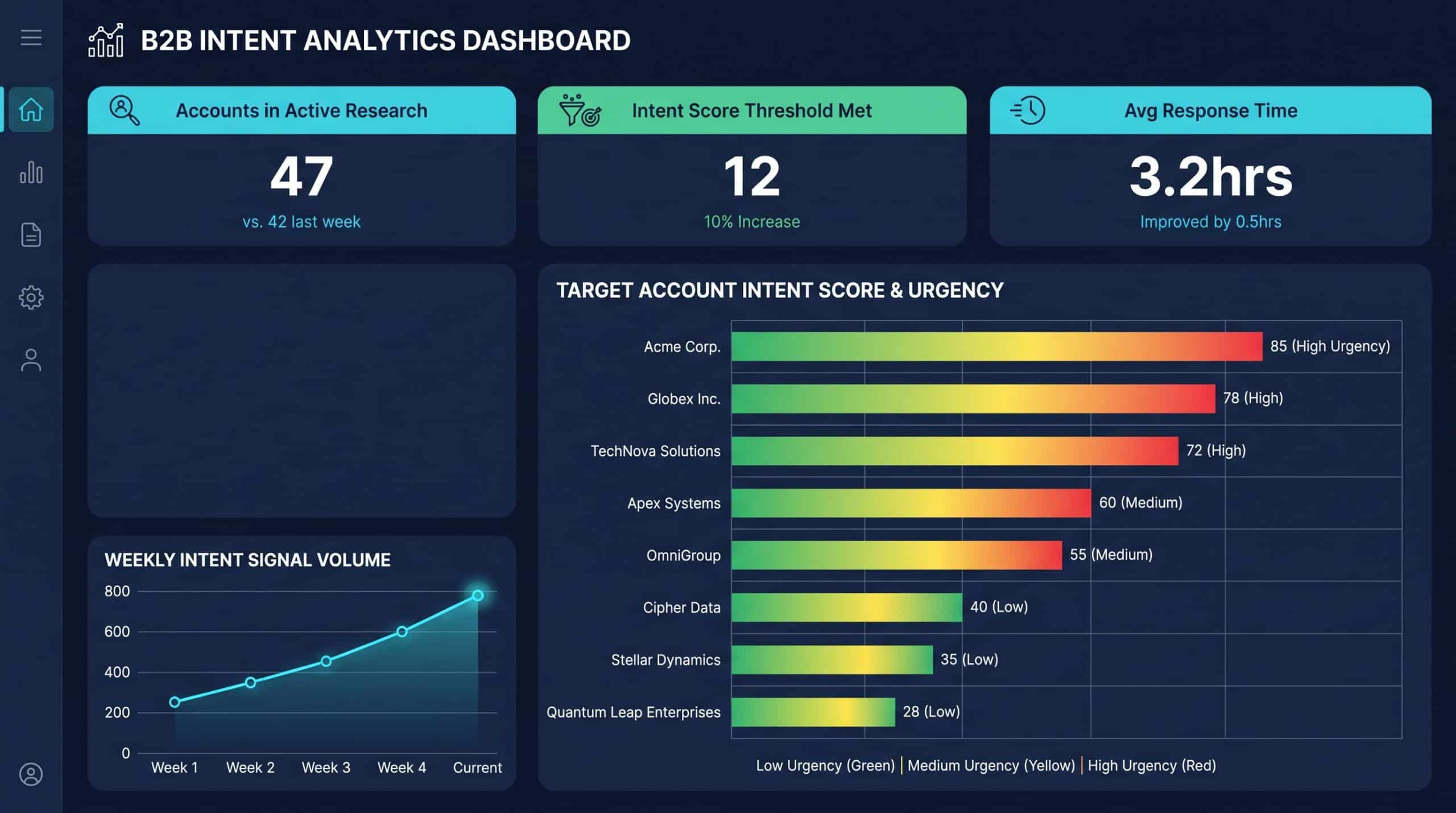
3. Intent data is now accessible. Platforms like 6sense, Bombora, and Demandbase surface real-time buying intent signals — which companies are researching your category, which competitors they’re evaluating, what content they’re consuming. This makes RTM systematic rather than reactive.
5 Real-Time Marketing B2B Tactics That Drive Pipeline
1. Intent-Based Outreach Triggered by Buying Signals
Set up alerts for when target accounts hit intent thresholds — a combination of page visits, content downloads, or third-party research signals that indicate active buying consideration. When an account crosses the threshold, trigger a sales sequence within 24 hours.
Direct Answer: How to Set Up Intent-Based Real-Time Outreach
Use an intent data platform (6sense, Bombora, or Demandbase) to define intent thresholds for your ICP accounts. Connect it to your CRM so that when an account reaches a defined score, it automatically creates a task for your SDR and queues a personalized email sequence. The email references the specific topic the account was researching — not your product, but the problem they’re investigating. Response rates from intent-triggered outreach are typically 3–5× higher than cold sequences.
2. Newsjacking Industry Events and Reports
When a major report, regulatory change, or industry event hits, publish a response piece the same day. Not a reaction post — a perspective piece that adds analysis your buyers can’t get from the original source.
Build this into your workflow: maintain a list of 10–15 industry publications and analyst firms whose research your buyers follow. When they publish something significant, your content team has a 4-hour window to draft a response and get it live.
3. Conference and Event-Based Campaigns
Industry events concentrate your entire buyer base in one place for 2–3 days. Real-time marketing during those windows compounds dramatically.
Specific tactics:
- Publish daily roundup posts during major conferences (SaaStr, Dreamforce, your vertical’s key event)
- Run LinkedIn ads targeting conference attendees in the week before and during the event
- Post LinkedIn commentary on session themes in real time
- Use conference hashtags to enter conversations your buyers are already having
Direct Answer: How to Run a Real-Time Event Campaign on LinkedIn
Before the conference, use LinkedIn Campaign Manager to build a custom audience targeting attendees by job title and industry. Prepare 5–7 short posts tied to likely session themes and trending topics. During the event, post daily commentary reacting to the most discussed ideas — even if you’re not attending. Use the event hashtag. Engagement rates on LinkedIn during major industry conferences are typically 40–60% higher than normal periods because your entire audience is in an active, engaged mindset.
4. Competitive Intelligence Activation
When a competitor makes a major move — a pricing change, an acquisition, a product launch, or negative press — you have a short window to reach their unhappy customers or confused prospects.
Tactics:
- Set up Google Alerts and LinkedIn notifications for key competitors
- Monitor G2 and Capterra for spikes in negative reviews following a competitor announcement
- Prepare a “competitive response” content template you can activate in hours
- Brief your sales team with talking points within 24 hours of any significant competitor move
5. Behavior-Triggered Email and Content Sequences
Move beyond drip campaigns that run on fixed schedules. Trigger-based sequences respond to what buyers actually do rather than how long they’ve been in your system.
High-value triggers for B2B:
- Opens your email three consecutive times without clicking → send a different subject line
- Views your pricing page but doesn’t request a demo → trigger a case study sequence
- Visits your comparison page → activate a direct outreach from sales
- Downloads a bottom-of-funnel resource → accelerate the nurture sequence
Direct Answer: What’s the Difference Between Drip and Behavior-Triggered Sequences?
Drip sequences send emails on a fixed schedule regardless of recipient behavior (Day 1: welcome, Day 3: case study, Day 7: demo invite). Behavior-triggered sequences are sent based on what the recipient does — opening an email, clicking a link, or visiting a specific page. The key difference is relevance: a behavior-triggered email arrives when the buyer has just demonstrated interest, not on an arbitrary schedule. Most modern marketing platforms (HubSpot, Marketo, ActiveCampaign) support this natively, but most B2B teams underuse it.
Real-Time Marketing B2B Examples: How Tech Companies Win (2024–2026)
Drift (Salesloft) — Conversational AI for Immediate Engagement
Drift pioneered real-time marketing at the conversation level: when a target account visits a specific page, a personalized chatbot message appears within seconds, referencing the account by name and the page they’re viewing. High-intent visitors get a sales rep routed to them live. Vendors in this category reported large pipeline gains from live chat over standard form fills, though those numbers were self-reported and are no longer published.
6sense — Intent Data Activating Real-Time Account Campaigns
6sense’s own go-to-market is the best case study for their product. When an account in their ICP begins showing intent signals in a specific category, they activate coordinated campaigns across email, LinkedIn, and direct mail simultaneously. The account receives aligned messages across multiple channels within 24 hours of crossing the intent threshold.
Gong — Newsjacking Analyst Reports
When Forrester or Gartner publishes research touching on revenue intelligence or sales performance, Gong publishes a detailed response post within 48 hours. These posts consistently rank well because they’re the first comprehensive analysis from a practitioner perspective, capturing search traffic from buyers who just read the original report and want additional context.
IBM — Real-Time ABM During Regulatory Events
When major compliance or regulatory events drop (GDPR enforcement actions, AI regulation announcements, data sovereignty rulings), IBM activates pre-built ABM campaigns targeting the industries most affected within 72 hours. These campaigns position IBM’s consulting and cloud services as the solution — reaching buyers at peak anxiety and search intent.
How to Build a Real-Time Marketing B2B System
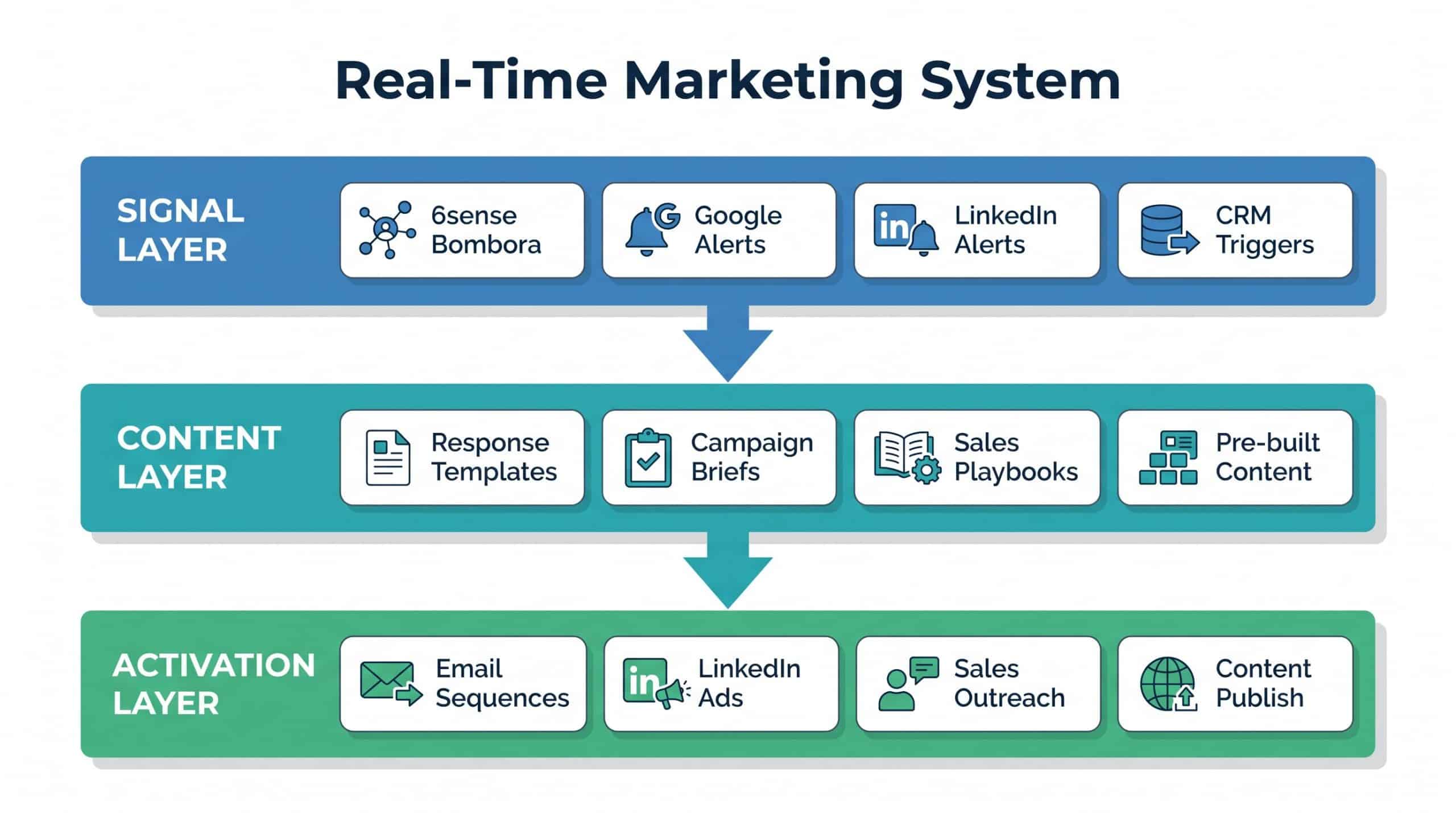
Most B2B teams can’t do real-time marketing because they don’t have the infrastructure. Here’s what you actually need:
Signal layer: Tools that surface real-time triggers — intent data platforms (6sense, Bombora), social listening (Mention, Brandwatch), news monitoring (Google Alerts, Feedly), competitor tracking.
Content layer: Pre-built templates for common scenarios — competitive moves, industry events, analyst reports. Not blank pages; starting points your team can adapt in 2 hours.
Activation layer: Systems that connect signals to execution — CRM alerts, automated email sequences, LinkedIn Campaign Manager audiences, sales playbooks.
Approval process: The speed bottleneck in most teams. Build a “fast track” approval process (one person, 1-hour turnaround) for time-sensitive content. Define in advance what can be published without full review.
Measuring Real-Time Marketing ROI
Direct Answer: How Do You Measure Real-Time Marketing Effectiveness?
Measure RTM by comparing outcomes from time-triggered content against your baseline campaign performance. Key metrics: response rate on intent-triggered outreach vs. cold outreach; pipeline velocity for accounts touched by real-time campaigns vs. those in standard nurture; content engagement rate on newsjacking posts vs. evergreen posts; and time-to-first-meeting for accounts where RTM was used. Most teams find that intent-triggered campaigns generate 3–5× higher response rates and that real-time content drives 2–3× more organic traffic in the 72 hours following a major industry event.
Common Real-Time Marketing Mistakes B2B Teams Make
Reacting without a point of view. Real-time doesn’t mean fast and empty. Newsjacking a report with “interesting report from Gartner” adds nothing. Your commentary needs a specific angle — a counterpoint, an implication your buyers haven’t considered, or a concrete recommendation.
No pre-built infrastructure. Most B2B teams try to do real-time marketing from scratch each time. Build templates, pre-approve budget for reactive campaigns, and designate a “rapid response” owner before a trigger occurs.
Treating all signals equally. A visit to a pricing page is a stronger signal than a visit to a blog. A competitor acquisition is a bigger trigger than a feature update. Prioritize your signal types and build different response protocols for each tier.
Optimizing for speed over relevance. The goal isn’t to be first — it’s to be first and useful. A mediocre post published 2 hours after an industry event is worse than a genuinely insightful one published 6 hours later.
Frequently Asked Questions About Real-Time Marketing
What’s the difference between real-time marketing and agile marketing?
Agile marketing refers to using iterative processes and data to improve campaign performance over time. Real-time marketing specifically refers to responding to live events or signals within hours. Agile marketing is a methodology; real-time marketing is a tactic. Many B2B teams use agile processes to become faster at real-time marketing, but agile processes aren’t the same as real-time marketing.
Do small B2B teams need intent data platforms to do real-time marketing?
No. Intent data platforms (6sense, Bombora) are powerful but expensive. Smaller teams can do meaningful real-time marketing with free tools: Google Alerts for competitor and industry news, LinkedIn notifications for target accounts and keywords, and native CRM triggers for page visits and email behavior. Start with what you have; layer in intent data once you’ve validated the approach.
How much content budget should go to real-time marketing?
A useful starting point is to hold 20–30% of your content production capacity in reserve for reactive content. This doesn’t mean unspent budget — it means having team bandwidth available to produce 2–3 reactive pieces per month without disrupting your planned calendar.
Can real-time marketing work for long B2B sales cycles?
Yes, and it’s often more valuable in longer cycles. A 12-month enterprise deal has dozens of inflection points — when a new stakeholder joins the evaluation, when a competitor gets acquired, when a relevant regulation changes. Real-time marketing lets you be present at those moments. These inflection points can dramatically shift deal momentum.
What B2B verticals benefit most from real-time marketing?
Verticals with active regulatory environments (fintech, healthcare tech, legal tech), fast-moving competitive landscapes (AI tools, developer tooling, cloud infrastructure), and strong conference cultures (martech, salestech, cybersecurity) see the highest returns from real-time marketing. These industries have frequent high-signal moments that concentrate buyer attention and create windows for relevant outreach.
How do you measure real-time marketing without contaminating other campaigns?
Use UTM parameters and separate campaign groups in your CRM to tag all real-time marketing activity. Track response rates, pipeline contribution, and influenced revenue separately from your standard campaigns. After 90 days, compare aggregate metrics. Most teams find real-time campaigns show higher engagement, faster pipeline velocity, and lower cost-per-meeting than equivalent planned campaigns.
Conclusion
Real-time marketing isn’t about chasing every trending topic. It’s about building the capability to respond when your buyers’ environment changes — and being present with something useful when they’re most receptive.
For B2B tech companies, the opportunity is large and underexploited. A real-time marketing B2B system lets you reach buyers when they’re most receptive — while most competitors still run static campaigns on fixed schedules. The companies that build real-time marketing infrastructure — signal monitoring, pre-built content templates, behavior-triggered sequences, and fast-track approvals — gain a systematic advantage that compounds over time.
The starting point is simpler than most teams expect: pick two signal types (competitor monitoring and intent-triggered outreach), build a response protocol for each, and run one real-time campaign in the next 30 days. The data will tell you where to invest next.
If building this capability is on your roadmap but bandwidth is the constraint, Sproutworth works with B2B tech companies on content systems that can move at market speed — including real-time content infrastructure built around your ICP and sales motion.
