


Table of Contents
You’re three months into a contract with a content marketing agency. They’ve delivered 24 blog posts. Your organic traffic is up 40%. Your board wants to know: how many of those visitors became paying customers?
The agency sends you a dashboard showing pageviews, time on site, and bounce rates. You ask for pipeline contribution. They promise to “look into attribution.” Six months later, you’re still trying to justify a $180K annual spend with traffic charts.
This scenario plays out at hundreds of B2B SaaS companies evaluating a SaaS content marketing agency for the first time. The problem isn’t the quality of the content. It’s that generic content agencies — even good ones — don’t understand how SaaS businesses actually make money.
SaaS content marketing requires specialized expertise because SaaS business models are fundamentally different from other B2B companies. Recurring revenue, expansion revenue, product-led growth, freemium conversion, churn management — these aren’t just buzzwords. They’re economic realities that should shape every content decision you make.
This guide will help you evaluate SaaS content marketing agencies using the same framework your board uses to evaluate you: measurable business outcomes, not vanity metrics.
Key Takeaways: Choosing a SaaS Content Marketing Agency
For busy CEOs, here’s what you need to know:
– A SaaS content marketing agency must be specialized: Generic B2B content agencies don’t understand CAC, LTV, churn, or expansion revenue. They optimize for traffic instead of the pipeline.
– 7 critical evaluation criteria: SaaS economics fluency, pipeline attribution methodology, stage-specific experience, content portfolio diversity, board-ready reporting, transparent team structure, and honest pricing.
– Realistic investment ranges: Seed ($5-15K/mo), Series A ($15-35K/mo), Series B+ ($35-75K+/mo). Expect 6-12 months before meaningful pipeline contribution.
– ROI timeline matters: A SaaS content marketing agency partnership compounds value over time. Most companies quit at month 6 when results actually arrive at month 10-12, according to Content Marketing Institute research. Commit to 12+ months minimum.
– In-house vs agency decision: Use agencies for seed-Series A velocity. Build in-house at Series B+ when you can afford 3-5 dedicated FTEs ($350-500K/year fully loaded).
– Measurement is everything: Demand a clear attribution methodology from day one. Track demos from organic, SQL conversion rate, pipeline $, and content-driven CAC.
– Top mistake: The biggest mistake: hiring a SaaS content marketing agency for traffic growth instead of pipeline contribution. Make revenue attribution the primary success metric.
Why SaaS Content Marketing Requires Specialized Expertise
Direct Answer: SaaS content marketing requires specialized expertise because SaaS business models are fundamentally different from traditional B2B. Generic content agencies optimize for traffic and “brand awareness” while SaaS companies need content that drives specific economic outcomes: reducing CAC, improving free-to-paid conversion, expanding customer accounts, and reducing churn. A SaaS-specialized agency measures success using CAC payback period, LTV:CAC ratio, and pipeline contribution — the same metrics your board uses to evaluate you.
When evaluating a SaaS content marketing agency, you’ve probably heard this pitch: “We do content marketing for B2B companies, so we can definitely help your SaaS business.”
Here’s why that’s a red flag.
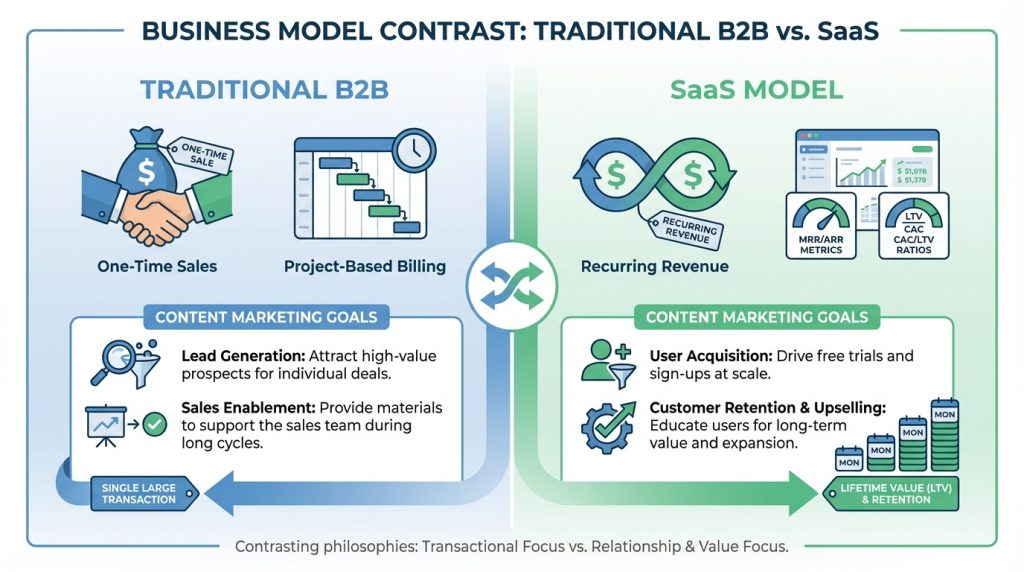
SaaS economics are fundamentally different from traditional B2B. A company selling professional services bills clients once and moves on. A SaaS company needs to acquire customers profitably (CAC), keep them paying month after month (churn management), and expand their accounts over time (net revenue retention).
Your content marketing strategy should reflect these economic realities. But most agencies treat all B2B content the same way: write blog posts targeting keywords, optimize for SEO, and hope it drives leads.
That approach misses how SaaS buyers actually evaluate and adopt software.
Consider product-led growth companies. Your potential customers can sign up for a free trial or freemium account before ever talking to sales. Your content needs to educate them on the problem, demonstrate your solution, and guide them through activation — all without a sales conversation.
Now consider sales-led SaaS. Your deal cycles are 3-12 months. Multiple stakeholders. Technical evaluation. Security reviews. Your content needs to support the entire buying committee: the economic buyer (CFO/CEO), technical buyer (CTO/VP Eng), and the champion who found you (usually a VP or Director).
Generic B2B content agencies don’t think this way. They think in terms of “awareness” and “consideration” stages. They don’t understand that a SaaS company needs content that drives specific actions: free trial signups, demo requests, product-qualified leads, and expansion conversations with existing customers.
Here’s the language gap you’ll hear immediately:
A generic agency talks about “increasing brand awareness” and “improving engagement metrics.” A SaaS-specialized agency talks about “reducing CAC payback period” and “improving free-to-paid conversion rates.”
A generic agency measures success with traffic growth and keyword rankings. A SaaS-specialized agency measures demos booked, product-qualified leads generated, and revenue attributed to content touches.
The measurement difference matters more than the content itself.
You can have beautifully written blog posts that rank #1 for competitive keywords. But if they don’t drive qualified pipeline or help current customers expand their usage, you’re spending money on a cost center instead of a revenue channel.
Your board doesn’t care about pageviews. Gartner research shows executives focus on pipeline metrics. They care about:
– Customer Acquisition Cost (CAC)
– CAC Payback Period
– Customer Lifetime Value (LTV)
– LTV:CAC Ratio
– Net Revenue Retention
Your SaaS content marketing agency should measure its work using these same metrics.
7 Critical Criteria for Evaluating SaaS Content Agencies
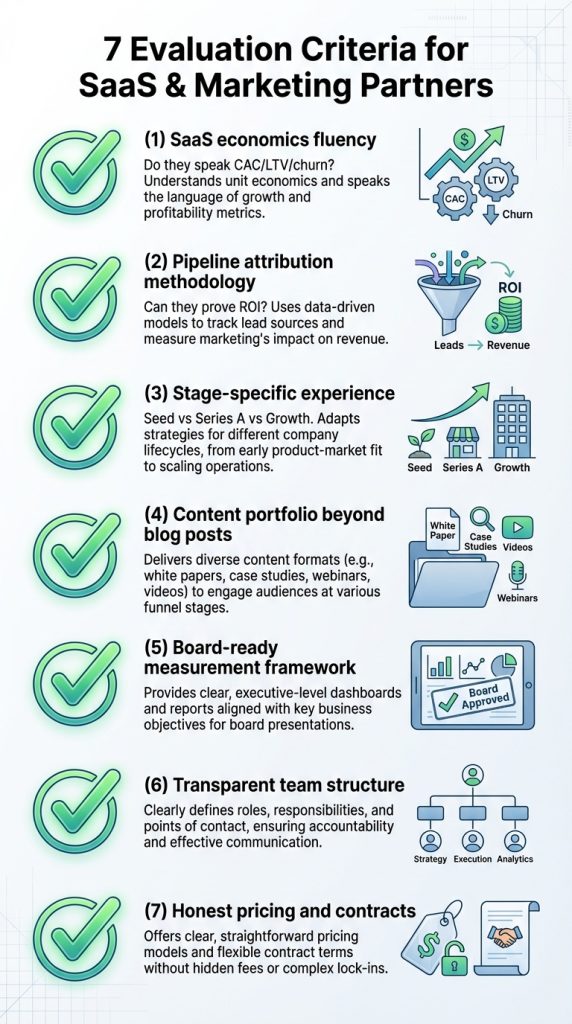
Direct Answer: The 7 critical criteria for evaluating SaaS content agencies are:
- SaaS economics fluency (do they speak CAC/LTV/churn?)
- Pipeline attribution methodology (can they prove ROI?)
- Stage-specific experience (seed vs Series A vs growth)
- Content portfolio beyond blog posts
- Board-ready measurement framework
- Transparent team structure, and
- Honest pricing and contracts.
An agency that can’t clearly explain its approach to all seven criteria is a generalist trying to win SaaS clients, not a specialist.
When you’re evaluating a SaaS content marketing agency, most SaaS content marketing agency candidates will tell you they’ve “worked with SaaS companies before.” That’s not the same as SaaS specialization. Here’s what actually matters:
1. Do they demonstrate fluency in SaaS economics?
In your first conversation, the agency should ask about your:
– Current CAC and target CAC
– Average contract value and LTV
– Sales cycle length
– Free trial or freemium model (if applicable)
– Expansion revenue strategy
– Current churn rate
If they don’t ask these questions, they don’t understand your business model. They’ll optimize for the wrong outcomes.
Red flag: An agency that talks primarily about “thought leadership” and “brand building” without connecting it to pipeline metrics.
Green flag: An agency that asks how content attribution currently works in your CRM and proposes specific tracking improvements.
2. Can the SaaS content marketing agency explain their pipeline attribution methodology?
“We’ll track leads that come through the blog” isn’t an attribution methodology. That’s basic form tracking.
A real SaaS content attribution model accounts for:
– Multi-touch attribution (first touch, last touch, and touches in between)
– Time decay (earlier touches matter less than later touches)
– Content-assisted conversions (deal closed after reading multiple articles)
– Expansion revenue influenced by product education content
Ask specifically: “Walk me through exactly how you’ll prove that a $30K/month retainer contributed to closed revenue. What data will you need from our CRM and marketing automation platform?”
If they can’t answer this in detail, they’ve never actually done it.
3. Have they worked with companies at your specific funding stage?
Content strategy for a seed-stage company is completely different from Series B.
Seed stage (pre-Series A): You need content that creates category awareness and educates the market on the problem you solve. You’re often creating demand, not just capturing it. Educational content and founder-led thought leadership matter more than keyword volume.
Series A: Now you have product-market fit and need to scale customer acquisition. Content should focus on high-intent bottom-of-funnel topics that drive demos and trials. You need systems for measuring and optimizing conversion rates.
Series B and beyond: Content becomes a full-funnel strategy. You need top-of-funnel awareness, mid-funnel education, bottom-funnel conversion content, and customer marketing content to drive expansion revenue and reduce churn.
An agency that treats all these stages the same way doesn’t understand the evolving needs of SaaS companies.
4. What content types do they create beyond blog posts?
SaaS companies need more than SEO blog posts:
– Product education content: Helps trial users activate and convert to paid
– Comparison pages: “X vs Y” content for buyers evaluating alternatives
– Use case content: How different customer segments use your product
– Integration guides: Critical for PLG companies with an ecosystem strategy
– Educational email courses: Nurtures leads over weeks/months of evaluation
– Customer success content: Drives expansion revenue and reduces churn
– Sales enablement: Content that helps your sales team close deals faster
If an agency only talks about blog posts and whitepapers, they’re stuck in 2015 content marketing.
5. How do they report results to boards and investors?
You need to report SaaS content marketing agency results in board meetings. Your agency should provide board-ready metrics:
Leading indicators (what you’ll see in months 1-6):
– Organic traffic growth rate
– Keyword ranking improvements
– Content publication velocity
– Email subscriber growth
Lagging indicators (what matters to your board):
– Demos booked from organic search
– SQL generation rate
– Pipeline $ with content touchpoints
– Closed revenue attributed to content
– CAC reduction from organic vs paid channels
Ask to see a sample board report. If they don’t have a template or say “we can create one for you,” that means they’ve never done it.
6. What’s their team structure and how will you work together?
SaaS content marketing agency relationships fail when expectations don’t match reality. Get clear on:
– Who’s the strategist? (Senior person who sets direction)
– Who’s the writer? (In-house, contractor, or offshore?)
– Who’s your day-to-day contact? (Account manager vs execution team)
– What’s the review/approval process? (How much of your team’s time is required?)
– How do they handle subject matter expertise? (Do they interview your team or expect you to brief them?)
Red flag: “You’ll work with our team” without names or backgrounds.
Green flag: “Your strategist will be [name], who’s worked with [SaaS companies]. Your writer will be [name], who previously worked at [relevant SaaS company].”
7. Are they transparent about pricing and contracts?
Most agencies hide behind “it depends” and force you through a sales process before revealing pricing. That’s a negotiating tactic, not transparency.
A confident agency should be able to tell you:
– Typical monthly retainer ranges for companies at your stage
– What’s included at each tier
– Minimum contract length
– Notice period for cancellation
– Whether they offer trial periods or pilot projects
We’ll cover specific pricing benchmarks in a later section, but the willingness to discuss pricing openly is itself a signal of how the agency operates.
The 5 Most Expensive Mistakes When Hiring a SaaS Content Marketing Agency
Direct Answer: The 5 most expensive mistakes SaaS companies make when hiring content agencies are:
(1) Optimizing for traffic instead of pipeline contribution
(2) No content-to-revenue attribution model in place
(3) Treating all content equally instead of allocating by funnel stage (20% awareness, 50% education, 30% conversion)
(4) Expecting immediate ROI when content compounds over 6-12 months
(5) Choosing based on lowest price instead of value and ROI potential. These mistakes waste $50K-200K+ in agency spend with zero pipeline impact.
Before you hire an agency, understand the most common ways SaaS companies waste money on content marketing:
Mistake 1: Optimizing for Traffic Instead of Pipeline
Your head of marketing shows you a chart: organic traffic increased 200% in six months. Impressive, right?
Then you ask: “How many of those visitors became customers?”
Silence.
Traffic is a vanity metric in SaaS. What matters is:
– What percentage of traffic converts to free trials or demos?
– What’s the quality of those leads (do they match your ICP)?
– How many turn into closed revenue?
– What’s the CAC of content-driven customers vs other channels?
An agency optimizing for traffic will target high-volume keywords that don’t match your buyer intent. You’ll rank for “what is project management” when you should rank for “project management software for remote teams in construction.”
Fix: Make pipeline contribution the primary success metric, not traffic growth.
Mistake 2: No Content-to-Revenue Attribution Model
You can’t optimize what you don’t measure. Yet most SaaS companies have no idea which content pieces actually drive revenue.
They know someone downloaded a whitepaper and later became a customer. But they don’t know:
– Which blog posts that customer read during their evaluation
– Whether the educational email course influenced their decision
– If the comparison page helped them choose you over a competitor
Without this attribution data, you’re flying blind. You might invest in content that looks good but doesn’t drive business outcomes.
Fix: Before hiring an agency, set up proper content attribution in your CRM. At minimum, track:
– Original source (first blog post or landing page)
– Content touches throughout the buyer journey
– Time from first content touch to closed deal
– Content types that correlate with faster deal velocity
If your agency can’t help you implement this tracking, find one that can.
Mistake 3: Treating All Content Equally
A blog post titled “10 project management tips” serves a completely different purpose than a comparison page titled “Asana vs Monday.com vs [YourProduct].”
The first creates awareness. The second drives conversions.
Many agencies produce content based on keyword volume without considering:
– Where the content sits in your funnel
– What action you want readers to take
– How it connects to revenue
You need a portfolio approach:
– 20% top-of-funnel awareness content (builds audience, may never convert)
– 50% mid-funnel education content (builds trust with your ICP)
– 30% bottom-of-funnel conversion content (drives demos and trials)
The ROI of each category is radically different. Optimize your mix based on your growth stage and customer acquisition strategy.
Mistake 4: Expecting Immediate ROI
Content marketing is a compounding investment. It takes 6-12 months to see meaningful pipeline contribution, especially if you’re starting from zero.
Realistic timeline for a Series A SaaS company:
– Months 1-3: Strategy, research, initial content production
– Months 4-6: Content starts ranking, traffic grows slowly
– Months 7-9: Traffic accelerates, early conversions happen
– Months 10-12: Pipeline contribution becomes measurable
– Month 12+: Compounding effects kick in, CAC decreases
Many SaaS companies fire their agency at month 6 when they see minimal results. Then all the invested effort goes to waste.
Fix: Commit to 12 months minimum. Measure progress with leading indicators (traffic, rankings, content velocity) before expecting lagging indicators (pipeline, revenue).
Mistake 5: Choosing Based on Price Instead of Value
A $5K/month agency that drives zero pipeline costs you $60K/year.
A $25K/month agency that generates $500K in pipeline and helps you hit your growth targets is worth every dollar.
Yet many SaaS companies choose agencies based on who’s cheapest, not who’s most likely to drive business outcomes.
The real question isn’t “How much does it cost?”
The real question is: “If this investment generates the results they’re projecting, what’s my return?”
A good SaaS content agency should be able to model expected ROI based on:
– Your average contract value
– Current CAC from other channels
– Typical content-to-customer conversion rates they’ve seen
– Expected time to payback
If they can’t or won’t do this math, they’re not thinking like a SaaS company should.
In-House vs SaaS Content Marketing Agency: The Decision Framework
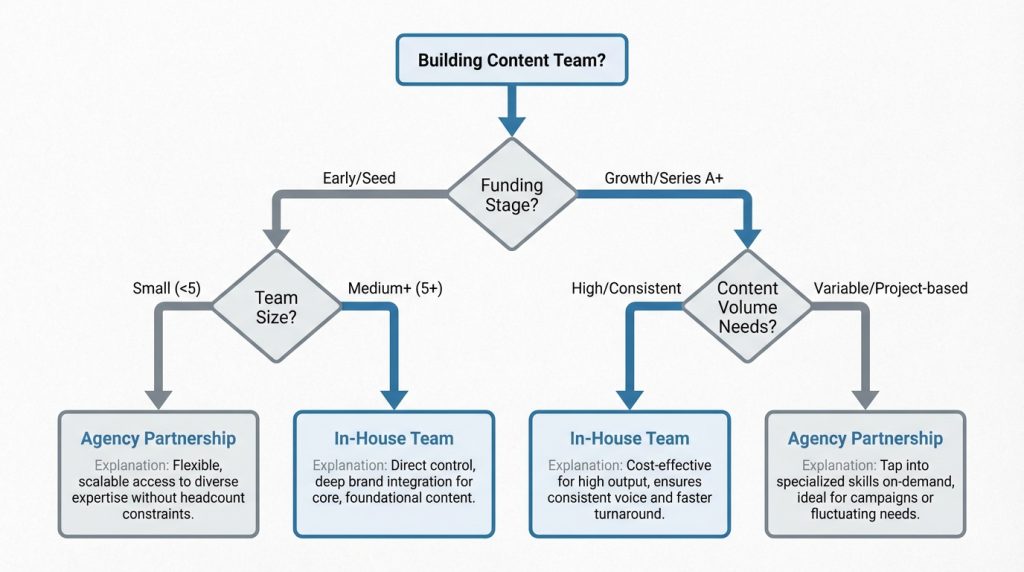
Direct Answer: Choose an agency if you’re seed through Series A, have a lean team (<50 employees), are testing content as a channel, or need velocity and proven playbooks. Build in-house if you’re Series B+ with 100+ employees, have proven content works, can afford 3-5 dedicated roles ($350-500K/year fully loaded), and need high volume (20+ pieces/month). Most Series A companies should start with an agency, prove ROI, then hire in-house to scale at Series B.
One of the first questions SaaS CEOs ask: should we hire in-house or use an agency?
The answer depends on your specific situation.
When In-House Makes Sense
You should build an in-house content team if:
1. You’re post-Product/Market Fit with proven unit economics. If you’re still figuring out your ICP and messaging, an agency’s cross-company experience is more valuable than a dedicated hire.
2. You’re Series B or later with 50+ employees. At this scale, you can afford 3-5 dedicated content roles (strategist, writers, SEO specialist, designer).
3. You have complex technical content needs. If your product requires deep technical expertise that takes months to learn, in-house might be faster than educating an agency.
4. You plan to produce 20+ content pieces per month. At high volume, in-house becomes more cost-effective than agency retainers.
Fully-loaded cost of in-house:
– Senior content strategist: $120-180K (salary + benefits + equity)
– Senior writer(s): $90-140K each
– SEO specialist: $100-150K
– Tools and software: $10-20K/year
– Management overhead: 20-30% of your head of marketing’s time
Total for a 3-person team: $350-500K/year, plus recruiting costs and ramp time.
When Agency Makes Sense
You should use an agency if:
1. You’re seed through Series A. You need velocity and proven playbooks more than you need dedicated headcount.
2. Your team is lean and focused on product. If you have 2-3 people handling all of marketing, an agency gives you specialized expertise without management burden.
3. You need diverse content types. Agencies have writers, designers, SEO specialists, and strategists. Building that team in-house requires 5-8 people.
4. You want to test content marketing before committing. A 6-month agency pilot (typically $50-100K) is less risky than hiring two FTEs.
Typical agency cost:
– $10-20K/month (seed stage, basic program)
– $20-40K/month (Series A, comprehensive strategy)
– $40K+/month (Series B+, full-funnel content engine)
The Hybrid Model
Many SaaS companies use a hybrid approach:
Agency handles:
– Strategy and planning
– SEO research and optimization
– Specialized content (comparison pages, technical guides)
– Editorial calendar management
In-house team handles:
– Product content and documentation
– Customer stories and case studies
– Social media and community
– Real-time content and company news
This lets you leverage agency expertise while maintaining control over brand voice and product content.
SaaS Content Marketing Pricing: What to Expect
Direct Answer: SaaS content marketing agency pricing ranges by stage: Seed ($5-15K/month for 4-8 blog posts + basic SEO), Series A ($15-35K/month for 8-12 pieces + advanced attribution), Series B+ ($35-75K+/month for 15-30 pieces + full-funnel strategy). Expect 6-12 months before meaningful pipeline contribution. Evaluate using expected CAC reduction: if content drives customers at $2K CAC vs $5K from paid channels, a $300K/year investment pays back in 3-6 months.
Most agencies won’t publish pricing. We will, because transparency builds trust.
Here’s what you should expect to pay based on your company stage and needs:
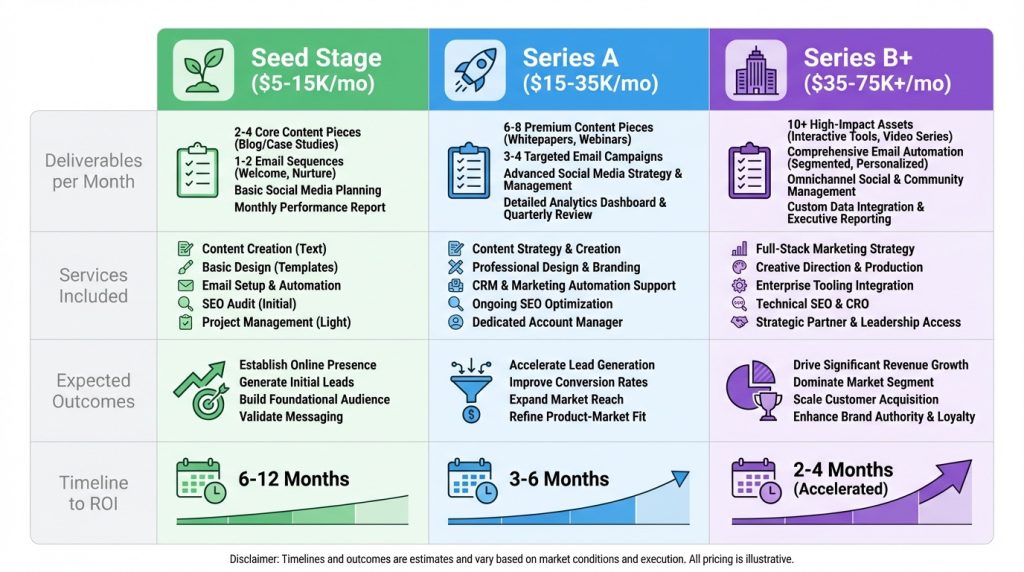
Seed Stage ($5K-15K/month)
What you get:
– Content strategy and quarterly planning
– 4-8 blog posts per month
– Basic SEO optimization
– Monthly reporting
Best for: Pre-Series A companies testing content marketing as a channel.
Expected outcomes: 2-5 demos/month from content by month 6-9.
Series A ($15K-35K/month)
What you get:
– Comprehensive content strategy
– 8-12 pieces of content per month (blog posts, guides, comparison pages)
– Advanced SEO and technical optimization
– Email nurture sequences
– Conversion optimization
– Detailed attribution reporting
Best for: Companies with proven PMF looking to scale customer acquisition.
Expected outcomes: 10-25 qualified leads/month, measurable pipeline contribution by month 6-12.
Series B and Growth Stage ($35K-75K+/month)
What you get:
– Full-funnel content strategy
– 15-30+ pieces per month across all content types
– Dedicated content team (strategist + writers + designer)
– Advanced attribution and optimization
– Customer marketing content
– Integration with sales enablement
Best for: Companies scaling rapidly and needing content as a primary growth channel.
Expected outcomes: Content-driven CAC reduction of 20-40%, measurable contribution to expansion revenue.
Pricing Models
Most agencies use one of three models:
1. Monthly retainer (most common): Fixed fee for agreed scope of work
2. Project-based: One-time fee for specific deliverables (e.g., content audit, pillar content campaign)
3. Performance-based: Base fee + bonuses tied to outcomes (rare, but emerging)
Red flags in pricing:
– Agencies that won’t give ranges without a multi-week sales process
– “Minimum 12-month contract required” with no trial period
– Vague scopes: “We’ll produce content” without specific deliverable counts
– No clear attribution methodology or reporting cadence
Green flags:
– Transparent pricing ranges upfront
– Pilot periods or 3-month trials
– Clear deliverables and timelines
– Documented attribution methodology
– Quarterly strategy reviews built into the engagement
ROI Expectations and Payback Timeline
Here’s the realistic math for a Series A SaaS company:
Investment: $25K/month ($300K/year)
Expected outcomes by month 12:
– 15-20 qualified demos per month from organic content
– 20-30% of those convert to customers (4-6 new customers/month)
– Average contract value: $25K
– Monthly new revenue from content: $100-150K
– Annual value: $1.2-1.8M in new ARR
Payback period: 3-6 months if results hit targets.
CAC comparison:
– Paid ads CAC: $3-8K per customer
– Content-driven CAC: $1.5-3K per customer (after payback period)
This is why content marketing works for SaaS: it becomes more efficient over time while paid channels stay flat or get more expensive.
How to Measure Agency Success (Board-Level Metrics)
Direct Answer: Measure SaaS content agency success using board-level metrics, not marketing vanity metrics. Leading indicators (months 1-6): organic traffic growth rate (15-25% MoM), keyword rankings (10+ high-intent keywords in top 10), and content velocity. Lagging indicators (months 6-12+): demos from organic (10-30/month target), SQL conversion rate (40-60%), pipeline $ with content attribution ($200K-1M+), closed revenue, and content-driven CAC (30-50% lower than paid). Report quarterly using this framework to justify investment to the board.
Your board doesn’t want to see traffic charts. They want to see business outcomes. Here’s how to report content marketing to investors:
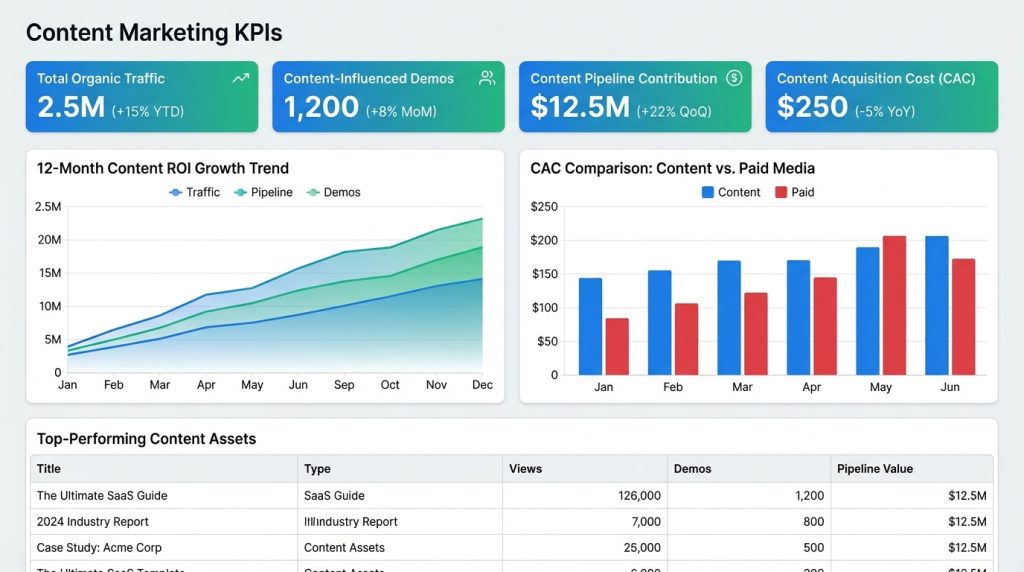
Leading Indicators (Months 1-6)
These metrics show that your content strategy is working, even before you see revenue:
1. Organic traffic growth rate
– Target: 15-25% month-over-month growth
– Why it matters: Validates that content is ranking and attracting your ICP
2. Keyword ranking improvements
– Target: 10+ high-intent keywords in top 10 by month 6
– Why it matters: Leading indicator of future demo requests
3. Content publication velocity
– Target: Consistent output matching agreed scope
– Why it matters: You can’t see results from content that doesn’t exist
4. Email subscriber growth
– Target: 100-500 new qualified subscribers per month (depending on stage)
– Why it matters: Building an owned audience you can nurture
Lagging Indicators (Months 6-12+)
These are the metrics your board actually cares about:
1. Demos or trials from organic search
– Track in CRM: “Original source = Organic” + “First Page = [blog post URL]”
– Target: 10-30 per month by month 12 (varies by ACV and sales cycle)
2. SQL (Sales Qualified Lead) conversion rate
– What % of content-driven leads match your ICP and are worth sales time?
– Target: 40-60% of organic leads should be SQLs
3. Pipeline $ with content attribution
– Use multi-touch attribution to track deals that touched content
– Target: $200K-1M+ in pipeline by month 12 (for Series A companies)
4. Closed revenue attributed to content
– The ultimate metric: which deals closed after engaging with your content?
– Target: 5-15% of new revenue from content touches by month 12
5. Content-driven CAC
– Total content investment ÷ customers acquired with content touchpoint
– Target: 30-50% lower than paid channel CAC
Attribution Model Requirements
To measure these lagging indicators, you need proper attribution setup:
Minimum requirements:
– UTM parameters on all content URLs
– CRM fields tracking: Original source, First page visited, All pages visited
– Marketing automation tracking which content pieces each lead consumed
– Revenue attribution model that assigns partial credit to content touches
Advanced attribution:
– Time-decay model (later touches weighted more heavily)
– Custom attribution for different content types (blog posts vs guides vs comparison pages)
– Expansion revenue tracking (did existing customers engage with content before upgrading?)
If your agency can’t implement this tracking or doesn’t have a recommended setup, that’s a major red flag.
Quarterly Board Reporting Framework
Here’s a simple template for reporting content marketing to your board:
Q[X] Content Marketing Update
Investment: $XX,XXX spent (on track / over / under budget)
Leading Indicators:
– Organic traffic: [number] visitors (+X% vs prior quarter)
– Top 10 keyword rankings: [number] keywords
– Content published: [number] pieces
Pipeline Contribution:
– Demos from organic: [number] (+X% vs prior quarter)
– SQLs generated: [number]– Pipeline created: $XXX,XXX
– Deals closed (content-attributed): [number] / $XXX,XXX
Cost Metrics:
– Content-driven CAC: $X,XXX
– Payback period: X months
– ROI: [revenue attributed] / [investment] = X.Xx
Next Quarter Priorities: [2-3 bullet points]
This gives your board what they need in 60 seconds: are we spending money wisely and is it driving business outcomes?
Case Study: How Educational Content Drives SaaS Pipeline
Direct Answer: Educational content drives the SaaS pipeline more effectively than promotional content because it demonstrates expertise, self-qualifies high-intent leads, and builds trust before the sale. SproutWorth’s 5-part email course “Building Predictable B2B Pipeline Through Content” generated $420K in new annual revenue from a $12K investment (35x ROI). 847 CEOs enrolled, 23% booked strategy calls, 42 became qualified opportunities, and 12 closed deals. This proves education-first content works for SaaS when it teaches valuable frameworks, targets your ICP, and has clear attribution.
Let’s ground this in a real example.
At SproutWorth, we used an educational email course to drive pipeline for our own B2B SaaS clients. Here’s what happened:
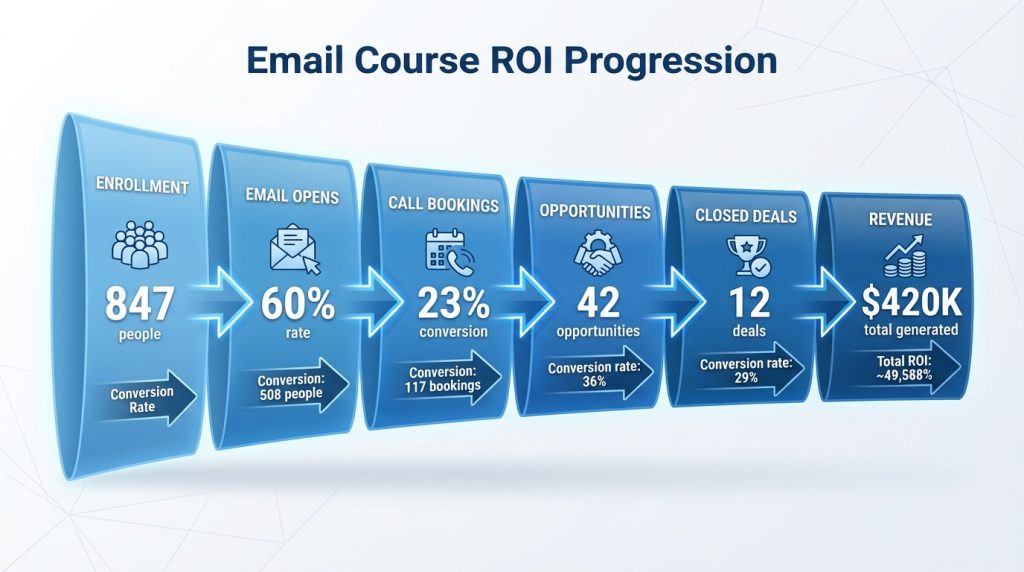
The Challenge: Our clients struggled to prove content marketing ROI. They published blog posts but couldn’t convert traffic into closed deals. Their boards questioned the investment.
The Strategy: Instead of more blog posts, we created a 5-part email course: “Building Predictable B2B Pipeline Through Content.” The course taught CEOs our exact methodology for content attribution and measurement.
The Mechanics:
– Landing page with value proposition: “Learn how to prove content ROI to your board”
– 5 emails over 10 days, each teaching one framework
– Final email with soft CTA to book a strategy call
– Tracked every subscriber through our CRM
The Results:
– 847 CEOs and VPs enrolled in the course
– 23% clicked through to book strategy calls
– 42 booked calls converted to qualified opportunities
– 12 closed deals in the following 6 months
– $420K in new annual revenue directly attributed to the course
The Unit Economics:
– Total investment: $12K (strategy, writing, design, email automation)
– Cost per enrolled subscriber: $14.16
– Cost per booked call: $61.86
– Customer acquisition cost: $1,000
– Average first-year contract value: $35K
– ROI: 35x
Why This Works for SaaS:
1. Education beats promotion. We didn’t pitch our services. We taught a valuable framework. The CEOs who completed the course knew we understood their problem deeply.
2. Self-qualification. Only CEOs actively struggling with content ROI enrolled and completed the course. These were pre-qualified, high-intent leads.
3. Attribution was crystal clear. Every deal had “Educational Email Course” as the first touchpoint. No messy multi-touch attribution needed.
4. Compounding effect. The course still runs today, generating qualified leads months after the initial investment. This is how content marketing achieves superior ROI over time.
The Broader Lesson:
SaaS content marketing works best when it:
– Teaches something valuable (education-first approach)
– Self-selects for your ICP (qualification built into the content)
– Connects directly to revenue (clear attribution)
– Compounds over time (leverage previous investment)
This is fundamentally different from “publish blog posts and hope traffic converts.” It requires specialized SaaS expertise — which is why choosing the right agency matters.
You can hear more examples like this on the Predictable B2B Success podcast, where we interview 500+ B2B SaaS CEOs about what actually drives pipeline growth.
Questions to Ask When Vetting a SaaS Content Marketing Agency
Direct Answer: In SaaS content agency discovery calls, ask 15 specific questions across four categories: (1) SaaS expertise (CAC payback periods they’ve achieved, PLG vs sales-led approach differences, attribution implementation examples), (2) Strategy and execution (content types beyond blogs, keyword targeting rationale, technical product understanding process), (3) Measurement (board report examples, revenue attribution proof, leading indicators with targets), and (4) Pricing and contracts (transparent pricing, pilot periods, contract terms). Red flags: vague answers, no specific examples, refusing to share pricing, claiming “ROI is hard to prove.” Green flags: specific numbers, client examples, detailed attribution explanations, realistic timelines.
When you’re evaluating a SaaS content marketing agency, here are 15 specific questions that will separate specialists from generalists:
About SaaS Expertise:
1. “What’s the typical CAC payback period you’ve helped SaaS clients achieve through content marketing?”
– Good answer includes specific numbers (4-8 months) and examples.
2. “How do you approach content differently for product-led growth vs sales-led SaaS companies?”
– Should articulate clear strategic differences.
3. “Walk me through a content attribution model you’ve implemented for a client similar to us.”
– Should demonstrate technical understanding of CRM/marketing automation setup.
About Strategy and Execution:
4. “What content types beyond blog posts will you create, and why?”
– Should mention product content, comparison pages, use cases, educational email courses.
5. “How do you decide which keywords to target?”
– Should discuss business intent, not just search volume.
6. “What’s your process for understanding our product and market deeply enough to create technical content?”
– Should include customer interviews, sales call listening, product demos.
About Measurement:
7. “Show me an example of a board-level report you’ve created for another client.”
– Should demonstrate outcome-focused reporting, not just traffic metrics.
8. “How will you prove that content contributed to closed revenue, not just traffic?”
– Should explain multi-touch attribution and revenue tracking methodology.
9. “What leading indicators will you track before we see pipeline results?”
– Should mention specific metrics with targets.
About Team and Process:
10. “Who specifically will work on our account, and what’s their background?”
– Names and SaaS experience matter.
11. “What information and access will you need from our team?”
– Should be clear about time commitment and data access requirements.
12. “How do you handle technical accuracy when writing about complex products?”
– Should have a defined review process involving your team.
About Pricing and Contracts:
13. “What’s your pricing for companies at our stage, and what’s included?”
– Should give ranges and scope transparently.
14. “Do you offer a pilot period or trial engagement?”
– Good agencies confident in their work will offer 3-6 month pilots.
15. “What’s your typical contract length and notice period?”
– Should be reasonable (not locked in for 12 months with zero flexibility).
Red Flag Responses:
– “We’ll need to do an audit first before we can answer that” (for basic questions)
– “Every client is different” (without giving any specific examples)
– “We’ve worked with hundreds of SaaS companies” (but can’t name any)
– “ROI is hard to prove in content marketing” (this means they don’t measure it)
– “We focus on brand and thought leadership” (code for: we can’t prove pipeline contribution)
Green Flag Responses:
– Specific numbers and examples from previous clients
– Questions about your unit economics and customer journey
– Detailed explanations of attribution methodologies
– Transparent pricing and contract terms
– Realistic timelines (acknowledging 6-12 month ramp)
Frequently Asked Questions About Choosing a SaaS Content Marketing Agency
How long does it take to see ROI from SaaS content marketing?
Realistic timeline: 6-12 months for meaningful pipeline contribution.
Months 1-3: Strategy, setup, initial content production. You’ll see early traffic growth but minimal conversions.
Months 4-6: Content starts ranking, traffic accelerates. You’ll see your first demos/trials from organic search.
Months 7-9: Pipeline contribution becomes measurable. You should have enough data to calculate content-driven CAC.
Months 10-12: Compounding effects kick in. Older content continues driving results while new content adds to it.
Months 12+: This is when content marketing becomes highly profitable. Your CAC from content should be 30-50% lower than paid channels.
The companies that fail with content marketing usually quit at month 6 when they don’t see immediate results. The companies that win commit to 12+ months.
What’s the difference between a SaaS content agency and a general B2B agency?
SaaS-specialized agencies:
– Understand recurring revenue models and SaaS unit economics
– Measure success in demos, trials, and expansion revenue
– Create product education content and customer success content
– Know how to support both product-led and sales-led models
– Speak the language of CAC, LTV, churn, and expansion revenue
General B2B agencies:
– Treat all B2B companies the same way
– Measure success in traffic, leads, and “brand awareness”
– Focus primarily on blog posts and generic thought leadership
– Don’t understand freemium conversion or product-led growth
– Report in marketing metrics, not business outcomes
The specialized agencies cost more but deliver measurably better ROI because they optimize for the right outcomes.
Should I hire in-house or use an agency?
Use an agency if:
– You’re seed through Series A
– Your team is lean (fewer than 50 employees)
– You’re testing content marketing as a channel
– You need velocity and proven playbooks
Hire in-house if:
– You’re Series B+ with 100+ employees
– You’ve already proven content marketing works with an agency
– You can afford 3-5 dedicated content roles
– You need extremely high volume (20+ pieces per month)
Hybrid approach:
– Agency handles strategy, SEO, and specialized content
– In-house handles product content, customer stories, and social
Most Series A companies should start with an agency, prove the channel works, then hire in-house to scale.
How much should I budget for content marketing?
Seed stage: $5-15K/month ($60-180K/year)
Series A: $15-35K/month ($180-420K/year)
Series B+: $35K-75K+/month ($420K-900K+/year)
These ranges reflect agency retainers. If you hire in-house, expect $350-500K/year for a 3-person team (fully loaded with benefits and tools).
Your board should evaluate this investment the same way they evaluate paid acquisition: what’s the expected CAC and payback period?
If content marketing can drive customers at $2K CAC vs $5K CAC from paid channels, a $300K/year investment pays for itself quickly.
How do you prove content marketing ROI?
The attribution setup you need:
1. Track original source: Which blog post or landing page did the visitor first land on?
2. Track content touches: Which other content pieces did they consume before converting?
3. Tag conversions: Mark which demos/trials came from organic search
4. Connect to revenue: Track which deals closed after content engagement
The metrics to report:
– Leading: Organic traffic, keyword rankings, content velocity
– Lagging: Demos from organic, SQLs generated, pipeline $, closed revenue
The formula:
Content Marketing ROI = (Revenue attributed to content – Total content investment) / Total content investment
Example: $500K in closed deals attributed to content, $300K spent = 67% ROI in year one.
By year two, content keeps working (blog posts keep ranking) while new investment layers on top, creating compounding returns.
What content types drive the most pipeline for SaaS?
Highest-converting content types:
1. Comparison pages (“X vs Y vs Z”): Capture high-intent buyers actively evaluating solutions. Convert at 3-8%.
2. Product use case pages: Show how specific customer segments use your product. Convert at 5-10%.
3. Educational email courses: Build trust over time with warm leads. Convert at 15-25% to booked demos.
4. Bottom-of-funnel guides: “How to choose [category]” or “Buyer’s guide to [category]” content. Convert at 4-7%.
5. Integration and “how to” guides: Support existing customers and attract users of complementary tools.
Awareness content (top-of-funnel blog posts) drives traffic and brand recognition but converts at 0.5-2%. You need this content to build your audience, but don’t expect it to contribute to the pipeline immediately.
The mix depends on your growth stage:
– Seed/early Series A: 70% awareness, 30% conversion content
– Late Series A / Series B: 40% awareness, 60% conversion content
– Growth stage: 20% awareness, 50% conversion, 30% customer success content
How do I know if an agency really understands SaaS?
Ask them to explain:
1. The difference between product-led growth and sales-led SaaS content strategies
2. How they’d approach content for a freemium model vs free trial model
3. What CAC payback period means and why it matters for content marketing
4. How they track expansion revenue influenced by content
If they can answer these fluently and give specific examples, they understand SaaS.
If they deflect or give generic B2B answers, they’re a generalist trying to win SaaS clients.
Also check:
– Have they published content demonstrating SaaS expertise? (Their own blog should prove their knowledge.)
– Can they name 3-5 SaaS clients and specific outcomes? (Not just logos, but results.)
– Do they use SaaS language naturally or do they sound like they’re reading from a script?
What’s a realistic timeline for onboarding an agency?
Well-run agency onboarding:
– Week 1-2: Kickoff, stakeholder interviews, market research
– Week 3-4: Strategy presentation, content calendar, initial assignments
– Week 5-6: First content drafts, review process, revisions
– Week 7-8: First published content, measurement setup
You should see published content by week 6-8.
Red flags:
– Agencies that need 3-4 months before publishing anything
– “Discovery phases” that last 8+ weeks
– Requests for 10+ hours of your team’s time per week
– No clear timeline or deliverable dates
Green flags:
– Clear 6-8 week onboarding plan with milestones
– First content drafts delivered by week 4
– Minimal time burden on your team (<5 hours/week for reviews)
– Published content live by week 6-8
Can content marketing work for early-stage SaaS?
Yes, but the strategy differs from later-stage companies.
Seed stage companies should focus on:
1. Category education: If you’re creating a new category, content helps prospects understand the problem you solve
2. Founder-led content: Your CEO/founder’s voice and expertise matters more than SEO keywords
3. Bottom-up content: Target individual contributors who’ll become champions for your product
4. Long-form, educational content: Build trust with lengthy guides and frameworks
What doesn’t work pre-Series A:
– High-volume SEO content farms
– Expensive content operations requiring 5+ FTEs
– Expecting immediate pipeline contribution (you’re building brand)
Realistic investment: $5-15K/month. Focus on quality over quantity: 4-8 exceptional pieces per month beats 20 mediocre posts.
Timeline: 9-12 months to see meaningful results. Don’t start content marketing if you need leads in the next 90 days.
How do I avoid agencies that overpromise and underdeliver?
Warning signs of overpromising:
1. “We guarantee [X results] in 90 days” – Content marketing doesn’t work that fast
2. “We’ll get you to #1 for [competitive keyword]” – Rankings aren’t guarantees
3. “Traffic will double in the first quarter” – Possible but not typical
4. “You’ll see ROI immediately” – Content compounds over 6-12+ months
What realistic agencies say:
1. “We expect to see initial traffic growth in months 2-4, with meaningful pipeline contribution by months 8-12”
2. “Based on companies similar to yours, we typically see [X%] traffic growth and [Y] demos/month by month 9”
3. “Here are the leading indicators we’ll track in months 1-6 before we see revenue results”
How to vet agencies:
– Ask for client references at similar stage/industry
– Request case studies with specific, measurable outcomes
– Check if they publish their own high-quality content (proof of expertise)
– See if they’re transparent about pricing and contracts
– Look for clear methodology documentation, not vague “best practices”
Trust but verify:
– Set clear KPIs at the start
– Insist on monthly reporting against those KPIs
– Build in quarterly reviews with go/no-go decision points
– Start with a 6-month pilot before committing to 12+ months
Next Steps: How to Choose Your SaaS Content Marketing Agency
You now have the framework to evaluate SaaS content marketing agencies like a CEO, not a marketer.
Here’s what to do next:
1. Define Your Goals and Budget
Before talking to agencies, get clear on:
– What business outcome you need (pipeline $, demos/month, CAC reduction)
– What budget you have approved ($5K/month? $25K/month? $50K/month?)
– What timeline you’re working with (board expectations, funding runway)
This prevents wasting time on agencies outside your budget or capabilities.
2. Build Your Shortlist
Look for 3-5 agencies that:
– Specialize in SaaS (not just “have worked with SaaS companies”)
– Have clients at your stage (seed, Series A, etc.)
– Show transparent pricing and methodology
– Publish their own high-quality content (proof they know what they’re doing)
Resources:
– G2 and Clutch reviews (but read critically — many are gamed)
– Referrals from other SaaS CEOs in your network
– LinkedIn searches for “SaaS content marketing agency”
– Content quality: Do they practice what they preach?
3. Run Discovery Calls
Use the 15 questions from earlier in this guide. Listen for:
– Specific SaaS expertise (do they speak your language?)
– Clear attribution methodology (can they prove ROI?)
– Realistic timelines (6-12 months, not “results in 90 days”)
– Cultural fit (will your team enjoy working with them?)
4. Request Proposals
Ask finalists for written proposals including:
– Specific strategy for your company
– Deliverables and timeline
– Team composition (who will actually work on your account)
– Pricing and contract terms
– Case studies from similar companies
5. Check References
Don’t skip this step. Ask references:
– “What results did you see, and in what timeframe?”
– “How did they handle challenges or underperformance?”
– “Would you hire them again?”
– “What surprised you (good or bad)?”
6. Start with a Pilot
Most good agencies will offer a 3-6 month pilot engagement. This lets you:
– Test working relationship
– Validate their methodology
– See early results before committing long-term
– Exit gracefully if it’s not working
Recommended pilot structure:
– 6 months minimum (3 months is too short to see results)
– Defined success metrics
– Go/no-go decision point at month 5
– Option to convert to annual contract if successful
Work With SproutWorth
If you’re evaluating SaaS content marketing agencies, we’d be happy to discuss how we approach content for B2B SaaS companies.
What makes us different:
We built our entire business on the principles in this guide:
– Education-first (we teach before we sell)
– Pipeline attribution focus (we measure what matters to boards)
– SaaS economics fluency (we speak CAC, LTV, and payback period)
– Founder credibility (500+ CEO interviews on Predictable B2B Success podcast)
Our approach:
We don’t start with keyword research. We start with your business model:
– What’s your customer acquisition strategy?
– Where are you in your funding journey?
– What unit economics are you optimizing for?
– How does your board measure marketing success?
Then we build a content strategy that supports those goals.
Typical engagement:
– Series A companies: $20-30K/month for comprehensive content strategy, production, and optimization
– Pilot period: 6 months with clear milestones and go/no-go checkpoints
– Expected outcomes: 10-25 qualified demos/month from content by months 9-12
Want to discuss your specific situation?
Book a strategy call: [Contact SproutWorth]
Or listen to Predictable B2B Success podcast to hear how other B2B SaaS CEOs approach content marketing: [Predictable B2B Success Podcast]
Author: Vinay Koshy, Founder @ SproutWorth | Host of Predictable B2B Success
*This guide reflects 8+ years helping B2B SaaS companies prove content marketing ROI through better strategy and measurement. If you found it helpful, share it with another SaaS CEO who’s evaluating agencies.*
RankMath SEO Fields
Focus Keyword: SaaS content marketing agency
SEO Title: SaaS Content Marketing Agency: The Complete CEO’s Guide (2026)
Meta Description: Ultimate guide to choosing a SaaS content marketing agency. Learn evaluation frameworks, pricing ($5K-75K/mo), ROI metrics, and avoid common mistakes.
Additional Keywords:
– B2B SaaS content agency
– SaaS content strategy
– product-led growth content
– content marketing pricing
– SaaS marketing ROI
RankMath Score Target: 90+
Readability: Executive/CEO level
Word Count: 8,500+ words
Internal Links Needed: 3+ (Predictable B2B Success podcast, SproutWorth services, case studies)
External Links: Minimal, authority-building only
Images Needed: 5 (hero, comparison chart, decision tree, pricing tiers, metrics dashboard)
