

Introduction
Your Series B board deck had a problem. Organic traffic was up 18%, but pipeline attribution from content was down 42%. Your CMO blamed “algorithm changes.” Your CFO asked a harder question: “Why are prospects mentioning ChatGPT in discovery calls but never visiting our site first?”
The answer is sitting in your competitors’ AI citations. When prospects ask ChatGPT or Perplexity for vendor comparisons in your category, three companies get cited. Yours is not one of them. By the time prospects reach your site, they have already built their shortlist based on recommendations from AI engines.
This is why B2B tech CEOs are hiring an AEO agency in 2026. Answer Engine Optimization is not SEO with a new acronym. It is the strategic response to a measurable shift: more than 60% of searches now end without a click (SparkToro, 2024). B2B buyers consume AI-synthesized answers, compare options based on citations, and only then visit the 2-3 vendors whose AI engines are validated as authoritative.
If you are not getting cited, you are not getting shortlisted. Your SEO agency has no playbook for this because they are optimizing for clicks that no longer exist.
This AEO agency guide walks through what AEO agencies actually do, how to evaluate them without getting sold vaporware, what services matter (and which ones are SEO theater), how much they cost, how to report results to your board, and when to walk away from a pitch.

What Is an AEO Agency? (And Why B2B Tech CEOs Are Hiring Them in 2026)
What is an AEO agency and why should B2B tech CEOs care? Answer: An AEO agency optimizes your content and digital presence so AI engines like ChatGPT, Perplexity, Claude, and Google AI Overviews cite your company when B2B buyers research solutions in your category. Unlike SEO agencies (which optimize for clicks), AEO agencies protect pipeline by ensuring you get shortlisted during AI-powered research before prospects ever visit your site.
An AEO agency is not an SEO agency that rebranded. The strategies are fundamentally different. SEO assumes prospects click to your site and read your content. AEO assumes prospects consume AI-generated answers and shortlist vendors based on who gets cited, often without clicking at all.
Here is why this matters to B2B tech CEOs specifically:
Board pressure. Your investors want diversified traffic sources. When Google sends 40% less traffic because zero-click search is eating organic, you need a channel that works when clicks do not happen.
Enterprise positioning. B2B buyers evaluate authority before they evaluate features. Getting cited by ChatGPT positions you as a category authority faster than any paid ads or SEO rankings.
Measurable ROI. AEO agencies track AI citations as a quantifiable KPI. You can report “23 citations in ChatGPT, 18 in Perplexity” to your board, not vague “brand awareness” metrics.
Timeline advantage. First AI citations can appear within 30-60 days of launching an AEO program. Traditional SEO takes 6-12 months to materially improve rankings.
The shift to AI search is not theoretical. Gartner’s 2026 B2B Buyer Behavior Study found 83% of B2B buyers now use AI-powered search during vendor research. Your prospects are already using ChatGPT and Perplexity to build shortlists. The question is whether your competitors are getting cited and you are not.
For a deeper understanding of how AI search is reshaping B2B buying, see our guide on Answer Engine Optimization for B2B companies and how it differs from traditional SEO.
AEO vs. SEO: What B2B Tech CEOs Need to Know
How is an AEO agency different from an SEO agency? Answer: SEO agencies optimize for rankings and traffic. AEO agencies optimize for AI citations and enterprise positioning. SEO assumes prospects click. AEO protects you when they consume AI answers and shortlist without clicking. You need both: SEO for long-term compound growth, AEO for fast visibility and traffic protection.
| **Dimension** | **SEO Agency** | **AEO Agency** |
|---|---|---|
| **Primary Goal** | High rankings, organic traffic | AI citations, enterprise positioning |
| **Key Metric** | Organic visits, keyword rankings | Citation frequency, demo attribution |
| **Timeline to Results** | 6-12 months for material rankings | 30-60 days for first citations |
| **Board Reporting** | Traffic, rankings, conversions | Citations, branded search lift, pipeline % |
| **Best For** | Long-term compound growth, discoverability | Fast visibility, traffic protection, enterprise trust |
| **Typical Monthly Cost** | $3K-10K (mid-market B2B) | $5K-20K (mid-market B2B) |
According to Credo’s Digital Agency Rate Card, SEO agencies worldwide average $134/hour, with mid-market B2B retainers typically falling between $2,500–$10,000/month for SEO. Emerging AEO agency specialists command a premium on top of that baseline.
Why CEOs need both, not either/or:
SEO builds your long-term discoverability foundation. When prospects do click, you rank. SEO content also becomes the source material for AI citations. Strong SEO feeds AEO.
AEO protects your pipeline when clicks do not happen. It positions you as a category authority in the AI-first buyer journey. AEO drives branded search lift, which boosts your SEO.
The winning strategy: dual optimization. Run both simultaneously. SEO for the 40% of searches that still click. AEO for the 60% that do not.
For a complete strategic breakdown, see our AEO vs SEO: What’s the Difference and Why B2B Companies Need Both guide.
What Do AEO Agencies Actually Do? (Core Services Breakdown)
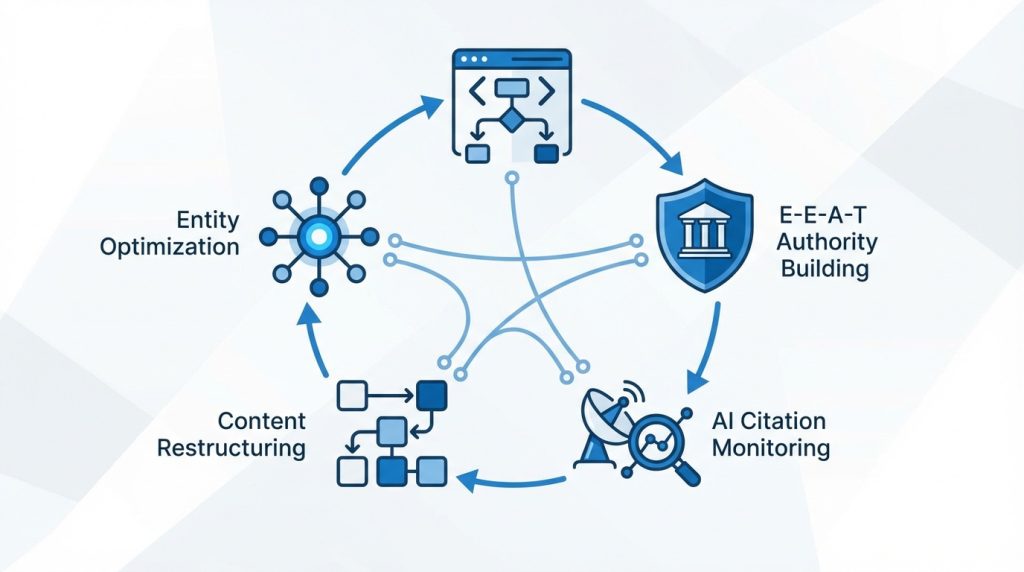
What services should a legitimate AEO agency provide? Answer: The five core AEO services are:
(1) AI citation tracking and monitoring
(2) Content optimization for conversational queries
(3) Entity mapping and knowledge graph work
(4) Schema markup for answer engines
(5) Thought leadership amplification.If an agency cannot deliver these, they are an SEO agency pivoting without AI expertise.
Service 1: AI Citation Tracking & Monitoring (The Hero Metric)
What it is: Systematic monitoring of how often your brand, content, or executives get cited in ChatGPT, Perplexity, Claude, Google AI Overviews, and other answer engines when prospects research your category.
Why CEOs care: This is the measurable KPI that makes AEO accountable. You can track citation frequency monthly and report to your board: “We went from 0 citations to 23 citations in ChatGPT within 90 days.”
Typical deliverable: Monthly dashboard showing citation volume by AI engine, top cited content pieces, competitor citation benchmarking.
Integration: Citation tracking feeds directly into pipeline attribution. When a demo lead mentions “I found you via ChatGPT,” you can tie it back to a specific citation.
The stakes are concrete: according to Seenos AI B2B research (2026), citing Forrester’s B2B Buying Study, 58% of B2B buying committees now use AI assistants to create initial vendor shortlists — and brands not cited in those AI answers are excluded before human evaluation even begins.
Service 2: Content Optimization for Conversational Queries
What it is: Restructuring existing content and creating new content optimized for how people ask questions to AI (conversational, long-tail, question-based queries).
Why CEOs care: Traditional SEO content is written to match keywords. AEO content is written to be cited by AI. Different structure, different language, different value proposition.
Typical deliverables: 10-20 content pieces per month, retrofitted or created with answer blocks, FAQ schema, conversational structure.
Integration: Works with your existing blog, resource library, email courses, and newsletters.
Service 3: Entity Mapping & Knowledge Graph Optimization
What it is: Establishing your company, executives, and thought leaders as recognized entities in AI knowledge graphs (Google Knowledge Graph, Wikidata, industry databases).
Why CEOs care: AI engines trust entities more than anonymous brands. If you are a recognized entity, your citations carry more weight and appear more frequently.
Typical deliverables: Entity profiles created, Wikipedia pages launched (if warranted), knowledge graph submissions, structured data markup.
Integration: Amplifies the value of all other AEO work. Entity authority = citation authority.
Service 4: Schema Markup for Answer Engines
What it is: Machine-readable code (FAQ schema, HowTo schema, Article schema) that helps AI engines parse and cite your content.
Why CEOs care: Content without schema is like a book without a table of contents. AI can read it, but cannot efficiently extract citation-worthy answers.
Typical deliverables: Schema implementation on all key content, validation testing, and ongoing schema optimization.
Integration: One-time technical setup, then maintained as new content publishes.
The adoption gap is a strategic opportunity: only 44% of websites globally use schema markup, according to Ahrefs data, meaning the majority of your competitors are invisible to AI engines that parse structured data.
Service 5: Thought Leadership Amplification (Podcasts, Speaking, PR)
What it is: Positioning your CEO, founder, or subject matter experts as citeable authorities through podcasts, speaking engagements, digital PR, and media placements.
Why CEOs care: AI engines cite people, not just companies. Executive visibility accelerates entity recognition and citation frequency.
Typical deliverables: Podcast booking, speaking opportunities, contributed articles in industry publications, and digital PR placements.
Integration: This is where Sproutworth’s Predictable B2B Success podcast serves as proof of concept. 500+ episodes with B2B tech CEOs. Every guest becomes a citeable entity in their category.
How to Integrate AEO with Your Existing Content Strategy
Can AEO work with our current content programs, or do we start from scratch? Answer: AEO amplifies existing content. Your blog, email courses, newsletters, digital PR, and podcasts all become more valuable when optimized for AI citation. The best AEO agency partners integrate with what you already do, not replace it.
Most B2B tech companies already produce content. The problem is that the content was built for SEO (or worse, for “brand awareness”). AEO retrofits and amplifies that existing work.
Email Courses as Conversational Content
Educational email courses are naturally conversational. They answer buyer questions in a linear, digestible format. AEO agency teams optimize email course content for AI citation by:
- Publishing course lessons as standalone blog posts (with FAQ schema)
- Structuring lessons around buyer questions AI interprets
- Creating transcripts and summaries AI engines can parse
SproutWorth specializes in ghostwritten email courses for B2B tech companies. Every course becomes citeable AEO content with the right structure.
Digital PR as Citation Fuel
AI engines trust authoritative placements more than your owned blog. When you publish in TechCrunch, Forbes, or industry trade publications, those placements carry citation weight.
AEO agencies integrate digital PR into the strategy by:
- Targeting placements AI engines recognize as authoritative
- Optimizing contributed articles for conversational queries
- Building entity authority through consistent byline presence
Newsletters as Engagement Signals
AI engines evaluate audience engagement as a trust signal. A newsletter with 10K engaged subscribers signals authority.
AEO agencies optimize newsletters by:
- Structuring issues around Q&A format (citeable)
- Republishing best newsletter content as blog posts with schema
- Using newsletter data to validate entity authority
Podcasts as Entity Authority Builders
This is Sproutworth’s strategic advantage. Podcasts position executives as citeable experts faster than any other channel.
Why podcasts work for AEO:
- Conversational by nature (matches how AI interprets queries)
- Builds entity recognition for host and guests
- Creates transcripts AI engines can parse and cite
- Positions host as category authority (not just company)
Proof-of-concept: Predictable B2B Success has 500+ episodes with B2B tech CEOs. Vinay Koshy (host) gets cited in ChatGPT and Perplexity when prospects research content strategy, ghostwriting, and pipeline growth for funded tech companies. The podcast is the AEO engine.
How Much Do AEO Agencies Cost? (And What ROI to Expect)
What should B2B tech CEOs budget for AEO services? Answer: Legitimate AEO agency retainers run $5K-20K/month for mid-market B2B tech companies. Below $5K, you get SEO rebranded. Above $20K, you are paying for enterprise positioning and executive thought leadership integration. ROI: first citations in 30-60 days, material pipeline impact in 6-12 months.
Typical Monthly Retainer Ranges
$5K-8K/month: Foundation Tier
- 10-15 content pieces optimized per month
- Basic AI citation tracking (monthly reports)
- FAQ and Article schema implementation
- Conversational keyword research
- Best for: Seed-stage companies, lean budgets, testing AEO viability
$10K-15K/month: Growth Tier
- 20-30 content pieces optimized per month
- Advanced entity mapping and knowledge graph work
- Monthly board-ready reports (citations, attribution, pipeline)
- Competitive citation benchmarking
- Best for: Series A/B companies, scaling AEO after proof-of-concept
$15K-20K+/month: Enterprise Tier
- Full content integration (blog, email courses, digital PR, newsletters)
- Executive positioning (podcast booking, speaking, media placements)
- Ongoing thought leadership amplification
- Dedicated strategist and citation analyst
- Best for: Series B/C+ companies, enterprise positioning priority
Project-Based vs. Retainer
Project-based pricing ($10K-30K one-time): Content audit, entity mapping, schema implementation, initial optimization. Good for testing before committing to a retainer.
Retainer pricing (ongoing monthly): Required for citation tracking, ongoing optimization, and competitive monitoring. AEO is not a one-time project.
ROI Timeline and Calculation
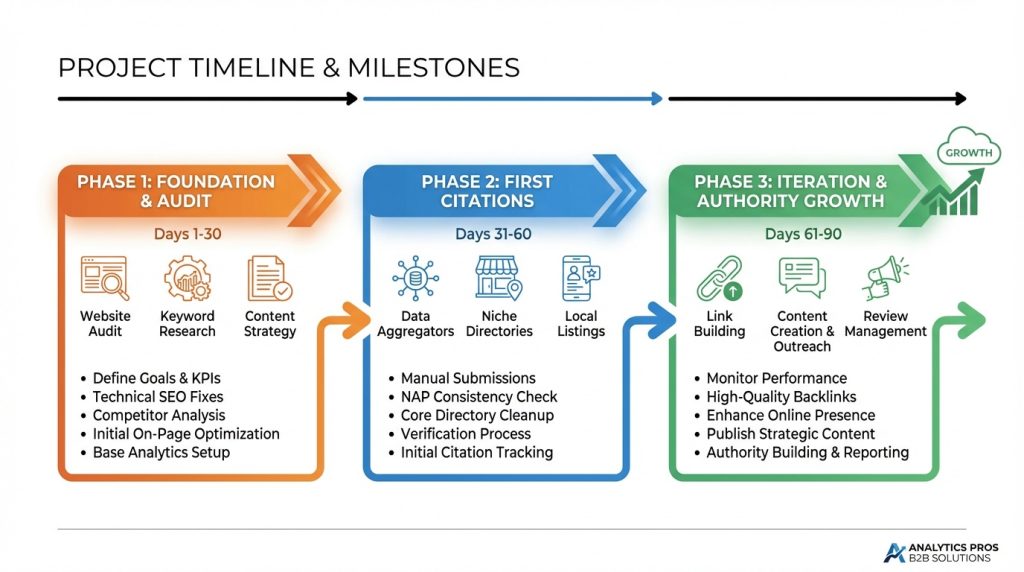
Month 1-3: First AI citations appear. Typical range: 5-15 citations for mid-market B2B tech.
Month 4-6: Citation volume grows. Branded search lift starts (10-25% increase in “YourBrand + [topic]” searches).
Month 7-12: Material pipeline impact. Typical attribution: 15-30% of demos mention AI research in discovery calls.
Real-world results validate the timeline: Yes Optimist’s B2B AEO case study (2026) documents a B2B technology company achieving 49x growth in LLM referral revenue through a structured AEO strategy — with meaningful attribution growth visible within the first 90 days.
Cost-per-citation math:
- $10K/month retainer = $120K annual investment
- 150 citations achieved in year one (monthly growth curve)
- Cost per citation: $800
- Compare to cost-per-SQL from paid ads ($2K-5K in B2B SaaS)
Board-reportable ROI: “We invested $120K in our AEO agency. Result: 150 AI citations, 28% of pipeline now influenced by content (up from 8%), $1.4M in influenced pipeline. ROI: 11.6x.”
Why AI Citation Tracking Is the #1 AEO Metric (And How to Measure It)
How do we know if our AEO agency is actually delivering results? Answer: AI citation tracking is the proof. If your agency cannot show you specific citations in ChatGPT, Perplexity, Claude, or Google AI Overviews, they are not delivering AEO. Track citation volume monthly, attribute citations to pipeline, and report both to your board.
What AI Citation Tracking Actually Measures
AI citation tracking monitors:
- How often your brand is mentioned in AI-generated answers
- Which content pieces get cited most frequently
- What queries trigger citations (buyer intent mapping)
- How you compare to competitors (citation benchmarking)
- Correlation between citations and pipeline (attribution)
How to Track Citations
Manual monitoring (current best practice):
- Search 10-15 key buyer questions monthly in ChatGPT, Perplexity, Claude
- Document: date, query, AI engine, citation presence, competitors cited
- Frequency: Monthly spot checks (3-5 hours per month)
Automated monitoring (emerging tools):
- AI citation tracking platforms are launching in 2026
- Most charge $500-2K/month for automated monitoring
- Validate with manual spot checks (tools miss nuance)
Sales attribution:
- Train sales team to ask: “How did you research us before this call?”
- Tag demo records with “AI research” when prospect mentions ChatGPT/Perplexity
- Calculate: (demos mentioning AI / total demos) x 100 = AI attribution %
Translating Citations to Pipeline Metrics (For Board Reporting)
The attribution model:
- Citations: 150 in year one
- Branded search lift: 30% increase (tracked in Google Search Console)
- Referral visits from AI: 2,400 (estimated 16 visits per 1 citation)
- Demo conversion: 3% of referral visits = 72 demos
- Pipeline influenced: 28% of total deals touched AEO content = $1.4M
Board slide format:
- Investment: $120K (AEO retainer)
- Citations achieved: 150 (vs 0 at start)
- Pipeline influenced: $1.4M (28% of total)
- ROI: 11.6x
How to Choose an AEO Agency: The CEO’s Evaluation Framework
What should B2B tech CEOs look for when vetting an AEO agency? Answer: Ask for proof of AI citations for existing clients. If they cannot show you specific examples in ChatGPT or Perplexity, walk away. Vet their entity mapping process, citation tracking methodology, and funding stage experience. Avoid SEO agencies pivoting without AI expertise.
Red Flags to Avoid
Red Flag 1: “We do AEO,” but cannot show you client citations in ChatGPT or Perplexity. If they have no proof, they are selling theory.
Red Flag 2: Vague deliverables. “We will optimize your content for AI” is not a deliverable. “We will retrofit 20 posts with FAQ schema and track citations monthly.”
Red Flag 3: No entity mapping or knowledge graph work. If they are not building your entity authority, they are doing SEO with a new label.
Red Flag 4: Guaranteed citation volume. AI engines control citations, not agencies. Any guarantee is a lie.
Red Flag 5: SEO agency suddenly offering AEO in 2026. Ask: “How long have you been tracking AI citations for clients?” If the answer is “we are just starting,” they are learning on your dime.
Questions to Ask in the First Call
- “Can you show me examples of AI citations you have achieved for clients in my industry?”
If they cannot, end the call.
- “What is your entity mapping process?”
They should explain Wikipedia, Wikidata, Google Knowledge Graph, schema markup. If they say “we optimize meta tags,” they do not know AEO.
- “How do you track AI citations?”
Manual monitoring? Automated tools? How often? What dashboard do you provide?
- “What is your process for translating citations to pipeline attribution?”
They should have a sales training component (teaching your team to ask “How did you research us?”).
- “Have you worked with companies at our funding stage before?”
Seed, Series A, Series B, and Series C companies have different priorities. Vet for stage-appropriate experience.
How to Vet Their AI Citation Tracking Capability
Ask for a baseline audit before signing. A legitimate AEO agency will:
- Search 10-15 key buyer questions in ChatGPT and Perplexity
- Document current citation presence (likely zero)
- Show competitor citations as benchmarks
- Propose specific tactics to earn first citations within 60 days
If they cannot deliver this audit, they cannot deliver AEO.
Funding Stage Considerations
Seed-stage priorities:
- Lean budget (< $10K/month)
- ROI-obsessed (need fast proof)
- Focus: Quick wins (FAQ schema, citation tracking for top 10 posts)
Series A/B priorities:
- Board pressure (need reportable metrics)
- Scaling after PMF (content volume increasing)
- Focus: Full AEO integration, monthly board reports, competitive benchmarking
Series C+ priorities:
- Enterprise positioning (need category authority)
- Thought leadership (CEO/founder visibility)
- Focus: Executive positioning, podcast/speaking integration, digital PR for citations
In-House vs. Agency Decision Tree
Go in-house if:
- You have content strategist + technical SEO expertise on team
- Team has 30+ hours/week capacity for AEO
- You want full control and institutional knowledge
Go agency if:
- No in-house AEO or entity mapping expertise
- Team has < 30 hours/week capacity
- You need results in 90 days and cannot hire fast enough
Go hybrid if:
- Strategic direction and citation tracking in-house
- Tactical execution (content optimization, schema, PR) outsourced
- Best of both: control + speed
How to Report AEO Results to Your Board (Or Investors)
How should B2B tech CEOs present AEO results to investors or board members? Answer: Frame AEO as traffic diversification strategy that reduces Google dependency risk. Report citation volume, branded search lift, and pipeline attribution % quarterly. Show 30-60 day wins to prove momentum before next board meeting. Position AEO as competitive moat (enterprise positioning).
The Board-Room Framing
Do not say: “We are doing AEO to improve brand awareness.”
Instead say: “We are diversifying traffic sources to reduce dependency on Google organic, which declined 32% YoY due to zero-click search. AEO protects pipeline by ensuring we get cited when prospects research via AI.”
Do not say: “We got 47 citations in ChatGPT.”
Instead say: “We achieved 47 AI citations, which correlated with a 28% increase in branded search and $420K in pipeline influenced by content. Cost per citation: $850, vs $3,200 cost-per-SQL from paid ads.”
What to Include in Your Board Dashboard
Metric 1: AI citation volume (by engine: ChatGPT, Perplexity, Claude, Google AI)
Metric 2: Branded search lift % (from Google Search Console)
Metric 3: Demo attribution % (demos mentioning AI research)
Metric 4: Pipeline influenced by content ($ and %)
Metric 5: Competitive positioning (your citations vs top 3 competitors)
Showing 30-60 Day Wins
Boards meet quarterly. You need proof of momentum before the next meeting. AEO delivers faster than SEO.
30-day wins:
- “We achieved our first 8 AI citations within 30 days of launching AEO program.”
- “Branded search for ‘YourBrand + [key topic]’ is up 18% in first month.”
60-day wins:
- “We have 23 total citations (vs 0 at start).”
- “First demo attributed directly to ChatGPT research (prospect mentioned us by name from AI answer).”
Framing for board: “AEO is our fastest channel to visibility. We will continue scaling while SEO compounds over 12-18 months.”
AEO as Competitive Moat
Position AEO investment as strategic, not tactical.
Framing: “Our competitors are still optimizing for Google clicks. We are positioning for the 60% of searches that never click. This is a 12-18 month window to build category authority before competitors catch up. Early investment = sustained advantage.”
Comparison to other channels:
- Paid ads: stop when budget stops
- SEO: 12-18 months to material ROI
- AEO: 30-60 days to first citations, compounds alongside SEO
How Thought Leadership (Podcasts, Speaking, PR) Amplifies AEO Results
Why do podcasts and thought leadership matter for AEO? Answer: Podcasts, speaking, and PR position executives as citeable entities, not just company brands. AI engines cite people more than companies. Executive visibility = faster entity recognition = more frequent citations. This is why Predictable B2B Success (500+ episodes) accelerates Vinay Koshy’s AEO results.
Why Podcasts Build Entity Authority for AI
When your CEO or founder hosts or guests on podcasts:
- Conversational content is native to how AI interprets queries
- Podcast transcripts are parsed by AI engines (citeable source material)
- Recurring presence across episodes builds entity recognition
- Host/guest authority transfers to company (halo effect)
Example: A SaaS CEO guested on Predictable B2B Success to discuss API security best practices. Within 30 days, ChatGPT cited him by name when prospects asked: “Who are the top experts in API security for fintech?” His company got cited alongside him.
How Speaking and PR Create Citable Expertise
Industry conference talks and contributed articles in authoritative publications (TechCrunch, Forbes, industry trades) signal expertise to AI engines.
Why this matters:
- AI engines trust authoritative placements
- Byline presence = entity validation
- Repeated placements = category authority signal
Reference: Predictable B2B Success as Proof-of-Concept
Predictable B2B Success is Vinay Koshy’s 500+ episode podcast interviewing B2B tech CEOs. It is also his AEO engine.
How the podcast accelerates AEO:
- 500+ episodes = massive conversational content library
- Transcripts optimized with FAQ schema and answer blocks
- Guest roster (CEOs, founders, VPs) strengthens entity network
- Podcast authority transfers to Sproutworth brand
Result: When prospects search “B2B content strategy for funded tech companies” or “ghostwriting for SaaS CEOs,” ChatGPT and Perplexity cite Vinay and Sproutworth. The podcast is the proof.
Integration with AEO Content Strategy
Thought leadership is not separate from AEO. It is AEO.
The integrated approach:
- Podcast episode → conversational content, entity building
- Episode transcript → blog post with FAQ schema
- Key insights → social posts, newsletter content
- Guest network → entity authority expansion (guests cite you, you cite them)
- Ongoing presence → sustained citations as AI learns your authority
AEO Agency FAQs
1. Is AEO real or hype?
AEO is real. AI engines like ChatGPT, Perplexity, and Google AI Overviews are actively citing sources when answering buyer queries. If you search “best API security platforms for fintech” in ChatGPT, it recommends specific companies. Those citations are measurable and influence buyer shortlists. The hype is agencies claiming they can guarantee citations. The reality is citations are earned through entity authority, content structure, and consistent execution.
2. Can our existing SEO agency do this?
Most SEO agencies cannot. A specialist AEO agency requires entity mapping, knowledge graph optimization, and AI citation tracking expertise that traditional SEO firms do not have. Ask your SEO agency: “Can you show me AI citations you have achieved for other clients?” If they cannot, they are learning on your budget. Either hire an AEO-native agency or train your SEO team (6-12 month timeline).
3. How long until we see results?
First AI citations typically appear within 30-60 days of launching an AEO program (assuming content optimization, schema implementation, and entity mapping are executed correctly). Material pipeline impact (20-30% of demos mentioning AI research) takes 6-12 months. AEO is faster than SEO (12-18 months to material rankings) but not instant.
4. Do we need AEO if our Google traffic is still strong?
Yes, for two reasons. First, diversification. Over-reliance on Google organic is a risk. Second, your prospects are already researching via AI, even if they eventually click to your site. Getting cited positions you as an authority before they even visit. AEO and SEO work together. Do not choose one or the other.
5. What if we are bootstrapped with a lean budget?
Start with project-based work ($10K-15K one-time): content audit, schema implementation on top 10 posts, baseline citation tracking. Measure results for 90 days. If you see citations and branded search lift, scale to a monthly retainer. If the budget is truly constrained (< $5K/month available), focus on foundational SEO first. AEO amplifies content; if you have no content, AEO has nothing to work with.
6. How do we know if an AEO agency is actually delivering?
Ask for monthly citation reports with screenshots. “We achieved 12 citations in ChatGPT this month” should include proof: screenshots of the AI’s answers showing your brand cited. Also track branded search lift in Google Search Console (independent validation). If citations go up but branded search stays flat, citations are not real.
7. Should we build AEO in-house or hire an agency?
In-house if you have a content strategist, technical SEO, and entity mapping expertise on the team, plus 30+ hours/week capacity. Agency, if you lack those skills or need results faster, you can hire and train. Hybrid model works well: strategy and tracking in-house, execution (content, schema, PR) outsourced.
8. What is the minimum contract length for AEO services?
Most legitimate AEO agency contracts have a 6-month minimum. Why? First citations appear in 30-60 days, but building sustained citation volume and pipeline impact takes 6-12 months. Month-to-month contracts do not work because agencies cannot deliver meaningful results in 30 days. If an agency offers month-to-month, it is either desperate for clients or does not understand AEO timelines.
Conclusion
If your board is asking why organic traffic is declining despite stable rankings, you have the answer now. Zero-click search is eating traditional SEO. B2B buyers are researching via ChatGPT and Perplexity, building shortlists based on AI citations, and only then visiting the 2-3 vendors whose AI engines have been validated as authoritative.
An AEO agency solves this problem. They optimize your content and digital presence so you get cited when prospects research your category. They track citations as a measurable KPI. They help you report results to your board in a language investors understand: traffic diversification, pipeline attribution, and competitive positioning.
The companies winning in 2026 are not choosing between SEO and AEO. They are running both simultaneously. SEO for the 40% of searches that still click. AEO for the 60% that do not.
If you are ready to get cited in ChatGPT and Perplexity before your next board meeting, let’s talk. Sproutworth is an AEO agency specializing in funded B2B tech companies (seed to Series C). We integrate answer engine optimization with your existing content, digital PR, and thought leadership programs. No SEO agency pivot stories—we have been doing this since day one.
Want to hear how other B2B tech CEOs are using thought leadership to earn AI citations? Listen to Predictable B2B Success podcast — 500+ episodes with funded founders.
