

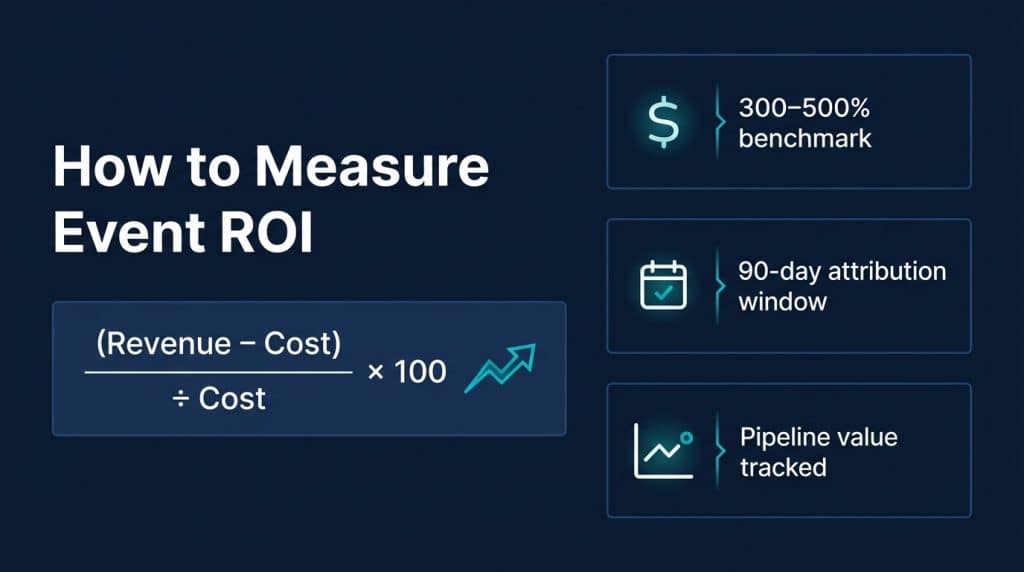
Knowing how to measure event ROI is what separates B2B companies that justify their event budgets from those that keep hoping the numbers work out. According to Cvent’s event marketing research, 67% of B2B marketers name measuring event ROI their biggest challenge. For funded tech companies spending $50,000 to $500,000 per event, that gap is not sustainable. In this episode of the Predictable B2B Success podcast, Hailey Ingraham of Event Cadence explains exactly how to fix it.
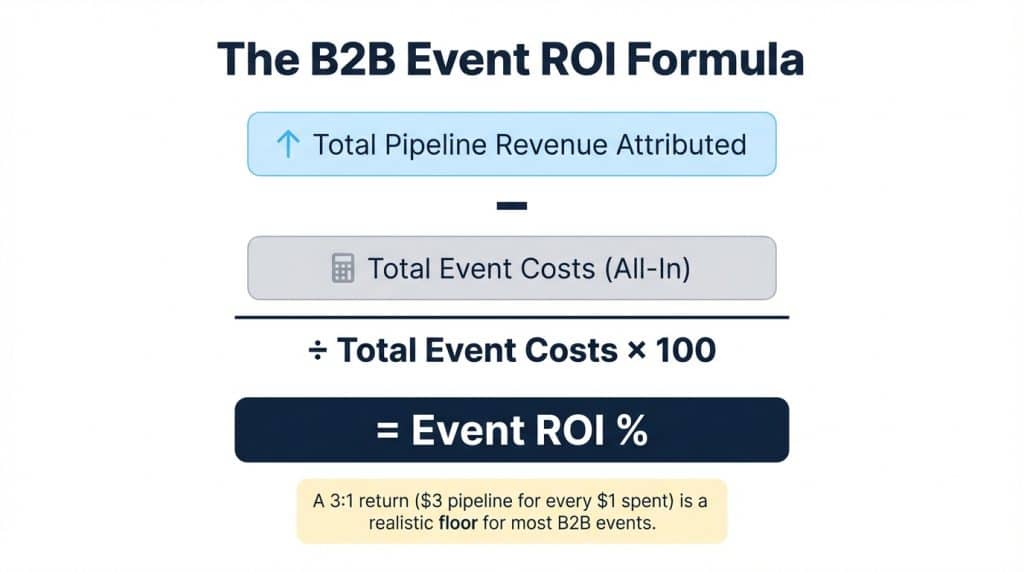
The event ROI formula: ROI = ((Total Value Generated − Total Event Cost) ÷ Total Event Cost) × 100. For B2B, “total value generated” includes pipeline created within 90 to 180 days of the event, not just revenue closed on the day. A 3:1 return ($3 in pipeline value for every $1 spent) is a realistic floor for most B2B events.
Table of Contents
Meet Hailey Ingraham
Hailey Ingraham is Director of Marketing at Event Cadence, a bootstrapped event management platform that has grown past $10M in revenue, serving clients from small nonprofits to Fortune 500 companies, including Merck Pharmaceuticals, MIT, Sony, and Intel. She joined as an entry-level professional in 2020 and rose to director within 4 years, bringing a journalism background that shapes her approach to B2B storytelling. In this episode, she breaks down the practical framework her clients use to measure event ROI before, during, and after every event.
Why Is Measuring Event ROI Harder Than It Looks?
Measuring event ROI is the top challenge for 67% of B2B marketers, according to Cvent’s research. Only 23% of businesses use event management software despite its documented benefits. The result: funded B2B tech companies invest six figures in events and walk away with a spreadsheet of badge scans they cannot connect to pipeline, retention, or revenue.
After 500+ interviews on the Predictable B2B Success podcast, I see a consistent pattern. Companies with solid event measurement systems treat events differently from the start. They decide what success looks like before signing a venue contract.
Companies without that discipline scramble for data after the event concludes. They want every report at once. The numbers sit in a deck. Nobody acts on them.
The measurement problem is not a data problem. It is a sequencing problem.
And it starts with a question most event teams skip entirely.
Define Your ROI Goals Before You Spend a Dollar
The most common event ROI mistake Hailey Ingraham sees is companies skipping goal-setting until the event is over. When metrics are defined after the fact, they get shaped to tell the most comfortable story rather than the most accurate one. Defining success criteria upfront creates an objective benchmark that determines what data to collect and how to act on it in real time.
Hailey frames the first question bluntly: “What is the purpose?”
A Fortune 500 company holding an internal sales kickoff has completely different goals from a pharmaceutical company running a medical congress. The ROI framework that works for one will fail the other.
“You have the great insights to think about ROI at the start. A lot of people don’t really think about ROI until the event has concluded. Really taking the time to write down what you’re trying to achieve, and what metrics you want to follow, how you can get ahead of those metrics instead of scrambling when the event is over.”
Hailey Ingraham, Director of Marketing, Event Cadence
The goal-setting conversation should happen before venue selection. It should answer four questions:
- What specific business outcome does this event need to move?
- Which metrics prove that the outcome changed?
- At what point in the event can those metrics be tracked in real time?
- What would a successful event look like on day one versus day three?
A Series B SaaS company I work with had been running an annual user summit for three years before they asked those questions. I cover this approach in detail in my B2B content marketing strategy guide. The first time they mapped the event to specific metrics (feature adoption, NPS, and expansion revenue), they restructured the agenda entirely. The event became shorter and cheaper, and produced a greater measurable business impact.
What to Include in Your Total Event Cost Calculation
Most B2B teams undercount event costs. They include venue and catering but miss the full picture. For an accurate ROI calculation, include every item below:
- Venue and booth fees: Floor space, registration, and any premium placement costs
- Travel and accommodation: Flights, hotels, and ground transport for your full team
- Staff time: Hours spent planning, attending, and following up, priced at fully-loaded cost
- Marketing materials: Design, print, swag, and branded assets created for the event
- Event technology: Platform licensing, lead capture tools, and app fees
- Shipping and logistics: Freight for booth materials and equipment
- Post-event content: Recap videos, blog posts, and follow-up campaigns
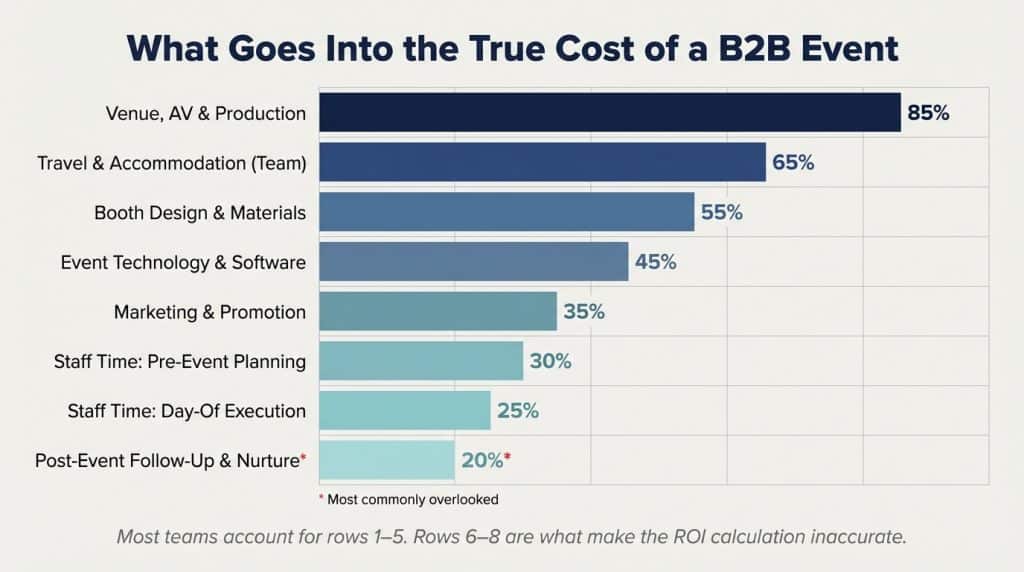
Staff time is the line item most companies omit. A three-day trade show with four team members on-site, plus two weeks of pre-event prep and two weeks of follow-up, represents roughly 300 hours of salary cost. That number belongs in the denominator of your ROI formula.
What Is a Good ROI for a B2B Event?
Good B2B event ROI ranges from 300% to 500%, meaning $3 to $5 returned for every $1 spent, according to industry benchmarks from OpenView Partners and Momencio. Enterprise deals and life sciences events with higher acquisition costs should target a 5x to 10x pipeline multiple rather than a single-event revenue figure.
The benchmark varies significantly by event type:
- Trade shows and industry conferences: Target 3x to 5x pipeline ROI within 90 to 180 days of the event
- User conferences and customer summits: Evaluate the net revenue retention and expansion rate among attendees versus non-attendees
- Internal company events (kickoffs, training): Measure engagement scores, knowledge retention, and output quality, not revenue
- Sponsored events and speaking slots: Track thought leadership metrics (content downloads, inbound inquiries, media coverage) alongside pipeline
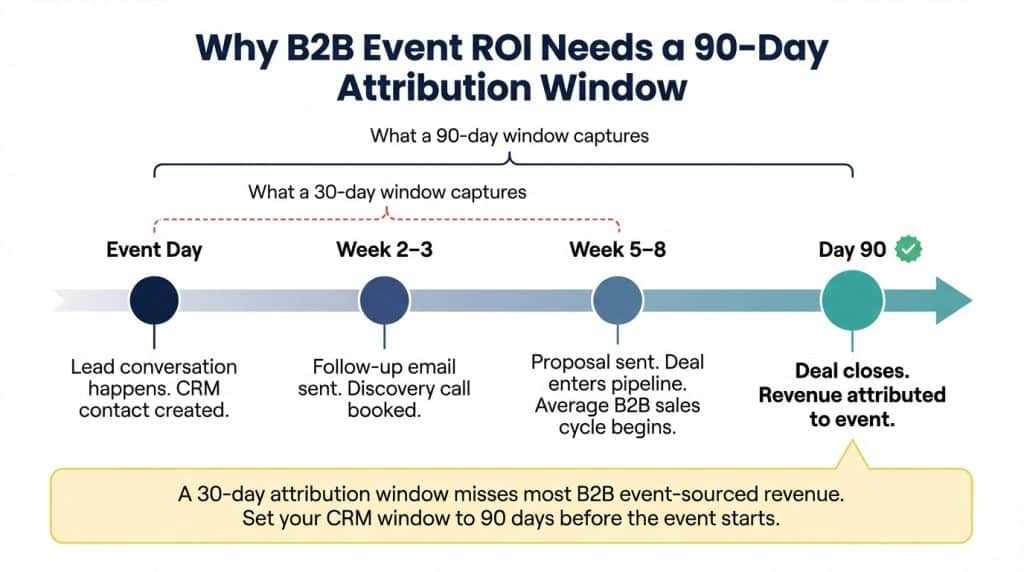
An important B2B-specific consideration: most deals do not close at the event. The attribution window for B2B events should be set to 90-180 days in your CRM, not the default 14 or 30 days. A contact who attended your booth in March and closed in August is still event-sourced revenue.
Pipeline attribution is often more useful than revenue ROI for B2B companies with long sales cycles. The formula: total pipeline value influenced ÷ total event cost. If you spend $50,000 on an event and attribute $500,000 in qualified pipeline, that is a 10:1 pipeline multiple. It does not matter that none of those deals have closed yet.
How Event Technology Makes ROI Measurable
Only 23% of businesses use event management software, according to Hailey’s experience at Event Cadence. For the 77% still running events on spreadsheets, the ROI problem is structural, not strategic. You cannot measure what you cannot track in real time.

Hailey makes the case with a concrete pharmaceutical industry example. Her clients rent 10 to 20 conference rooms for large medical congresses. Each room costs hundreds of thousands of dollars. Without platform data, they discovered on day three that only half the rooms were used, and on the last day, the meeting density was 5%.
With event technology, that data surfaces during the event. Not after.
That is the shift from reactive to proactive event ROI measurement. The platform gives planners data to act on while the event is still happening, not a report to rationalize after it ends.
Hailey lists the specific ROI signals her platform surfaces:
- Session check-ins: Who attended each session, and which sessions were underattended
- Material access: Which resources attendees opened and downloaded
- Live poll responses: Real-time engagement signals during sessions
- Room utilization: Booking density versus actual usage for trade show footprints
- Lead scans: Quantified sales conversations on the trade show floor
- Survey completion: Post-session feedback with measurable satisfaction scores
The platform creates, as Hailey calls it, a single source of truth. “Having that one source of truth has been really helpful for event organizers of companies and organizations of all sizes,” she notes. It happens in a 10-person nonprofit. It happens in a 10,000-person enterprise. Spreadsheets with 10 versions do not scale.
For funded B2B tech companies considering this shift, the measurement problem is not solved by buying software. It is solved by mapping the software’s data outputs to the business outcomes defined in step one. That connection is what transforms an event dashboard into an ROI story your board will understand.
Key Event ROI Metrics Every B2B Team Should Track
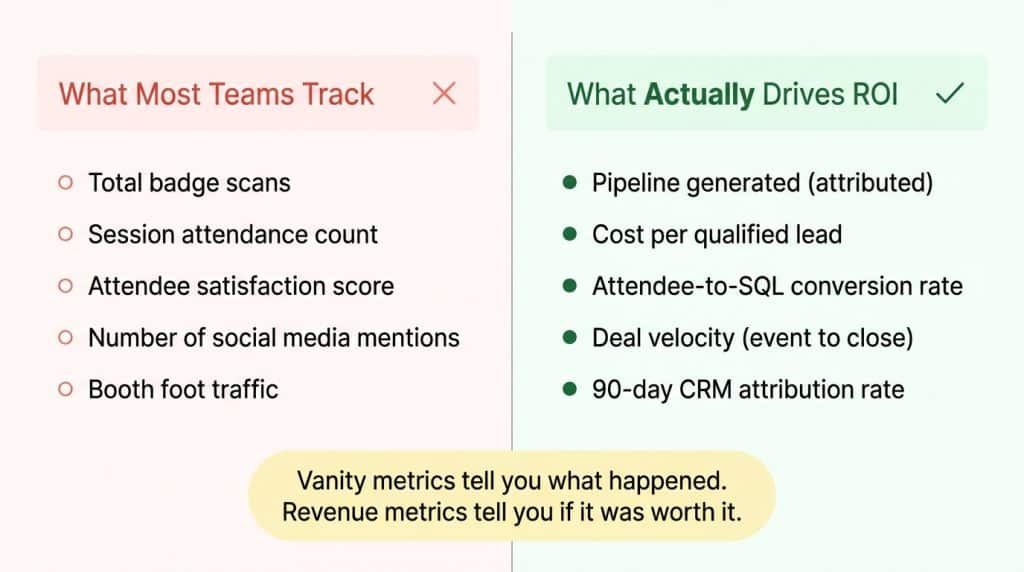
The most ROI-relevant B2B event metrics directly connect to revenue: sales-qualified leads generated, pipeline created within 90 days, meeting-to-opportunity conversion rate, cost per sales-qualified lead, and net revenue retention among event attendees versus non-attendees. Badge scans and session attendance are engagement metrics, not ROI metrics.
Here is how the key metrics break down by measurement stage:
| Metric | Stage | What It Measures | Target |
|---|---|---|---|
| Sales Qualified Leads (SQLs) | During / Post | Conversations that meet ICP and buying intent criteria | Set before event; track actual vs. target |
| Pipeline Created (90 days) | Post | Dollar value of opportunities opened within attribution window | 3x to 5x event cost minimum |
| Cost Per SQL | Post | Total event cost ÷ number of SQLs generated | Below your blended CPL from paid channels |
| Meeting-to-Opportunity Rate | Post | % of meetings that progress to qualified opportunities | 20% or higher for targeted events |
| Room / Booth Utilization | During | Actual usage vs. booked capacity for space | 70%+ utilization rate |
| Session Engagement Rate | During | Check-in rate × poll completion rate | 50%+ poll completion among attendees |
| Attendee NPS | Post | Net Promoter Score from post-event survey | 40+ for internal events; 30+ for external |
| Expansion Revenue (120 days) | Post | Upsell/cross-sell revenue from event attendees | Track separately from new pipeline |
I work with B2B founders who track every metric in the table above and report them in a single post-event dashboard. The companies that do this consistently get faster budget approvals for future events. The data tells a clear story: this is what events cost, and this is what they return.
The Networking ROI You Are Leaving on the Table
Most event ROI frameworks ignore networking entirely. They measure session attendance and lead scans. They miss the relationship value that extends months after the event ends.
In working with B2B founders on their event strategies, I find networking ROI is consistently the most undervalued element. Relationships that start at a well-run event often become the highest-quality pipeline. But only if there is a system to track and attribute them afterward.
Hailey describes the platform’s “recommended connections” feature as one of the highest-ROI elements they offer. When attendees are onboarded to the event app, they tag their profiles with professional interests. The platform recommends connections based on shared tags. Attendees message each other before the event, coordinate sessions during it, and maintain relationships afterward.
“There’s something inexplicable that happens when you’re in a space with many other people experiencing the same thing at the same time. Events really just bring something different to the table.”
Hailey Ingraham, Director of Marketing, Event Cadence
The networking ROI case for life sciences events is straightforward. Companies attend oncology congresses specifically to connect with researchers, clinicians, and procurement decision-makers. Those conversations have a dollar value. With an event platform, organizers can see how many bilateral meetings were scheduled, who participated, and which accounts had the highest engagement density.
Event Cadence ran the logistics for a major oncology congress serving 11 accounts, 300 meeting rooms, and over 5,000 attendees. At that scale, manual tracking is not just inefficient. It is impossible.
For B2B tech companies running user conferences, the networking ROI question to ask is: Which relationships that started at this event became customers or expanded accounts within six months? That answer requires connecting event attendance data to your CRM with a 90 to 180-day attribution window set before the event. Most companies do not have that connection built. Building it once is what turns event networking from a soft benefit into a measurable pipeline source. This is the core of how to measure event ROI in a B2B context: not just what happened at the event, but what changed in revenue and pipeline as a result.
The pipeline attribution calculation is simpler than most teams think. Take the total dollar value of opportunities where an event touchpoint appears in the contact’s history. Divide that by the total event cost. If the ratio is 5:1 or higher, the event is pulling its weight.
How to Use Post-Event Data to Improve the Next One
Post-event data is only useful if it changes a decision. Hailey Ingraham’s clients use room utilization reports to right-size their venue footprint at the next event. A pharmaceutical company that rented 10 conference rooms and used 5 at 50% capacity does not need 10 rooms next year. That single data point can reduce event costs by 30% to 40% without reducing meeting quality.
Beyond cost optimization, post-event data informs content decisions. Hailey’s team uses HubSpot to track which blog posts and event recap content continue to perform months after the event. Their best-performing post was written in 2020 and continues to drive traffic. They repurpose it, update it, and build new content around its core topic each year.
For event content specifically, the analysis should answer three questions:
- Which sessions had the highest attendance and survey scores? (Double down on those formats)
- Which speakers or topics drove the most post-event conversation? (Book them for the next event)
- Which attendee segments showed the highest engagement? (Focus acquisition budget on those profiles)
Hailey uses live polling during sessions as an early warning system. If 150 people checked into a session and only 10 completed the live poll, something is wrong. The data tells you in real time before the attendee walks out and never mentions the event again.
A pattern I notice working with funded B2B founders: the companies that improve their events fastest are not the ones with the biggest budgets. They are the ones who review their data within 48 hours of the event closing and run a structured debrief before anyone forgets what actually happened.
Trade Show ROI: What Actually Works for B2B Tech Companies
Trade shows are back. After the COVID-era pause, in-person events are the top growth driver for Event Cadence in 2024. But trade show ROI is notoriously difficult to measure. Hailey has a framework that cuts through the noise.
Her first rule: attend trade shows where the audience already matches your ICP, not shows where you hope your ICP might show up. Event Cadence focuses on niche life sciences, healthcare, and university conferences. A niche show with 500 right-fit attendees will outperform a 5,000-person general event every time.
Her second rule: create a reason to stop. Hailey’s most memorable trade show example involves luxury bathrobes. Her CEO noticed the bathrobes at a hotel, ordered 100 at under $20 each, and gave them away at their booth with the Event Cadence logo. The giveaway drove more conversations than any product demo. “That gets people’s attention,” she says. “Everyone deserves relaxation.”
The ROI measurement for trade shows should include:
- Conversations per day: Set a target before the show, track actual volume
- Lead scans with context: Badge scans are worthless without notes on the conversation
- Pipeline created within 90 to 180 days: The real ROI signal, tracked in your CRM
- Partnerships initiated: Referral agreements and preferred vendor arrangements
- Speaking slots: Whether you spoke and what registrations or inbound inquiries it drove
Hailey notes that Event Cadence had not prioritized speaking slots until recently. Now they are scheduled to speak at a March conference for the first time. The expectation: thought leadership visibility drives more qualified pipeline than booth traffic alone.
How Storytelling Connects Event Data to Revenue
Event ROI data tells you what happened. Storytelling explains why it matters to the people making budget decisions.
Hailey built her entire marketing approach around this principle. Her background is in broadcast journalism. Her strength is translating operational data into narratives that resonate. When she talks to customers or prospects, she does not lead with features. She leads with the pain everyone in the room already knows: “Remember having 10 versions of the spreadsheet and not knowing which one was current?”
That recognition moment is what drives action. Data creates the case. Stories create the motivation.
“If you can make someone relate it back to their own life or what they’re going through day to day, that’s the most successful way to market. It’s the most successful way to sell.”
Hailey Ingraham, Director of Marketing, Event Cadence
For B2B tech companies, this means the post-event report should not only contain a data table. It should contain a story. Which customer relationship started at this event and became a renewal? Which session created the insight that shaped the next quarter’s product roadmap? Which conversation led to the partnership announcement in Q3?
In my work with Series A and B companies building their event strategy, the companies that get budget approved for next year are not the ones with the most detailed spreadsheets. They are the ones who can tell the story of what the event changed. Data is the evidence. The story is what gets approved. Getting both right is how to measure event ROI in a way that earns continued investment.
💡 CEO Takeaways: How to Measure Event ROI
- Use the formula from the start. ROI = ((Total Value Generated − Total Event Cost) ÷ Total Event Cost) × 100. Build this calculation before the event, not after. Include staff time in the total cost.
- Set your CRM attribution window to 90-180 days. B2B deals do not close at the event. Set a minimum 90-day attribution window before the event starts so CRM data tells the full story.
- Track pipeline multiple, not just revenue. For events where deals close long after, pipeline value ÷ event cost is more useful than revenue ROI. A 5:1 pipeline multiple is a strong result.
- Use event technology to get data during the event, not after it. Room utilization, session check-ins, and live poll responses tell you what to fix while there is still time to fix it.
- Make the story as strong as the spreadsheet. The teams that get budget approved are the ones that can show what the event changed, not just what it cost.
Listen to the Episode
Some Areas We Explore in This Episode
- Why 67% of B2B marketers struggle to measure event ROI and the structural reason behind it
- How to define event success metrics before you sign a venue contract
- The room utilization data that can cut event costs without reducing outcomes
- How recommended connections features extend event value beyond the event dates
- Why in-person events are back as a top B2B growth channel in 2024
- The trade show giveaway strategy that outperformed product demos
- How storytelling connects event data to budget-holder decisions
- How AI will transform event ROI pattern recognition
- The difference between event ROI for internal company events versus life sciences congresses
- And much, much more
Frequently Asked Questions About How to Measure Event ROI
How do you calculate ROI for a B2B event?
The formula is: (Total Event Revenue − Total Event Cost) / Total Event Cost × 100. A 3:1 return ($3 in pipeline value for every $1 spent) is a realistic floor for most B2B events. Total costs must include venue, travel, staff time, technology, and post-event lead follow-up to get an accurate number.
What is a good ROI for a B2B event?
Industry benchmarks from OpenView Partners and Momencio suggest a 300–500% return on investment for well-executed B2B events. That means $3 to $5 in attributed pipeline or revenue for every $1 spent. Anything below a 3:1 return warrants a review of event selection, cost allocation, or follow-up execution.
How long should the attribution window be for event ROI?
Hailey Ingraham recommends a 90-day CRM attribution window for B2B events. Deals that originate from event conversations typically take weeks or months to close, so a 30-day window will undercount the true pipeline impact. Set the window in your CRM before the event so attribution is captured consistently.
What metrics should you track to measure B2B event ROI?
The five metrics that matter most are: pipeline generated (opportunities directly attributable to the event), cost per qualified lead, engagement rate (meaningful interactions per attendee), conversion rate from attendee to sales-qualified lead, and deal velocity (time from event contact to closed deal). Avoid vanity metrics like total badge scans or session attendance counts.
Why do most B2B companies get event ROI wrong?
Most teams measure outputs (badge scans, attendance numbers, session ratings) instead of outcomes tied to revenue. Without pre-event goal-setting, a defined CRM attribution window, and post-event follow-up tracking, the measurement becomes selective; teams highlight what went well and ignore what did not. The fix starts before the event, not after it.
Related Links
Connect with Hailey on LinkedIn or visit eventcadence.com
Related Resources From Sproutworth
- B2B Content Marketing Strategy: How to Build a System That Generates Pipeline
- B2B Digital PR: How Funded Tech Companies Build Authority That Converts
- Predictable B2B Success Podcast: 500+ Interviews With B2B Revenue Leaders
Subscribe to the Predictable B2B Success Podcast
Thanks for tuning in. If the insights from this episode helped you think differently about event ROI, please visit Apple Podcasts, subscribe to the show, and leave an honest review. Your feedback helps us reach more B2B founders and executives.
