


Last Updated: April 2026 — updated to include algorithm data, posting timing, funding-stage strategy, and AEO guidance.
Most B2B founders know they should be on LinkedIn. They save half-written posts in their notes app. They watch competitors rack up comments and inbound requests. Then they publish something generic, get 12 likes, and quietly conclude that LinkedIn doesn’t work for them.
LinkedIn generates 80% of B2B leads from social media, and founder profiles reach up to 10 times as many people as company pages. It’s not LinkedIn that isn’t working. It’s the absence of a system. A deliberate LinkedIn content strategy for B2B founders, built around your stage, your buyer, and your expertise, is one of the few things a seed-to-Series C founder can do right now that compounds without a 10-person marketing team.
What follows is the complete LinkedIn content strategy for B2B founders: profile setup, content pillars, posting cadence, pipeline conversion, and measurement. It directly builds a B2B SaaS pipeline that compounds rather than requiring constant manual outreach.
Table of Contents
What Is a LinkedIn Content Strategy for B2B Founders?
A LinkedIn content strategy for B2B founders is a structured publishing system that positions a founder as a credible voice in their category, earns the attention of enterprise buyers and investors before any sales conversation begins, and creates consistent inbound interest without paid distribution. It aligns content format, topic, cadence, and conversion architecture to specific business goals at a specific funding stage.
A LinkedIn content strategy generates a pipeline. Posting without one generates impressions.
That distinction defines whether your LinkedIn activity builds your pipeline or just fills your calendar.
For a funded B2B tech founder, this distinction is worth spelling out precisely. Impressions are a platform metric. Pipeline is a business metric. The entire architecture of a founder’s LinkedIn content strategy, from which content pillars you rotate through, to what conversion mechanism you attach to your posts, should be built backward from the pipeline outcome, not forward from a posting schedule.
According to the State of B2B Thought Leadership 2026 report by TopRank Marketing, 97% of B2B marketers say thought leadership is critical to full-funnel success, yet most companies still compete for attention after buyers have already formed their opinions. That pre-sales window is where a founder’s LinkedIn content strategy wins or loses deals.
“The founders I work with who started building content authority at Series A are the ones who have inbound from enterprise buyers by Series B, without hiring a 10-person marketing team.”
Why Most Founders Get LinkedIn Wrong
The mistake isn’t posting too little. It’s posting without a point of view.
Most B2B founders default to one of three broken patterns.
First, they share company news: funding announcements, product updates, and team hires. This content is relevant to existing stakeholders but invisible to prospective buyers who don’t yet know why they should care.
Second, they repost industry articles with a one-line comment. This signals that you read the news, not that you understand the problem better than anyone else.
Third, they post motivation-style content that performs well on engagement metrics but attracts no one with budget authority.
None of these approaches answers the question your ideal buyer is actually asking: Does this person understand my problem specifically enough that it’s worth my time?
A Series A founder I work with in the revenue intelligence space spent eight months posting company updates and earned exactly one inbound request, from a recruiter. We rebuilt their LinkedIn founder content strategy around a single point of view: that most SaaS companies were measuring pipeline velocity incorrectly and thereby compounding forecast errors. Within three months of publishing specific, counter-intuitive content on that thesis, they had four enterprise buyers requesting demos who cited LinkedIn as their first touchpoint.
The variable that changed wasn’t the posting frequency. It was the presence of a defensible perspective, consistently delivered to a clearly defined audience.
Optimize Your LinkedIn Profile Before You Post a Word
Every post sends readers to your profile. If the profile does not convert, the content effort leaks value.
Your LinkedIn profile is the foundation of any LinkedIn content strategy for B2B founders. If it doesn’t immediately answer “who does this person help and how,” every post you publish leaks value. Fix the profile first.
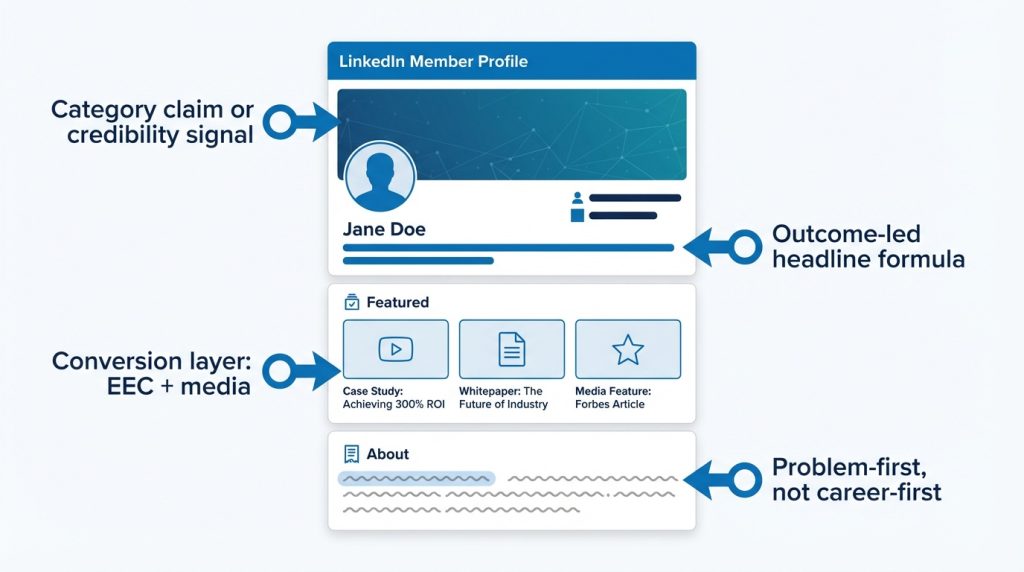
Headline
Most founders write their job title. That’s a waste of prime real estate. The formula that consistently works for B2B founder LinkedIn profiles: [What you do] for [who you do it for] so they can [outcome]. Example: “Helping Series A SaaS founders build enterprise pipeline through content, without a marketing team.” A buyer who matches that description will click through from a post before they’ve even finished reading it.
Featured Section
Use the Featured section as a conversion layer. One link to your educational email course or newsletter. One link to a podcast episode or media feature that signals category authority.
Keep it to two items maximum. A cluttered featured section signals someone who hasn’t thought about their buyer’s attention span.
About Section
Write the About section as a short-form sales page for your credibility, not a career summary. Open with the problem you solve. Follow with the specific outcomes you create. Close with a single call to action.
Three short paragraphs are enough. Nobody reads a six-paragraph About section on mobile.
Banner Image
Your banner should reinforce positioning, not act as decoration. The highest-converting banners for B2B founders state a specific claim or credibility signal: a key metric, a media logo, or a category statement. If your banner is a generic gradient or a stock photo of a cityscape, it is actively costing you profile conversions.
LinkedIn Strategy by Funding Stage: Seed vs Series A vs Series B
The right LinkedIn content strategy at seed stage differs fundamentally from that at Series B. The goal, audience, and conversion mechanism all shift by stage.
Most LinkedIn guides skip this when covering LinkedIn content strategy for B2B founders. They write for an abstracted founder with no funding context. The right LinkedIn content strategy at seed is not the same as at Series B. The goal, the audience, and the conversion mechanism all shift.
| Seed | Series A | Series B | |
|---|---|---|---|
| **Primary goal** | Credibility signal | Qualified attention | Category authority |
| **Content focus** | Category observations, market POV | Client outcomes, methodology | Frameworks, data, committee-wide reach |
| **Conversion mechanism** | None yet | Educational email course / newsletter | Newsletter + repurposing system |
| **KPI to track** | ICP profile views, investor notifications | DM volume from ICP, email list growth | Inbound demo requests citing LinkedIn |
| **Posts/week** | 1-2 | 2 | 2-3 with repurposing |
Seed Stage: Build Credibility, Not Pipeline
At seed, your primary LinkedIn job is not lead generation. It is a signal. Investors, future hires, and early enterprise buyers are all watching to assess whether you have genuine category expertise.
The LinkedIn founder content that works here is thought-provoking and specific: sharp observations about your market, counter-intuitive takes on industry norms, and early data from your own customers. Forget follower count. Track whether the right people are showing up in your notifications: the investors you want to know, the buyers who match your ICP, the journalists covering your space.
Series A: Shift From Credibility to Qualified Attention
At Series A, you have enough proof points to start building a pipeline directly. The LinkedIn content strategy for B2B founders shifts toward operational transparency: what you’re building, how it works, what your customers are achieving. A pattern I notice across Series A founders who use LinkedIn well: they rotate between category insight (building credibility with new audiences) and client outcome content (converting existing followers into pipeline). The conversion mechanism becomes critical here: an educational email course or newsletter that captures the warm audience your LinkedIn posting strategy is building for you.
Series B: Authority at Scale
At Series B, your LinkedIn strategy needs to reach not just your direct buyers but their entire buying committee. According to LinkedIn’s B2B Marketing research, the average buying committee now includes 6 to 10 stakeholders.
Your content needs to travel. That means frameworks shared internally, data points cited in board decks, and a consistent category narrative that makes your company the reference point in your space.
This is also the stage where content repurposing compounds: one founder interview becomes five LinkedIn posts, a newsletter edition, and a podcast episode. Systems matter more than individual posts at this stage.
The Four Content Pillars That Drive B2B Pipeline
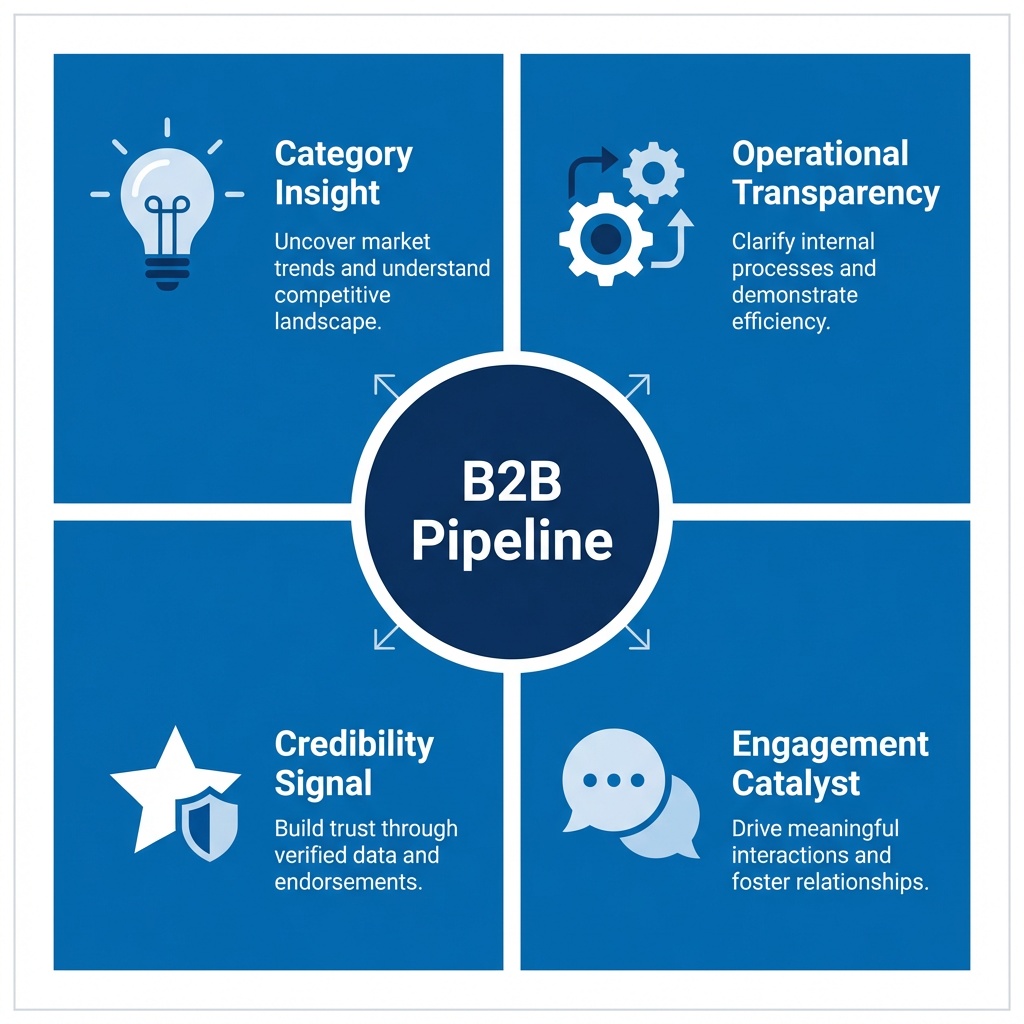
An effective LinkedIn content strategy for B2B founders rests on four content types. Each serves a different function in the buyer journey, and the best-performing founder accounts publish across all four on a rotating basis.
1. Category Insight Posts
These are your point-of-view posts. You take a widely held belief in your category and challenge it with evidence from your own experience.
They signal category expertise and attract buyers already researching your problem space. Aim for one per week. These are the posts that get saved, shared in Slack channels, and forwarded to decision-makers.
2. Operational Transparency Posts
Share how your team solves a problem your buyer faces. Not a feature announcement: a methodology. “Here’s how we helped a Series B logistics company reduce churn by 22% in 60 days, and the three decisions that made it work.” These convert awareness into trust faster than any case study PDF because they’re specific, conversational, and frictionless to read.
3. Credibility Signal Posts
Milestone announcements, media mentions, award recognitions, and podcast appearances, but framed around the insight, not the ego. Instead of “Excited to be featured in Forbes,” write: “Forbes asked me why so many Series B companies stall on content. Here’s what I told them, and what I left out.” The reframe shifts it from a brag to a useful perspective that happens to mention the credential.
4. Engagement Catalyst Posts
Posts explicitly designed to draw your ICP into conversation. A question for your buyer. A poll with an unexpected result. A “we got this wrong” post about a decision your team made. These posts don’t close deals. They open threads with future buyers who reveal themselves through engagement.
“The best-performing founder content strategy in B2B tech right now combines two text posts per week with one short video every two weeks. Sustainable, multi-format, and executable without a content team.”
How to Write Hooks That Stop the Scroll
Your first line determines whether anyone reads the rest. Most B2B founders lose their reader in sentence one.
Your first line is your entire post. If it doesn’t earn the next line, nothing else matters. Most B2B founders write openers that are either too vague (“Something I’ve been thinking about lately…”) or too corporate (“We’re excited to share…”). Neither stops anyone.
Four hook formulas that work within any LinkedIn content strategy for B2B founders, with examples you can adapt:
The costly mistake: “Most Series A founders kill their LinkedIn presence in the first 90 days. Here’s the exact mistake they make.”
The specific number: “We lost a $180K deal last quarter. One LinkedIn post brought it back. Here’s what happened.”
The counter-intuitive claim: “Posting five times a week on LinkedIn is slower than posting twice. I have data on this.”
The direct address: “If your LinkedIn posts are getting 20 likes and zero DMs, you don’t have a content problem. You have a conversion architecture problem.”
Notice what each of these has in common: a specific claim, a buyer who recognizes their own situation, and an implied answer the reader has to keep reading to get. That’s the formula. The topic changes. The structure doesn’t.
Posting Frequency and Format: What Actually Works
The data from Marina Byezhanova at Brand of a Leader, who advises CEOs and founders on personal branding, is clear: one to two posts per week is the optimal frequency for most founders. Consistency matters more than volume. A founder who executes a LinkedIn content strategy for B2B founders consistently, publishing two sharp, specific posts weekly for 12 months, compounds authority faster than one who posts daily for six weeks and disappears.
Format choices also drive reach. Based on patterns across funded B2B tech founders building LinkedIn posting strategies:
- Text-only posts with a strong first line remain the highest-reach format for founders with under 5,000 followers. The algorithm rewards posts that keep people on the platform. Avoid putting links in the body of a text post and drop them in the first comment instead. LinkedIn suppresses external links in the main post body.
- Document carousels generate the highest save rates, which LinkedIn weighs heavily as a proxy for content value. CXL’s analysis of over 100,000 LinkedIn posts found carousels generate 11.2 times more impressions than text-only updates. Use them for step-by-step frameworks and before/after comparisons.
- Short-form video (60 to 90 seconds, no production required) is the fastest path to trust with an audience that doesn’t yet know you. Authenticity beats production value at every follower count.
- Native LinkedIn articles serve a separate function: they’re indexable, increasingly cited by AI answer engines like Perplexity and Google AI Overviews, and they compound in discoverability long after publishing. Write one per month on a high-intent topic your buyer is actively searching for. This is the bridge between your LinkedIn content strategy and AEO visibility. Native articles are treated as standalone content by search and AI engines, meaning your LinkedIn posting strategy can generate organic search traffic with zero additional effort.
| Format | Best for | Reach signal | Primary value |
|---|---|---|---|
| Text-only post | POV, hooks, stories | High for <5K followers | Thought leadership |
| Document carousel | Frameworks, step-by-step | 11.2x impressions vs text | Saves, shares |
| Short-form video | Trust-building, introduction | Highest trust transfer | Audience warmth |
| Native article | SEO, AEO, deep expertise | Indexed by search + AI engines | Long-tail discoverability |
| Poll | ICP segmentation, engagement | Engagement catalyst | Lead identification |
Best Posting Times and Optimal Post Length
According to CXL’s analysis of LinkedIn internal data, Sunday is now the highest-performing day for organic reach. For maximum global reach, post at 4-5 AM GMT or 11 AM-1 PM GMT. Posts between 1,242 and 2,500 characters perform 32% better than shorter or longer content, and conversational posts between 1,300 and 3,000 characters perform 38% better.
Limit hashtags to 1-2 per post. Using more than 3 reduces reach, according to LinkedIn’s 2025 internal data.
The Podcast-to-LinkedIn Repurposing System
One angle no generic LinkedIn guide covers: if you have a podcast, media appearances, or regular speaking commitments, you already have a content system. One 45-minute founder interview, properly processed, produces five LinkedIn posts (one per content pillar), a LinkedIn newsletter edition, and a long-form article. The thinking happens once. The content appears all week. In my work with B2B tech founders who are also podcasters, this is the single highest-ROI content operation available, yet almost no one in the market packages it as a system. It directly builds a sustainable B2B pipeline that doesn’t depend on constant manual effort.
How to Turn LinkedIn Visibility Into Pipeline
LinkedIn visibility without a conversion mechanism is brand awareness, not pipeline. Three mechanisms turn engaged followers into buyers.
Visibility without conversion architecture is just brand awareness with extra steps. The LinkedIn content strategy for B2B founders needs a mechanism that moves engaged readers toward a buying conversation without forcing it.
The Insight-to-DM Flow
Your category insight post generates comments. Reply to every comment in the first two hours, not with “thanks!” but with one additional specific observation. Among the commenters, you’ll find buyers. Send them a brief DM: “Noticed you engaged with my post on [topic]. I have a longer version of this framework specifically for [their industry]. Happy to share it if useful.” No pitch, no call, ask, a resource offer. This is the LinkedIn equivalent of permission-based first touch, and it converts to introductory calls at rates that cold outreach never approaches.
The Educational Email Course CTA
Pin a post that links to a lead magnet, specifically an educational email course built around your buyer’s biggest problem. Not a PDF. A multi-part email course that delivers one specific insight per email over 5 to 7 days. It self-selects serious buyers from casual browsers, puts your thinking in front of them daily for a week, and gives you a permission-based email relationship that exists outside LinkedIn’s algorithm.
The Newsletter Bridge
Your most engaged LinkedIn followers will convert to newsletter subscribers if you give them a specific reason. “I go deeper on this in my weekly newsletter for B2B tech founders, link in comments” placed on a performing post drives consistent list growth. The newsletter relationship is durable in a way that LinkedIn reach is not. You own it, you control the send, and it compounds into a pipeline asset that survives algorithm changes. This connects directly to building B2B relationships that convert over time rather than through single-touch outreach.
What to Expect Month by Month: The Three Phases
LinkedIn results appear in three phases: no inbound at 0-6 months, warm outreach at 6-12 months, and compounding inbound at 12 months and beyond.
The biggest reason founders abandon their LinkedIn content strategy for B2B founders is one thing: unrealistic expectations. They expect results in 30 days from a channel that pays back over 12 months. Here’s an honest phase breakdown based on what I observe across funded B2B tech founders who commit to it.
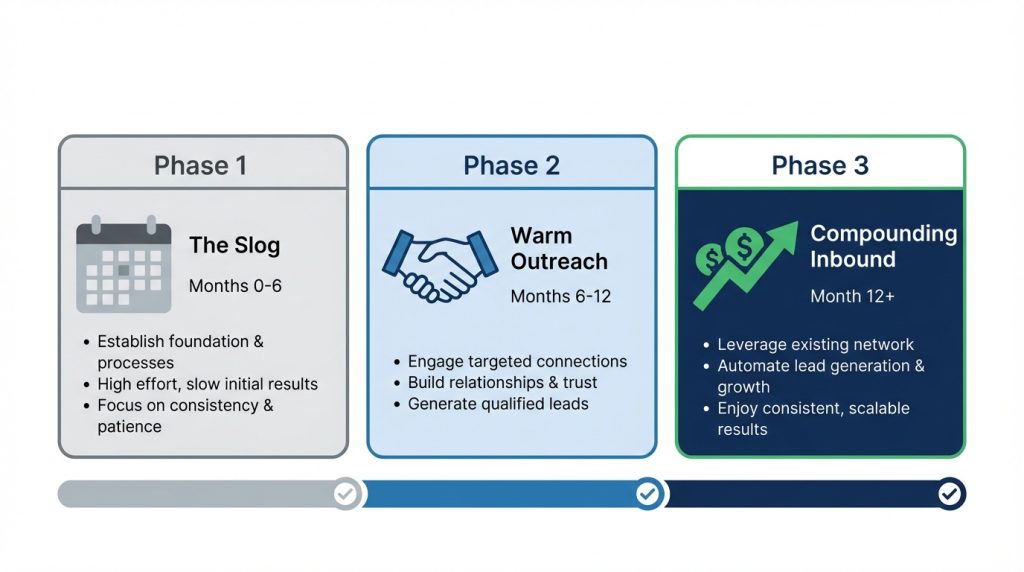
Phase 1: Months 0-6 (The Slog)
Expect almost no inbound leads from content alone. Engagement will be modest. Some posts will feel like they disappeared entirely. This is normal and not a failure signal. What is happening during this phase: your profile is being indexed, your consistent presence is building social proof, and the buyers you are doing outbound to are checking your profile and finding someone who clearly knows their industry. Reply rates on outreach typically improve because your profile backs up your credibility claims. Stay consistent. Two posts per week, every week. This phase is the cost you pay for the compounding that comes later.
Phase 2: Months 6-12 (Warm Outreach)
You will start seeing genuine engagement: a few dozen reactions on stronger posts, comments from people in your ICP, and occasional DMs that aren’t from recruiters. This is the phase where proactive outreach to engaged followers pays the highest returns. When someone who matches your ICP likes or comments on a post, that’s a warm signal. Reach out, thank them specifically for their engagement, offer a relevant resource, and start a conversation. These aren’t cold leads. They’ve already shown interest. Treat them accordingly.
Phase 3: Months 12 and Beyond (Compounding Inbound)
This is where the B2B founder’s LinkedIn content strategy pays back with interest. Inbound connection requests from buyers. Deals that reference a specific post. Speaking invitations and media requests that trace back to your LinkedIn presence. The founders I work with who reach this phase describe a qualitative shift: enterprise buyers arrive on introductory calls already convinced of their expertise, compressing the sales cycle significantly. The critical success factor across every founder I’ve seen reach this phase is identical. They never stopped during Phase 1.
How Do You Measure Whether Your LinkedIn Strategy Is Working?
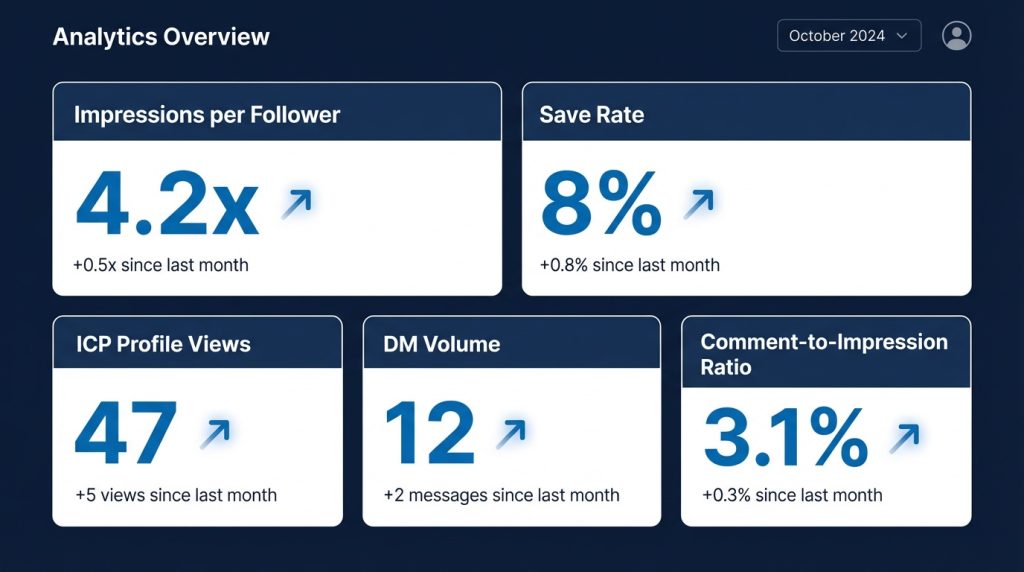
Track five metrics: impressions per follower, save rate, ICP profile views, DM volume, and comment-to-impression ratio. Vanity metrics like follower count will mislead you. Follower count and total impressions tell you almost nothing about pipeline impact. These are the signals that actually matter when running a LinkedIn content strategy for B2B founders:
Impressions per follower tells you whether your content is reaching beyond your existing audience. A post that gets 2,000 impressions with 500 followers is distributing well. The same 2,000 impressions with 10,000 followers signal weak distribution.
Save rate is LinkedIn’s strongest signal of quality. When someone saves your post, they found it useful enough to return to. A high save rate on a category insight post means it’s genuinely valuable, not just scroll-stopping.
Profile views from ICP accounts are the metric most founders never track, and it is one of the most actionable. Check your profile, view notifications weekly. If the right job titles at the right company sizes are viewing your profile after posts, the content is reaching your target audience, even if engagement looks modest.
DM volume and quality are the most direct pipeline signals. Track how many unsolicited DMs you receive per month, and whether the senders match your ICP. As the LinkedIn content strategy compounds, this number should increase month on month.
Comment-to-impression ratio measures how provocative and specific your content is. Generic posts get reactions. Specific, opinionated posts generate comments. A high comment rate on a post with modest reach often outperforms a high-impression post with no engagement in terms of pipeline signal.
Set a monthly 20-minute review. Look at these five metrics. Double down on what generated saves and ICP profile views. Adjust or cut what generated impressions, but nothing more actionable. For a deeper view of how content performance connects to broader pipeline health, the post on generative engine optimization for B2B covers how AI-mediated discovery is changing what “performance” means in 2026 and beyond.
Common Mistakes That Kill LinkedIn Momentum for Founders
Five mistakes kill LinkedIn momentum: inconsistent posting, AI-generated content, ignoring early comments, posting only company news, and siloing LinkedIn from the rest of your content system.
After working with funded B2B tech founders on content systems and interviewing hundreds of revenue leaders on the Predictable B2B Success podcast, certain failure patterns repeat. These are the ones worth explicitly avoiding.
Posting inconsistently. One viral post followed by three weeks of silence does not build authority. It trains the algorithm and your audience to stop expecting you. Consistency over months is the only LinkedIn content strategy for B2B founders that works in the long term. Two posts per week for 52 weeks compounds into something a burst of daily posting for six weeks never will.
Using AI to write everything. AI-generated content is increasingly obvious. LinkedIn audiences have calibrated to it, and the algorithm has too. The founders whose content performs best in 2026 use AI to structure and refine their thinking, not to replace it. Your genuine expertise, expressed in your actual voice, is the asset. Outsourcing your perspective to a language model doesn’t produce thought leadership. It produces content.
Ignoring comments for the first two hours. LinkedIn’s algorithm scores each post’s early engagement velocity. Replying substantively to comments within the first two hours signals active engagement and helps the post spread further. Founders who post and disappear for the rest of the day are systematically reducing their own reach.
Only posting about their company. Nobody follows a company’s PR department for genuine insight. The founders who build audiences worth having are the ones who share observations and opinions that would be valuable even if you’d never heard of their company. Company news belongs in press releases. LinkedIn is for genuine expertise.
Treating LinkedIn as a channel separate from the rest of their content system. The founders who see the fastest compounding results are those who treat LinkedIn as part of an integrated content operation: podcast insights become posts, posts become newsletter sections, and newsletter data becomes LinkedIn content. Each channel feeds the others. Siloed LinkedIn management, divorced from everything else the founder is thinking and saying, is both exhausting and ineffective.
Do You Need a LinkedIn Ghostwriter as a Founder?
A LinkedIn ghostwriter works when the founder contributes 60-90 minutes of genuine expertise per week. Without that raw material, the content reads as generic.
The right answer turns on one question: do you have the time to execute a LinkedIn content strategy for B2B founders consistently, or is the cost of inconsistency, stalled pipeline, slower authority building, higher than the cost of the help?
A good LinkedIn ghostwriter for founders amplifies and structures the founder’s existing thinking. They conduct regular interviews, extract the specific insights that only the founder has, and turn them into publishable content that sounds like the founder, because it is the founder’s thinking, packaged for the platform. What they cannot do is manufacture a genuine point of view that the founder doesn’t actually hold. The content has to be grounded in real expertise, or it reads like every other generic LinkedIn carousel from a company page.
The founders I work with who get the most from LinkedIn ghostwriting are the ones who can spare 60 to 90 minutes per week on a structured interview or voice note session. That’s the raw material. The ghostwriter handles the rest: post structuring, format selection, scheduling, and reply management. The result is a founder who appears consistently on LinkedIn without LinkedIn consuming the time a Series A CEO simply doesn’t have.
According to Impactable’s 2025 LinkedIn strategy guide, the average B2B buying committee now takes 6 to 10 stakeholders to close a deal, and LinkedIn thought leadership content reaches multiple members of that committee simultaneously, which no other channel does at this cost. That ROI argument for investing in consistent LinkedIn content, whether self-published or ghostwritten, only gets stronger as buying committees grow.
CEO Takeaway
- Fix the profile before the first post. Headline, featured section, and about section as a conversion layer, not a CV.
- Match your LinkedIn content strategy for B2B founders to your funding stage. Seed is credibility building. Series A is qualified attention. Series B is category narrative at buying committee scale.
- Rotate across all four content pillars: category insight, operational transparency, credibility signal, and engagement catalyst.
- Set realistic phase expectations. Months 0 to 6 is the slog. Months 6 to 12 is warm outreach. Month 12 and beyond is compounding inbound. Founders who quit in Phase 1 never see Phase 3.
- Measure what matters: impressions per follower, save rate, ICP profile views, DM volume, and comment-to-impression ratio. Follower count is vanity. Pipeline signal is the metric.
Frequently Asked Questions
What is a LinkedIn content strategy for B2B founders?
A LinkedIn content strategy for B2B founders is a structured publishing system that positions the founder as a credible category voice, builds trust with enterprise buyers before any sales conversation begins, and creates consistent inbound interest through deliberate content formats and cadence aligned to specific business goals and funding stage. It includes profile optimisation, content pillar selection, posting cadence, and a conversion mechanism to capture engaged audiences.
How often should a B2B founder post on LinkedIn?
One to two posts per week is the optimal frequency for most B2B founders. Consistency over months matters far more than volume in any single week. A founder who publishes two sharp, specific posts weekly for 12 months builds compounding authority faster than one who posts daily for six weeks and stops. Pairing text posts with occasional short-form video every two weeks covers multiple formats without requiring a content team.
What types of LinkedIn posts generate the most B2B pipeline?
Category insight posts, where you challenge a widely held belief in your space with evidence from your own experience, generate the highest-quality pipeline because they attract buyers already researching the problem you solve. Operational transparency posts showing methodology rather than just outcomes convert awareness into trust faster than case study PDFs. Both formats significantly outperform company news and generic thought leadership in driving inbound qualified conversations.
How long does it take to see results from a LinkedIn content strategy?
Most founders executing a LinkedIn content strategy for B2B founders see early signals within six to eight weeks of consistent, specific posting: ICP profile views, comment engagement from the right job titles, improved outreach reply rates. Meaningful pipeline attribution typically appears at the three-to-six month mark. Predictable inbound from enterprise buyers who cite LinkedIn as a touchpoint usually takes nine to twelve months of consistency to establish reliably.
Can a B2B founder outsource their LinkedIn content to a ghostwriter?
Yes, effectively, provided the founder contributes 60 to 90 minutes per week to a structured interview or voice note session. A skilled LinkedIn ghostwriter for B2B founders extracts and structures the founder’s genuine thinking. The content needs to sound like the founder because it is the founder’s expertise, packaged for the platform. Founders who try to ghostwrite content disconnected from their real knowledge produce content that reads as generic and converts at a fraction of the rate of authentic expertise.
What should a B2B founder post on LinkedIn?
B2B founders should rotate across four content types: category insight posts that challenge a common belief in their space, operational transparency posts showing how they solve client problems, credibility signal posts that anchor media or milestone mentions in a useful insight, and engagement catalyst posts that draw ICP buyers into direct conversation. Avoid company news, motivational content, and generic industry takes. Every post should answer one question for your ideal buyer: does this person understand my problem better than anyone else?
When is the best time to post on LinkedIn for B2B founders?
The best times to post on LinkedIn are 4-5 AM GMT or 11 AM-1 PM GMT to maximise global reach. Sunday is the highest-performing day for organic reach according to LinkedIn internal data from 2025. Tuesday through Thursday also perform well. Consistency matters more than precision on timing. A strong post at an off-peak time outperforms a weak post at the optimal hour.
Should a B2B founder post from their personal profile or company page?
Post from your personal profile first. Founder personal profiles generate up to 10 times more organic reach than company pages because LinkedIn’s algorithm favours person-to-person distribution over brand broadcasts. Your personal profile also builds the founder’s individual authority, which compounds into investor, buyer, and media trust that a company page cannot replicate. Use the company page to reshare top-performing personal posts, not as the primary content channel.
Is LinkedIn worth it for B2B marketing in 2025?
Yes, and the ROI case is stronger in 2025 than in 2023. LinkedIn generates 80% of B2B leads from social media. The average buying committee includes 6 to 10 stakeholders, and LinkedIn is the only platform where a founder’s content reaches every member organically before any sales conversation begins. Native LinkedIn articles are also increasingly cited by AI answer engines including Perplexity and Google AI Overviews, meaning a consistent LinkedIn content strategy for B2B founders now generates both social and search discoverability simultaneously.
Where to Start This Week
The most effective LinkedIn content strategy for a B2B founder isn’t the most complex one. It’s the one that gets executed.
Start with the profile. Rewrite the headline to state the outcome you create for your buyer. Update the About section to open with the problem you solve, not your career history. Set the featured section to one resource that converts.
Then write your first category insight post. Pick one belief your ICP holds that you think is wrong. Write 200 words that challenge it with a specific example from your own experience. Publish it on Tuesday or Wednesday morning. Reply to every comment within two hours.
That’s the first post of a LinkedIn content strategy for B2B founders that, maintained with discipline over 12 months, will reach more enterprise buyers than any outbound campaign you could run at the same cost.
If you’re at the stage where you know the LinkedIn content strategy for B2B founders but don’t have the time to execute it consistently, this is the kind of LinkedIn ghostwriting work I do for funded B2B tech founders at Sproutworth. The thinking stays yours. The system that makes it consistent becomes mine.
Related Resources
- B2B SaaS Pipeline Strategy: A 5-Step CEO Framework
- B2B Relationship Building That Gets 60% Response Rates
- Generative Engine Optimization: 5 Critical Mistakes Costing Your B2B Pipeline
- SaaS Content Marketing: The Ultimate CEO’s Guide
- Why Most B2B Sales Culture Efforts Quietly Fall Apart
