
📌 Key Takeaways (90-Second Read)
- B2B content-led growth uses educational content as the primary go-to-market mechanism, not a marketing add-on
- 70% of the B2B buying decision happens before a prospect ever contacts your sales team, content fills that gap
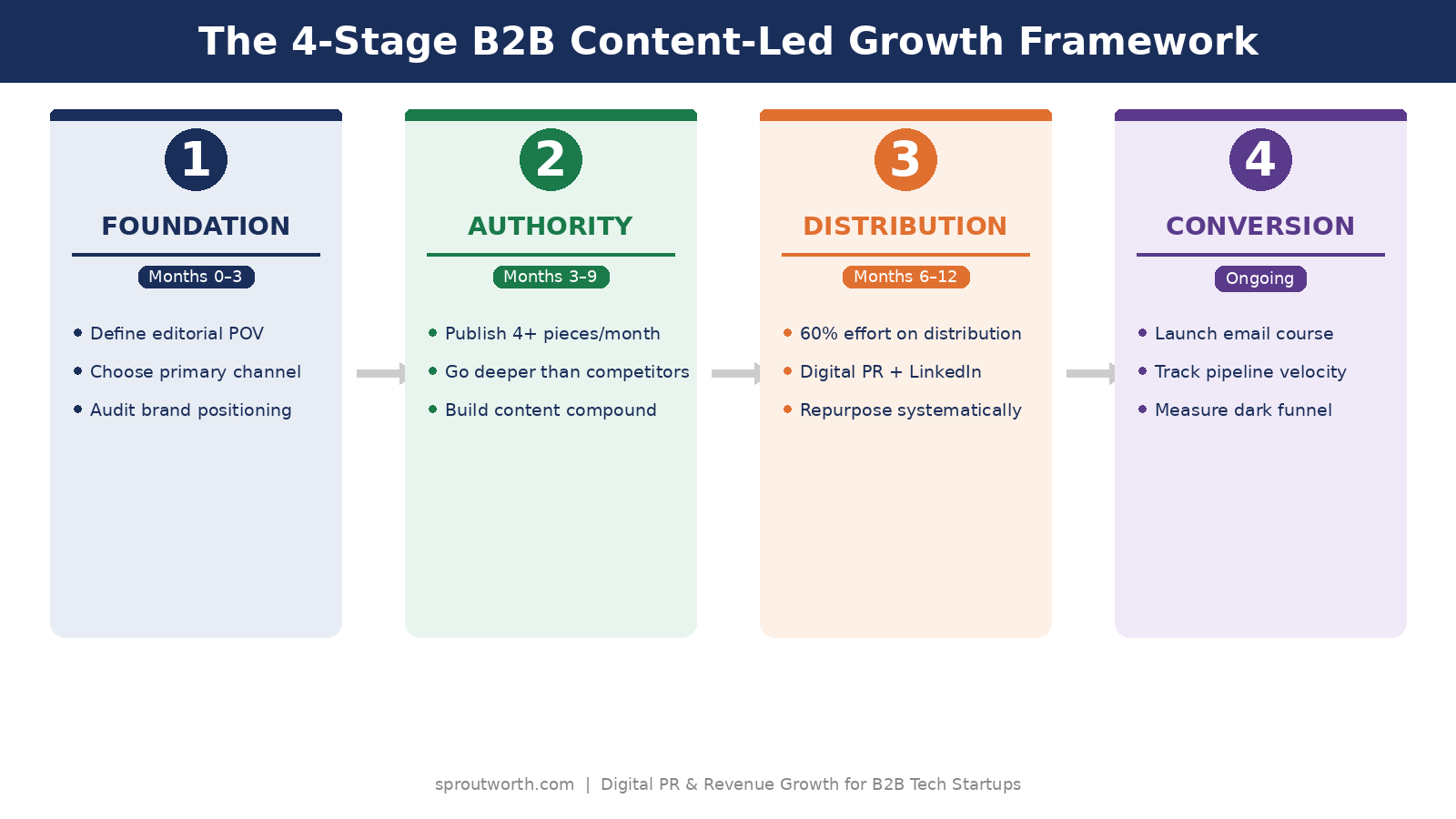
- The companies winning with it follow a 4-stage sequence: Foundation, Authority, Distribution, Conversion
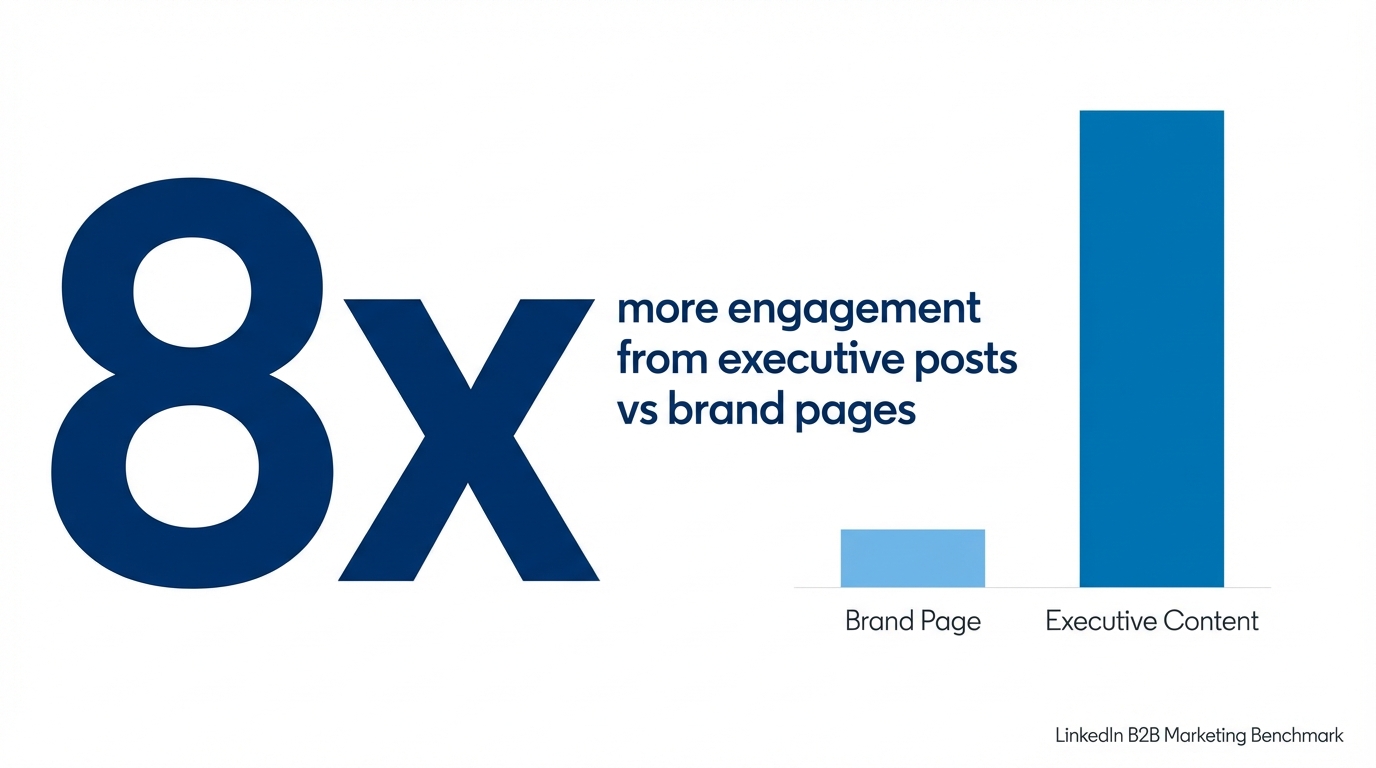
- Founder-led content on LinkedIn generates 8x more engagement than brand page content, and drives qualified pipeline
- Content-led growth compounds; paid acquisition doesn’t, the ROI math shifts completely at the 9-month mark
- Educational email courses convert at 5.31%+ for top performers vs. 0.5–1% for standard gated content
Table of Contents
Most B2B content strategies fail for one reason.
Not because the content is bad. Not because the team lacks talent.
They fail because the company treats b2b content-led growth as a traffic problem when it’s actually a trust architecture problem.
I’ve seen this pattern across hundreds of conversations with funded founders on the Predictable B2B Success podcast. A Series A company raises $5M, hires a content agency, publishes 20 blog posts, then abandons the strategy at month 4 when the pipeline doesn’t materialize.
The problem wasn’t the content. It was the strategic intent behind it.
After ghostwriting positioning and content strategies for funded B2B tech companies from seed to Series C, the pattern is consistent: companies that build genuine content-led growth treat content as a commercial infrastructure asset, not a marketing deliverable. Companies that fail treat it as a task to be completed.
This article is the framework that separates the two.
What Is B2B Content-Led Growth (And What It Isn’t)?
B2B content-led growth is a go-to-market strategy in which high-value educational content serves as the primary mechanism for generating awareness, building buyer trust, and driving qualified pipeline, without relying on paid advertising as the core acquisition channel.
That last clause matters.
Content-led growth isn’t the same as “doing content marketing.” Most B2B companies do content marketing. They publish blogs for SEO, share posts on LinkedIn, and send newsletters. They treat content as one channel among many.
Content-led growth is a strategic commitment. It means content is the engine your go-to-market runs on, not a support function for demand generation.
It’s also distinct from product-led growth (PLG). PLG uses the product itself as the acquisition and expansion mechanism, think freemium SaaS, trials, viral product loops. Content-led growth uses expertise and education as the mechanism for acquisition. The two aren’t mutually exclusive, but they require entirely different investments, timelines, and measurement approaches.
For most funded B2B tech companies, especially in complex categories like cleantech, fintech, and enterprise SaaS, content-led growth is the more viable path. Your product isn’t something a prospect can “try and decide.” Your category requires trust before trial.
Why B2B Buyers Have Already Made Up Their Mind Before You Call Them
Here’s the statistic that should change how every B2B CEO thinks about their go-to-market:
According to Gartner’s B2B Buying Report, 70% of the buying decision is made before a prospect ever engages with your sales team. They’ve read the articles. Watched the LinkedIn posts. Shared your newsletter in a Slack channel. Formed an opinion.
By the time they appear in your CRM, the content has already won or lost.
This is what Forrester calls the “dark funnel”, the 60–70% of the B2B buying journey that happens outside your tracked channels, invisible to standard attribution models. Buyers are consuming your content months before converting. Forwarding your emails to colleagues. Discussing your perspective in executive forums.
The implication is direct: if your content isn’t building trust with buyers in the 70% of their journey you can’t see, your pipeline is being decided for you.
This is why b2b content-led growth produces compounding returns where paid acquisition doesn’t. Every piece of high-quality content is a 24/7 trust-building asset. Paid ads stop working the moment you stop paying. Content equity grows with every month it’s live.
In my work developing content strategies for Series A and B tech companies, I’ve seen this dynamic play out consistently. A well-crafted educational article placed at the right moment in a buyer’s self-directed research doesn’t just generate a lead; it also drives sales. It closes the deal before the sales call starts.
Content-Led Growth vs. Product-Led Growth: Which One Fits Your Stage?
This distinction matters more than most funded founders realize.
| Factor | Content-Led Growth | Product-Led Growth |
|---|---|---|
| Primary mechanism | Education and expertise | Product trial and adoption |
| Best fit | Complex, high-trust categories | Self-serve SaaS, clear ROI products |
| Time to first result | 6–9 months (compounds) | Days to weeks (faster initial signal) |
| Sales cycle impact | Shortens through trust-building | Shortens through product experience |
| Investment type | Content creation + distribution | Product freemium + in-app experience |
| Founder skill requirement | Expertise and narrative | Product design and growth loops |
| Ideal funding stage | Seed–Series C (all stages) | Series A+ (needs product maturity) |
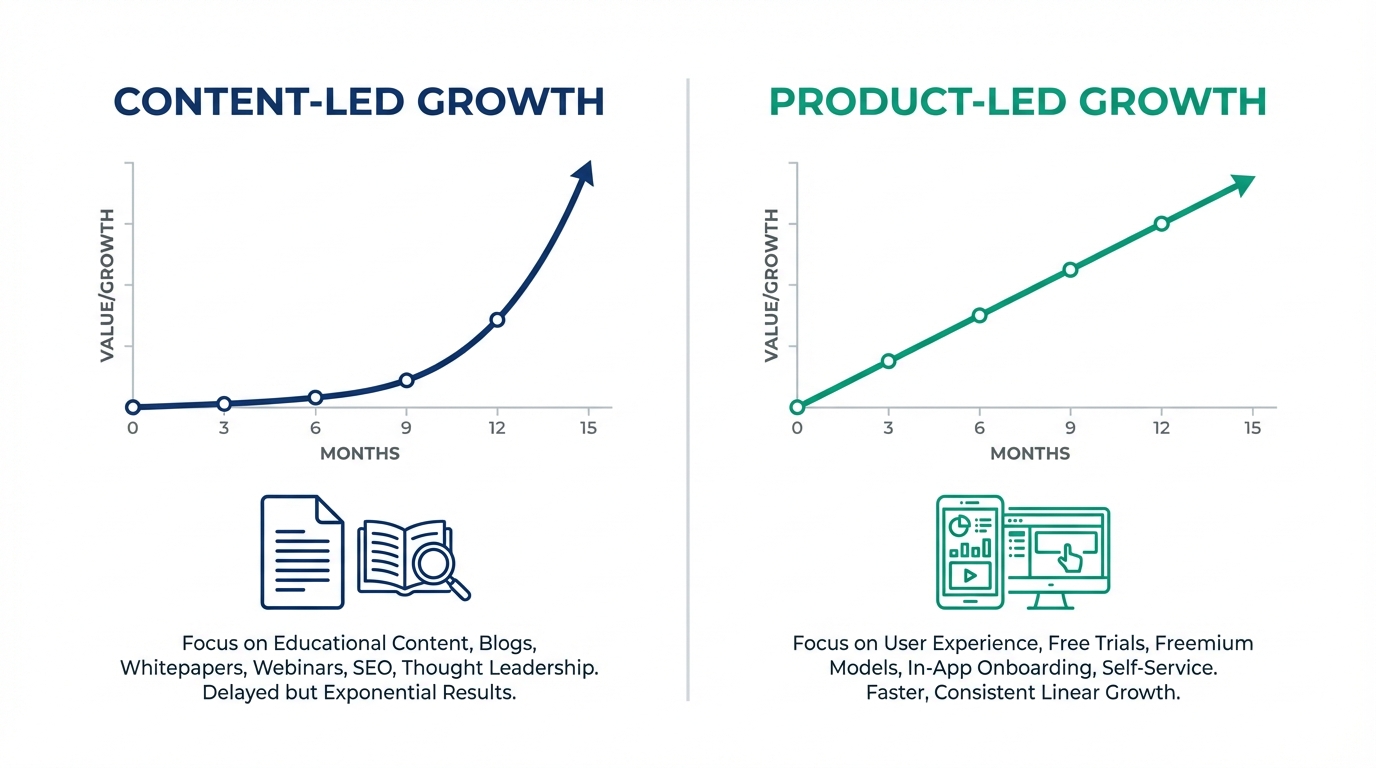
For most B2B tech companies targeting enterprise buyers, especially those involving procurement, legal, or multiple stakeholders, content-led growth is the more strategic bet.
A cleantech company selling carbon accounting software to enterprise procurement teams isn’t going to convert a CFO through a free trial. They convert through 6 months of consistent thought leadership that makes their CEO the most credible voice in the category.
That’s content-led growth doing what PLG cannot.
The 4-Stage B2B Content-Led Growth Framework
Across 500+ interviews with founders, growth leaders, and CMOs on the Predictable B2B Success podcast, and in my own client work, a consistent framework has emerged. Companies that succeed with b2b content-led growth move through four distinct stages. Companies that fail usually skip Stage 1 or abandon the strategy between Stages 2 and 3.
Stage 1: Foundation (Months 0–3)
Before publishing a single word of content, the strongest content-led growth companies spend time on three things:
An editorial point of view (POV) they can own. Generic perspectives produce generic content. The companies that cut through the noise own a specific, contrarian stance in their category. “Sustainable infrastructure takes longer to build than software” is an example of a POV. “Content is king” is not.
A specific ICP, not a broad audience definition. The tighter the target, the more resonant the content. “Series A fintech CEOs navigating enterprise sales cycles” produces better content than “B2B SaaS companies.”
A primary channel. Distributing across 8 channels from day one produces mediocre content everywhere. Choosing one primary channel, LinkedIn, a newsletter, a podcast, long-form SEO, and doing it exceptionally well is the discipline that pays off.
The foundation stage also requires an honest audit of whether the category needs education or has existing awareness. Getting your brand differentiation strategy right before investing in content prevents the most expensive content mistake: creating authority for the wrong positioning.
Stage 2: Authority (Months 3–9)
With the foundation in place, the authority stage focuses on building a consistent body of work that positions the company as the most credible voice in a specific problem space.
This means going deeper than competitors, not louder.
According to HubSpot’s State of Marketing Research, B2B companies that publish 4 or more high-quality pieces of content per month generate 3x more leads than those publishing fewer than 1. More importantly, organic traffic from that content starts compounding at month 9, not month 2.
Content compounds. The companies that abandon strategies at month 4 never see the inflection point that arrives at month 9.
The authority stage is also where content becomes a lever for customer acquisition costs. A single well-ranked article generating 1,500 organic visitors per month at a 2% conversion rate produces 30 leads per month indefinitely, with no ongoing cost. The math on B2B customer acquisition cost looks completely different once content is compounding.
Stage 3: Distribution (Months 6–12)
The best b2b content-led growth strategy with no distribution is a document no one reads.
This is where most funded startups fail. They optimize for creation and treat distribution as an afterthought. In practice, the ratio should be 40% creation, 60% distribution, especially in the first 12 months.
Effective B2B content distribution runs across three layers:
Owned distribution: your blog, email newsletter, LinkedIn company page. Assets you control completely. This is the foundation, but it’s also the lowest-reach layer.
Earned distribution: digital PR placements in industry publications, podcast guest appearances, contributed articles, and journalist source mentions. This layer builds domain authority and credibility, which makes owned content perform better. It’s also where most funded startups underinvest.
Founder-led social: executive content on LinkedIn that amplifies company expertise at a personal level. This is consistently the highest-ROI distribution channel for B2B companies, and it’s discussed in more detail in the next section.
The companies I work with that have cracked distribution treat it as a system, not a campaign. Every piece of content has a distribution plan before it’s written.
For SEO-focused content, understanding bottom-of-funnel SEO strategy is particularly critical, the content that converts buyers who are already in decision mode.
Stage 4: Conversion (Ongoing)
Distribution builds an audience. Conversion turns the audience into a pipeline.
The most effective conversion asset in b2b content-led growth, consistently, across industries and company stages, is the educational email course.
Not a whitepaper. Not a gated PDF. An email course.
Here’s why the economics work: a well-structured educational email course requires 5–7 hours of upfront creation. Once built, it runs automatically for every subscriber indefinitely. The cost-per-lead decreases with every passing month.
More importantly, it solves the trust deficit that kills most B2B content conversion strategies. A standard lead magnet creates one interaction. An email course creates 5, 6, 7 interactions over 2–3 weeks, enough for a buyer to form a genuine relationship with your expertise before any sales conversation begins.
HubSpot’s research puts top-performer conversion rates for educational email sequences at 5.31%, compared to 0.5–1% for standard gated content offers.
That gap isn’t marginal. It’s a category difference.

Why Founder-Led Content Beats Brand Content Every Time
This is the insight that most Series A marketing teams resist, and then regret ignoring 12 months later.
LinkedIn’s B2B Marketing Benchmark data is unambiguous: content published by individual executives generates 8x more engagement than the same content published by a brand page.
Not 8%. Eight times.
Buyers don’t buy from logos. They buy from people whose expertise they trust. Brand pages signal a company is active. Executive content signals a person has something worth saying.
In developing LinkedIn content strategies for B2B tech executives, from Series A founders to Series C CEOs, the pattern I observe is consistent. The executives generating a qualified pipeline from LinkedIn aren’t broadcasting product updates. They’re sharing strategic frameworks, honest assessments of category challenges, and perspectives that make their ideal buyers think differently.
A Series B cleantech CEO I worked with had zero LinkedIn presence 12 months ago. After implementing a consistent founder-led content strategy, they went from invisible to generating 15–20 qualified enterprise inquiries per month, without paid promotion.
The content worked because it was positioned around what their buyers were already thinking, not what the company wanted to sell.
For B2B companies at any stage, combining founder-led content with a systematic LinkedIn lead generation strategy creates the highest-ROI distribution channel available.
The misconception is that executives don’t have time to create this content. That’s what ghostwriting is for. The expertise, perspective, and authority are the executive’s. The strategy, writing, and optimization don’t have to be.
The Distribution Problem Killing Your Content ROI
There’s a distribution ratio problem endemic to funded B2B startups.
Most companies spend 80% of their content budget on creation and 20% on distribution. The return-maximizing ratio is closer to the inverse.
The result: excellent content that almost nobody sees.
A 3,000-word comprehensive guide on a high-intent keyword, properly researched and optimized, can generate organic traffic for 3–5 years. But if it sits on a domain with no backlinks and no promotion push in the first 30 days, it competes with nothing and ranks accordingly.
According to the Content Marketing Institute’s B2B Benchmarks report, 73% of B2B marketers use content marketing: but only 40% have a documented strategy, and even fewer have a documented distribution strategy. The content creates the differentiation; the distribution creates the discovery.
Digital PR is the most underutilized distribution multiplier for funded B2B startups. A single placement in an industry publication read by your ideal buyers does three things simultaneously: builds domain authority that compounds future content rankings, exposes your expertise to an audience you haven’t earned yet, and creates credibility signals (third-party validation) that no amount of owned content can replicate.
When I build content distribution strategies for B2B tech companies, the framework is distributed across:
- Email: newsletter to existing subscribers (warm, high-intent audience)
- LinkedIn: executive content expanding reach to new networks
- SEO: organic discoverability for buyers in research mode
- Digital PR: earned media amplification to new audiences
- Repurposing: turning long-form articles into LinkedIn posts, newsletter segments, social content
Each layer feeds the others. Each newsletter reader becomes a potential LinkedIn follower. Each LinkedIn post drives search-intent traffic. Each PR placement builds authority, making organic search rankings easier.
How to Measure B2B Content-Led Growth When the Funnel Is Non-Linear
Standard marketing attribution models are structurally incapable of accurately measuring B2B content-led growth.
Last-click attribution assigns 100% of credit to the final touchpoint before conversion. But the buyer who spent 4 months reading your articles, subscribing to your newsletter, and sharing your content with colleagues before requesting a demo was influenced primarily by your content, not by the demo request form.
Forrester’s B2B research identifies the dark funnel as representing 60–70% of the B2B buying journey. These are the interactions your CRM can’t see: buyers reading your LinkedIn posts without clicking, sharing your newsletter with colleagues, and discussing your content in Slack channels.
Measuring content-led growth requires different KPIs than measuring paid acquisition:
Pipeline velocity: Are deals moving faster for buyers who engaged with content before the first sales conversation? A 30% reduction in time-to-close for inbound vs. outbound indicates content is doing its job.
CAC by acquisition source: Inbound content leads should have significantly lower customer acquisition costs than paid or outbound sources. If they don’t, the content isn’t converting the right buyers.
Deal size by channel: Content-educated buyers typically enter at higher contract values because they’ve already self-qualified against your positioning.
Category search growth: Are more people searching for the specific problem your company solves? Growing category search volume is a leading indicator that content is building market awareness.
Share of voice: Are your executives being cited, quoted, and referenced in your category? Third-party authority signals compound over time.
The companies that get frustrated with content-led growth are almost always measuring the wrong things at the wrong time. Traffic at month 3. Leads at month 4. Pipeline at month 5. Content that compounds doesn’t produce linear returns, it produces exponential ones, starting later.
Stage-by-Stage Playbook: Seed Through Series C
B2B content-led growth strategy should look different depending on your funding stage. What works at Series B will waste resources at seed. What works at seed won’t scale to Series C.
Seed Stage: Foundation, Not Scale
At seed, the primary objective is establishing a POV and testing whether it resonates with your target buyers, not building a content machine.
Priorities:
- Define a defensible editorial point of view
- Build a founders’ LinkedIn presence (personal, not brand)
- Start a simple newsletter for 50–100 target buyers (not the world)
- Publish 2–4 deeply researched articles on your highest-intent keywords
Avoid at seed: Multi-channel distribution, video production, podcast launches, and content teams. Being spread too thin is worse than not starting.
Series A: Build the Engine
Series A is when b2b content-led growth becomes a systematic investment, not a founder side project.
Priorities:
- Establish a consistent publishing cadence (minimum 4 pieces/month)
- Launch the educational email course as the primary lead generation asset
- Begin digital PR outreach to build domain authority alongside organic content
- Develop a go-to-market content strategy aligned to specific pipeline goals
At Series A, content should be generating 20–30% of inbound pipeline within 9 months of consistent investment.
Series B: Distribute and Compound
Series B companies have content assets. The strategic gap is usually in distribution and conversion optimization.
Priorities:
- Systematic LinkedIn ghostwriting for the CEO and key executives
- Digital PR placements in tier-1 industry publications (3–5 per quarter)
- Content-assisted pipeline attribution, build the measurement infrastructure
- Repurposing program converting long-form content into LinkedIn posts, newsletter segments, sales enablement materials
At Series B, content should be influencing 40–50% of revenue (directly or as a material touchpoint) when measured honestly across the dark funnel.
Series C: Authority and Category Ownership
Series C content-led growth is about owning the category, not just generating pipeline.
Priorities:
- Thought leadership positioning for the entire executive team, not just the CEO
- Original research and industry reports that define the category narrative
- Conference speaking, media appearances, and contributed articles at scale
- Content that recruits talent, attracts partners, and builds investor confidence, not just customer pipeline
At Series C, content is a brand differentiation strategy asset, not just a marketing channel. The category you own in content is the category you own in the market.
Frequently Asked Questions
What is B2B content-led growth?
B2B content-led growth is a go-to-market strategy where high-value educational content is the primary mechanism for generating pipeline and driving revenue, rather than paid advertising or outbound sales. It differs from traditional content marketing in its strategic intent: content-led growth treats content as a commercial infrastructure asset that compounds over time, whereas traditional content marketing typically treats it as one channel among many. The approach is particularly effective for B2B companies with complex sales cycles, multiple buying stakeholders, or categories where trust must be established before purchase decisions are made.
How long does B2B content-led growth take to produce results?
Most B2B content-led growth strategies take 6–9 months to generate measurable pipeline impact. Organic SEO content begins compounding at months 6–9; educational email courses and LinkedIn executive content can produce leads within 60–90 days when properly distributed. The critical insight is that content compounds while paid acquisition doesn’t, companies that abandon content strategies at month 4 consistently miss the inflection point that arrives at month 9. Planning for an 18-month investment horizon, not a 90-day campaign, is the mindset that produces results.
How does content-led growth reduce B2B customer acquisition cost?
A well-ranked article generating consistent organic traffic reduces CAC by creating an acquisition channel that costs nothing per incremental lead once established. The math compounds: 2,000 monthly organic visitors at a 2% conversion rate produces 40 leads/month with zero ongoing ad spend. Over 12 months, the content asset’s cost-per-lead drops to a fraction of paid alternatives. B2B customer acquisition cost benchmarks across industries typically show inbound content leads costing 3–5x less to acquire than paid or outbound sources.
What’s the difference between content-led growth and product-led growth for B2B companies?
Product-led growth (PLG) uses the product itself, through trials, freemium tiers, or viral product loops, as the primary acquisition mechanism. Content-led growth uses expertise and education. For B2B companies in complex, high-trust categories (enterprise software, cleantech, fintech), content-led growth is typically more viable because the product can’t be meaningfully trialled without significant onboarding, and buying decisions involve multiple stakeholders who need to trust the vendor before trialling anything. PLG works best when the product has obvious, immediate value that buyers can discover independently. Many mature B2B companies successfully run both approaches simultaneously.
Do B2B founders need to create their own content for content-led growth to work?
No, but the expertise and perspective must be authentically the founder’s. The most effective B2B content-led growth programs use the founder’s genuine insights, frameworks, and professional observations as the source material. Writing, editing, optimization, and distribution can be handled externally through ghostwriting and content strategy partnerships. The audience relationship, authority, and credibility are built on the executive’s real expertise, not manufactured content. When ghostwriting is done well, the content is more authentic than most executives would produce independently, because it draws out and structures their best thinking rather than producing generic industry commentary.
Related Resources
- B2B Category Design: Escape Crowded Markets Fast, Why owning a category produces better content-led growth results than competing in one
- Brand Differentiation Strategy: Why 90% Fail, The positioning work that makes content-led growth cut through noise
- LinkedIn Lead Generation Strategy: 100% Process Proof, The systematic approach to turning LinkedIn content into qualified pipeline
- B2B Customer Acquisition Cost: The $10 Benchmark, The financial case for content-led growth vs. paid acquisition
- Bottom of Funnel SEO: A CEO’s Guide, How to capture buyers who are already in decision mode
