

Updated April 2026 with new sections on channel mix and B2B growth marketing vs. traditional approaches.
B2B growth marketing is the systematic practice of driving revenue by combining deep customer insight, brand storytelling, and full-funnel experimentation. McKinsey research shows only 30% of B2B companies maintain a clear, well-communicated growth strategy. For funded tech companies, that gap is the highest-ROI problem to solve. Jason Shafton scaled Google Ads, Headspace, and Soothe to millions of users. In this episode, he shares the growth flywheel framework he built for funded B2B companies.
Jason Shafton is the founder of Winston Francois, a growth marketing consultancy built on 20+ years of scaling some of the most recognized tech brands. He led growth at Google (Google Ads, Google Music, Google Play), co-founded Heal, and scaled Headspace and Soothe to millions of global users. He now serves as a fractional CMO and growth advisor to funded B2B tech founders. Connect with Jason on LinkedIn.
Some Areas We Explore In This Episode include:
- The three foundational questions of B2B growth marketing
- Building genuine customer understanding through first- and third-party research, product-market fit signals
- Product-market fit signals
- The eight-component B2B growth flywheel
- Breaking out of traditional B2B marketing playbooks
- Resilience and radical candor in growth leadership.
- North Star metrics and measurement infrastructure
- Balancing radical candor and empathy in leadership.
- The return of traditional media channels for B2B brands
- Community building and using unique marketing channels.
Listen to the episode
Table of Contents
What Is B2B Growth Marketing?
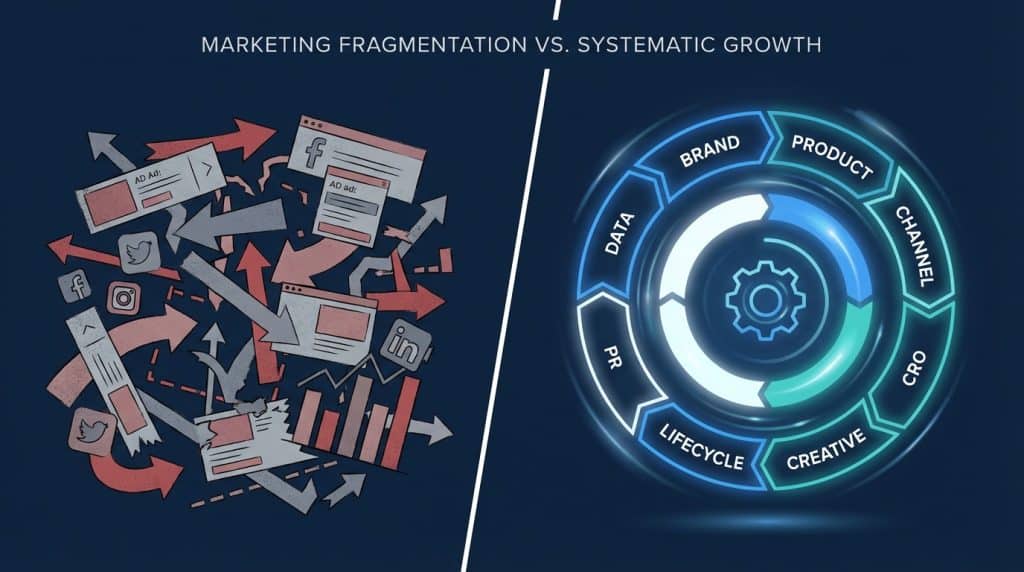
B2B growth marketing is a comprehensive approach to acquiring, retaining, and expanding customers by treating the entire revenue journey as a single, optimizable system. Unlike traditional marketing, which often operates in silos around awareness and lead generation, growth marketing spans brand, product, channel, lifecycle, and analytics. Companies with a clear growth strategy are 2.2 times more likely to outperform competitors, according to McKinsey research on B2B growth. Yet McKinsey data shows that only 30% of B2B companies have one.
“The combination of the art and science that comes with creating great growth marketing is what gets me super excited,” Shafton says. “Creating experiments, measuring what you do, understanding what works, and feeding that back into a framework that lets you keep iterating and getting better.”
In my work with funded B2B tech founders, the companies that grow predictably are not the ones spending the most on ads. They’re the ones who’ve answered three foundational questions with real specificity, questions most B2B marketers gloss over in their rush to execute. This is what separates a B2B marketing approach built around a customer story from a collection of disconnected campaigns.
B2B Growth Marketing vs. Traditional B2B Marketing
Traditional B2B marketing treats demand generation and brand as separate functions. B2B growth marketing treats them as a single, compounding system that optimizes the entire revenue journey from first impression to multi-year retention. The difference is not tactical. It is structural.
Most of the B2B tech companies I work with have inherited a traditional marketing setup. A demand gen team optimizing for MQLs. A brand team producing content with unclear pipeline attribution. A product team builds features without input from marketing data. These functions do not reinforce each other. Growth marketing reorganizes them around a unified system where every function contributes a measurable revenue signal.
| Dimension | Traditional B2B Marketing | B2B Growth Marketing |
|---|---|---|
| Primary goal | Lead generation and brand awareness | Full-funnel revenue and retention |
| Measurement | Campaign metrics: impressions, MQLs, clicks | Revenue outcomes: pipeline, LTV, NRR, churn |
| Lifecycle coverage | Acquisition only | Acquisition, activation, retention, expansion |
| Testing cadence | Annual campaign planning | Continuous experimentation across all channels |
| Product involvement | Low; marketing and product operate separately | High; product-led growth paths integrated |
| Brand role | Separate from growth function | Brand is the first flywheel element |
| Data use | Post-campaign reporting | Real-time optimization signals |
| Customer understanding | Persona documents, updated annually | Ongoing first-party research informing every decision |
The shift from traditional to growth marketing is not about adding headcount or technology. It is about changing the question: not “how many leads did we generate this quarter?” but “what is the compounding revenue impact of every marketing dollar over the next 24 months?” That shift forces fundamentally different investment decisions.
Forrester research shows that B2B companies using a full-funnel growth marketing approach achieve 24% higher revenue growth than those using traditional campaign-based marketing. The compounding effect is what matters: each element of a growth flywheel makes the others more effective over time.
The Three Questions That Drive Every B2B Growth Strategy
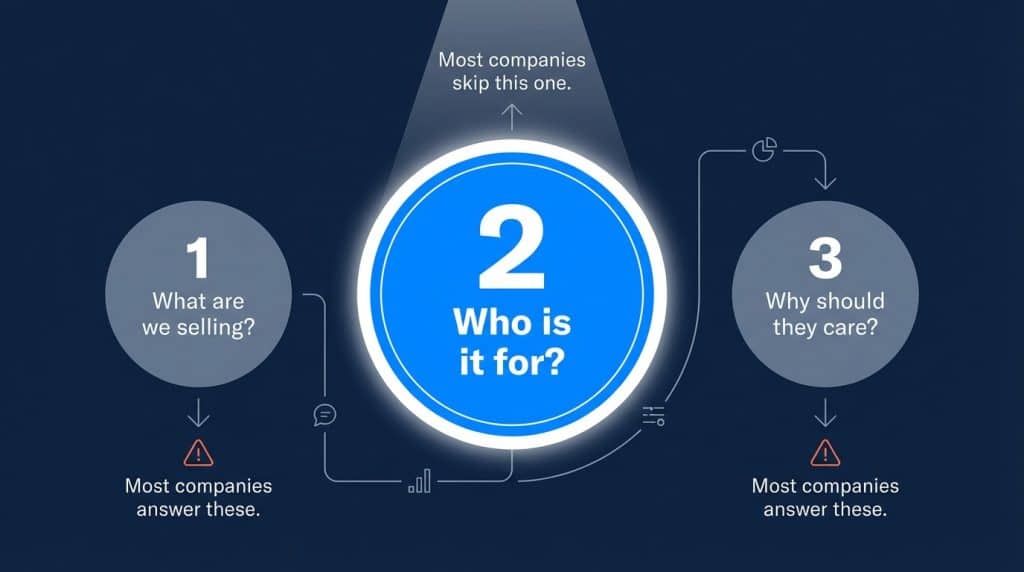
B2B growth marketing success comes down to three questions Shafton has applied across Google, Headspace, DaVita, and dozens of consulting clients. They sound simple. Most companies answer only one of them well.
- What are we selling?
- Who is it for?
- Why should they care?
The problem, Shafton says, is predictable. “I see a lot of companies spend a lot of time thinking about what are we selling and what is our product. It’s a little bit naval gazing in our own heads. We’re so excited about the thing we made.”
The middle question, who is it for?, is where most B2B growth strategies break down. Companies build detailed product roadmaps and elaborate demand gen programs, but they haven’t done the work to deeply understand the person they’re trying to reach.
“What are we selling? Who is it for? Why should they care? Don’t ignore that middle question. Make sure you understand your customer, and then everything else will follow.”
Jason Shafton, Founder at Winston Francois
This framework matters most at the seed-to-Series B stage. I’ve seen Series A SaaS founders with strong product-market fit stall on growth because they haven’t committed to an ICP with enough specificity to build a coherent go-to-market around. The three questions force that specificity.
The founders who answer all three questions clearly, including the often-skipped middle one about exactly who the customer is, build go-to-market strategies that compound. Founders who skip it rebuild their go-to-market strategy every 18 months.
How to Build a Real Understanding of Your B2B Customer
Building genuine customer understanding in B2B requires both third-party market research and first-party qualitative and quantitative research. Third-party research establishes baseline ICP characteristics using market data and product reviews. First-party research, including one-on-one interviews and large-scale surveys, reveals the Jobs-to-be-Done that third-party data misses. Combined, this process takes 6 to 10 weeks but produces the ICP clarity that makes every downstream marketing decision faster and cheaper.
Third-party research: establishing your baseline
Start with market research to understand who is already in your category. Read product reviews on G2, Capterra, or Reddit to surface raw customer language. Note the demographics, roles, and company types that appear repeatedly. This gives you a starting ICP hypothesis before you spend a dollar on paid research.
First-party research: qualitative and quantitative
Qualitative research means getting real people in front of your product or prototype. “Record those sessions and get that feedback and take detailed notes on where people get stuck, what questions they have, what their demographics and psychographics are,” Shafton advises. These one-on-one sessions reveal friction points and motivations that survey data never captures.
Quantitative research means surveying at scale. “You can survey a thousand of them so that we can get statistically significant data on the tools they’re using and what they’re interested in,” Shafton explains. Vendors like Dynata and SurveyMonkey Audience let you target specific buyer roles and company sizes.
When you stitch the two together, you get a complete picture of your ICP: what they care about, what they’re hiring your product to do, and how to communicate value in language they already use. That last point is what makes the difference between copy that converts and copy that sounds like every other B2B website.
A pattern I notice across funded B2B tech companies is that those with the clearest messaging have conducted this research formally. The ones with vague messaging haven’t. The research isn’t optional; it’s the foundation.
Getting fast insights without waiting 10 weeks
If you need results now, Shafton offers a faster path. Talk to your existing customers. Run performance marketing tests on LinkedIn or Google Ads to validate messaging with real spend before committing to a full positioning overhaul. And consider fake door testing: build a landing page for a product or feature that doesn’t exist yet, drive traffic to it, and measure signup or pricing intent before building anything.
“Just capture email address and interest or even have them click through on a pricing table, so you can see which price they’re interested in,” Shafton says. “Then say: the product’s not available yet, but we understand you’re interested at this price. We’ll contact you as soon as it’s available.” That’s the ICP signal in 48 hours, not 10 weeks.
When Is Your B2B Product Ready to Scale?
The single most expensive mistake in B2B growth marketing is scaling before product-market fit. More spending does not fix a product people don’t love. It accelerates churn and burns runway.
Shafton’s signals for genuine product-market fit are straightforward. “Are people absolutely raving about you unprompted? Is there really high customer satisfaction and Net Promoter Score?” When customers advocate without being asked, that’s the signal. When retention is high and churn is low, that confirms it. “You know it when you see it,” he says. “This is growing, and customers are happy. People are sticking around.”
In subscription businesses specifically, high retention is the leading indicator to watch before you open the growth spend taps. A Series B cleantech founder I work with delayed a major paid campaign by two quarters, specifically to improve retention. When they launched, CAC payback was 40% faster than in their previous attempt because the retention numbers supported higher LTV assumptions in their media model.
The Eight Elements of a B2B Growth Marketing Flywheel

A growth flywheel is a self-reinforcing system in which each component builds momentum for the others. Shafton has built these systems at billion-dollar companies and early-stage startups. The architecture is consistent regardless of company size.
1. Brand
Every flywheel starts with a clear brand promise. “At Google, it was: know the user, know the magic, connect the two,” Shafton explains. A compelling brand story that resonates with your specific ICP becomes the anchor for every channel, every campaign, and every piece of content that follows.
2. Product marketing
Product marketing connects your product’s capabilities to customer needs at the moment of decision. Stripe does this exceptionally well. “From a product marketing perspective, Stripe is a great example of how to do a good job communicating the value of your product,” Shafton says. Their mission, to increase the GDP of the internet, is aspirational. Their documentation and onboarding make the functional case in minutes. Both must exist.
3. Channel strategy
Channel strategy is a media mix decision. Which organic channels (SEO, content, social, app store) carry the base load? Which paid channels test and scale messaging? Which offline channels reach decision-makers where digital doesn’t? Having a clear answer to all three prevents the common trap of over-indexing on one channel and becoming fragile when it underperforms.
4. Conversion rate optimization
CRO is about making it easy for prospects to say yes. Shafton’s biggest critique of B2B websites: “Book a demo is the kind of end action you want the user to take when they get to your website. That kinda sucks. As a user, I’d like to just try the product.” Free trials, sandbox environments, and self-serve onboarding outperform gated demo flows in most B2B tech contexts.
5. Creative excellence
“Apple is the gold standard when it comes to marketing,” Shafton says. “It’s just super slick.” Clear, concise, visually distinctive creative is not a luxury. It’s the mechanism through which everything else in the flywheel gets communicated. Poorly designed creative at high spend is a tax on every other element of the system.
6. Lifecycle marketing
Lifecycle marketing covers pre-customer nurturing, onboarding, retention, expansion, and win-back. Each stage requires distinct messaging and a distinct goal. Companies that treat lifecycle as a single “email nurture” track leave significant revenue unrealized, particularly at the retention and expansion stages. According to Bain and Company, increasing customer retention by 5% can increase profits by 25% to 95%.
7. Public relations and earned media
Earned media builds the authority that amplifies every paid dollar. Press placements, analyst mentions, and podcast appearances create the credibility context that makes your paid campaigns more believable. In my work ghostwriting for funded founders, the executives who invest in consistent thought leadership see lower CPAs across their paid programs because warm prospects already recognize the brand before the first ad impression.
8. Measurement and analytics
“That comes back to reporting,” Shafton says. “You have to have a really strong understanding of the performance of the business.” A business intelligence tool like Tableau, Looker, or Google Data Studio, fed by a properly configured data stack, gives you the visibility to make decisions quickly. Real-time alerts matter: “Where I’ve seen this done well, something stops working in a dashboard or an ad goes offline and people know about it immediately.”
B2B Growth Marketing Channels That Scale

The most effective B2B growth marketing channel mix combines one owned organic channel, one paid channel, and one relationship channel, all tied to a shared measurement framework. Spreading too thin across all channels yields mediocre results. Depth in the right three channels compounds.
A pattern I see consistently across Series A and Series B companies is the temptation to chase every channel simultaneously. LinkedIn, Google Ads, SEO, outbound, ABM, email, events. Each initiative gets partial resourcing and produces partial results. The growth marketing approach is to identify the two or three channels where your ICP actually makes decisions, invest deeply in those, measure precisely, and expand only when the first set is producing predictable returns.
Organic search and content marketing
Organic search is the highest-return channel for most B2B tech companies, but it is the slowest to deliver results. The investment case is not the traffic. It is the compounding: content written today can generate a pipeline for five years at zero marginal cost per click. For funded founders with a 24-month runway mindset, this math is compelling. Organic content also produces the authority signal that makes every other channel more effective.
The trap is writing for everyone and ranking for no one. A Series B SaaS company I advised spent 18 months producing generic “content marketing” posts that attracted practitioners, not buyers. The fix was not more content. It was narrowed down to six high-intent keywords that their actual buyers searched for before making purchase decisions. Traffic dropped 15%. Pipeline from content increased 40% in the following two quarters. Specificity beats volume every time.
LinkedIn and social media
LinkedIn is the dominant B2B social channel for reaching decision-makers at the company sizes and stages that matter most to B2B tech founders. Founder-led content on LinkedIn consistently outperforms company page content, often by a factor of 10x in reach and engagement. The reason is simple: people buy from people. A CEO posting their own framework, sharing their own failures, and commenting substantively on their industry creates buyer trust that no company page post can replicate.
The data supports this. According to LinkedIn’s B2B marketing research, posts from individual executives generate an average 3x the engagement rate of company page posts. For funded B2B tech founders, systematic LinkedIn content is one of the fastest ways to build brand awareness and trust, thereby shortening enterprise sales cycles.
Email and lifecycle marketing
Email is the highest-conversion channel in B2B when it is used for lifecycle marketing rather than broadcast campaigns. The distinction matters. A broadcast campaign sends the same message to everyone on your list. Lifecycle marketing sends targeted messages to specific segments based on where they are in the buyer journey and what actions they have taken.
The most underused email format in B2B is the educational email course: a structured sequence of 5 to 10 emails that teaches a specific skill or framework relevant to your ICP’s job. Educational email courses generate 4x higher open rates than standard newsletters because they are intrinsically valuable rather than promotional. They also build the sustained attention that newsletter-style emails rarely achieve.
Account-based marketing (ABM)
ABM flips the funnel. Instead of generating large quantities of leads and qualifying them down, ABM identifies a specific list of target accounts and orchestrates highly personalized outreach across multiple channels simultaneously. For B2B companies selling to enterprise accounts or to a small number of high-value buyers, ABM consistently produces higher deal velocity and larger average contract values than broad-based demand generation.
The challenge with ABM is its resource-intensive nature. Done properly, it requires account-level research, personalized content and outreach, and tight coordination between marketing and sales. For a Series A company with a small team, ABM should target a focused list of 20 to 50 accounts rather than the hundreds that enterprise ABM platforms are designed to support. Fewer accounts, higher quality, better outcomes.
Paid media: when to use it
Paid media is the accelerator, not the engine. Using paid search and social to drive awareness for a brand or product with no organic foundation is an expensive way to generate leads with no compounding value. The unit economics rarely survive past Series A at scale. The right time to use paid media is after the organic foundation is in place: clear ICP, validated messaging, and enough retention data to model LTV with confidence.
When the inputs are right, paid media can accelerate audience-building, validate new product or market positioning quickly, and reach segments that organic content takes 12 to 18 months to reach. The key is using paid to amplify what already works organically, not to substitute for it.
“The B2B companies pulling ahead in 2025 are not running more campaigns. They are running fewer, better-instrumented channels where every dollar has a measurable compounding return.”
Vinay Koshy, Sproutworth
Why Great B2B Marketing Breaks the Rules
“B2B marketing is consistently boring and uncreative, unimaginative,” Shafton says without hesitation. “In B2B tech marketing, the difference between a great marketer and everyone else is the ability to do the unexpected.”
The table stakes, demand generation, account-based marketing, content marketing, and demo-to-close funnels are necessary but not differentiating. Every competitor is running the same playbook. The companies that stand out are the ones that zag when everyone else zigs.
“You’re building a story and a business around real customer stories and the transformation your product has delivered. It’s not just the demand gen, ABM, content marketing, demo-to-close funnel.”
Jason Shafton
Shafton points to three companies doing this exceptionally well. Stripe built a product marketing machine so clear and developer-focused that it made complex financial infrastructure feel approachable. Salesforce built Dreamforce, an annual event that became a destination brand for the entire industry. Monday.com and Ramp went offline with out-of-home advertising in airports and on highways, reaching decision-makers where no competitor was showing up.
“Think about traditional media channels and breaking out of some of the norm and the standard operating procedure and show up in the real world in innovative ways,” Shafton advises.
There’s a parallel question most B2B marketers won’t ask themselves: can you build a business without depending entirely on Google and Meta? “It’s almost like a four letter word or the elephant in the room,” Shafton says. “Can you exist and thrive in a world without buying media on Google and Meta? Can you reach your audience in ways that don’t require you to succumb to the big two ad platform?”
The B2B companies building resilient growth engines in 2025 are the ones who can answer yes.
Resilience and Radical Candor: The Human Edge in B2B Growth
Shafton’s perspective on B2B marketing is shaped by experiences most CMOs don’t reference in case studies. He was diagnosed with a degenerative retinal disease. His family lost twins at 20 weeks of pregnancy. These experiences didn’t just affect him personally. They changed how he leads, how he gives feedback, and how he builds marketing that connects.
“Everybody is going through something,” he says. “Something you can’t see on purpose that makes their life more challenging.” When leaders internalize that, they stop managing performance and start leading people. The distinction produces different business outcomes. Teams that feel seen and supported do work that is, in Shafton’s word, “extraordinary.” Teams that don’t produce adequate work.
A Harvard Business Review study found that 58% of leaders struggle with resilience, and 71% find it challenging to maintain a positive attitude in the face of adversity. The leaders who manage it have usually been forced to confront something difficult. Shafton channeled his personal challenges directly into his work at Headspace, where he could speak authentically about what meditation can do for people going through hard things. That authenticity helped scale the product to millions of users.
On radical candor: Shafton recommends Kim Scott’s book of the same name and summarizes his approach as “tactful truth.” The goal is not to make people feel bad. It’s delivering honest feedback in a context that makes it actionable. “It’s important to be honest and to tell people what you really think in a way that they can hear,” he says. Feedback delivered around results, not personality, travels further.
Creating the conditions for radical candor requires leaders to go first. Ask for feedback before giving it. “What can I do better? What am I not doing well?” A signal that nothing said will change your opinion of the person. That psychological safety is what allows hard truths to flow in both directions without damaging the relationship.
Don’t underestimate internal marketing either. “Internal communications can be as important, if not more important than external,” Shafton says. Cross-functional alignment is a prerequisite for any growth program that touches product. Shafton recommends the Jeff Bezos memo approach: a short prose document that states the strategy, the metrics being moved, what the team is blocked on, and what they need. Clear internal communication reduces the “make-work” problem where teams spend more time presenting than executing.
How Do You Measure B2B Growth Marketing Success?
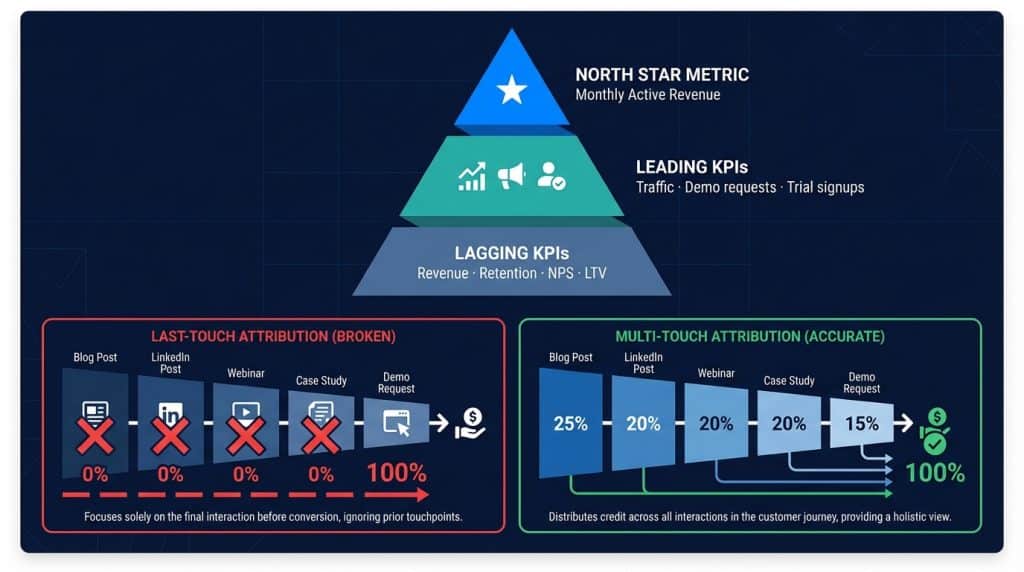
Every growth marketing system needs a North Star metric: the single most important number the entire organization is aligned around. “Is it revenue? Is it customers? Is it a compound annual growth rate? Is it month-over-month growth, weekly active users?” Shafton asks. Facebook’s was monthly active users, targeted at one billion. Having one number focuses every trade-off decision.
Below the North Star sit leading and lagging KPIs. Leading indicators include website traffic, demo requests, free trial signups, and engagement metrics. Lagging indicators include revenue growth, customer retention, Net Promoter Score, and Customer Lifetime Value. Together, they tell you whether you’re on track before the revenue number confirms or denies it.
Measurement infrastructure matters as much as the metrics themselves. A well-configured BI stack, powered by tools like Tableau, Looker, or Metabase and fed by a clean data pipeline, gives leadership real-time visibility. Executive-level dashboards show the story. Operator-level dashboards show the details. Alert systems catch problems before they compound.
“Where I’ve seen it go badly is where the organization’s flying blind,” Shafton says. Days or weeks can pass before anyone realizes a campaign stopped because a payment failed. That lag is avoidable with the right infrastructure.
AI-powered analytics tools are changing the speed at which B2B growth marketing teams can detect and respond to performance changes. Companies using real-time anomaly detection cut their average time-to-insight from weeks to hours, allowing faster iteration across their entire channel mix.
The most important shift in measurement for 2025 and beyond is moving from last-touch attribution to multi-touch attribution models that reflect the actual B2B buying journey. A decision-maker at a Series B company typically consumes 8 to 12 pieces of content before requesting a demo, according to Gartner research on B2B buying journeys.
Last-touch attribution assigns 100% of the credit to the final conversion point, systematically undervaluing the organic content, LinkedIn thought leadership, and email nurture sequences that did the actual convincing. Multi-touch models surface the real ROI picture.
💡 CEO Takeaway
Five things to apply from Jason Shafton’s B2B growth marketing framework:
- Answer the middle question first. “Who is it for?” is the question most B2B companies under-invest in. Before the next campaign, validate your ICP with real first-party research. Not assumptions. Interviews.
- Define your North Star metric before scaling. Choose one number that aligns your entire organization. Revenue, MAU, retention: pick one and make every trade-off against it.
- Verify product-market fit before opening the spend taps. Unprompted advocacy, high NPS, and low churn are the signals. Without them, more spend accelerates churn, not growth.
- Break out of the standard B2B playbook. Demand gen, ABM, and demo funnels are table stakes. The companies pulling away are doing something unexpected: offline channels, community, product-led conversion paths.
- Lead with vulnerability to unlock team performance. Ask for feedback before giving it. Create the psychological safety that lets your team bring their full capability to work.
Frequently Asked Questions
What is B2B growth marketing and how is it different from traditional B2B marketing?
B2B growth marketing is an approach that treats the entire customer revenue journey, from awareness through acquisition, retention, and expansion, as a single, optimizable system. Traditional B2B marketing often focuses on demand generation and lead handoffs to sales. Growth marketing integrates brand, product, lifecycle, and analytics into a compounding flywheel, producing more predictable revenue at lower incremental cost over time.
How long does it take to build a strong B2B ICP and customer understanding?
Building a rigorous B2B ICP through combined third-party and first-party research takes 6 to 10 weeks, according to Jason Shafton. Qualitative interviews, quantitative surveys, and market data each add a layer of specificity. Faster alternatives include talking to existing customers and running performance marketing tests on LinkedIn or Google Ads to surface ICP signals in days.
What are the signs of product-market fit in B2B before scaling growth marketing?
Key product-market fit signals in B2B include unprompted customer advocacy, high Net Promoter Score, strong retention rates, and low churn. When customers recommend the product without being incentivized and retention cohorts hold steady over 6 to 12 months, marketing spend compounds rather than accelerates churn. Scale only after these signals appear.
What is a B2B growth marketing flywheel and how do you build one?
A B2B growth marketing flywheel is a self-reinforcing system where brand, product marketing, channel strategy, CRO, creative, lifecycle marketing, PR, and measurement each strengthen the others. Building one starts with a clear brand promise, a rigorous ICP, and a North Star metric. Each element feeds into the next, compounding acquisition and retention.
How do you measure B2B growth marketing performance?
Start with a single North Star metric the entire organization aligns around: revenue, monthly active users, or net revenue retention. Support it with leading indicators like demo requests and trial signups, and lagging indicators like revenue growth and NPS. A BI tool with real-time alerts catches performance problems in hours, not days.
What is the difference between B2B growth marketing and traditional B2B marketing?
Traditional B2B marketing focuses on lead generation and brand awareness, measured through campaign metrics like MQLs and impressions. B2B growth marketing treats the entire revenue journey as one system covering acquisition, activation, retention, and expansion, measured through revenue outcomes and customer lifetime value. The difference is compounding: growth marketing investments compound over time; traditional campaigns reset each cycle.
What B2B growth marketing channels work best for funded tech startups?
The most effective B2B growth marketing channel mix for funded tech startups combines one owned organic channel like SEO content, one paid channel for validation, and one relationship channel like LinkedIn or ABM. Depth over breadth: two or three channels executed with precision consistently outperform six channels at half-capacity. Start where your ICP makes purchasing decisions.
Putting It All Together
Effective B2B growth marketing is not a campaign. It’s a system. It starts with genuine customer understanding, built through research, not assumptions. It flows through a flywheel of eight interconnected components, each reinforcing the others. And it compounds over time when the team has the resilience and psychological safety to do their best work.
Shafton’s three questions are worth returning to every quarter: what are you selling, who is it for, and why should they care? The middle question is always where the opportunity is.
If you’re a funded B2B tech founder building thought leadership to drive inbound pipeline, this is the authority-building work I do at Sproutworth: ghostwritten educational email courses, newsletters, and LinkedIn content for executives.
Related Links
- Jason’s company: Winston Francois
- Connect with Jason on LinkedIn or at wf.team/pod.
Related Resources
- How to Build a B2B Content Marketing Strategy That Drives Results
- How to Get Reliable Pipeline Growth Via B2B Marketing Strategies
- How to Unlock Customer-Centric Innovation to Drive B2B Growth
- 9 B2B Internal Marketing Insights to Thrive and Drive Revenue Growth
