
A B2B SaaS sales cycle is the complete process a software company follows to convert a prospect into a paying customer, from first contact to a closed deal. For enterprise-focused B2B SaaS companies, this cycle averages 84 days across all deal sizes. But for complex, regulated-industry deals above $100,000 ACV, it routinely stretches to six to 18 months, according to HubSpot benchmark data.
Rook, a wearable health data platform connecting over 300 devices through a single API, used to live in that 12-month territory. Then, co-founders CEO Marco Benitez and COO Jonas Ducker rebuilt their go-to-market motion from the front of the funnel instead of the back. Their B2B SaaS sales cycle now averages around 95 days. More than 70% of new clients arrive through inbound channels. This is a practical account of what they changed and why it worked.
Meet Marco Benitez and Jonas Ducker of Rook
Marco Benitez is the CEO and co-founder of Rook. A former Taekwondo champion and biomedical engineer, Marco spent over eight years in pharmaceutical sales at companies including Roche and Novartis before co-founding his first fitness startup in Mexico. That background shapes how he approaches enterprise buyers, persistence, evidence, and trust.
Jonas Ducker is Rook’s COO and co-founder. With a background in fitness tech startups across Latin America and Europe, Jonas brings operational precision to a company that has processed over 400 billion API calls, raised $1.7 million in funding, and gone through Techstars and Endeavor. He is the architect of Rook’s inbound strategy and operational cadences.
Rook serves healthcare, insurance, pharma, and fitness industries with HIPAA, GDPR, and ISO certification. Their website is tryrook.io.
What Is a B2B SaaS Sales Cycle?
A B2B SaaS sales cycle is the repeatable sequence of stages a software company moves through to close a deal with another business, from identifying a prospect to receiving a signed contract and activating the account. Unlike B2C sales, B2B SaaS cycles involve multiple decision-makers, technical evaluations, security reviews, procurement processes, and budget approvals, all of which add time.
The cycle is distinct from a sales funnel. The funnel is an aggregate view of where all prospects sit at any moment. The sales cycle maps the journey of a single deal. Understanding that distinction helps founders focus on the right lever: the funnel tells you where deals are stalling; the cycle tells you why.
The 7 Stages of the B2B SaaS Sales Cycle
While every company’s process is slightly different, the B2B SaaS sales cycle consistently moves through these seven stages:
- Prospecting: identifying potential customers through outbound outreach, inbound content, referrals, or product-led signals
- Qualification: determining whether a prospect has the budget, authority, need, and timeline to purchase
- Discovery: understanding the prospect’s specific problem, technical environment, and success criteria
- Demonstration: showing how the product addresses the prospect’s specific needs; in B2B SaaS, this typically includes a technical evaluation
- Proposal and negotiation: presenting pricing, terms, and handling objections; for enterprise deals, this includes legal and procurement review
- Closing: securing signatures, processing payment, and completing contracting
- Onboarding and activation: getting the customer live and generating the data that validates their purchase decision
Most cycle delays occur in stages three through five, where multi-stakeholder alignment and security reviews add weeks or months of dead time.
How Long Is a B2B SaaS Sales Cycle?
The average B2B SaaS sales cycle is 84 days. But this figure masks enormous variation by deal size, market segment, and go-to-market motion.
According to HubSpot benchmark research and SaaStr founder data, the practical benchmarks by deal size are:
| Deal size (ACV) | Expected cycle length |
|---|---|
| Under $5,000 | 14–40 days |
| $5,000–$25,000 | 30–90 days |
| $25,000–$100,000 | 90–180 days |
| $100,000–$500,000 | 3–9 months |
| Over $500,000 | 6–18+ months |
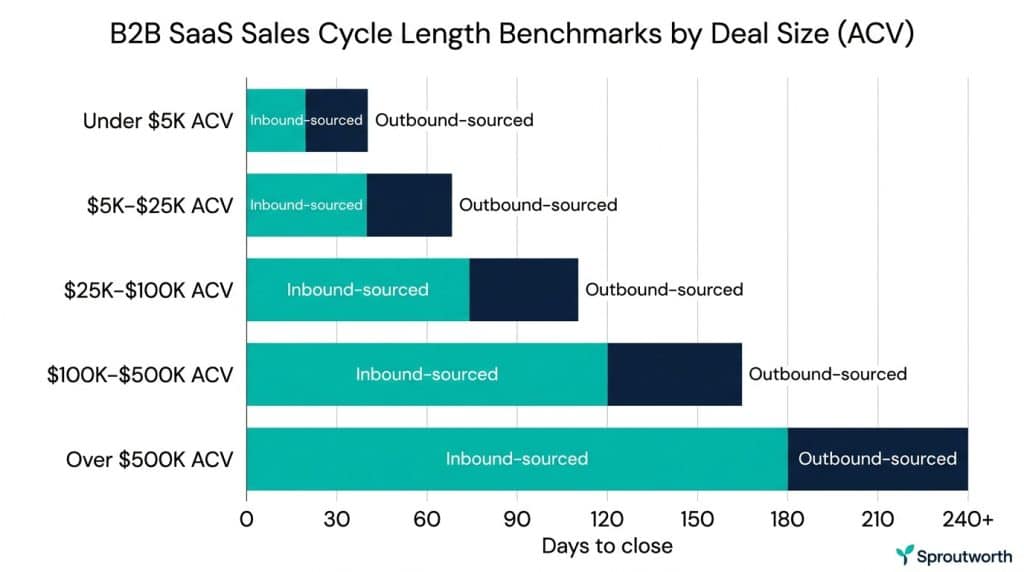
These benchmarks assume a mix of inbound and outbound-sourced deals. Inbound-originated deals, where the buyer has already researched the product before reaching out, consistently compress the cycle across all price points. Rook’s shift to 70%+ inbound was what drove their average from 12 months to 95 days, despite selling into regulated enterprise verticals with high complexity.
B2B SaaS sales cycles have lengthened 22% since 2022, according to research published by Arcade Software in 2026. Buying committees have grown from an average of three to five stakeholders to eight to 12. Budget scrutiny has increased at every stage. The answer is not to fight these structural changes from the back end. The answer, as Rook demonstrated, is to change who shows up at the front.
Why Most B2B SaaS Sales Cycles Stay Stuck
Most advice for shortening the B2B SaaS sales cycle focuses on execution: faster follow-up, better demos, tighter proposals. That advice treats the symptom.
Jonas puts the actual diagnosis clearly. When Rook was doing outbound in the early days, closing a single enterprise deal took over a year. “The chance is that you meet the right person with budget, that has exactly the problem you want to solve, that has buy-in from the rest of the team, at the right time you knock on their door. The likelihood of this all coming together is very tiny.”
Outbound is a timing lottery. The more complex the product, the more variables must align simultaneously. For a technical API platform targeting healthcare enterprises, that alignment almost never happens on the first cold outreach.
The fix is not better outbound. The fix is generating buyers who arrive already informed. An informed buyer, even on the enterprise side, makes faster decisions because they have already done most of the evaluation before the first call.
In my work helping funded B2B tech founders build content strategy, this is the pattern most consistently missed. Teams spend tens of thousands on SDR headcount and outbound sequences, then wonder why the pipeline stalls. The buyers who close fastest are almost always the ones who founded the company, not the ones the company found.
The Three B2B SaaS Sales Models and How They Affect Cycle Length
Before choosing how to compress your sales cycle, it helps to understand which model you are operating under. Each carries a different baseline cycle length and a different compression lever.
Self-service model: The product sells itself. Marketing drives traffic; the product converts. Cycle length: minutes to a few days. Works for lower-priced tools where the buyer is also the end user and the decision is individual.
Transactional model: Inside sales reps manage a moderate volume of deals at moderate prices. Cycle length: 30 to 90 days. Works for SMB-focused SaaS where the buying unit is small, and decisions are relatively contained.
Enterprise model: High-touch sales, complex evaluation, multiple stakeholders, compliance review. Cycle length: 90 days to 18 months. Rook operates here. The enterprise model rewards early authority-building because it shortens the trust-building component that typically extends the cycle the most.
Most B2B SaaS companies start self-service or transactional and evolve toward enterprise as deal sizes grow. The compression strategy must match the model. Enterprise cycle compression is not a sales execution problem; it is a buyer education and authority problem.
The Core Thesis: Flip the Funnel Before the First Sales Conversation
Rook’s B2B SaaS sales cycle compression has one root cause: more than 70% of their new clients now arrive through inbound channels.
Jonas describes the shift. “An informed buyer, even on the enterprise B2B side, is a buyer that makes faster decisions. They have a problem identified, they have informed themselves about potential solutions, they identified you as a potential solution, and now they’re reaching out asking for your help.”
Inbound-sourced deals compress the B2B SaaS sales cycle because the buyer has already done the evaluation work before the first call. They arrive with context. They skip the education phase. They ask sharper questions. They move faster.
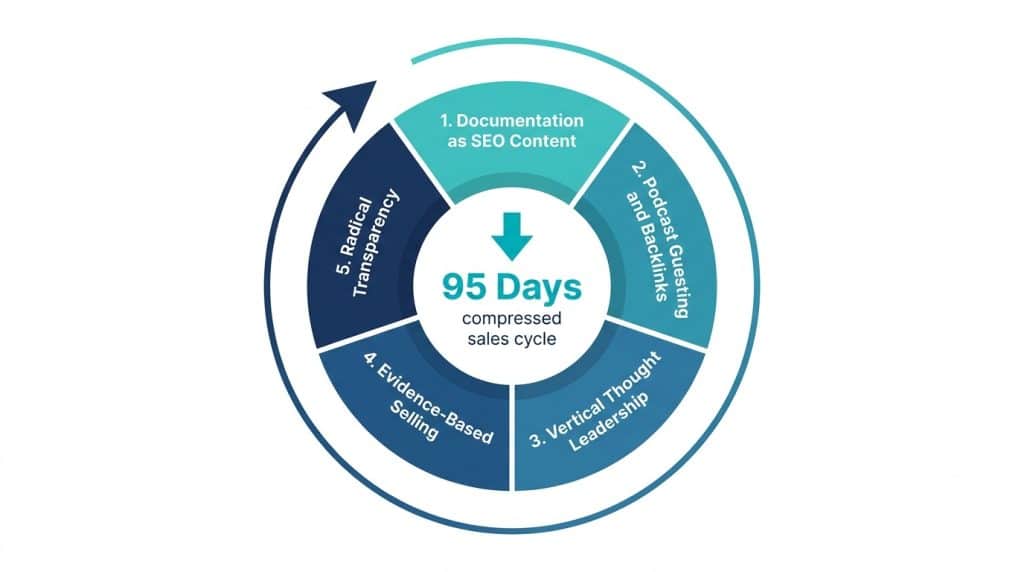
The question is how to build inbound before you have brand gravity. Rook’s answer is a five-layer flywheel. Each layer compounds on the one before it.
This is the same foundation behind effective inbound sales: the cycle compression happens before the first call, not during it.
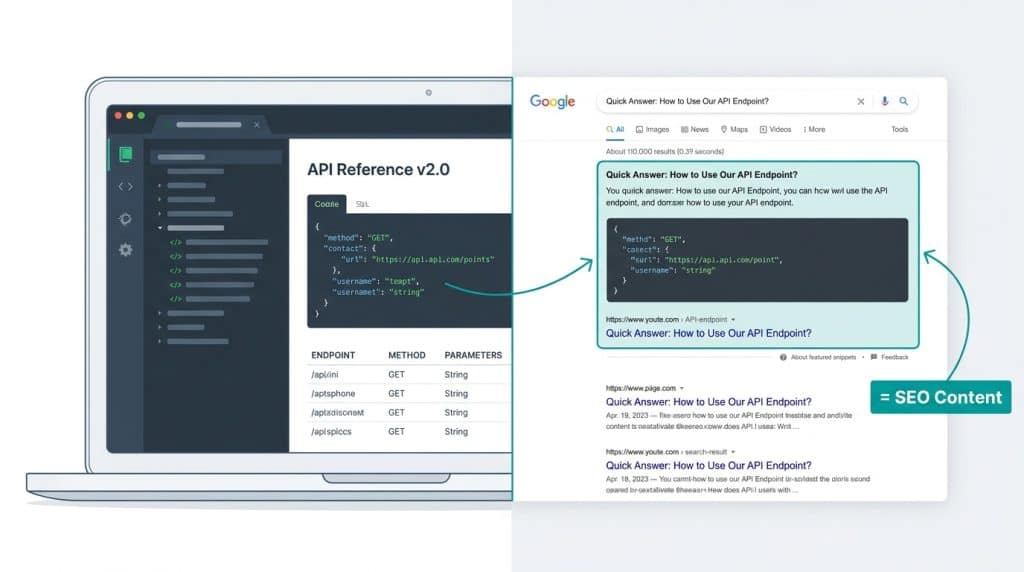
Layer 1: Documentation as Content
Rook’s product is an API. From day one, they had to write extensive technical documentation. That documentation is also a search-optimized content library.
Jonas explains. “By the nature of the product we had, from the start on, we had pretty quickly a lot of content around the solution that we offer. And that content we were able to use in many different ways, placing it through directories, through other external sources, which helped with the back-linking strategy.”
Technical founders consistently undervalue this. Documentation answers specific, high-intent search queries. Every integration guide, endpoint explanation, and troubleshooting article is a content asset that surfaces in search results, AI engine answers, and developer forums where your buyers already spend time.
If your SaaS product has a technical layer, your documentation is likely your least-used content asset.
Layer 2: Podcast Guesting as a Backlink and Domain Authority Engine
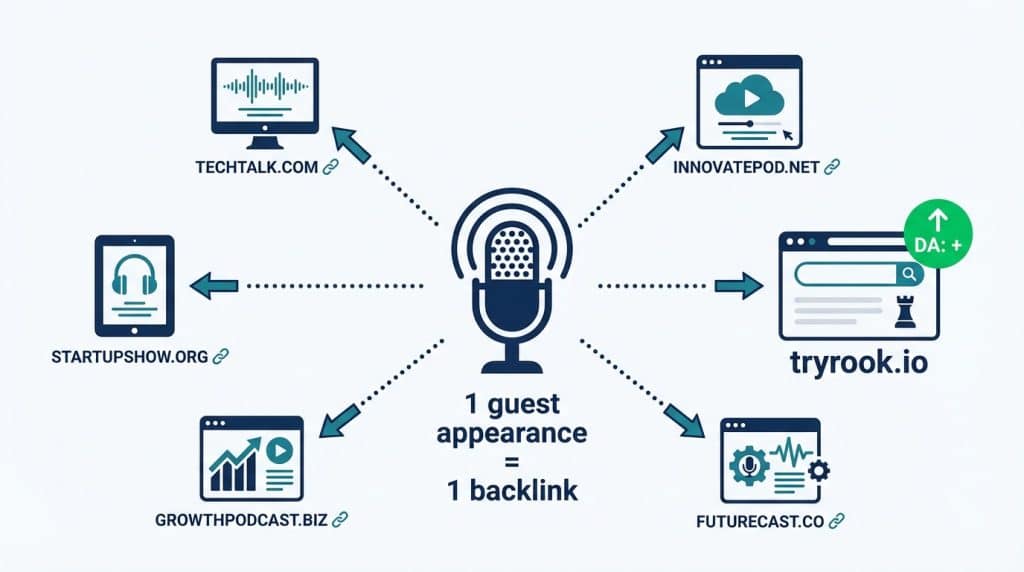
Rook needed domain authority fast to compete with established enterprise vendors. Their vehicle was podcast guesting, approached as a systematic backlink acquisition strategy, not just a brand-awareness play.
Jonas breaks down the mechanics. “Each podcast has their own website where they also host this session. And there is a link back to Rook’s website. So that’s yet another backlink. The typical SEO strategy: on-page SEO plus back-link building by guest posting, getting your word out in directories, doing press and PR-related work. That combination helps you get out the name quickly.”
This is the link-building argument for digital PR and thought leadership that most B2B founders still underweight. Sites with strong backlink profiles generate 3.8x more organic traffic than those without, according to Semrush’s State of Content Marketing research. Podcast appearances at scale are a systematic way to earn those links from relevant, domain-authoritative sites.
There is also a buyer-warming benefit. When you appear on a podcast your buyer’s peers listen to, you are one step removed from a cold outreach. The audience already knows your thinking before you make contact. When you follow up, you are not a stranger.
Layer 3: Thought Leadership That Converts Enterprise Buyers
Here Jonas’s playbook gets counterintuitive. He describes the B2B SaaS sales cycle as a storytelling challenge disguised as a product challenge.
“The only thing that changes is actually the narrative and the positioning of the solution in each of these verticals, but the product itself is not changing. The product that Rook offers to all of these verticals is exactly the same.”
The same API that helps an insurance company with risk modeling also helps a pharma company with clinical trial adherence and a hospital with remote patient monitoring. What changes is how Rook tells the story.
Effective thought leadership is not about promoting your product. It is about demonstrating that you understand the specific business question your buyer’s vertical is trying to answer, before they talk to you.
A pattern I notice across funded SaaS companies: the ones with the longest sales cycles typically lead with product features. The ones with the shortest cycles lead with the buyer’s business question, then show how their product answers it. This shift eliminates the education phase that extends most enterprise cycles by weeks.
Layer 4: Evidence-Based Selling Borrowed from Pharma
Marco Benitez spent eight years in pharmaceutical sales. In pharma, you cannot change prescribing behavior without clinical evidence. He brings the same standard to enterprise B2B.
“Everything that is evidence-based, having an impact on the patient, on the user, directly translates to conversations on the healthcare side. We can prove there is an opportunity using wearable data to decentralize clinical trials, remote patient monitoring, manage chronic disease in a continuous fashion.”
For technical buyers at the CTO or Chief Data Officer level, evidence-based selling matters for one practical reason: it transfers credibility before the close.
When a buyer can point to documented proof of outcomes in a comparable setting, they have the internal justification they need to move. Without that evidence, they must build the business case from scratch. That process takes months and frequently stalls.
Evidence-based selling is particularly powerful in enterprise sales strategies for regulated industries, where buyers face compliance scrutiny for every vendor decision.
Layer 5: Radical Transparency as a Sales Acceleration Tool
Most early-stage B2B SaaS companies hide weaknesses. Rook does the opposite.
Marco explains their approach with clients. “Being very transparent with clients is very important. Our clients are super grateful for all the transparency we have. Our competitor is telling them they have all these type of things, but doesn’t have it because the connections are completely different.”
On the Rook website, they publish exactly which wearables are connected, what type of data each device delivers, and what the integration experience looks like. No false advertising. No overpromising.
Jonas takes the same approach to competitive positioning. “Being precise on where you’re really good at and where others might be better is actually what makes sales cycles really fast. I can save myself so much time if I know a client is searching for A and Rook is really good at B. It doesn’t matter to entertain that conversation.”
Radical transparency about what your product does and does not do qualifies buyers before the first call. The ones who show up are already sold on fit. That is the fastest B2B SaaS sales cycle there is.
When I develop content strategy for funded B2B tech founders, transparency is consistently the most underused trust lever. Publishing honest capability maps and upfront integration timelines builds credibility that a polished sales deck cannot match.
How Compliance Became a Competitive Advantage
HIPAA and GDPR are usually treated as cost centers in B2B SaaS. Rook treats them as pipeline accelerators.
Marco frames the logic. “If you have a passport, you can go to other countries. If you have certifications, you are a trustable person to go to that country. It’s almost the same thing. HIPAA, GDPR, ISO allow you to build a very good structure and give you the credibility in the industry.”
For enterprise healthcare and insurance buyers, compliance certification functions as a pre-qualification filter. It narrows the shortlist before the first meeting. If your product is certified and your competitor’s is not, you have an advantage that no outbound sequence can replicate.
Marco adds a deeper point. “HIPAA is not only one thing. It’s so many things. It’s also the process of your company, how you write an email, how you structure all your SOPs, how you code. It’s a culture.”
Enterprise buyers can sense the difference between a company that is compliant on paper and one that is compliant in practice. That operational credibility accelerates trust. Trust compresses the B2B sales cycle.
The Partnership Shortcut: How a Strategic Relationship Halved Their Cycle
One of Rook’s most powerful cycle-compression tools was a strategic partnership, not a sales tactic.
Their relationship with Intersystems, which serves clients including Epic, Meditech, and Cerner, gave Rook warm introductions to enterprise health system buyers already inside Intersystems’ trusted network. This is the partnership framework in practice: access to qualified buyers through someone the buyer already trusts.
Jonas explains the win-win calculus that makes partnerships work. “Everyone wants to make business. Really getting to the bottom line of: how can I make revenue for you? How can I help accelerate revenue for you, and how can you help accelerate revenue for me? That is the fundamental discussion.”
The partnerships that never went anywhere shared one trait: neither side generated incremental revenue for the other. The ones that compressed Rook’s sales cycles had a clear commercial exchange at the center.
Their development agency partnerships follow the same logic. When a client asks Rook for implementation support, Rook refers a trusted dev agency partner. When the dev agency has a client needing wearable data integration, they refer Rook. Revenue flows in both directions. That mutual flow is what sustains the relationship.
Building a Remote Sales Culture That Delivers Consistent Deals
Rook runs a distributed team across the Americas: Canada, the US, Mexico, Brazil, and Argentina. Keeping sales culture consistent across time zones is a people-and-process problem, not a technology problem.
Marco’s approach combines operational cadence with cultural alignment. The team uses Loom for asynchronous communication, structured weekly meetings, and a sales playbook that defines the “Rook language”: how to speak with clients, how quickly to respond, and what quality looks like in every interaction.
Jonas complements this with a North Star metric framework. The entire team aligns on one primary metric: active users. Each quarter, individual goals cascade from that number. Team members also know the company’s financial position and runway, and how their contributions track toward growth targets and their own “dream salary.”
When everyone on the sales team knows the single metric that drives the business and how their work connects to it, pipeline momentum is self-sustaining. That alignment is one of the most effective levers for consistent deal velocity in a distributed team. It also connects directly to the broader B2B demand-generation motion: a team that knows its number closes with greater urgency.
The Rook Playbook: 5 Levers to Compress Your B2B SaaS Sales Cycle
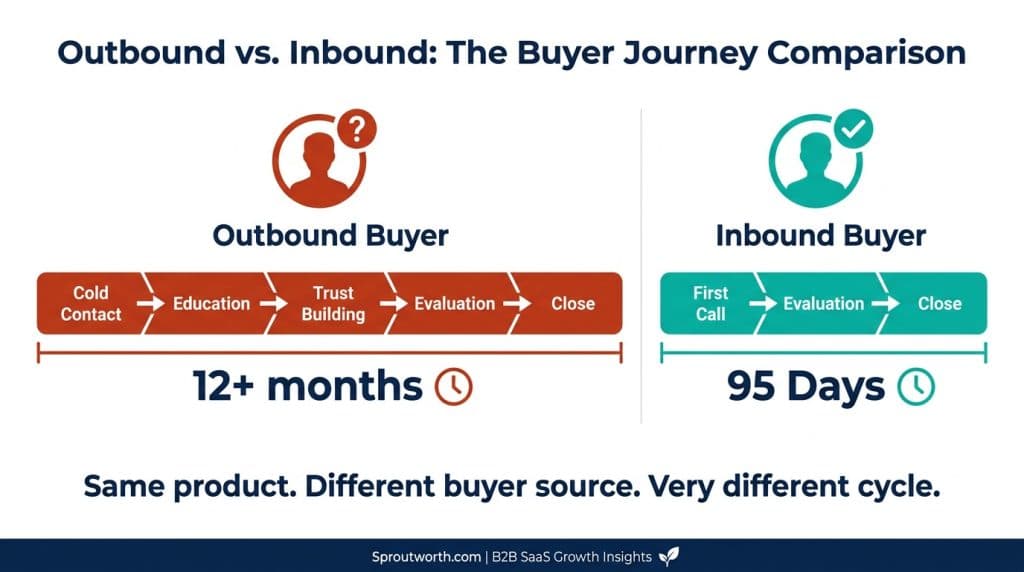
These are the five specific levers Rook used to move from 12-plus-month cycles to an average of 95 days:
Flip the funnel before optimizing the back end. Stop trying to accelerate outbound-sourced deals. Build the content, documentation, and thought leadership that creates inbound buyers who arrive already educated.
Make technical documentation serve double duty. Every API guide, integration doc, and troubleshooting article is a search-optimized content asset. Treat it that way.
Use podcast guesting as a backlink strategy. Each guest appearance is a domain authority transaction. A consistent cadence of appearances on relevant B2B podcasts builds search visibility that drives inbound.
Lead with the buyer’s question, not your product. Rook sells the same API to healthcare, insurance, and pharma. What changes is the story. Match your narrative to the vertical’s specific business question, and you eliminate the education phase entirely.
Publish your limitations. Radical transparency about what your product does and does not do qualifies buyers before the first call. The ones who show up are already sold on fit. That is the fastest achievable B2B SaaS sales cycle.
How to Measure Your B2B SaaS Sales Cycle Length
To improve your cycle, you need to measure it accurately. The calculation is straightforward:
Average cycle length = Total days across all closed-won deals in the period / Number of closed-won deals
But total cycle length is a lagging indicator. To find your actual bottleneck, break the measurement down by stage: prospecting to first call, first call to proposal, proposal to close. The slowest stage is where to invest next.
Track cycle length separately by:
– Deal source (inbound vs. outbound; the difference is often 40–60%)
– Deal size (ACV bracket)
– Buyer vertical (regulated industries add compliance review time)
– Sales rep (outliers reveal coaching opportunities)
Founders who track only total cycle length miss the signal. Stage-level measurement shows where time is actually lost.
Frequently Asked Questions About B2B SaaS Sales Cycles
What is a B2B SaaS sales cycle?
A B2B SaaS sales cycle is the complete sequence of stages a software company follows to convert a prospect into a paying customer, from initial contact to a signed contract and account activation. B2B SaaS cycles are longer than B2C cycles because they involve multiple decision-makers, technical evaluations, compliance reviews, and procurement approval processes. The average B2B SaaS sales cycle is 84 days, though enterprise deals can take 6 to 18 months.
How long is the average B2B SaaS sales cycle?
The average B2B SaaS sales cycle is 84 days across all deal sizes, according to HubSpot benchmark data. For deals under $5,000 ACV, the cycle averages 40 days. For deals with ACV over $100,000, it extends to 170 days or more. Enterprise deals in regulated industries, such as healthcare and insurance, typically run for 6 to 18 months. Inbound-sourced deals consistently compress these benchmarks across all deal sizes.
What are the stages of a B2B SaaS sales cycle?
The standard B2B SaaS sales cycle moves through seven stages: prospecting, qualification, discovery, demonstration (including technical evaluation), proposal and negotiation, closing, and onboarding or activation. Most cycle delays occur in stages three through five, where multi-stakeholder alignment, security reviews, and procurement processes add time that sales execution cannot recover.
How do you shorten a B2B SaaS sales cycle?
The most effective way to shorten a B2B SaaS sales cycle is to change who reaches the top of your funnel, not how you handle them once they get there. Inbound-sourced buyers, who have already researched your product before reaching out, close significantly faster than outbound-contacted prospects at every deal size. Building inbound through content, SEO, podcast guesting, and digital PR creates informed buyers who compress the cycle from the front end.
Why are B2B SaaS sales cycles getting longer?
B2B SaaS sales cycles have lengthened 22% since 2022, according to Arcade Software’s 2026 enterprise sales research. Buying committees have grown from three to five stakeholders to an average of eight to 12. Budget scrutiny has increased. Security and compliance reviews are now standard at lower deal sizes than before. These structural shifts mean that any compression strategy focused only on sales execution tactics will produce diminishing returns.
How does inbound marketing affect B2B SaaS sales cycles?
Inbound marketing shortens B2B SaaS sales cycles by creating informed buyers. When a prospect reaches out after reading your content, attending a webinar, or finding your documentation through search, they have already answered many of their own evaluation questions. They arrive with context, skip the education phase, and require less hand-holding through the buying process. Rook moved from a 12-month average to 95 days primarily by shifting from outbound to 70%-plus inbound client acquisition.
What is a good B2B SaaS sales cycle benchmark for early-stage startups?
For a seed or Series A B2B SaaS company selling to enterprise buyers, a sales cycle under 120 days is strong. Under 90 days is excellent, and typically requires 50% or more of the pipeline to be inbound-sourced. The SaaStr benchmark for deals under $25,000 ACV is 90 days or less. For deals above $100,000 ACV, a realistic target is 90 to 180 days for a company with established inbound content and credibility signals.
What causes long B2B SaaS sales cycles for funded startups?
Three root causes drive long cycles for early-stage B2B SaaS companies: buyers who arrive uninformed and require extended education, missing trust signals that delay compliance and credibility evaluations, and too many prospects in the pipeline who were never going to close. Addressing the first two is a content and authority problem; addressing the third is a qualification problem. Fixing the outbound-inbound ratio is typically the highest-use first move.
Related Resources
- How to Develop an Enterprise Sales Strategy to Drive Growth
- What is Inbound Sales: How to Use it the Way Prospects Buy
- B2B Thought Leadership: How to Build Authority That Drives Revenue
- Sales Flywheel vs Sales Funnel: Which Model Drives Sustainable Growth?
- B2B Buyer Psychology: The $50B Strategy Behind Enterprise Decisions
Related Links
- Marco Benitez on LinkedIn: linkedin.com/in/marcobenitezcruz
- Jonas Ducker on LinkedIn: linkedin.com/in/jonasducker
- Rook Website: tryrook.io
- Rook on LinkedIn: linkedin.com/company/tryrook
Some topics we explore in this episode include:
Listen to the episode.
Subscribe to & Review the Predictable B2B Success Podcast
Thanks for tuning into this week’s Predictable B2B Podcast episode! If the information from our interviews has helped your business journey, please visit Apple Podcasts, subscribe to the show, and leave us an honest review.
Your reviews and feedback will not only help me continue to deliver great, helpful content but also help me reach even more amazing founders and executives like you!
