

A leadership voice is the distinct perspective and philosophy a founder uses in high-stakes moments to win deals, attract investors, and reduce customer acquisition costs. It is built from four components: a purpose platform statement, an origin story, a point of view and playbook, and operating principles. Most founders have the raw material. Almost none have assembled it.
Most founders can tell you their customer acquisition cost to the cent.
Ask them what it costs to walk into every high-stakes conversation sounding like their marketing team’s latest messaging document, and they go quiet.
That silence is expensive. And it compounds every quarter.
Leadership communications expert Dia Bondi has spent more than two decades coaching CEOs, co-founders, and executives through the moments that determine whether a business moves forward or stalls. Her conclusion: a founder’s leadership voice is not a communication skill to polish once the product ships. It is a go-to-market asset sitting largely unused, even at companies spending tens of thousands per month on paid acquisition.
Developing that voice follows a structure. Dia calls it the Platform Map, and its four components reshape how founders show up in every room that matters.
About Dia Bondi
Dia Bondi is a leadership communications expert and the author of Ask Like an Auctioneer: How to Ask for More and Get It. Over 22 years, she has coached founders and C-suite executives at Salesforce, Google X, Dropbox, and Quartz. As a certified charity auctioneer who has raised millions for women-led nonprofits, she developed her approach to strategic asks on the fundraising stage and brought those principles directly into the boardroom, pitch room, and enterprise sales conversations.
Her work draws one central distinction: what you have to say versus how you say it. Most communication training focuses on delivery. Dia starts a step before that, with the substance, the platform, that gives delivery something worth saying.
She also played a role in securing Rio de Janeiro’s bid for the 2016 Summer Olympics.
Watch The Episode
What Is a Leadership Voice?
A leadership voice is the distinct perspective, philosophy, and narrative a founder uses in high-stakes communication moments. It is not the same as communication skills, presentation style, or personal brand. Those are outputs. Leadership voice is the substance that produces them: what you actually stand for, what drives you, and what transformation you believe is inevitable in your market.
Leadership voice is your most underused go-to-market asset as a B2B founder.
Most founders develop communication skills. Far fewer develop a leadership voice. That gap shows up in how long their sales cycles run, how much they have to pay to generate a first enterprise conversation, and how often they walk out of a critical meeting unsure whether they landed.
According to the Edelman-LinkedIn 2024 B2B Thought Leadership Impact Report, 71% of B2B decision-makers say that less than half of the thought leadership content they consume provides valuable insights. The problem is not that founders are not publishing. It is that most are publishing the marketing team’s perspective rather than their own.
Leadership voice vs marketing voice: why founders confuse them
Your leadership voice and your marketing voice are not the same thing. Understanding the gap between them is what makes the Platform Map worth the investment.
| Leadership Voice | Marketing Voice | |
|---|---|---|
| Source | Founder’s worldview, drive, and principles | Brand messaging and comms team |
| Primary function | Builds trust with investors, partners, and enterprise buyers | Builds awareness at scale |
| Communication moments | Pitches, board meetings, partnerships, M&A discussions | Ads, email campaigns, content marketing |
| What it signals | A specific belief about where the market is headed | What the product does and why it is different |
| Compounding effect | Every conversation reinforces authority and conviction | Resets with each campaign cycle |
A founder with only a marketing voice parrots their pitch deck in critical meetings. A founder with a developed leadership voice shows up with a point of view that investors and enterprise buyers cannot find on the product page.
Why Founders Underestimate the Cost of an Undeveloped Voice
Vinay Koshy raised this directly with Dia: most funded founders obsess over measurable acquisition metrics but lack a framework for quantifying the cost of an undeveloped leadership voice in deal velocity, partnership development, and customer trust.
Dia’s response is worth sitting with.
“A missed opportunity is hard to quantify,” she said. “But I can tell you that clients who secure deals generating tens of thousands of users at a time, who might have missed it entirely without a clear voice. That gap is not theoretical..”
LinkedIn’s own research shows that personal executive profiles generate roughly seven times more impressions than company pages. But reach without conviction does not close deals. Dia’s point is not that founders need more visibility. It is that visibility built on generic messaging, specifically founders who sound like their marketing team rather than themselves, creates impressions without relationships.
In ghostwriting LinkedIn content for funded B2B tech founders, I notice this pattern consistently — and it’s a thread that runs through more than 500 conversations on the Predictable B2B Success podcast. The founder spending on paid acquisition while posting product updates to a dormant LinkedIn profile is not doing thought leadership. They are doing announcements. The difference shows up in pipeline quality three quarters later.
A strong thought leadership strategy addresses this. But a strategy without a developed voice produces more of the same output at a higher volume. The Platform Map solves the source problem, not the distribution problem.
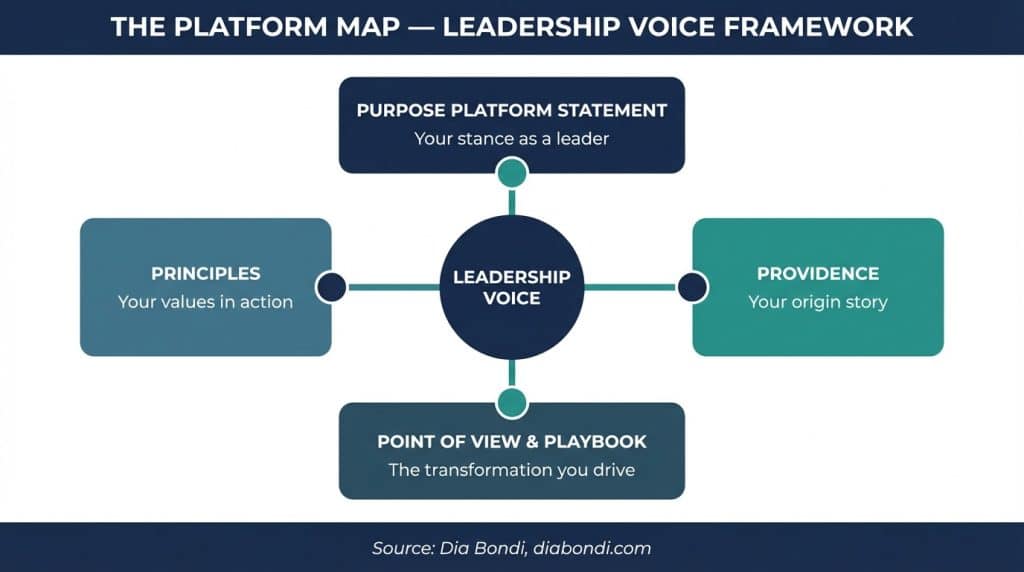
The 4-Part Platform Map: A Leadership Voice Framework for Founders
The Platform Map is not a content calendar. It is source material. Each of its four components gives founders something to draw from in any high-stakes moment: a pitch, a board presentation, a first enterprise conversation, or a panel where they have ninety seconds to establish why they are in the room.
Part 1: Purpose Platform Statement: Your Stance, Not Your Script
The purpose platform statement is a lens, not a tagline.
It names the role you play as a leader. Are you a rule-breaker? A truth-teller? A champion for the right ideas? The statement is not content to publish. It is the filter through which you make choices about what to say and what to let go of in any given moment.
Dia worked with a founder whose purpose platform statement was: “I’m a champion for mastery of the good idea.” That phrase never appeared in a pitch deck or a LinkedIn post. But it became the internal accountability mechanism that sharpened every high-stakes conversation. When preparing for an enterprise meeting, the question shifted from “what are my talking points?” to “where am I actually championing the right idea here, and where am I just filling time?”
The result: he arrived at conversations with a point of view rather than a list.
This matters especially for founders at seed and Series A. When I’m developing educational email course frameworks for early-stage founders, the hardest part is always helping them identify the one idea they actually stand for. Clarity in a purpose platform statement makes the rest of the content system coherent, rather than a collection of unrelated posts.
For B2B tech founders specifically, this is where the generic “just be authentic” advice from every communication coach finally becomes actionable. Dia’s observation: “Just be authentic” is useless feedback unless a founder knows what authentic looks like for them. A purpose platform statement defines it.
Part 2: Providence: The Origin Story That Actually Matters
By the time a founder gets into the room where the real decisions are made, the resume has already done its job. It got them past the gatekeeper. Repeating it in the room signals that they do not know why they are really there.
Providence answers a different question: I have always been driven by [blank]. That is why [my accomplishments].
Two sentences. But those two sentences communicate what the founder is invested in beneath the credentials, why they are building what they are building now, and why the people in the room should follow them into the next phase of the company’s growth.
Dia illustrated this with a financial services executive who found himself on stage at a major industry conference alongside two famous athlete-entrepreneurs. He was not an athlete. His instinct was to establish his resume before the audience judged him out of context. Instead, she helped him surface his actual Providence: he had always been driven by being part of something significant, and this moment in financial services, coming out of the pandemic, navigating extreme inflation, managing institutional uncertainty, was one of the most significant moments in the industry’s history.
That positioning made him credible as a peer to the athletes on stage rather than an awkward sponsor filling a seat. He was not competing on the basis of athletic credentials. He was speaking from his actual drive.
A Series A SaaS founder I work with went through a version of this exercise after three years of describing herself in terms of her product’s technical capabilities. When she surfaced her actual Providence, she had always been driven by making complex systems legible to the people who depend on them; her next investor conversation produced a materially different response. The investors asked about her as a builder, not her product’s current feature set.
That is what Providence is designed to produce. Investors at early stages are not funding a product. They are funding a founder’s drive. A well-built Providence story answers the question they are actually trying to answer.
Part 3: Point of View and Playbook: Own a Topic, Not Just a Product
This is where founders separate themselves from their venture, and where most of the B2B thought leadership that actually builds pipeline lives.
The point of view and playbook answers two questions: what transformation do you believe is inevitable in your market, and how do you uniquely cause it?
Your product is one expression of the answer, not the whole answer.

Dia worked with a market-making executive at a large SaaS enterprise who struggled to articulate what he actually cared about beyond “growing businesses.” After working through the point-of-view and playbook exercise, he landed on what he called “the economics of trust.” His transformation statement: he wanted to see every business leader pair their business model with a trust model. His playbook: five principles for building trust-driven growth. His product and role became specific illustrations of those principles in action.
That shift let him enter any C-suite conversation engaging at the level of ideas rather than deliverables. He could discuss the future of his market shoulder-to-shoulder with peers, and then point to what he was building as evidence of his point of view.
The LinkedIn content that generates a real, qualified pipeline for B2B tech founders works the same way. When I ghostwrite for founders at Series A through C, the posts that consistently outperform are not product updates. They are point-of-view pieces: what the founder believes is broken in their market and what they think is inevitable. That specificity is what differentiates a founder’s content from every other “here are my lessons” post in a busy executive’s feed.
Part 4: Principles: Values You Can Actually Use
Principles are your values in operation, not on a wall.
Think of the leaders who have shaped you. The mentor who kept saying, “Things take longer than you think.” The manager who insisted, “If you’re given a mic, speak your mission.” Those phrases stuck because they captured how someone actually moved through decisions under pressure.
Your principles apply equally to your teams, your buyers, and the investors who are watching how you operate over time.
Dia’s observation: founders already have these operating principles. They are just so innate that they have never been named. Named principles become cultural anchors. They show up in how you onboard people, how you handle a deal going sideways, and how your go-to-market team represents you when you are not in the room.
Organizations spend significant resources defining company values. A founder’s principles are the personal version: the specific, operational expressions of how they move through the world that make working with them feel coherent and trustworthy over time.
The Six Attributes of Founders Who Communicate When It Counts
Beyond the Platform Map, Dia identifies six attributes that distinguish founders who perform at their highest in high-stakes moments, what she calls “clutch communicators.”
Clutch communicators are not born. They are built through consistent, deliberate practice in the moments that count.
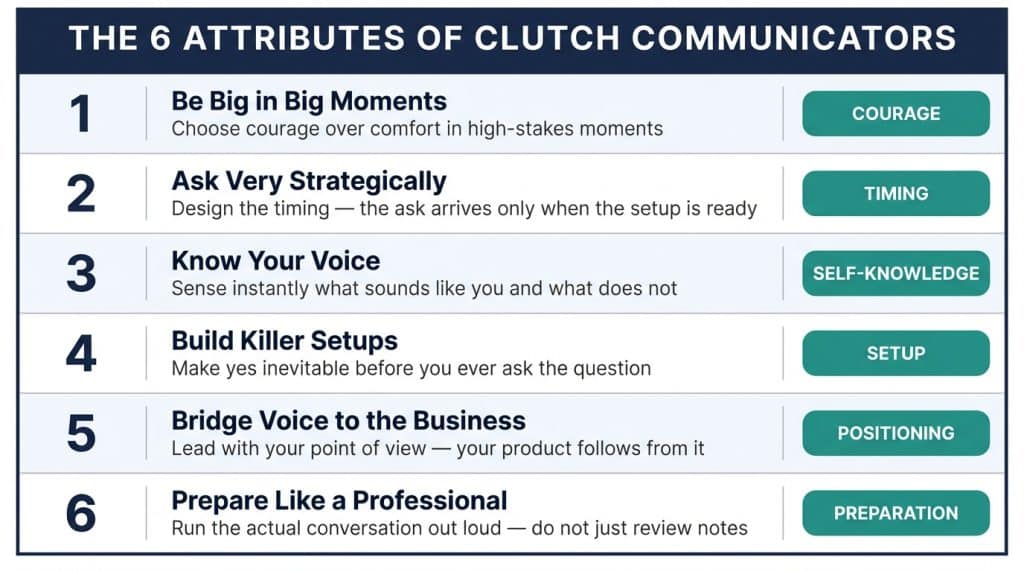
1. They choose to be big in big moments. Not loud. Not aggressive. They make the more courageous choice: slowing down to paint the full picture, naming the truth in the room, saying the specific thing they have been sitting on. For a founder Dia worked with, “being big” meant taking the time to tell a detailed historical analogy, specifically the story of Visa’s 1960s infrastructure build, rather than rushing to the efficient version that would not have landed.
2. They ask very strategically. The ask arrives after the relationship, and the setup is ready for it, not before. Timing is not improvised. It is designed.
3. They know their voice. They can look at content produced by a ghostwriter, a comms team, or a chief of staff and immediately sense what sounds like them and what does not. That fluency makes them collaborators, not bottlenecks. It is also what makes B2B thought leadership content sustainable at scale rather than a one-off sprint.
4. They build killer setups. The story before the ask is what makes the ask land. Founders who skip to the ask skip the setup that would have made yes inevitable.
5. They bridge their voice to the business. They speak from their point of view, then point to the product or venture as an expression of that view. They are not the product’s spokesperson. They are a voice that the product reflects.
6. They prepare like professionals. Not reviewing slides. Actually running the conversation, out loud, in real time, taking feedback in real time. One of Dia’s clients changed his shirt, washed his face, and drank a glass of water between back-to-back calls. That ritual helped him start each conversation fresh rather than carrying the residue of the previous one. The principle: do the work, do not talk about the work.
How Do You Know If Your Leadership Voice Is Working?
Test it in the room. Watch whether people lean in, ask follow-up questions, or go quiet and reflective. Those signals tell you more than any post-meeting survey.
Dia recommends a simple feedback framework she calls the Spiral Framework. After a conversation, presentation, or sales meeting, ask someone who was present two questions:
“What worked about what I said? And what would you like to hear more of?”
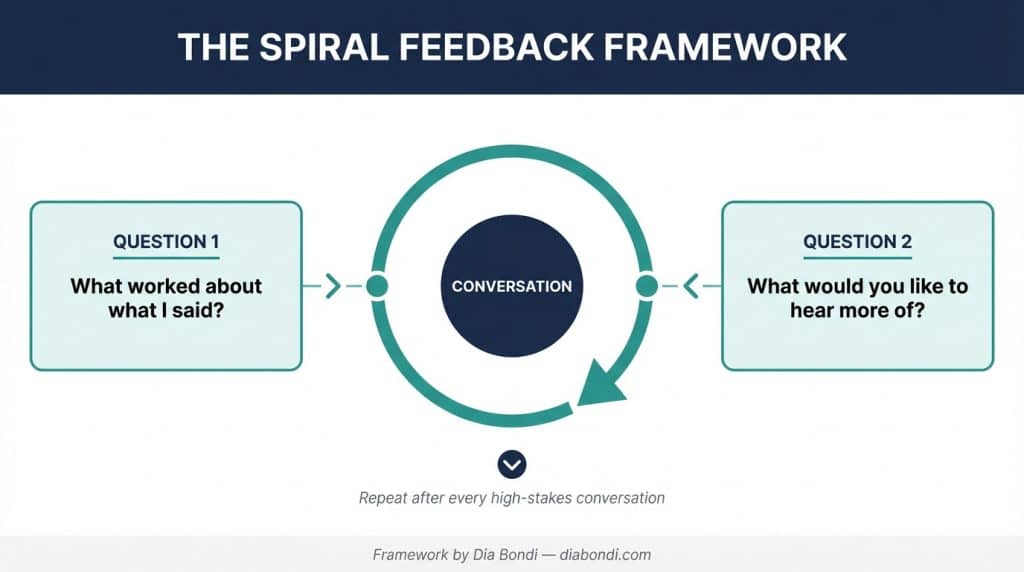
Those questions consistently produce more useful feedback than any general “how did I do?” request. They are also safe to ask: they position the respondent as a collaborator rather than a critic.
Then run field experiments. Try two different ways to describe your company’s problem in low-stakes settings: a coffee meeting, a networking event, or an internal all-hands. Watch what happens in the room. Does the conversation stop? Does someone follow up with a specific question? Do you get silence and polite nods?
A Series A founder I work with tried exactly this. One framing of his company’s problem, the polished, safe version, consistently produced polite nods. A second framing, blunter and more specific about what was broken, consistently produced follow-up questions and “that is exactly what I’m seeing.” The second version felt riskier. The data said otherwise.
That is Dia’s central point about personal experimentation. Your experience of your voice is not your audience’s experience of it. The gap between the two is where the real coaching work happens.
What Happens to Your Leadership Voice When You Use AI for Content?
AI tools generate content that reflects the average of everything they have been trained on. Without a developed leadership voice, the output sounds like everyone else.
Dia made an observation worth taking seriously for any founder using AI tools for content creation: you cannot prompt your way to a distinct voice without first doing the Platform Map work.
AI tools generate content that reflects the average of everything they have been trained on. Without a specific point of view, a clear Providence, and named principles as input, the output sounds like everyone else’s output. The result is what Dia calls the flattening of culture: a world where every founder’s LinkedIn posts and newsletter sections feel interchangeable because they were generated from the same undifferentiated prompts.
Founders who have done the Platform Map work can use AI in different ways. They can teach their tools who they are, with real source material from their platform, and use those tools to scale content that is genuinely theirs. The Platform Map is the source material that makes AI-assisted content development worthwhile rather than a race to the bottom.
When I ghostwrite for executives at the seed to Series C stage, the same discipline makes the work durable. Generic frameworks amplified are still generic. A distinct point of view amplified compounds. The difference is the source material, and the source material is the voice. Exploring how founders build personal brands that stand apart from their products is where this foundation becomes a growth asset.
Frequently Asked Questions About Leadership Voice
Why is leadership voice important for B2B founders specifically?
In B2B selling, buyers do not buy from companies at an early stage. They buy from founders. Enterprise buyers and investors use high-stakes conversations to assess whether the founder behind the product sees the market clearly, has a credible view of where it is headed, and is worth following. A distinct leadership voice is what makes that assessment go in the founder’s favor. Without it, the product has to carry all the weight.
What is an example of a leadership voice in practice?
Dia Bondi worked with a fintech founder heading into an acquisition discussion. His instinct was to present his pitch deck. Instead, she helped him develop his Point of View: he believed the future of fintech was “autonomous finance,” and every product decision his team made reflected that belief. In the meeting with the acquiring CEO, he discussed the industry’s future as a peer, not a vendor. That shift in framing changed the dynamic of the entire discussion.
What is the difference between a leadership voice and a personal brand?
A personal brand is how the market perceives you. Your leadership voice is the substance that creates that perception. Brand is the output; voice is the input. Founders who try to build a personal brand without developing a leadership voice end up with visibility without conviction. The Platform Map develops the voice first, so the brand that follows it has something real to stand on.
How long does it take to develop a leadership voice using the Platform Map?
Clarity on the four components can emerge in a focused one-to-three-day intensive. Using that clarity consistently, in conversations, content, and presentations, is where the compounding begins. Most founders who apply the Platform Map notice shifts in how they are received within two to three months of consistent use. The framework provides the structure; consistency provides the results.
Can a founder’s leadership voice actually reduce customer acquisition costs?
Not in a way that maps cleanly to a dashboard. But the mechanism is real. If a potential customer is already familiar with a founder’s worldview before the first sales conversation, they move from awareness to consideration faster. Fewer ad impressions before a click. Shorter due diligence cycles. Warmer first meetings. The attribution is hard to track directly. The conversion and cycle-length data, when viewed by channel, tend to tell the story.
What if I’m an introvert who hates being in the spotlight?
The Platform Map is not about performance. It is about clarity. An introvert who knows exactly what they stand for and why they are building what they are building can communicate that in writing, in one-on-one conversations, and in small rooms without ever needing to be the loudest voice in any of them. Leadership voice is not extroversion. It is specificity. Specificity travels in quiet rooms as well as large ones.
What does Dia Bondi mean by “being big in a big moment”?
It means making the more courageous communication choice when the stakes are highest. For most founders, that choice looks like slowing down when every instinct says to rush, saying the specific thing rather than the safe version, and tolerating the discomfort of taking up space in a room. Dia’s framing: often, the audience can handle you. The limitation is usually that you cannot yet handle yourself.
Conclusion
The founders who build efficient, compounding growth businesses do not just have better products. They have a leadership voice that makes investors want to back them before the deck is finished, enterprise buyers want to partner with them before the demo, and potential customers want to follow them before they have seen the product page.
That voice follows a structure: a purpose platform statement that guides what to say in each critical moment, a Providence story that answers why this founder is building this thing right now, a point of view and playbook that lets them own a category conversation rather than just describe a product, and principles that show how they actually operate under pressure.
Whether a founder develops that structure through Dia’s intensive, through a ghostwriting and content partnership, or by working through the Platform Map on their own, the investment compounds faster than any paid acquisition campaign. The difference shows up in the conversations where it matters most—and in the deals, partnerships, and rounds that follow.
Related Resources
- Thought Leadership Strategy: A Step-by-Step Guide With Examples for Growth. Build the systematic strategy that turns your Platform Map into a consistent pipeline authority.
- B2B Thought Leadership: Maximizing Impact to Drive Growth. How thought leadership translates to pipeline velocity, based on Edelman-LinkedIn research.
- What Is a Personal Brand and How to Build One That Drives Growth. The relationship between leadership voice and how the market perceives you over time.
- How to Use Storytelling in Business to Fuel Growth. The narrative techniques that make leadership voice land in practice.
- LinkedIn Content Strategy: How to Build Authority That Generates Pipeline. Turn your point of view and playbook into a consistent LinkedIn presence that works.
Connect With Dia Bondi
- Website: diabondi.com
- Book: Ask Like an Auctioneer: How to Ask for More and Get It
- LinkedIn: linkedin.com/in/diabondi
Some topics we explore in this episode include:
Listen to the episode.
Subscribe to & Review the Predictable B2B Success Podcast
Thanks for tuning into this week’s Predictable B2B Podcast episode! If the information from our interviews has helped your business journey, please visit Apple Podcasts, subscribe to the show, and leave us an honest review.
Your reviews and feedback will not only help me continue to deliver great, helpful content but also help me reach even more amazing founders and executives like you!
