

CEO content strategy is the systematic approach to publishing authoritative content that converts executive buyers at a predictable scale. Content Marketing Institute’s 2024 B2B research found that companies with a documented content strategy are significantly more effective at content marketing than those without one. For funded B2B founders, the compounding effect is real: each article builds authority that makes the next one rank faster, surface in AI search results, and convert more readily. This guide covers the exact framework applied with seed-to-Series-C companies to turn executive content into a qualified inbound pipeline.
Table of Contents
What Is CEO Content Strategy?
CEO content strategy is the documented plan governing what a B2B executive publishes, on which platforms, at what frequency, and how it converts audience attention into a qualified pipeline. According to the 2023 Edelman-LinkedIn B2B Thought Leadership Impact Report, 89% of decision-makers say thought leadership content influences their purchasing decisions. For seed-to-Series-C companies, executive authority is often the primary differentiator in a crowded market. A documented strategy ensures that influence compounds across platforms rather than dissipating across inconsistent posts.
The distinction from standard company marketing is practical. A company blog generates traffic. A CEO content strategy generates trust. Trust is what converts a warm prospect into a first meeting faster than any outbound sequence.
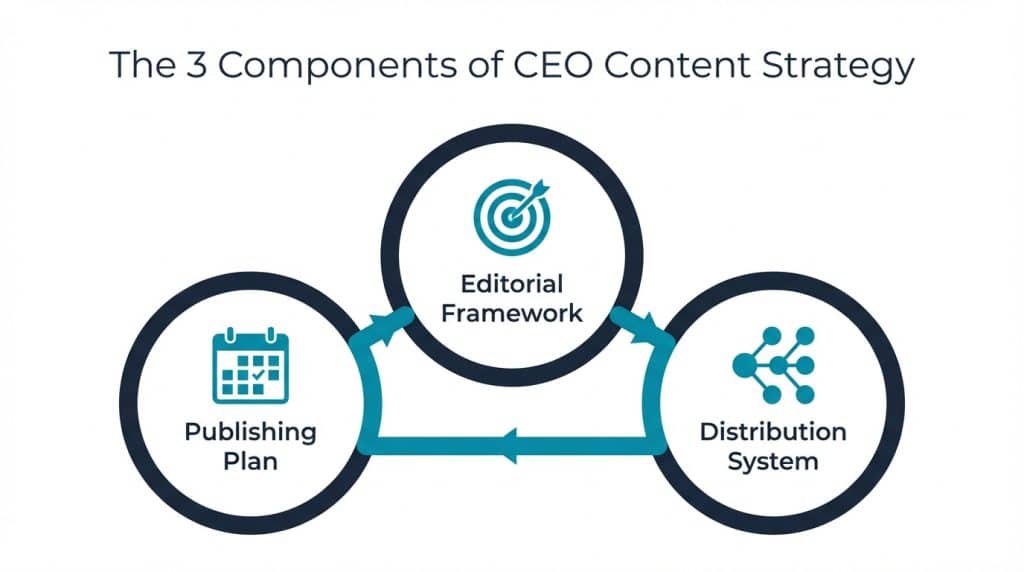
Three components define a functioning CEO content strategy: a documented publishing plan (what, where, and how often), an editorial framework (the point of view and positioning that makes content distinctive), and a distribution system (how content reaches the right people beyond organic reach). Without all three, content produces impressions but not a pipeline.
In my work with funded B2B tech companies, the most consistent gap I see is the second component. Executives publish regularly but never develop a defensible point of view. The result is founder-led content that generates followers but no inbound authority signal. Buyers read it, nod, and move on.
Why Most B2B CEOs Get Content Strategy Wrong
Most B2B CEOs either publish inconsistently or publish content that serves their own interests rather than their buyer’s decision journey. Both patterns produce the same result: content that generates impressions but no pipeline.
Most B2B CEOs get their executive content strategy wrong by publishing for visibility rather than buyer alignment. HubSpot’s 2024 State of Marketing Report found 60% of B2B marketers say their biggest challenge is generating traffic and leads from content. The underlying cause is usually a mismatch between what the executive wants to discuss and what decision-makers need to know to move the sales cycle forward. Fixing this starts with mapping every piece of content to a specific buying stage: awareness, consideration, or decision.
Three patterns consistently underperform across the funded B2B companies I work with.
Publishing without positioning. Content that could have come from any executive at any company generates zero authority. Every post, article, and newsletter issue needs a specific, defensible claim someone could disagree with.
Chasing short-form virality over long-form depth. LinkedIn commentary gets likes. Long-form frameworks build the trust that closes enterprise deals. Both have a role, but the ratio matters. Most CEOs are 90% short-form and wonder why they have large audiences but no inbound.
Ignoring distribution. The best B2B thought leadership strategy collapses without systematic distribution. LinkedIn, newsletter, and podcast appearances are not optional channels for a funded founder who wants inbound from content.
A Series A SaaS founder I work with had been posting on LinkedIn weekly for six months with zero inbound attribution. Every post was market commentary with no original angle and no buyer-stage mapping. Within three months of switching to a framework-forward approach with consistent newsletter distribution, they attributed two inbound enterprise conversations directly to content. The output volume did not change. The strategy did.
The CEO Content Stack: What to Publish and Why
The CEO content stack consists of three tiers: authority anchors (long-form guides and frameworks), distribution fuel (LinkedIn posts, newsletter issues), and conversion content (case studies, educational email courses). Authority anchors build credibility over months. Distribution fuel keeps the executive visible week to week. Conversion content turns interested readers into qualified conversions. Without all three tiers operating together, content-led growth produces awareness but not revenue.
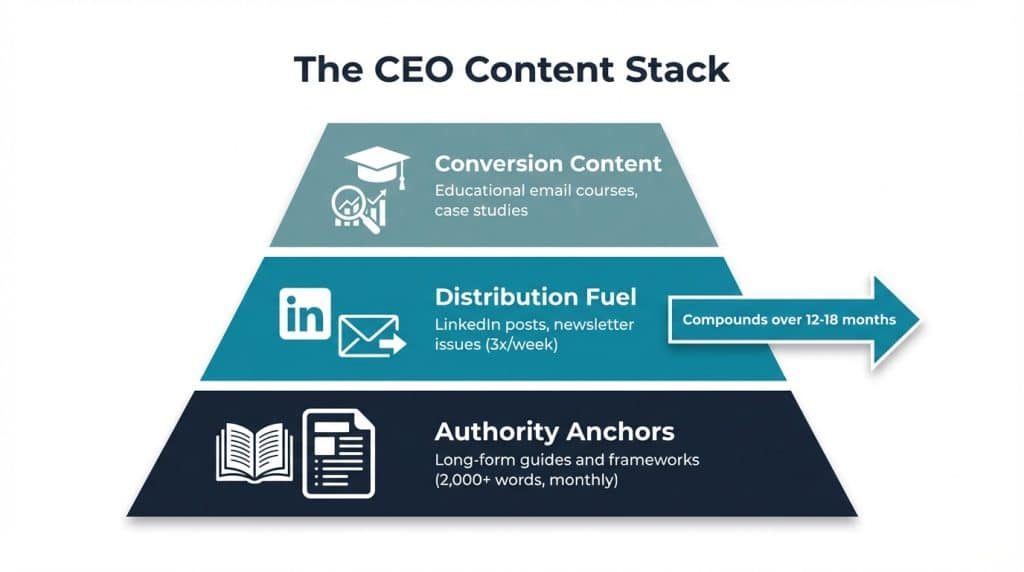
Authority anchors are the 2,000-plus-word articles, comprehensive guides, and definitive frameworks published on the company blog or a platform like Substack. These rank in organic search, surface in AI responses, and build long-term domain authority that amplifies every other channel. According to Orbit Media’s 2024 Blogger Survey, articles over 2,000 words report stronger results than shorter posts at a ratio of nearly 2:1. For a B2B CEO, one well-crafted authority anchor per month is achievable and compounds significantly over 12 to 18 months.
Distribution fuel keeps the executive visible between major pieces. LinkedIn posts, newsletter issues, and short-form observations extracted from longer content drive consistent engagement without requiring the same production investment. Three LinkedIn posts per week, extracted directly from the month’s authority anchor, is the minimum effective distribution cadence for a funded B2B CEO targeting an inbound pipeline. DSMN8’s 2025 executive influence research found that CEOs who post consistently generate the same number of audience reactions as their company page, with only 1.67% of the follower count, because personal credibility multiplies reach far beyond raw audience size.
Conversion content closes the gap between credibility and conversation. Educational email courses, in-depth case study narratives, and ROI-focused deep dives give the buyer a reason to engage beyond passive reading. The educational email course model, specifically, where a CEO shares a five-to-seven-part framework delivered over email, is one of the highest-converting assets in a B2B content stack. It moves a reader from an audience member to a relationship in a single interaction.
Most B2B CEOs focus entirely on distribution fuel, which creates visibility without authority. Most content agencies focus only on authority anchors, which build SEO without a sustained pipeline. The framework works when all three tiers operate in parallel.
How to Build Thought Leadership Without Writing Everything Yourself
The most consistent objection from funded B2B founders is that they do not have time to write. This is a production constraint, not a strategic one. The most effective executive thought leadership programs separate content thinking from content production.
The approach works in four steps. First, capture the CEO’s thinking in low-friction formats: voice notes, podcast appearances, client call recordings, and interview transcripts. The source material already exists in the executive’s experience. The challenge is extraction and structuring, not invention.
Second, apply an executive ghostwriting framework that converts raw thinking into structured content. This is the core of the ghostwriting work I do for B2B tech executives at Sproutworth: converting executive voice memos and interviews into LinkedIn posts, newsletter issues, and long-form articles that read as authentic because they are written in the executive’s own words and frameworks.
After 500-plus interviews on the Predictable B2B Success podcast, I have observed one consistent pattern: the founders with the strongest content presence are not the ones who write the most. They are the ones with the clearest point of view and the most disciplined distribution system.
“The executives building the strongest content presence aren’t writing more. They’re thinking more clearly about their buyer’s journey and then capturing that thinking systematically.” — Vinay Koshy, Founder at Sproutworth
Third, maintain a content calendar that balances consistency with quality. For most funded founders, publishing three times per week on LinkedIn, one newsletter issue every two weeks, and one long-form authority anchor per month is achievable and effective. More volume does not produce better results if the underlying point of view is weak.
Fourth, distribute systematically. A post published once and left to organic reach is wasted production time. Republication across channels, email distribution to the newsletter list, and deliberate LinkedIn amplification turn each content investment into six to eight distinct audience touchpoints.
CEO Content Distribution: Where Your Audience Actually Is
Distribution is where most CEO content strategies collapse. Content gets created, published once, and then abandoned. Without a distribution system, even the best content produces minimal pipeline impact.
For funded B2B CEOs targeting seed-to-Series-C buyers, three channels dominate.
LinkedIn is the primary research environment for B2B buyers. According to LinkedIn’s own B2B marketing data, 4 out of 5 LinkedIn members drive business decisions, and the platform delivers 2x the conversion rate of other social channels. For a CEO targeting enterprise buyers, consistent, POV-forward founder content on LinkedIn is the highest-ROI distribution investment available.
An email newsletter is the highest-trust, highest-attention channel a B2B executive can own. Open rates in the 30-40% range are achievable for a focused executive audience in a specific niche. A newsletter ghostwritten in the CEO’s voice, arriving on a consistent schedule, becomes the most reliable pipeline touchpoint in the content stack. It is the one channel that bypasses algorithm changes entirely.
Podcast appearances function as trust accelerators. A 45-minute interview on a niche B2B podcast reaches a concentrated, pre-qualified audience that has opted in to hear from experts in that space. I have seen founders close enterprise deals directly attributable to podcast appearances. The key is targeting podcasts whose audiences match the CEO’s ICP, not the ones with the largest listenership.
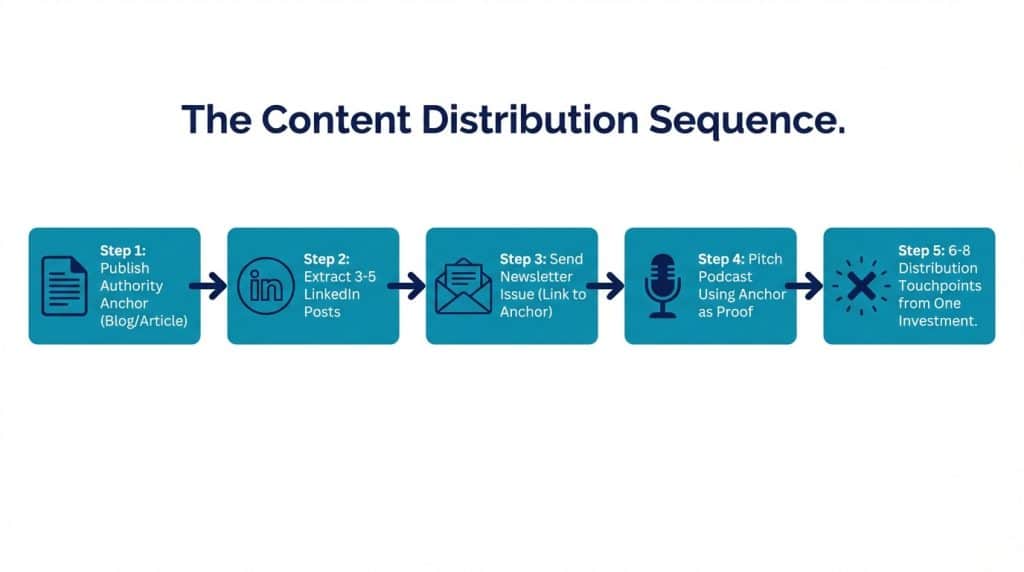
The distribution sequence matters. Publish the long-form authority anchor. Extract three to five LinkedIn posts from it. Send a newsletter issue linking to the anchor. Pitch a podcast using the anchor as the proof of point of view. One content investment becomes six to eight distribution touchpoints across three to four weeks.
How AI Search Engines Are Changing CEO Content Strategy
CEO content strategy now extends beyond Google rankings into AI search engine visibility. When B2B buyers ask Perplexity, ChatGPT, or Google AI Overviews, “who are the leading experts on B2B content for funded startups?” or “what’s the best framework for executive thought leadership?”, the AI engines surface answers based on the same signals Google does: published long-form content, external citations, and named expertise with a consistent track record. Executives who publish authoritative, citable content are increasingly surfaced as AI-cited sources before a buyer ever reaches the company website.
This changes the distribution calculus in a concrete way. Every authority anchor should now be engineered for two audiences simultaneously: the human reader who will share it and the AI engine that may extract and cite it when a buyer asks a related question in ChatGPT or Perplexity. Articles with clear definitions, direct-answer passages, and attributed statistics are dramatically more likely to be cited by AI engines than articles built around narrative flow alone.
For B2B CEOs, this means the question is no longer “will people find my content?” It is “will AI engines recommend my expertise when buyers are researching their options?” The answer depends on how citable the content is, not how well it reads.
I track this manually for the companies I work with by running targeted queries in Perplexity and ChatGPT quarterly. The founders who appear in AI-generated answers to industry questions are pulling inbound from a new channel that most of their competitors have not yet optimized for. That window does not stay open indefinitely.
Measuring CEO Content ROI: The Metrics That Actually Matter
CEO content ROI measurement should track pipeline-adjacent signals rather than vanity metrics. The three indicators that connect content investment to revenue are: inbound conversation rate (qualified conversations that begin because someone saw your content), content-influenced pipeline (active deals where the prospect references specific content during the sales cycle), and authority signals (backlinks, media citations, AI engine mentions, speaking invitations). Tracking impressions and follower counts tells you about reach, not pipeline.
Track three data points every quarter. First, inbound conversation rate: how many new qualified conversations opened with “I read your newsletter,” “I saw your LinkedIn post,” or “someone shared your article.” This is the clearest signal that content is doing its job.
Second, content-influenced pipeline: ask every new prospect during discovery how they found you and which specific content they consumed before reaching out. Build a simple attribution log. Within two quarters, patterns emerge that tell you which content types and topics are driving the highest-value conversations.
Third, authority signals: backlinks to your content from external sites, citations in AI search responses (test this manually in ChatGPT and Perplexity quarterly), podcast invitations, speaking requests, and media mentions. These signals compound into a domain authority that makes future content rank faster and surface more frequently in AI-generated answers.
A Series B cleantech founder I work with went from zero content-attributed inbound conversations to four per month within eight months of implementing this measurement framework. The most valuable change was not the increase in content volume. It was the shift in what they measured that changed what they produced.
CEO Content Strategy by Funding Stage
The right CEO content strategy changes as a company scales. What works at the seed stage would underperform at Series B. The framework adapts to the company’s primary goal at each stage.
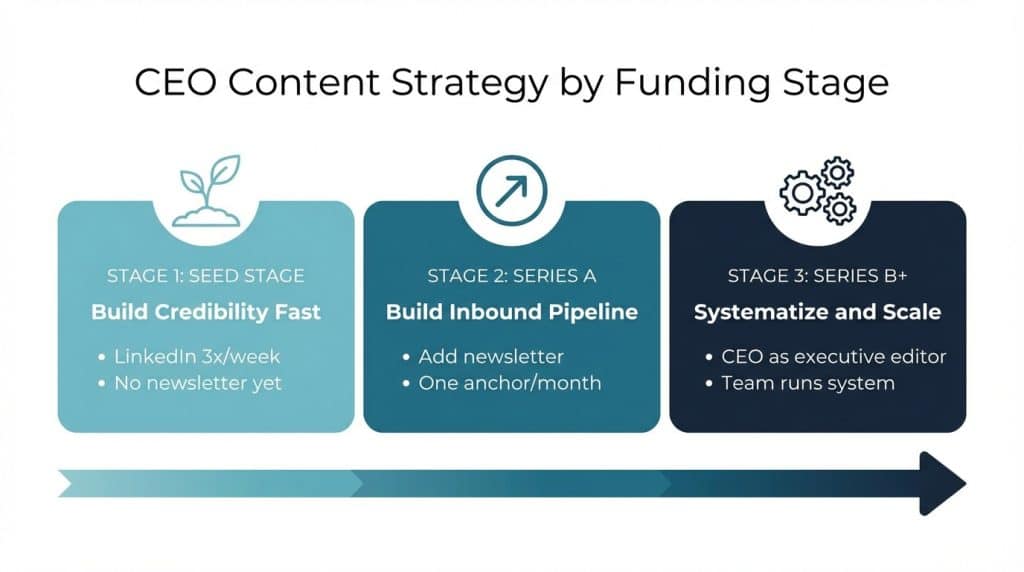
Seed stage: build credibility fast. Focus on one platform, LinkedIn, and one core message aligned with your fundraising narrative and ICP pain points. Publish three times per week. No newsletter yet. No authority anchors required. Consistency and a clear POV matter more than production quality at this stage. The goal is to become recognizable to a specific audience, not to generate a comprehensive pipeline.
Series A: build inbound pipeline. Add a newsletter. Begin publishing one authority anchor per month. Invest in executive ghostwriting support to maintain consistency as the CEO’s calendar expands post-raise. The content goal shifts from “people know I exist” to “people trust me to solve this specific problem.” Content-influenced pipeline becomes a measurable KPI.
Series B and beyond: systematize and scale. The CEO transitions from sole content producer to executive editor and primary voice. A team of ghostwriters, strategists, and distributors runs the production system. Content strategy connects directly to the enterprise sales motion. Speaking engagements, media coverage, analyst relations, and podcast appearances amplify reach beyond owned channels. The CEO’s content becomes a company asset rather than a personal project.
💡 CEO Takeaway
- Document the strategy. Write down what you publish, where, how often, and what each piece should accomplish. An undocumented executive content strategy is not a strategy.
- Map content to buying stages. Every piece of content should serve awareness, consideration, or decision-stage buyers. Publishing without buyer-stage alignment generates vanity, not pipeline.
- Build the three-tier stack. Authority anchors, distribution fuel, and conversion content working together. Missing any tier breaks the content-led growth equation.
- Distribute, do not just publish. Every piece of content should generate at least five distribution touchpoints. Publishing once is not a distribution strategy.
- Measure pipeline, not impressions. Track inbound conversation rate and content-influenced deals. Drop follower growth as your primary KPI.
- Optimize for AI search citability. Each authority anchor should include direct-answer passages and attributed statistics so AI engines surface your expertise when buyers are researching their options.
Frequently Asked Questions
What is a CEO content strategy?
A CEO content strategy is the documented plan governing what a B2B executive publishes, on which platforms, at what frequency, and how it converts audience attention into a qualified pipeline. It differs from company marketing because authority flows from the individual’s voice and expertise. A documented strategy ensures publishing decisions serve the buyer’s decision journey and compound into the inbound pipeline over time rather than dissipating across random posts.
How often should a CEO publish content?
B2B CEOs building authority and pipeline should publish on LinkedIn three times per week, send a newsletter once or twice a month, and publish one long-form article or guide per month. Consistency matters more than volume at early stages. A CEO who publishes once per week for 18 months will build more measurable authority than one who publishes daily for three months and then stops. The compounding effect of consistent content is the asset, not any single piece.
What is the difference between CEO content strategy and a company’s content marketing?
CEO content strategy is built around the executive’s personal authority and voice, with the explicit goal of converting that authority into an inbound pipeline and deals. Company content marketing is typically brand-centric and SEO-focused. The two overlap but operate differently: CEO content strategy positions the individual as the primary trust signal rather than the company domain, and it performs best on platforms where personal credibility matters, specifically LinkedIn and email newsletter.
Can a CEO build thought leadership without writing everything themselves?
Yes. The most effective executive thought leadership programs combine the CEO’s original thinking, captured in voice notes, interviews, and conversations, with professional executive ghostwriting support that structures and publishes that thinking consistently. The CEO provides the point of view, frameworks, and authentic experience. The ghostwriter handles production, structure, and distribution. The output reads as authentic because the source material comes directly from the executive’s own expertise and client work.
How do you measure the ROI of CEO content strategy?
Measure CEO content ROI through three pipeline-adjacent signals: inbound conversation rate (how many qualified conversations begin because of direct content exposure), content-influenced pipeline (how many active deals reference specific content during the sales cycle), and authority signals (citations, media mentions, podcast invitations, and AI engine appearances). Impressions and follower counts are awareness metrics. They do not indicate whether content is contributing to revenue.
How does CEO content get surfaced in AI search engines like Perplexity and ChatGPT?
AI search engines surface CEO content based on three signals: consistent long-form publishing on a specific topic, citability (clear definitions, direct-answer passages, attributed statistics), and external validation through backlinks and credible citations. Executives who publish framework-level authority articles are more likely to appear in AI-generated answers than those who post general commentary. Running quarterly tests in Perplexity and ChatGPT with buyer-intent queries reveals whether your executive content is surfacing as a cited source.
Conclusion
CEO content strategy is not a nice-to-have for funded B2B companies. It is the highest-ROI marketing channel available to a founder with a clear point of view and a commitment to consistent publishing.
The framework is straightforward: document the strategy, build the three-tier content stack, distribute across LinkedIn and email, measure pipeline rather than impressions, and scale the production system as the company grows. The compounding effect of 12 to 18 months of disciplined B2B executive content execution is what separates funded founders with strong inbound pipelines from those still relying entirely on outbound.
The companies getting this right are not necessarily the ones with the largest marketing budgets. They are the ones with executives who understand that authority is built in public, through consistent publishing, over time. And increasingly, that authority is surfacing not just in Google search but also in the AI engines buyers use to research their options before they ever contact a vendor.
If you are building content systems for your executive team, this is the kind of work I do at Sproutworth, combining ghostwritten thought leadership with digital PR to build the authority signals that convert into an inbound pipeline.
Related Resources
- B2B SaaS Pipeline Strategy: The CEO Framework for Qualified Inbound
- B2B Demand Generation: 15 Expert-Tested Strategies for Funded Startups
- How to Get Reliable Pipeline Growth via B2B Content Strategy
- How to Drive Pipeline With Less Spend Using a Data-Backed Content Strategy
- About Sproutworth: Working With Funded B2B Tech Founders
