
A B2B LinkedIn marketing strategy is a systematic plan for using LinkedIn to generate a qualified pipeline, not follower counts. LinkedIn drives 80% of B2B social media leads according to LinkedIn marketing data (2024), yet most companies treat it like a broadcast channel. For funded B2B tech companies, the difference between LinkedIn as a cost center and a pipeline driver comes down to intentional architecture across the founder profile, company page, and outreach system.
What Is a B2B LinkedIn Marketing Strategy?
A B2B LinkedIn marketing strategy is a coordinated system for turning LinkedIn activity into a measurable revenue pipeline. It spans content, outreach, advertising, and employee amplification. LinkedIn’s targeting precision and professional context make it the highest-intent B2B network available. Unlike Twitter or Instagram, nearly everyone on LinkedIn is there for professional reasons. Your content reaches buyers when they’re in a buying mindset.
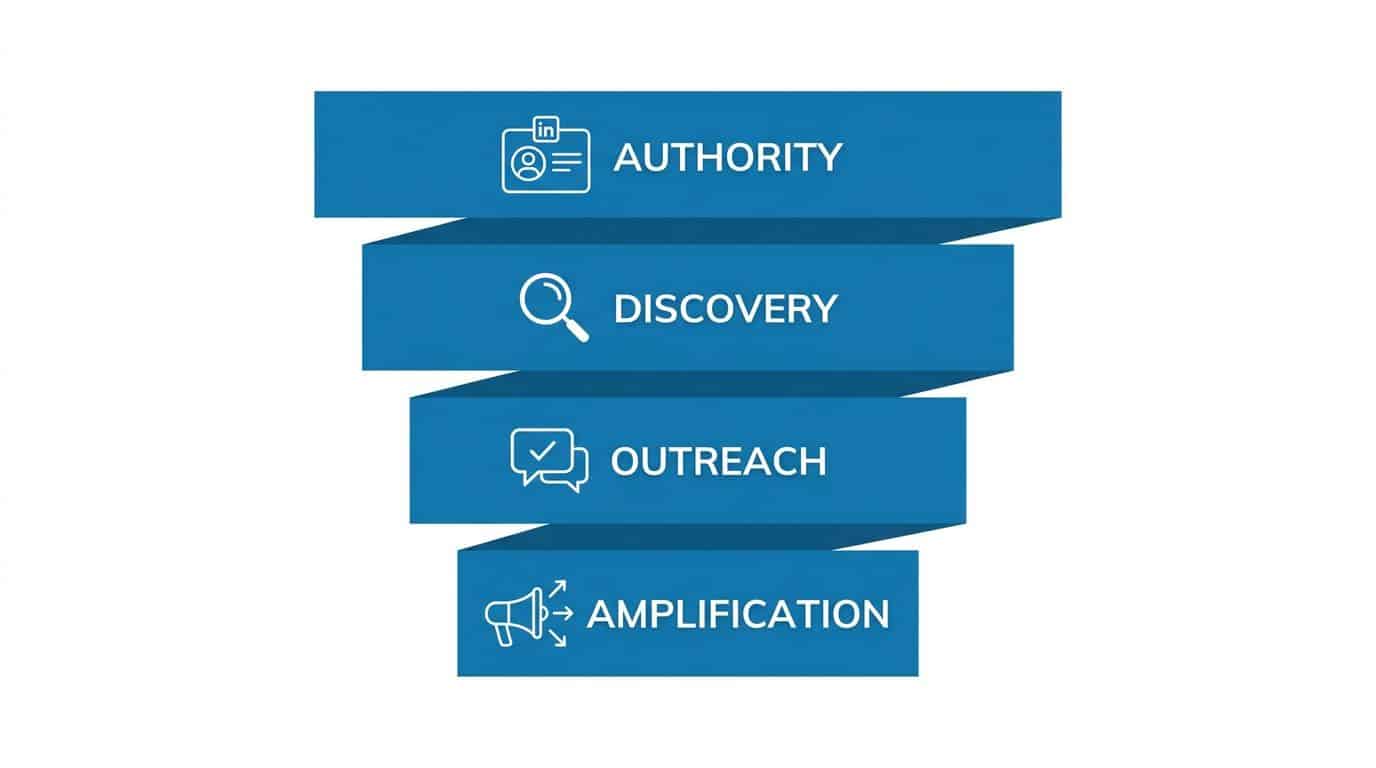
The core architecture of an effective B2B LinkedIn strategy has four layers working together:
| Layer | What It Does | Primary Tool |
|---|---|---|
| Authority | Positions you as credible to your ICP before any outreach | Founder content + company page |
| Discovery | Gets you found by in-market buyers searching for solutions | Profile optimization + article SEO |
| Outreach | Initiates direct conversations with qualified prospects | Connection requests + DM sequences |
| Amplification | Extends reach and builds social proof at scale | Employee advocacy + LinkedIn Ads |
Most B2B companies only operate at the outreach layer. They send cold messages without the authority layer in place, which is why LinkedIn InMail response rates average just 18-25% across the platform. The companies generating a consistent pipeline from LinkedIn run all four layers simultaneously.
Tactic 1: Build a Founder Profile That Converts Visitors Into Leads
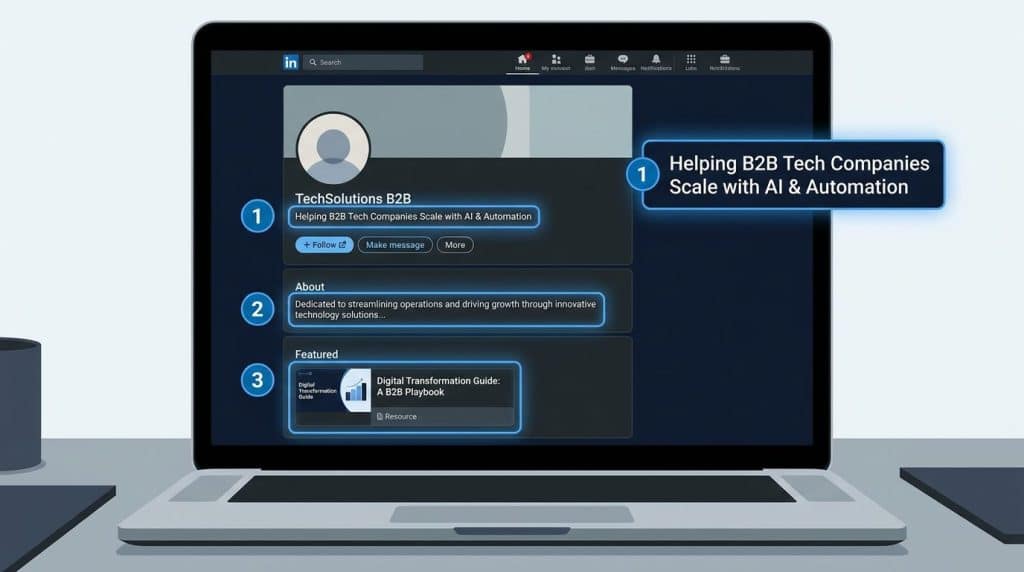
Your LinkedIn profile is a landing page, not a resume. Optimized founder profiles convert at 3-5x the rate of standard corporate profiles according to LinkedIn Marketing Solutions benchmarks. The headline, about section, and featured section need to speak directly to your ICP’s problem, not list your credentials.
The anatomy of a high-converting founder profile:
- Headline (220 characters): Lead with the problem you solve, not your title. “I help Series B SaaS companies cut CAC by 30% through content-led GTM” beats “CEO at Acme Corp” every time.
- About section (2,600 characters): Open with a one-sentence buyer problem. Follow with your framework for solving it. Close with a clear CTA, newsletter signup, free audit, or direct booking link.
- Featured section: Three items maximum. Prioritize lead magnets, case study posts, or demo videos over press mentions.
- Experience section: Write each role as an outcome statement. “$12M ARR in 18 months” lands better than “responsible for revenue growth.”
One thing most founders skip: the Creator Mode toggle. Enabling Creator Mode moves your Connect button to Follow by default, increases your content distribution, and adds a newsletter subscription prompt to your profile. For founders with audiences over 1,000 connections, it’s worth enabling.
Tactic 2: Use Your Company Page as a Proof Engine, Not a Billboard
Company pages rarely drive pipeline on their own, but they do heavy lifting as a credibility checkpoint. When your outreach lands in a prospect’s inbox, the first thing they do is check your company page. A weak page kills deals before they start. A strong page pre-sells the conversation before it happens.
| Dimension | Company Page | Founder Profile |
|---|---|---|
| Primary purpose | Credibility checkpoint | Pipeline driver |
| Best content type | Case studies, product news, team wins | Insights, frameworks, opinions |
| Follower growth rate | Slower (brand-driven) | Faster (algorithm favors people) |
| DM capability | Limited (InMail only) | Full (connection + DM) |
| Content reach | ~5-7% of followers | ~10-15% of connections organically |
The most effective company page strategy is to make it a repository of results. Every quarter, publish three to five client outcome posts: specific metrics, named industries (even if the client is anonymous), and before/after comparisons. This gives every prospect who checks your page a reason to believe your outreach claim. Before they reply.
Sproutworth works with funded B2B tech founders on exactly this, building the content layer that makes outreach convert. The company page is where that proof lives.
Tactic 3: Publish Content That Attracts In-Market Buyers
LinkedIn content that generates pipeline is specific, opinionated, and structured around buyer problems rather than company updates. According to LinkedIn’s B2B Institute, content that addresses buyer challenges generates 7x more engagement than product-focused posts (LinkedIn B2B Institute, 2024). The algorithm rewards content that keeps people on the platform, which means educational and opinionated posts consistently outperform promotional ones.
Five LinkedIn post formats with consistently high pipeline conversion rates for B2B companies:
- The framework post: Share a 5-step system you use with clients. Add a specific outcome at the end (“this framework helped one SaaS client cut time-to-close from 47 days to 22”). These generate DMs from people who want the full system.
- The contrarian take: Disagree with something your ICP believes but shouldn’t. Back it with data. These generate comments from people in your exact target segment.
- The client’s win post: Anonymized if needed, but specific. Industry, metric, timeline. Avoid vague claims like “helped a client grow significantly.”
- The data breakdown: Take a recent study relevant to your ICP and add your interpretation. This positions you as the person who synthesizes the research they don’t have time to read.
- The decision framework: Help your ICP make a specific decision they face regularly. “How to decide whether to hire a content lead or outsource” is more valuable to a Series A CEO than “why content matters.”
A sustainable content cadence for most B2B founders is three posts per week: one educational, one opinion, one case study or result. That’s enough to stay visible without becoming a full-time content creator.
| Day | Format | Content Type | Topic Source |
|---|---|---|---|
| Monday | Educational post | Framework or how-to | Client work, internal processes |
| Wednesday | Opinion post | Contrarian take or data commentary | Industry news, recent research |
| Friday | Social proof post | Client win or case study | Recent client results |
Tactic 4: How to Build a LinkedIn Outreach System That Gets Replies
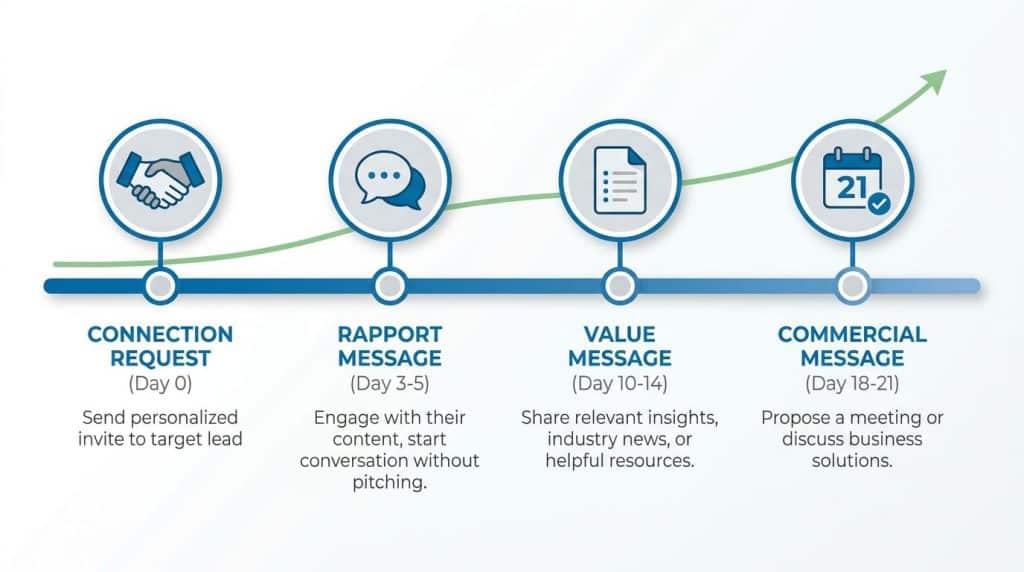
A LinkedIn outreach system that works follows a three-stage sequence: connection request, rapport message, and value message. Cold pitching in the first message kills response rates. Most people skip directly to the pitch, which is why average cold InMail response rates sit below 25%. The companies generating a consistent outbound pipeline from LinkedIn run a 14-21 day sequence before any commercial message.
| Message # | Timing | Content | Max Length |
|---|---|---|---|
| 1, Connection request | Day 0 | Personalized to their recent post or company news. No pitch. | 300 chars |
| 2, Rapport message | Day 3-5 post-connect | Specific insight or observation relevant to their business. Ends with a question. | 150 words |
| 3, Value message | Day 10-14 | Share a relevant resource (article, case study, framework). No ask. | 150 words |
| 4, Commercial message | Day 18-21 | Soft pitch referencing previous conversation thread. One specific ask. | 120 words |
The single most important variable is the connection request message. Generic requests (“I’d like to add you to my professional network”) are accepted at 15-20%. Requests that reference something specific in their recent content accept at 35-45% in our experience running this sequence for B2B tech founders.
One constraint worth noting: LinkedIn limits connection requests to approximately 100 per week for most accounts, and more strictly for accounts with high ignore rates. Quality beats volume here. 20 well-researched connection requests will outperform 100 generic ones on every metric that matters.
Tactic 5: Build an Employee Advocacy Program That Multiplies Your Reach

Employee-shared content receives 8x more engagement than content shared by brand pages, according to LinkedIn’s 2024 employee advocacy research. For B2B companies with a team of 5-50 people, activating even three or four employees as regular LinkedIn posters creates a distribution multiplier that no ad budget can easily replicate.
The practical challenge is that most employees don’t know what to post, don’t have time to write it, and don’t want to post something that looks like corporate PR. Solving all three of those objections is what makes employee advocacy programs work.
A lightweight employee advocacy system that actually works:
- Create a weekly content brief: Send 2-3 post ideas every Monday, each with a hook, key point, and optional stat. Employees pick one, personalize it, and post it. Personalization is non-negotiable, verbatim company posts read as inauthentic, and LinkedIn’s algorithm penalizes identical content.
- Focus on domain experts first: Your head of engineering posting about technical architecture will outperform the sales team posting about ROI every time. Match content angles to each person’s genuine expertise.
- Remove the friction: Set up a shared Slack channel or Notion doc with ready-to-use posts. The easier you make it to post, the more consistently it happens.
- Celebrate results publicly: Share engagement metrics internally. When someone’s post gets 5,000 impressions, announce it. Social recognition drives continued participation.
For early-stage companies, the founder and two subject matter experts posting consistently outperform a company page with 10,000 followers. The difference is individual voices. No branded page can replicate them.
Tactic 6: Use LinkedIn Ads to Accelerate Demand, Not Create It
LinkedIn Ads are the most expensive B2B advertising platform per click, with average CPCs running $5– $ 15, and they’re frequently misused as demand-creation tools. The companies that get ROI from LinkedIn Ads use them to accelerate existing demand: targeting people who’ve already shown intent through content engagement, website visits, or competitor research.
Three LinkedIn Ad formats with reliable B2B ROI at the seed-to-Series B stage:
- Lead Gen Forms (LGF): The highest-converting LinkedIn ad format because the form pre-fills with profile data. CPL averages 50-80% lower than driving traffic to a landing page. Best used for lead magnet downloads, webinar registrations, and demo requests from warm audiences.
- Thought Leadership Ads: Promote your best-performing organic posts to lookalike or targeted audiences. Cost-effective because you’re boosting content that has already proven its engagement. Best for building awareness with new ICP segments.
- Retargeting campaigns: Target people who’ve visited your website or engaged with your content in the last 90 days. These audiences are small, but their conversion rates are 3-5x higher than those of cold audiences. Budget $1,000-2,000/month to stay visible with warm prospects.
One targeting insight worth knowing: LinkedIn’s job function targeting is more reliable than job title targeting for B2B campaigns. Job titles vary wildly across companies (“VP of Revenue” vs “Chief Revenue Officer” vs “Head of Sales” are all the same role). Job function + seniority level produces a cleaner audience composition.
Tactic 7: How Does LinkedIn Analytics Help You Improve Pipeline Results?
LinkedIn Analytics tells you what’s working and what to stop doing. The metric most B2B marketers ignore is follower demographics. Specifically, the seniority and job function breakdown of your page followers. If your followers are predominantly junior roles when your ICP is C-suite, your content is attracting the wrong audience.
| Metric | How to Track | What It Tells You |
|---|---|---|
| Follower demographics | Company page Analytics > Followers | Whether your content attracts your ICP |
| Post reach by content type | Content Analytics > Impressions | Which formats earn the most distribution |
| Profile views from target companies | LinkedIn Sales Navigator or Who’s Viewed | Whether outreach is generating ICP curiosity |
| Inbound connection quality | Manual review of accepted connections | Whether content is attracting buyers or peers |
| DM response rate by message type | Manual tracking in CRM or Airtable | Which connection request angles convert best |
The most actionable LinkedIn metric for pipeline purposes isn’t impressions or follower count, it’s the ratio of profile views from your ICP segment to total profile views. Track this monthly via LinkedIn Sales Navigator’s “Who Viewed Your Profile” filter. If ICP views aren’t increasing despite content volume, the problem is targeting (who sees your content), not production (what you’re posting).
Tactic 8: Build a LinkedIn Newsletter as a Long-Game Pipeline Asset
LinkedIn newsletters have open rates of 40-50% (2024 benchmark data), compared to the 20-25% average for email newsletters. For B2B founders, the LinkedIn Newsletter feature creates a subscription-based audience inside the platform , one that receives a notification every time you publish, without competing with inbox noise.
The mechanics that make LinkedIn Newsletters valuable for the B2B pipeline:
- Subscriber acquisition is automatic: LinkedIn prompts your existing followers to subscribe when you publish your first newsletter. A founder with 3,000 connections can realistically acquire 500-1,000 newsletter subscribers in the first 30 days without any promotion.
- Each issue creates multiple assets: A 1,500-word newsletter becomes one article post, three excerpt posts, and a LinkedIn poll, four pieces of content from one piece of writing.
- The algorithm treats newsletter publications differently: Articles and newsletters get indexed by Google, giving you long-term SEO value that standard LinkedIn posts don’t create.
The best LinkedIn Newsletter strategy for a B2B pipeline is to publish a single weekly insight that your ICP can’t get anywhere else. Not a roundup, not company news, one specific insight that shows you understand their world better than most advisors they’ve paid. That positions you as the obvious first call when they need what you do.
Tactic 9: How to Optimize LinkedIn for AI-Driven Discovery (LLMSEO)
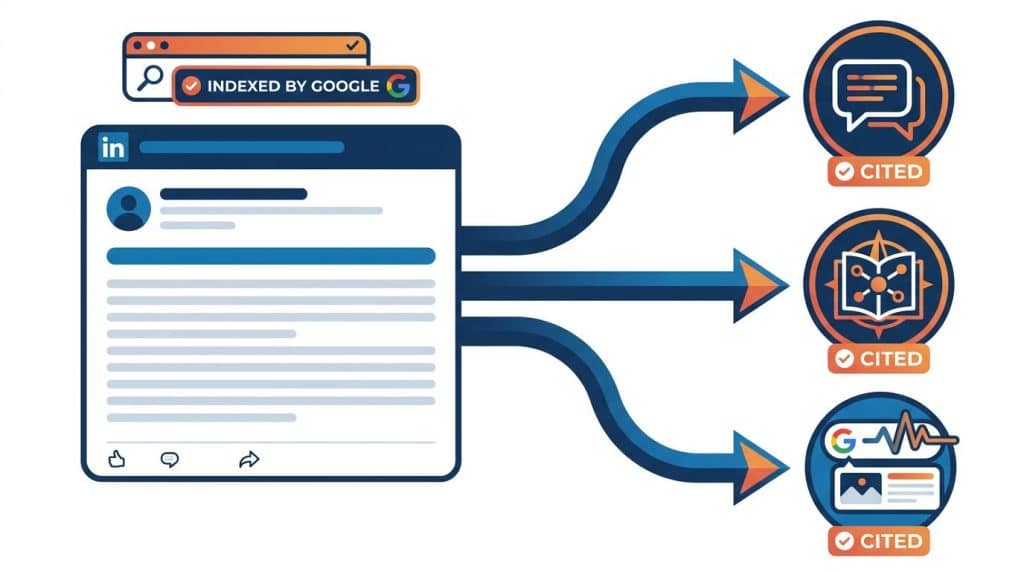
AI engines, ChatGPT, Perplexity, and Google AI Overviews are now the first place many B2B buyers start research. When a buyer asks, “what’s the best B2B content marketing agency for SaaS companies?” the AI engine pulls from indexed content. It draws from LinkedIn articles, company blog posts, and cited sources. None of the standard LinkedIn marketing guides cover this, making it an untapped opportunity.
Three ways to optimize your LinkedIn presence for AI-driven discovery:
- Publish LinkedIn Articles, not just posts: LinkedIn Articles are indexed by Google and referenced by AI engines. Long-form articles (1,500+ words) on specific queries your ICP searches (“how to build a B2B content strategy” or “B2B LinkedIn ROI benchmarks”) get cited in AI responses. Regular posts don’t.
- Create standalone citable statements: AI engines pull specific, self-contained claims from content. Structure your most important points as standalone sentences: “B2B LinkedIn generates 80% of social media leads” is citable. “LinkedIn is really important for B2B” isn’t. Write with citation-readiness in mind.
- Build your entity graph: AI engines associate company names with specific expertise when the same entity appears consistently across indexed content. Publishing on LinkedIn and your company blog, and getting cited in industry articles, builds the entity association that helps AI engines route relevant queries to you.
At Sproutworth, we call this LLMSEO, optimizing content specifically for citation by AI answer engines. For B2B founders, it’s the next frontier of LinkedIn marketing: not just being findable in LinkedIn search, but being cited by AI tools when your buyers ask for recommendations.
Key Takeaways: Your B2B LinkedIn Strategy Checklist
- ✅ Optimize your founder profile as a lead conversion page, not a resume
- ✅ Turn your company page into a proof repository with client outcome posts
- ✅ Publish educational, opinionated content 3x per week (Mon/Wed/Fri)
- ✅ Run a 4-message outreach sequence over 18-21 days before any commercial ask
- ✅ Activate 3-5 employees as consistent LinkedIn voices
- ✅ Use LinkedIn Ads to accelerate warm demand, not create cold awareness
- ✅ Track follower demographics and ICP profile views monthly
- ✅ Launch a LinkedIn Newsletter targeting 500+ subscribers in the first 30 days
- ✅ Publish LinkedIn Articles optimized for AI engine citation (LLMSEO)
Frequently Asked Questions About B2B LinkedIn Marketing
What is the most effective B2B LinkedIn marketing strategy for generating a pipeline?
The most effective B2B LinkedIn strategy combines three elements: a founder profile optimized as a conversion page, consistent educational content (3x per week) positioned around your ICP’s specific problems, and a structured outreach sequence. It builds trust before any commercial ask. Companies that run all three together consistently generate 3-5x more qualified pipeline from LinkedIn than those using only one element. The foundation is the founder profile; without it, even high-volume outreach converts poorly.
How long does it take to see results from a LinkedIn B2B marketing strategy?
Most B2B founders see the first qualified leads from LinkedIn within 60-90 days of running a consistent content + outreach strategy. The timeline depends on three variables: your existing network size, how specifically your content addresses your ICP’s pain, and your outreach volume and quality. The first 30 days typically build an audience. Days 30-60 mark the start of generating inbound interest. Days 60-90 yield the first pipeline conversations when the outreach sequence runs in parallel.
How much should B2B companies spend on LinkedIn Ads?
For most seed-to-Series B companies, $3,000- $ 8,000 per month is sufficient for meaningful LinkedIn Ads retargeting and lead-gen campaigns. That assumes the organic content foundation is already in place. Without organic content, LinkedIn Ads rarely produce positive ROI because the content being promoted hasn’t been validated with a real audience. The minimum viable LinkedIn Ads budget for a single campaign is approximately $1,500- $ 2,000 per month. Below that, audience sizes are too small for the algorithm to optimize effectively.
How do I build an employee advocacy program on LinkedIn?
Start with three employees who are already active on LinkedIn and have domain expertise your ICP cares about. Create a weekly content brief with 3 ready-to-personalize post ideas every Monday. Build a shared Slack channel or Notion doc where approved posts live. Require personalization. Identical posts kill credibility and get penalized by the algorithm. Share engagement metrics publicly to reward participation. Once the system is running with three people, add two more every quarter. Don’t try to activate the whole company at once.
What LinkedIn metrics should B2B companies track?
The five metrics that actually correlate with B2B pipeline are: follower demographics (% matching your ICP), ICP profile views (are the right people checking you out?), inbound connection quality (are buyers requesting to connect with you?), outreach sequence response rate (per message stage), and content-to-conversation rate (which posts generate DMs from your ICP). Vanity metrics like total impressions and follower count are poor predictors of pipeline. Track pipeline-correlated metrics weekly in a simple CRM or spreadsheet.
How does LinkedIn compare to other B2B social media channels?
LinkedIn generates 80% of B2B social media leads across all platforms, according to LinkedIn data. It outperforms Twitter/X for B2B because professional context is the norm, not the exception. It outperforms Instagram and Facebook because targeting precision matches B2B buying criteria (job title, company size, seniority). For funded B2B tech companies specifically, LinkedIn is typically 3-4x more efficient as a pipeline channel than any other social platform. The trade-off is that LinkedIn requires more content investment per post to perform well; short, casual posts underperform relative to other platforms.
Will AI tools like ChatGPT and Perplexity find my LinkedIn content?
LinkedIn Articles are indexed by Google and accessible to AI engine crawlers, which means a well-written LinkedIn Article on a specific query can appear in AI-generated answers. Regular LinkedIn posts are not indexed by Google and are not directly accessible to AI engines. To optimize for AI discovery, publish long-form LinkedIn Articles (1,500+ words) on the specific questions your ICP asks AI tools. Write citable standalone statements that AI engines can quote as direct answers. This is an emerging area, LLMSEO for LinkedIn, that most B2B marketers haven’t begun addressing yet.
What’s the difference between LinkedIn marketing for personal brands vs company pages?
Personal profiles consistently outperform company pages for B2B pipeline generation. LinkedIn’s algorithm distributes personal content to 10-15% of connections organically, compared to 5-7% for company pages. Personal profiles also enable direct messaging, which company pages can’t do. The practical implication is that founder and executive profiles should be your primary LinkedIn content channels. The company page serves as a credibility checkpoint when prospects research your business, not as a primary lead source. Invest content effort in personal profiles first, then build the company page as a proof repository to support outbound conversion.
The Real Difference in B2B LinkedIn Results
The companies generating a consistent pipeline from LinkedIn aren’t doing anything exotic. They’re running a content layer that builds authority, an outreach layer that builds trust, and an amplification layer that extends both. What separates them from everyone else is that they’re doing all three simultaneously, not cycling through them one at a time. If you’re only running outreach without content, or only posting without outreach, you’re operating on one cylinder.
The nine tactics in this guide give you the full architecture. The sequence that produces results fastest: fix the founder profile first (one week). Build the content cadence in the second week (weeks 2-4). Launch outreach sequences third (week 3 onward). Then layer in employee advocacy and LinkedIn Ads once the organic machine is working.
If you want help building this system, Sproutworth works with funded B2B tech founders on LinkedIn ghostwriting and content strategy. We handle the full content layer so you can focus on the conversations the content creates.
