
Ranking in ChatGPT means appearing as a cited source when your buyers ask the AI about your problem space, product category, or competitors. ChatGPT reaches over 300 million users weekly, and B2B buyers now use it to shortlist vendors before a discovery call. This guide covers the six content signals that determine who gets cited, the off-page moves most B2B teams skip, and how to build measurable ChatGPT citation presence in 90 days.
Key facts on ChatGPT as a B2B channel:
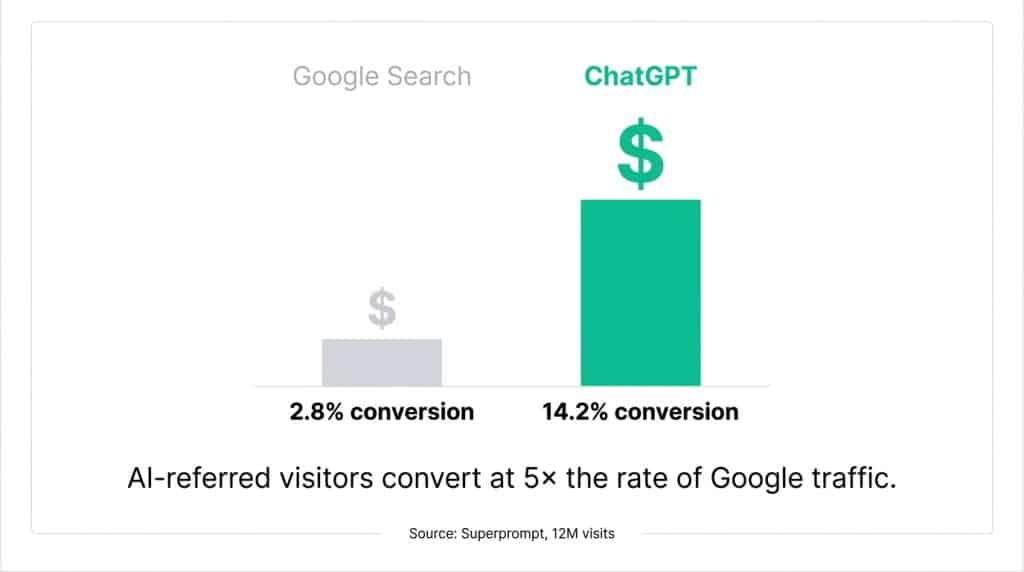
• ChatGPT-referred visitors convert at 14.2% vs Google’s 2.8% (Superprompt, 12M visits)
• Generative AI traffic grew 796% from 2024 to 2025 (WebFX, 2.3B sessions)
• 80% of URLs ChatGPT cites don’t appear in Google’s top 100
• Content updated within 30 days gets 3.2× more citations than content 90+ days old
• Community platforms (Reddit, Quora) account for 52.5% of all AI citations (OtterlyAI)
Table of Contents
Why ChatGPT Citations Outperform Google Clicks
ChatGPT-referred visitors convert at a fundamentally different rate than search traffic. Superprompt tracked 12 million visits and measured ChatGPT traffic converting at 14.2% versus Google’s 2.8%, a fivefold advantage. A WebFX analysis of 2.3 billion site sessions found generative AI traffic grew 796% from 2024 to 2025, with B2B software companies seeing AI-referred visitors convert at 57.84% compared to 37.17% for organic search. The reason is simple: buyers arrive pre-educated. The average ChatGPT session duration is 5:18, compared with 1:24 for traditional search. By the time they reach your site, they have already had a research conversation with an AI that synthesized the options and made a recommendation.
The citation gap makes this more urgent: 80% of the URLs ChatGPT cites don’t appear in Google’s top 100 results. Your Google ranking predicts almost nothing about your ChatGPT visibility. Citation slots are finite. ChatGPT typically cites 5-7 sources per response, and those slots go to brands with established credibility in specific topical areas. A B2B company receiving 1,000 monthly visitors from ChatGPT at 14.2% conversion generates 142 customers. The same company needs 5,000 Google visitors at 2.8% to match that output. This is the highest-converting discovery channel most B2B founders are not in yet.
What Does Ranking in ChatGPT Actually Mean?
Ranking in ChatGPT is not the same as ranking on Google. Google surfaces a list of links. ChatGPT reads sources, synthesizes an answer, and attributes specific passages to the pages it drew from. Your goal is to be one of those authoritative sources for the questions your buyers ask most often.
This distinction matters because the optimization strategy is completely different. A page optimized to rank #1 on Google may generate zero ChatGPT citations if it doesn’t answer the query directly in the opening paragraph. The reverse is also true: a well-structured, direct-answer page on a low-authority domain can generate consistent ChatGPT citations that a higher-authority competitor misses entirely.
ChatGPT citations work differently from search rankings. When a user asks ChatGPT a question, the model either draws from its training data or runs a real-time web search via Bing. For either path, the sources cited are those that answered the question most directly, not those that ranked highest on a keyword. A page that answers a specific question in 60 clear words will outperform a 5,000-word pillar page that buries the answer in section seven. Understanding what answer engine optimization actually is is the prerequisite to building a ChatGPT ranking strategy. The short version: AI citation is a structural and specificity problem, not a content volume problem.
How ChatGPT Selects Its Sources
ChatGPT uses two pathways to select sources, and knowing which one to target changes how you approach content production.
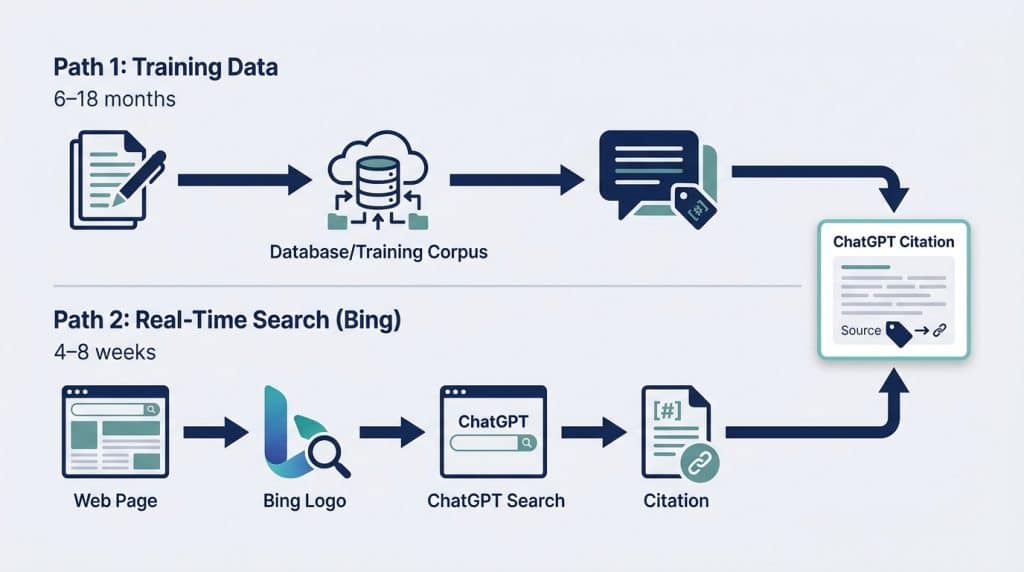
Path 1: Training data. For queries that don’t require real-time information, ChatGPT draws from its training corpus. If your content was authoritative, widely referenced, and clearly structured before the model’s training cutoff, it is more likely to be cited from memory. This is a long-game channel.
Path 2: Real-time web search (ChatGPT Search). When a user has Search enabled, ChatGPT queries Bing’s index and pulls live results. The Bing index is the entry point, but the content structure determines which page gets cited.
Three factors determine which source gets cited in ChatGPT’s real-time search mode. First, the content must be indexed by Bing: technically accessible and crawled. Second, the page must answer the specific query directly in the first paragraph, rather than burying it in a long post. Third, the answer must be self-contained: ChatGPT extracts individual passages rather than full articles. A 70-word answer block that reads coherently without surrounding context will outperform a 3,000-word deep dive every time. Most B2B brands fail on factor three. Their content is logically connected across sections, but none of the individual paragraphs stand alone.
Before any of these factors can apply, your site must be crawlable by AI systems. Check your robots.txt for User-agent: GPTBot. If it shows Disallow: / ChatGPT’s web crawler is completely excluded from your site. Also check for OAI-SearchBot and ChatGPT-User entries. A 2026 OtterlyAI analysis of 1 million AI citations found 73% of sites have technical barriers blocking AI crawler access. This is a categorical exclusion, not a ranking disadvantage. Fix it before optimizing anything else.
One detail most founders miss: ChatGPT Search uses Bing, not Google. Your Google rankings mean nothing here. A page needs Bing indexation to appear in real-time ChatGPT answers. Submit your sitemap to Bing Webmaster Tools. It takes five minutes, and most B2B content teams skip it entirely. Then activate IndexNow, Bing’s real-time submission protocol, which pushes new and updated pages to the index in hours rather than days, directly accelerating ChatGPT Search visibility for your latest content.
The 6 Signals That Drive ChatGPT Citations
Cyrus Shepard at Zyppy analyzed hundreds of ChatGPT-cited pages and identified patterns that predict the likelihood of citation. These six are the most directly actionable for B2B founders:

1. Direct answer at the top. ChatGPT extracts passages, not articles. The first 1-2 sentences of each section need to contain the answer, not a warm-up to it. Every section that buries the point gets skipped.
2. Entity specificity. ChatGPT trusts sources that name specific companies, products, people, and statistics. “Many SaaS companies face this challenge” is uncitable. “74% of Series B SaaS companies cited churn as their primary growth constraint (Bessemer Venture Partners, 2024)” is citable. Named entities signal that the content is grounded in real-world knowledge rather than generic filler.
3. Question-based headers. H2s and H3s formatted as questions match buyer queries directly. “How does ChatGPT decide what to cite?” is a stronger header than “The Citation Selection Process.” The former is what buyers type. The latter is what writers think sounds authoritative.
4. FAQ sections. Structured FAQ content is the highest-yield format for AI citations. It matches the question-answer pattern ChatGPT is trained to recognize. Zyppy’s research found that FAQ sections appear in a disproportionately high share of consistently cited pages. Every post should include at least 4 targeted FAQ questions at the end.
5. Schema markup. FAQPage and Article schema tell AI crawlers exactly how your content is structured. Implementing FAQPage schema gives ChatGPT machine-readable confirmation that specific text blocks are direct answers. Beyond the FAQPage schema, implement the Organization schema on your homepage with sameAs links to your LinkedIn, Crunchbase, Wikipedia, and social profiles. This consolidates entity recognition across the web: AI systems learn that your website, LinkedIn page, and other brand references are all the same entity. For individual authors, Person schema linking to LinkedIn profiles and external bylines further strengthens E-E-A-T signals. In WordPress, RankMath handles all of this without code.
6. Topic cluster depth. ChatGPT weights source authority partly by topic consistency. A site with fourteen posts about AI search citation will outcite a site with one post on the same subject. Owning a topic in depth signals that your domain is a reliable reference for that category.
These signals compound. A post with a FAQ section but no entity specificity and no schema still underperforms. The ceiling for citations rises when all six are present simultaneously.
How to Structure Content ChatGPT Can Extract
The structural pattern that maximizes ChatGPT citation rates runs counter to most B2B content conventions. Traditional blog writing builds context before delivering the point. ChatGPT citation requires the opposite.
Three rules govern extractable content. Open every section with the answer: put the most important information first, then explain it. Keep each paragraph to one claim, supported by one piece of evidence. Never write a paragraph that requires the reader to have read the surrounding paragraphs to understand it. If a paragraph only makes sense in context, ChatGPT will not cite it.
The BLUF (Bottom Line Up Front) paragraph is the most important structural element on any page. This is a 55-75 word opening that states the main answer of the entire post immediately. Entity-first: “Ranking in ChatGPT requires…” not “When it comes to AI search, there are many factors to consider…” Every AI engine uses the first paragraph to decide whether the post is worth citing at all.
Direct Answer Blocks (DABs) are the per-section equivalent of the BLUF. Place a 40-80 word direct answer immediately after each major H2. A reader who reads nothing else should still get the answer. This structure is not just good for AI citations. It is significantly more readable for the busy B2B executive who is skimming rather than reading.
For a practical breakdown of how to implement this across an existing content library, our guide to how to get cited by AI search engines covers the full content audit framework.
“ChatGPT doesn’t rank pages. It extracts passages. The B2B founder who understands this writes differently, winning citations their competitors never see.”
Why Most B2B Companies Stay Invisible in ChatGPT
Most B2B content is written for an imagined human reader who will read every word in order. ChatGPT is not that reader. Four content patterns consistently produce zero ChatGPT citations:
Thought leadership with no specific answers. “The future of B2B is human-AI collaboration” is an observation. Observations are not citable. “B2B companies that restructured their content for AI extraction saw ChatGPT citation rates increase within 90 days” is a claim with a specific outcome and is citable. The shift from observation to claim-with-evidence is the single biggest structural change most B2B content needs.
No FAQ section. FAQ content consistently appears in a disproportionate share of AI-cited pages. Most B2B content teams still treat FAQ as an afterthought tacked on at the end. It should be the most strategically planned section of every post, and every question should be one a real buyer has actually asked.
Indirect service language. “We help companies achieve their goals” is not findable by AI. “Sproutworth builds AI-searchable content strategies for seed-to-Series B B2B tech companies, focused on appearing in ChatGPT and Perplexity answers before competitors in the same category” is specific enough to cite. The specificity signals that the content is describing real, verifiable activity.
Context-dependent paragraphs. “As we established in the section above…” is an extraction killer. ChatGPT reads passages in isolation. Each paragraph must stand alone as a complete, extractable unit of information.
The good news: fixing these patterns does not require new content. It requires restructuring what you already have. Our guide to answer engine optimization for SaaS walks through how to audit existing posts and apply structural fixes without rewriting from scratch.
Which Brands Are Winning ChatGPT Citations Right Now
The brands consistently cited in B2B ChatGPT answers share a recognizable content profile. They publish specific, question-driven content on a narrow set of topics. They maintain FAQ sections on every major post. They use schema markup across their content library. And they have been doing this for long enough that ChatGPT treats their domain as a category authority.
HubSpot, Gartner, and G2 dominate because they have years of topic-cluster depth and FAQ-structured content. Replicating their domain authority is not a realistic goal for a funded startup. Replicating their content structure is.
The opportunity for most B2B companies sits in the gap between what buyers are searching for and what is being answered well. The keyword “how to rank in ChatGPT” had Reddit as its top result for months. Reddit is indexed, but it does not answer the question with consistent specificity. That gap is a citation opportunity for any B2B brand willing to publish a direct-answer post on the topic and maintain it.
One opportunity most B2B founders overlook: comparison queries. When buyers are evaluating tools, they ask ChatGPT to compare options directly. “How does [your brand] compare to [competitor]?” is one of the highest-intent queries in any B2B category. Brands that publish dedicated comparison content (honest, structured, specific to buyer profiles) consistently appear in these answers. If your competitor has a comparison page and you don’t, ChatGPT cites their framing of the comparison rather than yours. Owning these queries is a higher-priority investment than generic category SEO for most early-stage B2B companies.
Digital PR accelerates this. When authoritative third-party sites link to your content and reference your company by name in the context of a specific topic, ChatGPT’s training data treats your brand as a category reference point. This is why digital PR for B2B tech companies is becoming a core component of AI citation strategy, not just a backlink play.
The Off-Page Factor Most B2B Founders Miss
The most consistent finding across ChatGPT citation research is that off-page signals outperform on-page signals in determining citation probability. A Neil Patel analysis of 82 factors across 100+ ChatGPT recommendation queries found the top two correlations were relevancy (.91) and brand mentions (.87). Both are off-page signals. On-page content structure didn’t rank in the top factors. OtterlyAI’s 2026 analysis of 1 million AI citations confirmed that co-occurrence (your brand being mentioned alongside category-defining terms in sources ChatGPT already trusts) is the strongest single predictor of citation frequency.
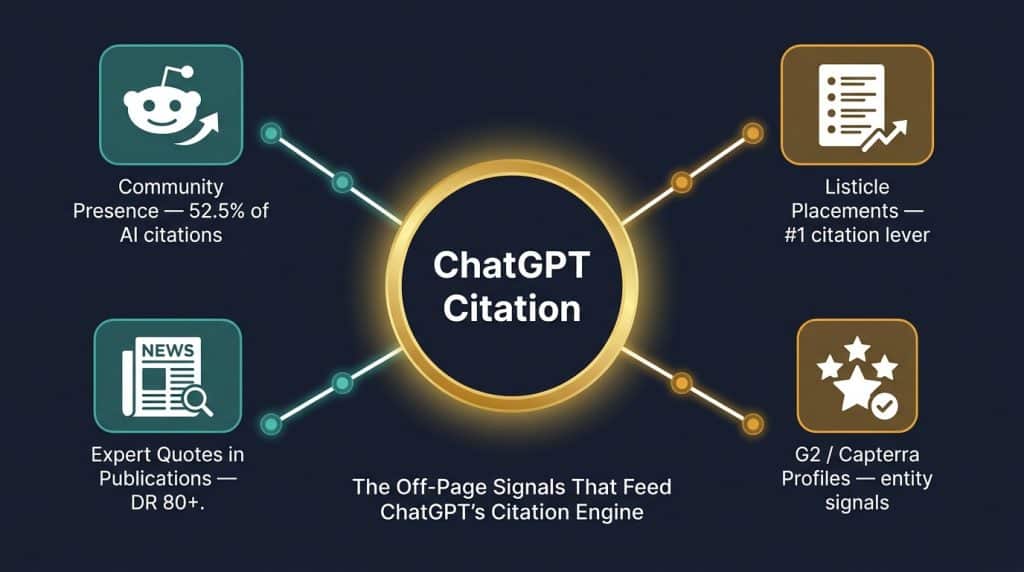
For B2B founders, four specific off-page channels drive the bulk of ChatGPT citation gains:
Listicle and roundup placements. Every “best [category] tools” and “top [category] software” article that ranks well on Google and Bing is a page that ChatGPT retrieves directly when buyers ask for recommendations. Above Apex, which tracks results across 60+ B2B SaaS companies, identifies listicle placements as the highest-impact tactic for measurable ChatGPT citations. The evidence is direct: Improvado gained 77 ChatGPT citations and 49,700 new monthly organic visits, primarily through systematic listicle placement. If you are in the listicles your buyers read, you are in the answer.
Expert quotes in high-authority publications. HubSpot, Fast Company, Forbes, Shopify, Nasdaq. Being named as an expert source on your category topic (not merely referenced as a company) creates the co-occurrence signal that tells ChatGPT your brand belongs in authoritative discussions about that topic. Every published quote is a data point reinforced in the model’s training corpus. A consistent program of expert quote placements in DR 80+ publications compounds faster than any on-page fix.
Reddit and community presence. OtterlyAI’s analysis of 1 million AI citations found community-driven platforms (Reddit, Quora, industry forums) account for 52.5% of all citations across ChatGPT, Perplexity, and Google AI Overviews combined. Authentic participation in relevant subreddits (genuine answers to real questions, not promotional posts) builds a citation surface the model reads and trusts. For B2B founders, this means being present in the subreddits your buyers frequent before they ask those questions to ChatGPT.
Review platform profiles. G2, Capterra, and TrustRadius serve two functions: they build the third-party entity mentions that ChatGPT requires, and they supply the review content that ChatGPT surfaces when users specifically ask about your product. Keep profiles complete, up to date, and populated with genuine reviews. An incomplete G2 profile is a citation gap that a competitor with a complete one will fill.
The compounding timeline for off-page signals is 90-120 days. First citation signals can appear within a week of new placements going live. ChatGPT’s real-time retrieval quickly picks up freshly indexed content. But sustained category presence builds in that 90-120 day bracket, when the accumulated weight of multiple off-page channels reaches a tipping point, and the model cannot answer category questions without encountering your brand. This is the work Sproutworth’s digital PR for B2B tech startups service is built to execute: systematically, across every channel that feeds ChatGPT’s citation engine.
How Long Does It Take to Rank in ChatGPT?
The timeline for ChatGPT citation visibility depends on which path you are targeting. For training data citations, expect 6-18 months: new content must be published, indexed, referenced by other authoritative sources, and then captured in a future model training run. For real-time ChatGPT Search citations, the timeline compresses to 4-8 weeks: Bing needs to index the page, the content needs to match enough queries with enough specificity, and the page needs to hold up against competing sources. The fastest path combines both: publish optimized content now to capture real-time Search citations, and build backlinks from established sources to accelerate Bing trust signals and improve inclusion in training data.
One data point founders often overlook: content updated within the past 30 days receives 3.2 times as many ChatGPT citations as content last updated more than 90 days ago (Superprompt, 2026). A disciplined refresh schedule (updating top posts monthly with new data and current dates) compounds citation performance over time. Three months of consistent updates to an existing optimized post often outperform publishing three new posts without a maintenance plan.
The practical starting point for most B2B companies is ChatGPT Search. This gives you a feedback loop you can act on in weeks, not months. Publish an answer-optimized post, query ChatGPT Search with your target questions, check whether your page appears in citations, refine the structure, and republish. This iteration cycle is not possible with training data.
Three months of disciplined, structured publishing consistently beats three years of occasional long-form content for ChatGPT citation performance. Frequency and structure matter more than total word count.
CEO Takeaway
Ranking in ChatGPT is a structural problem, not a content volume problem. Most B2B companies already have the ideas. They are missing direct answer blocks, FAQ sections, and entity-specific claims. Audit your top 10 posts and fix the structure before publishing anything new. Then close the off-page gap: get into the listicles your buyers read, earn expert quotes in publications ChatGPT trusts, and build your G2 profile. The citations will follow the brand that actually shows up where it matters.
How to Rank in ChatGPT: Your 7-Step Action Plan
To rank in ChatGPT, execute these seven steps in order. Each targets a different citation signal. Skip any one and a competitor fills the gap.
- Answer the exact query directly. Identify the specific questions your buyers type into ChatGPT. Write a post that answers each one in the first 150 words. One query per post, answered immediately after the H1.
- Structure content for AI extraction. Use H2 and H3 headings that label each section clearly. Write paragraphs of 2 to 4 sentences. Use numbered lists for processes, bullet lists for multi-item points. Avoid dense prose blocks.
- Add FAQPage schema. Mark up your FAQ section with JSON-LD FAQPage schema. ChatGPT extracts structured answers from schema-marked content more reliably than from plain HTML.
- Unblock GPTBot in robots.txt. Check that
User-agent: GPTBotis not disallowed. 73% of sites block AI crawlers by default (OtterlyAI, 2025). A blocked GPTBot means zero training-data citations. - Submit to Bing via IndexNow. ChatGPT Search runs on Bing. IndexNow submits new and updated URLs to the Bing index within hours. Set it up once and every future post update is submitted automatically.
- Add Organization schema with sameAs links. AI engines use entity graphs to identify which company a domain belongs to. An organization schema with sameAs links to your LinkedIn, Crunchbase, and Wikipedia page builds that entity recognition.
- Build off-page citation signals. Post on Reddit and LinkedIn communities where your buyers make research decisions. Earn brand mentions in industry publications, podcasts, and newsletters. Aim for your brand name to co-occur with your target queries across sources ChatGPT trusts.
Completing all seven steps yields results in 4 to 18 weeks, depending on whether ChatGPT cites via real-time Bing Search (faster) or training data (slower). Start with steps 1 through 3, which are fully in your control and deliver the fastest lift.
FAQ: How to Rank in ChatGPT
What type of content ranks best in ChatGPT?
FAQ sections, how-to guides with step-by-step specificity, and direct-answer posts consistently generate the highest rates of ChatGPT citations. Content that opens each section with a 40-80-word direct answer block outperforms content that builds toward its answer. Specificity beats comprehensiveness: a 600-word post that answers one question directly will often out-cite a 4,000-word post that covers a topic broadly without delivering clear, extractable answers.
Do I need a high domain authority to be cited by ChatGPT?
Domain authority helps, but is not the primary driver. A low-authority page that answers a specific query with direct, self-contained passages will often get cited over a high-authority page with indirect, context-dependent writing. Specificity and structure matter more than authority for individual citation events. Broader domain authority increases the likelihood that ChatGPT will use your domain as a reference source across multiple queries over time.
How is the ranking in ChatGPT different from the ranking on Google?
Google ranks URLs and gives users a list of links to choose from. ChatGPT extracts passages and synthesizes an answer, citing the sources those passages came from. Your goal on Google is to appear in position 1-3. Your goal in ChatGPT is to have your specific passage extracted and attributed. Google rewards comprehensive topic coverage. ChatGPT rewards direct, extractable answers to specific questions. A page can rank well on Google and generate zero ChatGPT citations, or vice versa.
Does ChatGPT Search use Google’s index?
No. ChatGPT Search uses Bing’s index, not Google’s. Pages need Bing indexation to appear in real-time ChatGPT citations. Most pages indexed by Google are also indexed by Bing, but Bing indexation is slower, and some pages are missed entirely. Submit your sitemap to Bing Webmaster Tools and use the Bing URL Submission tool to accelerate indexation of new and restructured content. Activate IndexNow for real-time push indexing of updates.
How do I measure whether ChatGPT is citing my content?
Build a list of 20-30 queries your buyers ask most often about your product category. Run them weekly in ChatGPT Search (web search enabled) and standard ChatGPT (without web search), noting which sources appear in citations and whether your domain is among them. Test both modes. They use different retrieval logic, and your visibility may differ between them. Track competitor citations alongside your own: which listicles are they in, which publications quote them? That tells you exactly where to close the off-page gap. Google Analytics 4 referral data from chatgpt.com will also show when users click through from a ChatGPT citation to your site, giving you a conversion baseline to track against.
Can I pay to rank in ChatGPT?
No. ChatGPT does not sell citation placement, and there is no advertising mechanism that determines which sources get cited. Citations are earned through content quality, structural citability, entity authority, and off-page mentions in sources ChatGPT already trusts. Paid search campaigns may indirectly drive Bing indexation, but they do not influence which sources appear in ChatGPT’s synthesized answers.
What is GEO (Generative Engine Optimization) and how does it relate to ranking in ChatGPT?
Generative Engine Optimization (GEO) is the practice of structuring and distributing content so it gets cited by AI answer engines, including ChatGPT, Perplexity, Google AI Overviews, and Claude. Ranking in ChatGPT is the application of GEO to one specific engine. The principles are largely the same across engines: direct-answer structure, entity clarity, off-page authority, and technical AI crawler access. Optimizing for one typically improves citation rates across all of them.
Related Resources
- How to Get Cited by AI Search Engines: the full AI citation framework
- Answer Engine Optimization for SaaS: deep-dive on AEO for B2B tech companies
- What Is Answer Engine Optimization?: start here if you’re new to AEO
