
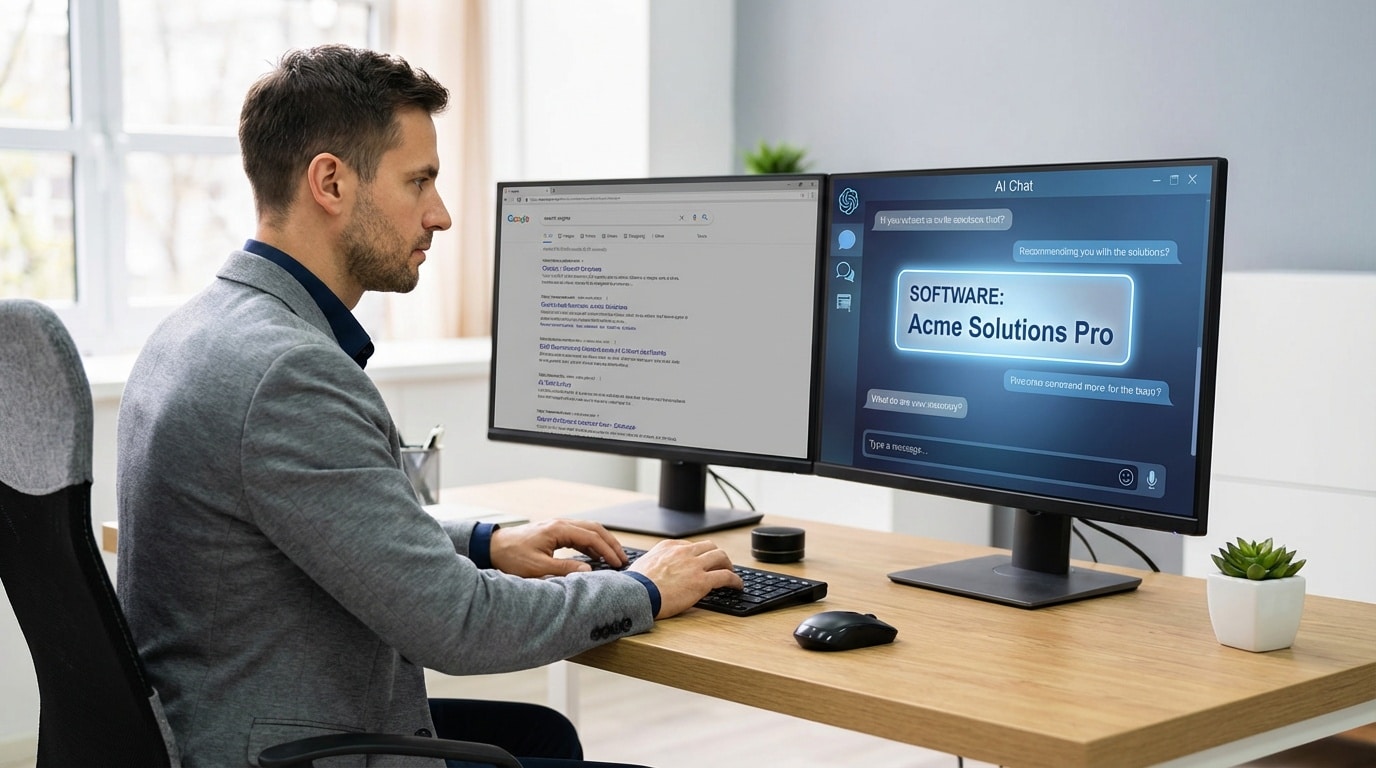
Most SaaS founders are optimizing for rankings, but their best buyers no longer click.
According to G2’s April 2026 research, 51% of B2B software buyers now begin their software research with an AI chatbot rather than Google, up from 29% just 12 months earlier. In the same study, 69% of buyers said they chose a different software vendor than they initially planned, based on AI chatbot guidance. Answer engine optimization for SaaS is the practice of ensuring your company is the one buyers find.
This guide explains what AEO is, why it hits SaaS companies differently, how to implement it, and how to measure whether it’s working. No agency pitch. No tools listicle. Just what a funded B2B SaaS CEO needs to know to act on this now.
What Is Answer Engine Optimization for SaaS?
Answer engine optimization (AEO) for SaaS is the practice of structuring your content so that AI assistants like ChatGPT, Perplexity, Google Gemini, and Claude cite your company when B2B buyers ask research questions about your category or solution. Unlike SEO, which earns a ranked link, AEO earns a citation inside an AI-generated answer.
For a SaaS company, this means appearing when a VP of Operations asks Perplexity, “What’s the best project management tool for distributed engineering teams?” or when a CFO asks ChatGPT, “How do SaaS companies reduce customer churn?” The buyer gets an answer. Your company is either in it or invisible.
The distinction matters: SEO earns a ranking. AEO earns a citation. Optimizing for one does not automatically optimize for the other.
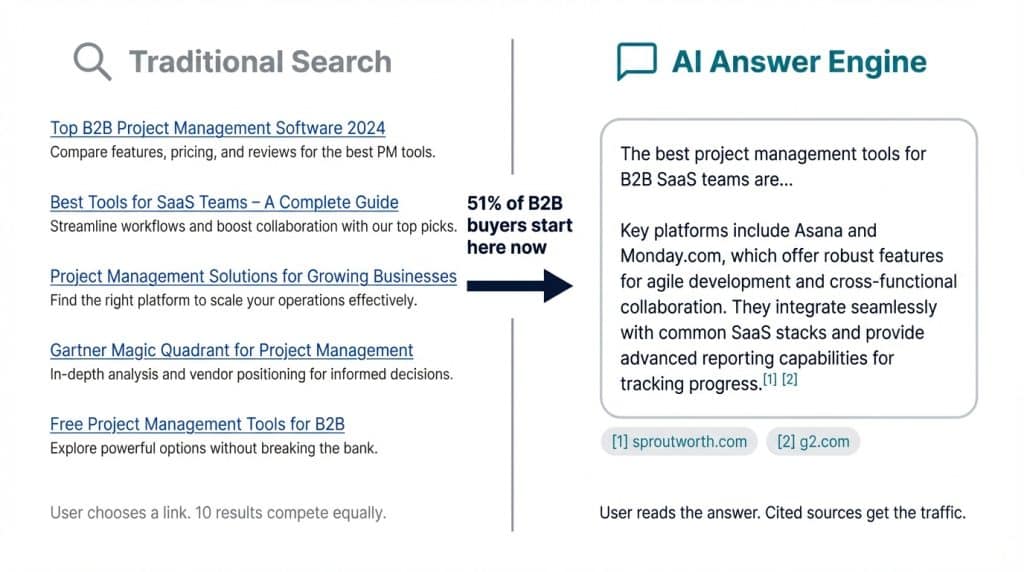
Table of Contents
Why AEO Matters More for SaaS Than Any Other Business Category
SaaS has a unique discovery problem. The category is crowded. Buyers do deep research before engaging vendors. And increasingly, that research starts with a question to an AI assistant, not a Google search.
The G2 data above makes this concrete: more than half of B2B software buyers now open a chatbot before they open a browser tab. And 69% of those buyers end up choosing a different vendor than they originally planned, based on what the AI told them. For SaaS companies, this is not a traffic problem. It is a consideration-set problem. Your company is being excluded from buying decisions you never knew were happening.
There is a second problem specific to SaaS: the category query problem. When someone asks ChatGPT “best CRM for Series B startups,” they are asking a purchase-adjacent question with real buying intent. If your company is not cited in that answer, you do not exist in that buyer’s consideration set. No traffic penalty shows up in your analytics. No ranking drop to notice. Complete invisibility at a critical decision moment.
The opportunity is significant. Most SaaS companies have not begun thinking about AEO. Their content is optimized for Google crawlers, not AI summarization engines. That gap creates a first-mover window that will not stay open as the category matures.
How AI Answer Engines Evaluate SaaS Content
AI answer engines do not rank pages. They summarize and attribute. The selection logic is fundamentally different from Google’s PageRank.
Kevin Indig’s February 2026 analysis of 3 million ChatGPT responses and 30 million citations identified a consistent pattern: 44% of all ChatGPT citations come from the first third of a page’s content (Search Engine Land, 2026). For SaaS content teams, the implication is direct: definitions, key facts, and strongest claims must be front-loaded. AI engines do not reward the build-up.
The same research found that headings framed as questions are cited twice as often as declarative headings. This is why FAQ sections and question-format H2s are not a formatting preference. They are a citation strategy.
AI engines consistently prioritize content that:
- Directly answers the query in the first paragraph, before any context or preamble
- Uses structured formatting with descriptive headers, numbered steps, and clean lists
- Cites specific, attributable statistics with named sources and live URLs
- Demonstrates E-E-A-T signals: experience, expertise, authoritativeness, trustworthiness
- Can be summarized in two sentences without losing the core argument
SaaS content commonly fails on the first and last criteria. Marketing teams write for engagement, not for AI extraction. The content meanders. Definitions arrive in paragraph four. The core argument is scattered across headings that do not build to a clear conclusion.
How Is AEO Different from SEO for SaaS?
AEO and SEO share the same content foundations but optimize for fundamentally different outcomes. SEO helps a page rank higher in search results. AEO earns a citation inside an AI-generated answer. For SaaS companies, both matter, but the tactical differences are real.
| Dimension | SEO for SaaS | AEO for SaaS |
|---|---|---|
| Goal | Rank in Google blue links | Be cited in AI-generated answers |
| Success metric | Rankings, organic clicks | Citation rate, prompt share of voice |
| Content structure | Keyword density, backlinks, headers | Inverted pyramid, citable units, FAQ blocks |
| Authority signals | Backlinks dominate | Brand mentions 3x more correlated than backlinks (Ahrefs) |
| Definition placement | Anywhere in first 500 words | First 400 words, quotable in isolation |
| FAQ | Nice-to-have for featured snippets | Highest-impact AEO element on the page |
| Stat requirements | Sourced statistics strengthen authority | Named source + year + URL required for citation |
| Timeline | 3–12 months to see ranking movement | 4–12 weeks to see initial citations for AEO-restructured posts |
The practical implication: a SaaS company that invests only in SEO is visible to buyers who still click on ranked links. A company that also invests in AEO is visible to the growing share of buyers who ask AI assistants before they run a search. Both matter. AEO is simply the one that most SaaS companies have not started. HubSpot’s 2026 AEO research identifies entity consistency, answer-first content formats, and AI visibility tracking as the three highest-impact priorities for the year ahead.
The 6 AEO Pillars for SaaS Companies
After 500+ conversations with B2B revenue leaders on the Predictable B2B Success podcast and running an answer engine optimization strategy for funded B2B tech companies, I have found that SaaS companies that get cited consistently do six things differently.
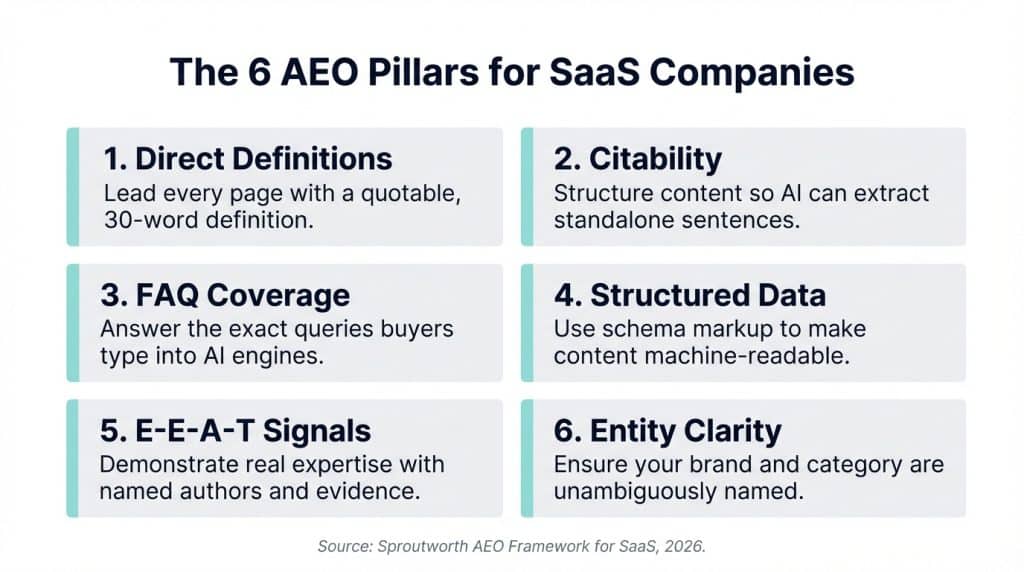
1. Lead with a Direct, Quotable Definition
Every AEO-optimized piece needs a clean, 40–60 word definition of its main topic within the first 400 words. This is the passage AI engines are most likely to extract verbatim, and Kevin Indig’s research confirms that content in the first third of the page is cited at nearly double the rate of content further down.
The format that works: “[Topic] is [concise definition in 1–2 sentences]. Unlike [common misconception], [topic] [key differentiator]. B2B SaaS companies use [topic] to [specific outcome].”
Most SaaS blog posts do not have this. They open with context, then bury a definition in paragraph three. That structure consistently fails the AI extraction test.
2. Answer the Exact Query, Not a Related One
AI engines match user queries to content with precision. If a query is “how does [Category] reduce [Pain Point],” your content needs to address that specific question directly, not a similar question about why reducing [Pain Point] matters in general.
A pattern I see constantly across SaaS content: a buyer asks ChatGPT, “how do SaaS companies improve NRR through onboarding,” and the AI cites the one competitor who answered that exact question. Ten other companies wrote about onboarding in general and received nothing. Query specificity is a competitive advantage when most competitors write for broad topics.
3. Build an FAQ Section Engineered for AI Search
FAQ sections are the single highest-impact AEO element for SaaS content. AI engines treat structured Q&A as pre-formatted answers. The research showing that question headings are cited twice as often applies directly here.
Requirements for an effective AEO FAQ section:
- Questions phrased exactly as users type them into AI assistants, not as formal headings
- Answers in complete natural sentences, 50–70 words each
- First sentence of every answer is a direct, complete response to the question
- 6–8 questions minimum, covering all “People Also Ask” variations for your keyword
- FAQPage schema applied (RankMath or manual JSON-LD)
“What is the difference between AEO and SEO for SaaS?” is a good FAQ question. “How do AEO and SEO compare strategically in enterprise environments?” is not. The phrasing matters because AI engines match natural language, not formal headings.
4. Make Every Statistic Attributable
AI engines’ weight was heavily attributed to statistics. A claim like “44% of ChatGPT citations come from the first third of content” with a named source, year, and URL carries far more citation weight than “AI engines prefer content near the top of the page.”
The format is: named source, year, number, live URL. Every significant statistic needs all four elements. Vague claims are not cited. Specific, attributed claims are. This is a higher standard than most SaaS content teams currently meet, but it is the standard AI engines apply when deciding what to surface to buyers.
5. Structure Content So AI Can Navigate It
AI engines parse structure. They follow heading hierarchies. They identify list items. They treat numbered steps differently from bullet points. For SaaS content:
- Use numbered lists for process steps (“Here is how to implement X in four steps”)
- Use bullet lists for features, signals, and components
- Use comparison tables for “AEO vs. SEO” or “tool A vs. tool B” queries
- Cap paragraphs at 2–3 sentences
- Phrase at least two H2s as questions (AI citation rate doubles)
Content that is easy for a human to scan is easy for AI to parse. Dense paragraphs of prose are not extracted. Short, structured, scannable sections are.
6. Build Entity Clarity Around Your Brand and Category
Entity optimization is the AEO pillar most SaaS companies miss entirely. AI answer engines build a model of entities (brands, products, categories, people) and their relationships. If your brand is not clearly associated with a category in the AI’s model, you will not appear in category queries even when your content is well-structured.
For SaaS companies, entity clarity means:
- Consistent brand name, product names, and category labels across all content
- Clear “X is a [category] tool for [ICP] that does [outcome]” framing repeated across your site
- Wikipedia and Wikidata presence (even a stub entry strengthens entity recognition)
- Mentions on third-party review platforms (G2, Capterra, Trustpilot) reinforce entity signals
- Ahrefs’ analysis of 75,000 brands found that brand mentions (correlation: 0.664) are three times more strongly correlated with AI visibility than traditional backlinks (correlation: 0.218)
A Series B infrastructure SaaS I work with had strong rankings for its target keyword but minimal AI citations. The issue was entity confusion: their brand name appeared in three variations across their site and review platforms. Standardizing it across 40+ pages and updating the G2 profile drove a measurable increase in citation frequency within 6 weeks.
How to Implement AEO for Your SaaS Content
This is where most SaaS content teams get stuck. The principle makes sense. The execution sequence does not.
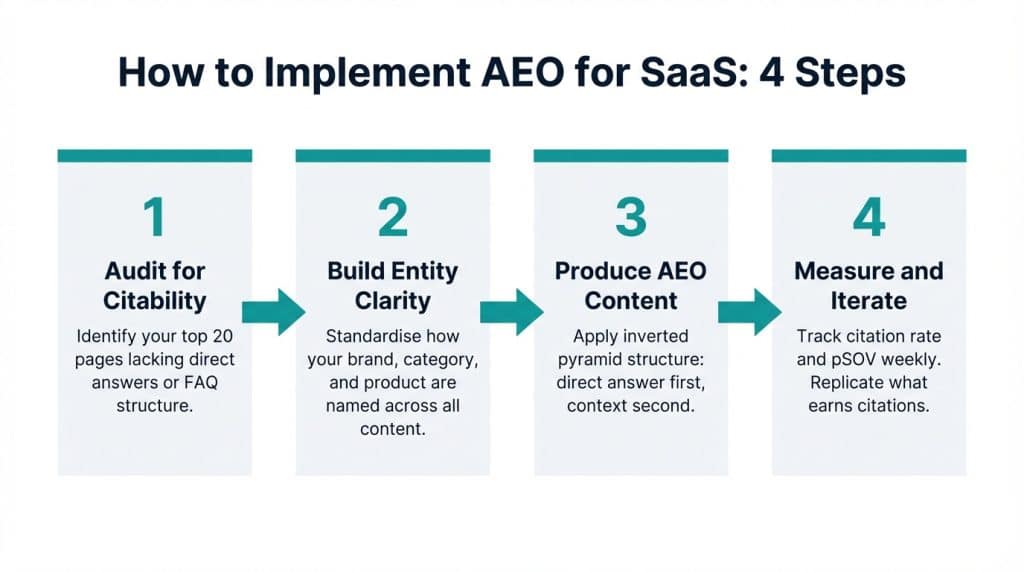
Follow this order for the fastest results:
- Audit your existing high-traffic posts first. Posts already ranking on page one have authority. Restructuring them for AEO delivers faster citation results than building new content. Add a direct definition in the first 400 words, expand the FAQ to 6+ questions phrased as natural queries, and attribute every statistic with a named source and URL.
- Standardize entity references across your site. Pick one version of your brand name, product name, and category label. Apply it consistently across all pages, your G2/Capterra profile, your LinkedIn company page, and your About page. This is the fastest entity fix with the most impact.
- Build AEO-first for new content. Design the structure before writing prose. Start with: the definition you want cited, 6–8 FAQ questions you will answer, and the external sources you will cite. Write the body sections around that scaffolding. Structure determines content, not the other way around.
- Target category-adjacent queries. Your strongest AEO opportunity is often not your brand keyword. It is the category that your buyers ask before they know your company exists. “How do SaaS companies generate pipeline without a sales team?” “What is the best onboarding tool for PLG companies?” These are the queries that create unconsidered demand.
A Series A cleantech SaaS I work with restructured six existing posts using this sequence. Within ten weeks, they appeared in Perplexity responses to two category queries they had never ranked for in Google. The content quality was identical. The structure was what changed.
How Do You Measure AEO Success for SaaS?
Measure AEO success using four metrics: citation rate, prompt share of voice (pSOV), source attribution rate, and AI-referred traffic in GA4. Unlike SEO, there is no single platform equivalent to Google Search Console that tracks all AI citations in real time. But each metric is trackable, and together they give you a complete picture of your AI search visibility for board or investor reporting.
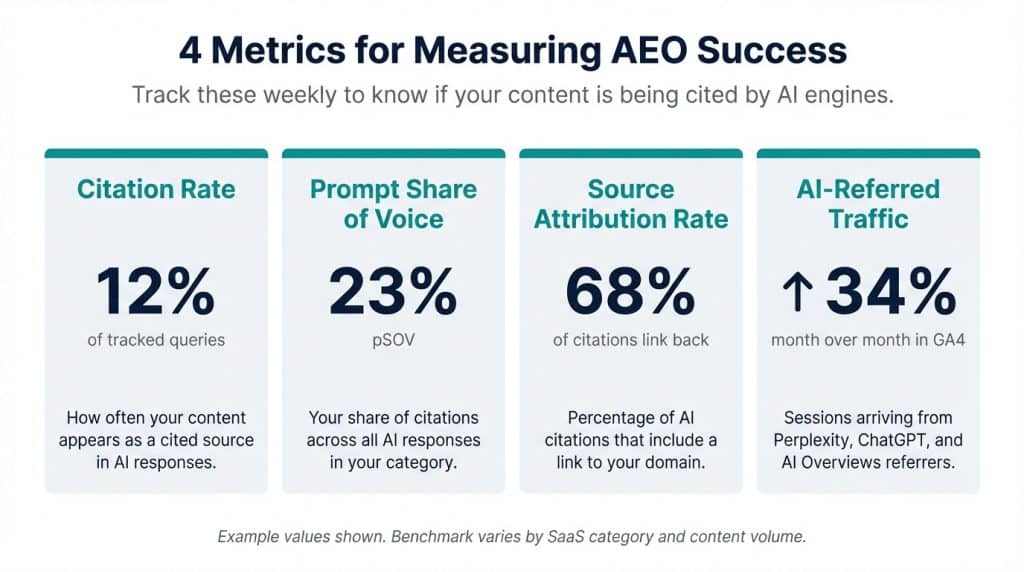
The four metrics in detail:
Citation Rate
Build an AEO prompt library: a set of 30–50 buyer-intent queries mapped to your category and use cases. Test these prompts across ChatGPT, Perplexity, and Google AI Overviews weekly. Track how many responses cite your brand, product, or content. This is the foundational AEO metric, equivalent to keyword rankings in traditional SEO.
Prompt Share of Voice (pSOV)
Compare your citation rate against competitors on the same prompt library. If your brand appears in 12 of 50 prompts and your nearest competitor appears in 28, your pSOV is 24% against their 56%. This is the competitive AEO benchmark. Growing pSOV is the goal, not just growing raw citations.
Source Attribution Rate
Track what percentage of your AI citations include a direct hyperlink back to a specific piece of your content. Linked citations drive measurable traffic in your GA4 attribution reports. Unlinked mentions build awareness but do not generate a traceable conversion path. Both matter, but the source attribution rate tells you which content is performing at the highest AEO level.
AI-Referred Traffic in GA4
Tag and monitor traffic from Perplexity, ChatGPT, and other AI sources as referral channels in GA4. Initial AEO visibility typically shows up in citation rate 4–6 weeks before it registers as measurable traffic. When it does register, traffic quality is high: buyers who clicked from an AI citation have already received a recommendation and arrive with intent.
What Separates SaaS Companies That Get Cited vs. Those That Don’t
The AEO gap between SaaS companies is mostly a content design gap, not a content quality gap.
Companies that get cited write for extraction. Their content is structured for readers who want a fast, clear answer. Every section stands alone. Every statistic is attributed. Every FAQ question is phrased as a real query, a real buyer types. Their definitions appear in the first 400 words. Their headings are questions.
Companies that do not get cited write for engagement. Long introductions. Buried definitions. Vague claims. FAQ sections phrased as formal questions nobody types into an AI assistant. Their content quality is often identical. Their structure is the problem.
The Ahrefs research on brand mentions is worth sitting with: across 75,000 brands studied, brand web mentions correlated with AI visibility at 0.664 versus 0.218 for backlinks. Brands in the top mention quartile earn up to 10 times more AI Overview appearances than those in the next quartile. SaaS companies that invested years in link-building without building a review platform presence have an AEO gap that content restructuring alone will not close. Both need work, in parallel.
“Most SaaS companies have plenty of content. The ones that win in AI search have engineered that content to be extractable, not just readable.”
Vinay Koshy, Founder, Sproutworth
This is the window. B2B SaaS companies that restructure content for AI citation in 2026 will build a compounding visibility advantage that is difficult for later-movers to displace. As AI search penetration grows, citation authority built now compounds.
💡 CEO Takeaway
- 51% of B2B buyers now start their research in an AI chatbot (G2, April 2026), up from 29% 12 months earlier. And 69% of those buyers chose a different vendor than planned based on AI guidance.
- 44% of AI citations come from the first third of your page (Kevin Indig, Feb 2026). Front-load your definitions and key facts.
- Question-format headings are cited twice as often. Rephrase your H2s and FAQ questions as natural queries.
- Brand mentions are 3x more correlated with AI visibility than backlinks. Build your entity presence on review platforms.
- Start with existing high-traffic posts. Restructuring posts that already have authority delivers faster citation results than new content.
Frequently Asked Questions
What is answer engine optimization for SaaS?
Answer engine optimization for SaaS is the practice of structuring content so that AI assistants like ChatGPT, Perplexity, and Google Gemini cite your SaaS company when B2B buyers ask research questions related to your category. It differs from SEO in that it targets AI citations inside generated answers rather than ranked positions in traditional search results.
How is AEO different from SEO for SaaS companies?
AEO optimizes content to be extracted and cited by AI answer engines; SEO optimizes for Google’s ranked links. For SaaS companies, AEO requires direct definitions within the first 400 words, question-format headings, FAQ sections with natural-language questions, and attributed statistics with live URLs. Authority in AEO correlates more with brand mentions than backlinks, which is the opposite weighting from traditional SEO.
How long does AEO take to show results for SaaS companies?
SaaS companies that restructure existing high-authority content for AEO typically begin seeing citations in Perplexity and ChatGPT within 4–12 weeks. New AEO-first content takes longer because it needs to build authority first. Starting with your highest-traffic existing posts accelerates results significantly. Entity standardization across your site and review platforms can show impact in as little as 4–6 weeks.
Which AI answer engines should SaaS companies prioritize first?
Perplexity and ChatGPT are the highest-priority targets for B2B SaaS companies based on buyer research behavior. Perplexity cites sources prominently and drives measurable referral traffic. ChatGPT reaches the largest user base. Google AI Overviews is important for reach but harder to optimize for directly. Content that meets AEO standards generally improves citation likelihood across all major engines simultaneously.
Does answer engine optimization replace SEO for SaaS?
No. AEO and SEO are complementary. Well-structured AEO content tends to perform well in Google because both reward clear structure, authority, and topical relevance. The difference is optimization priority. For SaaS companies in competitive categories where ranking on page one is slow or expensive, AEO offers a faster path to buyer visibility that doesn’t depend on backlink volume.
How do you measure AEO results for SaaS?
Measure AEO using four metrics: citation rate (how often your brand appears in AI responses), prompt share of voice (your citation rate vs. competitors), source attribution rate (what percentage of citations include a link), and AI-referred traffic in GA4. Build a prompt library of 30–50 buyer-intent queries and test them weekly across ChatGPT, Perplexity, and Google AI Overviews. Citation rate is the foundational metric, equivalent to keyword rankings in traditional SEO.
What role do brand mentions play in AEO for SaaS?
Brand mentions are three times more strongly correlated with AI visibility than traditional backlinks, according to Ahrefs research. For SaaS companies, this means presence on G2, Capterra, Trustpilot, Reddit, and relevant community platforms directly influences how AI engines model your brand and in which category queries you appear. Pure content restructuring without entity presence work will not close the full AEO gap.
Can SaaS companies do AEO in-house or do they need an agency?
Most of the foundational AEO work (restructuring existing posts, writing question-format FAQs, attributing statistics, standardizing entity references) can be done in-house by a content lead or founder who understands the principles. The measurement infrastructure (prompt libraries, cross-engine citation tracking, pSOV dashboards) takes more setup. Agencies add value primarily on measurement, entity building, and high-volume restructuring.
What tools do SaaS companies use for answer engine optimization?
The core AEO toolset for SaaS includes Perplexity and ChatGPT for manual citation testing, a custom prompt library for tracking citations weekly, and GA4 for monitoring AI-referred traffic. Ahrefs Brand Radar tracks AI Overview visibility at scale across tens of thousands of brands. For schema markup, RankMath (WordPress) or manual JSON-LD both work. There is currently no single platform that tracks all AI engine citations across ChatGPT, Perplexity, and Gemini simultaneously.
AEO Is Not a Future Strategy. Start Now.
Answer engine optimization for SaaS is no longer a forward-looking bet. Half of B2B software buyers are already starting their research in an AI chatbot. The question is not whether AI search matters for your pipeline. It is whether your company appears when buyers ask about your category.
The structural changes are not complex: definitions in the first 400 words, question-format headings, FAQ sections phrased as real queries, attributed statistics with live URLs, and consistent entity references across every platform where your brand appears. The companies that make these changes now build a citation authority that compounds as AI search penetration increases.
If you are building a content system for your SaaS company and want to understand how AEO fits into a broader strategy, this is the kind of work I help funded B2B tech companies implement through Sproutworth’s answer engine optimization services.
Related Resources
- What Is Answer Engine Optimization? The Complete Guide
- AEO vs SEO: What Is the Difference for B2B Companies?
- LLM Visibility for B2B Companies: The Practical Framework
- Generative Engine Optimization: The B2B Tech Framework for AI Search in 2026
- Content Marketing for Funded Startups
