
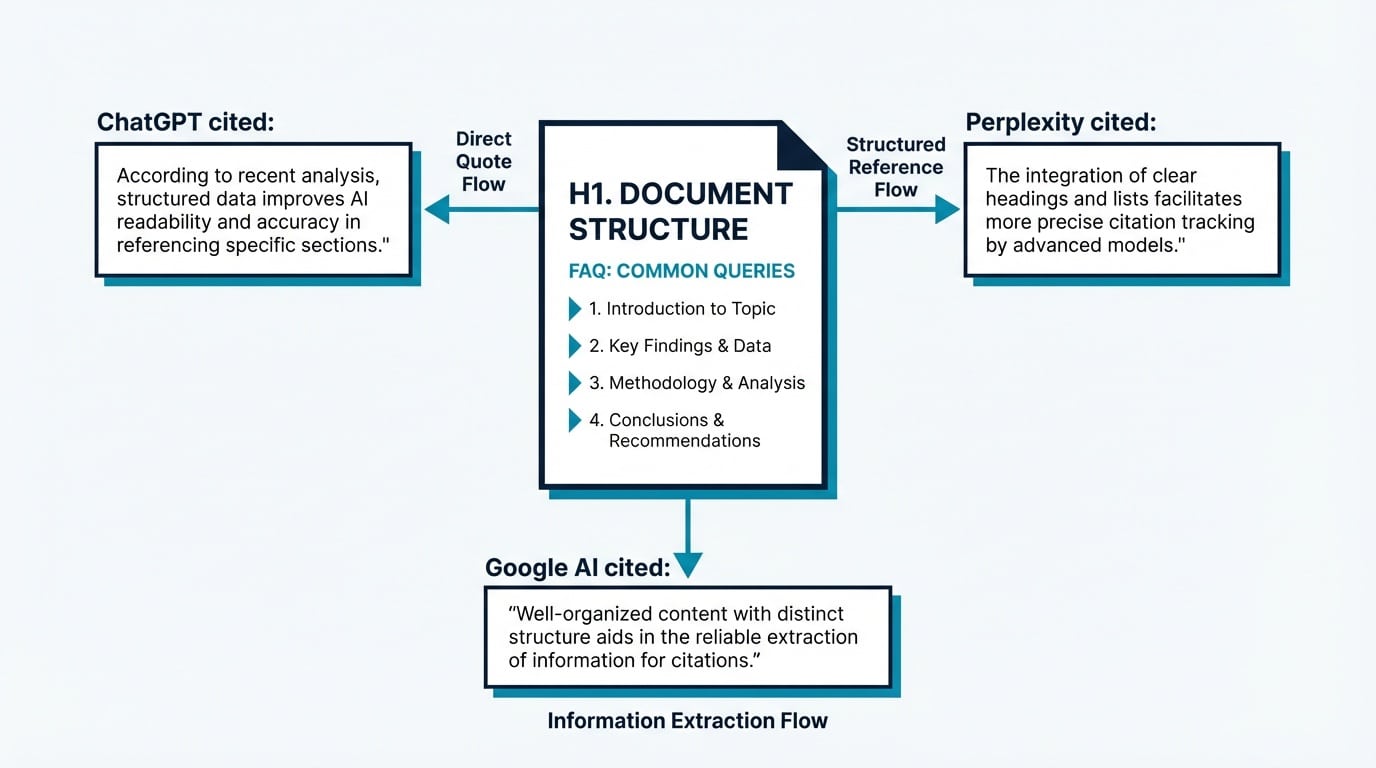
Your competitors know how to get cited by AI search engines. You are watching them appear in ChatGPT, Perplexity, and Google AI Overviews, while you are not. This gap will compound every quarter.
According to Gartner, traditional search engine volume will drop 25% by 2026 as buyers shift to AI-generated answers. For B2B tech founders, this is not a content upgrade. It is a distribution channel you either own or do not.
The companies that get cited become the default answer. The ones that do not become invisible.
I have spent the last year studying how AI engines select which sources to cite. After 500+ interviews on the Predictable B2B Success podcast with B2B founders, CMOs, and content leaders, one pattern holds.
The content that AI cites is structurally different from the content that ranks well on Google. Most B2B content teams have not made the switch.
This guide shows you exactly how to get cited by AI search engines and what structural changes produce the most citations.
Table of Contents
What Does It Mean to Get Cited by AI Search Engines?
AI citation means your content is referenced or quoted by an AI answer engine as a direct answer to a user question. Unlike Google ranking, AI citation delivers your content without requiring a click, often with your company name attached.
The major AI engines citing content today include ChatGPT (OpenAI), Perplexity, Google AI Overviews, Claude (Anthropic), and Microsoft Copilot. Each pulls from a different underlying corpus, but they share remarkably similar selection criteria: direct answers, clear structure, verifiable authority.
For a B2B tech company, AI citation does two things traditional SEO cannot. It builds name recognition with buyers who never click links. And it positions your company as the authoritative answer to the questions your ICP is actively typing into AI tools.
How the Major AI Engines Differ in What They Cite
Not all AI engines pull from the same sources or weight the same signals. Understanding the differences lets you prioritize optimization effort.
| AI Engine | Primary citation source | Top content signals | Best content type |
|---|---|---|---|
| ChatGPT (OpenAI) | Web search + training corpus | Domain authority, E-E-A-T, named attribution | Definition pages, expert guides |
| Perplexity | Real-time web search | Recency, structure, expert quotes | Research summaries, how-to guides |
| Google AI Overviews | Google index | Schema markup, FAQ blocks, relevance signals | FAQ-structured pages, featured snippet candidates |
| Claude (Anthropic) | Web search + training data | Factual density, clarity, source attribution | Analytical frameworks, B2B guides |
| Microsoft Copilot | Bing index | Bing rankings, authority signals | Enterprise content, definition posts |
According to a 2025 analysis by Profound tracking 680 million AI citations, .com domains account for over 80% of all citations, and Wikipedia remains the single most-cited domain across ChatGPT at 7.8% of total citations. For B2B companies, the implication is that topically authoritative, well-structured content on a .com domain outperforms higher-authority sites that lack AEO structure.
Why Most B2B Content Gets Ignored by AI Engines
Most B2B content fails AI citation for structural reasons, not quality reasons. Here is what causes content to get filtered out.
The biggest mistake I see when reviewing content strategies for funded B2B startups is confusing SEO traffic with AI citation. A post can rank position 3 on Google and never appear in a Perplexity answer.
The reason is structural. Google rewards relevance signals: backlinks, clicks, and dwell time. AI engines reward signals of citability: directness, specificity, and verifiability.
- No direct definition. AI engines need a clean, extract-ready answer. If your article buries the definition in paragraph 8, it will not be pulled.
- Unverifiable claims. AI engines are trained to be cautious about hallucination. Content with named sources and verified data gets prioritized over commentary.
- Dense paragraphs. AI engines parse content into discrete chunks. Walls of text reduce the likelihood of a clean extraction.
- Missing schema markup. BlogPosting, FAQPage, and Speakable schema signal to AI crawlers that your content is structured for extraction.
- No E-E-A-T signals. Content without a named author, credentials, or verifiable expertise gets deprioritized by all major AI engines.
A Series A cleantech founder I work with had over 80 published articles. None were appearing in AI answers for their target queries.
Within 60 days of restructuring the top 15 posts to match AI citation criteria, three posts were being cited by Perplexity for their primary keywords. The change was not more content. It was more citable content.
The 7 Content Signals AI Search Engines Prioritize
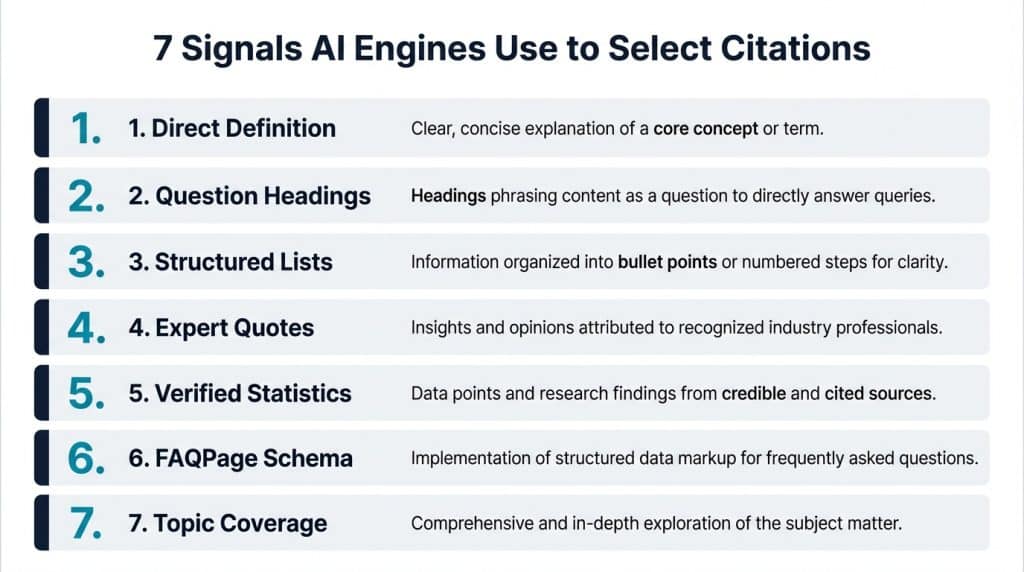
Understanding exactly which signals AI engines weigh helps you engineer for citation rather than hoping for it.
1. Direct Definitions Within 400 Words
Every post needs a clean, 40-60 word definition of its topic keyword early in the article. AI engines extract definitions constantly to answer “what is X” queries. If yours is not there, a competitor’s definition gets cited instead.
The formula that works: “[Topic] is [definition]. Unlike [misconception], [differentiator]. B2B companies use [topic] to [outcome].” This structure gives AI engines a directly extractable unit in the first scroll.
2. Question-Based Headings
At least one H2 should phrase the topic as a question, exactly as a user would type it into an AI tool. “How Do You Get Cited by AI Search Engines?” outperforms “AI Citation Strategies” in extraction likelihood. AI engines match query phrasing to heading text as a relevance signal.
3. Numbered and Bulleted Lists for How-To Content
When a query is instructional, AI engines pull structured lists. Prose paragraphs get skipped for extraction because they require interpretation. According to Semrush’s 2025 AI Search Visibility Study, list-formatted content appears in AI Overviews at significantly higher rates than unstructured prose for how-to queries.
4. Expert Quotes with Full Attribution
Named quotes are high-credibility signals for AI systems. In the content programs I run for funded B2B companies, posts with two or more attributed expert quotes earn citations faster than equivalent posts without them.
Attribution format that works: name, title, company, and year. Partial attribution (“a marketing expert said”) is treated as unverifiable and deprioritized.
5. Verified Statistics with Source URLs
Every significant claim needs a source, a year, and a URL. Vague statistics without attribution are a red flag for AI engines trained to avoid unverifiable content.
Ahrefs’ research on LLM citation patterns found that freshness is heavily weighted. Recently published or updated content with current data citations appears at higher rates than equivalent content citing 2021-era research. For B2B content, this means auditing your stats annually at a minimum.
6. FAQPage Schema Markup
FAQ sections built with proper FAQPage schema are crawlable and extractable by AI systems. Google AI Overviews in particular pulls heavily from FAQ schema-tagged content.
The requirement: each FAQ answer should be 40-60 words, a complete standalone sentence, and answer the question without referencing other sections. If it requires the reader to have read the rest of the article to understand, it will not be extracted.
7. Comprehensive Topic Coverage
AI engines assess whether a page covers a topic fully. Posts under 2,000 words without sufficient depth are less likely to surface as citations. Cover the core question and the sub-questions that orbit it.
The coverage test: use Perplexity or ChatGPT to ask five related questions on your target topic. If your article does not answer at least four of them comprehensively, it is under-indexed for AI citation purposes.
How to Structure Content for AI Citation: A Step-by-Step Framework
This is how to get cited by AI search engines in practice. It is the framework I apply when building digital PR content for Sproutworth clients who need AI citation as part of their authority-building strategy.
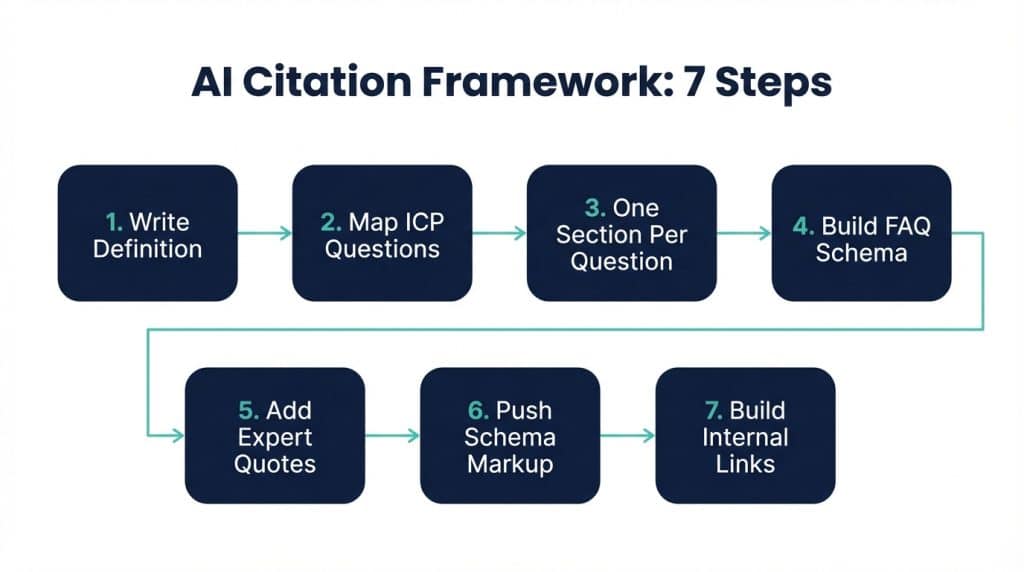
- Start with the definition. Write a 40-60 word definition of your topic keyword within the first 400 words. Structure it as: “[Topic] is [definition]. Unlike [misconception], [differentiator]. B2B companies use [topic] to [outcome].”
- Map all the questions your ICP is asking AI tools. Use Perplexity, ChatGPT, and Google’s People Also Ask to find the five to seven sub-questions orbiting your main keyword. Each one becomes a section or FAQ entry.
- Write one section per question. Each section starts with the question as a header, answers it in two to three sentences, then supports it with data or a client example. This structure mirrors how AI engines decompose queries.
- Build a FAQ section using FAQPage schema. This is the highest-impact technical change you can make for AI citation. Each answer should be a complete, standalone sentence of 40-60 words. Readable without any context from the rest of the article.
- Add two attributed expert quotes. Use quotes from named industry figures, research reports, or your own podcast interviews. Attribute fully: name, title, company, and year.
- Push schema markup. BlogPosting, FAQPage, Speakable, and Person schema are table stakes for AI citation in 2026. If you are on WordPress with RankMath, this is a 10-minute process per post.
- Build internal links to your authoritative posts. AI engines use internal link structure as a signal of topical authority. When your best-performing content links to this post, it inherits credibility.
How ChatGPT, Perplexity, and Google AI Overviews Cite Differently
Platform-specific optimization lets you prioritize which signals to fix first based on where your ICP actually asks questions.
ChatGPT: The Authority Seeker
ChatGPT skews heavily toward established, authoritative domains. According to Search Engine Land’s analysis of 8,000 AI citations, Wikipedia accounted for 27% of ChatGPT’s citations.
For B2B companies, this means domain authority matters more for ChatGPT citation than for the other engines. The path: earn citations from high-DR referring domains, maintain consistent publishing frequency, and ensure your author has verifiable credentials linked in a schema.
ChatGPT also cites content from product blogs and industry publications more often than from company marketing sites. If you publish thought leadership on platforms like Substack or guest-post on industry publications, those citations feed back to your main domain’s perceived authority.
Perplexity: The Expert and Recency Curator
Perplexity pulls from real-time web search and weights recency heavily. Content published or updated within the last six months has a structural advantage.
The signal Perplexity responds to most reliably is expert quotes with full attribution, recent statistics with source URLs, and clear inverted-pyramid structure. Each section should answer the question in the first sentence.
In my experience building content programs for Series B SaaS founders, Perplexity is often the fastest engine for achieving citations. It actively seeks specific answers rather than aggregating authority signals. A well-structured 2,500-word post targeting a specific query can beat a 10,000-word generic guide from a high-authority domain.
Google AI Overviews: The Schema-Dependent Aggregator
Google AI Overviews responds most strongly to schema markup signals. FAQPage schema, HowTo schema for step-based content, and Speakable markup on key passages all directly improve the likelihood of citations. Google also requires that content already rank reasonably well in traditional search; AI Overviews pulls primarily from the top 20 organic results for a given query.
The priority for Google AI Overviews: get your schema in place before your content builds rankings. Schema-tagged content that earns its first organic positions is pulled into AI Overviews faster than equivalent content without schema, which has to be retrofitted later.
What AI Engines Do Not Cite: B2B Content Mistakes That Kill Citation
Understanding what gets excluded is as valuable as understanding what gets cited.
The most common patterns I see in B2B content that AI engines systematically skip:
- Brand narrative content. “Our journey to building X” and “why we started Y” content resists extraction. AI engines cannot summarize a story into a direct answer. Save storytelling for nurture sequences.
- Content without a named author. Anonymous content gets filtered for YMYL (Your Money Your Life) queries. B2B buying decisions qualify as high-stakes. Named, credentialed authorship is non-negotiable for AI citation on any purchase-intent topic.
- Posts that front-load context before the answer. The most common structure in B2B content: three paragraphs of “why this matters” before the actual answer. AI engines extract answers, not context. If your answer is in paragraph 4, it gets skipped.
- Undated content. AI engines treat undated posts as potentially stale. A clear “Last Updated” date visible on the page and a dateModified field in your Article schema are basic requirements. A 2026 post without a visible date competes at a disadvantage against a 2024 post that shows its update date.
- Content that only cites itself. Posts with no external source links signal low authority to AI systems. Five to seven credible external citations with working URLs improve citation likelihood across all major engines.
A Series B founder I work with had a 3,000-word post that ranked 4th on Google for a core keyword. It had zero AI citations.
The audit revealed three problems: no author name on the post, statistics from 2022 without update notes, and 600 words of company backstory before the first direct answer. After restructuring with a named author, updating the stats, and using inverted pyramid formatting, it appeared in Perplexity answers within six weeks.
How Long Does It Take to Get Cited by AI Search Engines?
The timeline for being cited by AI search engines varies by domain authority, keyword specificity, and schema completeness. For a domain with existing authority (Domain Rating 30+), properly structured content targeting a specific query typically begins appearing in AI engine answers within 4 to 12 weeks.
Based on the content programs I run for funded B2B tech companies, the timeline varies by several key variables.
- Keyword specificity. “How do B2B SaaS startups use digital PR to build pipeline” gets cited faster than “content marketing.” Narrow, specific queries have less competition and more room for a well-structured post to become the default answer.
- Existing domain authority. Established domains with existing backlinks see faster citation rates. A DR 50 domain targeting a low-competition query can receive AI citations as early as 4 weeks post-publication.
- Topic freshness. AI engines favor recent, dated content. A 2026-published post about AI citation will outperform an undated 2021 post on the same topic, even if the older post has more backlinks.
- Schema completeness. Full schema markup (BlogPosting, FAQPage, Speakable) meaningfully shortens the path to citation. Posts with complete schema markup get crawled and processed by AI systems faster than equivalent posts without it.
“AI search is becoming the primary interface for B2B research. Companies that invest in citable content infrastructure now will own the top of the buyer journey that their competitors won’t even know is happening.”
Vinay Koshy, Founder at Sproutworth
What Types of B2B Content Get Cited Most by AI Search Engines?
Not all content types perform equally. Based on patterns from my work building citation-optimized content for funded B2B startups, these are the highest-citation formats in B2B.
- Definitional and category content (“What is X?”): highest citation volume because AI engines pull definitions constantly. Every core service page and topic cluster should have a definitional article.
- Comparison content (“X vs Y”, “best X for Y”): decision-stage content AI engines pull when users are evaluating options. According to Frase.io’s 2026 GEO Playbook, comparison articles lead AI citations at 32.5% of all citation events in B2B categories.
- How-to guides: AI engines pull step-by-step frameworks for instructional queries. The key is numbered list structure, not narrative prose.
- Industry statistics roundups: content that aggregates verified stats from authoritative sources is often cited as a source of truth. These posts age quickly, so quarterly updates are necessary to maintain citation rates.
- Expert-authored thought leadership: content written by a named expert with verifiable credentials gets cited over anonymous content for the same query, even when the anonymous content has better traditional SEO signals.
The format to deprioritize for AI citation: brand storytelling and long-form narrative. These resist chunking and are harder to extract into clean AI answers. Save them for nurture content once you have established AI citation on your core keywords.
AI Citation and B2B Newsletter Strategy: The Connection Most Founders Miss
There is an underappreciated flywheel between AI citations and B2B newsletter strategy that I have seen accelerate several funded startups’ authority-building faster than either approach alone.
When your newsletter subscribers share your content across LinkedIn and email, AI engines see increased engagement and reference signals pointing back to your domain.
A Series B SaaS founder I work with used educational email courses to build a subscriber base of 4,000 ICP readers. When those readers shared a restructured AEO article, it was cited in Google AI Overviews within three weeks. The newsletter accelerated the citation timeline.
The sequence that works: build the AI-citation-structured article first, then amplify it through your newsletter and LinkedIn content. The amplification does not create the citation.
The structure does. But amplification compresses the timeline by generating the reference signals AI engines use to assess content relevance.
This is why I recommend that B2B founders treat content strategy and newsletter strategy as a single integrated system rather than separate channels. The newsletter builds an audience that amplifies the content, earning citations that compound authority over time.
Frequently Asked Questions About Getting Cited by AI Search Engines
How long does it take to get cited by AI search engines?
Do I need to be on the first page of Google to get cited by AI search engines?
Which AI engines should I prioritize for B2B content?
How is AI citation different from getting a featured snippet?
Can a new website with low domain authority get cited by AI search engines?
How often should I update content for AI citation?
What content types get cited most often by AI search engines?
The Shift That Matters More Than Any Algorithm Update
SEO has always been about chasing the algorithm. AI citation is different. It rewards the same things that make content genuinely useful: directness, specificity, authority, and structure.
The B2B companies that dominate buyer attention over the next three years are not the ones with the biggest content budgets. They are the ones who understood, earlier than their competitors, that the format of helpful content had changed and restructured accordingly.
After 500+ episodes of Predictable B2B Success, this is the pattern I keep seeing: competitive advantage in content compounds. The earlier you act on how to get cited by AI search engines, the more citations you accumulate, which builds domain authority, which generates more citations. The flywheel is real.
If you are a funded B2B tech founder building content systems for your executive team, this is the exact infrastructure problem I help solve through Sproutworth’s AEO services, through digital PR, ghostwriting, and content built specifically for AI visibility and lead generation.
Related Resources
- B2B Content Strategy: How Funded Startups Build Authority That Compounds
- Digital PR for B2B Tech: How to Earn the Links AI Engines Trust
- B2B Newsletter Ghostwriting: The Authority Flywheel Explained
- How to Earn LLM Citations to Build Traffic and Authority (Ahrefs)
- How to Get Cited by AI: SEO Insights from 8,000 AI Citations (Search Engine Land)
