
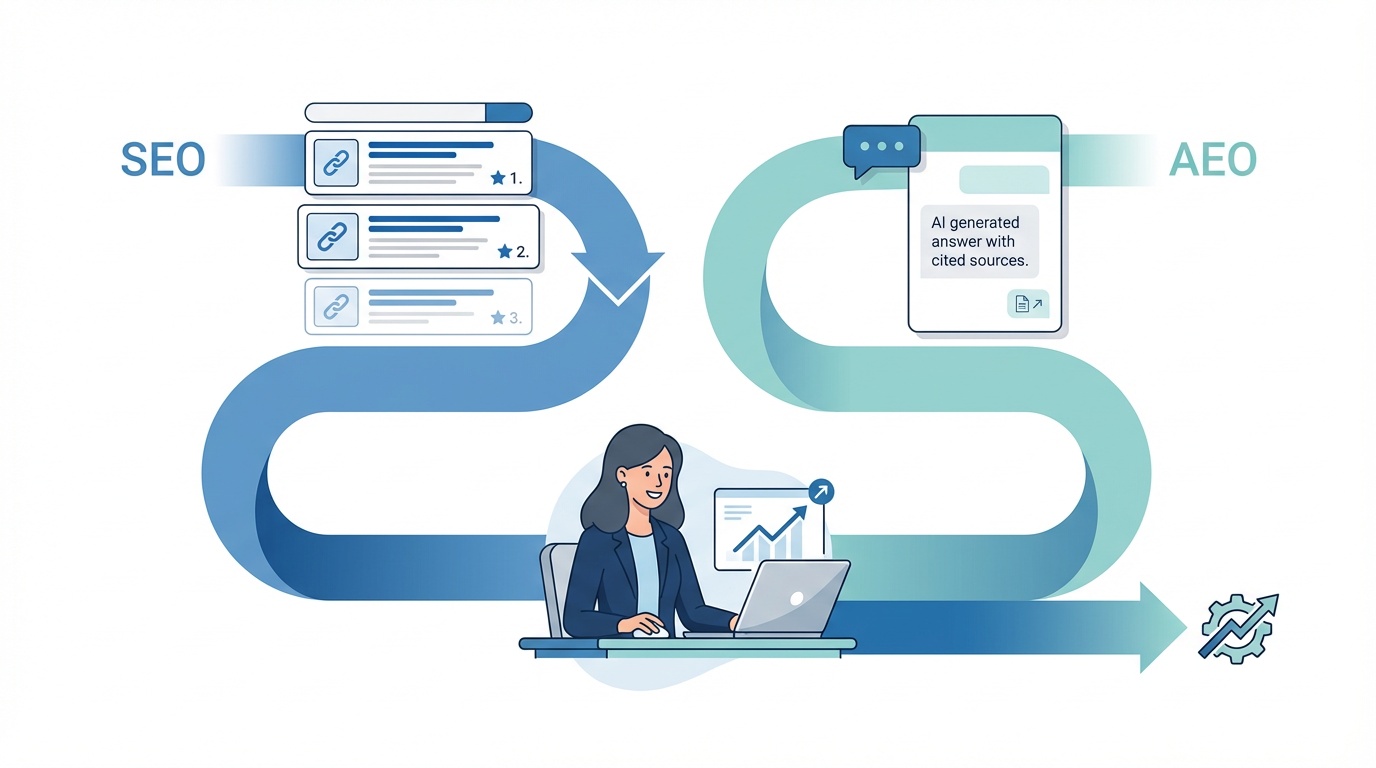
AEO, SEO and GEO name three optimisation targets, not three competing strategies. SEO earns a ranked position in Google’s blue links. AEO earns a citation inside an AI-generated answer. GEO, defined in a 2023 arXiv paper by Aggarwal and colleagues, describes that same citation work for generative models. Across 548 live B2B SERPs measured in August 2026, 94.7% carried an AI Overview, which is why this distinction now decides where buyers read you.
The short answer. Build SEO first. For a funded B2B tech company under 50 indexed pages, SEO is the prerequisite, because the domain authority and content depth that earn rankings are the same signals generative engines weigh when they select sources. Layer AEO structure onto those pages once they rank. Treat GEO as a synonym for AEO rather than a third budget line. A company that optimises for citation before it holds authority earns neither.
Quick Answer: What is the difference between AEO and SEO?
SEO optimizes content to rank in traditional search engine results. AEO optimizes content for citation in AI-generated answers. The key difference is the success metric: SEO measures ranking position and click-through rate; AEO measures brand mention rate and citation frequency in tools like ChatGPT, Perplexity, and Google AI Overviews. Most B2B companies need both.
The case I hear most often goes something like this: “Our SEO is strong, so we’ll figure out AEO later.” That’s the mistake. The B2B companies that will own AI-generated answers in your category 12 months from now are building that position today, through content structure, expert authority signals, and consistent brand narrative across every surface AI crawls. Waiting isn’t neutral.
This guide gives you the complete picture: what AEO and SEO actually are, where they differ, where they overlap, the GEO question, and a practical 30-day action plan for building both without overhauling your existing content program.
Key Takeaways
- AEO and SEO are complementary, not competing. Strong SEO authority is one of the primary signals AI platforms use to decide which sources to cite.
- B2B buyers increasingly use AI tools to research vendors before they ever visit your site. Forrester’s 2026 Buyers’ Journey Survey of 18,000 business buyers found that generative AI and conversational search are now the most meaningful source of vendor discovery.
- The AEO vs SEO debate misses the real question: are you showing up on both surfaces your buyers use?
- AEO content requires a different structure than SEO content, direct answers, explicit Q&A format, strong E-E-A-T signals, and schema markup that lets AI extract clean, citable units.
- For B2B tech companies with a podcast, structured transcript pages are one of the fastest AEO wins available.
- The zero-click problem is real and accelerating. Google AI Overviews now appear in roughly 25% of all queries (Conductor, 2026). The right response is not to abandon SEO but to become the source AI cites.
Table of Contents
What Is AEO?
Answer engine optimization is the practice of structuring content so AI systems can understand, trust and cite your brand as the direct answer to a query. Those systems include ChatGPT, Perplexity, Google AI Overviews, Google Gemini and Microsoft Copilot. Where SEO gets you found when someone searches, AEO gets you cited when someone asks. Across 548 live B2B search results measured in August 2026, 94.7% carried an AI-generated answer above the links.
The term sits alongside GEO (Generative Engine Optimization) and AIEO (AI Engine Optimization), all of which roughly describe the same discipline. More on the terminology distinction in the GEO section below.
The Answer Engines You Actually Need to Care About
Answer engines do not carry equal weight for B2B tech buyers. Forrester’s 2026 study of 18,000 business buyers found generative AI and conversational search are now the most meaningful source of vendor discovery, which makes the priority order a commercial decision rather than a technical one. ChatGPT, Google AI Overviews, Perplexity and Microsoft Copilot are the four that carry B2B vendor research in 2026.
Google AI Overviews and Google AI Mode, The highest-volume surface. Google AI Overviews now appear in approximately 25% of all searches, according to Conductor’s analysis of 21.9 million queries. Google AI Mode is a separate, conversational interface layered on top of Google Search. Both pull from the same content pool that SEO optimizes, which is why strong SEO authority is your foundation for AEO on Google.
ChatGPT, 800 million weekly active users as of 2026, with a significant portion using it for research and vendor discovery. Semrush’s research shows ChatGPT has the weakest alignment with Google’s top search results, meaning high Google rankings don’t automatically translate to ChatGPT citations. Authority signals matter, but different pages may be cited than the ones ranking on Google.
Perplexity AI, heavily used by technical buyers for detailed research. Perplexity has the strongest alignment with Google’s top-10 results of any major AI engine, meaning strong SEO performance translates more directly here than elsewhere.
Gemini, Google’s standalone AI assistant. Growing rapidly in enterprise adoption, particularly for companies using Google Workspace.
For most B2B tech companies, Google AI Overviews is the highest-priority AEO target simply because of volume. Perplexity matters disproportionately for technical audiences. ChatGPT matters for upper-funnel brand awareness at scale.
AEO vs SEO: The Real Differences
AEO and SEO differ in their target surfaces, success metrics, content structures, and time horizons. SEO is a 20-year-old discipline with well-established KPIs. AEO is 2-3 years old with no standard measurement framework yet. Here is how they compare across the dimensions that matter for B2B marketing decisions.
| Dimension | SEO | AEO | GEO |
|---|---|---|---|
| Primary goal | Rank in Google/Bing search results | Be cited in AI-generated answers | Be cited in generative model output, including ChatGPT and Perplexity |
| Success metric | Ranking position, click-through rate, organic traffic | Brand mention rate, citation frequency, citation accuracy | Citation share of voice across model providers |
| Optimization target | Pages and keyword clusters | Brand narrative, entity clarity, citable content units | Passage-level extractability and source diversity |
| Content structure | Long-form depth, internal linking, keyword density | Direct answers, explicit Q&A, standalone citable blocks | Self-contained 40 to 80 word passages, tables, named entities |
| Key signals | Backlinks, technical health, relevance, Core Web Vitals | Content consistency, E-E-A-T, schema markup, freshness | Third-party corroboration, entity consistency, recency |
| Success timeline | 3-12 months for ranking changes | Weeks for citations; months for brand authority compounding | Weeks to first citation, dependent on re-crawl |
| Measurement maturity | 20+ years of standard KPIs, established tooling | No standard KPIs yet; manual prompt testing + emerging tools | Least mature of the three, no cross-provider standard exists |
The most important row is the measurement maturity row. Because AEO KPIs are not yet standardized, it’s easy to deprioritize. But that is exactly why now is the time to build, the companies getting cited in AI answers today are doing it with less competition than will exist in 12 months.
The core distinction worth internalizing is that SEO asks, “Does my page rank?” AEO asks “when AI talks about my brand, does it get the story right?” Both questions matter. Most B2B content teams are only asking the first one.
GEO vs SEO vs AEO: The Three-Way Comparison
SEO
Search engine optimization earns a ranked position in a list of links. The work targets pages and keyword clusters, and the ranking signals are backlinks, technical health, topical relevance and Core Web Vitals. Google has refined those signals across more than 20 years, so SEO carries mature tooling and standard KPIs. A B2B page ranking in the top 10 has cleared the authority bar that both AEO and GEO depend on.
AEO
Answer engine optimization earns a citation inside a generated answer. The unit of work is a self-contained passage of roughly 40 to 80 words that answers one question without surrounding context. Success is measured as citation frequency and citation accuracy, not position or clicks. Sproutworth measured 548 live B2B SERPs in August 2026 and appeared as a cited source in 10% of the AI Overviews it reached.
GEO
Generative engine optimization is the academic name for the same citation work. Aggarwal and colleagues defined the term in a 2023 arXiv paper, framing it as optimising content for generative engines rather than for ranked lists. In commercial practice GEO and AEO cover identical tactics. Profound, an answer engine optimization platform, published its own position under the title “AEO vs. GEO: Why they are the same thing”.
Are AEO and GEO the same thing?
AEO and GEO describe the same work under two names. Both optimise for a citation inside a generated answer rather than for a ranked blue link, and both operate on self-contained passages rather than on whole pages. The vocabulary split by origin: GEO came from the 2023 academic paper, and AEO became the working term in B2B marketing. Choosing between the two words changes nothing about the work itself.
💡 CEO Takeaway
- Build SEO first. Generative engines cite sources that already rank.
- Fund one citation workstream, not two. AEO and GEO name the same work.
- Measure citation frequency and accuracy. Do not measure this work on clicks.
- Restructure existing ranked pages into 40 to 80 word self-contained passages before writing new ones.
AEO (Answer Engine Optimization), SEO (Search Engine Optimization), and GEO (Generative Engine Optimization) are three overlapping disciplines that describe how to get your content found across different search surfaces. SEO targets traditional search engines. AEO targets AI-powered answer engines. GEO, a term originating from a 2023 Princeton/Georgia Tech research paper, specifically addresses large language model outputs from generative AI systems. In practice, AEO and GEO describe near-identical work.
Here is where each term is most useful:
SEO, the established foundation. Everything built by 20 years of search optimization: keyword research, backlink building, technical site health, on-page optimization. The content authority and domain trust that drive SEO rankings are also the primary signals AI platforms use to decide which sources to cite. SEO is not optional for AEO, it’s the prerequisite.
AEO, the preferred term in B2B marketing and SaaS contexts. Focuses on brand authority and citation accuracy: making sure AI represents your company accurately when buyers ask evaluative questions about vendors, methodologies, and expertise. “What’s the best marketing agency for B2B SaaS companies?” is an AEO problem, not a keyword ranking problem.
GEO, more common in ecommerce and academic contexts. Focuses on product discoverability: making sure AI shopping assistants surface your SKU or product category. For B2B companies, GEO’s framing is less useful because your buyers aren’t asking AI “show me the cheapest CRM”, they’re asking “which CRM is best for Series B SaaS companies?” That’s an AEO question.
The practical advice is the same regardless of which term you use: structure content for direct answer extraction, build E-E-A-T signals, use schema markup, maintain consistent brand narrative across every surface AI crawls, and publish original data and expert perspectives that give AI something worth citing. The tactics overlap almost entirely.
For the rest of this guide, we’ll use AEO because that is the more relevant frame for the B2B tech companies working with Sproutworth.
How Your B2B Buyers Actually Use AI Search
B2B buyers in 2026 use AI tools across multiple stages of the purchase process, not just for initial discovery. Forrester’s 2026 Buyers’ Journey Survey of 18,000 business buyers found that generative AI and conversational search are now the most meaningful source of vendor research, ahead of peer recommendations, review sites, and analyst reports for the first time. Understanding where in the purchase process this happens shapes which AEO investments matter most.
The pattern that emerges from working with B2B tech companies is consistent across sectors:
Problem awareness stage, A B2B buyer notices something is wrong (growth has stalled, content ROI is declining, competitors appear in AI answers while they don’t). They open ChatGPT or Perplexity and describe the symptom. The AI generates an explanation and typically names 2-3 companies or content types as relevant. If your brand isn’t in that response, you don’t exist in this buyer’s world yet.
Vendor research stage, The buyer asks AI to compare vendors, explain service categories, or recommend approaches. This is the most critical AEO moment for B2B companies. The AI is synthesizing everything it knows about your brand from your website, blog, social content, review sites, and external mentions. Inconsistent messaging across those surfaces produces a muddled recommendation.
Validation stage, The buyer uses AI to validate a shortlisted vendor (“what do people actually say about Sproutworth?”) or stress-test a decision (“what are the downsides of working with a B2B content agency?”). This is where strong brand authority signals, consistent POV, named client work, specific results, pay off most.
What makes AI buyer research different from traditional search research: the buyer gets a synthesized answer rather than a list of links. They’re not comparing 10 blue links and deciding which to click. The AI has already synthesized and made a recommendation. The companies that shape that synthesis win disproportionately, because the AI’s recommendation carries implicit authority that a search ranking does not.
SEO Is the Prerequisite for AEO, Not the Alternative
Here is the number that changed how I brief clients. Across 548 live B2B SERPs I measured in August 2026, 94.7% returned an AI Overview. By impression volume, 96.6% of my site’s addressable demand now sits under a generated answer, and my site is cited in 10%. I stopped treating citation as upside on ranking. For a seed to Series C company, citation is the visibility.
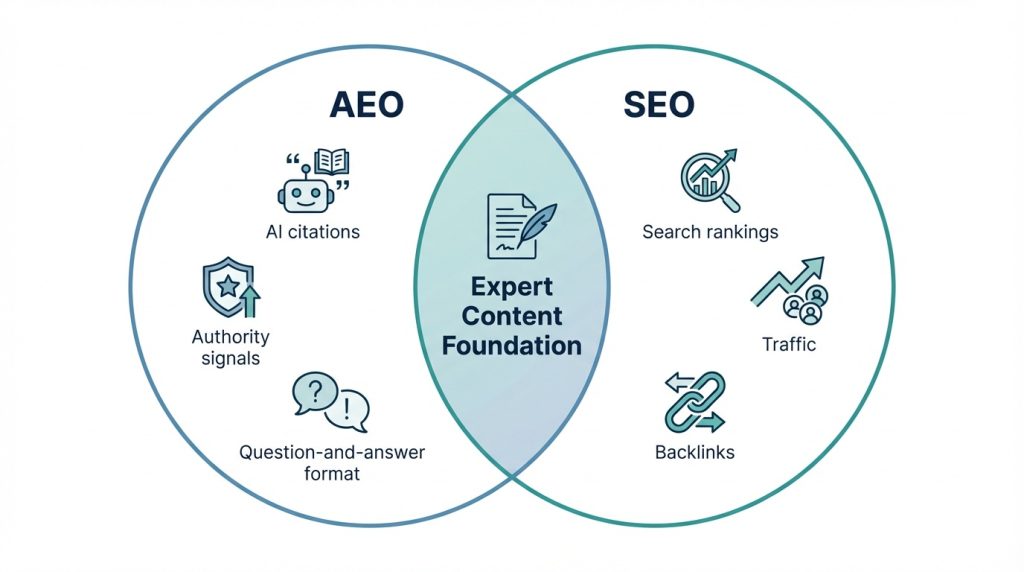
The AEO vs SEO framing implies you have to choose. You don’t. In 2026, content is discovered across two distinct surfaces, Google’s results pages and AI-generated answers, and your B2B buyers use both. Treating AEO and SEO as competing budget items misses the more important insight: the same underlying asset (authoritative, well-structured, expert content) performs well on both surfaces.
Strong SEO authority is one of the primary signals AI platforms use to decide which sources to cite. Research by Semrush found that AI consistently prioritizes domains with strong backlinks, authority, and visibility. Perplexity, in particular, shows strong alignment with Google’s top-10 organic results. Doing SEO well creates the trust foundation that AEO builds on.
What AEO adds on top of SEO is structural: it requires that your content be extractable as standalone, citable units. An article that ranks well in Google but buries its key claims in long narrative paragraphs is hard for AI to quote accurately. The same article, restructured with explicit direct-answer blocks, FAQ sections, and strong schema markup, gets cited in AI answers. The underlying quality is identical, the extractability is different.
The companies that will own AI-generated answers in their category in 2026 are not doing “AEO instead of SEO.” They’re doing SEO to build the foundation of authority, then structuring that content for AI extraction. These are not competing investments, they are sequential layers of the same content program.
AEO for B2B: The 4 Content Types That Get Cited
AEO content is not simply SEO content with better schema markup. The content types that get cited in AI answers share specific structural characteristics: they answer questions directly, they are written by named experts with verifiable credentials, and they contain claims specific enough for an AI to extract and quote. Here are the four types that perform consistently well for B2B tech companies.
1. FAQ-structured content with explicit Q&A format
The single most reliably cited content structure in AI-generated answers is explicit Q&A format. When you write a question as a heading and answer it directly in the first 60 words of the section, you create what practitioners call a “citable unit”, a passage an AI can extract and present as a direct answer to a user’s query. This is distinct from content that discusses a topic; it answers a specific question. Every FAQ section on your site is AEO content. The question is whether it’s structured for direct retrieval of answers.
2. Expert thought leadership with original POV
AI systems need something to cite. When your content offers a genuinely unique perspective, original analysis, counterintuitive insight, or specific expertise not found elsewhere, it becomes more citable than generic information summaries. The pattern in ghostwriting content for B2B tech executives is consistent: the pieces that get cited and shared are the ones that take a clear position on something the industry is actively debating. Not neutral summaries, actual positions.
3. Podcast transcripts and structured show notes (high AEO/SEO crossover value)
This is the most underused AEO asset for B2B brands that run a podcast. A well-optimized podcast episode page, with a structured transcript, an explicit Q&A format in the show notes, and clear speaker-expertise signals, is high-value for AI citation. AI systems actively cite podcast content from subject matter experts, particularly when the transcript answers specific questions in clear, quotable language. If you run a B2B podcast or your leadership team makes regular guest appearances, optimizing those transcript pages for AEO is one of the fastest ways to build citation frequency. (The Predictable B2B Success episode on B2B SEO strategy is a practical example of this approach.)
4. Primary research and original data
AI systems prioritize original data sources. If your company produces annual benchmarks, survey data, or original research, this content is cited disproportionately because it’s not available elsewhere. AirOps research found that content updated within the past 10 months accounts for 95% of all ChatGPT citations, which means publishing original data on a regular cadence, not just once, builds compounding citation advantage. For B2B tech companies, original research doesn’t require a large budget: a well-structured analysis of your own customer data, anonymized and published as industry insight, functions as citable primary research.
The Schema Markup Non-Negotiables
Three schema types carry AEO: FAQPage, Article and Organization. Schema markup is structured code that tells a search engine what each part of a page means, and answer engines lean on it because it removes ambiguity about who is making a claim. A developer can add all 3 in a few hours, and WordPress with RankMath or Yoast ships the tooling to do it without writing code.
- FAQ schema on every FAQ-format post, signals to AI crawlers that your content is Q&A structured and ready for direct retrieval
- Article schema with author expertise signals, establishes the human expertise behind your content (this matters for E-E-A-T scoring that powers AI citations)
- HowTo schema where you’re providing step-by-step guidance, highly citable by AI when answering “how to” queries
These are technical additions that your developer or CMS can implement in under an hour per page. With RankMath or Yoast on WordPress, FAQ schema is generated automatically from properly marked-up Q&A content. The ROI is disproportionate to the implementation effort.
If Your SEO Traffic Is Declining, Here’s What’s Actually Happening (And What to Do)
The AEO vs SEO dynamic explains something many B2B marketers ask: why does organic traffic decline even when Google rankings hold steady? If you’re watching this happen, here is what’s going on, and how to respond without abandoning either channel.
Google AI Overviews now appear for roughly 25% of all searches (Conductor, 2026 analysis of 21.9 million queries). When a prospect searches a question your content previously answered, they now see an AI-generated summary at the top of the page. For many informational queries, they get their answer without clicking through. Research from Superlines (2026) shows that Google AI Overviews reduce website visits by 30-70% for affected informational queries.
This is the zero-click problem. It’s real, it’s measurable, and it’s accelerating.
The responses I see from B2B companies fall into three categories:
The wrong response: abandon SEO. Don’t do this. Organic search still drives a significant portion of the B2B pipeline. Zero-click searches build brand awareness even when they don’t drive direct clicks. And the companies abandoning SEO are creating more space for those who stay.
The partial response: double down on bottom-of-funnel SEO. Focus SEO investment on high-intent, transactional queries where users need to click through to get specific information, pricing, case studies, demos. These queries are less affected by AI Overviews because the answer requires visiting your site. This is a smart strategy.
The complete response: add AEO to your SEO foundation. If Google’s AI Overview is going to summarise your content, make sure you’re the one being cited. Add structured data. Build explicit FAQ pages. Strengthen your author and company expertise signals. Become the source the AI pulls from, not the competitor it mentions. This turns declining click traffic into growing brand authority, a different metric, but one that compounds into pipeline over time.
The third approach requires more effort. It also builds a compounding advantage that the other two don’t. Semrush research found that visitors arriving through AI citations convert at 4.4x the rate of traditional organic search visitors, meaning AEO traffic, while lower in volume, carries disproportionate business impact when it does arrive.
How to Measure Your AEO Performance
AEO measurement is immature next to SEO, with no universally accepted KPIs and tooling that is still developing. The practical approach in 2026 tracks citation frequency and citation accuracy rather than position or clicks. Sproutworth measured 548 live B2B search results in August 2026 and appeared as a cited source in 10% of the AI Overviews it reached, which is the kind of baseline worth holding a programme against.
Manual prompt testing (the fastest starting point)
Open ChatGPT, Perplexity, and Google AI Overviews. Ask each one the questions your buyers are most likely to ask when researching your category, “what’s the best approach for [your service]?”, “who are the leading [your category] companies for B2B SaaS?”, “how does [your core capability] work?” Document whether your brand appears, what it says, and whether the characterization is accurate. Do this monthly with a consistent set of prompts. The change in your brand’s citation frequency over 3-6 months is your primary AEO KPI.
AI referral traffic in Google Analytics
Configure a custom channel group in GA4 to track referral traffic from AI sources: chatgpt.com, perplexity.ai, claude.ai, gemini.google.com, copilot.microsoft.com. This traffic is currently small, roughly 1% of total web traffic for most sites, but it is measurable and growing. Track it as a trend indicator: which pages are being cited, and is the volume increasing month over month?
Google Search Console for AI Overviews
GSC now shows impressions and clicks from Google AI Overviews as a separate search appearance type. This is the most reliable signal for AEO performance on the highest-volume surface. Monitor which queries trigger AI Overview appearances for your content, and track whether your pages are cited in those overviews.
Emerging AEO monitoring tools
Tools like Otterly.AI, BrightEdge, Semrush’s AI Visibility Toolkit, and Ahrefs’ AI response count are building AEO monitoring capabilities. These automate the prompt-testing process and track brand mention rate across AI platforms at scale. For most B2B companies, the manual approach works well enough to start, move to tooling once you have a baseline and consistent testing cadence.
The key metric to anchor on: brand mention rate across a consistent set of 10-15 buyer-relevant prompts, tested monthly. This single number, tracked over time, tells you whether your AEO investment is producing results more reliably than any single traffic or ranking metric.
Your AEO Quick-Start: What to Prioritize in Your First 30 Days
Resource-constrained B2B teams need a starting point more than they need a full programme. The sequencing that delivers most in the first 30 days restructures existing pages that already rank into self-contained passages of 40 to 80 words, before writing anything new. Pages that already rank give an answer engine something to select, and a new page on a domain with no rankings does not.
Week 1-2: Audit and enrich your best existing content
Identify your 5-10 most authoritative, expert-level posts, the ones that already rank, already get traffic, and represent your most credible thinking. Add FAQ schema to each one. Add an explicit “Frequently Asked Questions” section if the content supports it. Strengthen the author bio with specific expertise signals: years of experience, credentials, named clients where possible. This is the lowest-effort, highest-return move in the AEO playbook. You’re not rewriting anything, you’re structuring existing content for AI citation.
Week 2-3: Create or expand one expert FAQ hub
Build one definitive FAQ page in your primary area of expertise. Aim for 10-15 questions with direct, clear answers of 60-100 words each. Structure it explicitly as Q&A. Add FAQ schema. This single page, built properly, can generate a significant share of early AEO citations because it’s exactly the format AI systems prefer when answering buyer questions.
Week 3-4: Set up your AEO measurement baseline
Choose 10-15 prompts your buyers are most likely to ask across ChatGPT, Perplexity, and Google AI Overviews. Document the current results for each, what appears, whether your brand is mentioned, what competitors appear. Set up AI referral tracking in GA4. Check GSC for AI Overview impressions on your top pages. This baseline makes every future AEO investment measurable.
Week 3-4: Optimize your company and author authority signals
AI systems evaluate expertise, authoritativeness, and trustworthiness before deciding whether to cite content. Make sure your About page, team pages, and author bios clearly signal: specific experience with the problems your clients face, named credentials or relevant experience, and links to authoritative external mentions such as podcast appearances, media coverage, and published research.
Ongoing: Structure every new content piece for explicit Q&A
For every article or guide going forward, include a direct answer block at the top answering the article’s primary question in under 60 words, and a FAQ section at the bottom with 5-7 questions. This structural habit, applied consistently, compounds over time as more and more of your content library becomes AI-citable.
If you have a podcast: Prioritize optimizing your episode show notes. Add structured Q&A summaries, speaker expertise signals, and FAQ schema to your most popular episodes. For any B2B brand with an existing podcast library, this is one of the highest-impact AEO investments available, and it’s largely a structuring exercise rather than a content creation exercise.
Who Each Approach Is For, and When It Is the Wrong Choice
Choosing between SEO, AEO and GEO is a sequencing decision rather than a menu of three options. Each one fits a different stage of domain authority, and each has a condition under which it is the wrong first investment. Sproutworth measured 24 of 28 comparison queries across its own service lines at zero monthly searches, which is the clearest case of a sound tactic aimed at demand that does not exist.
SEO is for a funded B2B company selling into a category that buyers already search by name, with the runway to wait 3 to 12 months for ranking movement.
SEO is the wrong first investment when the category carries no search volume. Sproutworth measured 24 of 28 comparison queries across its own service lines at zero monthly searches. Pages built against those terms cannot earn traffic that does not exist.
AEO is for a company whose pages already rank, and whose buyers ask evaluative questions that a generated answer now intercepts before the click.
AEO is the wrong first investment for a domain holding no ranking authority. Generative engines draw disproportionately from sources that already rank, so a site with no top-20 positions offers them nothing to select. Sproutworth verified 548 queries against live SERPs and found only 41% of pages reached the live top 30 at all.
GEO is for nobody as a separate line item.
GEO is the wrong budget line, because it duplicates AEO. Funding both splits one workstream across two owners and two sets of reporting, and produces two dashboards counting the same citations. Profound, an answer engine optimization platform, reached the same conclusion and published it as company policy.
FAQ: AEO vs SEO for B2B Companies
Is AEO better than SEO for B2B companies?
Neither replaces the other. SEO captures high-intent search traffic from buyers who know what they’re looking for. AEO builds brand authority at the top of the funnel, before the buyer has started active research. B2B companies that invest in expert-level content get both because the same content quality that ranks well in SEO also gets cited in AI answers. The right question is not AEO vs. SEO, but how to structure your content so it performs on both fronts.
How long does AEO take to show results?
Unlike SEO, where you typically wait 3-12 months before ranking improvements appear, AEO can produce citations relatively quickly once content is properly structured. Well-structured FAQ content with schema markup can start appearing in AI-generated answers within weeks of publication. The compounding brand authority effect, where consistent citation across multiple AI platforms builds buyer familiarity, takes 6-12 months of consistent investment.
Do I need technical expertise to implement AEO?
The core AEO tactics need minimal technical knowledge, and there are only 3 of them: FAQ schema, Article schema and structured question-and-answer content. A developer can add the necessary schema markup in a few hours, and most modern CMS platforms, including WordPress with RankMath or Yoast, ship built-in schema tools. The harder work in AEO is content quality and structural discipline, which no plugin supplies.
Can AEO replace SEO entirely?
No. AI-generated answers still draw on web content discovered through traditional search. A site that is poorly indexed or short on domain authority does not get cited, whatever the content quality. AEO builds on the same foundation as SEO: good content, proper site structure and domain authority. Sproutworth’s own 10-page AEO cluster produced 1 click on 5,547 impressions across 90 days, so ranking and citation solve genuinely different problems.
How do I know if my company is being cited in AI answers?
Search your key topics in ChatGPT, Perplexity, and Google AI Overviews. Note whether your company appears in responses. Check Google Search Console for AI Overview impressions. Set up AI referral tracking in GA4 to monitor traffic from chatgpt.com, perplexity.ai, claude.ai, and similar sources. Tools like Otterly.AI and Semrush’s AI Visibility Toolkit automate this monitoring. Manual spot-checking gives you a directional signal while tooling matures.
What’s the difference between AEO and GEO (Generative Engine Optimization)?
AEO and GEO describe near-identical disciplines. GEO originates from a 2023 Princeton and Georgia Tech research paper and is more common in ecommerce contexts focused on AI-driven product discovery. AEO emerged alongside featured snippets and voice search, and has become the preferred term among B2B marketers and SaaS-focused agencies. For B2B companies, AEO is the more useful frame because it centers on brand authority and vendor evaluation rather than product discoverability. The tactics are almost entirely the same.
How much should a B2B company invest in AEO vs SEO?
For a company with an established SEO program, AEO additions are largely incremental: schema markup, FAQ content structure, expert authority signals, measurement setup. Budget for perhaps 20-30% additional effort on top of your existing SEO investment. For companies starting from scratch, build the SEO foundation first (6-12 months), then systematically layer in AEO. Companies that treat AEO as a complete replacement for SEO will underperform on both.
GEO vs SEO: which should a B2B company invest in first?
Invest in SEO first. GEO vs SEO is a sequencing question rather than a choice, because generative engines select sources that already demonstrate authority. A B2B site holding no top-20 rankings gives a generative engine nothing to cite. Build the ranked pages first, then restructure them into self-contained passages that a generated answer can lift.
Answer engine optimization vs generative engine optimization: what is the difference?
There is no practical difference. Answer engine optimization vs generative engine optimization is a naming dispute rather than a strategic one. GEO entered the vocabulary through a 2023 arXiv paper by Aggarwal and colleagues. AEO became the working term among B2B marketers. Both describe writing self-contained passages that a generative model can lift and attribute.
Related Resources
- Best Answer Engine Optimization Agencies for B2B Tech
- What Is Answer Engine Optimization
- Generative Engine Optimization: The B2B Tech Framework
- How to Get Cited by AI Search Engines
- AI Overview Optimization
The Bottom Line: AEO and SEO in 2026
The AEO vs SEO question has a clear answer for B2B companies in 2026: it’s a sequence, not a choice. Content is now discovered across two distinct surfaces: Google’s results pages and AI-generated answers, and your buyers use both. Your content needs to work on both.
SEO gets you found when prospects know what they’re looking for. AEO gets you cited before they start looking. Together, they create a flywheel: your content builds authority with AI systems, which builds brand familiarity with buyers, which improves conversion rates when those buyers eventually land on your site through organic search.
The companies making serious AEO investments right now are still in the early stages. Most B2B content teams haven’t started. That window won’t stay open, the same consolidation dynamic that made it progressively harder to crack Google’s top three will eventually apply to AI citations.
If you’ve been doing SEO and wondering whether to add AEO: yes, add it. Start with the quick-start framework above. It doesn’t require replacing your existing content program; it requires structuring what you already create with AI citations in mind.
The investment compounds. The authority you build in AI answers today will be significantly harder for competitors to displace in 12 months.
If your content program is already generating strong SEO results but you’re not yet showing up in AI-generated answers, the gap is usually structural, not a volume problem. The B2B companies that build AEO visibility fastest are typically the ones with a clear point of view, consistent brand narrative, and an audience that already trusts their thinking. The work is connecting those assets to the right structure. If that’s where you are, it’s worth a conversation.
