
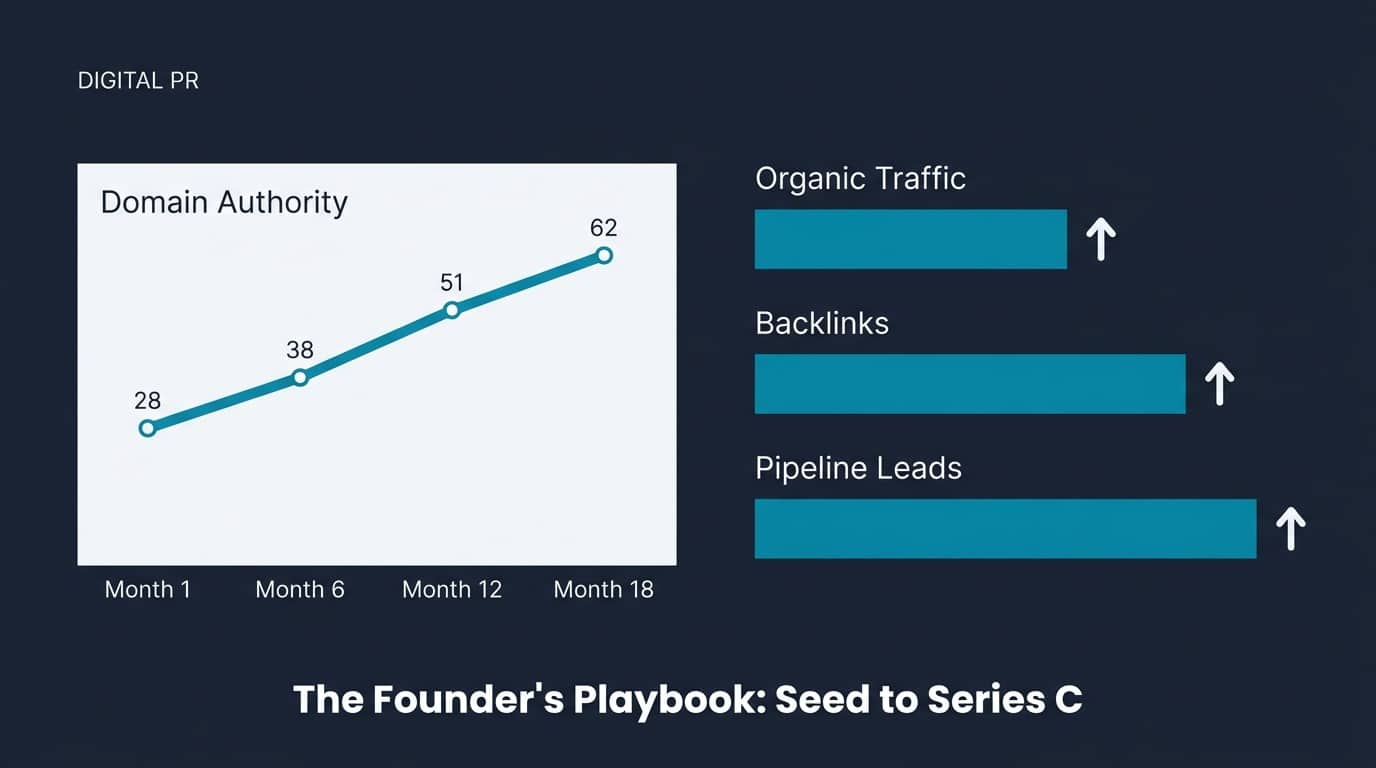
A digital PR strategy is a program for earning editorial coverage, expert quote placements, and high-authority backlinks from publications your buyers read. According to a 2025 survey of 518 SEO professionals by Search Logistics, 48.6% now rate digital PR as the most effective link-building tactic. For funded B2B founders, that compounds directly into pipeline — not just traffic. This guide covers what works from seed through Series C: tactics, costs, tools, and ROI measurement.
Quick Answer
What is a digital PR strategy? A digital PR strategy earns editorial mentions, backlinks, and expert quote placements from media your buyers trust. It differs from traditional PR by connecting coverage to search authority and pipeline. B2B digital PR strategies combine journalist source pitching, original research, and bylines to build domain authority over 18 months.
By Vinay Koshy — host of Predictable B2B Success (500+ episodes), content strategist for funded B2B tech companies, and founder of Sproutworth. Updated July 2025.
Table of Contents
What Is Digital PR Strategy for B2B Tech Startups?
Digital PR strategy earns editorial backlinks that compound in authority — no other B2B link tactic does this.
Digital PR strategy for B2B tech startups is a structured outreach program designed to earn editorial mentions, expert quotes, and high-authority backlinks from media outlets your target buyers trust.
Unlike traditional PR — which focuses on brand awareness and press releases — a digital PR strategy connects media coverage directly to search authority and organic pipeline. Funded B2B startups that execute digital PR consistently see increases in domain authority that make every subsequent piece of content rank faster.
Most founders confuse digital PR strategy with press releases and media pitching. Press releases announce things. A digital PR strategy builds something: a compounding asset of backlinks and brand mentions that signals to both search engines and buyers that your company knows what it is talking about.
According to analysis by Presslei, a single placement in a DR 70+ publication can be worth $5,000 to $50,000 in paid link-building costs. The real value is not the link — it is the trust transfer that happens when a Series A CTO reads your CEO’s expert commentary in a publication they already follow.
“The best digital PR strategies for B2B tech startups do not aim for press coverage. They aim for authority signals your buyers use to qualify you before the first call.” — Vinay Koshy, Sproutworth
Digital PR tactics for B2B tech companies include journalist source pitching via platforms like Connectively (formerly HARO), original research publication, thought leadership bylines, and earned podcast placements. Each tactic produces a different type of authority signal. Taken together, they create a moat that generic content marketing cannot replicate.
How Does a Digital PR Strategy Differ from Traditional PR?
Digital PR builds domain authority that grows for years. Traditional PR impressions disappear in days.
A digital PR strategy for B2B tech startups builds compounding domain authority, earns high-quality backlinks, and drives organic search rankings that grow in value over time. Traditional PR produces brand impressions and press coverage that disappear when the campaign cycle ends. For funded founders on limited budgets, only one builds a lasting commercial asset.
| Dimension | Traditional PR | Digital PR Strategy |
|---|---|---|
| Primary output | Brand mentions, impressions | Backlinks, domain authority |
| How results compound | They don’t. Each campaign restarts. | Each backlink reinforces past links. Authority grows cumulatively. |
| Measurement | Impressions, AVE | Domain authority, organic rankings |
| Shelf life | Short. News-dependent. | Long. A DR 70+ backlink from 2024 still passes authority in 2027. |
| Budget fit | $15K–$50K/month retainers | Scalable: $500/month founder-led to $15K/month agency |
| AI search visibility | No direct impact | Editorial mentions feed AI training data and citation pools |
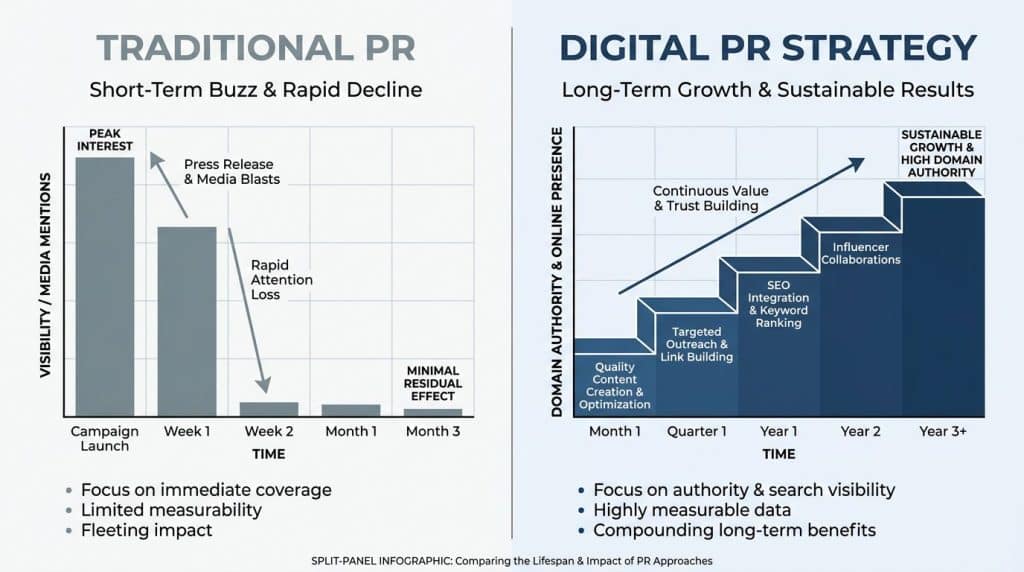
A Series A cleantech startup I worked with ran a traditional PR campaign for its funding round. It secured five media placements, a 48-hour traffic spike, and no lasting search benefit. The same budget applied to a six-month digital PR program produced 23 editorial backlinks from industry publications, a 12-point increase in domain authority, and inbound leads that still cite those placements in discovery calls today.
Why B2B Tech Startups Need a Digital PR Strategy After Funding
Post-funding B2B startups face a credibility gap. A digital PR strategy closes it systematically.
Post-funding, B2B tech startups face a credibility paradox: investors believed in them enough to write a cheque, but enterprise buyers have not yet heard of them. A seed or Series A round announcement generates a day or two of coverage, then disappears.
A digital PR strategy converts that moment of attention into sustained authority-building. Companies that start immediately after a round give themselves a 6–12 month head start over competitors who wait until Series B.
There is also an AI search dimension that most teams are not accounting for. Perplexity, ChatGPT, and Google AI Overviews now surface editorial mentions when buyers search for vendors. A funded B2B startup with no media coverage will not appear in those answers. The next section covers this in full — it is the highest-leverage reason to start a digital PR program in 2025.
How Digital PR Strategy Affects AI Search Citations
Editorial mentions are the primary signal AI search engines use to recommend B2B vendors.
AI-generated search answers have changed how B2B buyers discover vendors. When a Series B procurement lead asks Perplexity for “best B2B SaaS onboarding tools” or ChatGPT for “what is the best digital PR agency for tech startups,” these systems do not search websites — they surface entities with the strongest editorial-mention footprint. Publications your buyers trust are the primary training signal.
This creates a direct line between digital PR strategy and AI search visibility that most funded B2B tech teams have not mapped:
- Earn editorial mentions in buyer-trusted publications — trade media, vertical publications, and high-DR industry outlets
- Those publications feed AI training datasets — AI systems ingest editorial content from authoritative sources
- AI systems cite the companies mentioned — when relevant buyer queries trigger the topic
- Your company appears in AI-generated recommendations — before the buyer visits your website
The platforms matter: Perplexity, Google AI Overviews, and ChatGPT search now account for a growing share of early-stage B2B vendor discovery. According to analysis from Sproutworth’s ongoing GEO monitoring work, B2B SaaS companies with 30+ editorial mentions in vertical trade publications are cited in AI-generated vendor lists at rates significantly higher than companies with pure SEO but no editorial presence.
For founder-CEOs at seed through Series B, this means digital PR is no longer an optional “awareness” play. It is the mechanism that gets your company cited in AI-generated answers to buyer queries — which now function as the new first page of search for high-value B2B vendor evaluations.
The AI citation playbook for B2B founders:
- Target publications that AI systems draw from: industry trade media, Forbes, MIT Technology Review, Fast Company, and vertical SaaS publications
- Publish original research that AI engines cite directly when answering data questions in your category
- Build journalist relationships that generate repeated mentions across multiple publications — entity diversity matters as much as domain authority
- Pitch expert commentary on AI-adjacent topics (automation, LLMs, data infrastructure) to publications covering enterprise technology
If you want to learn more about making your content AI-citation-ready, the B2B AI Search Citation Playbook covers the full technical and content framework.
How to Build a Digital PR Strategy: 6-Step Framework
Skipping steps 1 and 2 is why most B2B digital PR programs stall after the first few placements.
A digital PR strategy for funded B2B startups works best when built in this order. Skipping steps — especially steps 1 and 2 — is why most programs stall after the first few placements.
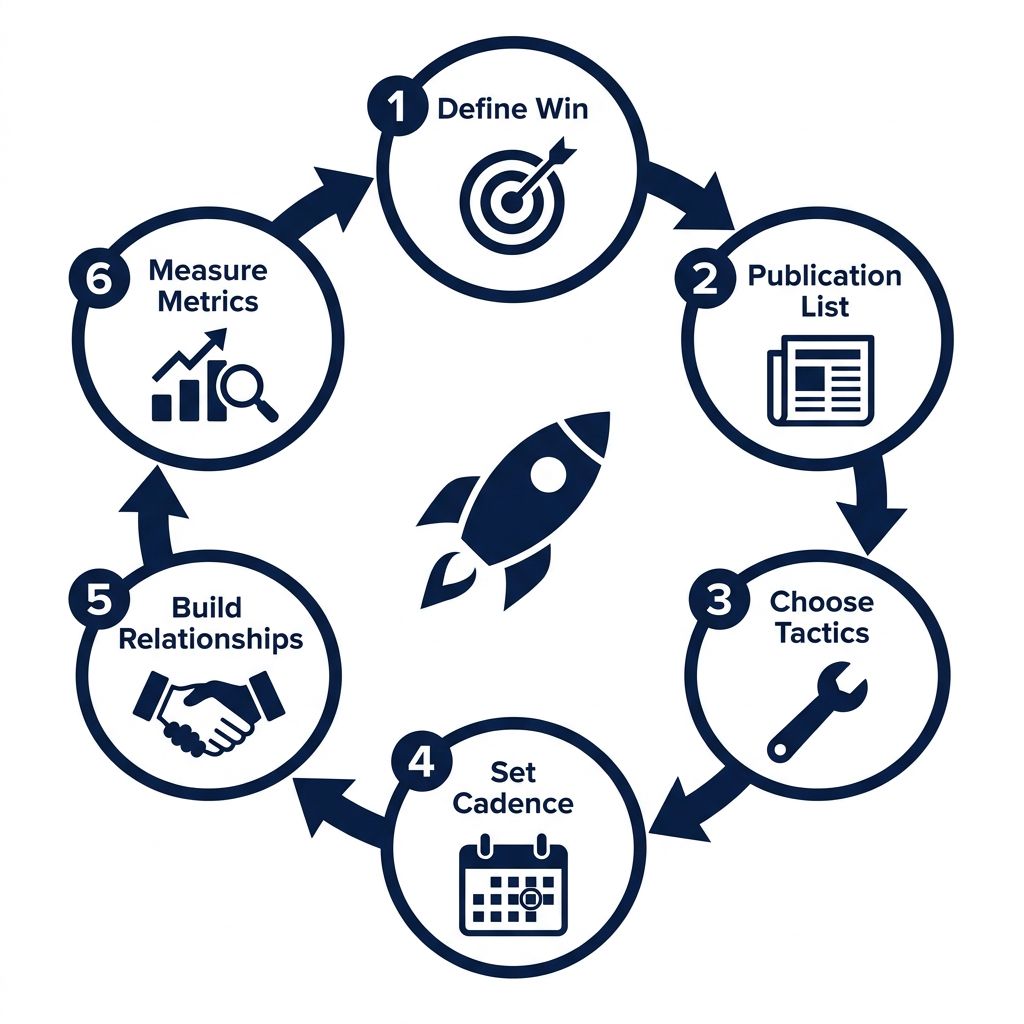
Step 1: Define What “Win” Means at Your Stage
At seed, a digital PR strategy win is a credibility layer that accelerates outbound conversion. At Series A, it is organic inbound from authority-backed content. At Series B, it is enterprise buyer trust that clears procurement shortlists.
Set stage-specific KPIs before anything else. The domain rating trajectory and the referring domain count are leading indicators. Pipeline attribution — which inbound leads entered through authority-linked pages — is the lagging indicator that connects digital PR to revenue.
Step 2: Build Your Publication Shortlist Around Buyer Behavior
The right publication for your digital PR strategy is the one your buyer reads before making a vendor decision — not the one with the highest domain rating.
A framework that works at seed and Series A: identify the five publications your best current customers read to stay current in their role. These are your primary targets. Then identify the five publications your CEO’s potential investors follow. These become your secondary targets for credibility signaling.
At Series B and beyond, vertical media matters less than category-defining publications. Presence in HBR, MIT Technology Review, or Financial Times signals enterprise readiness in a way that niche trade press cannot.
“A Series B CEO targeting digital PR should ask one question: what does my enterprise buyer read the morning of a vendor evaluation meeting? That publication is worth ten high-DR links from irrelevant domains.” — Vinay Koshy
Step 3: Choose Your Tactics Based on Resources
Not all digital PR tactics produce equal returns for early-stage B2B companies. Tactic selection should follow the resource model below — not what agencies sell.
Expert source pitching (Connectively, Qwoted): Best for pre-seed to seed. Zero cost beyond founder time. Responds to journalist queries with specific, data-driven answers. According to analysis from PressHERO, nearly one in five placements via journalist sourcing land on DR 90+ sites when responses are specific and delivered quickly.
Original research: Highest-impact tactic for companies with proprietary data. A single well-designed study earns 30–80 natural backlinks without additional outreach. Research content earns 3x more links than other content types, according to Backlinko’s analysis of 900 million articles. A Series A fintech founder I work with published a dataset analysis on payment failure rates in SaaS. Within 90 days, it had 47 editorial citations and a 47% jump in trial sign-ups — at less than a month of paid media cost.
Thought leadership bylines: Guest articles in Forbes, Fast Company, Inc., and vertical trade publications position your executive team as the definitive voice on your problem space. The mistake most teams make: writing about their product. Editors reject product pitches. Bylines that get placed take a strong contrarian position on a topic buyers care about, backed by real data.
Podcast guest placements: B2B podcast audiences are small, engaged, and often exactly the buyers you need. A guest appearance on a podcast with 2,000–10,000 listeners can produce qualified pipeline that a Forbes mention with 10 million readers does not. After 500+ interviews on the Predictable B2B Success podcast, I have watched guests convert listeners into enterprise customers within days of an episode dropping.
Journalist relationship outreach: The most sustainable digital PR approach for funded B2B teams. Build relationships with 15–30 journalists before you need coverage, share useful data and perspectives without a pitch, and become a trusted source before you have a story to tell. According to the Reboot Online 2025 Digital PR Statistics Report, the average campaign combining content assets with journalist relationships earns placements from 42 unique domains, with 20%+ from DR 70+ publications.
Newsjacking: Monitor industry news as it breaks and respond immediately with expert commentary. Journalists building same-day stories need authoritative sources fast. Speed matters: a response within two hours of a news break is 4x more likely to get used than one sent the next day.
Step 4: Set Your Publishing Cadence
A digital PR strategy that runs for three months and stops produces noise. One that runs consistently for 12 months produces domain authority movement.
For source pitching: commit to 30–45 minutes daily on Connectively or Qwoted. For research campaigns: one original study per quarter is more impactful than monthly thin reports. For bylines: target one byline per month at Series A and two per month at Series B.
Step 5: Build Journalist Relationships Before You Need Them
Targeting publications is the wrong frame. Journalists accept pitches — not publications. A startup with no existing relationship to a Forbes contributor will wait months for a response. The same startup, with a genuine connection to two Forbes contributors, can secure a byline within three weeks.
The relationship-building formula: identify the three journalists who most consistently cover your problem space. Share one genuinely useful data point with each this week — no pitch, no ask. That relationship is the first brick.
Step 6: Measure the Right Metrics
Most early-stage teams default to counting placements and impressions. These are vanity metrics for a funded B2B company.
The metrics that connect to pipeline:
- Domain rating (DR) trajectory: Track monthly via Ahrefs or Semrush. Seed-to-Series A programs should target 5–15 DR points per year.
- Referring domain count: Unique domains linking to your site. Quality and diversity better predict ranking ability than raw link count.
- Organic keyword rankings: Track commercial-intent keywords on page one. Digital PR amplifies this by boosting the authority of existing content.
- Inbound lead source attribution: Tag leads arriving through organic search and note which pages they landed on.
- AI search citation coverage: Run monthly prompt tests in Perplexity and ChatGPT to track whether your company appears in vendor recommendations for your category.
- Buyer-aware impressions: Estimate readership overlap between your publications and your ICP. 10,000 impressions in a trade publication your buyers read daily outperforms 500,000 impressions in a general tech blog.
Reporting cadence that works at Series A: monthly DR snapshot, quarterly keyword ranking review, half-year pipeline attribution analysis.
Digital PR Strategy Costs at Each Stage
Stage determines the right digital PR investment. Not what agencies pitch you.
Digital PR cost transparency is rare, which is why most funded B2B tech founders overpay or underspend at the wrong stage.
Founder-led digital PR: $0–$500/month (time cost: 3–5 hours per week). Suitable for pre-seed to seed. Involves personal source pitching, relationship-building with 10–15 journalists, and publishing original perspectives in relevant communities. Low cost, high relationship value, lower placement volume.
Fractional digital PR specialist: $2,000–$5,000/month. Suitable for Series A. Brings consistency and dedicated relationship management without full agency overhead. Typically delivers 4–8 quality placements per month across DR 50–80 publications.
Digital PR agency: $5,000–$15,000+/month. Suitable for Series B and beyond when pipeline velocity justifies faster authority accumulation. Full-service programs include research campaigns, journalist relationships, byline placement, and monthly DR and traffic outcome reporting.
The metric that matters most is not cost per placement — it is cost per acquired backlink, weighted by the publication’s buyer relevance. A $200 placement on a DR 75 industry trade site your buyers read daily outperforms a $2,000 placement on a general business publication they do not.
How Digital PR Strategy Connects to Pipeline at Each Stage
Digital PR strategy looks different at seed, Series A, and Series B — what pipeline means varies at each stage.
A digital PR strategy looks different at seed, Series A, and Series B — because what “pipeline” means changes at each stage.
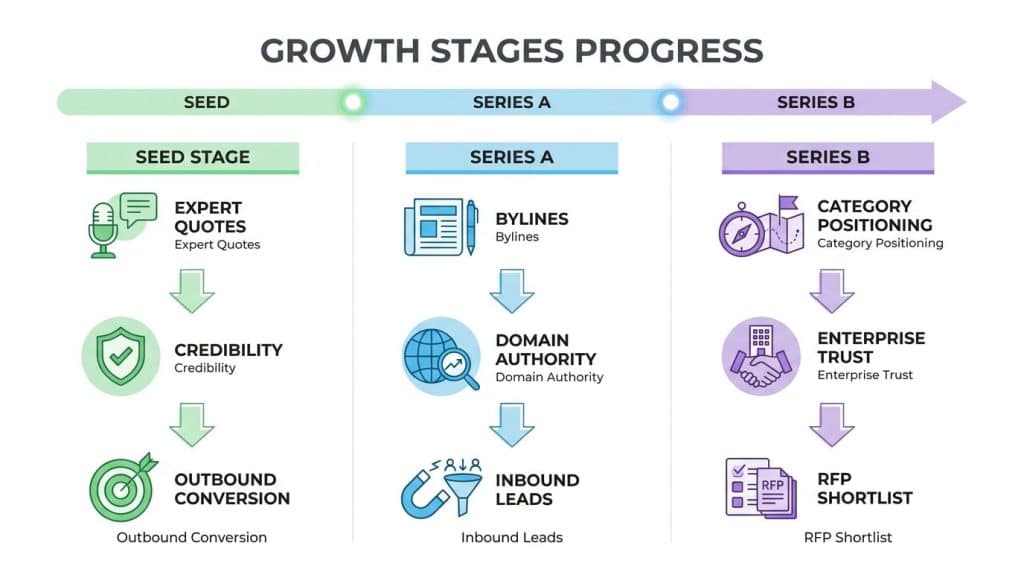
At seed: Digital PR builds the credibility layer that accelerates outbound conversion. When a founder emails a prospect and that prospect searches for them — finding expert quotes in three relevant publications — first-meeting conversion rates increase significantly. The earned media does the warm-up that sales sequences cannot.
At Series A: Digital PR shifts to authority signaling for inbound. Well-placed bylines and research studies drive organic traffic to bottom-of-funnel content. A single well-cited piece of original research can generate 500–2,000 qualified visits per month for two to three years without further promotion. According to Powered by Search’s B2B SaaS SEO analysis, B2B SaaS companies see an average 702% ROI from SEO when authority content compounds at this stage.
At Series B: Digital PR activates enterprise buyer trust. Enterprise procurement teams research vendors across 10 or more sources before engaging. Companies that appear in trade publications, analyst briefings, and podcast transcripts clear procurement shortlists that pure-outbound competitors never reach. Digital PR at Series B is less about backlinks and more about being the category-defining voice before the RFP arrives.
If you are building a broader content and pipeline strategy, the B2B Content Distribution Strategy guide maps how digital PR fits into the full owned, earned, and paid framework.
What Are the Risks of a Digital PR Strategy for B2B Startups?
Digital PR compounds. But it is competitive, slow to start, and guarantees nothing.
No guide that tells you only the upside of digital PR is useful to a founder making a budget decision. Here is an honest assessment of the risks.
It is slower than paid acquisition. Most digital PR programs produce measurable SEO impact at the 6–12 month mark, not the 6–12 week mark. Founders accustomed to paid media feedback loops often underinvest in patience and abandon programs before they compound. If you have a 90-day window to show pipeline results, digital PR is not the right tool.
Placements are not guaranteed. Journalist relationships and pitch quality improve placement rates, but editorial decisions are outside your control. A well-crafted pitch to a relevant journalist can still be declined for reasons unrelated to quality: timing, competing stories, the journalist’s current beat, or their publication’s editorial calendar. High-quality programs expect a 20–40% pitch-to-placement conversion rate at best.
Low-quality backlinks can harm rankings. A backlink from a low-DR, spam-adjacent website is worth nothing — and a pattern of them can trigger Google’s spam signals. This is why publication quality matters more than placement volume. Founders running founder-led programs who accept any placement risk building a low-quality backlink profile that underperforms.
Outcomes are hard to attribute directly. A DR increase does not have a direct revenue line. Pipeline attribution for organic traffic requires tagging, CRM discipline, and time — resources that early-stage teams often lack. The ROI exists, but measuring it requires setup work that many teams skip.
The market moves. AI search changes how editorial mentions are weighted. Google algorithm updates can reset rankings. A publication that was authoritative in your vertical last year may have lost DR since. Digital PR built on a narrow set of publications is more fragile than a diverse editorial presence across 30+ domains.
These risks are manageable with the right setup: clear stage-appropriate KPIs, quality publication standards, realistic timelines, and a measurement framework established before the program begins.
Best Digital PR Tools for B2B Tech Startups
The minimal effective digital PR stack costs under $100/month at the seed stage. You do not need agency-tier tools.
B2B tech startups need tools across three categories: journalist monitoring, outreach management, and performance measurement.
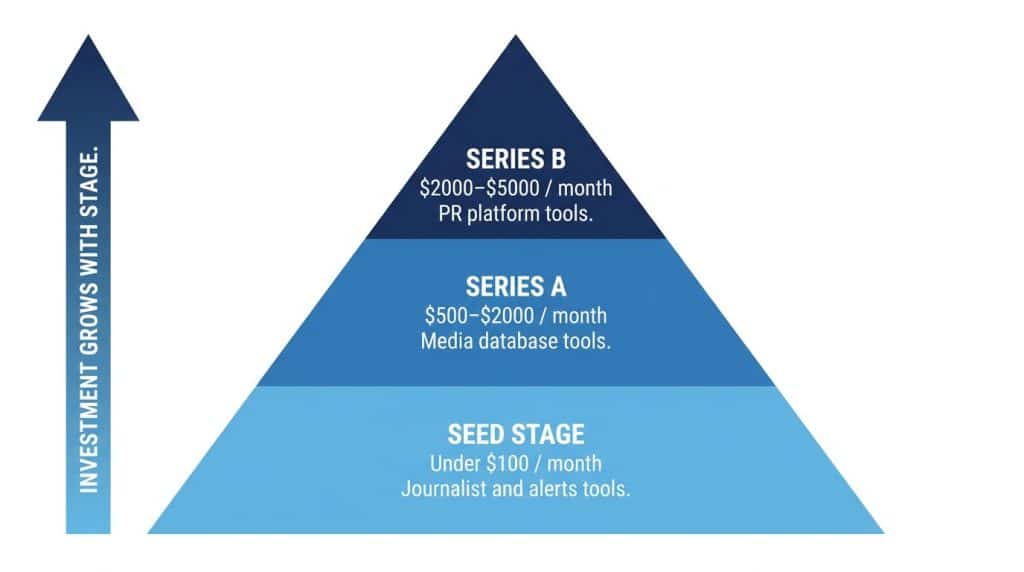
Connectively (formerly HARO): Free to start. Sends journalist source requests three times daily. Best for founder-led programs at seed, where response speed and specificity win placements.
Qwoted: A Connectively alternative with better filtering for B2B tech verticals. Paid only, starting around $100/month. Attracts more business and technology journalists — higher signal-to-noise than HARO for B2B SaaS companies.
Muck Rack: The professional standard for journalist relationship management. Search journalist profiles, track coverage, monitor competitor coverage, and manage outreach lists. Pricing starts around $400/month. Most useful at Series A when relationship volume justifies the cost.
Ahrefs or Semrush: For tracking the SEO impact of your digital PR program. Monitor DR changes, new referring domains, and keyword ranking improvements that correlate with placements. Plans start at $99–$129/month.
BuzzSumo: Identifies which content formats earn the most backlinks in your vertical and tracks journalist coverage patterns. Useful for research campaign ideation. Plans start around $199/month.
Google Alerts (free): Set up alerts for your company name, CEO’s name, competitors, and primary topic areas. Ensures you never miss a mention that requires a response.
Prowly: A PR platform for building journalist contact lists, sending press releases, and tracking coverage. Useful for teams running structured outreach at scale. Plans start around $189/month.
The minimal effective stack for seed stage: Connectively (free) + Google Alerts (free) + Ahrefs ($99/month). Add Muck Rack and Qwoted at Series A when a fractional specialist is managing outreach at scale, and relationship count justifies the cost.
What Digital PR Mistakes Do Funded B2B Startups Make?
The same five mistakes appear across every funded B2B digital PR program, regardless of stage or sector.
Targeting publications instead of journalists. Publications do not accept pitches. Journalists do. Build journalist relationships first, then pitch.
Announcing instead of educating. Press releases about product features earn coverage once. Educational content — original data, actionable frameworks, contrarian positions on industry assumptions — earns repeated coverage. According to Motive Agency’s 2025 analysis, the global digital PR services market was worth $12.3 billion in 2023, with most of that spend on the announcement model. The founders who win own the educational model instead.
Measuring placements instead of buyer impressions. A startup that tracks “media placements” as a KPI optimizes for volume over relevance. The team that tracks estimated buyer impressions makes better publication decisions.
Starting too late in the funding cycle. Digital PR compounds. A program that starts six months before a Series B announcement produces meaningfully better results than one that starts the month before. The best time to build authority is immediately after the previous round — not immediately before the next one.
Neglecting crisis preparation. Even early-stage B2B startups face negative coverage risks — founder controversies, product incidents, competitive attacks on third-party review sites. Building journalist relationships before you need them creates goodwill capital. Companies with established editorial relationships navigate negative coverage cycles faster than those that only call journalists when they have a problem.
💡 CEO Takeaway
- Start your digital PR strategy immediately after your current funding round — not before the next one. Authority compounds over a minimum of 6–12 months.
- Select target publications by where your buyers read, not by domain rating. Buyer-relevant DR 55 beats buyer-irrelevant DR 80 every time.
- Original research is your highest-impact tactic if you have unique data. A single study can earn 30–80 natural backlinks without active outreach.
- Build relationships with journalists before you have a story. Relationships convert to placements. Cold pitches rarely do.
- Track domain rating trajectory, referring domain count, and organic keyword rankings. Placement count alone is a vanity metric for B2B pipeline goals.
- Use the free stack first (Connectively + Google Alerts + Ahrefs) at seed stage. Add Muck Rack and Qwoted at Series A when relationship volume justifies the cost.
- Run monthly prompt tests in Perplexity and ChatGPT to track AI search citation coverage for your vendor category. Editorial presence is now the mechanism for AI visibility.
- Understand the risks before you begin: slow start, no guaranteed placements, and attribution difficulty. Set a 12-month program minimum before evaluating ROI.
Frequently Asked Questions
What is a digital PR strategy? A digital PR strategy is a plan for earning editorial mentions, expert quote placements, and high-authority backlinks from publications your buyers trust. Unlike traditional PR, it connects media coverage directly to search authority and organic pipeline. B2B tech startups use digital PR strategy to build credibility with buyers before the first sales conversation and to generate compounding organic traffic that reduces reliance on paid acquisition over time.
How long does a digital PR strategy take to show results? A digital PR strategy for B2B tech startups produces initial media placements within 4–8 weeks of a consistent program. SEO and pipeline impact compound over 6–12 months. According to Powered by Search, B2B SaaS companies see the strongest ROI from content and authority investments at the 12–18-month mark, when domain authority growth begins to meaningfully accelerate organic rankings and inbound lead volume.
What is the difference between a digital PR strategy and a traditional PR strategy? Traditional PR focuses on brand visibility, press releases, and media coverage, with media coverage measured by impressions. A digital PR strategy focuses on earning high-authority backlinks, improving domain rating, and generating qualified organic traffic that converts to pipeline. For B2B tech startups, digital PR strategy ties directly to revenue: higher domain authority makes content rank faster, increases inbound traffic, and puts you in front of enterprise buyers during active vendor research.
How much should a B2B startup spend on a digital PR strategy? B2B tech startups at the seed stage can run an effective digital PR strategy for $500–$1,500 per month through founder-led source pitching and relationship-building. Series A companies invest $2,000–$5,000 per month with a fractional specialist. Series B companies running full agency programs budget $5,000–$15,000 per month. The right level depends on how quickly authority needs to compound relative to your next funding or revenue milestone.
Does a digital PR strategy work for early-stage B2B startups without traction? A digital PR strategy works at pre-traction stages if the founder has genuine expertise to share. Journalists seek expert sources, contrarian data, and specific perspectives — not company milestones. A seed-stage B2B tech CEO with a unique point of view on an industry problem can earn placements in relevant publications within weeks. The mistake early-stage founders make is waiting until they have enough traction to feel credible. Expertise, not scale, earns digital PR placements.
What tools do B2B tech startups use for digital PR strategy? The core digital PR strategy stack for funded B2B tech startups includes Connectively or Qwoted for journalist source monitoring, Muck Rack for managing journalist relationships at scale, and Ahrefs or Semrush for tracking domain authority gains and keyword ranking improvements. At seed stage, the minimal effective stack is Connectively (free) + Google Alerts (free) + Ahrefs ($99/month). Add paid outreach and relationship tools at Series A when program volume justifies the cost.
How do you measure the ROI of a digital PR strategy for a B2B startup? B2B startups measure the ROI of their digital PR strategy by tracking domain rating trajectory, referring domain count, organic keyword ranking improvements, and inbound lead source attribution. The most reliable leading indicators are monthly domain rating growth and link-building velocity (new referring domains per month). A 5–10 point DR increase per year correlates with meaningful organic ranking gains at the 12–18 month mark. Pipeline attribution requires tagging organic leads and identifying which authority-linked pages they entered through.
How does digital PR strategy affect AI search citations? Digital PR strategy is the primary mechanism for appearing in AI-generated search answers (Perplexity, ChatGPT, Google AI Overviews). AI systems surface vendor recommendations based on editorial mention footprint — companies cited in authoritative trade publications and vertical media appear in AI-generated vendor lists at significantly higher rates than companies with SEO alone. A consistent digital PR program targeting publications that AI engines index is now essential for B2B vendor discovery in 2025 and beyond.
What are the biggest risks of a digital PR strategy? The primary risks of a digital PR strategy for B2B tech startups are slow ramp time (6–12 months before SEO impact), no guaranteed placements despite strong pitches, low-quality backlinks from indiscriminate placement that can harm rankings, and attribution difficulty that makes ROI calculation harder than paid media. These risks are managed through clear, stage-appropriate KPIs, publication-quality standards (target DR 50+), a minimum 12-month program commitment, and a measurement setup that connects organic traffic to pipeline from day one.
Is digital PR strategy the same as link building? Digital PR strategy and link building overlap but are not the same. Link building historically referred to any tactic that acquires backlinks — including low-quality, paid, or manipulative methods that Google’s algorithm updates now penalize. A digital PR strategy specifically earns editorial links from authoritative media through genuine coverage: journalist source pitching, original research, bylines, and thought leadership. These editorial backlinks carry significantly more authority than directory listings or guest posts on low-DR sites, and they generate brand awareness alongside SEO impact.
The Compounding Case for Starting Now
A digital PR strategy for B2B tech startups is not a quarter-end tactic. It is a compounding system that pays forward.
The founder who builds 40–60 quality backlinks across buyer-relevant publications in the next 12 months arrives at their next funding round with an inbound pipeline, enterprise credibility, and a searchable authority trail that accelerates every sales cycle. The founder who waits will still be dependent on outbound at Series B, competing for attention with companies that built their authority layer two years earlier.
Start with one tactic: identify the three journalists who cover your problem space most consistently and send each a genuinely useful data point this week — no pitch, no ask. That relationship is the first brick.
This is the kind of authority-building work I help funded B2B tech founders systematize at Sproutworth. If you want to map out what a digital PR program looks like at your specific stage, the thought leadership strategy guide is the right next read.
Related Resources
- Thought Leadership Strategy: The B2B CEO’s Guide to Building Pipeline
- Content Marketing for Funded Startups: Build Pipeline Fast
- B2B Content Distribution Strategy: The Owned, Earned and Paid Framework
- How to Get Cited by AI Search Engines: A B2B Playbook
- B2B Link Building Strategy: What Actually Works for Funded Startups
