
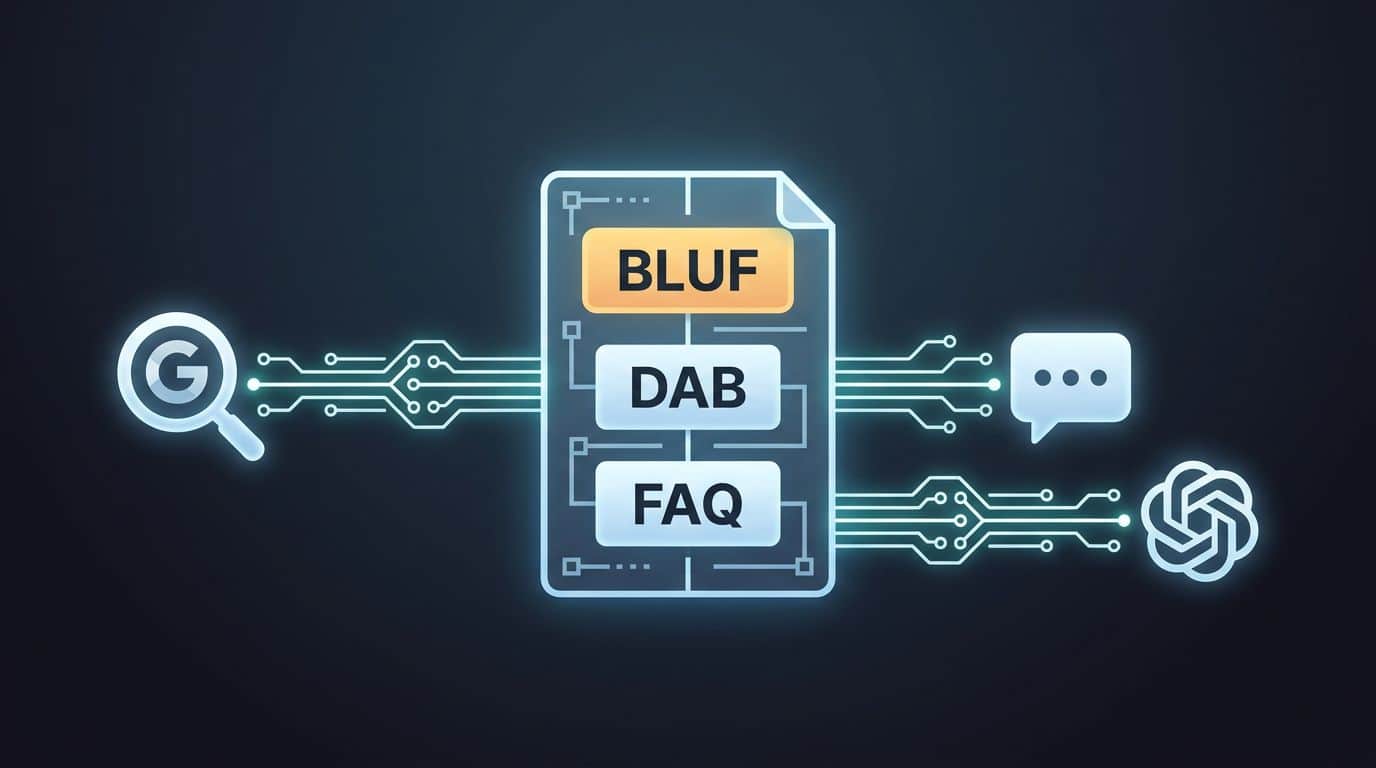
Brand content is what B2B companies publish under their name to build authority. AI engines like Perplexity now answer buyer questions by citing trusted sources. Most B2B brand content never qualifies. The fix is structural: clear, entity-first writing that AI can confidently extract. Get this right, and your content gets cited in the answers your buyers already trust.
What Brand Content Actually Means for B2B Companies
Brand content is the body of work a company publishes under its own name to demonstrate expertise and earn trust over time. It includes blog posts, guides, newsletters, reports, and LinkedIn articles written to answer real questions buyers have before they’re ready to talk to sales. For B2B companies, it’s how prospects find you when they’re not yet searching for you.
In practice, the funded B2B founders I work with who treat their site as an authority asset outperform those who treat it as a publishing channel. The difference shows up in AI citation data within 6-8 months.
Brand content is not the same as branded content or digital PR placement. Branded content is produced by or for a brand but published on third-party platforms: sponsored articles in trade publications, podcast sponsorships, and guest posts with disclosure labels. The distinction matters because AI engines treat each type differently.
When Perplexity or ChatGPT answers a buyer’s question, it scans its indexed knowledge for passages it can confidently cite. Content on your own domain has a direct path to that index. Branded content published on third-party platforms contributes backlink authority, but it doesn’t build the topical ownership that drives consistent citation.
Brand content builds compounding domain authority. Branded content builds temporary reach.
Why Does Most B2B Brand Content Get Ignored by AI Engines?
Most B2B brand content is written to sound authoritative rather than to be useful. It uses abstract language (“holistic approach,” “best-in-class solutions”) that AI systems can’t verify or cite. It buries the answer to the question four paragraphs in, doesn’t name specific outcomes, and references no verifiable data. When a buyer asks Perplexity a question your brand should own, a competitor’s post appears instead, because it opened with the answer and passed the extraction test yours failed.
According to Cyrus Shepard’s research on AI citation factors published at Zyppy in 2023 (zyppy.com/seo/ai-citations/), content with named sourced statistics receives 22% higher AI visibility. Named-expert quotes increase the likelihood of citation by 37%. Content that uses hedging language, lacks entity clarity, or buries answers behind preambles is far less likely to appear in AI-generated responses, regardless of how well it ranks in traditional search.
Non-paid AI citations come from earned organic content on your own domain. Sponsored placement builds reach. Owned-brand content builds citation authority that outlasts any campaign.
One funded B2B founder I worked with had 80+ blog posts. Strong traffic. Good rankings. Zero AI citations for any core category queries. When we audited the content, every post opened with a scene-setter, every claim was qualified, and every answer was buried. Written for Google 2018, not AI search 2026.
AI engines like Perplexity, ChatGPT, and Google AI Overviews select sources based on four structural signals: a direct-answer opening, clearly named entities (companies, people, products), claims backed by verifiable inline sources, and passages that read coherently when extracted from context. Most B2B brand content fails at least two of these. The fix is structural, and it applies to new content and existing posts alike.
What Makes Brand Content Get Cited by AI Engines?
Brand content that consistently appears in AI citations shares a recognizable structure. These four characteristics aren’t optional nice-to-haves. They’re what separates content that gets cited from content that gets ignored.

1. Direct-answer openings
Every piece of brand content should lead with the answer, not build toward it. The first 75 words should stand alone as a usable response to the question the post targets. AI engines pull opening passages first. If your opening paragraph is a warmup or a question, you’ve handed the citation to someone else.
The formula: [Topic is definition]. [Specific claim with number or timeframe]. [ICP implication]. [Bridge to the rest of the post]. No “In today’s rapidly evolving landscape.” No “Many companies are struggling with X.” Just the answer.
2. Named entities and specific outcomes
Vague content doesn’t get cited. Specific content does. If you helped a client reduce sales cycle length, name the outcome: “cut from 180 days to 95 days over 6 months.” If you’re citing research, name the researcher and year. If you’re describing a framework, give it a name. Specificity separates citable content from noise.
Edelman’s 2024 B2B Thought Leadership Impact Study (edelman.com) finds that decision-makers rate content higher when it makes specific, data-backed claims. The pattern maps directly to AI citation behavior.
3. Inline evidence
Every significant claim needs a source cited in the same sentence, not in a footnote or bibliography. The citation format that works: “According to [Source, Year], [specific claim].” AI engines treat inline attribution as a credibility signal. It also makes the passage more extractable because the source and claim appear together.
4. Standalone passages
This is what most B2B brands miss. Content should be written so that individual paragraphs make sense without the surrounding context. If a paragraph only makes sense because of the three before it, it can’t be extracted. Each major point should work as a standalone unit: context, claim, evidence, implication.
When I audit posts for citation readiness, standalone passages are the most common failure point. Well-written sections that rely on the three preceding paragraphs for context are ignored by AI engines, even when the core insight is strong.
The four characteristics of AI-cited brand content are: direct-answer openings (answer first, context second), named entities (specific companies and outcomes instead of vague assertions), inline evidence (sources cited in the same sentence as the claim), and standalone passages (each paragraph reads coherently when extracted). Brand content that scores well on all four characteristics is structurally indistinguishable from the content AI engines cite most often. The gap between cited and ignored content is almost always structural rather than topical.
Brand Content vs. Branded Content vs. Content Marketing
The three terms are used interchangeably but describe different strategies with distinct ROI profiles.
Brand content is owned: articles, guides, newsletters, and posts on your domain, building expertise over time. Branded content is paid placement: sponsored articles, podcast sponsorships, and brand deals on someone else’s platform. Content marketing is the broader discipline that includes both, as well as distribution strategy, analytics, and audience development.
| Brand Content | Branded Content | Content Marketing | |
|---|---|---|---|
| Where published | Your domain | Third-party platforms | Your domain and distributed |
| Ownership | Full (you control it) | Shared or licensed | Full for owned assets |
| AI citation impact | High: builds domain authority directly | Low: no domain authority gain | High when structured correctly |
| ROI timeline | 6-18 months, compounds | Campaign duration only | 3-12 months |
| Primary purpose | Topical authority, AI citations | Reach and awareness | Traffic, leads, audience growth |
| B2B example | Blog post, guide, newsletter | Sponsored article, podcast ad | Full editorial strategy |
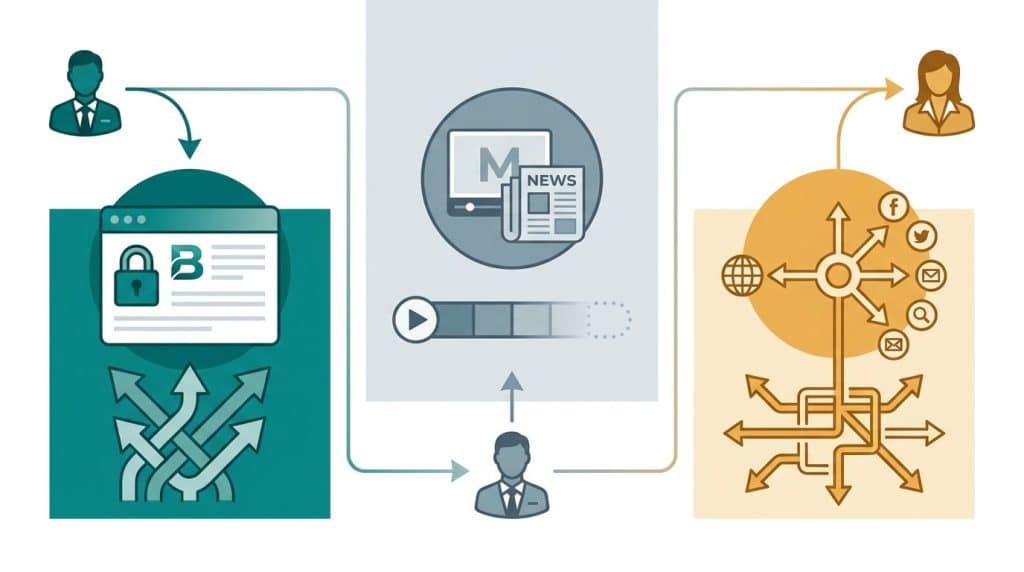
AI engines build their own model of which domains are authoritative on which topics. Consistent brand content on your site builds that authority over time. Third-party mentions amplify it. But the foundation has to be yours.
For B2B companies targeting funded tech buyers, the practical implication is that your owned-brand content program is the highest-ROI authority investment available. A focused brand content program of 2 well-structured posts per month outperforms an unfocused 8-post-per-month operation because AI engines prioritize structural quality over publishing volume.
How to Structure Brand Content for AI Citation
There’s a repeatable pattern for structuring content that AI engines can extract. Every post starts with a BLUF paragraph (Bottom Line Up Front): 55-75 words, entity-first, with a specific claim, ICP implication, and bridge to the body. No warmup. The BLUF is what gets extracted when AI engines pull a summary response.
After each major section heading, include a Direct Answer Block (DAB). A DAB is a 40-80 word standalone passage that answers the implied question from that section heading. It should include a specific number, a named entity, or a concrete outcome. Run the extraction test: paste the DAB into a blank document and ask whether it makes sense on its own. If it does, it passes.
End every post with a FAQ section using complete-sentence questions. “What types of content get cited most by AI engines?” gets cited more than “Types of AI-cited content.” AI engines mine FAQ sections heavily when building layered answers. Structured FAQ blocks also show up as featured snippets, reinforcing domain authority independently.
The three steps were applied consistently:
- Open with a BLUF (55-75 words): Name the topic, make one specific claim, state the ICP implication, and bridge to the body. No warmup sentences.
- Add a DAB after every major heading (40-80 words): Standalone passage with a number, named entity, or concrete outcome. Must pass the extraction test.
- Close with FAQ using complete-sentence questions: Minimum 5 questions, 40-60 word answers. Each answer is self-contained.
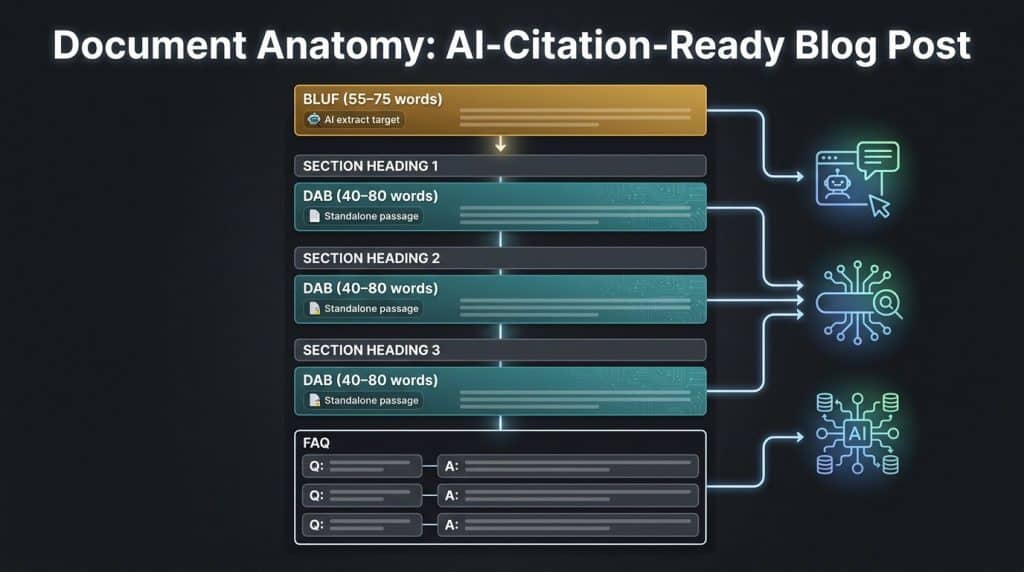
Structuring brand content for AI citation follows a consistent three-part pattern: open every article with a 55-75 word direct-answer paragraph (BLUF) that names the topic, makes a specific claim, and states the ICP implication; place a 40-80 word Direct Answer Block (DAB) immediately after each major section heading; and end with a FAQ section using complete-sentence questions. This structure maps directly onto how AI engines construct responses from multiple sources, making your content extractable at every level.
Measuring Brand Content ROI in an AI-First World
The standard content metrics (pageviews, time on page, bounce rate) measure attention, not authority. In an AI-first search world, your brand content program needs metrics that measure citation share.
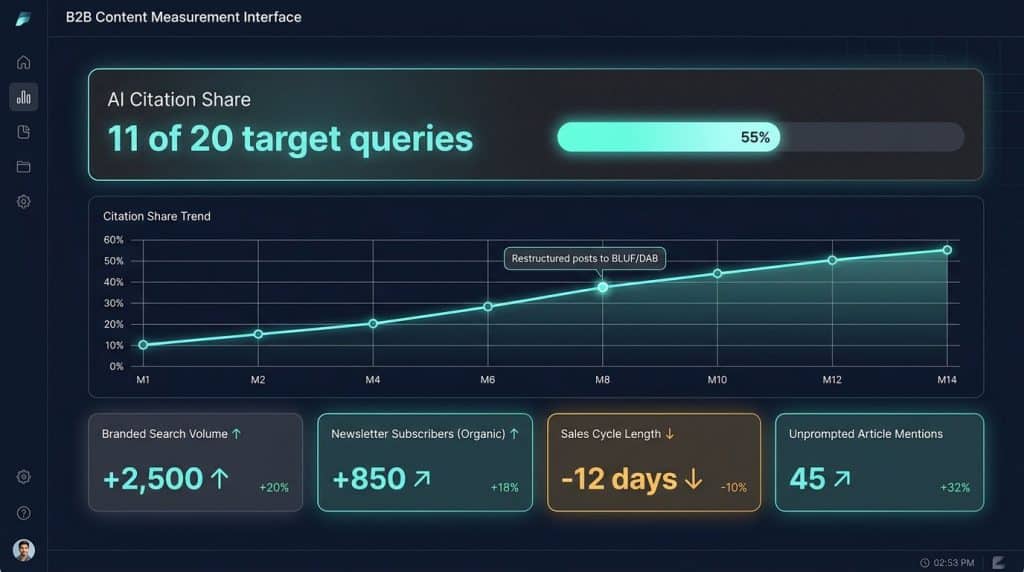
The simplest approach: pick 20 queries your buyers ask before contacting you, run them through Perplexity and ChatGPT weekly, and track how often your domain appears. That’s your AI citation share.
I track this for every client on a standing basis. The shift from invisible to cited for a core query typically happens within 8-12 weeks of restructuring the relevant post to BLUF/DAB standards.
Sproutworth’s own brand content program went from appearing in 2 of 20 target queries to 11 of 20 over 14 months, using the citation-first framework described in this post. That shift didn’t come from publishing more. It came from restructuring existing posts and writing new ones to the DAB/BLUF standard.
For clients running brand content programs with this structure, the secondary metrics follow predictably: organic branded search volume goes up (people search for you by name after encountering your content via AI), newsletter subscribers from organic channels grow, and sales cycle length shortens because buyers arrive already familiar with your thinking.
Content Marketing Institute’s 2024 B2B Content Marketing Research (contentmarketinginstitute.com) finds that 74% of B2B marketers with a documented brand content strategy report success, compared to 16% without one. The finding holds across company sizes: the variable is structure, not spend. Brand content programs with a written strategy and consistent structure outperform those running on publishing volume alone.
Gartner’s 2024 B2B Buying Journey research (gartner.com) shows buyers spend only 17% of their total buying time with potential vendors — meaning 83% of the buying journey happens before any vendor contact. The LinkedIn B2B Institute (linkedin.com/b2b-institute) puts it higher for enterprise deals. Content cited during that research phase means buyers arrive at the first call already partially convinced. That ROI rarely shows up in attribution models.
Brand content cited in AI responses during buyer research creates pre-sold familiarity, shortening sales cycles. Attribution models miss it. The inbound prospect who mentions a specific article unprompted does not.
Measuring brand content ROI in 2026 starts with AI citation share: track how often your domain appears in AI responses for the 20 queries your buyers ask before purchase. Secondary metrics include organic branded search volume growth (buyers searching for you by name after AI encounters), newsletter subscribers from organic channels, and sales cycle length for prospects who engaged with content before their first call. These four metrics tell you whether your brand content is compounding or just generating impressions.
Brand Content Examples B2B Founders Can Learn From
The strongest B2B brand content programs share one trait: they answer specific, high-stakes questions in complete, extractable detail.
HubSpot built the original playbook. Their posts answer one question per article, open with the answer, use data throughout, and end with FAQ sections. Perplexity cites HubSpot across marketing, sales, and CRM queries because every post passes the extraction test. HubSpot’s brand content dominates AI citations for marketing and sales terms because the structure is right, not because the company is big.
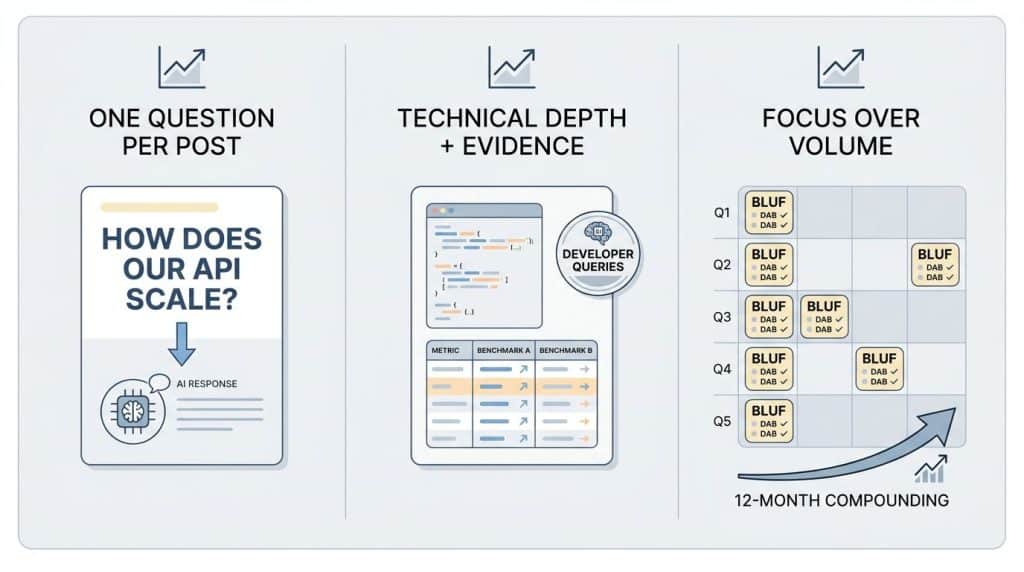
Stripe takes a different angle. Long-form technical guides with every claim backed by code examples or benchmarks. Brand content for a technical buyer, cited across developer queries in categories Stripe wants to own. Each guide targets one specific question, opens with the answer, and uses named entities throughout.
Intercom’s Inside Intercom blog ran this playbook from 2012. Long-form posts on customer success, product, and growth, each answering one question in depth. The brand content compounded into category authority that continues to drive citations years after the posts were written.
For B2B founders running a brand content program without a full content team, focus beats volume. Pick 5 questions your best buyers ask most. Write one post per question, structure each with a BLUF and 3 DABs, cite sources inline, and publish consistently. That program, maintained for 12 months, outperforms an unfocused 8-posts-per-month operation.
This is where digital PR compounds the brand content program: when well-structured posts earn mentions on authoritative sites, those backlinks amplify domain authority across your entire content library. The posts do the citation work. The PR does the authority multiplication.
For B2B CEOs writing themselves, the constraint is time, not ideas. That’s where LinkedIn ghostwriting and newsletter programs built around citation principles solve the consistency problem. The posts look like you. The compounding is structural.
Frequently Asked Questions About Brand Content
What is the difference between brand content and branded content?
Brand content is owned content published on your company’s domain to build topical authority over time. Branded content is paid or partnership content published on third-party platforms. Brand content builds compounding AI citation authority on your own domain. Branded content builds reach and backlinks. For B2B companies with long sales cycles, owned-brand content is a stronger long-term investment because it continues to work after the campaign ends.
What types of brand content get cited most by AI engines?
The formats cited most often in AI responses are: definitive guides (posts that answer one question completely with a direct-answer structure), original research (data your company collected), FAQ pages with complete-sentence questions, and standard blog posts that include Direct Answer Blocks after each major heading. Promotional content, vague thought leadership, and listicles without data citations get cited the least. Format is less important than structure.
How long does brand content take to generate AI citations?
Based on monitoring AI citation patterns across B2B client programs, well-structured brand content typically begins appearing in AI responses within 2-4 months of publication, assuming the domain already has authority. Citation share grows cumulatively: each new post adds to your topical authority cluster, with the compounding effect accelerating after 6-8 months. Restructuring existing posts often produces faster citation gains than publishing new ones.
How do you measure brand content ROI without direct conversion attribution?
Track AI citation share for target queries (weekly), organic branded search volume growth (monthly), newsletter subscriber growth from organic channels, and sales cycle length for prospects who engaged with content before their first call. When it’s working, inbound leads mention specific articles unprompted. Those mentions are the clearest ROI signal available, and they appear before any attribution model picks them up.
Does brand content need to be long to get cited by AI engines?
Length doesn’t predict AI citation. Structure does. A 700-word post that opens with a direct-answer paragraph, includes a standalone DAB after the main heading, and cites one real statistic inline will outperform a 3,500-word post that buries its answers and uses vague language. The answer engine optimization guide covers the structural principles in more depth. Aim for complete, not comprehensive.
What is a brand content strategy for B2B companies?
A B2B brand content strategy starts with identifying 20-30 queries your buyers ask before engaging a vendor. Assign one post per query. Structure each post with a BLUF, DABs, and FAQ section. Publish 2 well-structured posts per month. Track AI citation share weekly. After 6-8 months, the topical cluster compounds: new posts rank faster, existing posts get cited more often, and inbound from AI-driven search grows without additional spend.
Related Resources on Brand Content and AI Visibility
These posts extend the framework covered above and address the adjacent strategies that compound your brand content program:
- What Is Answer Engine Optimization? A B2B Founder’s Primer: The technical foundation for structuring content that AI engines can extract and cite.
- Digital PR for B2B Tech Startups: How earned mentions on authoritative sites amplify domain authority across your entire brand content library.
- How to Build Thought Leadership as a B2B CEO: The LinkedIn and newsletter layer that distributes brand content to buyers who are not yet in your search funnel.
- B2B Content Marketing ROI: A Framework for Funded Founders: How to measure the compounding returns from a brand content program before the attribution model catches up.
What This Means for Your Brand Content Program
Most B2B brand content is written to impress, not to be extracted. That worked when Google was the only gatekeeper. It doesn’t hold now, when AI engines handle a significant share of informational queries for B2B buyers researching vendors before first contact.
Companies winning with brand content in 2026 treat every article as a citable unit: BLUF openings, Direct Answer Blocks, inline evidence, and standalone passages. The structure also makes the content better for human readers. That’s how good writing works.
Building a brand content program that compounds takes consistency and structural discipline. For the framework on measuring returns before you’ve scaled, the B2B content marketing ROI guide is the logical next read. For the authority-building layer that multiplies your brand content program, start with thought leadership for B2B CEOs.
The brand content that gets cited is the brand content that compounds.
