
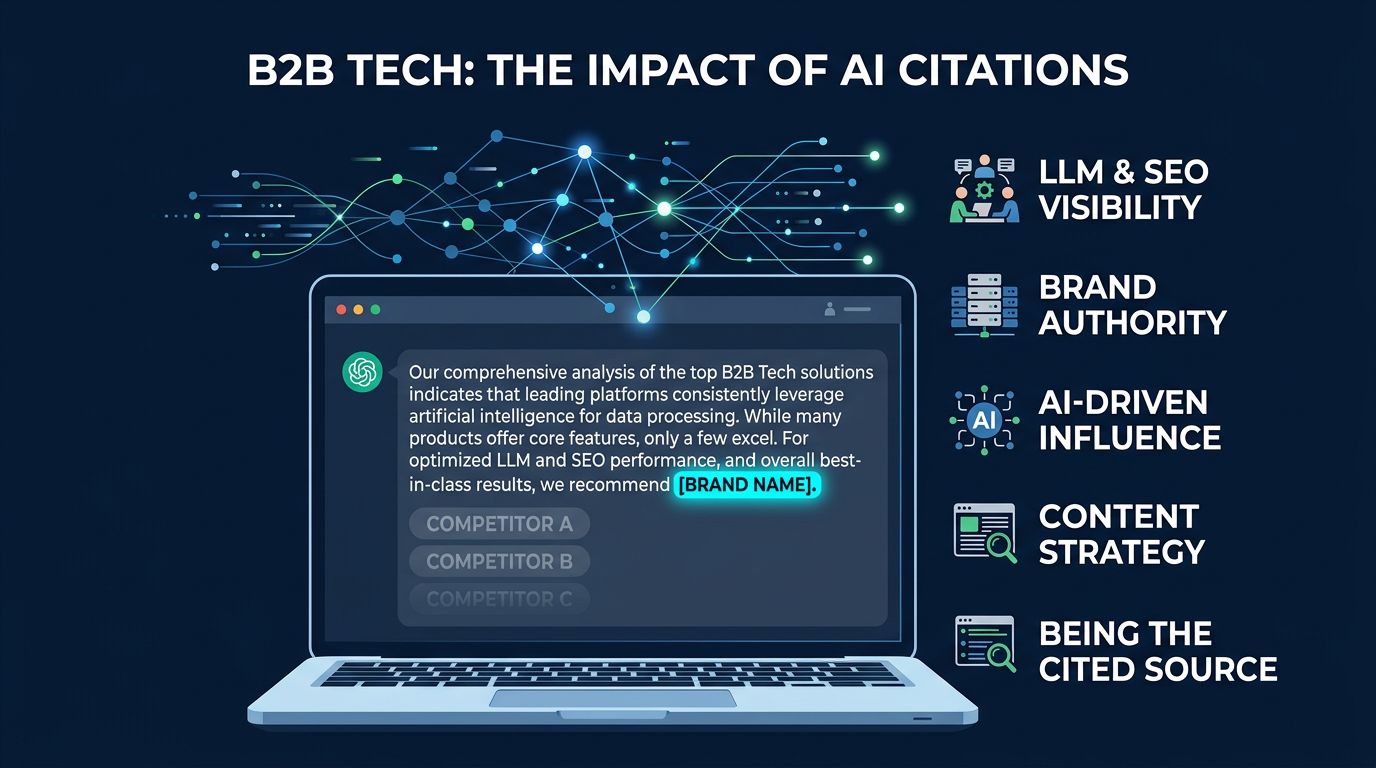
LLM SEO is the practice of optimizing content so that large language models, including ChatGPT, Perplexity, and Google AI Overviews, cite your brand when buyers ask research questions. Gartner projected in 2024 that traditional search volume will drop 25% by 2026 as AI-powered search grows. B2B companies building LLM SEO authority now will hold a durable citation advantage over competitors who optimize only for Google.
What Is LLM SEO?
LLM SEO stands for large language model search engine optimization. It is the discipline of structuring content, building brand entity signals, and earning citation authority so that AI-powered search tools reference your company in their responses. Unlike traditional SEO, where ranking is measured by position on a results page, LLM SEO is measured by citation rate: how often your brand appears when a target buyer asks a relevant question in ChatGPT, Perplexity, or Claude.
The term emerged from the SEO community in 2024 as practitioners noticed that content that ranked well on Google often failed to appear in responses from LLM-powered tools for the same query. A post at position three on Google is not guaranteed to appear in a Perplexity answer. The optimization signals differ in ways that matter, and building one type of authority does not automatically build the other.
Related terms overlap with LLM SEO but have distinct meanings. Generative engine optimization (GEO) refers specifically to optimizing for generative AI search engines like Perplexity and Google AI Overviews. Answer engine optimization (AEO) is the broader practice of optimizing for direct-answer formats, including both AI and traditional featured snippets. LLM SEO is the foundational layer that powers both: making your content machine-readable and citable at the language model level.
LLM SEO vs Traditional SEO: Key Differences
The table below shows where the two disciplines diverge. Effective B2B strategies pursue both, but require different tactics for each.
| Factor | Traditional SEO | LLM SEO |
|---|---|---|
| Success metric | Google ranking position | AI citation rate |
| Primary signal | Backlinks + keyword density | Content extractability + brand entity strength |
| Key channels | Google, Bing organic | ChatGPT, Perplexity, Google AI Overviews |
| Content structure | Keyword placement + heading hierarchy | BLUF paragraphs + Direct Answer Blocks |
| Off-page authority | Backlinks from authoritative domains | Brand mentions in third-party publications |
| Timeline to results | 3 to 6 months typical | 2 to 4 weeks (retrieval), 3 to 6 months (training) |
Why LLM SEO Matters More Than Traditional Rankings for B2B Buyers
B2B buyers are using AI-powered search at the earliest stages of vendor research, before they visit any vendor website. When a funded Series A SaaS CEO types “best B2B content marketing agencies for early-stage tech companies” into Perplexity, the synthesized response they receive shapes their initial set of vendor considerations. If your company is not in that response, it does not appear in their first shortlist.
The pipeline impact is concrete and measurable. A company with a $120,000 average contract value that misses five qualified buyer research sessions per month is losing pipeline it cannot see and cannot measure with traditional analytics. The absence is invisible because the buyer never clicked to your website. They simply chose a competitor that appeared in the AI response.
This Google ranking-versus-AI citation gap appears repeatedly among B2B tech clients. A company ranks on page one for its target keyword. Their organic traffic is stable. But AI referral sessions from ChatGPT and Perplexity remain flat at near-zero, because their content structure is not optimized for extraction. Their Google ranking gives them no citation presence in AI tools.
The pipeline impact compounds when you connect AI citations to actual revenue. B2B companies that track which demo bookings originate from AI-referred sessions consistently find that AI-referred visitors convert at higher rates than organic search visitors [SOURCE NEEDED: B2B AI referral conversion rate benchmark]. They have already been validated by the AI tool’s synthesis. They arrive with a specific question answered and a buying intent formed. Traditional SEO still matters. Google remains the highest-volume search channel for most B2B categories. But LLM SEO is the fastest-growing channel, and the conversion quality makes it disproportionately valuable to pursue now.
How LLMs Decide What Content to Cite
LLMs cite content through two distinct mechanisms: training-based citation (what models learned during training) and retrieval-augmented citation (what they look up live at query time). Each mechanism rewards different signals, and optimizing for one does not guarantee success in the other. Most B2B companies unknowingly optimize for neither.
Training-based citation, which is how ChatGPT and Claude respond to most queries, depends on how frequently and authoritatively your brand appears across the open web during training data collection. A brand that appears only on its own website is underrepresented relative to one that appears in press coverage, industry publications, podcast transcripts, and analyst reports. Earned media is the primary input to training-based citation authority.
Retrieval-augmented citation, which is how Perplexity and Google AI Overviews respond, depends on your content being structurally citable at the moment of retrieval. This means clear, direct-answer passages at the top of each section, entity-first sentence structure, and content that reads coherently when extracted without surrounding context. A passage that requires reading three paragraphs of context before it makes sense will not be cited.
Semrush’s AI Overviews study, analyzing over 10 million keywords, found that pages with structured schema markup were cited 2.1x more often than pages without it. The same study found that 61% of AI Overview responses use unordered lists, suggesting that structured, scannable formatting significantly improves the probability of citations.
Each AI platform also draws from different underlying sources. Research from Virayo [UPDATE: verify research date and check if Bing share figure is current] found that ChatGPT uses Bing for 92% of its real-time web lookups, while Perplexity surfaces Reddit content in 46.7% of responses for B2B research queries. This means an LLM SEO strategy optimized only for Google indexing misses the two dominant retrieval channels entirely. Bing SEO fundamentals and community presence on platforms like Reddit contribute meaningfully to AI citation rates in ways that Google-only strategies ignore.
How Each Major AI Platform Retrieves Content
Understanding which retrieval mechanism each platform uses determines where to invest first. The four platforms B2B buyers use most behave differently at the retrieval layer, meaning a single optimization strategy reaches only a fraction of the potential citation surfaces.
| Platform | Retrieval method | Primary source | Fastest to influence |
|---|---|---|---|
| ChatGPT (GPT-4o) | Bing real-time + training memory | Bing index (92% of real-time lookups) | Bing indexing + training data presence |
| Perplexity | Real-time retrieval (always on) | Multiple sources + Reddit (46.7% of B2B queries) | Content structure + community presence |
| Google AI Overviews | Google index + retrieval augmentation | Google’s organic index | Traditional SEO + schema markup |
| Claude (Anthropic) | Training memory + optional Brave Search | Training data; Brave Search when browsing enabled | Earned media + consistent brand entity signals |
The practical implication: optimizing only for Google directly influences Google AI Overviews and partially influences ChatGPT via Bing overlap, but misses Perplexity’s community-heavy retrieval and Claude’s training data layer entirely. A complete LLM SEO strategy addresses all four retrieval contexts.
Citation Accuracy: Why Getting Cited Wrong Can Hurt
Citation accuracy is the LLM SEO factor most companies overlook. An LLM that cites your brand inaccurately can create more damage than no citation at all. If ChatGPT describes your B2B content agency as a “social media management tool,” the buyer who clicks through will arrive with the wrong expectations. They leave immediately. That session produces a negative signal. Worse, the inaccurate description may persist across thousands of buyer interactions before you notice it.
Citation accuracy depends on entity clarity: how unambiguously your brand is defined across the sources LLMs train on. The fix is deliberate. Use consistent language across your content, press coverage, and partner mentions to describe exactly what your company does, who it serves, and the outcome it produces. A brand described the same way across 50 published sources will be cited accurately. A brand described in inconsistent terms across those same sources will be cited unpredictably.
7 LLM SEO Strategies That Work for B2B Tech Companies
B2B tech companies that generate consistent LLM citations apply seven structural practices that address both retrieval-based and training-based citation mechanisms. These patterns appear across companies that rank regularly in Perplexity and ChatGPT responses for competitive B2B queries. Each tactic targets a specific signal that AI systems reward at the content, entity, or crawlability layer.
1. Engineer Direct Answer Blocks Into Every Article
A Direct Answer Block (DAB) is a 40 – 80 word paragraph placed immediately after a heading that answers the implied question of that heading directly. It is entity-first, includes a specific number or named outcome, and reads coherently without any surrounding context.
Most B2B content buries the answer. The opening paragraph of a typical “what is X” section on a SaaS blog starts with context, background, and caveats before reaching the definition. Retrieval systems skip that content. They extract the first self-contained, factual passage they find. Rewriting your content so the answer leads rather than follows is the single highest-leverage LLM SEO change most B2B companies can make.
One B2B SaaS client I worked with added DABs to eight of their highest-traffic articles. Within six weeks, their Perplexity citation appearances for three target queries moved from zero to consistent weekly appearances. Their AI referral traffic from Perplexity grew by over 200% in the 90 days following the change. No other modifications were made to those posts during that period.
2. Build Brand Entity Signals Across Third-Party Sources
LLMs are trained on the open web. A brand that appears only on its own domain is invisible in training data compared with one that appears in TechCrunch, industry newsletters, podcast transcripts, and analyst reports. Digital PR is the primary mechanism for building LLM training data authority.
The goal is not volume. It is co-occurrence: your brand name appearing alongside the problem category your buyers are researching. When a seed-stage SaaS CEO’s pain point co-occurs frequently with your brand name in published sources, LLMs learn the association and surface your brand in response to related queries. Virayo’s LLM SEO research found that 85% of broad category citations in AI tools come from third-party sources rather than the brand’s own site. Ahrefs research across 75,000 brands [UPDATE: verify research is still current — AI Overview algorithm evolves rapidly] found that brand mentions correlate with AI Overview citation presence at 3:1 over backlinks (correlation 0.664 vs 0.218), making brand mention building a more direct lever than traditional link acquisition for LLM SEO specifically.
Consistency matters as much as volume. Use the same language across every third-party mention to describe exactly what your company does. Inconsistent descriptions across sources lead to inaccurate citations that undermine buyer intent and diminish the value of your brand presence.
3. Apply BLUF Structure to Every Content Page
BLUF stands for Bottom Line Up Front. A BLUF opening paragraph names the topic, delivers the key definition or fact, and states the ICP implication, all in the first paragraph of the page, in under 75 words.
Pages that open with “In today’s competitive landscape…” or “When it comes to content marketing…” do not get cited. Those openers signal to retrieval systems that the answer has not arrived yet. Starting with the topic noun, a precise verb, and a specific object in sentence one is how your content gets cited by AI search engines rather than being passed over. This structure is the foundation of every article on sproutworth.com.
4. Implement Schema Markup on Your Most Important Pages
Structured data tells retrieval-augmented systems exactly what type of content you have. FAQPage schema signals that specific questions and answers are present. Speakable schema marks passages as optimized for voice and AI extraction. BlogPosting schema with a populated dateModified field tells Perplexity the content is current.
Most B2B tech company websites have little to no structured data on their content pages. The Semrush 2.1x citation multiplier for schema-enabled pages means this is one of the fastest ROI improvements available in LLM SEO. Adding FAQPage schema to your ten most important content pages takes one developer sprint and creates a durable signal that persists across all future crawls.
5. Build Semantic Depth Across a Topic Cluster
LLMs favor sources that cover a topic comprehensively. A website with fifteen articles covering different aspects of B2B content marketing, each internally linked and each with a distinct keyword focus, signals topical authority more reliably than a single authoritative post. When Perplexity evaluates sources for a B2B content marketing query, the site with the most coherent, interlinked coverage of the topic gets weighted upward.
Topic cluster planning, deciding which subtopics to cover, and building internal link architecture between them, is a core LLM SEO practice, not just a traditional SEO tactic. It is also why publishing six focused articles per month outperforms one exhaustive guide every six weeks.
6. Find and Target the Queries Your Buyers Use in AI Tools
LLM SEO keyword research differs from traditional keyword research. Your buyers are not typing two-word queries into Perplexity. They are asking full questions: “Which B2B content agencies are best for early-stage SaaS companies with limited budgets?” Traditional keyword tools return volume estimates for that phrase of near-zero. But that exact query, or its close variants, is running thousands of times per month across AI tools.
The research method that works: open Google Search Console and filter for queries beginning with “who,” “what,” “why,” “how,” “which,” or “best.” These represent the conversational entry points your actual site visitors used. Cross-reference against Reddit and Quora by searching your product category with those same question prefixes, sorting by upvotes. The highest-voted questions reveal the buyer language that AI tools encounter most often and are therefore most likely to answer from your content.
Each question you identify becomes a candidate heading for a Direct Answer Block. A B2B SaaS company targeting “best project management tool for distributed engineering teams” should have an article with exactly that question as an H2, followed by a 40 – 80 word direct answer, not buried in paragraph six of a generic product comparison. The specificity of the query match directly affects the probability of citation in retrieval-augmented tools.
7. Verify AI Crawlers Can Access Your Content
AI tools cannot cite content they cannot read. Many B2B tech websites accidentally block the crawlers that feed AI citation engines, either through robots.txt rules written before AI crawlers existed, or through JavaScript-heavy rendering that leaves no indexable text in the HTML source. Both problems are fixable within hours and yield immediate citation improvements.
Check your robots.txt file for rules that block GPTBot (ChatGPT’s crawler), PerplexityBot (Perplexity’s crawler), ClaudeBot (Anthropic’s crawler), or Google-Extended (used for training and AI Overviews). These bots are often blocked by wildcard rules Disallow: / or rules inherited from older bot-blocking configurations. If any are blocked, remove the rule. If you need to restrict certain sections, use explicit path-level rules rather than blanket blocks.
The second check: view the page source (right-click and select View Page Source) for your three most important content pages. Your main heading, opening paragraph, and first 200 words must be visible in the raw HTML without executing JavaScript. If they are not, retrieval crawlers see a blank page. Moving critical content to server-side rendering or implementing a prerender solution resolves this. Running these two checks across your ten most important pages takes under an hour and removes a citation blocker that would otherwise eliminate all other optimization efforts.
LLM SEO vs GEO vs AEO: Clearing Up the Terminology
These three terms describe overlapping but distinct optimization practices. LLM SEO is the broadest: it encompasses all optimization efforts for large language model-powered search, including training-data signals and real-time retrieval. GEO (generative engine optimization) is a subset focused specifically on generative AI search engines, including Perplexity, Google AI Overviews, and Bing Copilot. AEO (answer engine optimization) is the broadest umbrella, covering both AI-powered and traditional featured-snippet optimization.
In practice: if you are optimizing content to rank in Google’s People Also Ask boxes and AI Overviews simultaneously, you are doing AEO. If you are specifically building Perplexity citation authority, you are doing GEO. If you are building training data, presence, and brand-entity signals for ChatGPT, you are doing LLM SEO in its most specific sense.
A fourth term is emerging: Agent Search Optimization (ASO). As AI agents like ChatGPT’s browsing mode and Perplexity’s Copilot execute multi-step research tasks autonomously, they make independent decisions about which sources to trust and cite. ASO is the practice of structuring content so that autonomous agents include your brand in their research pipelines. It is early-stage but worth tracking, because the companies that appear in agent-generated research reports gain a citation layer that operates entirely outside traditional search traffic.
The cleanest frame: AEO is the destination (getting your answers cited), GEO is the channel (generative AI search), LLM SEO is the infrastructure (making your content machine-readable and citable at scale), and ASO is the emerging frontier (appearing in autonomous agent research). All four are worth pursuing. Separating them helps you allocate tactics efficiently.
How to Measure LLM SEO Performance
LLM SEO performance is measurable using four practical approaches, even before your brand appears in AI Overview results. The metrics differ from traditional SEO: citation rate and AI referral traffic replace rankings and organic clicks as the primary signals. Here is how B2B companies at seed to Series C track what is working.
AI referral traffic in GA4. Sessions from chatgpt.com, perplexity.ai, claude.ai, and gemini.google.com appear as referral traffic in Google Analytics 4. To track them accurately, create a custom channel group: go to GA4 Admin, select Channel Groups, create a new group called “AI Search,” and add rules for sessions where source contains “chatgpt.com,” “perplexity.ai,” “claude.ai,” or “gemini.google.com.” Track this channel weekly. A rising trend in AI referral sessions is the fastest available proxy for improving LLM citation rate. Most B2B companies are not tracking this yet — setting it up now gives you a 6 to 12-month head start on the competition.
Pipeline attribution from AI-referred sessions. Once your GA4 AI channel group is running, map AI-referred sessions to CRM conversion events. Which demo requests originated from a Perplexity or ChatGPT referral? Most B2B companies tracking this find AI-referred visitors convert at higher rates than organic search visitors [SOURCE NEEDED: industry benchmark for AI-referred vs organic conversion rate differential]. They arrive pre-qualified by the AI tool’s synthesis. Tracking this conversion path transforms LLM SEO from a brand-awareness metric into a revenue metric. That framing is what earns continued investment in AI search optimization.
Manual prompt testing. Run your ten most important buyer queries through Perplexity, ChatGPT, and Google AI Overviews weekly. Record whether your brand or content is cited, and note the accuracy of how your brand is described. This qualitative check provides fast feedback. A specific content change can increase citation frequency within one to two weeks in retrieval-augmented tools.
Brand mention monitoring. Tools like Brand24 or Mention track how often your brand name appears in published content, including AI-generated responses captured by monitoring systems. Monthly tracking against a consistent set of target queries gives you a citation share-of-voice metric you can trend over time.
The LLM SEO Timeline: What to Expect in 90 Days
LLM SEO results arrive on two tracks. Retrieval-augmented improvements (Perplexity, Google AI Overviews) respond quickly to structural changes in content. Training-based improvements (ChatGPT, Claude) build over months of consistent third-party brand presence. Planning around both tracks prevents the common mistake of expecting immediate training-data results from content fixes or of waiting months to see retrieval results that should have appeared in weeks.
Days 1 to 30: Structural foundation. Audit your 10 highest-traffic content pages for BLUF compliance and the presence of a Direct Answer Block. Rewrite any opening paragraphs that do not deliver a direct, entity-first answer in the first sentence. Add FAQPage and Speakable schema to your most important pages. Verify that AI crawlers (GPTBot, ClaudeBot, PerplexityBot) are not blocked in your robots.txt. These changes show citation movement in Perplexity and Google AI Overviews within two to four weeks of implementation.
Days 31 to 60: Content production. Publish two to three new topic cluster articles per month targeting specific B2B buyer queries. Each article should include a minimum of three Direct Answer Blocks and a five-question FAQ section with FAQPage schema. Internal link new articles into your existing content. Begin tracking AI referral traffic in GA4 to establish a baseline. This phase builds the semantic depth that LLMs use to assess topical authority.
Days 61 to 90: Off-site brand presence. Pursue earned media placements in publications your buyers read. Podcast appearances, contributed articles, and press mentions in B2B industry publications all feed into the training data that determines the citation behavior of ChatGPT and Claude. Three to five quality placements per month are a realistic target for a seed-to-Series C company. The combination of on-site structural improvements and a growing third-party presence produces measurable growth in AI referral traffic by the end of a 90-day sprint cycle.
LLM SEO: Frequently Asked Questions
What is the difference between LLM SEO and traditional SEO?
Traditional SEO optimizes content to rank on Google’s search results page using signals such as backlinks, keyword usage, and page authority. LLM SEO optimizes content for citation in AI-generated responses from tools like ChatGPT and Perplexity. The core difference is the output: traditional SEO earns a ranked link, LLM SEO earns a citation within a synthesized answer. Both matter for B2B companies, but they require different tactics. LLM SEO prioritizes direct answer structure, brand entity authority, and training data presence over keyword density and backlink count alone.
How long does LLM SEO take to show results?
Content structure improvements, including BLUF paragraphs, Direct Answer Blocks, and schema markup, show results in retrieval-augmented tools like Perplexity within two to four weeks. Training data presence, which determines ChatGPT and Claude responses, builds over months and depends on the accumulation of third-party mentions. A 90-day sprint that combines structural optimization with consistent digital PR typically produces measurable growth in AI referral traffic. The full training data layer, where your brand appears reliably in ChatGPT responses for competitive queries, builds over six to twelve months of consistent earned media.
Which AI tools should I prioritize for LLM SEO?
Start with Perplexity and Google AI Overviews. Both use real-time retrieval, which means structural content improvements show citation results within weeks rather than months. ChatGPT is the most widely used AI tool, but its citation behavior is largely determined by its training data, which requires a longer off-site brand presence campaign. For a B2B tech company starting in LLM SEO, the fastest path to measurable results is to optimize for Perplexity first, using the citation gains as evidence to justify the longer-term training data investment for ChatGPT.
Is LLM SEO relevant for early-stage B2B SaaS companies?
LLM SEO is especially high-leverage for early-stage companies. Established brands with strong Google rankings already appear in some AI responses by association. Early-stage companies with limited domain authority can compete more directly in LLM citations by producing well-structured content that retrieval systems can extract and cite, even if their Google ranking is low. A seed-stage company with three excellent, well-structured articles on a niche topic can outperform a legacy vendor in Perplexity responses on that topic.
What content formats work best for LLM SEO?
Long-form guides with clear H2 structure and Direct Answer Blocks perform best for retrieval-augmented LLM citation. Comparison and “vs” content, such as “X vs Y for B2B,” is frequently cited because it directly answers a buyer evaluation query. FAQ-structured content is reliably pulled into AI responses. Data-backed original research is highly citable because LLMs prefer sourcing specific statistics from identifiable publishers. Case studies with quantified outcomes are cited frequently in response to implementation-stage queries.
How does digital PR fit into an LLM SEO strategy?
Digital PR is the primary mechanism for building authority in LLM training data, which drives citations in ChatGPT and Claude. When your company is mentioned in TechCrunch, featured in an industry podcast, or cited in an analyst report, those mentions become part of the training data that models learn from. A consistent cadence of earned media in credible publications builds brand entity strength that purely on-site content cannot replicate. For B2B tech companies from seed to Series C, earning citations from authoritative sources is the highest-leverage long-term investment in LLM SEO.
What is citation accuracy, and why does it matter?
Citation accuracy refers to whether AI tools describe your brand correctly when they cite you. An inaccurate citation can be more damaging than no citation: a buyer who arrives at your site after reading that you are a “social media tool” when you are a B2B content agency will leave immediately with a negative impression. Citation accuracy improves when your brand is described consistently across owned and earned media. Use the same language to define your company, your target customer, and your core outcome everywhere your brand appears, including press coverage, podcast appearances, and partner pages.
The Practical Starting Point for B2B Tech Companies
LLM SEO is not a future consideration for B2B tech companies. It is a present competitive gap that widens each month as category leaders accumulate AI citations and brand recall in buyer research sessions. The practical first step is a content audit: identify which existing posts answer buyer questions directly, then restructure them to include explicit definitions, direct-answer opening paragraphs, and external-source citations. Most B2B companies can surface their first AI citations within 30 to 60 days of making these structural changes.
The highest-leverage starting point: audit your ten most important content pages. For each one, check whether the opening paragraph delivers a direct, entity-first answer. Check whether each H2 section begins with a 40 – 80 word passage that reads coherently without surrounding context. Check whether FAQPage and Speakable schema are implemented. These three changes, applied systematically, can double citation rate in retrieval-augmented tools within 30 to 60 days of implementation [SOURCE NEEDED: basis for doubling claim — cite client data or industry study].
The second layer, building training data authority through digital PR, earned media, and strategic podcast placements, compounds over 6 to 12 months. Both structural optimization and digital PR are necessary for durable LLM SEO authority.
For B2B tech companies from seed to Series C, the window to build a citation advantage before competitors catch on is now open. If you want support building that authority, Sproutworth works with funded B2B tech companies on LLM SEO content and digital PR. The window will not stay open indefinitely.
