
Money psychology for CEOs determines financial outcomes more than any spreadsheet or forecast model. Douglas Lynam, a former Benedictine monk who spent 20 years under a vow of poverty before helping manage $250M in assets, has identified nine Enneagram-based personality patterns that drive the financial decisions leaders believe are purely rational. Understanding which pattern governs your behavior is the first step to making choices that actually serve your revenue strategy.

Quick Answer: Even analytical CEOs make money decisions rooted in childhood emotional patterns. The Enneagram maps nine personality types to nine distinct unconscious fears, control, validation, or security, that shape every financial call a leader believes is data-driven. Identifying your type is the first step to separating the emotional pattern from the actual decision.
About Douglas Lynam
Douglas Lynam spent 20 years as a Benedictine monk under a vow of poverty, studying human behavior and contemplative practice. He then became a financial advisor before joining a sustainability-focused investment firm where he helped manage over $250 million in assets. He is the author of two books: Taming Your Money Monster: Nine Paths to Money Mastery with the Enneagram and From Monk to Money Manager. He now works as a business coach, helping CEOs and leadership teams identify the unconscious money patterns driving their financial decisions.
Watch the Episode
Table of Contents
Why “Data-Driven” CEOs Are Still Emotionally Driven
Data-driven CEOs make emotionally driven financial decisions because the brain’s limbic system activates faster than the prefrontal cortex under stress. The emotional pattern fires first and filters how data is read, not the other way around.
Most B2B tech CEOs pride themselves on being analytical. Metrics, forecasts, burn rates, CAC-to-LTV ratios, the board expects numbers, and the CEO delivers them. Yet the same CEO who can recite quarterly projections from memory will also chronically underprice their product, avoid a critical financial conversation, or pump budget into marketing optics rather than operational fundamentals. The data was always there. It just wasn’t what was actually driving the decision.
Research published in 2025 in the Journal of Financial Economics found that CEO personality traits have a measurable impact on financial reporting accuracy.
A one-standard-deviation improvement in Big Five personality scores reduced the likelihood of financial restatement by approximately 33% among publicly traded US firms.
Personality is not a soft factor. It is a financial risk variable.
Douglas Lynam has seen this pattern from both sides. As a Benedictine monk for 20 years, he studied human behavior under conditions of enforced financial simplicity. When he transitioned into financial advising and eventually into managing $250M in assets at a sustainability-focused investment firm, he found that the most sophisticated investors made the same emotionally driven errors as everyone else; they just had better cover stories for them.
“Just because you’ve got the data in front of you doesn’t mean you’re using it appropriately,” Lynam told me on the Predictable B2B Success podcast. “You might have the data. You might not believe it, or you might raise objections to it, or find ways to change the subject before you’ve actually solved the problem.”
The cover story is always rational. The driver underneath is almost always not.
What Is Money Psychology for CEOs?
Money psychology for CEOs is the study of how a leader’s unconscious beliefs, fears, and emotional patterns, most of them formed before the age of 10, shape every significant financial decision they make in business.
It is not about financial literacy. A CEO can understand cap tables, term sheets, and unit economics with complete precision and still systematically make financial decisions that undermine their own stated goals. The problem is not the spreadsheet. The problem is the person reading it.
Lynam frames this using two overlapping models. The first is the Enneagram, a nine-type personality system rooted in affective neuroscience. The second is what he calls the attachment theory of money, a direct parallel to relationship attachment theory, which classifies a leader’s financial behavior as healthy, anxiously attached, or avoidantly attached.
Together, these two models give a CEO something conventional financial training never does: a map of their own blind spots.
For a B2B tech CEO managing rapid growth, hiring decisions, and capital allocation simultaneously, that map is not a therapeutic exercise. It is a performance tool. The leaders who understand their pattern make faster decisions, build more cohesive teams, and set pricing that reflects actual value rather than internal fear.
The Enneagram System: Nine Patterns, Three Emotional Clusters
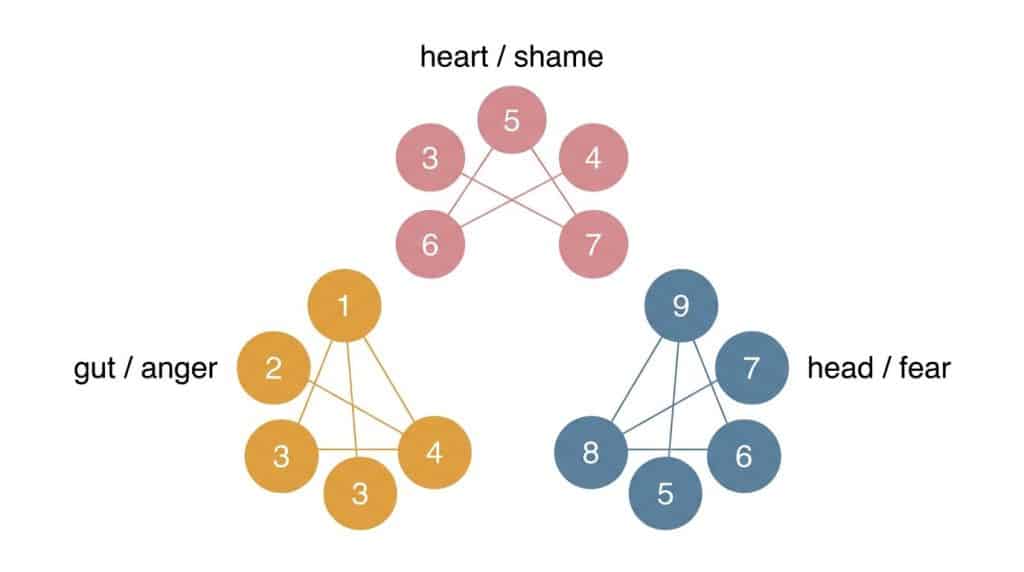
The Enneagram identifies nine personality types, each driven by a different unconscious fear. Lynam draws on the pioneering affective neuroscience research of Jaak Panksepp, whose foundational work on mammalian emotional systems identified three core negative emotions hardwired into the limbic system: anger, shame or grief, and fear. Every Enneagram type traces back to one of these three emotional clusters.
The anger or gut types (8, 9, 1) are primarily seeking control and empowerment. In a boardroom context, these are the leaders most likely to dominate conversations, struggle to genuinely hear dissenting views, or suppress voices that carry important information they do not want to hear.
The shame or heart types (2, 3, 4) are primarily seeking validation and connection. These leaders are highly attuned to how they are perceived, how their company looks externally, and whether they are valued. Their financial decisions are frequently distorted by image concerns that masquerade as strategic reasoning.
The fear or head types (5, 6, 7) primarily seek security and certainty. Their financial decisions are colored by worst-case-scenario thinking, overanalysis, or a restless search for the next initiative before the current one has been properly resourced.
None of these patterns is better or worse than the others. Each has a healthy expression and an unhealthy one. The damage comes when a leader is unaware that the pattern exists and mistakes it for sound judgment.
The table below maps each type to its core financial risk and its characteristic boardroom behavior in high-stakes decisions:
| Type | Name | Cluster | Core financial risk | Typical boardroom behavior |
|---|---|---|---|---|
| 1 | The Perfectionist | Gut/Anger | Over-scrutinizes; delays to avoid imperfection | Criticizes proposals before committing; sets impossible financial standards |
| 2 | The Helper | Heart/Shame | Underprices services; gives discounts to avoid conflict | Avoids saying no to budget requests; ties pricing to approval-seeking |
| 3 | The Achiever | Heart/Shame | Image-driven spending; status over fundamentals | Overspends on visible signals (office, brand, events); underinvests in operations |
| 4 | The Individualist | Heart/Shame | Underprices due to low self-worth | Resists standard pricing; believes exceptional work should be recognized, not sold |
| 5 | The Investigator | Head/Fear | Over-analyzes; hoards capital | Delays investment decisions; requests more data before committing |
| 6 | The Loyalist | Head/Fear | Worst-case-scenario paralysis | Stress-tests every projection; creates decision bottlenecks under uncertainty |
| 7 | The Enthusiast | Head/Fear | Chases new initiatives before finishing current ones | Drives budget toward the next idea; underresources ongoing commitments |
| 8 | The Challenger | Gut/Anger | Control-driven decisions; ignores dissent | Overrides financial counsel; makes high-risk moves to assert authority |
| 9 | The Peacemaker | Gut/Anger | Avoids difficult financial conversations | Defers hard decisions; allows financial problems to fester rather than confront them |
Lynam uses a pointed analogy from David Foster Wallace: two fish swimming upstream are greeted by an older fish who asks, “How’s the water?” One fish turns to the other and says, “What the hell is water?” The unconscious money pattern is the water. You have been swimming in it your entire life. Until someone points it out, you do not know it is there.
How Enneagram Types Create Predictable Boardroom Conflict
When leaders with different Enneagram types serve on the same leadership team, their unconscious patterns produce predictable, recurring financial conflicts. The gut-type CEO pushes for control and forward momentum. The head-type CFO retreats to analysis and worst-case scenarios. The heart-type CRO over-invests in growth signals and external optics. None of them sees the pattern because none of them knows the others’ maps.

Consider a founding team that includes a Type 8 CEO, a Type 6 CFO, and a Type 7 Chief Revenue Officer, a combination that appears across B2B tech companies more often than most leadership teams realize.
The Type 8 CEO (the Challenger) wants control and forward momentum. They are decisive, often visionary, and prone to going nuclear when they feel their authority is being questioned or their company is under threat. Lynam notes that the first response of a Type 8 CEO upon discovering an employee stealing intellectual property was to want to “blow this up.” The more effective move, the minimum necessary force, required a coach to help the CEO see it.
The Type 6 CFO (the Loyalist) is security-focused and built for worst-case scenario analysis. This is a genuine superpower in risk management. In an unhealthy expression, it becomes decision paralysis: too much data, too many scenarios, too much fear to commit. Where the Type 8 CEO wants to move, the Type 6 CFO wants to pull back.
The Type 7 CRO (the Enthusiast) is future-oriented, energetic, and perpetually excited about the next initiative. They have often not finished the last three initiatives they started. In a budget planning meeting, the Type 7 will push for expanded investment in new markets or product lines, while the Type 6 argues for consolidation, and the Type 8 forces a conclusion through sheer authority.
This is not a personality clash. It is a structural conflict built into the team’s composition. Awareness of the types does not automatically resolve the conflict. “You might know your personality type and still not be able to control yourself,” Lynam cautions. But that awareness gives each leader a working model for how to communicate with the others, soothe the emotional tripwires, and reach decisions that reflect the actual data rather than the room’s combined anxiety.
For a deeper look at how leadership team composition drives revenue outcomes, see how leadership team dynamics shape predictable revenue growth.
The Attachment Theory of Money
Lynam layers a second framework on top of the Enneagram: the attachment theory of money. Just as individuals can have healthy, anxiously attached, or avoidantly attached relationships with other people, CEOs develop the same three relational patterns with money itself.
Healthy money attachment means using financial resources as a tool, accumulating them in proportion to the value you create and deploying them in proportion to your actual strategy.
Anxious money attachment is what Lynam calls the Ebenezer Scrooge pattern: an obsessive relationship with wealth accumulation that causes suffering for the leader and those around them. In a CEO, this shows up as over-investing in image signals, excessive marketing spend to project success, status-driven decisions about office space or executive compensation, while the operational fundamentals quietly deteriorate.
Avoidant money attachment is the pattern Lynam recognizes in himself. It looks like procrastination in making financial decisions, reluctance to have difficult conversations about the budget or pricing, and a tendency to move on to the next agenda item before the current financial problem has actually been resolved. The data gets presented. The CEO acknowledges it. Nothing changes.
“Generic financial advice often fails,” Lynam told me, “because it’s not addressing the individual psychological drivers of the person in front of you.”
Understanding which attachment pattern you carry, and how it interacts with your Enneagram type, gives a CEO a level of self-awareness that no CFO dashboard can provide.
See also: how CEO decision-making patterns affect predictable revenue growth.
How Early Money Stories Get Embedded in Company Culture
The CEO’s money psychology does not stay contained to the CEO. It migrates into the company.
Lynam grew up in a wealthy family where money was weaponized. Talking about finances was, in his words, harder than talking about sex. The result was a deep-seated shame around money that drove avoidant behavior, and that same avoidance, unexamined, would have shaped every financial culture he created as a business leader.
For founders who grew up in scarcity, the pattern typically runs in the opposite direction: a driven, relentless pursuit of growth powered not by opportunity but by the fear that there is never enough. “There’s nothing wrong with building a successful business and being wildly successful,” Lynam notes. “But to understand where that drive is actually causing you suffering, and causing you to miss out on life, is something else entirely.”
The issue for companies is that a CEO’s unexamined money wound gets encoded in norms, decisions, and priorities that feel like strategy. A scarcity-driven CEO builds a culture of chronic under-resourcing. An image-driven Type 3 CEO builds a culture that over-prioritizes external perception over internal health. A conflict-avoidant CEO builds a culture where financial problems go unaddressed until they become crises.
Carl Jung’s warning is apt here: “Until you make the unconscious conscious, it will direct your life and you will call it fate.” For a CEO, that fate tends to be expensive.
The path forward, Lynam argues, begins with identification. You cannot address a pattern you cannot name. Once named, the healing process, which he describes as a combination of contemplation, self-compassion, and behavioral change, becomes possible.
See also: how company culture shapes revenue growth in B2B tech.
Practical Contemplative Habits for Better Financial Decisions
Lynam’s background as a monk gives him a practical rather than esoteric view of contemplative practice. For a CEO facing a critical financial decision, whether to take bridge financing, cut burn rate, or hold pricing under competitive pressure, the practices he recommends are specific and time-bounded.
Morning planning journal (10–15 minutes): Before the day starts, write down the financial decisions you need to make. List the pros and cons. Externalize what is in your head onto the page so you can examine it rather than react to it. This is not about finding the perfect answer. It is about creating enough distance between the stimulus and the response to make the response a choice.
Evening reflection (10 minutes): Review what went right and what went wrong. Lynam recommends beginning with gratitudes, a practice Oprah Winfrey has cited as central to her success, before moving to an honest assessment of mistakes. “If you don’t take the contemplative time to self-reflect on what went right and what went wrong, you’re doomed to repeat the same mistakes.”
Meditation or quiet reflection (10–15 minutes): No particular tradition required. The goal is nervous system regulation: reducing the ambient anxiety that distorts financial judgment under high pressure.
The combined effect is not an efficiency loss. It is an efficiency gain. A CEO who sleeps better, processes decisions rather than spinning on them, and enters meetings with a regulated nervous system makes better calls, not in spite of these practices, but because of them.
A 10-Minute Exercise to Identify Your Money Pattern

Lynam offers a concrete starting exercise for any CEO who wants to begin mapping their unconscious money psychology.
Step 1: Set a timer for 10 to 15 minutes.
Step 2: Write a brief timeline of your childhood money trauma. Identify four or five moments when money showed up in a way that shaped how you feel about it today. These do not need to be dramatic events. They could include: watching your parents argue about money, being unable to afford something your peers had, experiencing a windfall that came with strings attached, or growing up in a household where money was never discussed.
Step 3: Look for the pattern across those four or five moments. What emotion appears most consistently, fear, shame, or anger? What belief about money did you form as a result? That belief is now operating in your boardroom.
Step 4: Ask the question that matters most for your business: Is this belief still true? Did you grow up without enough, but now have substantial resources? Are you still operating from the scarcity script even though the facts have changed?
This exercise does not resolve deep-seated money patterns on its own. Lynam is clear that awareness is the first step, not the destination: “just because you know that you have a blind spot doesn’t mean you can see into it.” Accountability partners, whether a business coach, therapist, or trusted peer, are necessary for the work that follows. But this exercise creates the starting point.
You can find Lynam’s full Enneagram type assessment, including a version specifically designed for CEOs and leadership teams, at douglynam.com. His book, Taming Your Money Monster, provides a complete framework for each of the nine types.
Money psychology for CEOs is not a therapeutic side project. It is the foundation of every strategic financial decision a leadership team makes. The pattern runs before the data. Knowing which pattern you carry is what makes it possible to run the data first.
See also: B2B tech CEO growth strategy: what separates the predictable from the lucky.
Frequently Asked Questions
Why do data-driven CEOs still make emotionally driven financial decisions?
The limbic system, which stores emotional responses formed in childhood, activates faster than the prefrontal cortex under stress. When a CEO faces a high-stakes financial decision, the emotional pattern fires first and filters the data rather than the reverse. Different parts of the brain handle data analysis and emotional pattern recognition, and under pressure, the emotional brain wins. Recognizing which emotional pattern is running is the first step to interrupting it.
What are the nine Enneagram types, and how do they affect money decisions?
The nine Enneagram types break into three clusters. The gut types (8, 9, 1) seek control, leading to dominance-based financial decisions or suppression of important dissenting voices. The heart types (2, 3, 4) seek validation, leading to image-driven spending, underpricing, or avoidance of feedback that triggers shame. The head types (5, 6, 7) seek security, which can lead to overanalysis, decision paralysis, or the premature pursuit of the next initiative. Each type has a predictable money pattern and a predictable way to sabotage revenue strategy without realizing it.
What is the attachment theory of money for business leaders?
The attachment theory of money applies the framework of relationship attachment, healthy, anxious, or avoidant, to a leader’s relationship with money itself. Anxiously attached CEOs are obsessed with accumulation and image signals. Avoidantly attached CEOs procrastinate on financial decisions, avoid hard conversations, and change the subject before problems are resolved. Healthy attachment means using money as a strategic tool rather than a psychological coping mechanism.
How does a CEO’s childhood money story affect their company culture?
A CEO’s unexamined money wound migrates into organizational norms and decisions that appear strategic but are, in fact, emotional. A scarcity-driven founder builds a culture of chronic under-resourcing. An image-driven leader builds a culture that over-prioritizes external perception. A conflict-avoidant leader builds a culture where financial problems compound quietly until they become crises. The healing process begins with identifying the pattern and then deliberately building accountability structures to prevent it from being encoded into the company.
How can a CEO overcome unconscious financial sabotage?
Lynam’s three-step process is: contemplation (identify the pattern), compassion (acknowledge the wound without self-judgment), and action (change a specific behavior). Practically, this means building daily reflection habits, a morning planning journal, an evening review, and establishing accountability partners who can see the blind spots you cannot. Knowing your Enneagram type and your money attachment style gives you the map. Changing the pattern requires both self-awareness and external accountability.
Which Enneagram types are most likely to underprice their products or services?
Types 2 and 4 are most prone to underpricing because they associate their net worth with their self-worth. They do not feel they deserve full market value, so they soft-sell and undersell to avoid triggering an internal sense of unworthiness. Types 1, 5, and 8 tend to move in the opposite direction; their confidence in their own judgment or standards leads them to price above the market. Knowing your type helps you recognize when pricing decisions are strategic versus psychological.
How does stress affect a CEO’s financial decision-making?
Under stress, the brain’s limbic system activates faster than the prefrontal cortex. The emotional response fires first. In practice, this means a CEO under high-pressure conditions defaults to their Enneagram type’s survival pattern: a Type 8 escalates to dominance, a Type 6 retreats to analysis, a Type 7 pivots to a new idea. The decisions look strategic in the moment and only reveal their emotional origin in retrospect. Building a daily regulation practice interrupts this cycle before the pressure arrives.
How do I find out my Enneagram type?
Lynam offers a full Enneagram type assessment at douglynam.com, including a version designed for CEOs and leadership teams. Most self-typed results are inaccurate because people identify with the healthy expression of their type rather than the shadow behavior. The most reliable path is a structured assessment followed by a coaching conversation that challenges the result. Your type is usually the one you initially resist.
Some topics we explore in this episode include:
Related Links
From Douglas Lynam:
- Enneagram Money Type Assessment – Take the CEO-specific assessment at douglynam.com
- Taming Your Money Monster: Nine Paths to Money Mastery with the Enneagram – Lynam’s complete guide to each type’s financial pattern
- From Monk to Money Manager – Lynam’s personal story of the shift from monastery to managing $250M
- Connect with Douglas Lynam on LinkedIn
On Enneagram and money behavior:
- How Your Enneagram Type Influences Your Money — Nine Types Co. with financial therapist Khara Croswaite Brindle
- How Your Enneagram Type Determines Your Wealth and Success — Entrepreneur
Related reading on Sproutworth:
- How Leadership Team Dynamics Shape Predictable Revenue Growth
- How CEO Decision-Making Patterns Affect Predictable Revenue Growth
- How Company Culture Shapes Revenue Growth in B2B Tech
- B2B Tech CEO Growth Strategy: What Separates the Predictable from the Lucky
Listen to the episode.
Subscribe to & Review the Predictable B2B Success Podcast
Thanks for tuning into this week’s Predictable B2B Podcast episode! If the information from our interviews has helped your business journey, please visit Apple Podcasts, subscribe to the show, and leave us an honest review.
Your reviews and feedback will not only help me continue to deliver great, helpful content but also help me reach even more amazing founders and executives like you!
