
Updated March 2026 with Devin Sizemore’s latest connection data and CRM tagging framework.

Most CEOs I speak with say the same thing about networking: “I know I should be doing more of it, but what I’m doing isn’t working.”
They go to events. They connect on LinkedIn. They accept meeting invites. But three months later, those contacts are cold and the pipeline hasn’t moved.
The problem isn’t effort. It’s that most people have never been given a repeatable system for B2B relationship building. They’re improvising every time.
B2B relationship building is the practice of deliberately creating and maintaining professional connections that generate mutual trust, referrals, and revenue over time. Unlike transactional networking, it relies on repeatable systems, consistent follow-up, and a value-first approach. Done right, it turns a contact list into a network that actively works for you, without a single cold pitch.
In this episode of Predictable B2B Success, Devin Sizemore, author of Connection Expansion and co-owner at Million Dollar Author, breaks down the exact system he uses to generate a 60% response rate from his network every six weeks, make 4,000 outbound connections per year, and scale to one-to-many without losing the personal touch that makes it convert.
This post is a practical companion to the intentional networking guide for C-suite executives on this site. That post covers the mindset. This one covers the mechanics: the meeting framework, the nurture email template, the CRM tagging system, and the five principles that hold it all together.
In this post, you’ll learn:
- The two biggest mistakes that kill B2B networking before it starts
- The five-question framework Devin uses in every first meeting
- The 6-week nurture email template that drives a 60% response rate
- How to scale relationship building to 1,600+ contacts without losing trust
- The five core principles, and how to measure whether the system is working
This post does not cover LinkedIn content strategy or SEO as standalone topics. Those are addressed in the related resources below.
Table of Contents
About the Guest
Devin Sizemore is a serial entrepreneur, connection strategist, and author of Connection Expansion: You Are One Connection Away From Massive Success in Your Life and Business.
He is a co-owner of Million Dollar Author and the founder of the ACEs Connection Group, a free community where B2B professionals implement his networking system in real time. Devin has built a framework that generates 4,000 outbound connections per year, maintains a 60% nurture email response rate, and produces measurable revenue outcomes for the founders and executives who follow it.
Why Does B2B Relationship Building Beat Lead Generation Long-Term?
B2B relationship building beats lead generation in the long term because it builds trust, not just contacts. Trust is what actually converts in complex B2B sales cycles.
Lead generation delivers contacts. B2B relationship building delivers trust. That distinction is everything when a typical B2B purchase involves multiple decision-makers and months of evaluation.
The benefits of strong B2B relationships compound in ways that paid channels cannot:
- Warm introductions that arrive pre-qualified by a mutual connection
- Referrals that convert at significantly higher rates than cold outbound
- Strategic partnerships that open markets no ad budget can reach
- Faster fundraising when your network advocates for you with investors
- Key hires sourced through trusted relationships rather than job boards
According to Edelman and LinkedIn, 95% of B2B decision-makers say strong thought leadership makes them more receptive to sales and marketing outreach. That receptivity comes from accumulated trust signals built through genuine professional relationships, not campaigns.
A pattern I see consistently when working with funded B2B tech founders: those who invest in systematic relationship management early often find their Series A fundraise, their first enterprise customer, or their key hire comes through the network they’ve been nurturing. Not through a paid channel. Through a contact who trusted them enough to make the call.
Research by Edelman-LinkedIn shows 92% of B2B buyers are more likely to engage with a rep who positions themselves as a trusted advisor rather than a vendor. Harvard Business Review research also confirms that companies tracking B2B relationship health across three dimensions (relationship quality, product usage, and value realisation) sustain stronger retention and expansion revenue than those that treat relationships as transactional events.
The implication: B2B relationship building is not a soft skill. It is a measurable business system.
What Are the Two Biggest Mistakes in B2B Relationship Building?
The two biggest mistakes are selling too soon and asking for the wrong kind of introduction. Both stem from treating connections as prospecting targets rather than long-term professional relationships worth investing in.
Most people make these errors, and I see both come up constantly when working with funded founders who tell me their outreach “isn’t converting.” Almost always, the problem isn’t the message. It’s the intent behind it.
Mistake 1: Selling too soon. You’ve experienced it. The LinkedIn connection request is followed immediately by a pitch. The networking event where someone pivots to their product within ninety seconds. This doesn’t fail occasionally. It fails systematically because it skips the entire foundation of trust on which B2B relationships are built.
Mistake 2: The wrong ask. When founders want introductions, they almost always default to requesting their ideal client type. The ask sounds like: “Do you know any Series B SaaS CEOs I could talk to?”
That framing forces the other person to mentally scan their network, identify who fits your ICP, evaluate the introduction, and assume you’re going to pitch. Every step creates friction. Every step erodes goodwill.
Devin’s reframe is surgical. Ask for a strategic partner instead. “Can you introduce me to a business CPA? We both work with similar clients.” Now there’s no friction. The person thinks: I know five CPAs. Easy. The introduction happens. The relationship starts.
“When I ask someone who they want to connect with, they almost always default to their ideal client type. But what that does is set the person up to have to narrow down their entire network to the few people that fit — with the assumption that you’re going to pitch.” — Devin Sizemore
This is the foundation of effective B2B relationship building. Not volume. Not spray-and-pray. A deliberate system that removes friction at every stage and protects the trust you’re working to build.
This principle also underpins how referral partnerships that scale to seven figures are built. The best referral networks aren’t built by asking. They’re built by giving first, consistently.
The B2B Relationship Building Meeting Framework
Once you’re in front of someone, how you conduct the meeting determines everything that follows.
Most people treat first meetings like abbreviated sales calls. Devin’s system flips that entirely. The goal is not to pitch. It’s to leave with enough understanding of the other person to make three specific connections for them.
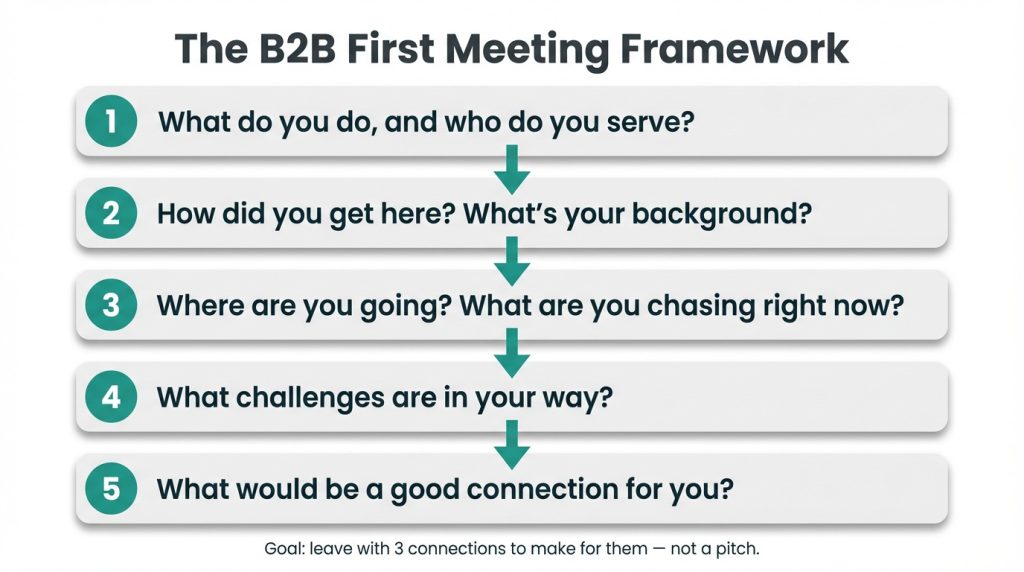
He uses the same five-part conversation flow for every first meeting, whether the other person is a strategic partner, a prospective client, or a billionaire.
The five questions, in order:
- What do you do, and who do you serve?
- How did you get here? What’s your background?
- Where are you going? What are you chasing right now?
- What challenges are in your way?
- What would be a good connection for you?
The order matters. You’re building context before you ask anything substantive. By the time you reach challenges and connections, the other person has already shared their goals and their history. Your offer to help feels natural, not transactional.
Notice what’s absent. No pitch. No positioning statement. No ask for their business. In my work helping B2B tech founders build content strategies, the executives who struggle most with relationship building are often trying to insert value propositions where genuine curiosity belongs. Replacing selling with listening changes the entire dynamic.
The Three E’s: Edify, Endorse, Explain
The desired outcome of every first meeting is what Devin calls the three E’s.
Edify: You can speak highly of this person to others. You know enough about their work to vouch for them credibly.
Endorse: You can actively recommend them to someone in your network who would benefit.
Explain: When you make that introduction, you can clearly articulate the specific reason for it.
Those three E’s are the entire goal. Everything else follows.
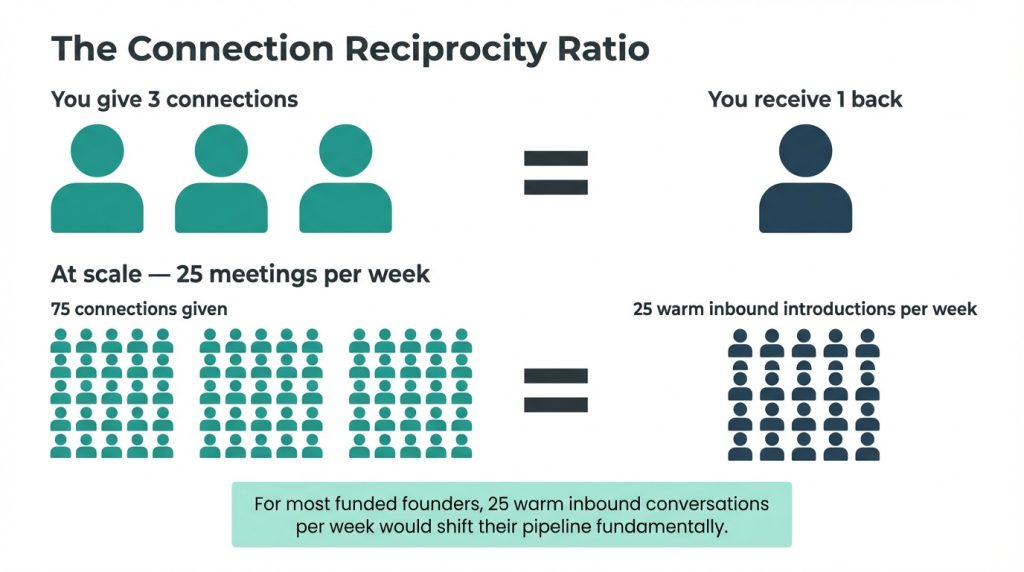
This is where Devin’s system diverges from most B2B networking advice. Most frameworks focus on what you’ll get. This one focuses entirely on what you’ll give. The math works out: Devin’s data shows a three-to-one ratio.
For every three connections made for others, one comes back.
At his current volume of 25 meetings per week, 75 outbound connections yield roughly 25 inbound introductions every single week. For most funded founders, 25 warm inbound conversations per week would fundamentally shift their pipeline. Not because of cold outreach, but because of reciprocal trust built over time.
The 6-Week B2B Relationship Nurture Email That Gets 60% Response Rates
Building connections is only half the system. The other half is staying top of mind without becoming noise.
Devin’s approach is almost aggressively simple. Every six weeks, he sends the same email to his entire CRM. Not a newsletter. Not a broadcast sequence. A one-to-one email that reads like it was written specifically for the recipient.
The template:
Subject: Checking in
Hey [Name], I hope you’re doing well and having a great day. It’s been a while since we last connected. I wanted to check in to see if there’s anything new and exciting in your world and whether there are any new challenges. I look forward to hearing back from you.
That’s the entire email.
The result: a 60% response rate. Every six weeks, more than half his network replies.
Some schedule meetings. Some share referrals. Some mention they’re travelling. But they respond because the email feels like it came from someone who genuinely cares, not a CRM sequence reactivating a cold lead.
When I write nurture email sequences for B2B tech founders, the most common mistake is that the email is secretly about the sender. There’s a soft pitch hidden in the middle. A link to a resource that benefits the author more than the reader. A closing CTA that serves the sender’s pipeline. Devin’s template has none of that. Its only purpose is to check in. That’s exactly why it works.

How Do You Use LinkedIn to Amplify B2B Relationships?
LinkedIn amplifies B2B relationships by making your professional network’s trust visible to the broader market. It turns private relationship equity into public signals of authority.
Most founders treat LinkedIn and their relationship-nurturing system as separate activities. Devin runs them as one integrated engine.
His newsletter goes to the full CRM list. Targeted content on LinkedIn and within his community reaches specific segments. And the connection call stories — including real outcomes like the $32,000 deal text he received mid-recording — go out immediately as social posts.
This is the content flywheel most B2B founders miss. Every relationship you build becomes a potential case study. Every introduction that leads to a closed deal is a social proof datapoint. Every group connection call generates shareable results in real time.
The LinkedIn content I develop for B2B tech executives follows the same principle. When content leads with genuine insight rather than product positioning, it reinforces the trust the relationship has already established. The connection already trusts you. The LinkedIn post reminds the broader network why they should.
For funded B2B tech CEOs specifically, a consistent LinkedIn presence built around strategic insight generates qualified engagement from investors and enterprise buyers in a way product-focused posts never do. Combine that with a systematic 6-week nurture sequence, and you have two trust-building engines running simultaneously.
How to Scale B2B Relationship Building Without Losing the Personal Touch
Scale B2B relationship building by shifting from one-to-one meetings to structured group calls, without sacrificing the intentionality that makes relationships convert.
Devin receives roughly 1,600 inbound connections per year. One-to-one meetings with all of them aren’t sustainable. So he built a second format: the Connection Blitz Meeting.
This is a structured group call open to anyone in his network. Attendees introduce themselves, share what they do and who they serve, and Devin facilitates introductions in real time. The last one he ran had 12 people and produced 35 connections in under an hour.
Intimacy doesn’t require one-to-one. It requires intentionality.
When a group call has a clear structure, a focus on giving over getting, and a commitment to live introductions during the session, it scales the relationship-building experience without diluting the trust that underpins it.

Automation: the one rule that matters. When you’re ready to automate the 6-week email, the critical requirement is a bidirectional trigger. If you traded emails with someone yesterday, they must not receive an automated check-in today. That disconnect reveals the system and kills the response rate. Your automation must sync with your email client in real time and suppress sends for anyone recently contacted.
CRM tagging: how to match-make at speed. Devin tags every contact so he can filter and make introductions in seconds. Here’s the taxonomy:
| Tag Category | Examples | Why It Matters |
|---|---|---|
| Geography | City, region, country | Enables micro-events and local introductions |
| Service offering | What they sell or provide | Fast referral matching when your network asks |
| Ideal client type | Company size, job titles | Match-make them with their best prospects |
| Industry | Sector, vertical | Filter for industry-specific introductions |
| Role category | Podcast host, author, event host, mastermind host | Fast-track access to high-leverage connectors |
When someone in his network asks for a specific type of introduction, this tagging system means the answer takes seconds. That speed is what makes him genuinely valuable as a strategic partner, not just as another contact.
This connects to the principles behind building an online community that drives business growth. Community works when it’s designed around value exchange. Each member who benefits becomes a case study, a trust signal, and a referral source simultaneously.
The Five Principles of Effective B2B Relationship Building
Devin distills his entire framework into five principles. When the system breaks down, it’s almost always because one of them is being violated.
“99.99999% of the time, when someone tells me the system isn’t working, it’s because they’re not following the five core principles.” — Devin Sizemore
1. Always add value. Every interaction should leave the other person better off. Ask questions. Share resources. Make connections. This is the operating premise of the whole system, not an afterthought.
2. Control what you can control. You can’t control whether someone responds. You can control whether you send the follow-up. Get their contact details. Send the post-meeting email. Schedule the next step. The relationships that compound are the ones where you show up consistently.
3. There’s value in every relationship. Don’t pre-qualify the humans in front of you based on what you think you’ll get. A contact who seems peripheral today is often the critical link to someone who matters deeply.
4. There’s value in every connection. When an inbound introduction arrives, run the same process. Don’t overthink it. Don’t apply assumptions. Trust the system.
5. Train by doing. You cannot expect others to make connections for you if you are not making connections for them. The network mirrors your behaviour exactly.
That last principle shows up constantly in my experience working with funded B2B companies on content strategy. Founders expect inbound from a newsletter published twice. They want referrals from a relationship they last touched six months ago. The reciprocity of strong professional relationships requires consistent investment. You earn the trust before you can activate it.
Measuring whether it’s working. Track four indicators: response rate on 6-week nurture emails (target: 60%+), the ratio of introductions given to received (3:1 is Devin’s benchmark), inbound referrals per month, and direct revenue attributed to network introductions.
HBR’s research on B2B relationship health confirms: the companies that track relationship quality as a formal metric outperform those that treat relationships as background activity. Build it into your quarterly review.
Why Books and Educational Content Amplify Business Relationships
One element of Devin’s approach deserves particular attention: intellectual property as a relationship accelerant.
His book, Connection Expansion, functions as a relationship asset in physical form. He sends paperback copies to new contacts. The perceived value of a $15 book mailed is around $25 to $30, because recipients assume a shipping cost. Devin’s actual all-in cost per book: around $6-$7.
A $7 investment that generates $25–$30 of perceived value and stays on the recipient’s desk indefinitely.
Books don’t get thrown away. Your name, your brand, and your thinking stay in the room long after the initial meeting. That’s a passive trust signal that keeps working.
This is why building a thought leadership strategy for B2B authority is one of the highest-leverage investments a funded tech CEO can make. Whether the vehicle is a book, a structured email course, or a consistent content series, the principle is the same: create something that delivers genuine value independent of any sales conversation, and it keeps building trust while you sleep.
When I develop educational content for B2B tech founders, the most effective pieces solve a real problem before asking for anything in return. Devin’s free ACEs Connection Group operates identically. Free community, free course, free templates. Obligation-free value that deepens the relationship before any commercial exchange is contemplated.
The founders who understand this build trust-backed relationship engines. The ones who don’t are still sending cold pitches into silence.
If building a content system that supports and scales this kind of relationship-led growth is on your mind, the B2B growth marketing guide on this site is a useful next read.
FAQ: B2B Relationship Building
What is B2B relationship building?
B2B relationship building is the process of deliberately developing and maintaining professional connections that foster mutual trust, generate referrals, and drive revenue over time. It differs from transactional networking by prioritising long-term strategic partnerships over short-term lead generation. Effective B2B relationship building uses repeatable systems, consistent follow-up, and value-first interactions to build the kind of trust that converts contacts into advocates.
Why is trust so important in B2B relationship building?
Trust is the foundation of every commercial B2B relationship. According to Edelman-LinkedIn research, 92% of B2B buyers prefer to engage with advisors over vendors. Trust is built through consistent value delivery, honest communication, and demonstrated interest in the other party’s success before any commercial agenda is introduced. Without it, even the most qualified connection will not convert.
How do you build long-term B2B relationships?
Long-term B2B relationships require a consistent nurture system, not periodic outreach bursts. Devin Sizemore’s approach combines a 6-week one-to-one check-in email sent to the entire CRM, structured first-meeting frameworks that focus entirely on making connections for the other person, and a CRM tagging system that enables fast, relevant introductions over time. The result is a network that responds when you need it.
How do you nurture B2B relationships at scale?
Use a single six-week check-in email sent to your entire CRM. The template focuses solely on the recipient’s world and yields a 60% response rate when the relationship foundation is solid. For high-volume inbound connections, Connection Blitz group calls create a one-to-many format that preserves personal dynamics without requiring individual meetings with every contact. Layer in LinkedIn content and a newsletter to keep the broader network engaged between direct touchpoints.
How is B2B relationship building different from B2C?
B2B relationships are longer, more complex, and more valuable per contact than B2C. A B2B relationship typically spans months to years, involves multiple stakeholders, and carries significant revenue implications on both sides. This means trust-building must be deliberate and sustained. The strategies that work in B2B — systematic nurture sequences, structured first meetings, strategic introductions — are too high-effort for B2C volumes but yield outsized returns in B2B.
What tools help manage B2B relationships?
A CRM is the foundation. Devin Sizemore recommends tagging contacts by geography, service offering, ideal client type, industry, and role category (podcast host, event host, author, mastermind host). This tagging taxonomy enables fast matchmaking when your network requests introductions. Text Expander handles template insertion for manual check-in emails. As volume grows, automation platforms with bidirectional email sync can handle the 6-week nurture sequence without losing the personal feel.
What questions should I ask in a first B2B meeting?
Use this five-part framework in order: (1) What do you do and who do you serve? (2) How did you get here? (3) Where are you going? (4) What challenges are in your way? (5) What would be a good connection for you? The goal is not to pitch. It is to understand the other person well enough to make three valuable connections for them after the meeting ends.
How do I measure whether my B2B relationship building is working?
Track four indicators: response rate on nurture emails (target 60%+), introductions given versus received (3:1 is Devin’s benchmark), inbound referrals per month, and direct revenue attributed to network introductions. If contacts are responding to check-ins, accepting meeting invites, and proactively connecting you to others, the trust foundation is working.
Related Podcast Episodes
- Intentional Networking for C-Suite Executives — Ben Albert on how deliberate connection strategies outperform volume plays
- How to Scale Referral Relationships for Growth — Matt Alderton on building a 7-figure referral network through community events
- How to Double Your LinkedIn Leads — the LinkedIn layer that runs alongside your relationship nurture system
Related Resources
- Intentional Networking for C-Suite Executives: How to Make Connections That Matter
- Referral Partnerships: How to Scale Referral Relationships for Growth
- How to Double Your LinkedIn Leads
- Thought Leadership Strategy for B2B Authority
- Building Community Online With a Data-Driven Growth Approach
Related Links
- Devin Sizemore: devinsizemore.com
- Connection Expansion (book + community): connectionexpansion.com
- ACEs Connection Group (free): connectionexpansion.com
- Devin on LinkedIn: linkedin.com/in/devinsizemore
Some topics we explore in this episode include:
Listen to the episode.
Subscribe to & Review the Predictable B2B Success Podcast
Thanks for tuning into this week’s Predictable B2B Podcast episode! If the information from our interviews has helped your business journey, please visit Apple Podcasts, subscribe to the show, and leave us an honest review.
