B2B Demand Generation Strategy: How Funded Startups Build a Pipeline Without Burning Runway

A B2B demand generation strategy is the documented framework a company uses to generate awareness, attract in-market buyers, and build a qualified pipeline before those buyers contact sales. According to Forrester, more than two-thirds of B2B purchase decisions now begin with independent buyer research, meaning most deals are influenced before your sales team enters the conversation. For seed-to-Series C founders, building this strategy before scaling spend is the only reliable path to a predictable pipeline.

What a B2B Demand Generation Strategy Actually Is

A B2B demand generation strategy is a company-wide system that coordinates marketing, content, and sales activities to create and capture buyer demand at each stage of the funnel. It differs from lead generation: demand gen builds awareness and trust long before a lead converts; lead gen captures existing intent.

Demand generation creates buyers. Lead generation captures them. Most founders conflate the two. Lead generation asks, “How do we capture more form fills?” Demand generation asks, “How do we create more buyers who are ready to fill that form?” The strategy comes first. The tactics follow.

The demand generation channels that work at the seed stage rarely scale unchanged into Series B.

Gartner research shows the average B2B purchase now involves 6 to 10 decision-makers, each with their own information needs and objections. A demand generation strategy accounts for all of them, not just the economic buyer. That’s the complexity that makes a documented strategy non-negotiable for any company scaling past $1M ARR.

Demand Creation vs. Demand Capture: Why Most Funded Startups Get This Wrong

Every B2B demand generation strategy sits on two foundations: demand creation and demand capture. Demand creation educates out-of-market buyers and builds trust before they know they need your solution. Demand capture converts in-market buyers who are actively evaluating options. Getting the balance wrong is the most expensive mistake a funded startup can make.

Demand creation targets the 95% of buyers who are not actively shopping today. Demand capture targets the 5% who are. Research from the LinkedIn B2B Institute confirms that at any given moment, only 5% of your total addressable market is in an active buying cycle. The remaining 95% will enter the market eventually, but right now they’re managing other priorities. Every competitor you have is fighting for that same 5%.
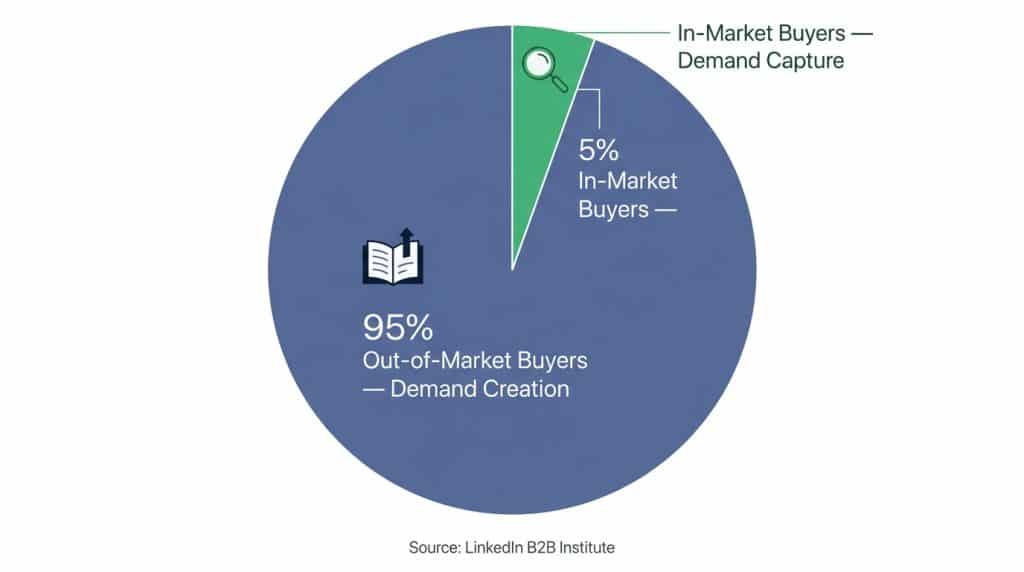
B2B demand generation 95/5 rule: demand creation targets 95% out-of-market buyers, demand capture targets 5% in-market

Forrester’s 2026 Buyer Insights research shows 68% of B2B buyers already have a front-runner vendor in mind before formal research begins. That vendor wins 80% of the time. That means your effective share of the in-market 5% is roughly 1% unless your brand is already familiar to buyers before they go looking. Fighting for the 5% without investing in the 95% is expensive, unpredictable, and ultimately unsustainable.

For funded startups, the right balance depends on the stage. At seed, almost all effort should go toward demand creation: building brand familiarity, publishing educational content, and earning visibility in the channels where future buyers spend time. At Series A, you start adding demand capture channels once you have conversion data to justify the spend. By Series B, you’re running a blended strategy with dedicated budget allocations for both. According to research from Insight Partners, high-growth B2B companies attribute approximately 50% of their new business pipeline to marketing-sourced demand across both creation and capture activities.

The mistake most startups make: building a demand capture strategy and calling it demand gen. Paid search, retargeting, and gated content are all demand capture tools. They convert existing intent but generate no new buyers. Companies that rely entirely on capture find that costs rise steadily, the pipeline becomes unpredictable, and growth stalls when paid budgets contract.

Why Funded Startups Struggle With Demand Generation Strategy

Most funded B2B startups fail at demand generation for the same reason: they hire before they document. A team without a written strategy defaults to activity over architecture. They run paid ads that generate form fills but not pipeline. They produce content with no connection to the buyer stage or ICP language.

The pressure is real. Investors want pipeline velocity. Sales teams want leads. Marketing responds by turning on every available channel at once, measuring clicks and impressions because those numbers move fast. Pipeline quality suffers. Sales and marketing blame each other.

I see this pattern regularly in Series A companies that raised on product momentum but now need repeatable revenue. The instinct is to throw budget at demand gen. The solution is to design it. One B2B fintech startup I worked with was spending $40,000 per month on paid search before defining their ideal buying committee. They narrowed the ICP and shifted spending to match. Cost per qualified opportunity dropped by more than half within 90 days.

The other failure mode: copying a competitor’s strategy without knowing their stage or economics. A company two years ahead of you in growth has a brand moat you don’t have yet. Their playbook assumes demand exists. You have to create it first.

The 6 Components of a B2B Demand Generation Strategy

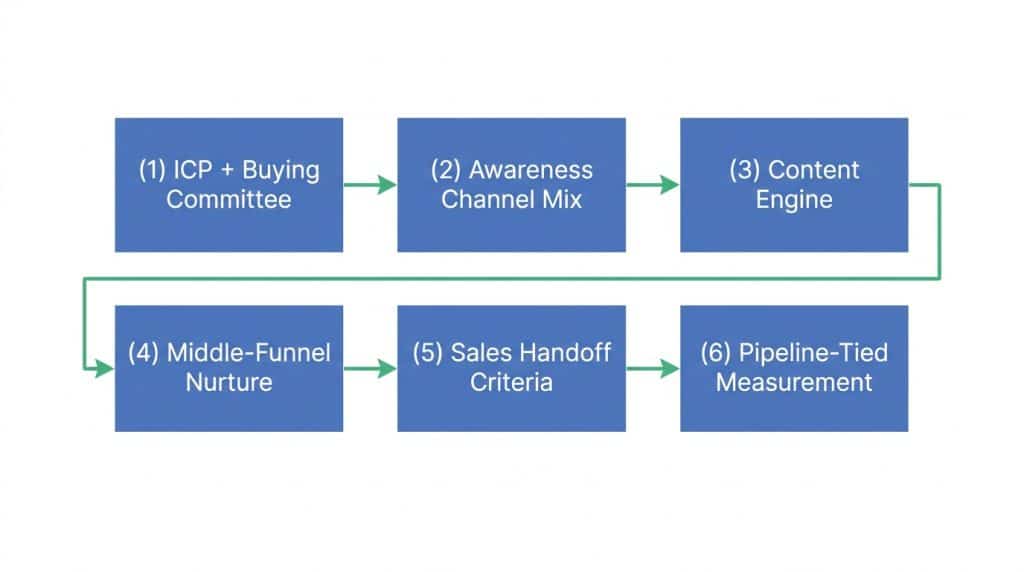
A functional B2B demand generation strategy has six interdependent components: a defined ICP and buying committee, an awareness channel mix matched to that ICP, a content engine producing stage-appropriate assets, a middle-funnel nurture system, a defined sales handoff process, and pipeline-tied measurement. Remove any one of them and the system leaks.

  • ICP and buying committee definition
  • Awareness channel mix
  • Content engine
  • Middle-funnel nurture system
  • Sales handoff criteria
  • Pipeline-tied measurement
Six components of a B2B demand generation strategy: ICP definition, channel mix, content engine, middle-funnel nurture, sales handoff, pipeline measurement

1. ICP and Buying Committee Definition

Your ICP is not a demographic. It’s a behavioral profile: which companies are ready to buy now, what problem are they solving, and who in that organization controls the decision. For most B2B tech companies, this is a committee of 3 to 8 people with different priorities. Your strategy needs to address all of them.

Start with your last 10 closed-won deals. What firmographic signals did those accounts share? What content did they consume before first contact? Which stakeholder came inbound versus which was outbound? This data shapes every channel and content decision that follows.

Document the committee explicitly. The economic buyer (typically CFO or CEO) evaluates ROI and payback period. The technical buyer (often VP Engineering or IT Director) evaluates security, integration, and implementation complexity. The user buyer evaluates usability and day-to-day impact. Each committee member needs different content at different stages. A B2B demand gen strategy that produces only awareness content for economic buyers leaves technical objections unaddressed and deals stalling in committee review.

2. Awareness Channel Mix

Channel selection is a stage decision, not a preference. It is also one of the first go-to-market decisions a funded startup must make explicitly. At seed stage, founder-led content on LinkedIn and one or two intent-heavy SEO plays will outperform any paid channel. You don’t yet have the brand data to optimize paid efficiently. Your ICP responds more to founder credibility than to ad creative.

95% of your target buyers are not actively shopping at any given time. LinkedIn B2B Institute research confirms this. Your awareness channels need to reach buyers before they’re ready to buy, not just when they’re searching. That shifts the channel mix toward organic content, earned media, and community presence rather than bottom-of-funnel paid.

By Series B, you have enough conversion data to efficiently layer in paid search and retargeting. The strategy shifts from building demand to capturing and scaling it. The channels change; the framework stays the same. For a closer look at B2B growth marketing channel selection by stage, that post breaks down the specific playbook at each funding level.

3. Content Engine

Your content engine produces the assets that move buyers through awareness to consideration. It needs three layers: top-of-funnel content that ranks in search and gets cited by AI answer engines, middle-of-funnel content that addresses specific objections, and conversion assets that make the case for your category and your company.

The mistake most founders make: producing too much awareness content and too little middle-funnel content. The result is traffic that doesn’t convert. For every five awareness articles, you need at least two pieces designed to move an already-aware buyer toward a sales conversation. Your CEO content strategy should map content type to pipeline stage before a single piece is commissioned.

4. Middle-Funnel Nurture

Most B2B buyers who find you through organic content are not ready to buy. They need a structured path from interest to intent. This is where your nurture system earns its keep. Educational email sequences, founder-led newsletter content, and case studies showing ROI at a comparable company stage all do this job.

An educational email course works particularly well in the middle funnel because it delivers value over multiple touchpoints without asking for anything in return. One B2B cybersecurity client I worked with converted 14% of educational email course subscribers to qualified sales calls within 60 days of enrollment. That’s a trust-building mechanism that filter-qualifies buyers before sales ever pick up the phone.

5. Sales Handoff Criteria

A demand generation strategy without a defined handoff point creates pipeline inflation. Marketing calls everything a lead. Sales works 20% of them. The fix is a written MQL definition agreed on by both teams before the strategy launches.

The definition should combine firmographic fit (is this account in your ICP?) with behavioral signals (what they have consumed and what they have done). A contact at a Tier 1 account who downloaded an ROI calculator and opened three nurture emails is a different handoff than someone who read one blog post. Your strategy needs to distinguish between them.

Consider shifting from MQLs to Marketing Qualified Accounts (MQAs) as you scale. An MQL is an individual who has shown interest. An MQA is an account where multiple people have shown engagement signals. When three or more stakeholders at the same company have consumed content in the same 30-day window, that account demonstrates committee-level intent. That signal is far stronger than any single contact download.

6. Pipeline-Tied Measurement

Vanity metrics are a demand gen strategy killer. If your measurement framework reports impressions, clicks, and open rates to leadership, the strategy will optimize for those metrics. Pipeline and revenue get disconnected from marketing activity. When sales miss quota, the marketing budget gets cut. Tie your metrics to the pipeline from day one.

The pipeline-to-spend ratio is the single metric that earns marketing more budget from finance. Track how much qualified pipeline each dollar of demand gen spend produces. Track content influence on closed deals: specifically, what percentage of closed-won accounts consumed content before the first sales contact. Track stage conversion rates at 90 days. These three numbers tell you whether your demand generation strategy is working.

Your demand generation strategy is only as precise as your ICP documentation.

The Dark Funnel: Why Most of Your Buyers Are Invisible Before They Reach You

The dark funnel describes the portion of the B2B buyer journey that occurs before any identifiable interaction with your brand: peer conversations, anonymous content consumption, community discussions, and vendor shortlisting, all of which take place entirely outside your CRM or analytics stack. 97% of B2B website visitors never fill out a form. The research, evaluation, and shortlisting that matter most happen where you can’t see them.

The dark funnel in B2B demand generation: 81% of buying decisions happen before buyers contact any vendor

6sense research shows that 81% of buyers identify a winning vendor before they talk to any sales representative. By the time a buyer fills out your demo form or responds to an outbound sequence, they’ve typically consumed 5 to 7 content pieces and spoken to 2 to 3 peers. They’ve done substantial comparative research across your category. They don’t start their evaluation journey when they contact you. They’re ending it.

For your demand generation strategy, this has two practical implications. First, your content needs to be present in the channels where dark funnel research happens: independent review sites, industry communities, LinkedIn, vertical podcasts, and analyst coverage. Second, your attribution model will systematically undercount the impact of awareness channels because most of the influence is invisible. Companies that optimize purely on last-touch attribution defund their most effective demand creation investments.

One way to surface dark funnel signals: ask every new customer how they heard about you and what they read or consumed before reaching out. Self-reported attribution typically reveals 2 to 3 channels that never appear in your analytics data. Those channels deserve investment, even if they can’t be tracked precisely. I’ve consistently found with clients that the content piece that influenced the decision is never the one that shows up as the last touch in HubSpot.

Matching Your B2B Demand Generation Strategy to Your Funding Stage

Channel selection at the seed stage is fundamentally different from Series B. A seed-stage company with 15 accounts in its pipeline runs a different playbook than a Series B company targeting 1,000 SMBs. The most common mistake: copying the strategy of a company two stages ahead, assuming the same channels will work before your brand has the authority to make them efficient.

At seed, your demand gen strategy should focus on three things: founder visibility, a small set of high-intent SEO keywords, and a single structured outbound motion into your top 50 target accounts. Adding more channels before those three generate a qualified pipeline is how runway disappears.

At Series A, you add a content engine targeting your core use cases and begin building a nurture system. Paid search enters the mix if you have enough conversion data to justify it. Your SEO strategy expands from 5 keywords to 20-50 as domain authority builds. Content strategy for B2B SaaS startups at this stage has a different shape than at Series B; the objective shifts from category education to competitive differentiation.

At Series B and beyond, your demand gen strategy focuses on scaling what’s proven, adding new segments, and defending your position in organic search and AI discovery. Introduce an Account-Based Marketing layer once you have a target account list of 200 to 500 companies with sufficient ACV to justify the additional coordination cost. ABM at Series B combines marketing’s demand creation content with sales’ personalized outreach, coordinated at the account level rather than the individual lead level.

The architecture you built at seed and Series A becomes the foundation. Rebuilding it at Series B costs both time and capital. Getting the architecture right early is a better investment.

How Content Drives Your B2B Demand Generation Strategy

Content is the connective tissue of a B2B demand generation strategy. It creates awareness, qualifies buyers, supports sales conversations, and generates organic traffic that compounds over time. The challenge for funded founders is producing content that serves all three funnel stages without defaulting to generic educational material any competitor could have written.

Map your content explicitly to buyer awareness stages. Buyers who are unaware of the problem need category-education content that names the challenge they’re experiencing. Problem-aware buyers need content that explains why existing solutions fall short. Solution-aware buyers need comparison content and proof that your approach specifically addresses their context. Without this mapping, your content engine produces awareness traffic that never converts.

Founder-led content outperforms brand content in most B2B contexts. When a CEO writes from direct experience about a specific problem their ICP faces, they attract buyers already in that problem. That’s demand creation, not just brand building. LinkedIn content written in the founder’s voice, grounded in specific client observations, generates qualified pipeline conversations that no amount of ad spend replicates. A well-structured B2B content marketing approach tied to ROI treats founder-led content as infrastructure, not a marketing expense.

Earned media and digital PR add a third dimension. When a B2B company’s insight is cited in industry publications, analyst reports, and AI answer engines, it builds domain authority that strengthens every other channel in the demand gen stack. A well-placed feature in a vertical publication can generate more qualified pipeline in 30 days than six months of ad spend, particularly for companies in emerging technology categories. Digital PR for B2B tech startups works precisely because most competitors haven’t figured out how to earn coverage rather than pay for it.

The founders who build the strongest demand gen systems combine three content levers: SEO-optimized articles that rank in search and get cited by AI engines, a founder-led social presence that builds trust before buyers are ready to purchase, and educational assets (email courses, reports, frameworks) that convert existing intent into a qualified pipeline. These three levers don’t require a large team. They require consistent execution and a documented strategy connecting each piece to a specific pipeline outcome.

How to Build Your 90-Day Demand Generation Launch Roadmap

A B2B demand generation strategy needs a phased launch roadmap. Trying to run all six components simultaneously from day one creates execution debt and makes it impossible to identify what’s driving results. A 90-day phased approach reduces that risk and produces your first pipeline data within a quarter.

90-day B2B demand generation launch roadmap: Days 1-30 Foundation, Days 31-60 Launch, Days 61-90 Optimize and Scale

Days 1 to 30: Foundation. Define or validate your ICP documentation. Confirm buying committee roles and map objections by role. Agree on MQL and MQA definitions with sales. Audit existing content for coverage of funnel stages. Identify your top 50 target accounts. Publish one detailed, SEO-optimized article targeting your highest-priority keyword. Set up pipeline attribution tracking before any campaign launches.

Days 31 to 60: Launch. Begin publishing consistently on the founder’s LinkedIn (a minimum of 3 posts per week). Launch the first educational email course to your existing contact list. Activate paid search on 3 to 5 non-branded, high-intent keywords. Begin targeted outreach to your 50-account list. Track pipeline-per-visit from content and pipeline-per-dollar from paid to establish your first benchmarks. Speed-to-lead for inbound demo requests should be under 5 minutes at this stage.

Days 61 to 90: Optimize and Scale. Evaluate which channels produce the highest pipeline-to-spend ratio. Reallocate 20-30% of the budget from underperforming channels to proven channels. Expand the SEO content plan from a single article to 8-10 priority keywords. Assess whether paid search data justifies expanding to additional campaigns. Review stage conversion rates and identify the single biggest drop-off point in your funnel: that’s where to focus next.

The 90-day roadmap won’t make every channel profitable by day 91. Organic content and earned media take 6 to 12 months to compound. But it gives you enough data to make confident investment decisions and demonstrates to investors and sales leadership that demand gen is tied directly to pipeline metrics, not vanity numbers.

How to Measure B2B Demand Generation Strategy Performance

Three metrics determine whether a B2B demand generation strategy is working: pipeline-to-spend ratio (how much qualified pipeline each dollar of demand gen spend generates), content influence on closed deals (what percentage of closed-won deals consumed content before the first sales contact), and stage conversion rates (what percentage of aware buyers become qualified opportunities within 90 days).

Most B2B marketing teams report channel metrics to leadership: traffic, MQLs, and email open rates. Those numbers optimize individual channels but tell you nothing about whether your strategy is building a pipeline. Demand gen leaders who report pipeline influence metrics earn more trust from sales and more budget from leadership. That correlation is not a coincidence.

Set your measurement cadence at 30, 60, and 90 days from strategy launch. Thirty-day reviews catch channel problems early. Sixty-day reviews show whether nurture sequences move buyers forward. Ninety-day reviews reveal whether the strategy generates a qualified pipeline at the expected rate. Anything less than a 90-day horizon is too short to evaluate most B2B demand generation investments.

For details on the metrics that matter at each stage, B2B lead generation strategies cover the pipeline metrics that distinguish high-performing teams from those optimizing for the wrong numbers.

Common B2B Demand Generation Strategy Mistakes

Scaling channels before defining the ICP is the most expensive mistake a funded startup can make. Paid search, content, and ABM all require a clear ICP to function efficiently. Without one, you’re generating traffic from buyers who will never convert, paying to attract attention from accounts outside your serviceable market.

Treating demand generation as a marketing function rather than a company function is the second. Sales and products both contribute to demand gen. Sales insights reveal objections that content should address. Product milestones create natural demand gen moments. Companies that silo demand gen inside marketing miss the cross-functional signals that would make every channel more efficient.

The third mistake: relying on demand capture alone and calling it a demand generation strategy. Gated content, retargeting ads, and demo request forms are all demand capture tools. They perform well when buyers already know they need a solution. They generate almost no pipeline for buyers who haven’t identified the problem yet. A strategy that consists entirely of demand capture forces you to compete for the same 5% of in-market buyers as every other vendor in your category, which is precisely why customer acquisition costs rise predictably as a category matures.

Measuring demand gen success at 90 days and declaring it too slow is the fourth mistake. B2B demand generation, particularly organic content and earned media, compounds over time. A company that starts SEO at Series A has a significant organic moat by Series B. A company that starts at Series B pays for that delay in both time and budget. The founders who build the strongest pipelines start building demand generation infrastructure earlier than they feel necessary.

Frequently Asked Questions About B2B Demand Generation Strategy

What is the difference between demand generation and lead generation in B2B?

Demand generation creates awareness and builds trust with buyers before they’re ready to purchase. Lead generation captures existing intent. Demand gen is an upstream investment that makes lead generation more efficient. Running lead gen without demand gen means competing for the same 5% of in-market buyers as every other vendor in your category, which drives up acquisition costs and makes pipeline unpredictable.

What is the difference between demand creation and demand capture?

Demand creation targets buyers who are not yet in an active buying cycle. The 95% of your market who will eventually need your solution but aren’t searching for it today. It uses content, thought leadership, and brand presence to build familiarity before buyers are ready. Demand capture converts buyers who are already evaluating solutions, using paid search, retargeting, and review site presence. Both are necessary; the optimal ratio depends on your funding stage.

How long does it take to build a B2B demand generation strategy?

Documenting a B2B demand generation strategy takes 2 to 4 weeks for a focused team. Seeing measurable pipeline impact typically takes 60 to 90 days for paid channels and 6 to 12 months for organic content and earned media. Companies that see the fastest pipeline returns start with a small number of high-confidence channels rather than building everything simultaneously.

What budget does a B2B demand generation strategy require?

A seed-stage company can build an effective demand gen strategy on $5,000 to $15,000 per month, prioritizing founder content and organic search. Series A companies typically invest $20,000 to $60,000 per month across content, paid search, and events. Series B budgets vary by market size and competitive intensity. Stage-appropriate investment outperforms budget size in almost every case.

Which channels work best for B2B demand generation at seed stage?

Founder-led LinkedIn content, high-intent SEO articles, and structured outbound to your top 50 target accounts are the three most efficient demand gen channels at the seed stage. These three channels require a low budget but high founder involvement, which is appropriate while you’re validating your ICP and refining your messaging. Add paid channels after you have conversion data that justifies the investment.

What is the dark funnel in B2B demand generation?

The dark funnel describes the buyer research and evaluation that happens before any identifiable contact with your brand. Peer conversations, anonymous content consumption, and community discussions all influence shortlisting decisions before buyers ever visit your website or fill out a form. 6sense research shows 81% of buyers identify a winning vendor before speaking with any sales representative. Being present in dark funnel channels, including review sites, communities, and podcasts, is non-negotiable.

How does content fit into a B2B demand generation strategy?

Content serves three demand generation functions: it creates awareness through search and social distribution, qualifies buyers by addressing stage-specific objections, and builds the trust a buying committee needs to recommend your solution internally. A demand gen strategy without a content engine relies entirely on paid channels, which stops generating pipeline the moment spend stops. Content builds compounding pipeline value that paid channels don’t.

Author

  • Vinay Koshy

    Vinay Koshy is the Founder at Sproutworth who helps businesses expand their influence and sales through empathetic content that converts.

    View all posts