
Eighty-three percent of B2B content marketers say lead generation is their top goal. Most of them are failing at it quietly.
If your B2B lead generation strategies are producing content but not a pipeline, you’re not alone. Most companies invest consistently in publishing, blog posts, LinkedIn updates, and case studies, yet the meetings calendar still sits empty. The problem is almost never effort. It’s a set of specific, fixable structural failures that undermine even well-funded B2B lead generation strategies.
Most B2B content programs produce content without producing leads. According to Ahrefs’ Content Study (2023), 91% of B2B content gets zero organic traffic from Google.
The reason isn’t that content marketing doesn’t work. It’s that most B2B lead generation strategies fail on a few specific, fixable dimensions. This article covers exactly what those are, and more importantly, how to fix them.
I have spent years working with B2B tech founders on content strategy, including hundreds of conversations with CEOs on the Predictable B2B Success podcast. The pattern I keep seeing is this: founders treat content as a volume game when it is actually a precision game.
This post is a diagnostic. Whether you are running inbound marketing programs, outbound sequences, or a mix of both, the structural failures are the same. Before we get to what works, we need to understand exactly why your current B2B lead generation strategies are not generating a qualified pipeline.
Table of Contents
What Are B2B Lead Generation Strategies (and Why the Standard Definition Fails You)
Ask ten B2B marketers to define “B2B lead generation strategies,” and you’ll get ten different answers. Some will say paid ads. Others will say outbound email. Most will mention SEO. The standard definition of B2B lead generation strategies, attracting and converting strangers into potential customers, is technically correct but practically useless, because it tells you nothing about which strategies build a durable pipeline versus which ones burn budget.
That is the textbook answer. Here is the more useful one.
B2B lead generation is the systematic process of creating the conditions for ideal-fit buyers to raise their hand, before they are ready to buy. Done right, inbound marketing and outbound B2B lead generation strategies work together so buyers arrive at a sales conversation already educated, already trusting you, and already partially sold.
Notice what is different: the emphasis is on before they are ready to buy. According to Gartner’s 2024 B2B Buying Journey research, B2B buyers spend only 17% of their total buying time meeting with potential suppliers across all vendors considered. The rest of the time, they are researching independently, often without your knowledge. That is the dark funnel.
Most B2B lead generation strategies focus entirely on capturing that 17%. The B2B lead generation strategies that win consistently focus on shaping the other 83%.
The Difference Between B2B and B2C Lead Generation
B2C lead generation is relatively simple: you target one decision-maker with emotional triggers and a clear call to action. B2B lead generation strategies are structurally different in three ways, and those differences explain why B2C tactics fail when applied to B2B without modification.
- Multiple stakeholders: Gartner reports that the average B2B buying group involves 6 to 10 decision-makers. Your content needs to work for the champion, the skeptic, the finance lead, and the end user simultaneously.
- Longer cycles: B2B deals can take 6 to 18 months. Lead generation is not a sprint; it is an influence campaign across time.
- Rational and emotional: B2B buyers use logical frameworks to justify decisions they have already made emotionally. Your content needs to serve both layers.
These structural differences are exactly why generic B2B lead generation strategies do not transfer cleanly from B2C playbooks. The B2B lead generation strategies that work are built around multi-stakeholder dynamics, not single-buyer shortcuts. Most competitors’ articles tell you what tactics to use. This one tells you why those tactics keep failing.
The 5 Reasons Your B2B Content Is Not Generating Leads
Five structural failures cause almost all B2B content underperformance. Fix these five failure points, and almost every lead generation tactic will start working better. Ignore them, and no amount of posting frequency, budget increase, or new channel will save you.
After analysing hundreds of B2B tech companies’ content strategies, I have found the same five failure points recurring. These are not opinions. They are patterns visible across 500+ CEO conversations on the Predictable B2B Success Podcast and dozens of content strategy audits.
Reason 1: You Are Targeting the Wrong Buyer Awareness Stage
The most overlooked dimension of B2B lead generation strategies is buyer awareness staging. Eugene Schwartz’s five stages of buyer awareness are the most underused framework in B2B content marketing. Every piece of content you create needs to be calibrated to one specific stage.
Here is what the stages look like for a B2B buyer:
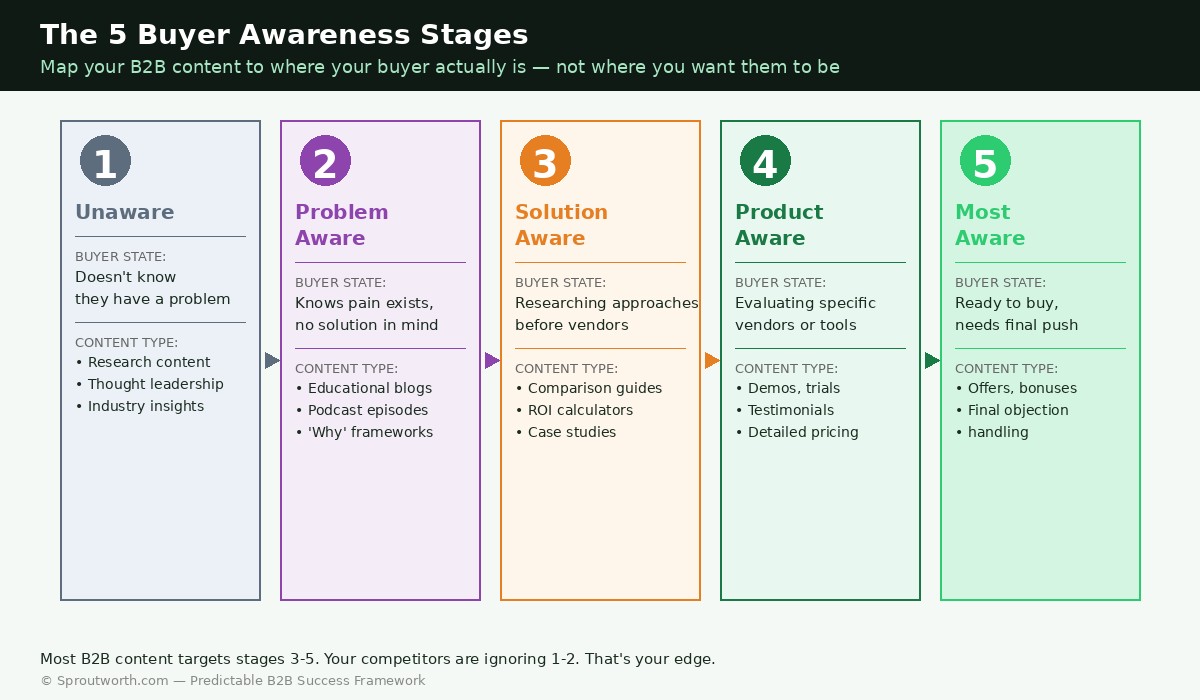
- Unaware: Does not know the problem exists
- Problem Aware: Knows the pain, does not know solutions exist
- Solution Aware: Researching approaches, not yet evaluating vendors
- Product Aware: Evaluating specific vendors
- Most Aware: Ready to buy, needs a final push
Ninety percent of B2B content targets stages 3, 4, and 5 – in traditional terms, the middle of funnel (MOFU) and bottom of funnel (BOFU) content. This is the most crowded, competitive part of the funnel. Meanwhile, top of funnel (TOFU) content for stages 1 and 2 remains largely uncontested. It is the MOFU and BOFU space where Gartner, HubSpot, and Salesforce already dominate with a domain authority you cannot outspend.
In my work ghostwriting content for B2B SaaS founders, the shift that consistently creates the biggest pipeline impact is moving content investment upstream, into stages 1 and 2. This is where your buyer is most receptive, least defended, and where your competitors are almost never present.
A cleantech startup I work with had zero blog traffic and was frustrated that its content was not generating leads. When we audited their content, every single piece was stage 4 or 5: product comparisons, feature roundups, pricing guides. Not one piece addressed the business problem their buyers were wrestling with before they knew software could solve it. We rewrote their strategy to focus on stage 2 and stage 3 content. Pipeline contribution from organic content doubled within 60 days.
The fix: Before publishing any piece of content, ask: Which awareness stage is my reader at right now? Then write for that stage, not for the buyer you wish you had.
Reason 2: Your Content Creates No Tension
Effective B2B lead generation strategies live or die on one variable: tension. Every great piece of B2B content does one thing: it creates a felt gap between where the reader is and where they want to be.
Most B2B content is tension-free. It describes a problem in abstract terms, explains a solution in neutral language, and ends with a soft call to action. The reader feels nothing. They leave without the one thing you needed them to feel: urgency.
Tension does not mean fear-mongering. It means specificity. It means naming the exact gap your reader is experiencing and making them feel the cost of not closing it.
Here is what the difference looks like in practice:
| Without tension | With tension |
|---|---|
| “Content marketing is important for B2B companies” | “If your content is not attributed to revenue, you are 6 months from losing the budget” |
| “SEO can help drive organic traffic” | “Your competitor’s domain authority means any blog post you publish today takes 6 to 12 months to rank; without a different strategy, you are already behind” |
| “Email nurture sequences improve conversion rates” | “Every lead who does not receive a nurture sequence is 3x more likely to buy from whoever reaches them first” |
The Content Marketing Institute’s B2B Content Marketing Report (2025) shows that only 29% of B2B content is rated as “very effective” by marketers themselves. Tension is the primary reason top-performing content outperforms average content. The top quartile of B2B content gets 9x more leads than the bottom quartile, per research from Kapost.
A pattern I notice when ghostwriting educational email courses for B2B tech founders: the emails with the highest reply rates are always the ones that name a specific, uncomfortable truth. Generic tips generate silence. Specific, tension-filled insights generate responses.
The fix: For every content piece, identify the single most uncomfortable truth your reader needs to confront. Lead with that. Not softly. Directly.
Reason 3: You Have No Dark Funnel Presence
The third reason most B2B lead generation strategies underperform is invisible: the dark funnel. The dark funnel is everything that influences a B2B buyer’s decision before they ever visit your website.
LinkedIn conversations. Podcast episodes during the commute. Slack community discussions. Newsletters from trusted voices. Private peer recommendations. This is where 60 to 70% of the B2B buying journey actually occurs, according to Forrester’s research on B2B lead and demand generation.
Most B2B content strategy frameworks are built entirely around trackable channels: website visits, form fills, and email opens.
The dark funnel is, by definition, invisible to your CRM. This creates a dangerous illusion: companies think their content is not working because they cannot attribute it to a form fill, when in fact it is working exactly as it should in an environment they are not measuring. Buyer intent signals in the dark funnel are real; they are simply not captured by standard analytics.
Demand Gen Report found that 47% of B2B buyers consume 3 to 5 pieces of content before engaging with a sales representative. Forrester Research puts that number even higher, with some complex B2B purchases requiring 12 to 16 touch points before a conversation begins. The majority of those touchpoints occur in the dark funnel.
The implication for content-led lead generation: you need to be present in the places your buyers trust, not just the ones you can track.
Practical dark funnel channels for B2B SaaS and tech companies:
- Executive LinkedIn content: Thought leadership from the CEO that builds recognition before the buying cycle starts
- Podcast appearances: Your ideal buyer trusts the voices they hear. Being a guest on two podcasts a month can reach more qualified prospects than six months of blogging
- Industry newsletters: Sponsoring or contributing to newsletters your buyers already read
- Slack and Discord communities: Genuine participation (not self-promotion) in buyer communities
- Digital PR: Getting your thinking cited in publications your buyers read as authority signals
In my work with Series A and B tech companies building LinkedIn content strategies, founders who show up reliably in the dark funnel (through weekly LinkedIn posts, podcast appearances, and industry newsletter contributions) regularly report that inbound leads arrive pre-educated and easier to close. Pipeline velocity improves before any change to the website or to the formal lead-gen infrastructure.
For a deeper look at how this connects to demand creation, see how B2B content-led growth works at scale.
The fix: Inventory your dark funnel presence today. How many pieces of content exist in channels you cannot directly track? If the answer is almost none, you have a fundamental gap in your demand strategy.
Reason 4: Sales and Marketing Are Misaligned on What a Lead Actually Is
Even well-designed B2B lead generation strategies collapse when sales and marketing cannot agree on what a lead actually is. Marketing thinks a lead is anyone who downloads a PDF. Sales thinks of a lead as someone with budget, authority, need, and a timeline. Both are right. The gap between them is where most B2B pipeline goes to die.
HubSpot’s 2025 State of Marketing Report consistently finds that marketing-sales alignment is the number one factor separating top-performing B2B revenue teams from average ones. Companies with tight alignment close 38% more deals, according to a study by MarketingProfs and Forrester. Yet SiriusDecisions research found that 79% of B2B marketing leads never convert to sales, not because they are bad leads, but because they are passed to sales before they are ready.
The lead lifecycle problem plays out like this:
- Marketing captures leads early in the funnel (stage 1 to 2 awareness)
- No nurture sequence exists to educate them to stage 3 to 4
- Leads are passed to sales based on time (30 days old), not behaviour (ready-to-buy signals)
- Sales reps call unready leads, burn credibility, and declare the leads “bad”
- Marketing gets blamed and cuts the budget
The solution is not a new tactic. It is a new agreement between marketing and sales on what constitutes a Sales Qualified Lead versus a Marketing Qualified Lead.
For lead generation for B2B SaaS companies specifically, I recommend building lead scoring around three dimensions:
- Firmographic fit: Company size, industry, funding stage, tech stack signals
- Behavioural intent: Visited pricing page, opened 3 or more nurture emails, downloaded case study
- Engagement velocity: Pace at which they are consuming content (accelerating consumption is an intent signal)
Only leads that score above a defined threshold on all three dimensions become SQLs. Everything else stays in nurture. This sounds like more work. It is. It also results in sales reps talking to buyers who are already warm, which dramatically improves close rates and CAC. See how this connects to reducing your B2B customer acquisition cost through a better-qualified pipeline.
The fix: Run a joint session with sales and marketing to agree on MQL and SQL definitions in writing. This single conversation can improve the performance of all your B2B lead generation strategies more than any tactical change.
Reason 5: You Have No Content-to-Pipeline System
Individual tactics do not generate leads. Systems do. This is the final reason most B2B lead generation strategies fail: they are collections of disconnected tactics, not connected systems.
This is the most common gap I see at Series A and B companies. They have individual pieces of content, individual email sequences, and individual LinkedIn posts. None of them is connected to a system that reliably moves a stranger from first encounter to sales conversation.

A content-to-pipeline system has six connected components:
- Demand creation content (stages 1 to 2): Builds awareness of the problem in your ideal buyer before they are searching for solutions
- Demand capture content (stages 3 to 4): Captures buyers who are actively researching. This is your SEO content, comparison guides, and case studies
- Lead magnet: A free resource that exchanges value for an email address. Educational email courses, calculators, or research reports work best for B2B
- Nurture sequence: An automated email sequence that educates leads from stage 3 to stage 4 over 30 to 60 days, without requiring sales involvement
- Lead scoring: Behaviour-based triggers that flag when a lead is ready for sales contact
- Pipeline attribution: Tracking which content pieces contribute to closed revenue, not just top-of-funnel metrics
Most B2B companies have component 2 (some blog posts) and a rough attempt at component 3 (a gated ebook). Components 1, 4, 5, and 6 are either missing or disconnected.
The educational email course format works exceptionally well as the lead magnet layer in B2B lead generation strategies for tech companies. Rather than a static PDF that gets downloaded and forgotten, an email course delivers value in sequenced installments. This maintains engagement, builds trust, and creates repeat touchpoints over 7 to 14 days. This is especially powerful for lead generation for B2B SaaS, where the buying cycle is long, and trust is the primary conversion barrier.
The fix: Map your current content assets against these six components of effective B2B lead generation strategies. Identify the gaps. Build one missing component at a time, starting with the nurture sequence if you have no email follow-up on existing leads.
B2B Lead Generation Strategies That Actually Work in 2026
Seven B2B lead generation strategies that reliably separate high-performing content programs from those that fill spreadsheets but not pipelines. These are not random tactics; they are the seven approaches that appear across every content program, generating a reliable, qualified pipeline in 2026.
- Build a Demand Creation Engine – target buyers in the dark funnel before they know they need you
- Publish Awareness-Stage Content – own the low-competition keywords your competitors avoid
- Replace PDF Ebooks with Educational Email Courses – create 7-10 trust-building touchpoints instead of one forgotten download
- Use Account-Based Marketing (ABM) – precision over volume for high-value B2B targets
- Convert Traffic with Intent-Based Landing Pages – align page messaging to each visitor’s specific intent signal
- Leverage Podcasting for Compounding Pipeline – content that generates leads for years, not days
- Build a Newsletter as a Revenue Asset – original thinking that builds trust before the first sales conversation
Strategy 1: Build a Demand Creation Engine (Dark Funnel First)
The most foundational B2B lead generation strategy is building demand before buyers know they need you. Before you invest in SEO content or paid campaigns, build organic authority in the channels your buyers trust before they start searching.
LinkedIn is the primary channel for B2B demand creation. According to LinkedIn’s 2025 B2B Marketing Benchmark, 4 out of 5 LinkedIn members drive business decisions, and B2B marketers rate it as the number one platform for generating leads. But most companies use LinkedIn wrong: they post company updates and product features when buyers want strategic insights and frameworks.
The LinkedIn content formula that generates a pipeline for B2B founders:
- Frameworks: Share a decision-making framework your ideal buyer would use (unprompted, no product tie-in)
- Contrarian takes: Challenge a common belief in your industry. Polarising content earns saves and shares from the right people
- Process transparency: Show how you solve a problem your buyer faces. “Here is how we [X]” posts from founders generate enormous trust
- Industry pattern recognition: Share observations from seeing many companies’ problems. This positions you as a source of intelligence, not just a vendor
Two posts per week, consistently, for six months, create a demand generation asset that compounds over time. Of all B2B lead generation strategies, consistent executive LinkedIn content remains one of the fastest paths to a warm inbound pipeline. This is also how you build the brand recognition that makes cold outreach warm, because your prospects already know who you are before you email them.
Strategy 2: Publish Awareness-Stage Content That Competitors Avoid
One of the highest-leverage B2B lead generation strategies is publishing awareness-stage content your competitors actively avoid. The least competitive space in B2B content is stage 1 and 2 content. Nobody is fighting for those keywords because the search volumes are lower. That is exactly why you should own them.
Stage 1 and 2 content targets the problem, not the solution. If you sell project management software for engineering teams, your stage 1 to 2 content is about engineering team coordination failures, sprint review inefficiencies, and cross-functional handoff problems, not about project management software.
This approach to B2B content strategy builds a category of demand that naturally pulls buyers toward your solution. According to Forrester, B2B buyers who consume more than 5 pieces of content from a vendor are 3x more likely to engage with their sales team than those who consume fewer than 2. Stage 1 and 2 content dramatically extends the consumption window.
When auditing content for a Series B software company recently, I found their highest-performing organic post was a stage 2 piece about a common operational failure their buyers experienced, not their features page or case studies. It ranked on page 1 for a low-competition keyword, drove three times more qualified traffic than their product pages, and had a 4x higher lead conversion rate. That is the awareness stage advantage.
Strategy 3: Replace Your PDF Ebook with an Educational Email Course
Educational email courses are among the most underutilised B2B lead generation strategies in tech. The PDF ebook is the least effective B2B lead magnet. It is static, forgettable, and delivers all the value in one batch that the reader never opens.
The educational email course is its replacement. A 7 to 10-email course that answers a specific, urgent question your buyer has, in stages (one insight per email, sent over 10 to 14 days), creates 7 to 10 separate touchpoints where you deliver genuine value and build trust before any sales conversation begins.
The mechanics of a high-converting educational email course:
- Email 1: The problem framing. Name the exact situation the buyer is in
- Emails 2 to 3: The diagnostic. Why most approaches fail
- Emails 4 to 6: The framework. Your proprietary approach to solving it
- Emails 7 to 8: Implementation. Specific steps, tools, or processes
- Emails 9 to 10: What comes next. Naturally connects to your service or a sales conversation
The format works especially well for content-led lead generation because, unlike static gated content (a PDF downloaded and forgotten), the email course trains buyers to expect value from you before the sales conversation. By the time the tenth email arrives, they have already experienced your expertise across 10 touchpoints. The sales conversation becomes a formality, not a pitch.
For more on how content drives predictable revenue growth, see how B2B content-led growth works at scale.
Strategy 4: Use Account-Based Marketing for High-Value B2B Targets
Account-based marketing is one of the B2B lead generation strategies with the highest proven ROI. For B2B SaaS companies with a clearly documented ideal customer profile (ICP), ABM paired with personalised content delivers the best return on investment in lead generation.
The good news: effective ABM-based B2B lead generation strategies do not require enterprise-grade tooling to get started. At its simplest, ABM means:
- Define your top 50 to 100 target accounts with the highest revenue potential
- Research each account’s specific challenges via LinkedIn, their content, job postings, and news
- Create content that speaks directly to that company’s specific situation, not just their industry
- Distribute that content directly via LinkedIn connection request, email, or warm introduction
Research from ITSMA shows that ABM delivers a higher ROI than other B2B marketing investments for 87% of B2B marketers who measure it. The reason is simple: precision beats volume in B2B. One well-crafted message to the right company is worth more than 1,000 generic email blasts.
The challenge is that ABM requires tight alignment between sales and marketing (see Reason 4 above). Without a shared understanding of which accounts to target and what a qualified response looks like, ABM devolves into expensive vanity outreach.
Strategy 5: Convert Organic Traffic With Intent-Based Landing Pages
Intent-based landing pages are the conversion layer that makes all other B2B lead generation strategies pay off. SEO content that does not convert is just traffic, not leads. The conversion gap between traffic and leads is almost always a landing page problem, not a traffic problem.
Intent-based landing pages are designed around the specific reason a visitor arrived. A visitor from an organic search for “how to reduce B2B customer churn” has a very different intent than a visitor from a paid ad for “CRM software for startups.” Same website, fundamentally different needs.
The highest-converting B2B landing pages share four elements:
- Specificity: Speak to the exact buyer segment, not “B2B companies”
- Social proof: Evidence from companies your visitor recognises or aspires to be
- Friction-appropriate offer: Low-friction for early-stage visitors (free resource), higher friction for intent-rich visitors (demo, consultation)
- Clear next step: One action, not three
According to HubSpot’s research, companies with 30 or more landing pages generate 7x more leads than those with fewer than 10. The implication is not to create 30 generic pages. It is to create more specific pages for each audience segment, and the intent signal you want to capture.
Strategy 6: Leverage Podcasting for Compounding B2B Lead Generation
Podcasting is among the B2B lead generation strategies with the highest long-term compounding value. Podcast content compounds in a way that almost no other B2B lead generation channel does. A podcast episode published today can generate leads for three years via search, social sharing, and subscriber growth.
There are two ways to leverage podcasting for B2B lead generation:
Option A: Guest appearances on existing shows. Being a guest on two relevant podcasts per month places your expertise in front of your ideal buyer’s most trusted listening context. According to Edison Research, 78% of podcast listeners have taken an action after hearing a podcast ad or mention, and the trust transfer from host to guest is significant.
Option B: Your own show, content repurposed. If you run a podcast, the content can be repurposed into blog posts (for SEO), LinkedIn clips (for dark funnel presence), and newsletter content (for nurture), creating a multiplier effect on your content investment.
The lessons from 500+ CEO interviews on scaling B2B startups repeatedly surface this pattern: founders who invested in podcast content early created brand recognition that paid dividends years later in deal velocity and inbound lead quality.
Strategy 7: Build a Newsletter as a Revenue Asset, Not a Broadcast Channel
Newsletter publishing is one of the B2B lead generation strategies most consistently underestimated by funded tech companies. A weekly or biweekly B2B newsletter to your target buyer audience is one of the highest-return lead generation assets available.
The reason is counterintuitive: a newsletter generates leads not directly (through CTAs) but indirectly (through trust accumulation). A CEO who reads your newsletter for six months arrives at a sales conversation already trusting your perspective, already familiar with your frameworks, and already partially convinced that you understand their business. The newsletter has done the selling before the first conversation.
HubSpot benchmark data shows that email marketing generates an average ROI of $36 for every $1 spent, the highest ROI of any digital marketing channel. For B2B, where buying cycles are long and trust is the primary driver of conversion, returns are typically higher.
The newsletter formula for B2B lead generation:
- One insight per issue: Not a content roundup. One original insight your reader cannot get anywhere else
- Problem-first framing: Each issue opens with a problem your buyer recognises
- Practical takeaway: Something actionable they can implement this week
- Light social proof: One example of a company that succeeded with this approach (unnamed is fine)
The key mistake B2B companies make with newsletters: treating them as a content distribution channel (sharing blog posts) instead of an original thinking channel. As a B2B lead generation strategy, newsletters only compound when they deliver original thinking that readers cannot get elsewhere. Readers unsubscribe from content roundups. They forward original insights to colleagues.
The Content-Led B2B Lead Generation Strategy Framework: Putting Your B2B Lead Generation Strategy Together
A complete B2B lead generation system comprises six interconnected components that guide a stranger from first encounter to sales conversation without requiring manual intervention at every stage. Here is how to connect the content funnel so that demand creation, capture, lead magnet, nurture, scoring, and attribution work as one system rather than six isolated experiments.
Here is the full framework as a linear flow:
- Demand creation: LinkedIn posts and podcast appearances build recognition in the dark funnel (stages 1 to 2)
- Demand capture: SEO blog content and digital PR capture buyers who are now actively searching for solutions to the problems you have been educating them about (stages 2 to 3)
- Lead capture: Educational email course or high-value report exchanges value for an email address (stage 3)
- Nurture: Email sequence moves captured leads from stage 3 to stage 4 over 30 to 60 days, building towards a sales conversation organically
- Qualification: Lead scoring flags high-intent leads for sales outreach (stage 4 and above)
- Attribution: Pipeline is tracked back to the specific content pieces that influenced each deal, allowing you to optimise for revenue, not vanity metrics
This system works at all stages of the company, but the emphasis shifts. At the seed stage, founder-led content and personal brand are the dominant levers. At Series A, you start systematising with email nurture and lead scoring. At Series B and beyond, you add ABM and intent data. See how B2B startup scaling changes the content strategy at each stage.
B2B Lead Generation Strategies: Metrics That Actually Matter
Most B2B lead generation strategies are measured by the wrong metrics. Traffic and follower counts are vanity metrics. The metrics that tell you whether your B2B lead generation strategies are actually working are harder to track, but they’re the ones that correlate with the pipeline.
Dark funnel metrics:
- LinkedIn engagement rate (especially saves and shares, not just likes)
- Email referrals: what percentage of new leads mention a piece of content or a podcast?
- Close call source attribution: ask every new prospect how they first heard of you
Pipeline contribution metrics:
- Content-influenced pipeline: which deals with a piece of content before closing?
- Lead-to-opportunity conversion rate by content source
- Time-to-close for leads generated through content vs other channels
- Customer acquisition cost (CAC) by channel. Content-generated leads should have lower CAC over time. See the B2B customer acquisition cost benchmark for reference
Quality metrics:
- Lead quality score (based on firmographic and behavioral dimensions)
- Sales accepted lead rate: What percentage of MQLs does sales actually pursue?
- Win rate by lead source
The single most important shift: stop reporting on traffic and impressions to leadership. Start reporting on pipeline attributed to content, and customer acquisition cost (CAC) by channel. This is the conversation that gets content marketing taken seriously as a revenue function, not a cost centre.
Key Takeaways
The most important lessons from this B2B lead generation strategies guide: most content underperformance is a structural problem, not a tactics problem. Fix the five failure points, run the seven strategies as a connected system, and measure pipeline impact rather than vanity metrics.
- Most B2B content fails because it targets the wrong buyer awareness stage, not because the tactics are wrong
- The dark funnel (LinkedIn, podcasts, newsletters, communities) represents 60 to 70% of the B2B buying journey. You must be present there, not just in SEO and ads
- Lead generation is a system problem, not a tactics problem. Individual tactics only work when connected to a content-to-pipeline flow
- Educational email courses outperform static lead magnets because they create multiple trust-building touchpoints over time
- Misalignment between marketing and sales on lead definitions is the single fastest fix for most B2B companies. A one-hour meeting to define MQL vs SQL can improve pipeline conversion rates overnight
- Measure pipeline-attributed content and CAC by channel, not vanity metrics like traffic and impressions
- Stage 1 and 2 awareness content is the least competitive and highest-leverage content investment that most B2B companies are not making
Frequently Asked Questions About B2B Lead Generation Strategies
What Are the Most Effective B2B Lead Generation Strategies in 2026?
The most effective B2B lead generation strategies in 2026 combine dark funnel demand creation (LinkedIn executive content, podcast appearances, and newsletter publishing) with demand capture (SEO content targeting stages 2 to 3 of buyer awareness) and a connected nurture system (educational email courses, lead scoring, and pipeline attribution). Companies that treat these as a connected system rather than separate tactics consistently outperform those running individual channels in isolation. The key insight is that 60 to 70% of B2B buying decisions are influenced before a prospect ever visits your website, so strategies that address the dark funnel phase generate significantly better-qualified leads than those focused exclusively on trackable inbound channels.
How long does content-led lead generation take to generate results?
Content-led lead generation typically delivers early results within 60 to 90 days for dark-funnel channels (LinkedIn and podcasts), while SEO content typically takes 6 to 12 months to rank competitively. However, the system compounds: companies that invest consistently for 12 months or more often report that content becomes their highest-quality and lowest-cost lead generation channel. The key is to track pipeline-attributed content from the beginning, so you can attribute revenue to specific content pieces and optimise investment accordingly. Companies that only track traffic or impressions routinely underestimate the ROI of content-led lead generation because most of the influence happens in the dark funnel, where standard analytics do not reach.
What is the difference between a marketing qualified lead (MQL) and a sales qualified lead (SQL) in B2B?
A marketing-qualified lead (MQL) is a prospect who has shown sufficient interest through content engagement to warrant further marketing nurture but is not yet ready for a sales conversation. A sales qualified lead (SQL) is an MQL who has demonstrated buying intent and meets the criteria for a sales conversation: typically a combination of firmographic fit (right company size, industry, and budget), behavioural intent signals (visited pricing page, requested a demo, or engaged with bottom-of-funnel content), and engagement velocity (accelerating content consumption pattern). The MQL-to-SQL transition is the most critical threshold in B2B lead generation, and misalignment between marketing and sales on this definition is the primary cause of pipeline underperformance in B2B tech companies.
How do you generate leads for a B2B SaaS company with no existing audience?
For B2B SaaS companies with no existing audience, the fastest path to early leads combines founder-led LinkedIn content (two posts per week targeting the specific pain points of your ideal buyer), guest appearances on two to three relevant podcasts your buyers listen to, and targeted cold outreach to 10 to 20 hand-selected ideal accounts per week with personalised, insight-led messages. This dark-funnel foundation builds brand recognition faster than SEO content (which takes months to rank) and also generates a direct pipeline through outreach. The first 90 days should focus on proving the messaging and ICP fit before investing in content infrastructure. See more on LinkedIn B2B lead generation strategy for B2B companies.
What is the dark funnel in B2B marketing, and why does it matter for lead generation?
The dark funnel refers to the portion of the B2B buying journey that happens outside of tracked digital touchpoints: LinkedIn conversations, podcast listening, Slack communities, private word-of-mouth recommendations, and newsletter reading. Research from Forrester and Demand Gen Report consistently finds that B2B buyers consume 3 to 5 pieces of content and have multiple touchpoints with a vendor before ever visiting the vendor’s website or filling out a form. Because these interactions happen outside standard analytics tools, they appear invisible to most marketing dashboards.
Companies that invest only in trackable channels (paid ads, SEO, form fills) miss the majority of the influence window. Building a strong dark funnel presence through consistent executive content, podcast distribution, and newsletter publishing creates a competitive advantage that compounds over time and is extremely difficult for competitors to replicate quickly.
How does account-based marketing (ABM) improve B2B lead quality?
Account-based marketing improves B2B lead quality by inverting the traditional funnel: instead of casting wide and filtering down, ABM defines the ideal accounts first and then creates content and outreach specifically for those accounts. This precision means that every lead generated through an ABM motion already fits your ICP by definition, which dramatically improves sales acceptance rate, close rate, and average deal size. ITSMA research shows that 87% of B2B marketers who measure ABM report higher ROI than other marketing investments.
ABM works best when paired with intent data (signals that a target account is actively researching your category) and personalised content that addresses the specific situation of each target account. At scale, ABM requires marketing-sales alignment and the right tooling, but even a basic manual ABM approach (50 target accounts, personalised outreach, specific content) consistently outperforms generic lead generation for most B2B SaaS companies with a clear ICP. The research backing these B2B lead generation strategies and why they work: Content Marketing Institute’s B2B report found that 72% of the most successful B2B marketers document their B2B lead generation strategies, versus just 30% of the least successful.
HubSpot’s State of Marketing report confirms that companies prioritising blogging are 13x more likely to see positive ROI. Gartner research shows that B2B buyers spend only 17% of their purchase journey talking to potential suppliers; the other 83% is spent on independent research, where your content either wins or loses. Forrester reports that buyers consume an average of 27 pieces of content before making a purchase decision. And LinkedIn B2B research shows that thought leadership content directly influences RFP inclusion at 58% of enterprise companies.
Related Resources
- B2B Content-Led Growth: Lessons From 500 CEO Interviews: How the best B2B companies build content engines that compound
- LinkedIn Lead Generation Strategy: 100% Process Proof: the step-by-step LinkedIn system for a consistent B2B pipeline
- B2B Customer Acquisition Cost: The $10 Benchmark Explained: How to Measure and Reduce CAC through Content-Led Growth
- How to Scale a B2B Startup: Lessons From 500 CEO Interviews: The Growth Stages Where Content Strategy Must Evolve
- Brand Differentiation Strategy: Why 90% Fail: How Positioning Clarity Amplifies the Effectiveness of Every Lead Generation Channel
The companies that are consistently generating high-quality leads from content are not using more tactics. They are running connected B2B lead generation strategies designed around how their buyers actually make decisions. Whether you build those B2B lead generation strategies internally or partner with specialists in content strategy and B2B ghostwriting for funded tech startups, the foundation is the same: meet your buyer where they are, not where you wish they would be.
