
Most B2B SaaS founders make the same pipeline mistake. They chase lead volume.
They set aggressive MQL targets. They celebrate when the number goes up. Then they wonder why the sales team keeps complaining about lead quality, why close rates are stagnant, and why the board keeps asking what all that marketing spend actually produced.
I have seen this pattern repeatedly across 500+ episodes of the Predictable B2B Success podcast. The problem is almost never the channel. It is the strategy behind it.
Scott Gelber has spent the better part of a decade building pipeline systems for funded SaaS companies. His framework runs counter to most conventional advice out there. In the past 12 months, his clients generated $3.6 million in qualified inbound pipeline by focusing on one metric most agencies ignore: qualified sales opportunities, not leads.
Here is what a deliberate B2B SaaS pipeline strategy actually looks like.
About the Guest
Scott Gelber is the founder of SRG Marketing, a growth marketing agency that helps Series A and Series B SaaS companies generate qualified sales opportunities through Google Ads. Before starting his agency, Scott spent over seven years as a demand generation specialist at funded startups, including Honest Buildings and Diligent Corporation. In the past 12 months alone, his clients have generated $3.6 million in qualified inbound pipeline. His north star metric is not leads or clicks. It is a qualified sales opportunity. That distinction is what this conversation is entirely about.
What you’ll learn in this article:
- The three-question ICP fit test to run before spending a dollar on pipeline channels
- The 5-step paid acquisition framework that generated $3.6M in qualified pipeline
- Why Google’s automated bidding actively harms most B2B SaaS campaigns
- The pipeline velocity formula your board will actually understand
- How to build a multi-channel pipeline system across paid, content, and SDR
- The board-ready metric framework for justifying and scaling marketing spend
Table of Contents
What Is a B2B SaaS Pipeline Strategy?
Quick answer: A B2B SaaS pipeline strategy is a systematic approach to generating qualified sales opportunities for software companies selling to other businesses. It combines channel fit analysis, CRM infrastructure, targeted keyword acquisition, and sales follow-up systems to produce revenue-ready leads rather than raw lead volume.
The distinction matters. Most pipeline “strategies” are really just channel tactics. They answer the question “how do we get more leads?” A genuine pipeline strategy answers a harder question: “how do we generate the right conversations, at the right cost, that our sales team can actually close?”
For Series A and Series B companies, this distinction is the difference between efficient growth and burning your runway on activity that does not convert.
What does a B2B SaaS pipeline look like in practice?
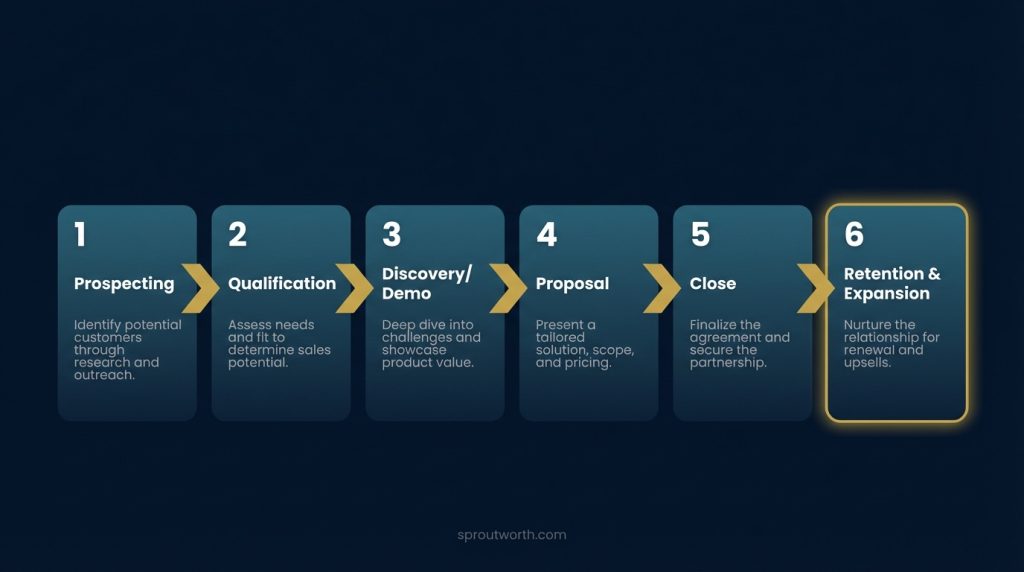
A healthy pipeline moves prospects through six stages:
- Prospecting — identifying companies that fit your Ideal Customer Profile (ICP) and are likely in-market
- Qualification — confirming budget, authority, need, and timeline before investing sales time
- Discovery or demo — a structured conversation that surfaces the prospect’s specific pain and maps your solution to it
- Proposal — a commercial offer tied to the outcomes discussed in discovery, not a generic pricing page
- Close — contract negotiation and signature; in B2B SaaS, this stage averages 84 days from first contact according to industry benchmarks
- Retention and expansion — the post-sale stage where net revenue retention is won or lost
Most pipeline strategies focus entirely on the top of this funnel. The highest-performing ones engineer each stage deliberately, knowing exactly what needs to happen to move a prospect from one step to the next.
Why Most B2B SaaS Pipeline Strategies Fail at Series A
Here is the uncomfortable truth most growth agencies will not tell you.
Google Ads, content marketing, and LinkedIn outreach all work. But they only work if your company is a fit for the channel. Most Series A founders skip the fit analysis entirely and go straight to execution. That is where the budget goes to die.
Before you build a pipeline strategy, you need to confirm your Ideal Customer Profile (ICP) is searchable. An ICP that is too narrow, too senior, or too novel in its buying behaviour will not generate enough search volume to make paid acquisition viable. Scott Gelber frames this around three questions he asks every potential client before agreeing to work with them.
First: Is your total addressable market large enough?
If you are selling exclusively to Fortune 500 companies or organisations with over a billion dollars in revenue, paid search will not work. The addressable market is simply too small. You will not find enough search volume to generate a meaningful pipeline.
Second: Is your product category mature enough to be searched?
This is the one most founders miss. Scott worked with a company creating a new type of contract for ocean freight shipping. Nobody was searching for that.
“You only search for things you already know you need. You search for shoes because you know what shoes are, yours are worn out, and you need new ones. The maturity of the category is really important.” — Scott Gelber, founder of SRG Marketing
A CRM, a content marketing tool, a project management platform: these are mature categories with established search behaviour. A genuinely novel product category? The demand has to be created before it can be captured. Google Ads for demand capture only works when demand already exists.
Third: Is there actual keyword search volume to validate the channel?
Before committing to a paid acquisition channel, do the keyword research. Not in depth. Just enough to confirm that people are actively searching for what you sell. If the search volume is not there, no amount of bidding optimisation will save you.
According to Gartner, 72% of B2B buyers conduct extensive research before contacting sales. The channel works when buyers are already looking. The strategy fails when you assume they are.
The 5-Step B2B SaaS Pipeline Strategy Framework
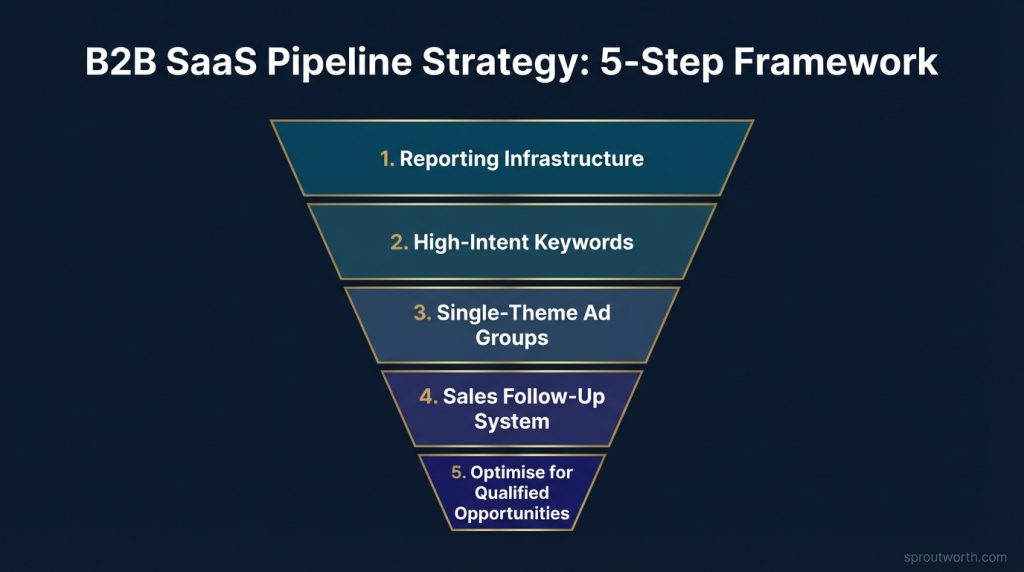
Once channel fit is confirmed, execution follows a sequence. Scott’s framework has five steps. Most agencies skip the first two. That is why they underdeliver.
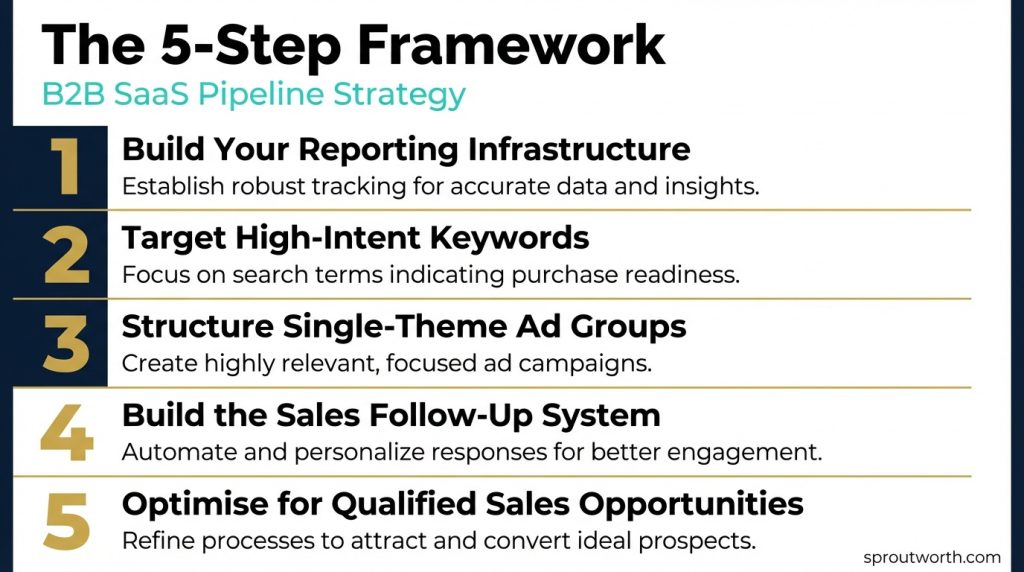
Step 1: Build Your Reporting Infrastructure Before You Spend a Dollar on Ads
This is the step that separates agencies that drive real pipeline from those that game vanity metrics.
Most Google Ads platforms only show you how many leads a keyword generated. They cannot show you who those leads are, what companies they are from, whether they booked a sales call, or whether they became revenue.
Scott’s first move with every new client is to connect the Google Ads account to the CRM, typically HubSpot, and set up conversion tracking in Google Analytics 4.
“In the Google Ads platform, you can only see the number of leads you’re generating, but you can’t see who they are. What HubSpot does is it shows you not just how many conversions you got by keyword, but who are they, what’s their job title, what company are they from, and did they actually end up taking a meeting with your sales team.” — Scott Gelber
Without this infrastructure, every optimisation decision is guesswork. You might increase spending on a keyword generating 20 conversions per month and discover, once the CRM data is in, that none of those leads became sales opportunities.
A pattern I have noticed when working with funded B2B tech companies: those who build this data infrastructure early, before scaling spend, can confidently justify marketing budgets to their boards. The ones who skip it keep having the same uncomfortable conversation about whether the marketing investment is working.
Understanding your attribution model is not a technical nice-to-have. For a Series A CEO reporting to a board, it is the foundation of every growth conversation.
Step 2: Target High-Intent Keywords That Signal Active Buying Behaviour
Not all search queries are equal.
High-intent keywords are phrases that indicate someone is actively looking for a software solution right now. Words like “software,” “platform,” and “tool” are reliable signals. “Content marketing software” suggests a buyer in the market. “What is content marketing?” suggests a researcher. The conversion rates are dramatically different.
Scott’s approach is to start narrow. Identify the two or three keyword clusters most closely aligned with your core offering and the specific outcome your buyers are seeking. Resist the temptation to cast a wide net.
According to Firebrand Marketing’s 2024 B2B advertising benchmarks, the average cost per conversion in B2B paid search is close to $986. That number makes a lot more sense when you are optimising for high-intent, high-value searches rather than spraying budget across 100 keywords hoping something sticks.
The goal is not volume. It is precision.
Step 3: Structure Ad Groups Around Single Themes
This is where most DIY campaigns break down.
Multi-product SaaS companies often make one critical mistake: they send all their keywords to the same ad and the same landing page. A prospect searching for “email marketing software” and a prospect searching for “sales CRM” have completely different needs. Showing them the same generic message wastes the click.
Scott’s approach is to use single-theme ad groups. Each cluster of closely related keywords gets its own dedicated ad copy and its own landing page. The ad speaks directly to what the person searched for. The landing page delivers exactly what the ad promised.
This alignment between the search query, ad copy, and landing page is what Google calls “relevance” and rewards with better Quality Scores. Higher Quality Scores mean lower cost per click and better placement.
When writing ad copy, Scott focuses on three layers: keyword relevance (does the ad confirm you are in the right place?), value proposition (what outcome does your product deliver?), and differentiation (what makes you different from every other ad on the page?). A 30-character headline and a 90-character description do not give you much room. Every word has to do work.
Step 4: Build the Sales Follow-Up System Before the Leads Arrive
Generating a qualified lead and failing to follow up on it is one of the most expensive mistakes in B2B SaaS.
“Getting the right people to convert is half the battle. If they fill out the form on your website to talk to sales or get a demo, but no one ever reaches out to them, it really doesn’t mean much for your business. In B2B, you have to get in touch with the buyer and have conversations to get them to become a customer.” — Scott Gelber
If no one follows up within 24 hours, ideally within five to ten minutes of the form submission, the lead goes cold. The buyer moved on to the next vendor. Your budget was wasted.
Research backs this up. A study from Harvard Business Review found that companies that contacted leads within an hour were nearly seven times more likely to have a meaningful conversation than those who waited longer. In B2B SaaS, where average sales cycles run three to nine months, the first response is often the conversation that determines whether you are even in the running.
The system needs two components: immediate notification to the relevant sales rep or SDR when a lead converts, and a standardised multi-touch outreach sequence that consistently books meetings. Without the sequence, follow-up depends on individual rep initiative, which is inherently inconsistent.
When I ghostwrite educational email courses for B2B tech companies, this sales-marketing handoff is one of the most common gaps I uncover. The content converts the lead. The follow-up system determines whether that lead becomes revenue.
Key takeaway: Your pipeline system is only as strong as its weakest handoff point. Building the sales follow-up sequence before the first lead arrives is not premature. It is the only way to protect the spend you have already committed.
Step 5: Optimise for Qualified Sales Opportunities, Not Lead Count
Once the infrastructure is running, the optimisation work begins. And this is where the quality-over-quantity thesis becomes most concrete.
“A lot of times the keywords that are consistently driving sales opportunities, there’s like less than five. A lot of times it’s two or three. Sometimes it’s one. But what they’re doing is spending all their budget across a hundred keywords.” — Scott Gelber
The Pareto principle applies with unusual clarity here. Find the 20% of keywords driving 80% of your qualified pipeline. Concentrate spend there. Kill everything else.
This requires regularly pulling the CRM data. Not just the Google Ads dashboard. The question is not “which keyword got the most conversions?” It is “which keyword produced the most qualified sales meetings and the best close rate?”
Lead scoring is the operational tool that makes this actionable before the CRM data matures. Assign scores to leads based on company size, job title, industry fit, and behavioural signals like pricing page visits or returning sessions. This gives your sales team a triage system for which form fills to pursue immediately and which to deprioritise, so pipeline quality improves even before your optimisation data is statistically significant.
Building a reliable pipeline growth system requires this kind of discipline. It means resisting the pressure to optimise for the metric that looks good in a report and instead tracking the metric that connects directly to revenue.
Key takeaway: Most SaaS companies are funding their own worst keywords without knowing it. The CRM-connected view reveals which two or three keywords are actually building pipeline. Everything else is eating budget that could be doubled down on what works.
The One Metric That Ties Your B2B SaaS Pipeline Strategy to Board Goals
Here is a question most founders cannot answer confidently: What does a qualified lead need to cost for your pipeline strategy to make sense?
Scott works backwards from what he calls the CAC payback period. Most funded SaaS companies have a target in mind, whether it is expressed as a payback period, a CAC-to-LTV ratio, or a target cost per acquisition. The board cares about one of these. The pipeline strategy has to be built around it.
The calculation works like this. Take your average contract value. Apply your historical close rate. Calculate your cost per qualified sales opportunity. If the math works at your current spend level, you have a scalable system. If it does not, you know exactly which variable to address.
For a company with a $30,000 average contract value and a 25% close rate, four qualified sales opportunities per month produces one new customer. At $10,000 in monthly ad spend, the math is compelling. The framework makes it visible. According to OpenView Partners’ SaaS benchmarks, top-performing SaaS companies at Series A maintain a CAC payback period under 18 months. That is the target to back-calculate from.
Pipeline velocity is the companion metric that turns this into a board-ready forecast. The formula is:
Number of Deals x Average Deal Value x Win Rate / Average Sales Cycle Length
It tells you how much revenue your pipeline generates per day.
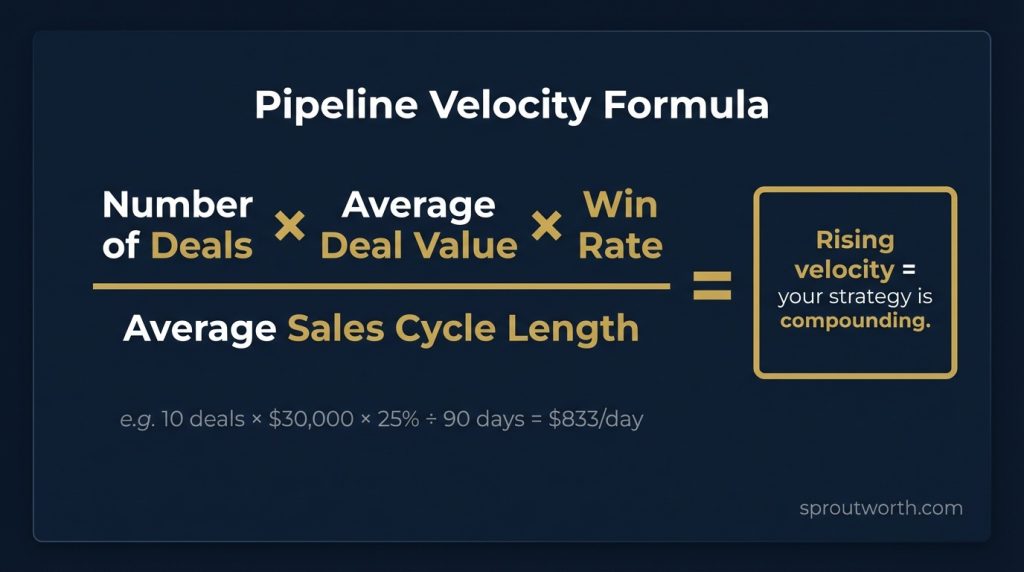
A rising pipeline velocity means your system is working. A flat or declining one tells you exactly which lever to pull: more deals entering, a higher average deal value, a better win rate, or a shorter cycle. When your ICP is well-defined and your pipeline stages are clean, this number becomes your most reliable growth indicator.
Together, cost per qualified sales opportunity and pipeline velocity give you a credible model rather than a guess. If you know your average cost per sales opportunity, your close rate, and your average contract value, you can construct a revenue forecast that holds up under board scrutiny. Not “we think marketing is working.” But “at our current pipeline velocity and cost per opportunity, we project X in new ARR by end of quarter, assuming our close rate holds.”
This is also how you have the budget conversation with a sceptical CFO. Not “we need to spend more on marketing.” But “at our current cost per sales opportunity, every additional dollar in spend returns X in expected pipeline value.”
Driving pipeline with less spend starts with understanding your unit economics well enough to have that conversation with clarity.
Key takeaway: Pipeline velocity turns your strategy into a board-legible forecast. Once you can express marketing spend in terms of daily revenue generation, the budget conversation changes entirely. You are no longer defending spend; you are proposing an investment with a calculable return.
Why Google’s Automated Bidding Fails B2B SaaS Companies
This is the part most agencies will not say out loud, because Google’s account managers are actively pushing automated bidding strategies to every client.
Scott’s position is clear: for most B2B SaaS companies, automated bidding makes things worse, not better.
The reason comes down to data. Google’s automated strategies are trained on consumer behaviour. They excel at identifying people likely to buy basketball shoes because billions of signals exist about consumers who do. They struggle to identify a VP of Sales at a 200-person Series B software company who is actively evaluating contract management tools, because that is a far smaller, far more specific signal set.
When you hand budget control to Google’s algorithm before feeding it enough qualified conversion data, it optimises for volume. And in B2B SaaS, volume is the enemy of pipeline quality.
Scott’s recommendation for companies early in their paid acquisition journey: start with manual bidding. Keep tight control over which keywords you appear for and at what price. Only consider automated bidding strategies after you have accumulated enough qualified conversion data to train the algorithm on what “good” looks like for your specific buyer.
| Manual Bidding | Automated Bidding | |
|---|---|---|
| Best for | Early-stage B2B SaaS, niche ICPs, long sales cycles | E-commerce, B2C, high-volume consumer searches |
| Control | Full control over bids per keyword | Google optimises autonomously |
| Data requirement | Works from day one | Requires substantial qualified conversion history |
| Risk | Requires active management | Optimises for volume, not lead quality |
| B2B SaaS verdict | Recommended until CRM data matures | Use only after ICP conversion signals are established |
According to Dreamdata’s B2B Google Ads benchmark report, cost per click for non-branded B2B search terms has increased 29% year over year. That makes precision more important than ever. Automated bidding without sufficient quality data amplifies the problem.
Similarly, keyword match types matter. Broad match tells Google to show your ad for anything it considers related. In B2B SaaS, “related” can mean a lot of things that have nothing to do with your buyer. Tight phrase and exact match types preserve your budget for the searches that actually matter.
Key takeaway: Automated bidding is not a shortcut. Without a meaningful history of qualified sales opportunities feeding the algorithm, it will optimise for what it can measure — volume — rather than what you actually need. Start manual, stay manual until your data earns it.
The Multi-Channel Pipeline System Most B2B SaaS Companies Get Wrong
Single-channel pipeline strategies create fragile businesses.
A company running only paid acquisition is one algorithm change or a budget cut away from a zero pipeline. A company relying only on content waits six to nine months for results while the runway ticks down. The most resilient B2B SaaS pipeline strategies operate three channels in parallel, each doing a distinct job.
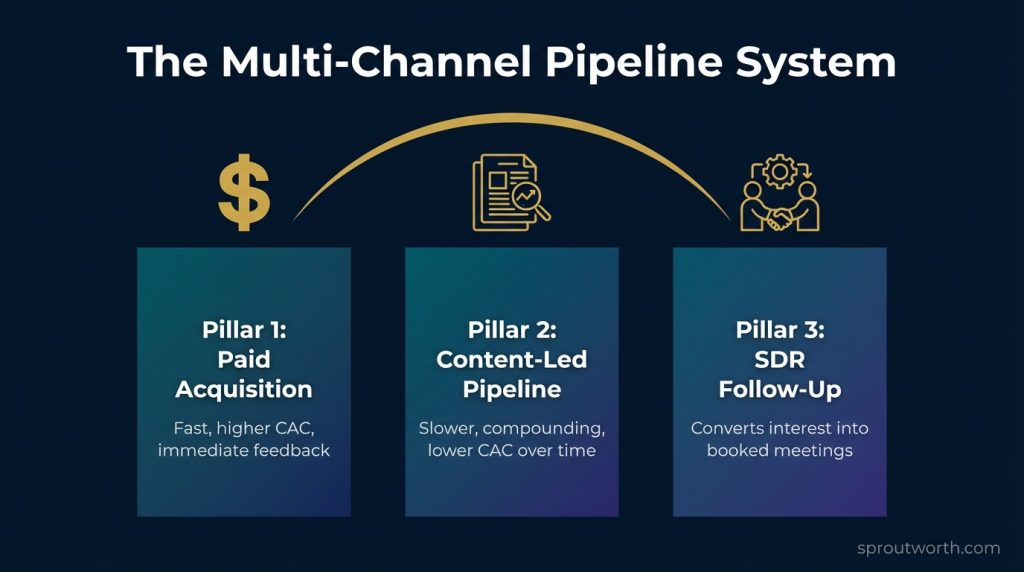
Pillar 1: Paid acquisition (fast, higher CAC, immediate feedback)
Google Ads captures buyers who are already searching for what you sell. This is the fastest path to qualified sales opportunities for companies whose ICP is searchable. The tradeoff is cost. The average cost per conversion in B2B paid search sits near $986, according to Firebrand’s benchmarks. The channel rewards precision and punishes volume-chasing, which is Scott’s entire thesis.
Pillar 2: Content-led pipeline (slower, compounding, lower CAC over time)
“More often than not, someone comes in and they know what I’m about. Before I work with anybody, I walk them through the framework. And I share this philosophy around: we goal ourselves on qualified sales opportunities. We don’t goal ourselves on clicks or impressions or even leads.” — Scott Gelber
His best clients arrive pre-educated, having found him on LinkedIn or YouTube first. The sales conversation is shorter because the education happened before the call.
This is not unique to his agency. It applies to every B2B SaaS company with a considered purchase cycle.
The LinkedIn content that generates qualified leads for a tech CEO is not product-focused. It is framework-focused. It positions the founder as someone worth listening to on the strategic challenges their buyers face every day. When a potential customer eventually needs what you sell, you are already the most credible option in their mind.
In the work I do, developing LinkedIn content strategies for Series A and Series B CEOs, this is the consistent finding: executives who publish strategic insights consistently attract higher-quality inbound conversations and spend less time educating prospects from scratch.
Pillar 3: SDR-assisted follow-up (converts interest into booked meetings)
Neither paid nor content conversions are fully efficient without a human-in-the-loop. The SDR or sales rep who follows up within five to ten minutes of a form submission, or who reaches out to a prospect who just engaged with three LinkedIn posts, closes the gap between interest and commitment. The system without this pillar leaks pipeline at every stage.
Paid pipeline is faster. Content-led pipeline compounds. SDR follow-up converts both. The most efficient B2B SaaS pipeline strategies use all three, with each pillar amplifying the others over time.
Effective B2B demand generation is not a single channel. It is a system where each component amplifies the others.
Whether you build the content capability in-house or work with specialists in executive content and ghostwriting, the principle is the same: the CEO’s voice, consistently applied to the strategic challenges your buyers care about, is your most durable pipeline asset. Learn more about how Sproutworth approaches content for funded B2B tech companies.
Key takeaway: Single-channel pipeline is a liability disguised as simplicity. The companies that scale efficiently are not the ones who found the best channel. They are the ones who built a system where paid, content, and SDR reinforce each other.
Conclusion
A B2B SaaS pipeline strategy is not a channel decision. It is a series of connected decisions: which channels fit your ICP, how to build the data infrastructure before you spend, which keywords signal genuine buying intent, how fast your follow-up system operates, and which metrics connect it all back to board-level goals.
Scott Gelber’s clients generated $3.6 million in qualified inbound pipeline in 12 months by making those decisions deliberately. Not by chasing lead volume. Not by letting Google’s algorithm optimise on its behalf before it had the data to do so. By treating the pipeline as a system and rebuilding it from the reporting layer up.
For Series A and Series B founders, the framework in this article is not theoretical. It is the sequence. Build the infrastructure. Target high-intent searches. Keep ad groups single-theme. Have your follow-up ready before the leads arrive. Then optimise relentlessly for the only metric that matters: qualified sales opportunities.
When the framework is right, the board conversation changes. You stop defending marketing spend and start presenting a growth model with visible unit economics.
That is what a real B2B SaaS pipeline strategy delivers.
FAQ
What is the most important metric in a B2B SaaS pipeline strategy?
Cost per qualified sales opportunity is the most useful metric for Series A and Series B companies. Unlike cost per lead, it accounts for whether the people entering your pipeline are actually worth pursuing. It can be back-calculated from your average contract value, close rate, and target CAC payback period, making it directly legible to investors and board members.
What is pipeline velocity, and why does it matter for B2B SaaS?
Pipeline velocity measures how much revenue your sales engine generates per day. The formula is: Number of Deals x Average Deal Value x Win Rate / Average Sales Cycle Length. It is the single metric that synthesises the health of your entire pipeline into one number your board can act on. A rising pipeline velocity confirms your B2B SaaS pipeline strategy is compounding. A declining one pinpoints exactly where to intervene, whether that is deal volume, deal size, win rate, or cycle length.
How much should a Series A SaaS company spend on paid pipeline generation?
There is no universal number. The better question is: at your current cost per qualified sales opportunity, is the return on ad spend moving you toward your target CAC payback period? For companies with average contract values above $30,000, the economics of paid search often become compelling even at modest conversion rates. Start with enough budget to generate statistically meaningful data (typically three to four months of consistent spend) before drawing conclusions.
Why does Google’s automated bidding underperform for B2B SaaS?
Google’s automated bidding strategies are trained on consumer purchase behaviour, which generates far more data points than B2B enterprise buying. For niche B2B audiences with long sales cycles, the algorithm lacks enough qualified conversion signals to optimise accurately. Manual bidding, combined with tight keyword match types and CRM-connected conversion tracking, typically outperforms automation until a company has accumulated a substantial history of qualified pipeline data.
How long does it take to build a qualified B2B SaaS pipeline through paid search?
Expect three to six months to see a consistent, qualified pipeline from a well-structured paid search program. The first month is typically spent on infrastructure (tracking, CRM integration, landing pages). Months two and three generate initial data. Optimisation toward cost-efficient qualified opportunities happens in months three through six. Companies that expect immediate results often cut programs before they reach their inflection point.
How does content marketing complement a paid pipeline strategy?
Paid acquisition captures buyers who are already searching for a solution. Content marketing, particularly thought leadership on LinkedIn and through email, builds familiarity and trust before a buyer enters the market. Scott Gelber’s clients who come in pre-educated through his LinkedIn and YouTube content require less convincing and close faster. For B2B SaaS companies with long purchase cycles, combining both channels yields a more durable pipeline than either channel alone.
Related Resources
- 5 Demand Generation Marketing Strategies to Drive Pipeline Growth — how to build demand alongside capturing it
- How to Drive Pipeline With Less Spend Using a Data-Backed Strategy — applying data to reduce CAC while growing qualified pipeline
- How to Get Reliable Pipeline Growth via B2B Marketing Strategies — building repeatable, predictable pipeline systems
- B2B Demand Generation in 2025: 15 Expert-Tested Strategies — a broader look at demand generation channels and approaches
- Qualified Leads: Roadmap to Customer Acquisition and Sales — defining and operationalising lead quality criteria
Guest Resources
- Scott Gelber on LinkedIn: linkedin.com/in/scott-gelber-36b8365b
- SRG Marketing: srgmarketing.co
Some topics we explore in this episode include:
Listen to the episode.
Subscribe to & Review the Predictable B2B Success Podcast
Thanks for tuning into this week’s Predictable B2B Podcast episode! If the information from our interviews has helped your business journey, please visit Apple Podcasts, subscribe to the show, and leave us an honest review.
Your reviews and feedback will not only help me continue to deliver great, helpful content but also help me reach even more amazing founders and executives like you!
