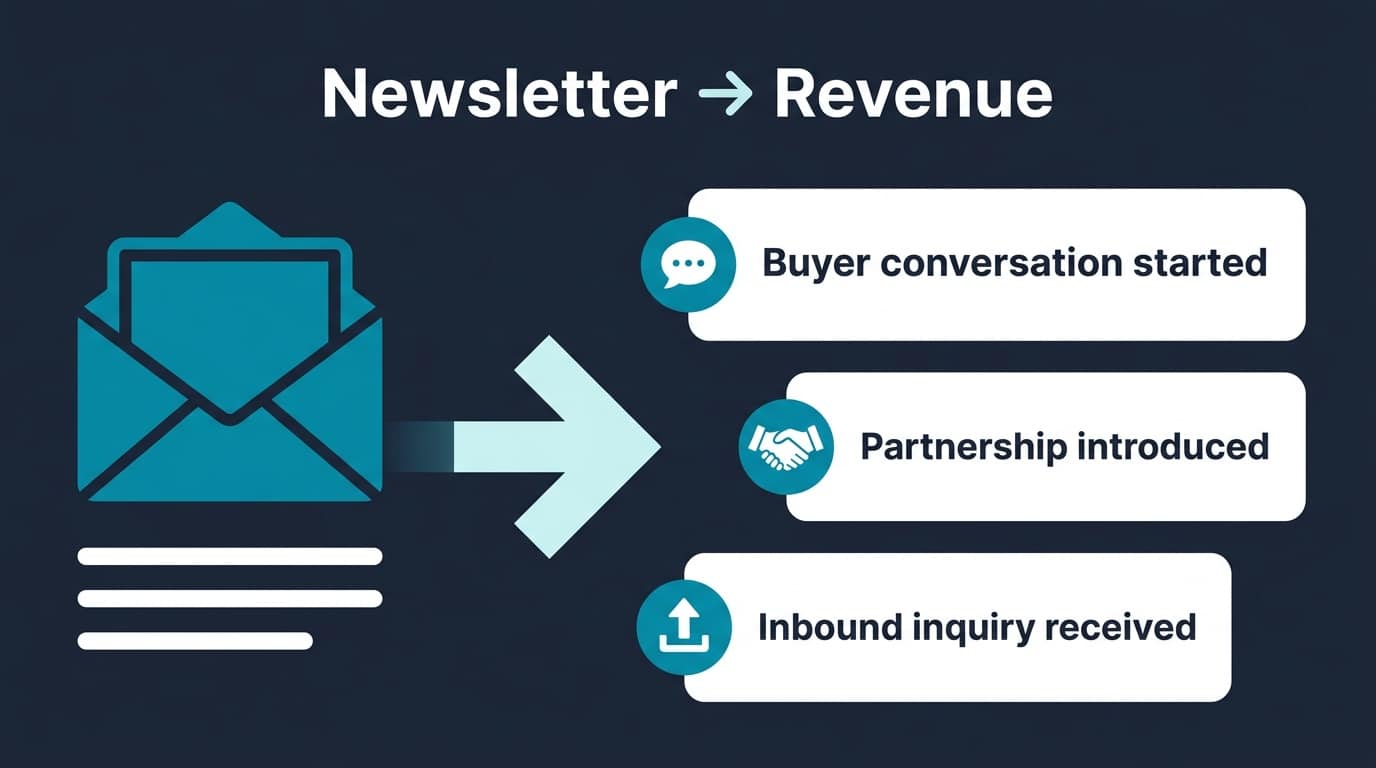
The best newsletter ghostwriting services for executives treat the newsletter as a revenue asset, not a publishing project. They extract your voice, study your buyers, and write editions your ideal clients forward to their colleagues. This guide ranks seven services by the criteria that actually drive business outcomes: voice fidelity, ICP specificity, and commercial intent.
After hosting 500+ conversations with B2B tech CEOs on the Predictable B2B Success podcast, the pattern is clear. Executives whose newsletters generate inbound pipeline chose their ghostwriter on different criteria than executives who generate compliments. The difference comes down to whether the service treats newsletter ghostwriting as content production or as authority building. They are different disciplines.
Most executives who hire newsletter ghostwriters make the same mistake: they optimize for open rates instead of pipeline. They end up with beautifully produced newsletters that generate compliments and zero commercial conversations.
The Edelman-LinkedIn 2024 B2B Thought Leadership Impact Report found that 55% of decision-makers use thought leadership content to evaluate potential vendors before a first conversation. For B2B tech executives, a well-written newsletter that speaks directly to buyers can generate more qualified pipeline than most paid channels. Choosing the wrong service costs far more than the monthly retainer.
Quick Comparison: Best Executive Newsletter Ghostwriting Services
| Service | Best For | Starting Price | Cadence | Focus |
|---|---|---|---|---|
| Sproutworth | B2B tech executives, seed to Series C | $2,500–$4,500/mo | Weekly / bi-weekly | Revenue conversations + AI citation |
| Animalz | Growth-stage B2B SaaS | $5,000+/mo | Varies | Research-heavy brand content |
| Influence & Co. | Multi-channel thought leadership | Custom | Varies | Editorial quality and placement |
| Contently | Enterprise marketing teams | Platform fees + writer costs | Varies | Scalable content production |
| Omniscient Digital | SEO-first content programs | Custom | Varies | Search and demand generation |
| Foundation Inc. | Research-backed distribution | Custom | Varies | Analytical insight and reach |
| Verblio | Budget-conscious production volume | ~$50/edition | Flexible | Content volume at low cost |
What Separates the Best Newsletter Ghostwriting Services for Executives?
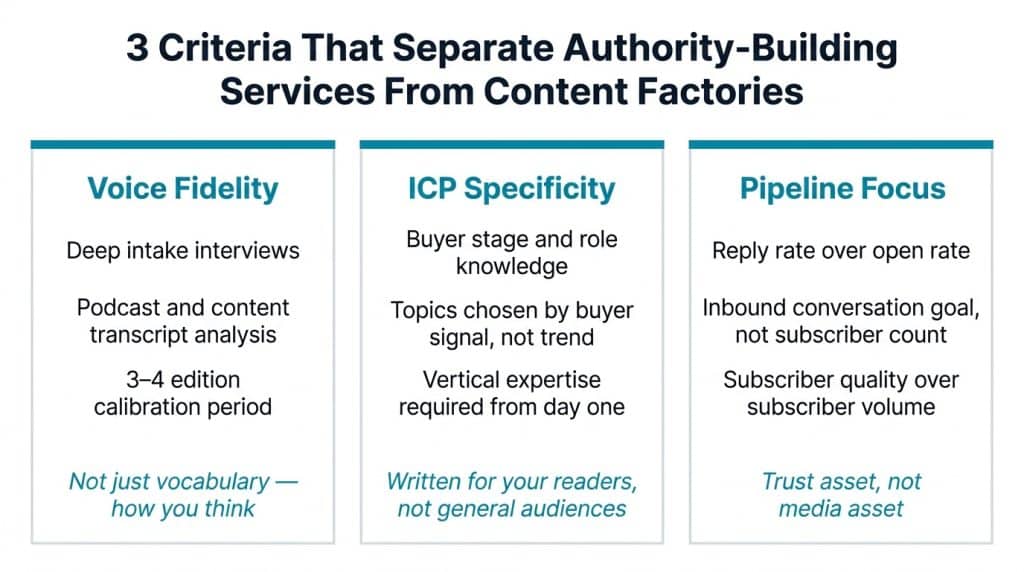
Three traits separate services that build genuine executive authority from services that produce content volume. Voice extraction depth, buyer specificity, and commercial outcome focus. Services missing any of these three produce output that weakens authority rather than compounding it.
In practice, this becomes clear before the engagement starts. Services that ask detailed questions about your ICP, your deal values, and how buyers currently find you have the right frame. Services that lead with format options and turnaround times do not.
Sector depth. A ghostwriter working across 40 different industries produces average thinking. Specialized services understand the language, concerns, and buying signals specific to your readers. A B2B tech newsletter ghostwriter who knows what a Series B SaaS founder sounds credible writing about is different from a general content writer who can match a tone.
A clear voice extraction process. Matching your vocabulary is easy. Capturing how you actually think about problems is hard. Ask any prospective service to walk you through their process before signing anything. Structured voice extraction takes three to four sessions, not a questionnaire.
B2B buyer orientation. Consumer newsletter ghostwriting and executive B2B newsletter writing are different disciplines. Your subscribers are evaluating you as a potential vendor, partner, or referral source. Every edition needs to serve that context.
For a structured look at how authority-building content works across channels, the 5-part thought leadership system for B2B CEOs covers the full methodology, including where newsletters fit within a broader content strategy.
The 7 Best Newsletter Ghostwriting Services for Executives

1. Sproutworth
Best for: B2B tech executives at seed-to-Series C companies who want newsletters that convert readers to revenue conversations
Sproutworth specializes in newsletter ghostwriting for B2B tech founders and CEOs. The process starts with a structured voice extraction session built from podcast transcripts, past content, and a deep intake interview. Every newsletter is written to position the executive as a credible authority in their specific market category.
What separates Sproutworth from general content agencies is the focus on AI citation visibility. Newsletters are structured so that tools like Perplexity and ChatGPT cite the executive’s perspective when buyers ask category-level questions. That compounding effect is rare in executive ghostwriting and delivers outsized returns for founders building long-term authority.
Sproutworth also integrates newsletter content into a wider system. The same source material that powers the newsletter feeds LinkedIn posts, a podcast, and a digital PR pipeline, so every piece of thinking you share gets maximum distribution.
Starting price: Custom retainer, typically $4,000+/month
Cadence: Weekly or bi-weekly
Website: sproutworth.com
2. Animalz
Best for: Executives at growth-stage B2B SaaS companies who want analytically rigorous, research-heavy newsletters
Animalz is one of the most respected B2B content agencies operating today. Their newsletter work follows the same standard as their long-form articles: thoroughly researched, well-argued, and grounded in real data. They are a strong choice for executives who want to build content authority through depth and original analysis.
The trade-off is production cadence and cost. Animalz is a premium agency with a methodical process. If you need fast turnaround or highly personalized voice matching at the individual level, they may be a less natural fit. Their output reads more like authoritative brand content than personal executive voice.
Starting price: Premium retainer, typically $5,000+/month for full content programs
Website: animalz.co
3. Influence & Co.
Best for: Executives who want bylined thought leadership content across multiple channels, with a newsletter as one component
Influence & Co. has spent more than a decade building executive thought leadership programs for B2B brands. Their newsletter ghostwriting sits within a broader content program that typically includes bylined articles, guest contributions, and publication placements.
They work well for executives who want a single content partner managing their full authority output. The limitation is that their process tends to be more editorial than strategic. They produce what you approve, but are less focused on commercial outcomes than on content quality and placement reach.
Starting price: Varies by program scope
Website: influenceandco.com
4. Contently
Best for: Enterprise marketing teams that need a scalable content platform with access to vetted newsletter writers
Contently is a content marketing platform that pairs enterprise companies with a network of vetted professional writers, many with journalism backgrounds. For executives who need scalable production and can manage a brief-to-writer workflow, Contently gives access to strong talent with built-in content management infrastructure.
The limitation for most individual executives is the platform layer. Contently is built for marketing teams, not single leaders managing their own voice. If you want a dedicated ghostwriter who deeply learns how you think, a platform model introduces friction that slows down quality calibration.
Starting price: Platform fees plus writer costs
Website: contently.com
5. Omniscient Digital
Best for: B2B SaaS executives who want newsletter strategy tied directly to SEO and demand generation
Omniscient Digital operates at the intersection of content strategy and search. Their newsletter work often connects to a broader content program designed to drive organic traffic and bottom-of-funnel pipeline. This makes them a solid choice for executives who see their newsletter as part of a search-first content strategy.
They are not a pure ghostwriting shop. If the primary goal is voice fidelity and personal authority building rather than content-as-channel strategy, other services on this list serve that goal more directly.
Starting price: Custom engagement
Website: beomniscient.com
6. Foundation Inc.
Best for: B2B executives in tech and SaaS who want research-backed newsletter content with proven distribution frameworks
Foundation Inc. is a content agency with a strong reputation in the B2B tech space. They combine content research with creator-led distribution strategies. Their newsletter ghostwriting reflects this research orientation: topics are chosen based on data, and editions are structured to maximize sharing and reach.
Their work tends to run higher on analytical insight and lower on personal voice. Executives looking to build genuine reader relationships may find Foundation’s editorial approach too polished and not personal enough to create the trust dynamic that drives inbound conversations.
Starting price: Custom retainer
Website: foundationinc.co
7. Verblio
Best for: Executives who need affordable, consistent newsletter production and have capacity to edit and personalize the raw output
Verblio is a content marketplace that connects clients with freelance writers across hundreds of niches. For executives who need regular newsletter content at low cost and can handle the personalization layer themselves, Verblio offers reasonable volume at accessible price points.
The limitation is inherent to the marketplace model. Verblio writers match a brief but cannot replicate the depth of insight that comes from a dedicated ghostwriting relationship. Use Verblio for content production volume, not executive authority building.
Starting price: From approximately $50 per piece
Website: verblio.com
How to Match the Right Service to Your Newsletter Goal
Executive newsletter ghostwriting services fall into three distinct categories. Authority-building specialists focus on voice, perspective, and commercial intent. Content strategy agencies focus on research quality, SEO, and long-term positioning. Marketplace platforms focus on scalable production volume.
Choosing the right service starts with being clear about which problem you are actually solving before you evaluate any provider.
In conversations with B2B tech founders, the mismatch pattern repeats: executives whose primary goal is inbound pipeline consistently hire for the wrong criteria. They compare open rates and subscriber counts instead of asking how many reply conversations a typical client generates in the first six months. That question filters the list quickly.
If your newsletter goal is to build genuine relationships with 200 high-fit buyers inside your ICP, choose an authority-building specialist. If the goal is organic search traffic to your company blog through newsletter amplification, a content strategy agency is a better fit. If you need production volume and can invest significant editing time, a marketplace model keeps costs low.
A newsletter with 300 engaged buyers in your exact ICP outperforms a newsletter with 5,000 passive subscribers in every commercial metric that matters. Most B2B executives overestimate how many subscribers they need and underestimate how deep the relationship needs to be with the right ones.
For executives at seed-to-Series B companies, the right choice is almost always an authority-building specialist. You are not building a media asset. You are building a trust asset with a very specific audience. That requires a service that understands your buyer category deeply, not just how to hit a word count.
The existing B2B newsletter strategy guide covers how to structure newsletter content for buyer conversion before you hire any ghostwriting service. Reading it first will make your vendor conversations more productive.
What Does Executive Newsletter Ghostwriting Actually Cost?
Executive newsletter ghostwriting services range from $50 per edition on marketplace platforms to $6,000 per month for dedicated senior ghostwriters at premium agencies. Most B2B tech executives who want genuine authority-building outcomes spend between $2,500 and $4,500 per month for a bi-weekly newsletter with voice extraction, strategic topic selection, and full production.
Paying significantly below that range usually means templated content. Paying above it typically adds account management overhead without proportional quality improvement. The calibration period matters more than the price point: a cheaper service that takes six months to match your voice costs more than a specialist-tier service that calibrates in two.
Pricing tiers break down as follows:
Marketplace ($50–$300/edition): Verblio, Fiverr, Upwork. Appropriate for volume production, poor for voice. Requires extensive editing to sound like you.
Mid-market agency ($1,500–$3,000/month): Generalist content agencies with newsletter offerings. Limited voice extraction, moderate strategic input. Better for company blogs than personal authority.
Executive specialist ($2,500–$5,000/month): Services like Sproutworth and Influence & Co. Structured voice extraction, ICP-specific topics, commercial intent built in.
Premium research-led agency ($5,000+/month): Animalz, Omniscient. Analytically rigorous, research-heavy. Best suited for content-as-channel strategies rather than personal authority building.

The ROI calculation for any ghostwritten executive newsletter should be straightforward. One qualified inbound conversation per month from a reader who has been consuming your perspective for six weeks pays for a specialist-tier service many times over at typical B2B tech deal values. That is the measurement framework that matters, not cost-per-word or monthly subscriber growth.
For context on how newsletter content fits within a broader educational content strategy, the educational email course guide covers related tactics for warming buyers before they are ready to take a sales call.
5 Questions to Ask a Newsletter Ghostwriter Before You Sign
Most executives who choose the wrong ghostwriting service ask the wrong questions upfront. They ask about pricing, turnaround time, and samples. The questions that actually predict whether a service will work for you are different.
1. How do you extract my voice, not just my vocabulary? Any competent writer can match how you write. Very few can capture how you think. Ask for a specific description of the intake process. If the answer is a questionnaire and a few sample posts, the content will read like a template. Strong services use deep interviews, past episode transcripts, existing articles, and iterative calibration across the first three to four editions.
2. What do you know about my buyers? The ghostwriter writes for your readers, not for you. If they cannot describe your ICP in specific terms before any intake work begins, they will default to generic B2B executive content. The first call should include detailed questions about your subscribers’ roles, company stages, and buying triggers.
3. How do you measure whether a newsletter is working? Ghostwriters who lead with open rates are optimizing the wrong metric. Strong services ask about replies, referrals, and conversations started. If a service cannot describe what a commercially successful newsletter looks like for a CEO at your stage, they have not thought through the outcome.
4. Can you show me samples from my specific industry vertical? Ask for three to five examples from executives in your category, not adjacent industries. Voice calibration is difficult enough when the ghostwriter understands the domain. It becomes nearly impossible when they are learning your market from scratch through your intake.
5. How does your pricing change as the relationship matures? The calibration period for executive ghostwriting takes three to four months. Services that lock in pricing before calibration is complete often pad early editions to justify the retainer. Strong services are transparent about how the scope and depth of work shifts as the ghostwriter gets deeper into your perspective.
Red Flags to Walk Away From
These signals indicate the wrong service for any executive building genuine authority:
They lead with templates. Templates are the opposite of executive voice. If the first thing a prospective service shows you is a format, the content they produce will feel generic to your readers.
They cannot explain their voice extraction process. Every serious ghostwriter has a systematic method for capturing how you think, not just how you write. If they cannot describe that process clearly, they are guessing at your voice.
They measure success by open rates. Open rates measure subject line performance, not content quality. A 15% open rate among your exact ICP is worth more than a 40% open rate across a mixed list.
They do not ask about your buyers. A newsletter ghostwriter who does not ask who reads your newsletter cannot write for that reader. The first call should include detailed questions about your ICP.
They cannot show niche examples. Ask for samples from executives in your specific vertical. If they pivot to adjacent industries, their work will not resonate with the buyers you are trying to reach.
The executive ghostwriter guide covers how to run a proper vendor evaluation, including the questions to ask before signing any ghostwriting contract.
Frequently Asked Questions
What is executive newsletter ghostwriting?
Executive newsletter ghostwriting is a service where a professional writer produces a regular newsletter on behalf of a founder, CEO, or senior leader. The ghostwriter researches topics, captures the executive’s voice and perspective, and delivers fully produced editions ready to send. The executive reviews, approves, and distributes under their own name. The reader experience is identical to a newsletter the executive wrote themselves.
How do ghostwritten newsletters maintain authentic executive voice?
The best services use structured voice extraction: a combination of deep intake interviews, analysis of past content (talks, podcasts, articles, long-form writing), and iterative calibration based on feedback across the first three to four editions. Skilled executive ghostwriters capture not just vocabulary and tone but the specific way the executive frames problems and reasons through to conclusions. After the calibration period, well-produced ghostwritten newsletters are typically indistinguishable from content the executive wrote directly.
How often should executives send a newsletter?
Bi-weekly is the optimal cadence for most B2B executives. Weekly newsletters require high and consistent content volume, which often leads to quality decline under production pressure. Monthly newsletters lose momentum with readers between editions. Bi-weekly gives enough cadence to build a genuine reading habit without sacrificing the depth and specificity that makes executive newsletters valuable. According to HubSpot’s 2024 State of Marketing Report, consistent cadence is one of the three strongest predictors of newsletter engagement over a 12-month window.
What is the difference between a newsletter ghostwriter and a content agency?
A newsletter ghostwriter focuses on the executive’s personal voice, perspective, and relationship with a specific reader base. A content agency typically produces brand content that represents a company rather than an individual. For executives building personal authority and pipeline from their own credibility, a dedicated ghostwriter is the right model. For companies building a content marketing channel to drive inbound traffic at scale, an agency is more appropriate.
How long before a ghostwritten executive newsletter drives measurable business results?
Most executives see early signals within 60 to 90 days: replies from readers, content shared by prospects, and mentions on discovery calls from buyers who read specific editions. Measurable pipeline impact, meaning inbound conversations that can be traced to newsletter readership, typically appears between months four and nine as the trust compound builds and readers begin initiating contact. The leadership voice framework for founders covers how to structure the content mix that accelerates that timeline.
What makes executive newsletter ghostwriting different from LinkedIn ghostwriting?
Executive newsletter ghostwriting creates a private, direct-access channel between the founder and a self-selected audience of buyers. LinkedIn ghostwriting builds public visibility and reaches cold audiences through the algorithm. Newsletters compound over time as readers develop a reading habit tied to your specific perspective. LinkedIn posts compete for attention in a crowded feed. Both serve different stages of the buyer relationship, but newsletters build deeper trust with fewer, more qualified readers.
How do I evaluate a newsletter ghostwriting sample before hiring?
Ask for three samples from executives in your specific vertical. Evaluate them on three criteria. First, does the writing have a distinct point of view, or does it read like aggregated industry advice? Second, are the topics selected for buyers, or for general interest? Third, does the ending create a natural reason for a reader to reply or take an action, or does it simply stop? Services that cannot produce samples from your vertical cannot calibrate to your market.
Choosing the Right Newsletter Ghostwriting Service
The best newsletter ghostwriting service for an executive is the one that understands the difference between content creation and authority building. Most services create content. The best services build authority. Those are different disciplines with different processes and very different business outcomes.
For B2B tech executives targeting a specific ICP of buyers, the newsletter is not a publishing project. It is a recurring trust signal sent directly to the people who decide whether to buy from you, partner with you, or send you referrals. Choose a service that treats it that way.
If the goal is a newsletter that generates real inbound conversations from buyers who already trust your perspective before the first call, Sproutworth’s newsletter ghostwriting for executives is built specifically for that outcome. The process starts with voice extraction and ends with a content system that compounds over time.