
Most B2B lead magnets collect email addresses. Educational email courses collect trust. That distinction is between a list that sits dormant and a pipeline that runs on autopilot.
Funded B2B tech founders are waking up to this. The ones scaling from Series A to Series C are not blasting cold outreach or hoping their blog drives inbound. They are building educational email sequences that teach prospects something genuinely useful, position the founder as the expert worth hiring, and qualify leads by how far they read before checking out. It is a smarter pipeline play than almost anything else in the B2B marketing toolkit right now.
Table of Contents
What Is an Educational Email Course for B2B?
An educational email course for B2B is a short automated sequence of emails, typically five to ten lessons, designed to teach a prospect something valuable while positioning the sender as a trusted authority. Unlike cold outreach or promotional sequences, each email delivers a standalone lesson with no ask. The goal is trust first, pipeline second.
In the B2B context, these courses serve a specific purpose. Enterprise buyers and funded startup teams take months to make vendor decisions. An educational email course keeps your thinking in their inbox during that window, building familiarity without pressure.
“The difference between a lead magnet and an educational email course is the difference between a business card and a conversation. One signals you exist. The other builds a relationship.”
That distinction matters enormously for B2B CEOs targeting slow-moving, committee-based buying cycles. A five-email course that genuinely teaches something relevant will do more for your pipeline than a whitepaper that gets downloaded and forgotten.
Why Funded Founders Treat B2B Email Courses as Pipeline Assets
A pattern I notice across seed to Series C companies is this: the fastest-moving pipelines belong to founders who have built some form of automated trust infrastructure. Educational email courses are the most efficient version of that infrastructure I have seen.
Here is why they work so well for funded B2B tech companies specifically.
Buyers do not trust vendors. They trust teachers.
Gartner research shows that B2B buyers now spend only 17% of their time meeting with potential suppliers across an entire purchase journey. The rest is independent research, peer consultation, and internal deliberation. By the time a prospect books a demo, they have largely decided whether you are credible. An educational email course puts your thinking in front of them during that invisible research phase, when no sales rep can reach them, but well-structured content can.
This is not a marginal advantage. LinkedIn’s B2B Buyers Survey found that nine out of ten B2B buyers say online content has a moderate to major effect on purchasing decisions. An educational email course delivers seven to ten pieces of your thinking, sequentially, at the exact moment a buyer is open to learning. No other format achieves that concentration of influence in a single subscriber experience.
Email converts better than almost every other B2B channel.
For a funded B2B company, spending on paid acquisition matters. Email nurturing sequences consistently outperform retargeting and social in terms of cost-per-qualified-lead. When those sequences teach rather than sell, engagement rates climb noticeably. The Inbox Collective documented a landing page that went from a 2% conversion rate to 48% after adding an educational email course as the primary lead magnet. That is not a marginal improvement. That is a different business model.
According to Campaign Monitor’s B2B email benchmarks, educational and instructional email sequences see open rates 30 to 40% above standard promotional emails. For a B2B company competing for executive attention in a crowded inbox, that gap determines whether your marketing gets seen or ignored.
The compounding effect accelerates over time.
A blog post can rank, plateau, and sometimes decline. An educational email course runs continuously. Every new subscriber enters the same trust-building sequence. Every completed course creates a prospect who knows your thinking, respects your methodology, and is far closer to a conversation than someone who read a blog post once.
I have seen this play out with Series B SaaS founders I work with. Their inbound inquiry quality shifted noticeably within three months of launching a well-structured email course. Not just more inquiries. Better ones. Prospects arriving pre-sold on the approach and wanting to explore fit rather than evaluate options.
How Educational Email Courses Build CEO Authority Before the Demo
There is a specific kind of authority that matters for B2B tech founders. Not the theoretical authority of a thought leader who talks about ideas. The practical authority of someone who has clearly done the work, made the mistakes, and built something that works.
Educational email courses are among the best ways to demonstrate authority at scale.
Each lesson is a compressed version of what you know. If you write a course on, say, how to reduce CAC in a B2B SaaS business, you are not writing for everyone. You are writing for a specific buyer with a specific problem. Every lesson they open and read moves you from “company we are evaluating” to “person who understands our situation.”
“An educational email course is your thinking, packaged for the moment a buyer needs it most, delivered automatically, without you needing to be in the room.”
This matters especially at the enterprise level. I work with cleantech founders pitching enterprise deals that take eight to fourteen months to close. During that window, the decision-making committee reads, researches, and compares. A founder whose educational email course has been sitting in the inbox of three people on that committee has a significant advantage over one who sent a one-page deck six months ago.
The authority signal is also useful beyond buyers. Investors notice how founders think. A well-structured educational email course shared during a fundraising process tells a story about intellectual rigor and audience understanding that a pitch deck alone cannot.
The LinkedIn connection is direct.
Founders who publish well on LinkedIn often already have the raw material for an email course. The same insights that perform well in posts work even better in a sequence where each email builds on the last. The difference is depth. A LinkedIn post is a headline and three paragraphs. An email course is a chapter. The thought leadership strategy that powers your LinkedIn can also power your email course. They reinforce each other.
The Pipeline Intelligence Signal Most B2B Founders Miss
Here is the insight that almost no one talks about when discussing educational email courses: your completion data is a lead-scoring engine.
Most B2B founders view their email course solely as a nurture tool. Open it, get nurtured, and eventually book a call. But the behavioral data inside the course tells you something far more precise.
A prospect who opens all seven emails, clicks through on lesson four about pricing strategy, and re-opens lesson six two days later is telling you something clear. They are in an active buying cycle. They are thinking seriously about the problem your course addresses. They are no longer a cold lead.
A prospect who opens lesson one and ghosts by lesson three is also telling you something. They are curious but not ready. They may be six months from a buying decision. They do not need a sales call. They need to stay in your newsletter until that changes.
This distinction is valuable because it lets you prioritize without guessing. I advise funded founders to set up a simple trigger: anyone who completes the full email course within the first fourteen days moves into a high-intent follow-up sequence. Not an aggressive one. Just one that offers a specific next step at the moment of highest engagement.
The segmentation goes further than just completers versus non-completers. Which specific email got the most re-opens tells you what your audience finds most relevant. If email four on pricing is opening twice among 30% of your list, you have just learned something important about your buyer’s primary concern. That is qualitative research delivered for free, embedded in your existing marketing motion.
A 2024 Litmus State of Email report found that segmented email campaigns generate up to 760% more revenue than non-segmented ones. The founders who treat their email course as a segmentation and lead-scoring engine rather than just a nurture tool are the ones unlocking that kind of difference in their pipeline outcomes.
“Your email course completion rate is a better lead-scoring signal than a whitepaper download. It measures attention, not just curiosity.”

The founders who use their course data this way turn their nurture infrastructure into a live pipeline dashboard. They know who is warm, who is cold, and who just moved from researching to buying.
A pattern I notice is that founders often set up their email course and then stop looking at the data. The course runs. Leads trickle in. But no one is reading the completion rates. That is leaving one of the most useful signals in B2B marketing on the table.
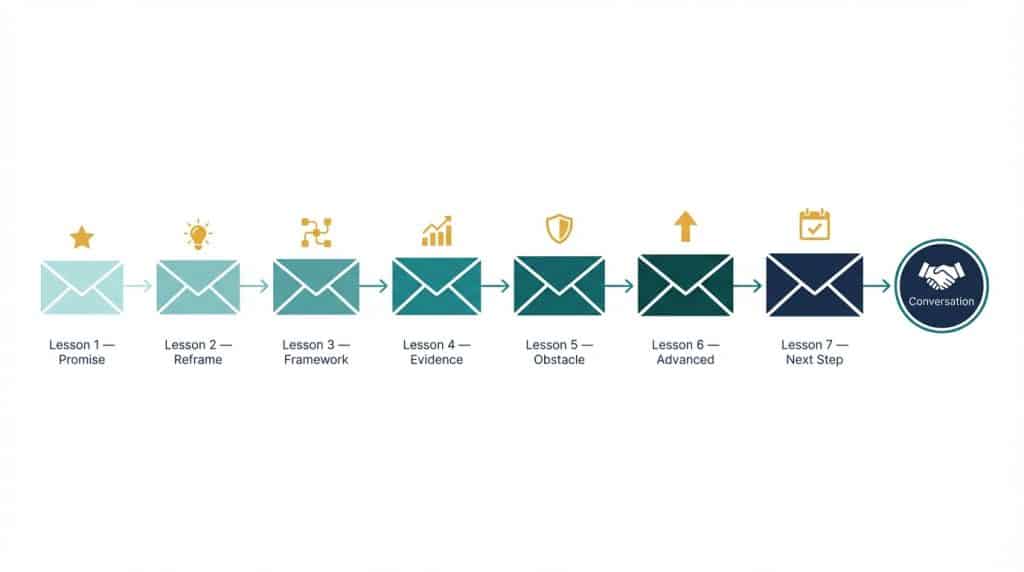
How to Structure a B2B Educational Email Course (7-Email Framework)
The specific structure of your course matters. Not because there is only one way to do it, but because the wrong structure breaks trust early and costs you the relationship.
Here is the framework I use when building educational email courses for funded B2B tech founders:
Email 1: The Promise
Set expectations clearly. Tell subscribers what they will learn, why it matters, and what they will be able to do by the end. This email has the highest open rate of the sequence. Use it to establish credibility and create anticipation for what follows. Keep it under 300 words.
Email 2: The Reframe
Challenge a commonly held belief in your buyer’s world. This is where you start demonstrating original thinking rather than recycling what everyone already knows. A Series A fintech founder I work with used this email to challenge the assumption that content marketing is a long-game-only play. That reframe made the rest of the course feel essential.
Email 3: The Framework
Give subscribers a named methodology or model. Something concrete they can apply immediately. Founders underestimate how much a named framework does for authority. Buyers remember frameworks. They share them. They come back to them.
Email 4: The Evidence
Use a real-world example. Anonymized client scenarios work well here. Something specific: the type of company, the problem they faced, the approach that worked, the result. Not vague. “A Series B cleantech company reduced demo-to-close time by 30% using…” is far more useful than “one of our clients found that…”
Email 5: The Obstacle
Address the most common objection or failure mode. What do companies try that does not work? Why does it fail? This builds trust because it shows you understand the reality of implementation, not just the theory.
Email 6: The Advanced Move
Give them something beyond the basics. This email rewards the people who are still reading at email six, which means it is reaching your highest-intent prospects. Give them something genuinely useful that they could not have gotten from a blog post.
Email 7: The Next Step
Summarise the course, acknowledge what they now know, and offer a specific next step. Not a generic “book a call.” Something related to where they are. If your course was about reducing CAC, the next step might be a specific resource on measuring content attribution, or an invitation to a relevant piece of content. For the B2B newsletter ghostwriting clients I work with, this final email is often where the first real conversation starts.

Practical notes on format:
– Each email: 350 to 600 words. Long enough to teach. Short enough to respect executive attention.
– Send cadence: one email every two days for a standard course. Daily for a five-day sprint format.
– Subject lines: state the lesson number and the specific value (“Lesson 3: The Framework That Reduces Demo Drop-Off”).
– Plain text performs better than heavily designed HTML for B2B executive audiences. It feels more like a message from a person than a marketing blast.
For a deeper look at the SaaS-specific version of this structure, see Educational Email Course for B2B SaaS: Build Trust Before the Demo Request.
How Does a B2B Educational Email Course Fit With Your Newsletter and LinkedIn Content?
This is one of the most common questions I hear from founders building their content ecosystem: where does the email course fit relative to the newsletter, the LinkedIn posts, and the podcast?
The short answer: the email course is the entry point, and everything else is the ongoing relationship.
Think of it as a funnel with three stages:
Stage 1: Discovery (LinkedIn + Podcast)
A prospect encounters your thinking on LinkedIn or as a podcast guest. They see something useful. They click through to learn more.
Stage 2: Depth (Educational Email Course)
They sign up for the email course. Over seven emails, they move from curious to convinced that you understand their world. This is where trust is built at scale.
Stage 3: Continuity (Newsletter)
After completing the course, they roll into your regular newsletter. They already know your thinking. Now they stay current with it. This is where the relationship compounds over months and years.
The content is not siloed. The frameworks in your email course can be turned into LinkedIn posts. The conversations from your newsletter can feed new email course lessons. The B2B content marketing strategy that drives your blog also provides raw material for both.
One specific approach I recommend: repurpose your five highest-performing LinkedIn posts into the first five lessons of your email course. If those posts resonated publicly, the thinking behind them will resonate in the inbox. The depth you can add in the email form, with 400 words per lesson instead of 250 words on LinkedIn, makes the course version noticeably more valuable than the social version. Subscribers feel like they are getting the director’s cut.

After 500 episodes of the Predictable B2B Success podcast, I can tell you that founders who have this ecosystem in place arrive at sales conversations in a completely different position. The prospect already knows their thinking. The conversation skips the credibility-building phase and goes straight to fit.
One thing I have started recommending to founders is to use the email course as a conversion point from podcast listeners. Pin the course URL in every episode description. Tease a specific lesson on air. Listeners who are curious enough to sign up are already deeply engaged with your thinking. That is a warm lead with almost no acquisition cost.
The Delegation Model: Why Funded Founders Commission Their Email Courses
Here is the reality. Most funded B2B tech founders have the expertise to build a great educational email course. What they do not have is the time to extract that expertise, structure it properly, write it, sequence it, and test it.
The delegation model is simple: the founder provides the thinking, the frameworks, and the client examples. A ghostwriter structures and writes the course in the founder’s voice. The founder reviews, edits for accuracy, and approves.
This is how most high-quality executive content gets produced. Not because the founder cannot write, but because writing is not the highest-leverage use of a Series B founder’s time. Salesforce research consistently shows that B2B buyers now expect vendors to demonstrate a deep understanding of their problems before any commercial conversation begins. The founder who is busy writing email sequences is not building the relationships, closing the deals, or developing the product that earns that understanding.
The key to making delegation work for an educational email course is the briefing process. A good ghostwriter does not just write from a one-page brief. They interview the founder. They extract the frameworks, the client examples, the contrarian angles, and the specific vocabulary the founder uses. Then they structure it into a sequence that sounds like the founder at their best.
I have seen founders who commission their first email course go from zero automated nurture infrastructure to a working pipeline engine in six to eight weeks. Not because the ghostwriting was magic. Because having the structure forced the thinking, and the thinking was already there.
The alternative, building it yourself without structure, often results in a course that sits half-finished for months. The intention is real. The execution gets deprioritized every week. A commissioned course has a deadline.
If you are a funded B2B tech founder evaluating whether to commission or build your email course, the question to ask is not whether you can do it. It is whether it will actually get done. This is the kind of content infrastructure work I do at Sproutworth for seed to Series C companies that need the pipeline asset but cannot afford to let it become a six-month side project.
💡 CEO Takeaway
- An educational email course is not a lead magnet. It is a trust-building pipeline asset that qualifies leads based on behavior, not just contact information.
- Set up a completion trigger: anyone who finishes all emails within 14 days enters a high-intent follow-up sequence.
- Use the 7-email framework: Promise, Reframe, Framework, Evidence, Obstacle, Advanced Move, Next Step.
- Treat your newsletter as the continuity layer that follows the course, not a replacement for it.
- If the course does not get built because you are too busy, commission it. An unfinished email course is worth exactly zero to your pipeline.
FAQ
What is an educational email course for B2B, and how is it different from a drip campaign?
An educational email course for B2B is a structured sequence of emails, typically five to ten lessons, where each email teaches a specific concept relevant to the subscriber’s problem. Unlike a standard drip campaign, which often mixes promotional and nurture content, an educational email course delivers only teaching content. Every email gives something without asking for anything. The goal is to build trust through demonstrated expertise, positioning the sender as the authority a buyer wants to work with before they ever make contact.
How many emails should a B2B educational email course have?
Most effective B2B educational email courses run five to ten emails. Five is the minimum to build meaningful trust; anything over ten risks losing attention. For funded B2B tech founders targeting busy executives, a proven approach is to send 7 emails. One email every 2 days. This gives enough time to establish credibility, demonstrate methodology, show evidence, and offer a natural next step, without overwhelming a time-poor inbox.
What topics work best for an educational email course targeting B2B CEOs?
Topics that perform best are those in which the subscriber has an urgent problem and a knowledge gap. For B2B tech companies, this often means topics such as reducing CAC, improving retention, building a pipeline without a large sales team, or navigating a specific industry challenge. The more specific the topic, the better the course performs. A course called “How to Build Pipeline Authority as a B2B Tech CEO” will outperform “B2B Marketing Tips” every time, because specificity signals expertise and attracts better-qualified subscribers.
How do I measure whether my B2B educational email course is working?
Track four metrics: open rate by email (should stay above 40% through email four if the content is strong), completion rate (how many subscribers finish all emails), click-through rate on the final email’s call-to-action, and time-to-book-demo for subscribers who completed the course versus those who did not. Completion rate is the most important signal. A drop-off between email two and three typically means the second email did not deliver on the promise of the first.
Can a B2B educational email course work without a large existing email list?
Yes, because the email course itself is what builds the list. Run paid traffic to a dedicated landing page offering the course as a free resource. Use LinkedIn posts to drive sign-ups. Pin the course URL in podcast episode descriptions. The course converts cold traffic into warm prospects far more effectively than a generic newsletter sign-up form, because it offers a specific outcome in exchange for an email address. A course that promises to help a B2B founder reduce their demo-to-close time is a far more compelling offer than “subscribe for updates.”
Conclusion
The educational email course for B2B is one of the most underused growth plays available to funded founders right now. The competition is thin. The trust-building mechanism is proven. The pipeline intelligence it generates is genuinely valuable.
Most founders know they need better nurture infrastructure. Few build it because the task feels large and the results feel distant. The founders who do build it, or commission it, tend to look back six months later and wonder why they waited.
Start with seven emails. Teach something specific. Let the completion data tell you who is ready to talk. And if the course is not getting built because life keeps happening, that is the signal that it needs to be commissioned rather than DIY’d. The pipeline it creates is worth it.
Related Resources
- Educational Email Course for B2B SaaS: Build Trust Before the Demo Request
- B2B Newsletter Ghostwriting: Build Pipeline as a Tech CEO
- Thought Leadership Strategy: The B2B CEO’s Guide to Building Pipeline Authority
- B2B Content Marketing: A CEO’s Guide to Building Scalable Pipeline
- Expert Ghostwriting Services for Thought Leadership