
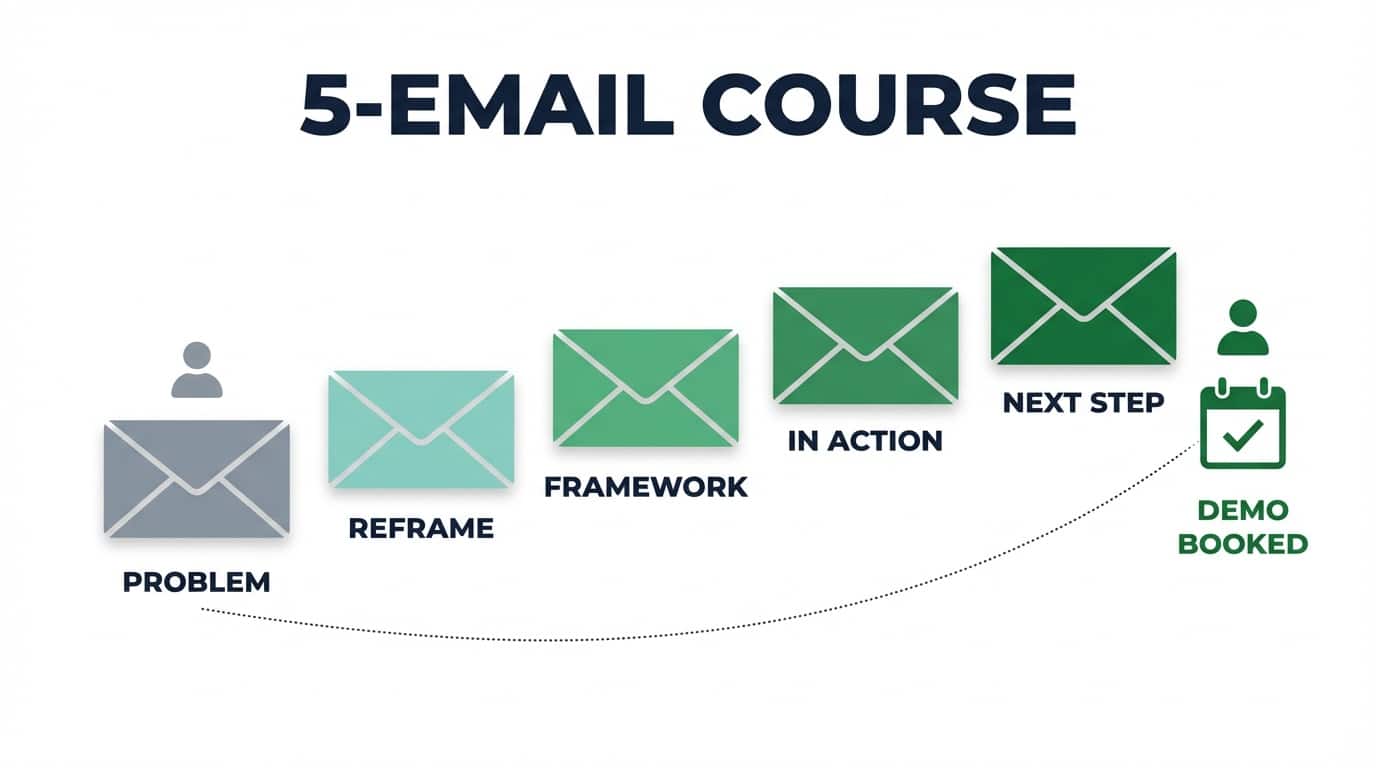
Most B2B SaaS companies treat lead nurture like a timer. Send a welcome email. Drop a case study three days later. Push a demo request on day seven. Then wonder why website conversion rates average just 1.1% across the industry.
The problem is not the timing. It is a category error. Drip sequences are interruptions. An educational email course is something your prospects actually request.
After interviewing 500+ B2B revenue leaders on the Predictable B2B Success podcast and ghostwriting content for funded SaaS founders from seed to Series C, one pattern holds: the companies building a real pipeline from email are not nurturing leads. They are teaching them.
This guide covers exactly what a B2B SaaS educational email course is, why it outperforms every other mid-funnel email asset, how to structure one that converts, what platforms to use, how to write subject lines that get opened, and how to build the whole thing without writing it yourself.
Table of Contents
What Is an Educational Email Course for B2B SaaS?
An educational email course for B2B SaaS is a structured sequence of five to ten emails, each delivering one focused lesson, that teaches a target prospect something genuinely valuable about the problem your software solves.
Unlike a generic drip sequence, it is designed as a complete learning experience with a clear arc: problem named, framework introduced, transformation delivered. Unlike a newsletter, it ends. Subscribers commit to a bounded experience with a defined outcome, not an indefinite subscription.
For B2B SaaS specifically, the EEC functions as an always-on trust engine. It sits between cold discovery and the first sales conversation. It converts website traffic, LinkedIn connections, and content readers into informed, warmed buyers before your BDRs make contact.
The distinction from other email assets matters. A newsletter is read and largely forgotten. A lead magnet is downloaded and rarely revisited. An educational email course is completed, referenced, and remembered because it produces a real change in how a subscriber understands their problem. That changed understanding becomes buying intent.
An educational email course is the only B2B email asset that teaches prospects to think about their problem the same way you do — and that cognitive shift is the conversion.
The format is deliberately bounded. Five to seven emails, one idea per email, delivered over five to ten days. Busy executives commit to a short, structured course, but they never commit to an indefinite subscription. That bound is a feature, not a limitation.
A Series A data infrastructure company I worked with described the shift clearly. Before adding an EEC to their website, their primary CTA was “subscribe for weekly insights.” After replacing it with a five-email course on calculating the true data pipeline cost, both the opt-in rate and the quality of demo requests changed significantly. Leads who booked a call after the course had already done most of the qualification work themselves.
Why Most B2B SaaS Lead Nurture Sequences Fail Before the Demo
Here is what I observe across funded B2B SaaS companies I work with: their “nurture” sequence is a newsletter wearing a drip costume.
Email 1: Welcome and company overview.
Email 2: Feature highlight.
Email 3: Case study.
Email 4: “Ready to book a demo?”
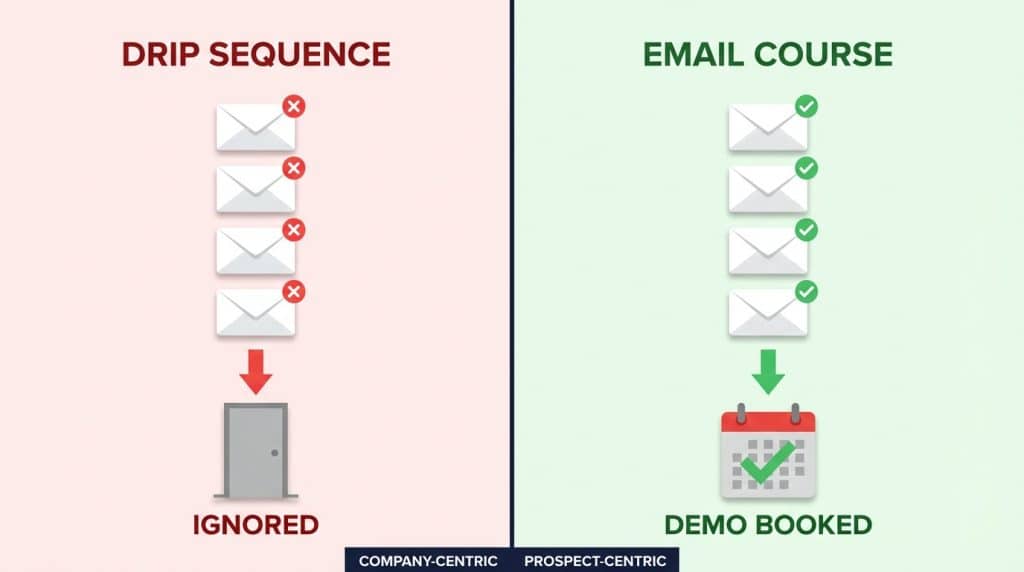
This sequence fails for one structural reason: it is entirely about the company, not the buyer. B2B SaaS buyers, especially at Series A targets and enterprise accounts, are not ready to engage with company-first content when they opt in. They are trying to understand a problem they may not have fully articulated yet.
The data supports this. Lead nurturing emails generate four to ten times more responses than generic email marketing campaigns, according to research compiled by Artisan AI. But the operative word is “nurturing.” Most sequences skip the nurturing and jump to selling.
The B2B SaaS buying environment makes this worse. The average B2B sales cycle is now 25% longer than it was five years ago, and six to ten stakeholders are typically involved in any significant purchase. A single case study does not move eight people through a buying committee. A structured educational experience can.
The B2B SaaS website conversion rate averages just 1.1%, well below the B2B average of 2.9%. That gap is not a traffic problem. It is a trust deficit. Visitors arrive, scan a features page, see a demo CTA they are not ready for, and leave. The EEC closes that gap by meeting prospects at the awareness stage, not the decision stage.
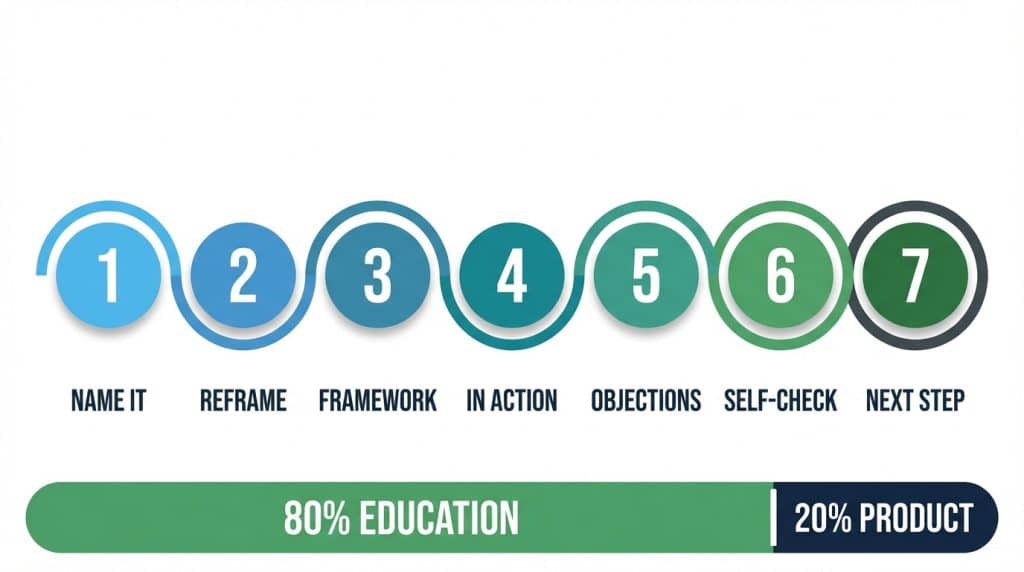
The 80/20 rule for EEC emails: at least 80% of your emails should deliver educational value before introducing any product messaging. In a seven-email course, that means emails one through five are pure teaching. Only emails 6 and 7 should reference your product. This ratio is what separates courses that convert from those that feel like a dressed-up sales sequence.
Most B2B SaaS “nurture” sequences are company-centric. An educational email course is prospect-centric. That one difference determines whether prospects read on or unsubscribe.
How an Educational Email Course Fits the B2B SaaS Buying Journey
B2B SaaS sales cycles are not linear. A prospect discovers you, reads one blog post, disappears for six weeks, sees your founder on LinkedIn, reads two more pieces, and then finally books a call. The trigger for that call is rarely a sales email. It is the accumulation of trust.
An educational email course inserts your brand into that accumulation process on your terms. Here is how it maps to each stage of the SaaS buying journey.
Awareness stage: naming the problem
At awareness, the prospect has a vague sense that something is costing them money or time, but they have not framed it as a problem your category solves. Your EEC names the problem precisely and gives it a framework. They now associate your brand with category intelligence, not vendor noise.
The goal here is not to sell. It is to be the company that made them smarter. That association is durable.
Consideration stage: owning the decision criteria
At consideration, the prospect is actively evaluating approaches and vendors. An EEC built around “how to evaluate solutions in this category” performs exceptionally well here. When your company writes the evaluation rubric, your approach naturally aligns with it.
A pattern I notice consistently across funded B2B tech companies: companies that build their EEC around evaluation criteria rather than product benefits generate far more self-qualified inbound demo requests. Prospects arrive on the call having already confirmed their own fit.
Decision stage: shortening the sales conversation
At the decision, the prospect is close to buying. If they have completed your EEC, the sales conversation starts three steps ahead. They understand the problem framework, know your perspective, and have already worked through common objections.
Leads nurtured through structured email sequences make purchases 47% larger than un-nurtured leads, according to Invesp data cited by Artisan AI. For a SaaS company selling $24,000 ARR contracts, that is significant ROI from a single content asset.
The multi-stakeholder forwarding effect
The EEC also addresses a challenge that single-touch content cannot: the multi-stakeholder buying committee. When a VP of Engineering completes your EEC and finds it valuable, they forward it to the CFO and Head of IT. Your course reaches three stakeholders through a single opt-in, without your team’s cold outreach.
From 500+ conversations on the Predictable B2B Success podcast, the consistent differentiator for companies closing enterprise deals efficiently is this: does the prospect understand the problem better after interacting with you than before? An EEC answers that definitively, at scale.
How to Structure an Educational Email Course for B2B SaaS (7 Steps)
Five to seven emails. One lesson per email. One call to action per email. Here is the framework I use when building EECs for funded SaaS founders.
Step 1: Choose your ICP segment and its number-one unsolved problem
Build your EEC for a specific segment, focusing on a specific problem. A Series B SaaS company selling project management software to professional services firms should build a course around “how professional services firms are losing 20% of billable hours to coordination overhead.” Not “how to manage projects better.”
Specificity is the difference between a course people complete and one they ignore after the first email. Conduct five customer interviews or review ten sales call transcripts before choosing your problem focus. The exact language your ICP uses to describe their problem should appear verbatim in your subject lines and opening sentences.
Step 2: Define the transformation
Before writing a single word, answer this: what will a subscriber know, believe, or be able to do differently after completing this course?
If the answer is vague (“they will understand our product better”), the transformation is wrong. If the answer is specific (“they will be able to calculate their current data pipeline cost in 20 minutes and know exactly what benchmark they should be hitting”), the transformation is right.
The specificity of the transformation determines the specificity of your opt-in promise. The specificity of your opt-in promise determines your conversion rate.
Step 3: Map the email arc
A well-structured B2B SaaS EEC follows a consistent narrative arc:
- Email 1: Name the problem. Make the subscriber feel deeply understood. No solution yet.
- Email 2: Reframe the problem. Show why the conventional approach fails. Introduce your category perspective.
- Email 3: Introduce the framework. Give subscribers a new mental model. Name the framework. Named frameworks are memorable and shareable.
- Email 4: Show the framework in action. Use a real scenario with a real outcome (client unnamed). Concrete numbers make this land.
- Email 5: Address the single biggest objection or risk. The concern that almost always comes up just before a prospect commits.
- Email 6: Give them a decision-readiness tool. A checklist, scorecard, or set of questions. This is not a demo request — it is a mirror that helps them self-qualify.
- Email 7 (optional): One brief case narrative, structured around outcome rather than process. End with the next step.
The sequence ends when the subscriber is informed and equipped to make a decision. Not when you run out of content.
Step 4: Apply the 80/20 rule to email content
At least 80% of your email content should be educational before any product reference appears. In a five-email course, no product mention appears until email five. In a seven-email course, the first five emails are pure teaching.
This runs counter to most sales instincts. It is also the rule that separates EECs with 40%+ completion rates from those abandoned after email two.
Step 5: Write each email for exactly one idea
Each email covers one lesson. One idea, one supporting example or data point, one call to action. Target length: 300 to 500 words per email.
The temptation to include everything in every email destroys completion rates. When a subscriber opens email two and finds three lessons and six links, they close it and never return to email three. Short and specific wins.
For enterprise B2B SaaS with long sales cycles (six-plus months), run a longer sequence: eight to twelve emails over 45 to 60 days, spacing emails every four to five days. For self-serve or freemium products with shorter cycles, five to seven emails over 21 to 30 days works well.
Step 6: Set up delivery cadence and behavioral triggers
Trigger the first email immediately after opt-in. Not the next morning. Immediate delivery catches the subscriber while their intent is warm.
For a five-email course: deliver one email per day. For a seven-email course: deliver every other day. Momentum matters. Gaps longer than three days cause subscribers to lose context.
Set a behavioral trigger at the end of the sequence. Subscribers who click the CTA in the final email route to a sales conversation sequence. Subscribers who complete without clicking route to your standard newsletter. Both outcomes are positive.
Step 7: Measure what connects to the pipeline
Open rates are directional, but not the number that matters. Track:
- Completion rate: the percentage of people who open all emails. Target: 40% or higher.
- Final email CTA conversion: percentage who take the desired next step. Target: 8 to 15% for a targeted B2B audience.
- Sequence-to-demo conversion: percentage of EEC completers who book a sales call within 30 days. This is the metric that matters to your revenue team.
B2B email open rates now average between 36.7% and 42.35% in 2025. A well-structured EEC with strong ICP targeting should meet or exceed that benchmark, because subscribers opt in with explicit intent.
What to Put Inside Each Email: The 3-Part Formula
Every high-performing EEC email follows a three-part structure.
Part 1: Situation (one paragraph)
Start where the subscriber is right now. What problem did they wake up with this morning? Name it specifically. Do not start with your lesson, your company, or your solution. Start with them.
Weak: “In today’s email we are going to cover a framework for evaluating data infrastructure costs.”
Strong: “If you are running a Series A SaaS company and your infrastructure costs are growing faster than your revenue, you already know that spreadsheet estimates are not giving you the full picture. Today’s email changes that.”
The second version mirrors the internal conversation the subscriber is already having. That mirroring is what keeps them reading.
Part 2: Lesson (two to three paragraphs)
Deliver the single insight or framework for this email. Be specific. Use a number where possible. Reference a real scenario, unnamed but concrete. This is the value. Do not dilute it with tangents or additional points.
Each lesson should feel like something a practitioner discovered through experience, not something aggregated from a blog post. The test: would a subscriber want to forward this to a colleague? If yes, the lesson is strong enough.
From my work ghostwriting educational email courses for cleantech and SaaS founders, the biggest quality improvement consistently comes from removing the company voice entirely from the first four emails. No product mentions, no service references. Just the lesson. The trust built in that space is what makes the final emails convert.
Part 3: Action (one CTA)
Give the subscriber one thing to do, reflect on, or answer before the next email. It can be as simple as: “Before tomorrow’s email, write down the number your team currently uses to measure this. We will tell you what it should be.” The action creates micro-engagement. Engaged subscribers complete courses. Completed courses generate a pipeline.
The CTA in emails one through five should never be “book a demo” or “contact us.” Those CTAs destroy the educational trust that the earlier emails have built. Save the conversion CTA for email six or seven, when the subscriber has enough context to self-qualify.
B2B decision-makers are 40% more likely to engage with educational content than product-focused messaging. An educational email course is the most concentrated form of educational content a SaaS company can deploy.
Subject Line Formulas That Get Your EEC Opened
Your EEC subject lines are different from your newsletter subject lines. Subscribers opted in for a specific transformation, so your subject lines should reference the lesson they are about to receive — not tease it cryptically.
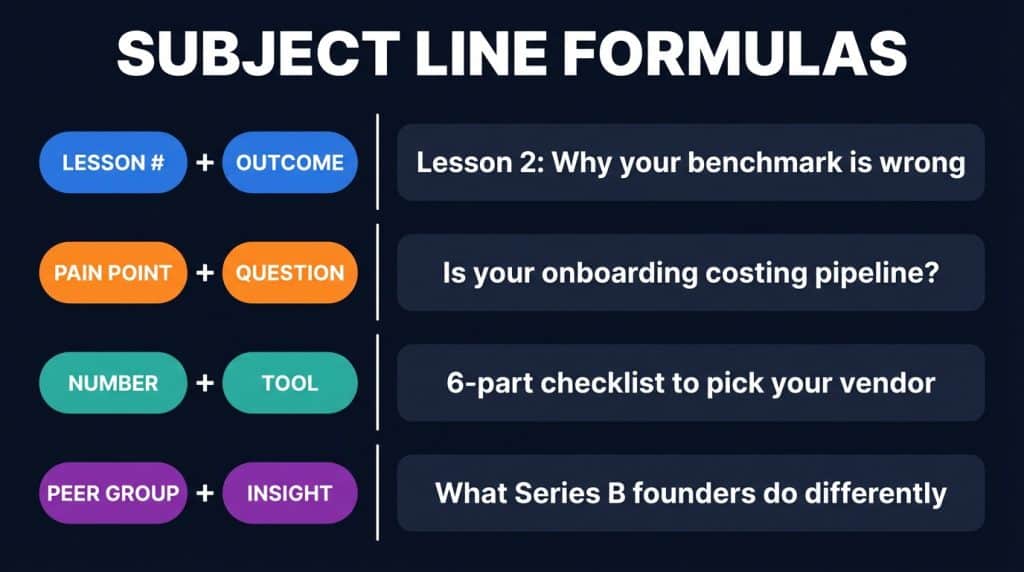
Four formulas that consistently work for B2B SaaS EECs:
Formula 1: The lesson number + specific outcome
“Lesson 2: Why your [metric] benchmark is wrong”
“Day 3: The framework 500+ B2B CEOs use to evaluate [category]”
The lesson number signals sequence. Subscribers who completed email one feel invested in opening email two.
Formula 2: The direct question your prospect is asking internally
“Is your [process] costing you 20% of pipeline?”
“Why isn’t [common tactic] working for B2B SaaS?”
Questions perform well because they mirror the internal dialogue. Question-based subject lines drive 10 to 20% higher open rates than statement-based equivalents.
Formula 3: The specific outcome with a number
“The 6-part checklist to evaluate your [category] vendor”
“3 signals your current [approach] is costing more than it earns”
Numeric elements can double standard open rates. Keep the number specific and connected to the lesson content.
Formula 4: The practitioner frame
“What Series B founders do differently with [topic]”
“What I noticed across 40 funded SaaS companies”
The practitioner frame works because it implies insider knowledge — something the subscriber cannot get from a generic blog post.
Subject line length: Keep EEC subject lines between 36 and 50 characters. This length performs best for B2B audiences and renders fully on mobile screens. Avoid subject lines that promise more than the email delivers. That mismatch destroys completion rates faster than any other variable.
One subject line practice to avoid: Do not use urgency or FOMO language in EEC subject lines (“Last chance to get lesson 3!”). Your subscribers opted in. They are already interested. Urgency language in this context reads as desperation.
What Platform Should You Use to Deliver Your EEC?
The best platform for a B2B SaaS educational email course is the one your marketing team will actually operate, but the platform choice does affect what is possible.
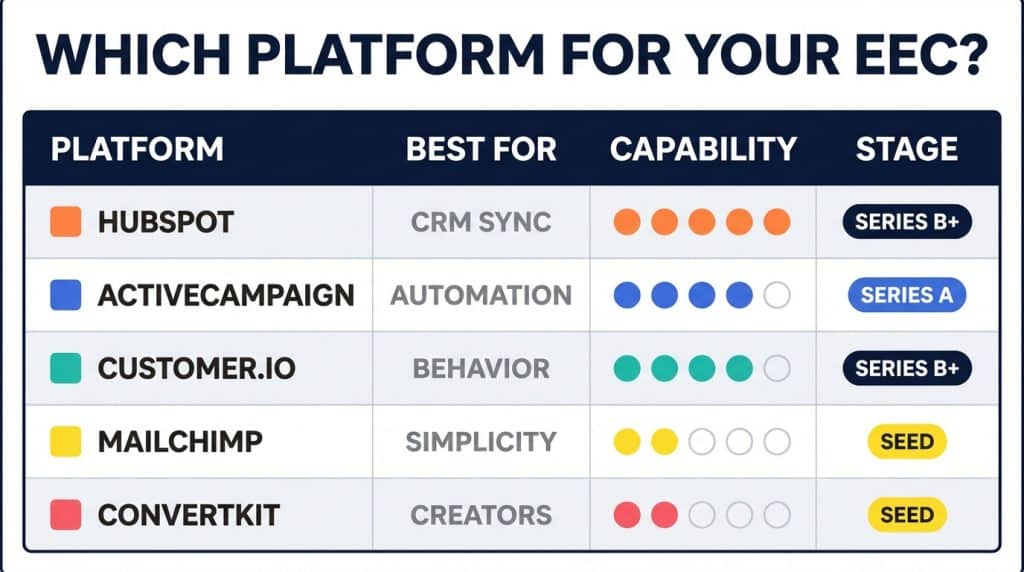
Here is how the main options compare for this specific use case:
HubSpot is the strongest choice for mid-market B2B SaaS companies that need to connect EEC completers directly to CRM data and sales sequences. When a subscriber completes your course and clicks the final CTA, HubSpot can automatically alert the assigned BDR, log the activity, and trigger a sales sequence. The workflow builder handles multi-step conditional logic well. Cost is the main drawback in the early stages.
ActiveCampaign is the best balance of power and cost for seed and Series A companies. Behavioral triggers, conditional sequences, and list segmentation are all accessible without enterprise pricing. The automation builder handles the “if subscriber clicked email six CTA, route to BDR sequence” logic cleanly.
Customer.io is the best choice for product-led growth companies where EEC opt-ins connect to product behavior data. If you want to trigger email course enrollment based on in-app actions (e.g., a user who viewed the pricing page 3 times enrolls in the EEC), Customer.io handles this more natively than HubSpot or ActiveCampaign.
Mailchimp works at the seed stage when simplicity matters more than sophistication. It handles basic drip sequences and has enough automation to run a five-email course. The limitation is behavioral triggers — Mailchimp’s logic is less flexible for complex post-completion routing.
ConvertKit is worth considering if the founder is the primary author and the EEC is closely tied to the personal brand rather than a corporate product. Its sequence builder is simple, and the broadcast-to-sequence routing is clean for a single-author publishing model.
The platform decision is secondary to the content decision. A well-written EEC on Mailchimp outperforms a poorly written EEC on HubSpot. Choose a platform your team will maintain, start with the features you need today, and upgrade as your sequence complexity grows.
The Most Common Mistakes B2B SaaS Companies Make With EECs
Most EECs underperform not because the format does not work, but because of avoidable execution errors. Here are the five I see most often.
Mistake 1: Making the course about the product, not the problem
The most common failure mode is an EEC that reads like a product onboarding sequence in disguise. Email 1 is “What our platform does.” Email 2 is “Key features to know.” Email 3 is “How our customers use us.”
This is not an educational email course. It is a sales deck delivered in installments. Subscribers signed up for the transformation. When they receive product content instead, they unsubscribe, and trust is gone.
The rule: your product should not appear by name until at least email five. The first four emails are entirely about the subscriber’s problem and your framework for solving it.
Mistake 2: Building a course for too broad an audience
“Our ICP is B2B SaaS companies” is not specific enough to build a compelling EEC. “Our ICP is heads of engineering at Series A SaaS companies managing teams of eight to 15 developers struggling with deployment frequency.”
The broader the audience, the weaker the subject lines and opening hooks, and the lower the completion rates. Specificity is the mechanism, not a limitation.
Mistake 3: Making each email too long
A 1,200-word email is not more valuable than a 400-word email. It is harder to read, harder to finish, and harder to forward. The EEC format lives or dies on completion rate. Short emails win.
Mistake 4: Sending emails too infrequently
Some founders, worried about overwhelming their list, send EEC emails once a week. At that cadence, subscribers forget the context from email one by the time email three arrives. The sequence loses its arc. Daily delivery (for a five-email course) or every-other-day delivery (for a seven-email course) is necessary to maintain momentum.
Mistake 5: Not tracking sequence-to-demo conversion
Most marketing teams measure email open rates and stop there. Open rates do not pay salaries. The number that matters is how many EEC completers turn into demo conversations within 30 days. Track this from week one. It is the only metric that will convince a skeptical revenue team that this content is generating pipeline.
Educational Email Course vs. Newsletter vs. Lead Magnet: What B2B SaaS CEOs Need to Know
The three most common email assets for B2B SaaS companies are regularly confused. The functional differences are significant.
| Asset | Format | Duration | Primary purpose | Best funnel stage |
|---|---|---|---|---|
| Newsletter | Episodic, ongoing | Indefinite | Stay top of mind | Warm, aware audience |
| Lead magnet | Single download | One interaction | Capture email address | Top of funnel, broad |
| Educational email course | Sequenced, structured | 5 to 10 days | Build trust and buying intent | Mid-funnel, not demo-ready |
The EEC is uniquely suited to the B2B SaaS buying environment because it respects the length of the sales cycle. A newsletter asks a busy VP of Engineering to subscribe indefinitely, with no end date and no specific transformation promised. A lead magnet gives them a PDF they download and never revisit. An EEC gives them a bounded commitment with a defined outcome.
Email marketing campaigns in B2B tech deliver an average 2.5% conversion rate. EECs targeting a specific ICP with a strong transformation premise consistently outperform that benchmark because opt-in intent is higher and content relevance is more precise.
The three assets are not in competition. The strongest B2B SaaS content systems layer all three: the lead magnet captures top-of-funnel addresses, the EEC converts mid-funnel prospects into demo-ready buyers, and the newsletter sustains the relationship over time. But if you can only build one email asset this quarter, the EEC has the most direct connection to pipeline.
A Series A fintech founder I work with replaced “subscribe to our newsletter” with an EEC offer: “5-email course: how to benchmark your fraud detection performance against industry standards.” The offer’s specificity led to a higher conversion rate, and the quality of conversations with subscribers who completed the course was significantly higher than with the general newsletter list.
How to Use Educational Email Courses at Each Funding Stage
The EEC serves different strategic purposes at different stages. Here is how to think about the format by funding stage.
Seed stage: prove category expertise before you have a brand
At seed, you are not yet known. An EEC is your fastest path to credibility with a cold audience without requiring an established brand or significant content infrastructure.
The goal at seed is not the pipeline. It is category positioning. Build a course that makes a prospect genuinely smarter about the problem you solve. When they eventually evaluate vendors six months from now, you are already the most credible voice in their memory.
Keep the seed-stage EEC tight: five emails, one specific problem, no product mentions. End with an invitation to share feedback rather than a request for a demo. The replies you receive at this stage are invaluable for product development and future messaging.
Series A: convert LinkedIn and content traffic into sales conversations
At Series A, you have traction and are scaling content and outbound. The EEC becomes the conversion layer between traffic and sales. Traffic without a capture mechanism is revenue leaving through an open window.
The EEC opt-in sits above the demo request in the funnel. Prospects who are not ready to talk to sales are ready to learn. Route them into the course. When they complete it, route qualified completers to your BDRs with course completion data attached. Your BDRs now call warm contacts who have consumed six emails of category context. Conversion rates improve. Call lengths shorten.
Series B and C: build a category authority asset that compounds
At Series B and C, you are competing with well-resourced incumbents. A well-built, well-promoted EEC with 5,000 subscribers is a trust moat that competitors cannot easily replicate. The content is proprietary. The framework is yours. The subscriber list is yours.
At this stage, consider a layered architecture. Offer a free five-email course as the entry point. Gate a seven-email advanced course for higher-intent buyers who complete the free course. The free course builds broad trust. The advanced course identifies your most engaged prospects for account-based sales outreach.
From conversations with revenue leaders on the Predictable B2B Success podcast, the consistent differentiator for companies closing enterprise deals efficiently is one thing: Does the prospect understand the problem better after interacting with you than before? An EEC answers that definitively, at scale.
The CEO Delegation Playbook: Building Your EEC Without Writing It Yourself
The most common objection from B2B SaaS founders is not “this format does not work.” It is “I do not have time to write it.”
That is the right instinct. You should not write your EEC. You should architect it and delegate the execution.
Your role (approximately three hours total):
– Define the transformation topic (30 minutes)
– Review a one-page outline and approve the arc (30 minutes)
– Do a 45-minute recorded conversation covering your framework, your client observations, and your perspective on common misconceptions in your category
– Review draft emails and flag anything that does not sound like you (60 minutes)
Your ghostwriter or content specialist’s role:
– Conduct a voice interview and build a brand voice brief
– Research the ICP’s language, pain points, and objections from sales call recordings
– Write all five to seven emails from the recorded conversation and research
– Build the delivery sequence in your chosen email platform
– Set up behavioral triggers and segment routing
– Measure and report on completion rates and sequence-to-demo conversion monthly
The recorded conversation is the differentiator. A 45-minute unscripted conversation from a SaaS founder who knows their category deeply produces enough material for a five-email course and three months of LinkedIn content. Nothing gets invented. Everything gets distilled. The ghostwriter’s job is to find the signal in what you already know and write it in a form that travels.
A Series B SaaS CEO I ghostwrite for had resisted building an educational email course for two years, believing it would require weeks of focused writing time. The actual process took one week: one planning call, one recorded conversation, and two rounds of revisions. That course has been running for 8 months and consistently generates qualified demo requests each week, with no ongoing effort.
Email marketing delivers an average ROI of $36 to $42 per dollar spent, according to 2025 B2B email benchmarks from Verified Email. An educational email course built to a specific high-intent ICP, with a strong transformation premise and clean delivery sequence, sits at the top end of that range.
💡 CEO Takeaway
- Start narrow. One ICP segment, one specific problem, five emails. The urge to make it comprehensive will kill it before it launches.
- Lead with transformation, not information. Ask: What will subscribers do differently after completing this? That is your course. Everything else is filler.
- Apply the 80/20 rule. The first 80% of your emails should be pure teaching. Product context belongs only in the final 20%.
- Measure completion rate and sequence-to-demo conversion. Open rates are not in the pipeline. Know the number that matters to your revenue team.
- Match cadence to your sales cycle. Enterprise SaaS: eight to twelve emails over 45 to 60 days. Self-serve: five to seven emails over 21 to 30 days.
- Architect, do not write. Your framework and lived experience are the assets. A ghostwriter extracts and builds from a 45-minute recorded conversation. You do not need to start from a blank page.
Frequently Asked Questions
What is an educational email course for B2B SaaS?
An educational email course for B2B SaaS is a structured sequence of five to ten emails, each delivering one focused lesson, that teaches a specific ICP something genuinely valuable about the problem your software solves. Unlike a generic drip sequence, it is designed as a complete learning experience that builds trust, demonstrates category expertise, and moves prospects from awareness to demo readiness without a direct pitch.
How long should a B2B SaaS educational email course be?
For self-serve or shorter-cycle SaaS products, five to seven emails over 21 to 30 days is the optimal length. For enterprise B2B SaaS with longer buying cycles, eight to twelve emails over 45 to 60 days maintains engagement without losing momentum. Each individual email should be 300 to 500 words and cover exactly one idea. Courses longer than 12 emails see a steep drop-off in completion rates for B2B audiences.
How is an educational email course different from a drip sequence?
A drip sequence is company-centric, delivering product updates, case studies, and demo requests on a fixed timer. An educational email course is prospect-centric, delivering structured lessons that help the subscriber solve a problem or understand a category. Drip sequences interrupt. Educational email courses teach. That fundamental difference explains the significant gap in completion rates and downstream conversion to demo.
What platform should I use to run a B2B SaaS educational email course?
The right platform depends on your stage and integration needs. HubSpot is best for mid-market companies needing CRM integration and BDR routing after course completion. ActiveCampaign offers the best balance of power and cost for seed and Series A. Customer.io is best for product-led growth companies that connect EEC enrollment to in-app behavior. Mailchimp works for seed-stage simplicity. The content quality of the course matters more than the platform choice.
When in the sales funnel should I use an educational email course?
An EEC works best at the mid-funnel stage: after a prospect has shown initial interest through a website visit, LinkedIn connection, or content download, but before they are ready to request a demo. It is the bridge between “aware of you” and “ready to talk to sales.” At the seed stage, it can also serve as a top-of-funnel category education tool that builds brand credibility before a formal sales motion exists.
Can a B2B SaaS CEO delegate the writing of an educational email course?
Yes, and for most founders, it is the right decision. The CEO’s role is to define the transformation topic, share their framework in a 45-minute recorded conversation, and review drafts for voice accuracy. The writing, ICP research, platform setup, and performance measurement should be handled by a ghostwriter or content specialist. This structure produces a higher-quality course in significantly less total founder time than self-writing.
Conclusion
Most B2B SaaS companies are one asset away from a meaningfully shorter sales cycle. That asset is an educational email course that teaches their ICP something genuinely valuable before anyone asks for a demo.
The window for first-mover advantage in your category is real but not permanent. Companies building their EEC now will compound the credibility and pipeline advantage for years. Companies that wait will build the same asset in a more crowded room.
The EEC does not replace your sales team, your outbound motion, or your content engine. It amplifies all three by ensuring that every prospect who enters your funnel arrives at the conversation better informed, more trusting, and closer to ready.
If you are building content systems for your executive team and want a pipeline asset that runs on autopilot, this is the exact problem I help solve at Sproutworth.
Related Resources
- B2B Growth Marketing: Building High-Performing Tech Brands
- Thought Leadership Strategy: A Step-by-Step Guide for Growth
- How to Write an Email Marketing Funnels Sequence That Converts
- B2B Buyer Psychology: Fortune 100’s $50B Strategy
- 4 Steps to Double Your LinkedIn Leads Today
