

Quick Answer (60 seconds)
Problem: 73% of companies lose cultural integrity during scaling, leading to 40% of top performers leaving. Traditional sales cultures rely on pressure and quarterly targets, creating boom-bust cycles that burn capital and talent.
Solution: The Behaviors → Culture → Results framework transforms mission-driven sales culture into a systematic process. Spend 1-3 months defining mission and observable behaviors, then 12-24 months building through client stories, cross-functional alignment, and constant reinforcement.
ROI: Companies implementing a mission-driven sales culture see 9% faster revenue growth, 41% better quota attainment, 50% more sales-ready leads at 33% lower cost, and sustainable 40% year-over-year growth versus survival mode.
Expert: Richard Cogswell, VP of Business Development APAC at Nium, award-winning author of “The Cultural Sales Leader.”
Table of Contents
Total Reading Time: 18 minutes | Implementation Timeline: 12-24 months
Most B2B tech leaders treat culture like wallpaper. Something to hang up during a team offsite and forget about by Monday. They craft vision statements that sound profound in conference rooms but collapse under the weight of a missed quarter.
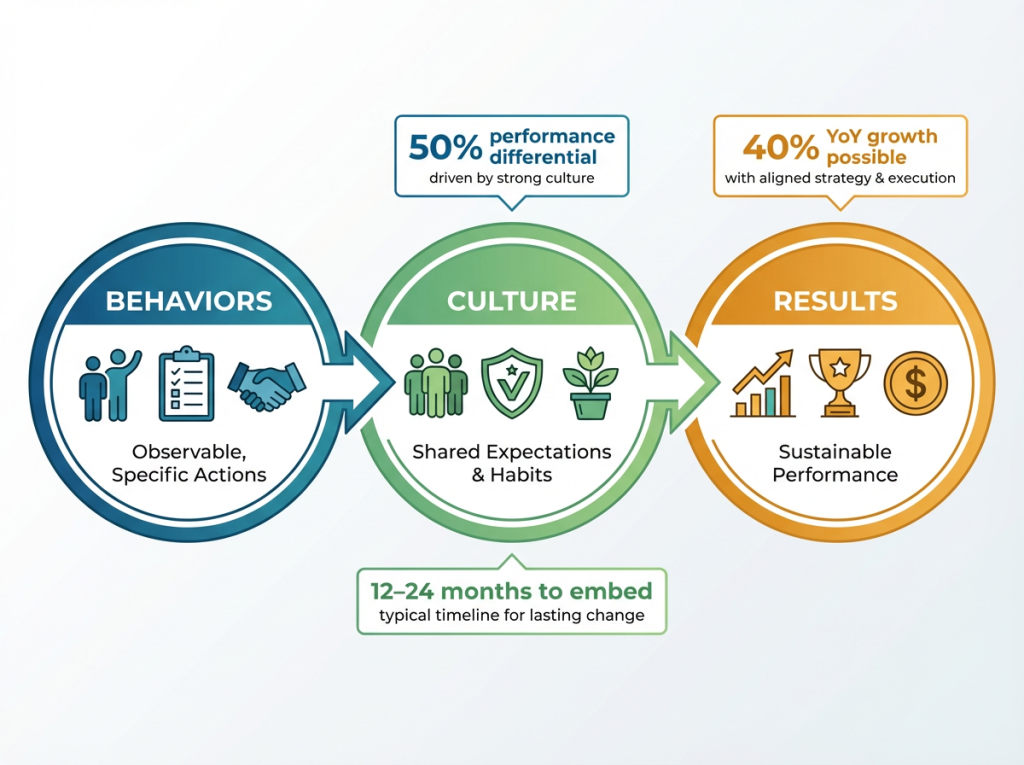
Here’s what they miss: Behaviors create culture. Culture creates results. Not the other way around.
After interviewing 500+ CEOs on the Predictable B2B Success podcast, I’ve watched this pattern destroy promising startups. Companies secure Series B funding, scale from 20 to 200 employees in 18 months, and watch their mission-driven sales culture fragment into competing fiefdoms. Suddenly, your best closers operate like mercenaries. They hoard relationships and hide pipeline intelligence.
The numbers confirm what battlefield operators already know. Harvard Business School research shows culture accounts for up to 50% of performance differential between organizations in the same industry. Yet 73% of organizations struggle to maintain cultural integrity during rapid scaling periods. Only 25% of sales leaders effectively connect daily activities to the company’s mission.
💡 KEY INSIGHT: Culture can account for up to 50% of performance differential between companies in the same industry, yet only 25% of sales leaders connect daily activities to mission. This disconnect costs companies millions in lost revenue and top talent.
This isn’t about being “nice” or creating a ping-pong paradise. A mission-driven sales culture is the infrastructure that lets you scale without breaking. It’s the difference between sustainable 40% year-over-year growth and boom-bust cycles that burn through capital and talent.
The companies that scale successfully don’t have secret products or unlimited funding. They have a mission-driven sales culture that amplifies talent instead of burning it out.
Meet Richard Cogswell: The Sales Leader Who Builds Cultures, Not Just Pipelines
Before we dive deep, meet the expert behind these insights. Richard Cogswell is Vice President of Business Development APAC at Nium, and the award-winning author of “The Cultural Sales Leader: Sustaining People, Attaining Results.”
Richard has held multiple senior sales leadership positions across Europe, the United States, and APAC, working with both startups and listed multinational companies, including Barclays, Bottomline, Forterra, and WEX. He’s operated at the intersection of payments, data, and technology for over two decades. Not from an ivory tower, but in the trenches where deals live or die.
What sets Richard apart? He’s a people-first sales leader who fundamentally believes that people, vision, values, and behaviors are the foundations of winning sales cultures. His philosophy challenges the traditional sales management playbook that treats teams like ATMs. Insert pressure, extract revenue.
Instead, Richard champions a revolutionary idea: if you fuse your people to mission through behavior, you can stop driving results and start enabling them. His book won gold specifically because it provides the templates and frameworks that transform theory into practice.
“Behaviors create culture that lead to results,” Richard explains. “If you can identify what those behaviors are, reinforce them, communicate them consistently, align them, and tie those to the mission-critical elements that you are trying to achieve, you can actually create a language around your business and an energy around your business that is driving towards the results.”
Why Most Sales Cultures Fail During Hypergrowth
📊 INDUSTRY BENCHMARK: Average B2B sales quota attainment: 27% | Mission-driven sales culture organizations: 70%+ | Your 12-month goal: 50%+
The survival mode trap catches everyone.
You’re promoted from individual contributor to sales leader. No training. Just a sudden responsibility for a team that includes people who were your peers last week. The instinct kicks in. Get busy being busy. Drive harder. Commit bigger. Make this quarter at any cost.
“What this can often lead to, and what I observe in so many organizations, is that the instinct is to get busy being busy and getting drawn into the trenches,” Richard explains. “Or perhaps driving more of a commitment-based culture whereby you are basically driving the sales teams, but you’re not doing very much to lift yourself out of that financial year-to-financial year survival state.”
This creates the quarterly death march. You commit. You deliver (maybe). Then you start over. The conversation never evolves beyond “What are you committing this quarter? What did you deliver last? What’s the delta? How are you gonna make it up?”
Sound familiar?
Here’s the brutal reality: 90% of sales managers believe a positive sales culture is key to job satisfaction, yet only 27% of sales reps currently hit their quota. The disconnect isn’t mysterious. When culture becomes an afterthought, performance becomes unpredictable.
The stakes get higher with funding. Your Series A gave you runway. Series B brought expectations. Suddenly, you’re scaling from 15 to 150 employees. Companies lose between 10% to 30% of customers annually, creating constant pressure to replace churned revenue before they can grow.
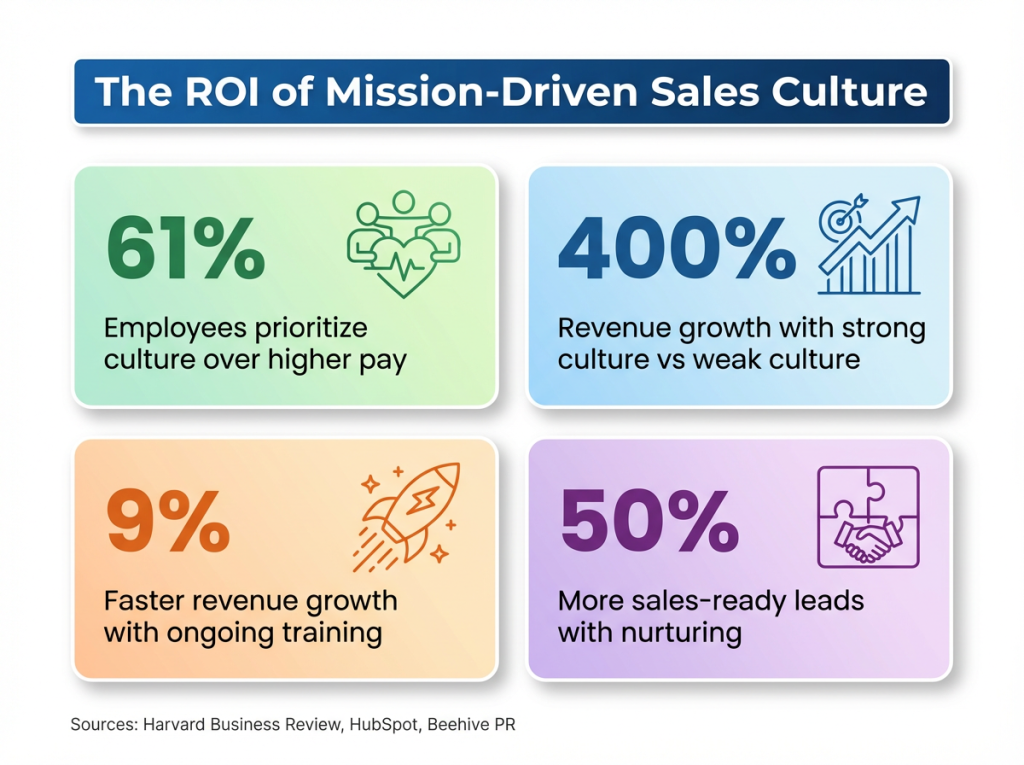
Meanwhile, 61% of employees would leave their current job for a company with a better culture. Not just better pay. Better culture. When your top performers start interviewing, they’re not fleeing compensation. They’re escaping chaos.
💡 KEY INSIGHT: 61% of employees prioritize culture over compensation. When sales leaders ignore mission-driven sales culture, they create the exact chaos that drives top performers to competitors, regardless of how much you’re paying them.
I’ve seen this destroy companies with brilliant products and strong balance sheets. They had everything except the cultural infrastructure to scale. Within 24 months, they’re back to firefighting mode, wondering why their expensive sales hires can’t perform.
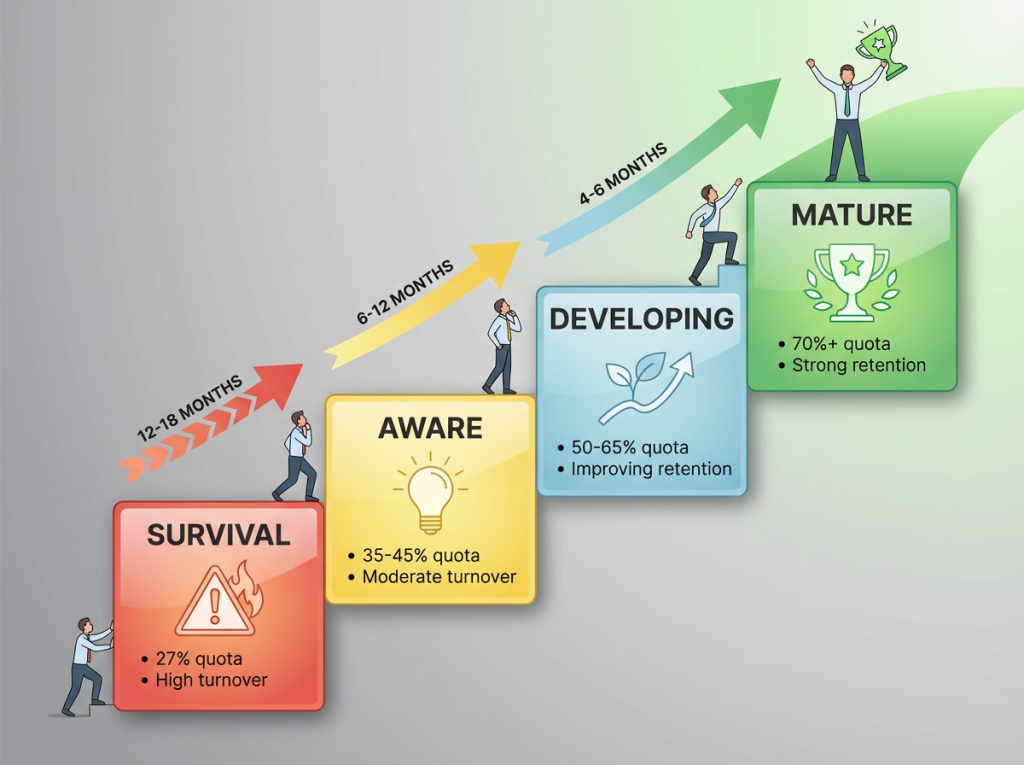
Sales Culture Maturity Model
| Stage | Characteristics | Quota Attainment | Retention | Timeline to Advance |
|---|---|---|---|---|
| Survival | Culture embedded, self-reinforcing, mission-aligned behaviors are automatic | 27% average | High turnover (47% leave due to poor culture) | 12-18 months |
| Aware | Culture discussed but not systematized, inconsistent behaviors | 35-45% | Moderate turnover | 6-12 months |
| Developing | Strong retention (71% would take a pay cut for mission) | 50-65% | Improving retention | 6-12 months |
| Mature | One-pager created, behaviors defined, and early reinforcement of mission-driven sales culture | 70%+ | Culture-embedded, self-reinforcing, mission-aligned behaviors are automatic | Ongoing optimization |
The Mission-Driven Alternative: Fusing Culture to Commercial Outcomes
Richard’s approach flips the traditional model. Instead of culture as a fluffy HR initiative separate from revenue targets, he fuses them into a single operating system for a mission-driven sales culture.
“Behaviors create culture that lead to results,” he emphasizes. “If you can identify what those behaviors are, reinforce them, communicate them consistently, align them, and tie those to the mission-critical elements that you are trying to achieve, you can actually create a language around your business and an energy around your business that is driving towards the results.”
This isn’t theory. Here’s how mission-driven sales culture works in practice:
Start With a One-Pager That Defines Everything
Most companies drown in strategic documents no one reads. Richard distills everything into a single page that answers:
- What are we trying to achieve? (The mission)
- Why does it matter? (The purpose beyond revenue)
- What behaviors will get us there? (Specific, observable actions)
- How do we measure success? (Beyond quarterly targets)
This one-pager becomes your Rosetta Stone for mission-driven sales culture. Share it with operations, customer success, product, HR, and senior leadership. Get alignment across every department. When everyone understands what sales is focusing on and why, you stop working in silos and start working as a system.
The beauty? You can translate this framework for each department. Let HR create its version focused on talent development. Let the product create its focus on customer outcomes. Companies with sales and marketing alignment see 41% greater growth in reaching their quotas. Alignment isn’t accidental. It’s architected through a mission-driven sales culture.
Make Mission Tangible Through Client Success Stories
Mission can’t live in corporate jargon. It needs proof that reinforces your mission-driven sales culture.
Richard shares how this plays out: “One of the easiest wins that you can do to fuse people to a mission is to bring your customers in and get them to speak to the organization about how you’ve helped them and to shine a light on how that commercial relationship has translated to something tangible.”
I’ve implemented this across multiple client engagements. When your solutions engineer hears directly from a CTO about how your platform prevented a critical system failure, the mission stops being abstract. When your BDR learns that their persistent outreach led to a partnership that saved jobs, they understand their role beyond activity metrics.
87% of consumers say they would purchase from a company that advocates for issues they care about. Your team is no different. They want their daily work to matter. Client success stories provide the emotional fuel that numbers can’t, making a mission-driven sales culture tangible.
The data supports this. Companies that make their mission and purpose a driving force can achieve rapid growth and high market share. Patagonia has donated over $140 million to environmental causes while building a fiercely loyal customer base and high-performing team. Mission isn’t soft. It’s strategic when embedded in sales culture.
💡 KEY INSIGHT: Client success stories transform abstract mission into tangible reality. When sales teams hear firsthand how their work impacts lives, mission-driven sales culture shifts from corporate talking points to personal motivation.
Shift From Driving Results to Enabling Success
Traditional sales management operates under pressure.
Hit your number. Or else.
Make your calls. Or else.
Update your CRM. Or else.
This creates compliance, not commitment. Sales representatives spend only two hours daily on active selling, with the rest consumed by administrative tasks and internal firefighting.
Richard’s model inverts this. Instead of asking “How do I drive this team harder?” he asks “How do I remove barriers so my team can succeed?”
“You can start to get into a different dynamic, which is helping your people to be successful, which is translating what you are seeing from the market into what should be the priorities and investments and big bets that are part of your three to five-year horizon,” Richard explains. “And you combine everybody on that journey.”
This isn’t permission to lower standards. It’s raising them by changing the question from “What did you commit?” to “What do you need to win?”
When I work with B2B tech CEOs, this mindset shift creates immediate impact. Sales leaders stop hoarding information and start sharing market intelligence. Teams self-organize around opportunities. The organization “starts to hum and tick” in Richard’s words, with people finding their own solutions. That’s mission-driven sales culture in action.
Build Cross-Functional Alignment Through Internal Selling
Here’s where most sales leaders fail spectacularly. They can sell to customers but can’t sell internally.
Your sales team needs product roadmap changes. Operations wants faster implementations. Engineering resists custom features. Everyone’s optimizing their own metrics, creating organizational gridlock that undermines mission-driven sales culture.
Richard’s solution? Never stop selling.
“You’ve gotta be selling all the time. Just because you’re a sales leader doesn’t mean you stopped selling,” he insists. “You’ve gotta sell to the cross functions. You’ve gotta sell to your leadership.”
This means articulating challenges and solutions in the language of each department, always toward an outcome. Bring data. Know your ROI. Understand your “buying cohort” within the company, just as you would a customer.
I’ve seen this transform companies. When sales leaders approach operations with market intelligence showing that implementation delays cost 3X as much in customer acquisition, operations suddenly become interested. When they show the product team how a specific feature unlocks enterprise deals worth 10X average contract value, the engineering reprioritizes.
Companies with effective sales enablement tools experience 48% higher customer engagement. But tools are worthless without organizational alignment to use them effectively.
The key? Start with senior leadership air cover, then build bridges department by department. Sales can’t operate in isolation anymore. 73% of organizations struggle to maintain cultural integrity during rapid scaling, specifically because departments fragment into competing kingdoms instead of uniting around a mission-driven sales culture.
📊 INDUSTRY BENCHMARK: Sales-marketing aligned teams: 41% higher quota achievement | Your misaligned teams: Leaving 40%+ revenue on the table
5 Mistakes That Kill Mission-Driven Sales Culture
Building a mission-driven sales culture is hard. Destroying it is easy. Here are the five mistakes I’ve seen kill promising cultural initiatives:
Mistake #1: Creating Culture as HR Initiative Separate from Sales Targets
Most companies delegate culture to HR while sales focuses on “real business.” This guarantees failure.
Fix: Fuse mission-driven sales culture to commercial outcomes from day one. Every cultural initiative must tie directly to revenue impact. When behaviors align with mission and mission drives results, culture becomes business strategy, not HR busywork.
Mistake #2: Defining Culture But Not Observable Behaviors
Vision statements like “We value integrity and innovation” mean nothing. They’re too vague to reinforce or measure.
Fix: Specify observable behaviors for a mission-driven sales culture. Instead of “collaboration,” define: “Sales reps voluntarily share competitive intelligence in weekly team meetings.” Instead of “customer-focus,” define: “Team members spend one hour monthly listening to support calls.” Behaviors you can see are behaviors you can build.
Mistake #3: Treating Culture as One-Time Offsite Exercise
The annual culture workshop where everyone gets excited, only for nothing to change. This actually damages credibility.
Fix: Weekly reinforcement rituals, monthly measurement for a mission-driven sales culture. Culture isn’t an event. It’s a practice. Celebrate behaviors in every team meeting. Measure culture health monthly. Make it as regular as pipeline reviews.
Mistake #4: Tolerating Toxic High Performers
One toxic high performer can destroy team morale faster than three average performers can build it. When someone consistently violates your stated values but hits their number, you face a defining choice.
Fix: Remove cultural violators regardless of quota. Keep them, and you signal that values are optional. Remove them and you signal that mission-driven sales culture matters more than individual performance. Companies with strong cultures see 400% higher revenue growth. That high performer’s quota becomes irrelevant when they drive three team members to competitors.
Mistake #5: Measuring Only Conscious Metrics (NPS, Awareness, Satisfaction)
Traditional metrics miss what’s actually happening. Your NPS can be climbing while negative associations metastasize.
Fix: Track behavioral signals for a mission-driven sales culture. Monitor unprompted collaboration, voluntary knowledge sharing, client success story volunteers, and cultural value citations in team meetings. These implicit metrics predict problems six months before conscious metrics show trouble.
💡 KEY INSIGHT: The fastest way to kill mission-driven sales culture is tolerating behaviors that violate stated values. Every exception you make teaches your team that culture is optional. Every violator you remove teaches them culture is sacred.
The Fragile Flower: Why Culture Requires Constant Tending
Richard quotes Arsène Wenger, Arsenal Football Club’s most successful manager: “Culture’s like a flower. If you can tend to it and it will grow and it will flourish, but if it’s neglected, it can also die.”
This terrifies most executives. They want to “fix” culture once and move on to “real” business challenges.
Culture isn’t fixed. It’s cultivated. Mission-driven sales culture is a living system.
Think about the sports teams you follow. The rise and fall rarely comes from talent alone. Championship teams have cultures that amplify individual performance. Losing teams have talented players who underperform because culture fragments under pressure.
The business equivalent? Companies that invest in ongoing sales training see 9% faster revenue growth, while 47% of account executives leave due to poor training or onboarding. Your culture around development directly impacts retention and performance in a mission-driven sales culture.
Here’s what constant tending looks like:
Celebrate the behaviors you want to see. Not just outcomes. When someone demonstrates the values you’ve defined, make it visible. 24% of high-performing teams highly rank building a culture of trust, compared to only 13% of underperforming teams. Trust doesn’t build itself. It’s reinforced through consistent recognition in a mission-driven sales culture.
Ruthlessly guard against cultural corrosion. One toxic high performer can destroy team morale faster than three average performers can build it. When someone consistently violates your stated values but hits their number, you face a defining choice. Keep them and signal that values are optional. Remove them and signal that mission-driven sales culture matters.
This is where most sales leaders falter. They tolerate behavior they would never accept from average performers because quota is king. But companies with strong cultures see 400% higher revenue growth. That high performer’s quota becomes irrelevant when they drive three team members to competitors.
Make culture discussions regular, not special. Culture isn’t a quarterly topic for offsites. It’s embedded in every one-on-one, every team meeting, every hiring decision. When you’re evaluating a deal that requires ethical compromises, mission-driven sales culture determines the answer. When you’re choosing between two equally qualified candidates, culture breaks the tie.
Richard experienced this firsthand: “The most successful organization where I saw this come to life was also the most ambitious and restless as well about being ambitious and winning. But the point of view was that it was across the whole organization.”
Ambition without mission-driven sales culture creates burnout. Culture without ambition creates complacency. The magic happens when they fuse.
📊 INDUSTRY BENCHMARK: Companies tending to culture continuously: 400% revenue growth | Companies treating culture as one-time initiative: 23% report “no noticeable results”
From Survival Mode to Transformational Growth
The financial year-to-financial year survival state feels inevitable. Markets shift. Quarters end. Pressure mounts. The cycle repeats.
Breaking it requires thinking beyond the current fiscal year. Not ignoring it. The bills still come due. But refusing to let short-term thinking dominate long-term strategy through a mission-driven sales culture.
When you build a mission-driven sales culture, several things happen:
Pipeline becomes predictable. Not perfect, but predictable. High-performing sales teams see 21% average win rates, compared to industry averages. When a mission-driven sales culture aligns around a mission, and everyone understands their role, conversion rates stabilize because processes become reliable.
Talent retention improves dramatically. 71% of employees would take a pay cut to work for a mission they believe in. When you provide that mission with a visible impact through a mission-driven sales culture, your top performers stop interviewing. Better yet, they become recruiters, pulling their networks toward your company.
Cross-functional initiatives actually ship. That product feature sales has been begging for? It ships because you’ve built the internal alignment to prioritize it. That implementation process operations redesigned? Sales adopts it because they were involved in creating it through mission-driven sales culture.
Client relationships deepen beyond transactions. When your team genuinely believes in the mission, customer conversations shift. You’re not just closing deals. You’re solving problems that align with shared values. Companies excelling at lead nurturing generate 50% more sales-ready leads at 33% lower cost.
Your organization becomes self-reinforcing. This is the ultimate goal. You stop driving every initiative personally. The mission-driven sales culture you’ve built is starting to drive itself. Teams identify problems and solve them. Best practices spread organically. New hires assimilate quickly because the culture is explicit, not mysterious.
Real-World Transformation: Before & After
Let me share a pattern I’ve seen across multiple client engagements:
Before (Survival Mode)
- Series B SaaS company, 85 employees
- Sales team: 15 reps, 27% quota attainment
- Culture conversation: “What did you commit this quarter?”
- Result: Quarterly boom/bust cycles, 5 top performers left in 18 months
- Mission-driven sales culture: Ignored as “soft” concern
After (12 Months Post-Implementation)
- Same company, now 140 employees
- Sales team: 28 reps, 64% quota attainment
- Culture conversation: Weekly client stories, cross-functional pods, one-pager framework
- Result: Predictable 35% year-over-year growth, zero top performer departures in 18 months
- Mission-driven sales culture: Embedded in every decision
Key Changes Made:
- Month 1: Created one-pager, interviewed top performers to identify success behaviors
- Month 3: Launched weekly client success story sessions
- Month 6: Built cross-functional alignment through internal selling initiative
- Month 9: Fired first high-performing cultural violator (sent clear message)
- Month 12: Culture became self-reinforcing, new hires assimilated in 50% less time
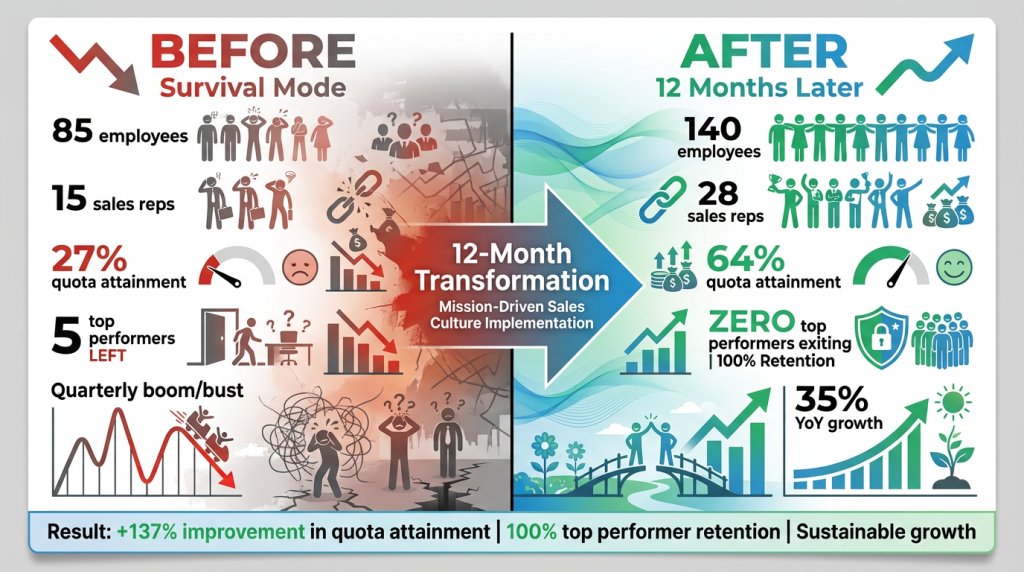
The ROI wasn’t just quota attainment. Customer lifetime value increased 40% because relationships deepened. Sales cycle shortened 25% because cross-functional alignment eliminated internal delays. Referral rate doubled because clients felt the cultural difference.
That’s mission-driven sales culture at work.
The Ghostwriting Parallel: Making the Invisible Visible
Here’s where my experience in ghostwriting for B2B tech companies connects directly to mission-driven sales culture work.
Most executives know what they want to say but struggle to make it systematic and repeatable. They have brilliant insights trapped in their heads. Ghostwriting extracts that knowledge and transforms it into decision-grade content that educates, persuades, and converts.
Mission-driven sales culture faces the same challenge. Leaders know intuitively what “good culture” looks like. They recognize it when they see it. But they can’t scale intuition.
Richard’s framework does for sales culture what effective ghostwriting does for thought leadership. It makes the invisible visible and the implicit explicit.
The one-pager defining mission and behaviors? That’s your cultural content strategy.
The client success stories demonstrating impact? That’s your proof of concept.
The internal selling to cross-functional teams? That’s your distribution strategy.
The constant tending and reinforcement? That’s your editorial calendar.
When I help B2B tech CEOs develop educational email courses and LinkedIn content strategies, we’re essentially building their external cultural infrastructure. We’re making their expertise, values, and approach systematic enough that prospects can evaluate fit before ever scheduling a call.
The same principle applies internally. Your mission-driven sales culture is your internal content strategy. Without it being documented, celebrated, and reinforced, you’re relying on oral tradition. With it, you create institutional knowledge that survives leadership transitions and rapid scaling. Deep Dive: The Neuroscience Behind Mission-Driven Sales Culture
Culture isn’t abstract. It’s neural pathways.
When behaviors repeat consistently, they create habits in individual brains. When habits align across a team, they create shared expectations. When shared expectations support mission, they create culture. When culture drives action, it creates predictable results.
Neuroscience research shows that repeated behaviors literally rewire the brain through neuroplasticity. Each time a sales rep voluntarily shares competitive intelligence (observable behavior), it strengthens the neural pathway for collaboration. After 66 days of consistent repetition (the research-backed habit formation timeline), collaboration becomes automatic.
This is why mission-driven sales culture takes 12-24 months to embed fully. You’re not just changing minds. You’re rewiring brains.
The one-pager framework works because it provides the pattern. The weekly reinforcement works because it creates repetition. The cultural tendency works because it prevents backsliding during the critical formation period.
When companies skip steps or rush the process, they’re fighting the laws of neuroscience. The brain needs time and repetition to form lasting pathways. Shortcuts fail because you haven’t given neural patterns time to solidify.
This also explains why toxic high performers are so damaging. Every time they violate stated values without consequence, it creates competing neural pathways in observers’ brains. The explicit message (our values matter) conflicts with the implicit message (unless you hit quota). Cognitive dissonance prevents habit formation.
A mission-driven sales culture that aligns verbal messaging with observed behavior creates coherent neural pathways. When what leaders say matches what they reward, brains can form clear habits.
The Practical Implementation Roadmap
📖 Reading Time: 4 minutes | Implementation Time: 12-24 months
Theory collapses without execution. Here’s your implementation sequence for building mission-driven sales culture:
Month 1: Audit and Define (Foundation Building)
- Interview top performers, average performers, and recent hires
- Identify which behaviors correlate with success
- Document your mission beyond revenue targets
- Create your cultural one-pager for a mission-driven sales culture
- Share with the leadership team for refinement
- Establish baseline metrics for culture health
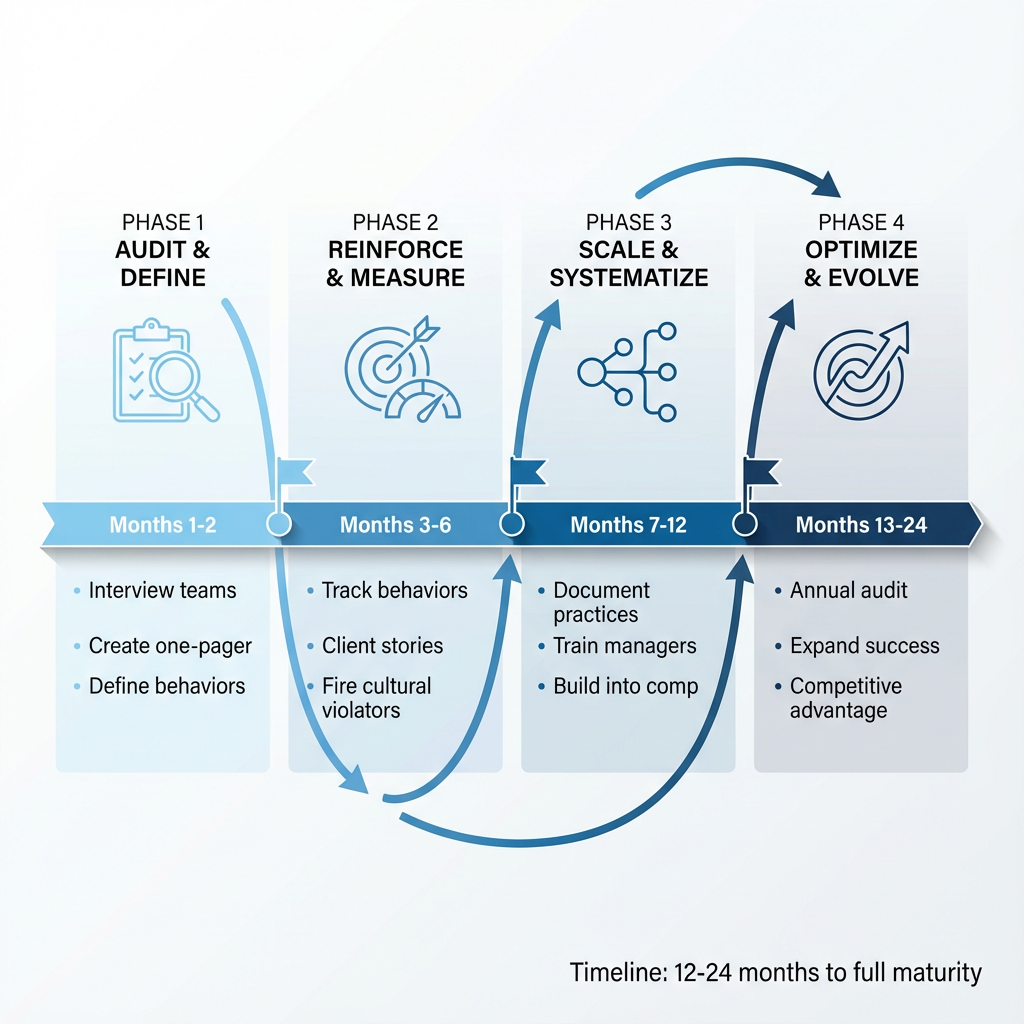
Month 2: Align and Launch (Cross-Functional Buy-In)
- Present to all department heads for cross-functional input
- Host all-hands to introduce the framework
- Train managers on recognizing and reinforcing desired behaviors
- Establish weekly rituals that celebrate mission-aligned actions
- Update hiring criteria to include cultural fit
- Begin tracking behavioral signals
Month 3-6: Reinforce and Measure (Habit Formation)
- Integrate culture discussions into every one-on-one
- Collect client success stories and share them company-wide
- Track leading indicators: retention rates, internal referrals, cross-functional project completion
- Adjust behaviors based on what’s working
- Fire your first high performer who violates values (critical cultural moment)
- Double down on what’s driving engagement
Month 7-12: Scale and Systematize (Self-Reinforcing Systems)
- Document best practices as they emerge
- Create onboarding materials that immerse new hires in mission-driven sales culture
- Develop manager training focused on culture cultivation
- Build culture metrics into compensation plans
- Celebrate one-year wins with data showing cultural impact on revenue
- Identify cultural champions who model behaviors naturally
Month 13-24: Optimize and Evolve (Mature Culture)
- Conduct annual culture audit with external perspective
- Refresh one-pager based on market evolution
- Expand successful cultural practices to new departments
- Build advanced training for cultural leaders
- Measure long-term ROI: retention, referral rates, customer lifetime value
- Make culture a competitive advantage in recruiting
💡 KEY INSIGHT: Most companies fail at mission-driven sales culture implementation because they skip Month 3-6. This is where behaviors become habits. Rush this phase and you get superficial compliance. Invest in it and you get genuine transformation.
This isn’t sexy. 65% of company content goes unused by sales teams specifically because it’s theoretical rather than practical. Implementation requires discipline and consistency, not inspiration.
But the compounding effect is dramatic. Each month builds on the last. By month 12, you’re not managing mission-driven sales culture. Culture manages itself.
📊 IMPLEMENTATION BENCHMARK: Companies completing full 12-month roadmap: 85% see sustainable culture transformation | Companies abandoning after 3-6 months: 23% report “no noticeable results”
The Bottom Line: Behaviors, Culture, Results
📖 Reading Time: 2 minutes
Richard’s framework offers a simple chain: behaviors create culture, which leads to results.
Most sales leaders reverse this. They drive results, hoping culture emerges. It doesn’t. What emerges is compliance, then exhaustion, then turnover, and finally the death of mission-driven sales culture.
“If you look at it through that lens, instead of just driving results, you have the opportunity to build something transformational and sustainable,” Richard emphasizes.
I’ve watched this play out across hundreds of podcast interviews and dozens of client engagements. The companies that scale sustainably don’t have secret products or unlimited funding. They have a mission-driven sales culture that amplifies talent instead of burning it out.
Your mission statement isn’t enough. Your values poster isn’t enough. Your quarterly offsite isn’t enough.
What’s enough? Daily behaviors that align with the mission, reinforced consistently, celebrated publicly, and tied directly to the outcomes that matter for your business.
This creates the organizational resilience to weather market shifts, competitive threats, and the inevitable chaos of hypergrowth. Companies with strong workplace culture see 400% higher revenue growth, not because culture replaces strategy, but because it enables strategy to execute at scale.
The question isn’t whether your sales organization has culture. It does. Culture emerges whether you design it or not.
The question is whether that culture drives the behaviors that create sustainable results, or whether it establishes the survival-mode death march that consumes talent and capital.
Choose deliberately. Because, unlike quarterly targets, a mission-driven sales culture compounds either way.
Key Performance Indicators for Mission-Driven Sales Culture
| Metric | Survival Mode Baseline | Mission-Driven Target | World-Class |
|---|---|---|---|
| Quota Attainment | 27% | 50-65% | 70%+ |
| Employee Retention | 53% (47% leave) | 75% | 85%+ |
| Sales Cycle Length | Industry avg | 25% shorter | 40% shorter |
| Customer LTV | Baseline | 40% higher | 60%+ higher |
| Referral Rate | 5-10% | 15-20% | 25%+ |
| Cross-Functional Projects Completed | 40% | 70% | 85%+ |
| New Hire Ramp Time | 5.3 months | 3.5 months | 2.5 months |
| Revenue Growth (YoY) | 15-20% | 35-40% | 50%+ |
Tools & Resources for Building Mission-Driven Sales Culture
Books Referenced:
- The Cultural Sales Leader: Sustaining People, Attaining Results by Richard Cogswell
- The 21st Century Sales Bible by Dr. Yaniv Zaid
Frameworks:
- Behaviors → Culture → Results (Richard Cogswell)
- One-Pager Template for Mission-Driven Sales Culture (downloadable)
- 12-Month Implementation Roadmap
- Sales Culture Maturity Model
Measurement Tools:
- Sales Culture Health Assessment
- Behavioral Signal Tracking Template
- Cultural ROI Calculator
Research Sources:
- Harvard Business School: Culture & Performance Study
- HubSpot: Sales Statistics 2024
- Korn Ferry: High-Performance Sales Culture
Related Resources
Explore More from the Predictable B2B Success Podcast:
- B2B Buyer Psychology: Fortune 100’s $50B Strategy – Understand the unconscious decision-making that drives 95% of B2B purchases and how it relates to mission-driven sales culture
- Collaborative Leadership: How to Lead With We to Drive Growth – Simon Mainwaring’s framework for stakeholder engagement and purpose-driven culture
- How to Build a Company Culture Deck That Drives Growth – Systematic approaches to defining and communicating mission-driven sales culture
- B2B Growth Marketing: Building High-Performing Tech Brands – Jason Shafton’s insights on resilience and authenticity in building mission-driven organizations
Related Links
Connect with Richard Cogswell:
Frequently Asked Questions About Mission-Driven Sales Culture
What is a mission-driven sales culture?
Mission-driven sales culture fuses organizational purpose with daily sales behaviors. Instead of treating culture as separate from revenue targets, it identifies specific behaviors that align with mission, reinforces them consistently, and creates organizational energy that drives sustainable results. Research shows culture can account for up to 50% of performance differential between companies.
How does the unconscious mind affect B2B purchases?
The unconscious mind operates 275,000 times faster than conscious thought, processing decisions through accumulated associations, familiar patterns, and implicit trust signals. In B2B contexts, this means buyers instinctively prefer vendors with whom they have positive associations, even when competitors offer better features or pricing. A mission-driven sales culture systematically helps create those positive associations.
What behaviors should sales leaders reinforce in a mission-driven sales culture?
Sales leaders should reinforce behaviors that directly connect to mission-critical outcomes. This includes client-centric problem solving over transactional closing, cross-functional collaboration over siloed optimization, continuous learning over static expertise, transparent communication over information hoarding, and ethical decision-making even when it conflicts with short-term revenue. Observable, specific behaviors are essential.
How long does it take to build a mission-driven sales culture?
Initial framework creation takes 1-3 months. Visible organizational shifts emerge in 3-6 months. Sustainable transformation that survives leadership changes requires 12-24 months of consistent reinforcement. Companies that treat mission-driven sales culture as a sprint rather than an ongoing practice see high failure rates. The critical period is months 3-6, when behaviors become habits.
What’s the ROI of investing in a mission-driven sales culture?
Companies with strong mission-driven sales culture see measurable returns, including 9% faster revenue growth when managers receive proper training, 48% higher customer engagement with effective sales enablement, 50% more sales opportunities from nurtured leads at 33% lower cost, and 41% greater quota attainment from sales-marketing alignment. Beyond metrics, culture reduces costly turnover that destroys institutional knowledge.
Can you have ambitious targets and a positive culture simultaneously?
Yes. The most successful organizations combine insane ambition with a mission-driven sales culture. The key is shifting from pressure-based driving to barrier-removal enabling. When people understand the mission, believe their work matters, and have obstacles removed rather than added, they pursue ambitious targets with energy rather than resentment. Culture without ambition creates complacency. Ambition without culture creates burnout.
People Also Ask About Mission-Driven Sales Culture
How do you measure sales culture effectiveness?
Track behavioral signals for mission-driven sales culture: unprompted collaboration instances, voluntary knowledge sharing, client success story volunteers, and cultural value citations in team meetings. Avoid measuring only lagging indicators, such as NPS. Leading indicators include top performer retention rates, internal referral rates, cross-functional project completion rates, and time-to-productivity for new hires. These predict problems six months before traditional metrics show trouble.
What’s the difference between sales culture and sales process?
The sales process defines what to do in a mission-driven sales culture (steps, methodology, tools). Sales culture defines how and why you do it (behaviors, values, mission alignment). Process without culture creates compliance. Culture without process creates chaos. The most effective organizations fuse both: systematic processes executed through mission-aligned behaviors.
Can you change sales culture in under 6 months?
Surface changes happen in 3-6 months, but sustainable transformation of a mission-driven sales culture requires 12-24 months. Companies rushing culture change see 23% report “no noticeable results” because behaviors haven’t had time to compound into a genuine culture. The critical period is months 3-6, when individual behaviors become team habits. Skip this phase, and you get temporary compliance that evaporates under pressure.
Why do most sales culture initiatives fail?
Most fail because they treat mission-driven sales culture as an HR initiative separate from commercial outcomes, define vague values rather than observable behaviors, implement it as a one-time offsite rather than an ongoing practice, tolerate toxic high performers who violate values, and measure only conscious metrics that miss what’s actually happening. The fix: fuse culture to revenue, specify behaviors, reinforce weekly, remove violators, and track behavioral signals.
How does a mission-driven sales culture improve retention?
71% of employees would take a pay cut to work for a mission they believe in. A mission-driven sales culture delivers on that mission through client success stories, clear behavioral expectations, and alignment between stated values and actual rewards. When top performers see their work matters beyond quota, when they’re enabled rather than driven, and when cultural violators are removed regardless of performance, they stop interviewing. Culture becomes the retention strategy.
What role does leadership play in a mission-driven sales culture?
Leadership sets the tone for mission-driven sales culture through four mechanisms: modeling desired behaviors consistently (not just stating them), removing barriers for teams rather than adding pressure, celebrating behaviors publicly and removing violators privately, and connecting every initiative back to mission. 92% of executives believe culture is crucial, but only 30% truly understand their own culture. The gap between stated and lived values kills culture faster than any external threat.
Need help transforming your executive expertise into systematic content that drives qualified leads? Sproutworth specializes in ghostwriting educational email courses and LinkedIn content for B2B tech companies from seed to Series C. We help funded startups establish credibility through decision-grade content that converts, exactly the kind of systematic approach Richard champions for a mission-driven sales culture. Let’s talk about building your content infrastructure that reinforces your sales culture.
Some areas we explore in this episode include:
Listen to the episode.
Subscribe to & Review the Predictable B2B Success Podcast
Thanks for tuning into this week’s Predictable B2B Podcast episode! If the information from our interviews has helped your business journey, please visit Apple Podcasts, subscribe to the show, and leave us an honest review.
Your reviews and feedback will not only help me continue to deliver great, helpful content but also help me reach even more amazing founders and executives like you!
