Outsourced B2B Sales: How Funded Startups Build Revenue Without Building a Team

Outsourced B2B sales is the practice of contracting a third-party team to generate pipeline and close deals instead of building in-house. For seed-to-Series B founders, it cuts time-to-first-revenue by 3–6 months. It works best once product-market fit exists, but the runway won’t support a full sales hire. This guide covers how to evaluate providers, structure the contract, and avoid the mistakes that burn six-figure budgets.

What Is Outsourced B2B Sales?

Outsourced B2B sales is the practice of hiring an external team to manage some or all of a company’s revenue generation process. This includes outbound prospecting, lead qualification, and, in some models, full-cycle closing. The external team works under the company’s brand, follows a defined playbook, and reports to internal leadership. Most engagements focus on sales development: generating meetings to help an internal team close.

Unlike traditional hiring, outsourced B2B sales delivers a functioning sales operation on a retainer or contract basis. There is no three-month recruiting cycle, no onboarding period, and no six-month ramp before the first pipeline is entered into the CRM. For a funded founder under pressure to show ARR growth, that compression matters.

“Outsourced sales fails when it is treated as a substitute for product-market fit, not a distribution mechanism for a proven offer.”

“Outsourced B2B sales compresses time-to-first-revenue from 12 months of hiring and ramping to 90 days of structured outreach. That compression is the core value proposition.”

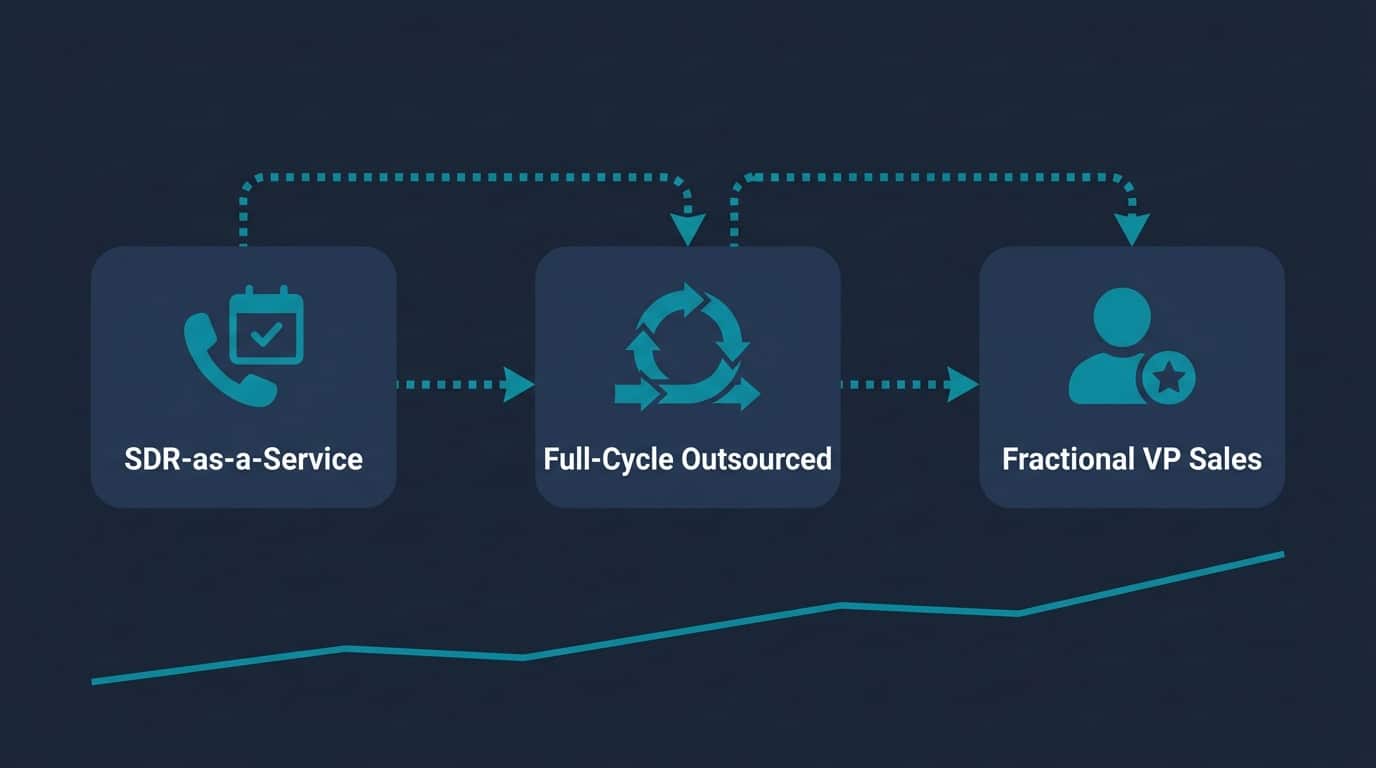
The term covers three distinct functions. Sales development covers outbound prospecting and meeting booking. Account management covers expansion and retention within existing accounts. Full-cycle sales covers cold outreach through to signed contract. Most outsourced B2B sales engagements focus exclusively on the first function.

“Outsourced B2B sales works when the problem is capacity, not product. If your offering isn’t resonating with any buyers, outsourcing sales just accelerates expensive rejection.”

Why Funded Startups Are Choosing to Outsource B2B Sales

Outsourced B2B sales solves a timing problem that most funded founders face. A seed or Series A company has a validated product, some early customers, and investor capital to deploy. But it lacks the runway to hire and ramp a full sales team before the next milestone. Outsourcing bridges that gap cleanly.


According to Gartner’s B2B buying research, the typical B2B purchase now involves 6 to 10 decision-makers. Building internal sales infrastructure to navigate that complexity at the seed or Series A stage is capital that most founders cannot justify spending.

According to HubSpot’s 2024 State of Sales report, sales reps spend only 28% of their week actually selling. The rest disappears into administrative tasks, CRM updates, and internal meetings. An outsourced team built specifically for outbound execution changes that ratio from day one.

A pattern I notice across funded B2B tech companies is that founders who struggle most with outsourced sales treat it as a replacement for sales leadership. It is not. Outsourced sales is an execution function. Someone inside your company still needs to own the ICP definition, the messaging, and the weekly review cadence. Without that, the engagement drifts.

The strongest argument for outsourcing is speed to market. A funded startup that outsources sales can have a functioning outbound operation in 30 to 45 days. Building the same capability in-house takes a minimum of 3 to 6 months, once you account for recruiting, onboarding, and ramp time for each new hire. For a company on a 12-month runway, that gap is material.

“The founders who get the most from outsourced B2B sales have already done the work of defining who they sell to and why those buyers care. The outsourced team executes. The ICP clarity is yours to provide.”

CEO content strategy and sales motion work best when built in parallel. Founders who invest in thought leadership content alongside their outsourced B2B sales team consistently report higher reply rates to outreach. Cold email lands differently when the prospect has already seen the founder’s LinkedIn posts or read their newsletter.

The Three Models of B2B Sales Outsourcing

Not all outsourced B2B sales engagements are structured the same. The model you choose significantly affects cost, control, and results. Understanding the three options before you engage a provider is the difference between a well-scoped engagement and a six-month misalignment.

Model 1: SDR-as-a-Service

The external team handles outbound prospecting only. They identify target accounts, run cold outreach sequences, and book qualified meetings for your internal team to close. This is the most common model for seed and Series A companies. Typical cost runs $5,000 to $12,000 per month. Typical output is 15 to 30 qualified meetings per month, depending on the target market and the quality of the offer.

Model 2: Full-Cycle Sales Outsourcing

The external team manages the entire sales cycle: cold outreach, discovery, demonstration, negotiation, and close. This model works for companies with short sales cycles and deal values under $30,000. Enterprise deals with complex buying committees are much harder to close without an internal relationship owner. The model breaks down at higher contract values.

Model 3: Fractional VP of Sales Plus Execution Team

A fractional sales leader sets the strategy, builds playbooks, and manages an execution team handling outreach and qualification. This is the highest-quality model. It provides strategic oversight without the $200,000 to $300,000 annual cost of a full-time VP of Sales. Several funded B2B companies I work with use this as a deliberate bridge before their Series B headcount expansion.

In my experience, Model 3 produces the most consistent results across funded B2B tech companies. The fractional VP owns accountability. Neither pure SDR services nor full outsourcing typically offer that level of ownership.

Model Comparison at a Glance

Comparison table of three outsourced B2B sales models — SDR-as-a-Service, Full-Cycle Outsourced, and Fractional VP Sales — showing best use case, startup stage, monthly cost, and deliverables
ModelMonthly CostBest ForSales Cycle FitIn-House Owner Needed?
SDR-as-a-Service$4,000–$12,000Seed / Series A building first pipelineShort to mid (30–90 days)Yes, to own strategy and close
Full-Cycle Outsourcing$10,000–$25,000Validated product, deal values under $30KShort (under 60 days)Yes, to manage and review
Fractional VP + Team$15,000–$35,000Series A/B needing sales leadershipAll cycle lengthsMinimal, VP owns the function

How Do You Choose the Right Outsourced B2B Sales Partner?

The right outsourced B2B sales partner has a proven track record selling to your exact buyer profile, charges performance-aligned fees, and shows you their playbook before you sign.

Choosing the wrong outsourced B2B sales provider is one of the most expensive mistakes a funded founder can make. A six-month engagement at $8,000 per month with no pipeline to show is $48,000 spent and six months lost. Four criteria matter most.

Vertical experience. A provider experienced in selling to enterprise SaaS buyers is not interchangeable with one experienced in cleantech or fintech. The objections, the buying committee, and the sales cycle length all differ. Ask for three references specifically in your vertical. If the provider can’t produce them, the match is probably wrong.

Methodology transparency. A credible outsourced B2B sales provider shows you their exact prospecting approach, the tools they use, their email open rates, and their meeting-to-close ratio from comparable engagements. If the process for selling their own service is opaque, treat that as a signal about how they run client work.

ICP alignment process. Before signing anything, spend two to three hours defining your ideal customer profile together. Which company sizes, industries, roles, and buying triggers signal the right fit? Providers who skip this step optimize for volume over quality. That shows up in the meeting calendar within 30 days.

Accountability structure. Retainer-only models without performance milestones create misaligned incentives. The best engagements include agreed targets for meetings booked, pipeline generated, and quarterly review checkpoints. If a provider resists that structure, that tells you something useful about how they handle underperformance.

What Outsourced B2B Sales Actually Costs

Outsourced B2B sales typically cost $5,000 to $25,000 per month, depending on the model, scope, and provider experience. Full-cycle outsourcing is the most expensive; SDR-as-a-Service is the most accessible entry point.

Bar chart comparing annual costs of outsourced B2B sales models versus an in-house SDR, showing in-house at $180,000+ versus outsourced options ranging from $5,000 to $25,000 per month

Outsourced B2B sales costs vary significantly based on model, market, and provider reputation. Here is a realistic framework for funded startups evaluating their first engagement.

Industry benchmarks from Bridge Group’s SDR Research show the fully loaded cost of an in-house SDR in North America ranges from $180,000 to $220,000 annually, including salary, benefits, tech stack, and management overhead. Outsourced B2B sales models typically deliver comparable output at 40 to 60 percent of that investment.

SDR-as-a-Service runs $4,000 to $15,000 per month. This typically covers one or two dedicated outbound reps, list building, tool costs, and management overhead. Lower-cost providers often offshore execution, which can affect quality on complex enterprise conversations. Budget for the higher end if your ICP includes senior decision-makers at companies with ARR above $ 50 M.

“The fully-loaded annual cost of one in-house SDR in North America exceeds $180,000. Most outsourced B2B sales contracts deliver comparable pipeline activity at 40 to 60 percent of that investment.”

Full-cycle outsourced sales costs $10,000 to $25,000 per month. Some providers also take a commission of 3% to 8% on closed deals, which aligns incentives but increases total cost significantly as the pipeline scales.

Fractional VP of Sales engagements run $8,000 to $20,000 per month for two to three days per week of leadership time. Add execution team costs on top of that.

A realistic total budget for a funded startup running a genuine first test: $120,000 to $180,000 for six months, including tooling, list costs, and management. That investment needs to generate at a minimum a 3x return in pipeline value within the first two quarters to justify continuation. PwC’s customer experience research confirms that B2B buyers increasingly evaluate vendors on the quality of the sales experience itself, a further reason to invest in the full model, not a discounted version.

The Mistakes That Kill Outsourced Sales Engagements

Outsourced B2B sales engagements that fail share a predictable set of patterns. I have seen these across funded B2B tech companies from seed through to Series B. Avoiding them mostly comes down to knowing they exist before the engagement starts.

Starting without a sales playbook. An outsourced team cannot sell a product they don’t understand at the level needed for credible outreach. Before week one, your provider needs a documented ICP, a defined value proposition for each buyer type, objection-handling scripts, and at least 3 customer case studies. Without these, they improvise. That is expensive improvisation at $10,000 per month. The best outsourced B2B sales engagements start with a 48-hour onboarding sprint to train the team before a single email is sent.

Running outbound without a content foundation. According to a 2023 LinkedIn and Edelman B2B Thought Leadership Impact Study, 89% of C-suite executives say thought leadership influences which companies make their shortlist of considerations. An outsourced sales team reaching cold prospects performs significantly better when the company has visible authority content behind the outreach. B2B growth marketing and outsourced sales are not competing investments. They compound.

A pattern I see regularly: companies with active executive thought leadership content, a digital PR presence, and visible founder LinkedIn activity report 30 to 40% higher meeting acceptance rates from their outsourced SDR teams. Cold outreach lands on warmer ground when the prospect has already encountered the founder’s thinking before responding.

Judging the engagement by month-one output. Outsourced B2B sales take 60 to 90 days to reach a steady state. Month one is testing and calibration. The messaging is being refined, the list is being built, and the outreach sequences are being tuned based on early reply data. Founders who kill engagement after five weeks based on week-two metrics have not run a real test.

No internal owner. The most common failure mode: assigning the engagement to a junior operations hire or leaving it with the CEO, who has no available time for it. Outsourced sales needs a named internal owner who reviews results weekly, provides rapid feedback on messaging, and has the authority to adjust the playbook without a committee decision. Without that owner, the engagement goes sideways by month three.

When to Bring Sales Back In-House

Outsourced B2B sales is a phase, not a permanent state. The model works exceptionally well as a bridge. It stops being the right answer at a predictable point in a company’s growth. Three triggers signal it is time to build in-house.

First: ARR above $2M to $3M. At this level, the cost efficiency of outsourced teams rarely beats a strong internal hire. A VP of Sales at $220,000 per year who builds and manages a team produces better long-term use than a provider at $15,000 per month with limited institutional knowledge of your product.

Second: deal complexity is increasing. If your average deal size grows above $100,000 and buying committees now include legal, IT, and finance sign-off, in-house reps who deeply understand the product and carry the company’s culture close more effectively than external teams who are learning the product on every call.

Third: Series B approaching. According to Forrester’s research on B2B buying behavior, Series B investors expect to see a replicable, owned sales motion. A company that can only generate revenue through an external provider raises questions about scalability. Build the in-house capability before the raise, not after.

From 500-plus interviews on the Predictable B2B Success podcast, the most common regret I hear from founders is waiting too long to bring sales in-house. Outsourced teams are excellent at proving the model and generating an early pipeline. At some point, owning the model becomes the competitive advantage that scales.

Is Outsourced B2B Sales Right for You?

Not every funded B2B startup is ready for outsourced B2B sales. Use this checklist before committing to an engagement. If you cannot check at least four of these five boxes, fix the gaps first.

Checklist card showing five criteria to determine if outsourced B2B sales is right for your startup, including validated ICP, deal value above $5,000 ARR, and budget for 3–6 months
  • Product-market fit confirmed: You have at least 3 paying customers who have renewed or expanded, with minimal founder involvement.
  • ICP documented: You can name the company size, industry, job title, and buying trigger that defines your best-fit customer, in one page or less.
  • Sales playbook exists: Objection handling, case studies, and a defined value proposition are written down, not in your head.
  • Budget committed for 6 months: You have $120,000-$180,000 allocated to the engagement. A three-month test produces inconclusive results.
  • Internal owner assigned: A named person inside your company reviews results weekly and can adjust the playbook without a board meeting.

According to Salesforce’s State of Sales report, companies that document their sales process outperform those that don’t by 33%. Outsourced B2B sales fails fastest when this documentation doesn’t exist before day one.

💡 CEO Takeaway

  • Outsourced B2B sales works best as a bridge: after product-market fit, before a full in-house sales team is viable.
  • Model 3 (fractional VP plus execution team) provides the most accountability and the most consistent results.
  • Budget $120,000 to $180,000 for a genuine six-month test. A shorter or smaller engagement rarely produces conclusive data.
  • Your outsourced team performs significantly better when backed by authority content. Invest in thought leadership before or alongside, not after.
  • Begin building an in-house capability before your Series B raise. Investors want to see a replicable, owned revenue motion.

Frequently Asked Questions

What is outsourced B2B sales?

Outsourced B2B sales is the practice of contracting a third-party team to handle pipeline generation, prospect qualification, and deal-closing on behalf of a B2B company. The external team works under the company’s brand and follows a defined sales playbook. Most engagements focus on outbound prospecting and meeting booking rather than full-cycle closing.

How much does outsourced B2B sales cost?

Outsourced B2B sales costs typically range from $5,000 to $25,000 per month depending on the model and provider. SDR-as-a-service engagements start around $4,000 to $8,000 per month. Full-cycle outsourced sales and fractional VP models run $10,000 to $25,000 per month. A realistic six-month test budget, including tooling and list costs, is $120,000 to $180,000.

When should a startup outsource B2B sales?

A startup should consider outsourcing B2B sales after validating product-market fit but before building a full internal sales team. The model works best when the company has a clear ideal customer profile, a defined value proposition, and at least six months of runway for a genuine test. Companies pre-product-market fit typically get poor results from outsourced sales.

What is the difference between outsourced sales and a sales agency?

A sales agency typically acts as a reseller or channel partner, selling your product alongside others. An outsourced sales team works exclusively for your company, represents your brand, follows your playbook, and reports to your leadership. Outsourced sales teams are more deeply integrated into your operation than traditional agencies and carry stronger accountability obligations.

Does outsourced B2B sales work for enterprise deals?

Outsourced B2B sales can work for enterprise deals, but it requires significant preparation. Enterprise buyers research companies before responding to outreach. An outsourced team pursuing enterprise accounts needs strong brand authority content, verified case studies, and detailed knowledge of the buying committee. Without that foundation, enterprise response rates drop significantly compared to mid-market outreach.

Conclusion

Outsourced B2B sales is a powerful bridge for funded startups that need revenue before they can build the team to generate it. The model works when the ICP is clear, the playbook is documented, and an internal owner manages the engagement with discipline. It stops working when founders treat it as a set-and-forget solution.

The founders who see the best results pair their outsourced sales team with a visible thought leadership presence: executive LinkedIn content, an educational email course for warm nurture, and content that makes cold outreach land on familiar ground. If you are building that content and authority system alongside your outsourced sales engine, this is the kind of work I help funded B2B tech companies build at Sproutworth.

Author

  • Vinay Koshy

    Vinay Koshy is the Founder at Sproutworth who helps businesses expand their influence and sales through empathetic content that converts.

    View all posts