
If you’re here to understand AEO vs SEO, you’re already ahead of most B2B companies — because most haven’t started thinking about it yet.
Your organic traffic is down. Not because you did something wrong. Because Google is now answering questions before your prospects click.
If you’ve invested the last two or three years building out your SEO—blog posts, backlinks, optimised pages—this feels like a betrayal. It isn’t. The rules just changed.
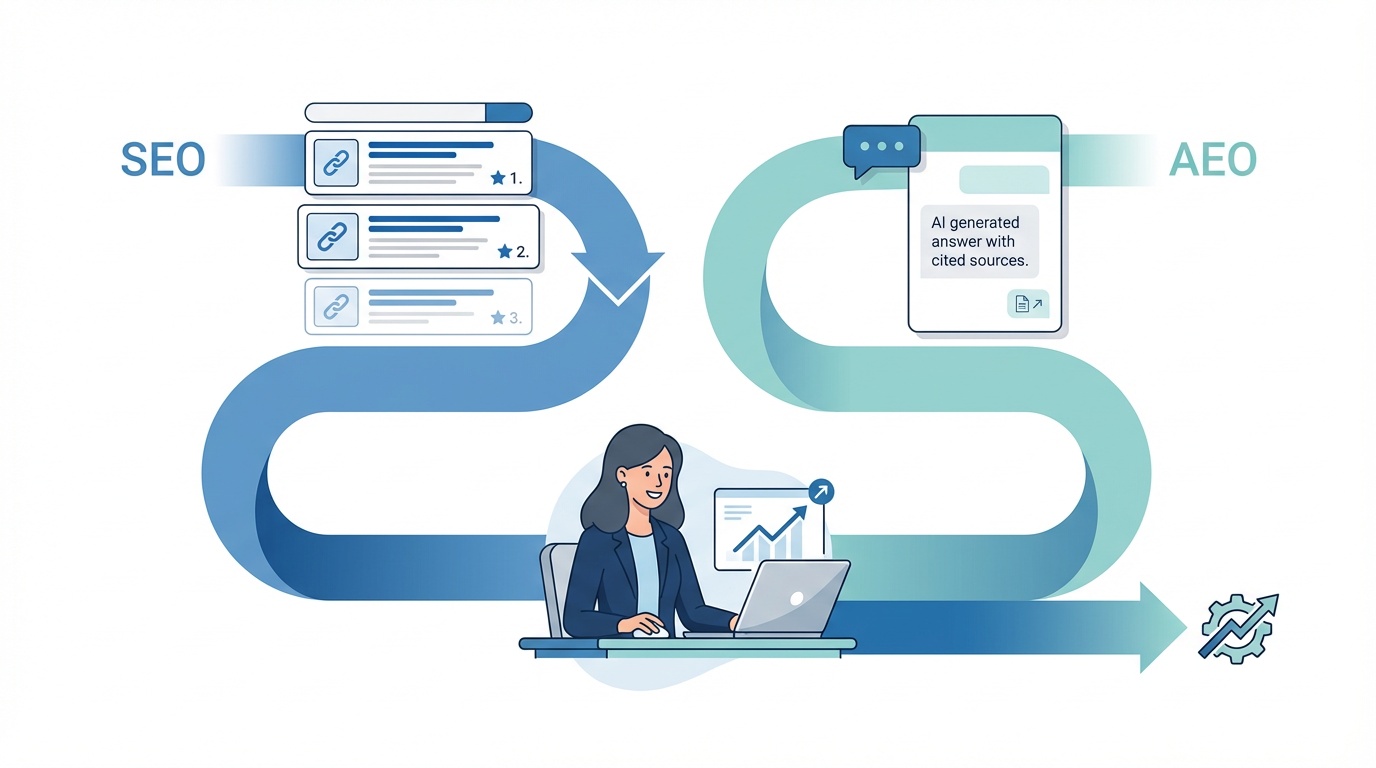
Answer Engine Optimization (AEO) is what changed them. While SEO optimises for Google’s search results pages, AEO optimises for something different: the AI-generated answers that now appear above those results. ChatGPT. Perplexity. Google’s AI Overviews. Bing Copilot. Your B2B buyers are using these tools to shortlist vendors before they ever run a single Google search.
The companies being cited as authoritative sources in those AI answers? They get a trust signal that no paid ad can buy. The companies that aren’t? They’re invisible at the exact moment the shortlist forms.
This isn’t a guide written for marketers. It’s written for B2B tech CEOs who need to understand what AEO is, how it differs from SEO, and how a resource-constrained team should approach both. By the end, you’ll have a clear framework—and a practical starting point.
Key Takeaways
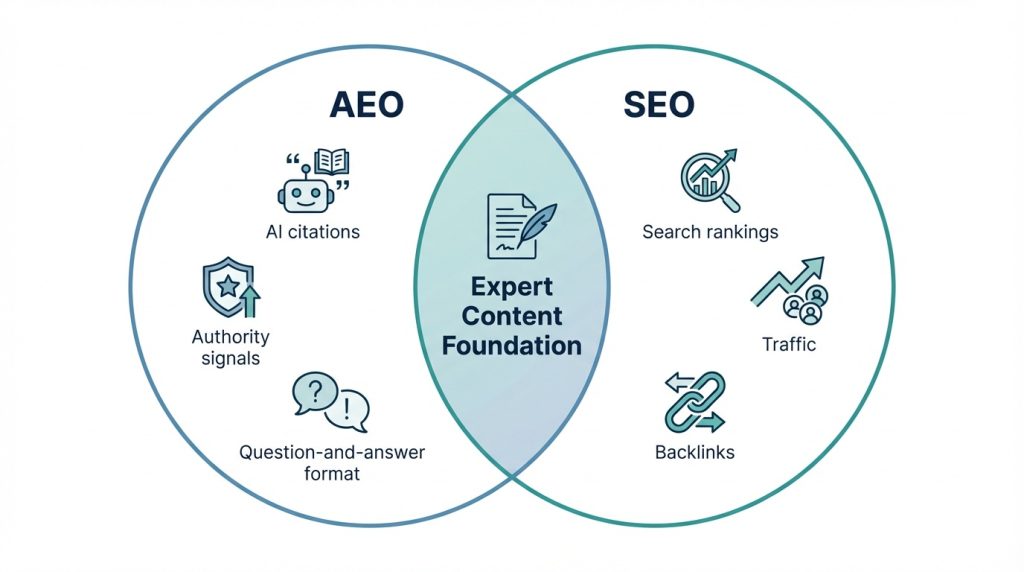
- AEO and SEO serve different surfaces—AI assistants vs. Google results pages—but both require the same foundation: expert-level content
- B2B buyers increasingly start with AI assistants, not Google, when researching vendors and building shortlists
- You don’t have to choose—a B2B team that creates genuinely helpful content gets both AEO and SEO benefits
- The window to build AEO authority is open now—most competitors in B2B haven’t started, and early movers compound
Table of Contents
- Key Takeaways
- What Is AEO? (And Why It’s Not Just a Rebrand of SEO)
- The Answer Engines You Actually Need to Care About
- AEO vs SEO: The Real Differences That Matter to Your Business
- How Your B2B Buyers Actually Use AI Search (And Why This Changes Everything)
- Why “AEO vs SEO” Is the Wrong Question
- AEO for B2B: The 4 Content Types That Get Your Company Cited in AI Answers
- The Schema Markup Non-Negotiables
- If Your SEO Traffic Is Declining, Here’s What’s Actually Happening (And What to Do)
- Your AEO Quick-Start: What to Prioritise in Your First 30 Days
- FAQ: AEO vs SEO for B2B Companies
- The Bottom Line: AEO and SEO in 2026
What Is AEO? (And Why It’s Not Just a Rebrand of SEO)
When people talk about AEO vs SEO, they’re asking the wrong question — but understanding AEO starts with the definition. AEO stands for Answer Engine Optimization. The goal is to structure your content so that AI systems, such as Google’s AI Overviews, ChatGPT, Perplexity, Bing Copilot, and voice assistants, use it as a cited source when generating answers.
That’s a fundamentally different goal from SEO and it’s the core of why AEO vs SEO is worth understanding as two distinct disciplines.
SEO optimises for position on a search results page. You want your URL to appear when someone searches for a query. You succeed when they click your link. The metric is traffic.
AEO optimises for inclusion in an answer. You want the AI to pull from your content when generating a response. You succeed when your content is cited—even if the user never visits your site. The metric is brand authority and citation frequency.
These are not the same thing. And a B2B company can miss one while succeeding at the other.
The CEO skepticism I hear most often: “Is AEO just SEO with a new name?” It isn’t. SEO and AEO share a foundation—both reward high-quality, relevant, expert content, but they have different technical mechanisms, different ranking signals, and operate on completely different surfaces.
The Answer Engines You Actually Need to Care About
Not all answer engines carry equal weight for B2B. Here’s where to focus:
- Google AI Overviews—the AI-generated summary appearing above organic results. High impact for B2B search. Advanced Web Ranking data (2026) shows over 60% of US searches now trigger a Google AI Overview
- Perplexity AI—rapidly growing, specifically popular among researchers and executives evaluating vendors
- ChatGPT (browsing mode)—used increasingly for vendor research and business problem-solving
- Bing Copilot—growing in enterprise settings, particularly among Microsoft-ecosystem companies
- Voice assistants—lower B2B relevance for most industries, but worth considering for awareness
The common thread: each of these surfaces synthesises information from multiple sources and presents a direct answer. Your content either gets cited, or it doesn’t.
AEO vs SEO: The Real Differences That Matter to Your Business
The AEO vs SEO comparison that matters isn’t technical — it’s strategic. Here’s what a CEO deciding where to put limited resources actually needs to know.
| Factor | SEO | AEO |
|---|---|---|
| Primary surface | Google/Bing results pages | AI-generated answers |
| Success metric | Rankings, traffic, organic conversions | Citations, brand mentions, answer inclusion |
| Timeline to results | 3-12 months | Citations can start immediately; compounding takes 6-12 months |
| Resource requirement | High (content + technical + links) | Medium (content + structure + schema) |
| B2B pipeline impact | Direct (traffic to site) | Indirect (trust building before site visit) |
| Zero-click exposure | Loses clicks to AI Overviews | Benefits from AI Overviews (you’re the source) |
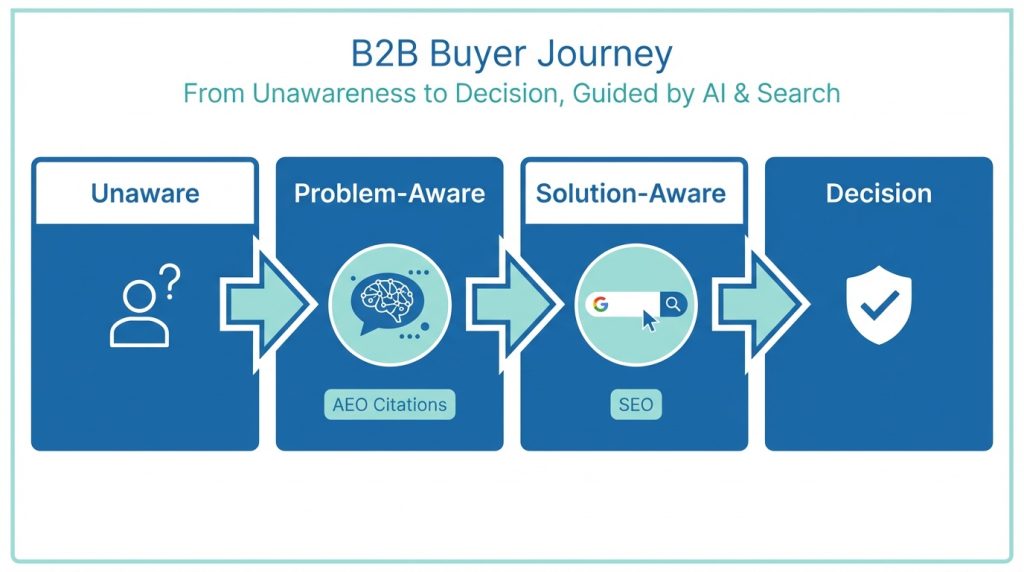
🖼 Image Placeholder: Supporting 1 — The B2B Buyer Research Journey: How AEO and SEO Work at Different Stages
Filename: b2b-buyer-research-journey-aeo-seo.jpg
Alt text: Diagram of B2B buyer research journey showing AI assistant queries at awareness stage and Google search at consideration stage, illustrating how AEO and SEO serve different touchpoints
fal.ai prompt: Clean flat design diagram showing a horizontal buyer journey with 4 stages: ‘Unaware’, ‘Problem-Aware’, ‘Solution-Aware’, ‘Decision’. At the ‘Problem-Aware’ stage, show an AI chat icon (abstract, not ChatGPT logo) representing AEO citations. At the ‘Solution-Aware’ stage, show a Google-style search bar icon representing SEO. Arrow connecting left to right. Corporate blue, white, and light teal colors. Simple icons, no photos. Minimal text labels only (stage names). B2B business publication quality. 900×400 pixels landscape.
Generate this image on fal.ai using the prompt above, upload to Media Library, then replace this block with the image.
The last row is what matters most right now.
Traditional SEO drives traffic to your site. But Google’s AI Overviews have significantly reduced click-through rates for informational queries—by as much as 30-70% depending on query type, according to Superlines (2026).
If you optimise only for SEO and AI Overviews start synthesising answers from your content without sending traffic, you lose. If you’ve also optimised for AEO, you’re the source being cited. You get the authority signal even without the click.
For B2B companies, the pipeline math works like this: a prospect sees your company cited in three different AI answers over two weeks. They develop familiarity and trust. When they eventually Google your service category, they already know your name. That’s a shorter sales cycle with a warmer lead.
How Your B2B Buyers Actually Use AI Search (And Why This Changes Everything)
Here’s a scenario that reframes the AEO vs SEO debate entirely. I see it playing out with increasing frequency.
A VP of Sales at a Series B fintech is evaluating content agencies. She doesn’t start with Google. She opens Perplexity and asks: “What are the best B2B content agencies for fintech companies?” The response names four or five agencies with brief descriptions of each. Those citations become her shortlist. She then Googles each named company individually to validate them.
If your company isn’t in that first answer, you never make her shortlist. You’re not considered—even if you’d be the best fit.
The AEO vs SEO implications of this shift are significant. According to 6sense data compiled by Thunderbit (2026), 94% of B2B buyers now use AI tools like ChatGPT during their buying process. Nearly 29% start their research with an AI tool before ever visiting a vendor website.
This is the pipeline mechanism that makes AEO matter to a CEO, not just a marketer.
Being cited in AI answers provides three compounding benefits:
- Pre-credentialing—the AI citing you acts as a third-party endorsement. It frames you as authoritative before the prospect ever sees your website
- Brand familiarity—repeated AI citations build name recognition with prospects who haven’t searched for you directly
- Research-stage positioning—you enter the buyer’s consideration set at the top of the funnel, weeks before they’re ready to buy
“Buying groups are larger and more complex than in prior years—and they’re using AI to shortlist vendors faster than ever.” Forrester Buyer Insights 2026 (Forrester, 2026)
In my work with B2B tech companies building content strategies, the shift became undeniable in late 2024. Clients who had invested heavily in thought leadership content—podcasts, detailed guides, expert Q&A pages—started showing up in AI-generated answers. (Here’s the SEO strategy episode that covers building this foundation.) Their lead quality improved not because of more traffic, but because prospects arrived already trusting them.
Why “AEO vs SEO” Is the Wrong Question
Here’s the take that might challenge your framing on AEO vs SEO: treating it as a binary choice is a trap.
SEO and AEO don’t compete for the same real estate. They serve different stages of the same buyer journey on different surfaces. Asking whether to do AEO or SEO is like asking whether to focus on your website or your LinkedIn presence. The answer is: they serve different purposes.
SEO captures intent. When a B2B buyer knows what they’re searching for and types it into Google, you want to be there. This is high-intent traffic—someone actively looking for your category. SEO is how you capture that demand.
AEO builds trust before intent. When that same buyer is still formulating their problem and asks an AI assistant a broad question about their industry challenge, you want to be cited as an authoritative source. AEO is how you build credibility upstream of the active search.
For a B2B tech company with a small content team, the practical question isn’t “which one”—it’s “which one first.”
My answer: If you haven’t built a solid SEO foundation (a well-structured site, existing content, and some domain authority), start there. It builds the credibility signals that also power AEO. Once you have that foundation, layering in AEO-specific tactics—FAQ schema, explicit Q&A structure, structured author expertise signals—adds meaningful visibility with relatively low incremental effort.
The companies that win in B2B search over the next 3-5 years will have both. The ones that are choosing between them will lose on both fronts.
AEO for B2B: The 4 Content Types That Get Your Company Cited in AI Answers
When we map AEO vs SEO content priorities for B2B clients, four content types consistently outperform. Not all content gets cited equally.
1. FAQ-structured content
AI systems are optimised to answer questions. Content that explicitly asks and answers questions—in a clear Q&A format—is the easiest content for an AI to cite. This means FAQ pages, Q&A blog posts, and structured “questions this article answers” sections.
The technical layer: add FAQ schema markup to these pages. This signals to both Google and AI crawlers that your content is structured for direct answer retrieval.
2. Expert thought leadership with original POV
AI systems need something to cite. When your content offers a genuinely unique perspective—original analysis, counterintuitive insight, or specific expertise not found elsewhere—it becomes more citable than generic information summaries.
In ghostwriting content for B2B tech executives, the pattern is consistent: the pieces that get cited and shared are the ones that take a clear position on something the industry is debating. Not neutral summaries—actual perspectives.
3. Podcast transcripts and structured show notes (high AEO vs SEO crossover value)
This is the most underutilised AEO asset for B2B brands that run a podcast. (On the Predictable B2B Success episode on B2B SEO strategy, we covered how podcast content builds domain authority alongside AEO signals.)
A well-optimised podcast episode page with a structured transcript, explicit Q&A format in the show notes, and clear speaker expertise signals is AEO gold. AI systems actively cite podcast content from subject matter experts—especially when the transcript answers specific questions in clear, quotable language.
If you run a B2B podcast (or your CEO is a regular podcast guest), optimising those transcript pages for AEO is one of the fastest ways to build citation frequency.
4. Primary research and original data
AI systems prioritise original data sources. If your company produces annual benchmarks, survey data, or original research, this content gets cited disproportionately because it’s not available elsewhere.
For B2B tech companies, this doesn’t require a massive research budget. Even a well-structured analysis of your own customer data, anonymised and published as industry insight, functions as citable primary research.
The Schema Markup Non-Negotiables
Three schema types are essential for AEO:
- FAQ schema on every FAQ-format post—signals to AI crawlers that your content is Q&A structured and ready for direct retrieval
- Article schema with author expertise signals—establishes the human expertise behind your content (crucial for E-E-A-T scoring that powers AI citations)
- HowTo schema where you’re providing step-by-step guidance—highly citable by AI when answering “how to” queries
These are technical additions that your developer or CMS can add in under an hour per page. The ROI is disproportionate.
If Your SEO Traffic Is Declining, Here’s What’s Actually Happening (And What to Do)
The AEO vs SEO dynamic explains something I get asked about constantly: why does organic traffic decline even when Google rankings hold? If you’re watching this happen, here’s what’s going on:
Google’s AI Overviews now appear for 60% of users. When a prospect searches a question your content previously answered, they now see an AI-generated summary at the top of the page. For many queries, they get their answer without clicking through.
This is the zero-click problem. It’s real, it’s measurable, and it’s accelerating. Research from Superlines (2026) shows Google AI Overviews are reducing website visits by 30-70%, with informational queries most affected
The responses I’ve seen from B2B companies fall into three categories:
The wrong response: abandon SEO. Don’t do this. Organic search still drives a significant portion of the B2B pipeline. Zero-click searches build brand awareness even when they don’t drive clicks. And the companies abandoning SEO are creating more space for the ones who stay.
The partial response: double down on bottom-of-funnel SEO. Focus SEO investment on high-intent, transactional queries where users need to click through to get the specific information they need (pricing, case studies, demos). These queries are less affected by AI Overviews because the answer requires visiting your site. This is smart.
The complete response: add AEO to your SEO foundation. If Google’s AI Overview is going to summarise your content, make sure you’re the one being cited. Add structured data. Build explicit FAQ pages. Strengthen your author and company expertise signals. Become the source the AI pulls from, not the competitor it references. This is what turns declining traffic into growing authority.
The third approach requires more effort. It also builds a compounding advantage that the other two don’t.
Your AEO Quick-Start: What to Prioritise in Your First 30 Days
The question I get from resource-constrained B2B teams isn’t “should we do AEO”; it’s “what do we do first without overhauling everything?”
Here’s the AEO vs SEO sequencing that delivers the most impact with the least disruption:
Week 1-2: Audit and enrich your best existing content
Identify your 5-10 most authoritative, expert-level pieces. These are the posts that already rank, already get traffic, and represent your most authoritative thinking. Add FAQ schema to each one. Add an explicit “Frequently Asked Questions” section if the content supports it. Strengthen the author bio with specific expertise signals (years of experience, credentials, named clients where possible).
This is the lowest-effort, highest-return move in the AEO vs SEO playbook. You’re not rewriting these—you’re structuring them for AI citation.
Week 2-3: Create or expand one expert FAQ hub
Build one definitive FAQ page in your primary area of expertise. Aim for 10-15 questions with direct, clear answers. Structure it explicitly as Q&A. Add FAQ schema. This single page, done well, can generate a significant portion of your early AEO citations.
Week 3-4: Optimise your company and author authority signals
AI systems evaluate expertise, authoritativeness, and trustworthiness before deciding whether to cite content. Make sure your About page, team pages, and author bios clearly signal:
- Specific experience with the problems your clients face
- Named credentials or relevant experience
- Links to authoritative external mentions (podcast appearances, media coverage)
Ongoing: Structure every new content piece for explicit Q&A
For every article or guide going forward, include a “Questions this article answers” section at the top and a FAQ section at the bottom. This structural habit, applied consistently, compounds over time.
If you have a podcast: Prioritise optimising your episode show notes. Add structured Q&A summaries, speaker expertise signals, and FAQ schema to your most popular episodes. This is one of the highest-impact AEO investments for any B2B brand with an existing podcast library.
FAQ: AEO vs SEO for B2B Companies
Is AEO better than SEO for B2B companies?
Neither replaces the other. SEO captures high-intent search traffic from buyers who know what they’re looking for. AEO builds brand authority at the top of the funnel, before the buyer has started active research. B2B companies that invest in expert-level content get both—because the same content quality that ranks well in SEO also gets cited in AI answers.
How long does AEO take to show results?
Unlike SEO, where you typically wait 3-12 months before rankings improve, AEO can produce citations relatively quickly once your content is properly structured. Well-structured FAQ content with schema markup can start appearing in AI-generated answers within weeks of publication. However, the compounding brand authority effect takes 6-12 months of consistent investment.
Do I need technical expertise to implement AEO?
One of the most common AEO vs SEO misconceptions is that AEO requires heavy technical work. The core AEO tactics—FAQ schema, Article schema, structured Q&A content—require minimal technical knowledge. A developer can add the necessary schema markup in a few hours. Most modern CMS platforms (including WordPress with Rank Math or Yoast) have built-in schema markup. The harder work is content quality, not technical implementation.
Can AEO replace SEO entirely?
No. AI-generated answers still draw on web content discovered through traditional search mechanisms. If your website isn’t indexable, your content won’t be cited. AEO builds on the same foundation as SEO: good content, proper site structure, and domain authority. Think of AEO as an additional optimisation layer, not a replacement strategy.
How do I know if my company is being cited in AI answers?
Search your key topics in ChatGPT, Perplexity, and Google’s AI Overviews. Note whether your company is mentioned. Tools like Otterly.AI and BrightEdge are building AEO monitoring capabilities. This is an emerging space—dedicated tracking tools are still developing, but manual spot-checking gives you a directional picture.
What’s the difference between AEO and GEO (Generative Engine Optimization)?
These terms are sometimes used interchangeably. Generative Engine Optimization (GEO) specifically refers to optimising for large language model outputs from generative AI systems. AEO is the broader term covering all answer engines—including featured snippets, knowledge panels, and voice search, not just AI-generated responses. In practice, the tactics overlap significantly.
How much should a B2B company invest in AEO vs SEO?
For a company with an established SEO programme, AEO additions are largely incremental: schema markup, FAQ content structure, expert authority signals. Budget for perhaps 20-30% additional content effort on top of your existing SEO investment. For companies starting from scratch, build the SEO foundation first (6-12 months), then layer in AEO systematically. The companies that treat AEO as a complete replacement for SEO will underperform on both.
The Bottom Line: AEO and SEO in 2026
The AEO vs SEO question has a clear answer for B2B companies in 2026 — and the answer reframes the AEO vs SEO debate entirely: it’s a sequence, not a choice. The content landscape now has two distinct surfaces: Google’s results pages and AI-generated answers. Your buyers use both. Your content needs to work on both.
SEO gets you found when prospects know what they’re looking for. AEO gets you cited before they start looking. Together, they create a flywheel: your content builds authority with AI systems, which builds brand familiarity with buyers, which means better conversion rates when those buyers eventually land on your site from organic search.
The companies making serious AEO investments right now are still early. The keyword difficulty for AEO-related terms is near zero—evidence that most B2B companies haven’t started. That window won’t stay open.
If you’ve been doing SEO and wondering whether to add AEO: yes, add it. Start with the quick-start framework above. It doesn’t require replacing your existing content programme—it requires structuring what you already create with AI citation in mind.
The investment compounds. The authority you build in AI answers today will be significantly harder for competitors to displace in 12 months.
If your content programme is already generating strong SEO results but you’re not yet showing up in AI-generated answers, the gap is usually structural—not a volume problem. The companies I work with at Sproutworth that solve AEO vs SEO most efficiently — and build AEO visibility fastest are typically the ones with a podcast, a clear point of view, and an audience that already trusts their thinking. The work is connecting those assets to the right structure. If that’s where you are, it’s worth a conversation.
