

Last Updated: October 29, 2025 | Reading Time: 12 minutes
TL;DR – Key Takeaways
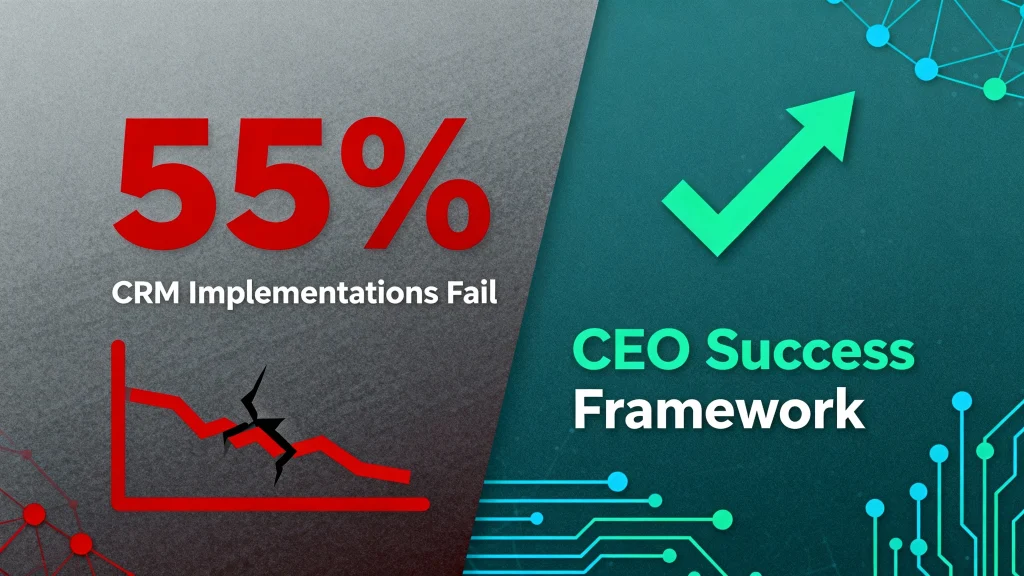
- 55% of CRM implementations fail due to poor planning and user adoption, not technology limitations
- Focus on process documentation before technology selection to avoid the $100K+ waste trap
- Train teams with live, customized sessions instead of generic videos nobody watches
- Connect every lead source to revenue in your CRM for true marketing attribution
- Re-engage existing customers first—it’s 5-10x cheaper than new acquisition
- The Framework: Process → People → Technology (in that order, always)
Stop wasting money on CRM systems your team won’t use.
Here’s the uncomfortable truth: Your $50,000 CRM investment is probably collecting digital dust. Research shows that 55% of CRM implementations fail to achieve their planned objectives. Even worse, while 85% of B2B organizations have CRM systems, only 27% of sales teams actively use them.
I’ve spent years helping B2B tech companies implement systems that actually generate revenue. What I’ve learned contradicts most conventional CRM advice you’ll hear from vendors pushing software subscriptions.
The real problem isn’t your CRM platform. It’s that nobody told you implementation is a revenue strategy problem, not a technology problem.
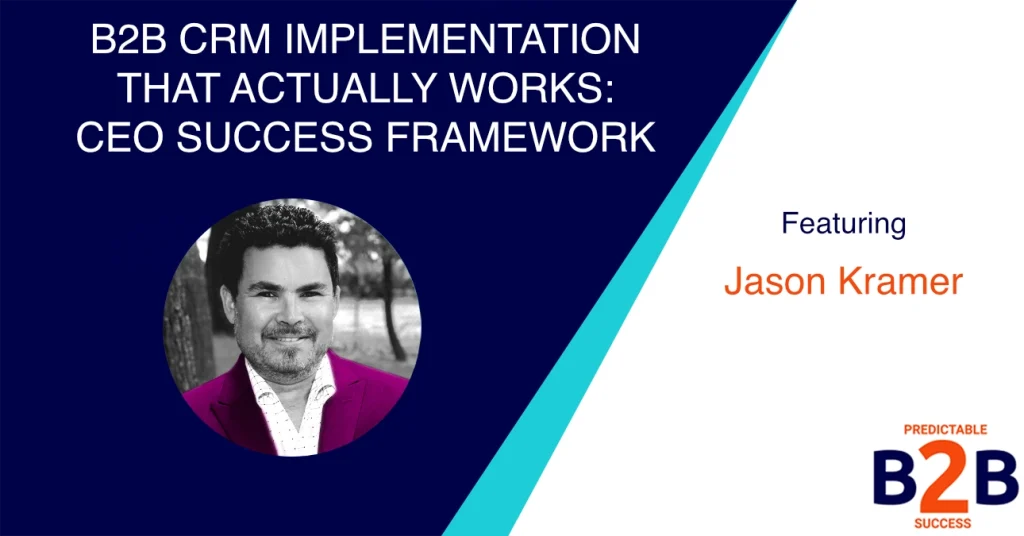
Meet Jason Kramer: The CRM Implementation Expert Who Bridges Marketing and Sales
Expert Profile
Jason Kramer is the founder and CEO of Cultivize, a consulting firm specializing in B2B lead nurturing strategies and custom CRM implementation. With over 20 years of experience in marketing and business development, Jason has worked with major brands including Virgin Atlantic Airways and Johnny Walker.
After running a boutique creative agency for 15 years, Jason identified a critical revenue gap: businesses were spending significant money on marketing but couldn’t connect those efforts to actual revenue. As he explains:
“They weren’t really able to understand if marketing was actually driving any revenue because they weren’t able to connect the dots. They didn’t have either a CRM at all or they didn’t have a CRM connected to their sales and their marketing efforts.”
This realization led him to found Cultivize in 2018, with a mission that goes beyond typical CRM vendors:
“We’re actually going to integrate everything, train them on how to use the tech stacks we’ve created, help their marketing team, their sales team, and almost be like a mentor and a coach on an ongoing basis so that we have that long term relationship with them and we’re not just a vendor selling a piece of software.”
What Makes Jason’s Approach Different:
- Direct implementation work (not just consulting)
- Ongoing training and support (not one-time setup)
- Focus on revenue attribution (not just lead tracking)
- Customized solutions (not cookie-cutter templates)
Jason’s approach addresses the human element of CRM implementation—the factor most vendors ignore and the primary reason implementations fail.
Professional Background:
- Founder & CEO, Cultivize (2018-Present)
- Chief Visionary Officer, JLK Creative, Inc. (2002-2018)
- Certified in SharpSpring, HubSpot, and Constant Contact platforms
- Featured expert on Revenue Rehab, Sales Evangelist, and 30+ business podcasts
The Hidden Crisis in B2B CRM Implementation
💡 KEY INSIGHT: CRM failure rates have remained consistently high for over 20 years despite massive technology improvements, proving this is a people and process problem, not a technology problem.
The statistics paint a grim picture:
- 55% of CRM projects fail to meet their objectives (Johnny Grow Research)
- 69% of implementations fail due to lack of planning during implementation (Badger Maps)
- 75% of companies report lengthening sales cycles, with enterprise deals taking 40% longer to close
- Only 7% of B2B companies have achieved marketing and sales alignment (despite proven 32% revenue increases)
- 94% struggle with data quality issues that cripple lead nurturing effectiveness
- 50-55% failure rate has persisted since Gartner first reported it in 2001

When CRM implementations fail, it’s expensive. Organizations typically invest three to five times the software cost in implementation, customization, and training. Factor in productivity losses and the opportunity cost of delayed revenue, and you’re looking at hundreds of thousands in wasted investment.
💡 KEY INSIGHT: The average company loses up to $15 million annually due to poor CRM data quality alone—before accounting for failed implementation costs.
But here’s what keeps me up at night: These failures are entirely preventable.
VIDEO: Full Interview with Jason Kramer
In this comprehensive interview, Jason shares:
- Real client examples of CRM failures and turnarounds
- The exact process he uses for successful implementations
- How to connect marketing dollars to revenue attribution
- Lead nurturing strategies that convert dormant prospects
- Trade show marketing tactics that generate measurable ROI
Why Your CRM Implementation Failed (And How to Fix It)
The People Nobody Consults
Jason hits on something crucial that most executives miss:
“The people that are in the trenches responsible for sales, responsible for marketing, are often not the people making decisions about what tools they are going to be able to use for their business, how things are going to flow, how the process is going to work.”
I’ve watched this play out dozens of times. C-suite executives attend vendor demos, get wowed by features, sign contracts—then wonder why adoption rates hover around 26% six months later.
Your sales reps aren’t using the CRM because nobody asked them what they actually need. They’re buried in manual data entry instead of closing deals.
Real Example from Jason’s Experience:
One client in the insurance space, mapping their CRM integration, focused entirely on contact information. Jason had to stop the implementation:
“I said, okay, this is all the contact information, but what about the company information, the account record? You guys are selling into accounts. Right now, you’re only mapping the contacts. What about all the information about the company? And they were like, oh, isn’t that part of it? And I was like, no, it’s actually two separate records in the CRM.”
They were ready to start programming a fundamentally flawed system. Without someone asking the right questions, they would have built a CRM that couldn’t track their actual sales process.
Training That Actually Doesn’t Work
“The training typically doesn’t work. People don’t watch those videos. They don’t look at the training guides. They’re going to try to figure it out as they go.” — Jason Kramer
💡 KEY INSIGHT: One-third of employees say it’s hard to stay motivated with training at work. A quarter say they quickly forget the material after training is complete.
Generic PDF guides and pre-recorded tutorials gather digital dust. Real training means live, customized sessions showing your team exactly how YOUR configured system works for THEIR specific workflows.
What Works Instead:
- Live Zoom or in-person training sessions
- Customized to your actual CRM configuration
- Role-specific training (sales vs. marketing vs. customer service)
- Hands-on practice with real scenarios
- Ongoing monthly check-ins and advanced training
This is where educational email courses excel—they provide structured, ongoing training that keeps teams engaged beyond the initial implementation phase, delivering bite-sized lessons over weeks rather than overwhelming users in a single session.
The Accountability Gap
Even perfect training fails without ongoing accountability. Jason emphasizes:
“If you don’t have anybody in the organization that’s making sure that people are doing the things they’re supposed to be doing, and if you’re not looking at that on a weekly, monthly basis at a minimum, then things are probably not going to be done the way that you expect them to be done.”
The Cost of No Accountability:
- Data entry becomes inconsistent or stops entirely
- Sales pipeline accuracy drops to 60% or lower
- Marketing attribution disappears
- Lead follow-up falls through cracks
- Teams revert to spreadsheets and email
Without a dedicated CRM champion or oversight, adoption withers within 90 days of implementation.
CRM Implementation: Success vs. Failure Factors
| Success Factors | Failure Factors |
|---|---|
| 6+ months planning with clear objectives | Rushed implementation under 90 days |
| Live, customized training for each role | Generic PDF guides and video tutorials |
| Executive sponsorship with visible support | IT-only initiative without C-suite buy-in |
| Process documentation completed first | Technology-first approach |
| Weekly accountability checks (first 90 days) | “Set and forget” mentality after go-live |
| Phased rollout by department or project | Company-wide rollout on day one |
| User input during selection and configuration | Top-down decision without user consultation |
| Data cleansing before migration | Migrating garbage data into new system |
| Clear metrics and KPIs defined upfront | Vague “improve efficiency” goals |
| Dedicated CRM champion or team | No ongoing support structure |
The Framework That Actually Works

Step 1: Connect Marketing to Revenue (Not Just Leads)
Most B2B companies track leads, but not revenue attribution. This is backward.
“The fundamental thing every business should do: When you get a lead, whether it be a phone call from a website lead, wherever it’s coming from, that should be tagged in some way in your CRM to say it came from here.” — Jason Kramer
This means tagging every lead source—specific Google Ads, social campaigns, trade shows, webinars—then tracking those leads through to closed revenue.
Real Client Example:
One of Jason’s clients, a roofing company spending six figures annually on marketing across TV, radio, and direct mail, couldn’t identify which channels drove revenue. His solution?
“We took QR code technology and built a separate QR code for each of their printed materials and digital. So the commercial for TV, a special QR code shows up in that commercial versus the direct mail campaign.”
Simple. Trackable. Impossible to ignore when budget planning arrives.
Another client, a marketing agency, discovered their Facebook campaigns generated hundreds of monthly leads:
“But something like 80% of them were just garbage. They were bad phone numbers. They weren’t returning anybody’s phone call when a salesperson called.”
Without CRM tracking showing zero conversions, they would have continued wasting budget on campaigns that generated volume but no revenue.
💡 KEY INSIGHT: Marketing viewed as a cost center exists only when you can’t connect marketing investments to revenue. CRM attribution changes the conversation from “marketing costs” to “revenue sources.”
Implementation Checklist for Revenue Attribution:
- [ ] Tag every lead source at entry point
- [ ] Connect CRM to all marketing platforms (Google Ads, social, email)
- [ ] Create unique tracking codes for offline channels (trade shows, events, direct mail)
- [ ] Build revenue reports by source
- [ ] Share attribution dashboards with marketing and sales teams
- [ ] Review ROI by channel monthly
- [ ] Eliminate or optimize underperforming channels
For B2B tech companies, this is where content marketing and digital PR services prove their value—when every piece of content, every backlink, every mention can be tracked to pipeline and revenue.
Step 2: Build Process Before Implementing Technology
Jason’s most contrarian insight challenges every vendor playbook: Document your processes FIRST.
“From marketing to sales to onboarding to customer service—how are those different divisions working within our company? What tools are they using? What are their steps when someone calls, speaks to a lead, what do they do first, what do they do second?”
This process mapping reveals:
- Workflow bottlenecks killing conversions
- Redundant tools wasting budget
- Gaps where leads disappear
- Opportunities for strategic automation
- Integration requirements between systems
- Data handoff points prone to errors
Only after mapping these processes should you configure your CRM to support them.
Process Documentation Template:
For each department, document:
- Current workflow (step-by-step, no matter how messy)
- Tools used (every platform, spreadsheet, email system)
- Handoff points (where information passes between people/teams)
- Pain points (manual work, errors, delays)
- Desired outcome (what success looks like)
- Metrics tracked (or should be tracked)
💡 KEY INSIGHT: “Software alone can’t solve our problems. Our CRM software will only take us as far as our sales process, sales strategy, and lead flow will allow.” — Jason Kramer
Most failed implementations start with selecting technology before understanding the process. This is building backwards.
I’ve seen this in my work with B2B tech companies developing podcast strategies—without a clear process for how podcast leads flow into your CRM and get nurtured, the podcast becomes another data silo instead of a revenue driver.
Step 3: Implement Lead Nurturing That Converts
Here’s where B2B companies leave massive money on the table.
“Lead nurturing is one thing that might get talked about, but I don’t know that it really gets fully implemented in the right way.” — Jason Kramer
Most companies focus exclusively on new lead generation while ignoring their existing database. Jason’s data shows re-engaging current customers costs 5-10 times less than acquiring new ones.
The solution? Systematic lead nurturing workflows triggered by behavior, not arbitrary time intervals.
“You can’t be expected as a busy business person to go in and be looking for that. You need a CRM to be able to say, hey, Jason, look at this. Melissa’s back on the website. You might want to give her a call. That’s what the idea of nurturing is—to educate, but also then to have the resources and technology to let you know who’s actually eating up all the information.”
Your CRM should alert sales when prospects:
- Return to your website
- Download resources
- Open emails and click links
- Attend webinars
- Engage with content
- Show buying signals
Lead Nurturing Framework:
Cold Leads (No recent engagement):
- Monthly educational email series
- Quarterly value-add content
- Annual re-engagement campaign
Warm Leads (Some engagement):
- Bi-weekly nurturing with case studies
- Triggered emails based on content consumption
- Sales alerts for high-value actions
Hot Leads (Multiple signals):
- Immediate sales notification
- Daily follow-up cadence
- Personalized outreach referencing specific behaviors
Educational email courses work particularly well here, positioning your brand as the trusted authority while keeping prospects engaged through lengthy B2B sales cycles. This is exactly what we help B2B tech brands create at Sproutworth—structured nurturing that integrates seamlessly with CRM tracking.
Jason’s free resource at AfterTheLead.com provides a complete playbook for setting up lead nurturing strategies regardless of your CRM platform.
Step 4: Audit Your Tech Stack (You’re Probably Wasting Money)
“Look to see what software you’re paying for on a monthly basis or annual basis. We’ve seen plenty of companies have tens of thousands of dollars in expenditure for software they don’t even use. It just somebody signed up for it a couple years ago and it keeps getting paid for.” — Jason Kramer
💡 KEY INSIGHT: The average company wastes $20,000-50,000 annually on unused software subscriptions. That’s enough to fund proper CRM implementation and training.
Before adding a CRM, audit existing tools:
- Which platforms do teams actually use daily?
- What integration gaps create data silos?
- Where is manual data entry happening?
- Which subscriptions have been forgotten?
- Are we paying for duplicate functionality?
Tech Stack Audit Checklist:
- [ ] Request bank/card statements for last 12 months
- [ ] Identify all software subscriptions
- [ ] Survey teams: “What do you use daily?”
- [ ] Compare stated usage vs. actual logins
- [ ] Calculate cost per active user
- [ ] Identify integration gaps
- [ ] Document manual workarounds
- [ ] Cancel or consolidate redundant tools
This audit typically uncovers enough waste to fund your entire CRM implementation. It also reveals integration requirements you didn’t know existed.
Step 5: Align Sales and Marketing (Actually)
Only 7% of B2B companies achieve true sales and marketing alignment, yet it drives 32% revenue increases.
The disconnect Jason sees constantly: Marketing tracks leads generated; sales can’t report what happened to those leads.
“If you don’t have a CRM in place that’s tracking that activity, you’re going to be really lopsided and potentially wasting a lot of marketing dollars on things that aren’t actually working.”
One marketing agency client discovered their Facebook campaigns generated hundreds of monthly leads—but 80% were garbage contacts with bad phone numbers. Without CRM tracking showing zero conversions, they would have continued wasting budget.
Real Alignment Requires:
1. Shared Dashboards
- Lead-to-revenue data visible to both teams
- Marketing sees conversion rates by source
- Sales sees lead quality by campaign
- Both own the full funnel metrics
2. Lead Quality Definitions
- Agreement on what constitutes a “qualified lead”
- Documented criteria for lead scoring
- Clear handoff procedures from marketing to sales
- Feedback loop when leads don’t convert
3. Unified Processes
- SLA on sales follow-up timing
- Marketing notified of won/lost deals
- Regular collaboration meetings (weekly minimum)
- Shared accountability for revenue targets
4. Agreed Metrics
- Not just lead volume
- Conversion rate by source
- Time to close by lead type
- Customer acquisition cost
- Lifetime value by source
This is where strategic B2B growth marketing intersects with CRM—when both teams use the same system, view the same data, and optimize toward the same revenue goals.
The ROI That Makes CFOs Happy
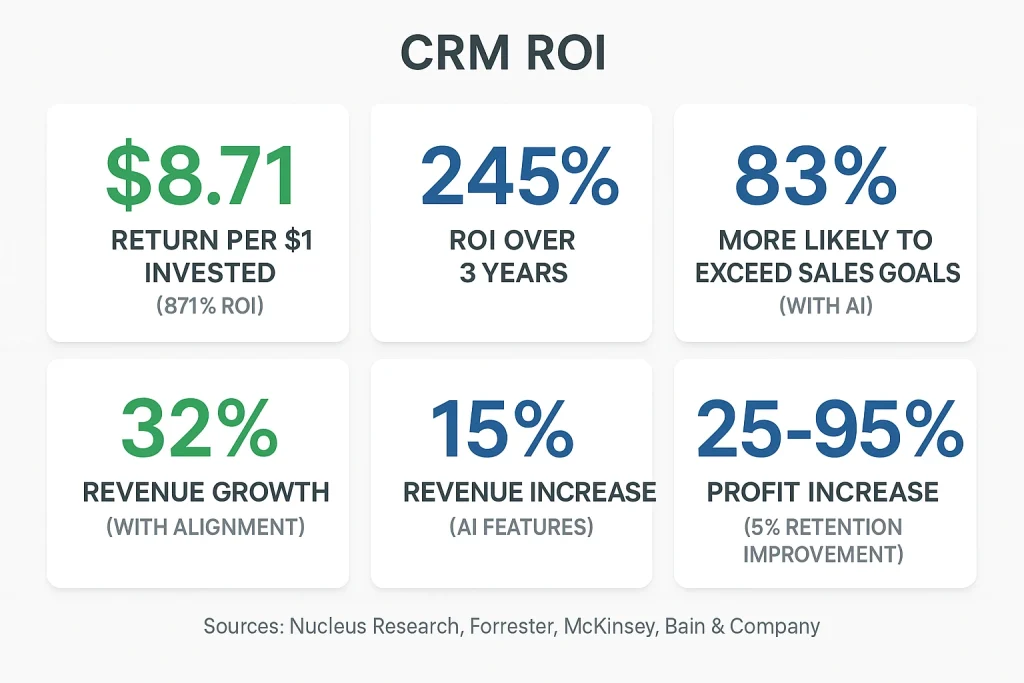
💡 KEY INSIGHT: When implemented correctly, CRM systems deliver an average ROI of $8.71 for every dollar spent—an 871% return.
Proven CRM ROI Statistics:
- $8.71 return per $1 invested (Nucleus Research)
- 245% ROI over three years (Forrester Research)
- 65% of businesses using CRM with generative AI are 83% more likely to exceed sales goals
- Companies with aligned sales and marketing teams see 32% revenue growth
- 15% revenue increase from AI-powered CRM features (McKinsey)
- 25-95% profit increase from just 5% improvement in customer retention (Bain & Company)
But these returns require treating CRM as an internal product requiring management and support, not a one-time technology purchase.
What ROI Actually Looks Like:
Before Proper CRM Implementation:
- Can’t identify which marketing channels drive revenue
- Sales reps spend 4+ hours daily on data entry
- 40% of leads fall through cracks
- Average sales cycle: 6-9 months
- Marketing and sales operate in silos
- Customer acquisition cost: $8,000
- Win rate: 15-20%
After Proper CRM Implementation:
- Clear attribution to every marketing dollar
- Sales reps focus on selling, not admin work
- 95% lead follow-up rate
- Average sales cycle: 4-6 months
- Unified revenue team with shared goals
- Customer acquisition cost: $5,000
- Win rate: 25-35%
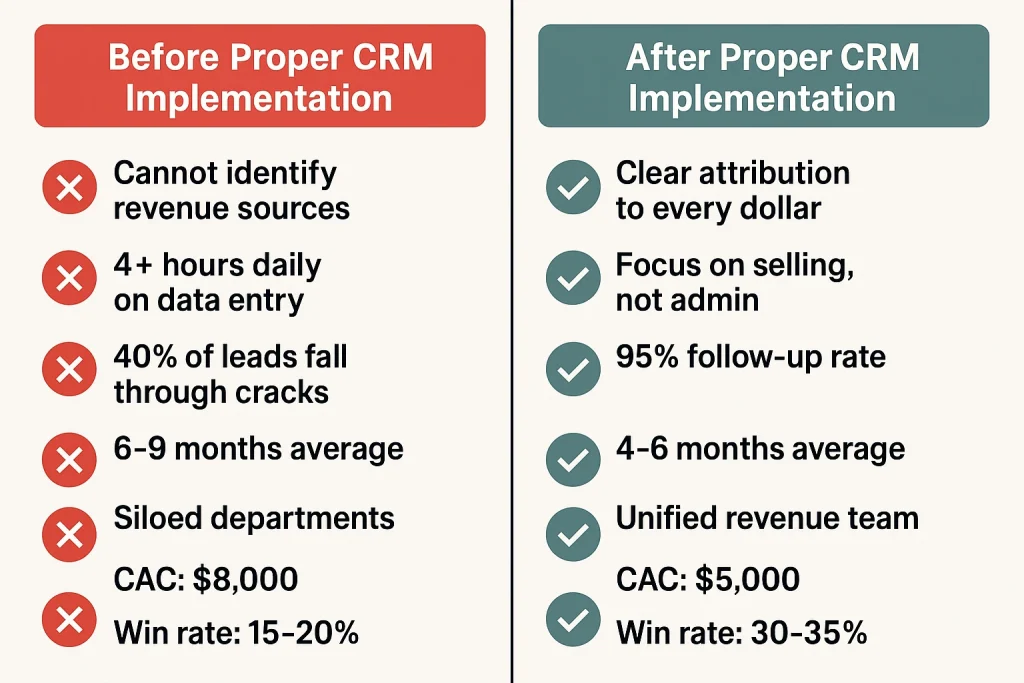
That’s the difference between CRM as a cost center and CRM as a revenue multiplier.
What CEOs Get Wrong About CRM Implementation
Most executives view CRMs as cost centers because they don’t connect marketing efforts to revenue.
“The reason they think that is because they don’t. They’re not connecting the marketing efforts to revenue. The fundamental thing every business should do: when you get a lead, whether it be a phone call from a website lead, wherever it’s coming from, that should be tagged in some way in your CRM to say it came from here.” — Jason Kramer
The Mindset Shift: Your CRM isn’t an expense. It’s the infrastructure enabling revenue attribution, lead nurturing, and sales efficiency.
Think about it this way: You wouldn’t run a manufacturing business without understanding unit economics. Why run a B2B company without knowing which marketing investments drive revenue?
Common CEO Misconceptions:
| What CEOs Think | The Reality |
|---|---|
| “CRM is a sales tool” | CRM is revenue infrastructure for the entire company |
| “Implementation takes 30 days” | Successful implementation takes 6-12 months |
| “Software will fix our process” | Process must be fixed before selecting software |
| “Training happens once at launch” | Training is ongoing for 12+ months |
| “We need every feature available” | Start with core features, expand gradually |
| “IT can handle the rollout” | Success requires executive sponsorship and change management |
| “ROI is immediate” | Full ROI typically realizes in 12-18 months |
I see this misconception in B2B tech CEOs I interview—they focus on raising capital while ignoring the revenue infrastructure that actually scales growth. Properly implemented CRM combined with strategic content isn’t a nice-to-have; it’s the foundation of predictable revenue growth.
The Content Strategy Connection
Here’s where digital PR and content strategy intersect with CRM implementation.
Educational email courses serve dual purposes in the CRM ecosystem:
- They nurture leads systematically through long B2B sales cycles
- They provide behavioral data showing which prospects are sales-ready
When a prospect engages with your educational email course, your CRM tracks that engagement. Sales receives real-time alerts when prospects consume content, revisit your website, or demonstrate buying signals.
This is how sophisticated B2B tech companies from seed to Series C create predictable revenue: by combining strategic content with properly implemented CRM systems that track engagement and trigger timely sales outreach.
Content + CRM Integration:
LinkedIn Content Strategy:
- Executive posts tracked in CRM
- Engagement data captured
- High-value prospects identified
- Sales receives a warm introduction context
Educational Email Courses:
- Completion rates tracked
- Topic interests identified
- Buying stage indicated
- Automated lead scoring updated
Podcast Strategy:
- Guest appearances tracked
- Listener attribution measured
- Download patterns analyzed
- Qualified prospects surfaced
Digital PR:
- Backlink sources monitored
- Referral traffic tracked
- Brand mention alerts triggered
- Authority signals captured

At Sproutworth, we help B2B tech companies create this integrated approach—ghostwriting educational email courses and LinkedIn content for C-suite executives that feed directly into CRM nurturing workflows, creating a seamless path from awareness to revenue.
Implementation Checklist for B2B Tech CEOs

Based on Jason’s framework and my experience with B2B tech clients:
Before Selecting a CRM:
- [ ] Document current sales and marketing processes end-to-end
- [ ] Survey teams on actual needs and pain points
- [ ] Audit existing tech stack for redundancies and gaps
- [ ] Define specific, measurable objectives (not “improve efficiency”)
- [ ] Secure executive sponsorship with visible commitment
- [ ] Calculate current customer acquisition cost
- [ ] Identify process bottlenecks and lead leakage points
- [ ] Establish baseline metrics for comparison
During Implementation:
- [ ] Start with core functionalities only (resist feature creep)
- [ ] Implement phase-by-phase (department, project, or pilot group)
- [ ] Provide live, customized training sessions (not videos)
- [ ] Create internal CRM champions in each department
- [ ] Establish data quality standards and entry requirements
- [ ] Build attribution tracking into every lead source
- [ ] Test workflows with real scenarios before go-live
- [ ] Create documentation specific to your configuration
After Go-Live:
- [ ] Schedule weekly adoption check-ins (first 90 days)
- [ ] Monitor usage metrics and address resistance immediately
- [ ] Refine workflows based on team feedback
- [ ] Celebrate early wins to build momentum
- [ ] Provide ongoing support and advanced training monthly
- [ ] Review revenue attribution reports with marketing and sales
- [ ] Optimize lead nurturing based on conversion data
- [ ] Audit data quality quarterly
The Trade Show Example That Changes Everything
Jason shares a powerful example about trade shows that illustrates the CRM implementation opportunity:
“I have a lot of experience with how to market to trade shows. It’s not something I sell as a service, but it’s my marketing experience that’s done helping other clients with trade shows marketing and how to make those conversions.”
Most B2B companies attend trade shows, collect business cards, return home, and see zero ROI. The cards become “paper dust.”
💡 KEY INSIGHT: Without proper CRM tracking, most trade show leads are never followed up within 48 hours—the critical window for conversion.
With Proper CRM Implementation:
- Leads are entered systematically with source tags
- Automated nurturing campaigns begin immediately
- Sales receives prioritized follow-up lists
- Revenue attribution tracks which deliver results
- Future trade show investments become data-driven
Real Numbers:
One client might spend $50,000 on a trade show booth. Without CRM tracking, they can’t justify the investment. With proper implementation, they discover that the show generated:
- $500,000 in qualified pipeline
- $200,000 in closed revenue over 18 months
- 32% conversion rate (vs. 8% from cold outreach)
- $4 revenue per $1 trade show investment
That’s the difference between viewing CRM as a cost center versus a revenue enabler.
Trade Show CRM Workflow:
Before Event:
- Pre-show outreach campaign
- Meeting scheduler integration
- Booth staff trained on data capture
- Mobile CRM access set up
During Event:
- Leads entered in real-time via mobile
- Qualification questions documented
- Follow-up timing assigned by priority
- Hot leads alerted to sales immediately
After Event:
- Automated thank-you emails within 24 hours
- Nurturing campaign begins day 2
- Sales follow-up within 48 hours for hot leads
- Attribution tracking through closed deals
This systematic approach transforms trade shows from expensive guesswork into predictable revenue channels.
Advanced Strategies: Leveraging Old Data
“Old data, old customers—you have customers that bought one thing are more than likely to buy something else from you that they may need. You should really be leveraging your old data, past customers, and trying to resell or upsell to them as well because that’s a lot more cost effective than trying to find brand new customers.” — Jason Kramer
💡 KEY INSIGHT: Acquiring a new customer costs 5-10x more than selling to an existing one. Yet most B2B companies spend 90% of their budget on new acquisitions.
Most B2B companies focus exclusively on new customer acquisition while ignoring the goldmine sitting in their database.
Your CRM Should Help You:
Segmentation:
- Past customers by product/service purchased
- Purchase history and patterns
- Engagement level and recency
- Contract renewal dates
- Upsell/cross-sell opportunities
Identification:
- Dormant accounts (no activity 90+ days)
- Customers using only partial solution
- Accounts with budget refresh cycles
- Companies in growth phases
Activation:
- Triggered re-engagement campaigns
- New feature announcements
- Industry-specific content
- Executive business reviews
Tracking:
- Customer health scores
- Usage patterns and trends
- Support ticket patterns
- Renewal likelihood
Automation:
- Renewal reminder workflows
- Upgrade offer campaigns
- Win-back sequences
- Referral request triggers
This is where newsletters and educational email courses for B2B tech brands become revenue drivers—keeping your brand top-of-mind during lengthy consideration periods and positioning new offerings to existing customers who already trust you.
Re-Engagement Campaign Framework:
Month 1: Value check-in (not sales) Month 2: Industry insights and trends Month 3: Customer success stories Month 4: New feature/service introduction Month 5: Personalized upgrade offer Month 6: Executive business review invitation
Each touchpoint is tracked in CRM, engagement is scored, and sales are alerted at the threshold.
The Future of B2B CRM: AI and Automation
“AI is here to stay,” — Jason Kramer
But he focuses on practical applications, not hype.
Current CRM AI Capabilities Delivering Real Value:
Predictive Lead Scoring:
- Identifies sales-ready prospects automatically
- Analyzes behavior patterns for buying signals
- Prioritizes follow-up based on conversion likelihood
- Reduces time wasted on cold prospects
Automated Data Entry:
- Captures information from emails and calls
- Updates contact records automatically
- Eliminates manual data entry tasks
- Improves data consistency and quality
Intelligent Email Responses:
- Handles routine inquiries automatically
- Routes complex questions to the appropriate team member
- Maintains brand voice and compliance
- Frees sales reps for high-value conversations
Pattern Recognition:
- Spots at-risk accounts before churn
- Identifies upsell opportunities
- Detects anomalies in the pipeline
- Forecasts revenue with higher accuracy
Content Recommendations:
- Personalizes nurturing campaigns
- Suggests next-best content for each prospect
- Optimizes send timing
- Improves engagement rates
💡 KEY INSIGHT: McKinsey research found 20% of sales functions could be automated by AI, with companies seeing 15% revenue increases and 20% ROI improvements.
But automation isn’t the goal—efficiency, enabling more human connection is.
“It’s more about process. Let’s break down for our different areas of the business—from marketing to sales to onboarding to customer service—how those different divisions work, what tools they’re using, what are their steps.” — Jason Kramer
AI should automate repetitive tasks, not replace strategic thinking or relationship building. The best CRM implementations use AI to handle admin work so sales teams can focus on conversations that close deals.
Where AI Falls Short:
- Complex negotiation strategy
- Executive relationship building
- Nuanced objection handling
- Strategic account planning
- High-stakes customer recovery
The future of B2B CRM isn’t full automation—it’s augmented intelligence where AI handles data and tasks while humans handle strategy and relationships.
How This Connects to Your Content Strategy
For B2B tech founders and executives reading this: Your CRM implementation and content strategy aren’t separate initiatives.
Educational email courses nurture leads in your CRM tracks. LinkedIn content generates engagement that your CRM monitors. Digital PR builds links and authority that drive traffic your CRM captures and converts.
The most sophisticated B2B tech companies I work with understand this intersection. They’re not choosing between content marketing and CRM implementation—they’re leveraging both to create predictable, scalable revenue.
When You Properly Implement Your CRM, You Can Finally Answer:
- Which content topics drive the most sales conversations?
- What engagement level predicts deal closure?
- Which LinkedIn posts generate qualified leads?
- How long does nurturing take before prospects buy?
- What content consumption patterns indicate buying readiness?
- Which email subject lines drive the highest open rates?
- What time of day generates the best response rates?
- Which case studies convert the most opportunities?
These insights inform smarter content creation, more efficient sales processes, and ultimately, accelerated revenue growth.
Integrated Strategy Example:
- Publish thought leadership on LinkedIn (awareness)
- CRM captures engaged prospects (identification)
- Automated email course begins (education)
- CRM tracks content consumption (qualification)
- Sales receives an alert at the threshold (activation)
- Personalized outreach with context (conversion)
Each stage is tracked, measured, and optimized based on data.
This is the podcasting strategy I help B2B companies implement—content that doesn’t just build awareness but feeds directly into revenue-generating systems.
Frequently Asked Questions About B2B CRM Implementation
What percentage of CRM implementations fail?
55% of CRM implementations fail to achieve their planned objectives, according to Johnny Grow’s research. The primary causes are poor user adoption (50%), lack of planning (69%), and inadequate training. This failure rate has remained consistent for over 20 years despite significant technology improvements.
How much should a B2B company invest in CRM implementation?
Organizations typically invest 3-5x the software cost in implementation, customization, and training. Total investment ranges from $50,000-$250,000, depending on company size and complexity. However, properly implemented CRMs deliver an average ROI of $8.71 for every dollar spent.
How long does a successful CRM implementation take?
Successful B2B CRM implementations typically require 3-6 months for initial rollout plus 6-12 months for full adoption and optimization. Rush implementations under 90 days have significantly higher failure rates (69%+). Allow time for process documentation, phased rollout, and iterative refinement.
Why do sales teams resist using CRM systems?
Sales teams resist when they see CRM as additional work rather than a tool that helps them sell. Common resistance factors include: being excluded from the selection process, inadequate training, complex interfaces, excessive data entry requirements, and lack of demonstrated value. Successful adoption requires involving sales teams early, providing customized training, and showing how CRM makes their jobs easier.
What’s the difference between CRM for B2B vs B2C companies?
B2B CRM focuses on longer sales cycles (3-18 months), multiple decision-makers, higher contract values, account-based selling, and relationship nurturing. B2C CRM handles shorter cycles, individual buyers, lower transaction values, and volume-based approaches. B2B CRM requires more sophisticated tracking of company information, buying committees, and complex touchpoints across departments.
Should we implement all CRM features at once?
No. Start with core functionalities that directly address your primary business objectives. Phased implementation, starting with a pilot group, has much higher success rates. Add features gradually as teams master basics. Companies attempting full-feature implementation immediately have 3x higher failure rates than those taking a phased approach.
How do we measure CRM success?
Define metrics before implementation: lead response time, conversion rate by source, sales cycle length, win rate, customer acquisition cost, customer lifetime value, data quality scores, user adoption rate, and revenue attribution accuracy. Set baseline measurements, then track improvement quarterly. Success means achieving your original objectives, not just “using the software.”
What’s the most important factor for CRM success?
Executive sponsorship and visible commitment from leadership. When executives actively use the CRM, communicate its importance, and hold teams accountable, adoption rates increase by 60%+. Technology and training matter, but without leadership commitment, even perfect systems fail.
Your Next Steps
If you’re a B2B tech CEO struggling with CRM adoption, marketing attribution, or lead nurturing, here’s what to do next:
Immediate Actions (This Week):
1. Audit Current State:
- [ ] Check your CRM usage rates by team member
- [ ] Identify adoption gaps and resistance points
- [ ] Calculate how much you’re wasting on unused software
- [ ] Review your last 100 leads—can you trace them to revenue?
2. Document Processes:
- [ ] Map your current sales workflow (even if messy)
- [ ] Document marketing-to-sales handoff process
- [ ] Identify where leads fall through cracks
- [ ] Note all manual workarounds your team uses
3. Survey Your Teams:
- [ ] What’s working in your current system?
- [ ] What daily frustrations do they experience?
- [ ] What data do they wish they had?
- [ ] What would make their jobs easier?
Get Expert Guidance:
Learn from Jason Kramer:
Visit AfterTheLead.com, where you’ll find:
- Free lead nurturing playbook explaining step-by-step how to set up nurturing strategies regardless of your CRM platform
- Free discovery call with Jason to discuss your specific challenges
- Monthly newsletter with CRM best practices and case studies
“Listen, at the end of the day, I’m all about education. For me, it’s not a sales call, it’s really more a discovery call and understanding what people’s problems are and any advice I can provide.” — Jason Kramer
Build Your Content Infrastructure:
If you’re ready to combine proper CRM implementation with strategic content that drives revenue, let’s talk.
At Sproutworth, I help B2B tech companies from seed to Series C create:
- Educational email courses that nurture leads systematically while providing CRM behavioral data
- LinkedIn content strategies for C-suite executives that generate a qualified pipeline
- Digital PR programs that build authority, drive traffic, and integrate with your CRM tracking
The companies I work with don’t choose between CRM and content—they leverage both to create predictable, scalable revenue growth.
Contact Sproutworth to discuss your content and CRM strategy.
Final Thoughts: Software Doesn’t Fix Companies
Let me leave you with Jason’s most important insight:
“Software alone can’t solve our problems. Our CRM software will only take us as far as our sales process, sales strategy, and lead flow will allow.”
Your CRM is a tool. A powerful one, certainly. But tools don’t fix broken processes, misaligned teams, or a lack of strategy.
💡 KEY INSIGHT: 55% of companies with failed CRM implementations aren’t failing because of bad software. They’re failing because they tried to automate chaos instead of fixing it first.
The Companies Winning with CRM Implementation Understand It’s Fundamentally About:
Creating Clear Processes People Can Follow:
- Document before automate
- Simplify before complicate
- Test before rollout
- Iterate based on feedback
Providing Ongoing Training and Support:
- Live, customized sessions
- Role-specific guidance
- Monthly advanced training
- Just-in-time help resources
Holding Teams Accountable to Standards:
- Weekly usage reviews (first 90 days)
- Data quality audits
- Performance metrics tied to CRM adoption
- Recognition for proper usage
Connecting Marketing Investments to Revenue:
- Every lead tagged with the source
- Full attribution tracking
- ROI reporting by channel
- Data-driven budget decisions
Nurturing Relationships Systematically Over Time:
- Automated workflows triggered by behavior
- Educational content delivered strategically
- Sales alerts for buying signals
- Long-term relationship building
Get these elements right, and your CRM becomes the revenue engine your CFO can’t imagine operating without.
Get them wrong, and you’ll join the 55% of failed implementations, wondering why your expensive software purchase didn’t magically transform your business.
The choice is yours.
But now you have the framework that actually works.
Related Resources from Sproutworth
Looking for more insights on driving predictable B2B growth? Check out these related articles and podcast episodes:
Podcast Strategy & Content Marketing:
- How to Create a Successful B2B Podcast That Drives Business Growth
- How to Use a Podcasting Strategy to Skyrocket Revenue Growth
- Identifying Target Audiences for B2B Podcast: Ideal Customer Profiles
B2B Growth & Marketing:
- B2B Growth Marketing: Building High-Performing Tech Brands
- Generating Demand: How to Use Demand Generation Strategies
- How to Pick B2B Marketing KPIs That Powerfully Drive Growth
Strategic Insights:
- How to Use The Power of Emotion in Marketing to Drive Growth
- 7 Disruptive Marketing Tips Every B2B Brand Needs to Know
Subscribe to the Predictable B2B Success Podcast for weekly interviews with founders and executives about creating predictable growth.
Connect with Jason Kramer
Want to learn more from Jason or get personalized guidance on your CRM implementation?
Professional Profiles:
LinkedIn: Jason Kramer – CRM & Marketing Automation Expert
Company LinkedIn: Cultivize – B2B Lead Nurturing & CRM Implementation
Websites & Resources:
Main Website: Cultivize.com – Custom CRM implementation and lead nurturing strategies
Free Resources: AfterTheLead.com
- Download free lead nurturing playbook
- Book strategy session with Jason
- Subscribe to monthly CRM best practices newsletter
- Access templates and worksheets
What Jason Offers:
- Free discovery calls (not sales calls)
- Custom CRM implementation
- Ongoing training and support
- Lead nurturing strategy development
- Marketing automation consulting
- Certified in HubSpot, SharpSpring, Constant Contact
“For your audience today, I’m willing to jump on a call with them and have that strategy session. For me, it’s not a sales call, it’s really more a discovery call and understanding what people’s problems are and any advice I can provide.” — Jason Kramer
Contact: Visit AfterTheLead.com to schedule your strategy session.
Ready to transform your CRM from an underutilized tool into a revenue-driving engine?
Start with Jason’s free playbook at AfterTheLead.com, then contact Sproutworth to build the content infrastructure that feeds your CRM with qualified, nurtured prospects ready to buy.
Some areas we explore in this episode include:
Listen to the episode.
Subscribe to & Review the Predictable B2B Success Podcast
Thanks for tuning into this week’s Predictable B2B Podcast episode! If the information from our interviews has helped your business journey, please visit Apple Podcasts, subscribe to the show, and leave us an honest review.
Your reviews and feedback will not only help me continue to deliver great, helpful content but also help me reach even more amazing founders and executives like you!
