
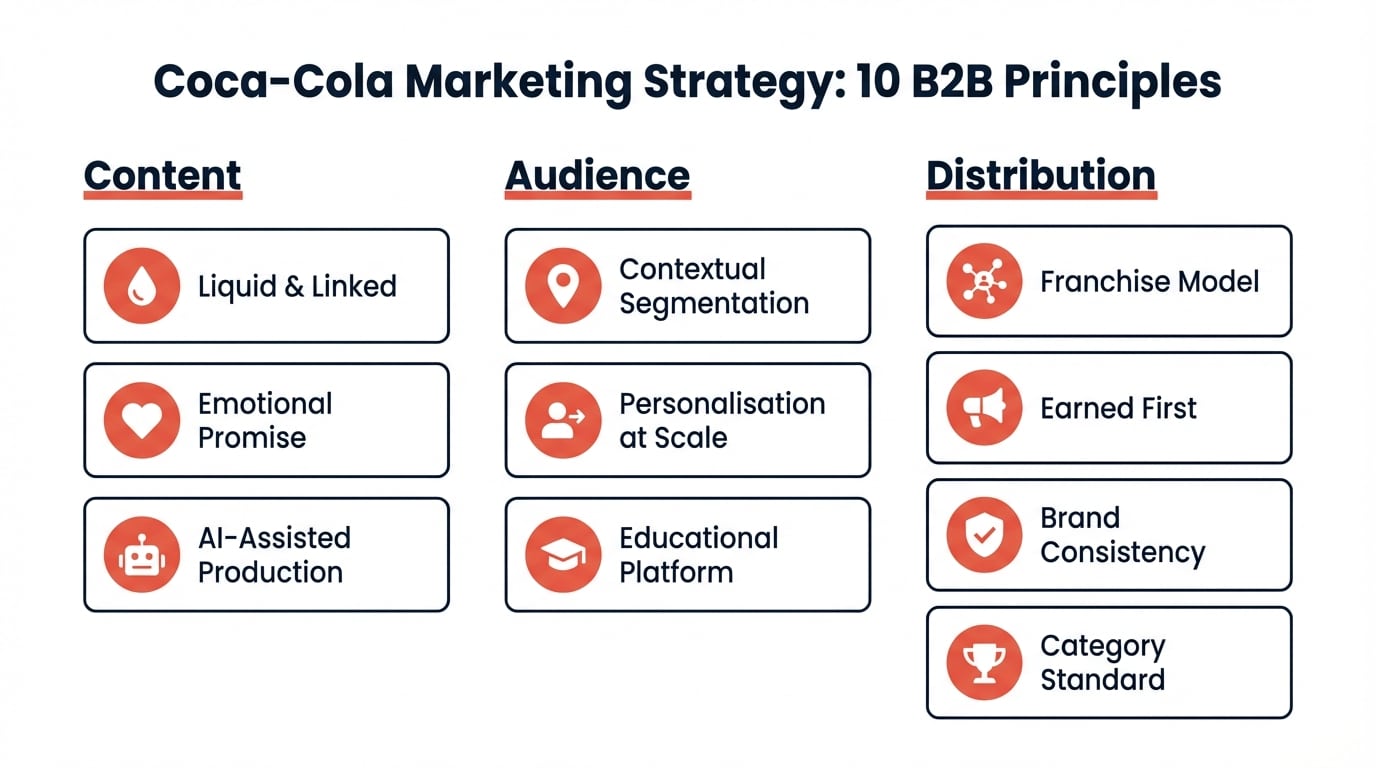
Last updated: March 2026. Updated to include Coca-Cola’s 2025 Studio X AI expansion, the Coca-Cola Lens B2B platform launch, and Project Fizzion.
The Coca-Cola marketing strategy is built on principles that work at any budget, and most B2B founders have never studied it properly.
They look at the $4.3 billion annual marketing spend and the 130 years of brand equity and conclude: nothing here applies to me. That’s the wrong read.
After 500+ conversations with B2B revenue leaders on the Predictable B2B Success podcast, I’ve watched funded founders dismiss consumer brand strategy as irrelevant to their world. The ones who look more carefully find the most transferable frameworks in the game: frameworks that compound just as powerfully at $500K ARR as at $500B market cap.
This article breaks down 10 of them.
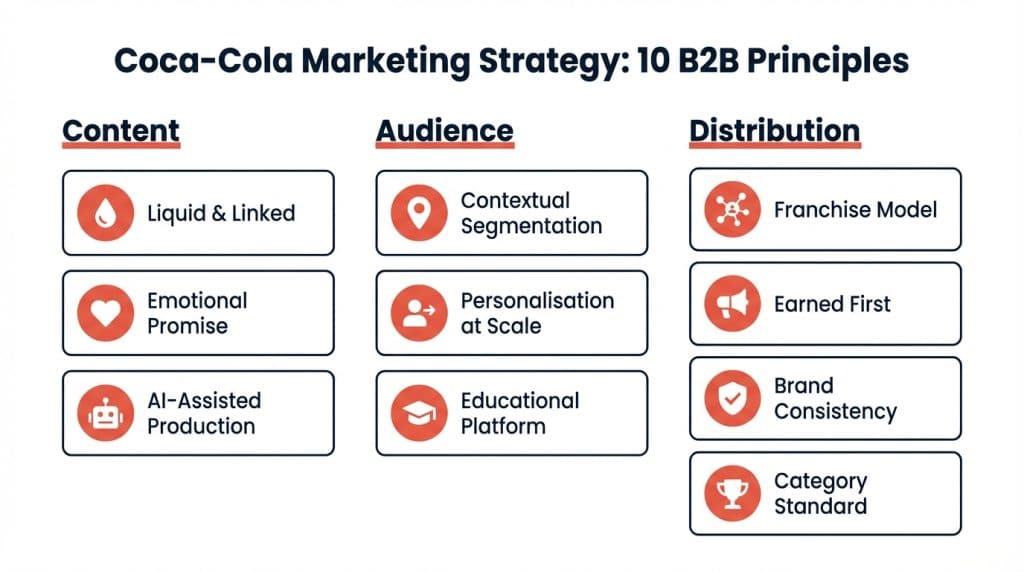
Summary: Coca-Cola’s marketing strategy combines emotional brand positioning, the liquid-and-linked content framework, and contextual audience segmentation to create content that earns attention without paid amplification. This article breaks down 10 of these principles, from the 4Ps system and AI-assisted content operations to sustainability narrative positioning, with direct translations for B2B tech founders at seed through Series C.
Table of Contents
What Is Coca-Cola’s Marketing Strategy?
Quick answer: The Coca-Cola marketing strategy is a system that combines emotional brand positioning, audience segmentation by lifestyle and context (not just demographics), globally consistent messaging with localized execution, and a data-driven content distribution model. The company allocates approximately $4.3 billion annually to marketing and uses a franchise-style distribution network across 200+ countries. The core principle is creating content so emotionally resonant it spreads without paid amplification.
That last part is what matters for B2B tech founders. Coca-Cola doesn’t just spend money on marketing. They engineer content to be inherently shareable, and they’ve been refining that system for over a century.
The Coca-Cola marketing strategy rests on three structural commitments most B2B companies abandon within 18 months of founding. A single emotional brand promise is defended across every channel. Audience segmentation by context rather than deal size. Content designed to spread before a dollar is spent amplifying it. Each of the 10 lessons below flows directly from one of those three commitments.
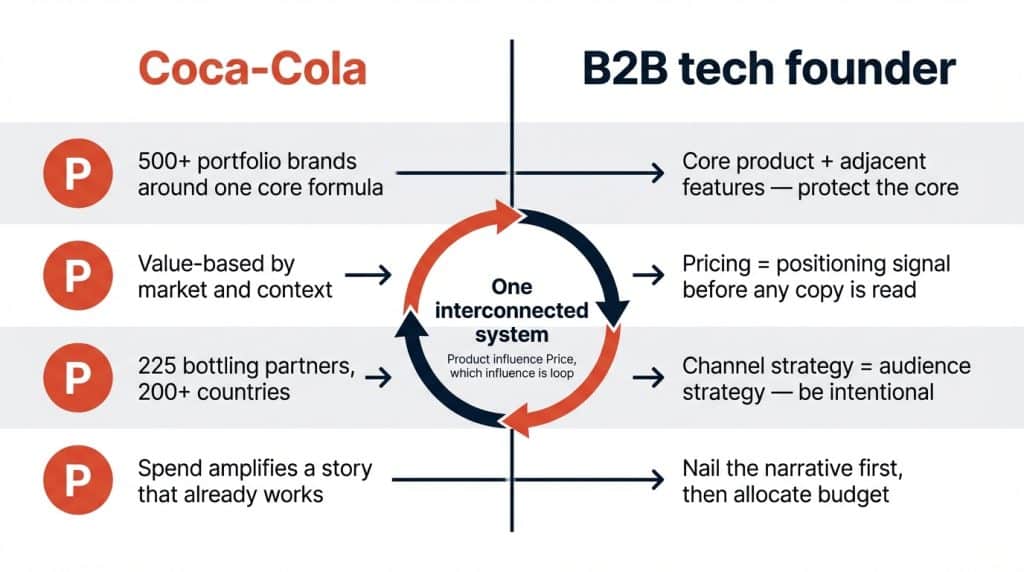
Coca-Cola’s 4Ps Marketing Mix: The B2B Translation
Quick answer: At the core of the Coca-Cola marketing strategy, the 4Ps marketing mix treats product, price, place, and promotion not as four separate levers but as one interconnected system. Each decision reinforces the others. For B2B tech founders, the same logic applies: your pricing signals your positioning, your distribution signals your audience, and your promotion only works if the first three are already coherent.
- Product: Balance a consistent core with an expanding portfolio. Extend when consumer needs shift; protect the core brand promise at all times.
- Price: Use pricing as a positioning signal, not just a revenue lever. What you charge tells the market who you serve before they read a word of copy.
- Place: The distribution strategy is the audience strategy. Be intentional about which channels carry your brand and support the partners who represent you.
- Promotion: Spend amplifies a story. Nail the story first, then spend to extend its reach.
Product: Portfolio discipline over product sprawl
Coca-Cola’s core product hasn’t changed in over a century. What has changed is the portfolio around it. Coke Zero, Smartwater, Fuze Tea, and 500+ other brands exist because Coca-Cola noticed shifting consumer preferences and moved to meet them, without abandoning the core.
For B2B founders, the equivalent discipline is knowing when to extend and when to protect. The founders I see lose momentum fastest are those who add features or service lines in response to a single customer request, diluting the core product positioning in the process. Coca-Cola’s rule (extend the portfolio, protect the core brand promise) translates directly to SaaS product strategy.
Price: What your pricing says before you say anything
Coca-Cola uses value-based pricing that varies by market, format, and context. A 600ml bottle at a convenience store and a glass at a fine dining restaurant carry different prices for the same liquid. The price signal tells a story about the context before the consumer even picks it up.
B2B founders underestimate how much their pricing communicates to the market. A seed-stage company pricing at enterprise rates signals ambition and category positioning. A Series B company pricing at SMB rates signals confusion about who they serve. I’ve watched pricing decisions accelerate or kill sales cycles for tech founders well before a product demo. Coca-Cola’s lesson: price isn’t just a revenue decision. It’s a market positioning signal.
Place: Distribution as a strategic moat
Coca-Cola’s products are available in 200+ countries via 225 independent bottling partners. The product doesn’t move without the distribution system. According to Coca-Cola’s own investor materials, this franchise distribution model is one of its clearest competitive advantages: global scale with deep local execution.
For B2B tech companies, “place” is channel strategy. Where does your ideal buyer encounter your brand? LinkedIn, category-specific newsletters, analyst reports, industry events, partner ecosystems? Most funded founders are present in two or three channels and barely active in any of them. Coca-Cola’s model says: choose your distribution partners carefully, support them well, and let the system scale rather than trying to control every point of sale yourself.
Promotion: Storytelling as the amplifier, not the strategy
Coca-Cola’s promotional spend is enormous, but the spend amplifies a story that already works. The emotional promise (happiness), the brand identity (red, white, the script logo), and the campaign themes are all decided before a dollar goes to media. Most B2B companies do this in reverse: they spend on promotion to figure out what resonates, then try to build strategy around what got clicks.
The correct sequence is the same for a funded startup as it is for a $47 billion revenue company: nail the story first, then amplify. Promotion that runs before the story is clear is just expensive research.
This principle sits at the heart of the Coca-Cola advertising strategy: every dollar spent on media amplifies a story that already has emotional resonance and strategic coherence.
The “Liquid and Linked” Content Framework
Coca-Cola’s former VP of Global Advertising Strategy, Jonathan Mildenhall, introduced the concept of “liquid and linked” content. It’s the clearest framework they’ve ever published, and most B2B founders have never heard of it.
Liquid content spreads without paid amplification. Linked content connects to a revenue outcome. Every piece of content should pass both tests.
Liquid content spreads. It’s so compelling, interesting, or useful that people pass it along without being asked. It takes on a life of its own.
Linked content connects back to the business objective. It doesn’t just entertain; it serves a strategic purpose tied to pipeline, authority, or retention.
“The role of content excellence is to be like a ruthless editor, and every contact point with a customer should tell an emotional story.” — Jonathan Mildenhall, VP of Global Advertising Strategy, The Coca-Cola Company
Most B2B content is neither liquid nor linked. It’s competent but inert. It doesn’t spread and it doesn’t serve a clear business purpose. It exists because “we need to post something.” If your content isn’t passing both tests, it may be quietly hurting your pipeline rather than building it.
When I work with Series A SaaS founders on their content strategy, I apply the Coca-Cola marketing strategy principle of liquid-and-linked to B2B. The first diagnostic question I ask is: “Could a prospect share this piece with a colleague and have it make sense without context?” If the answer is no, the content fails the liquid test. If the answer is yes but you can’t trace a line between that piece and a revenue outcome, it fails the linked test.
Both failures are common. The liquid-and-linked framework solves both at once by forcing you to design content that is simultaneously generous and purposeful.
How to apply this at seed or Series A:
- Before writing any content, write one sentence describing the business outcome it serves
- Before publishing, ask: would someone email this to a colleague? If not, rewrite the hook
- Build a “tent-pole” theme (your overarching narrative) and create “tent-peg” content (specific pieces that anchor the theme in different contexts)
Emotional Branding on a Founder’s Budget
Quick answer: Pick one emotional driver (happiness, belonging, or certainty) and build every piece of content around it. Coca-Cola has done this with a single word (happiness) for over a century.
Every campaign, every format, every market reinforces that promise. The “Share a Coke” campaign in 2011 put individual names on bottles. According to Marketing Mag’s post-campaign analysis, young adult consumption increased by 7% during the campaign period, making 2011 the most successful summer Coca-Cola had recorded in Australia. The campaign ran in 80+ countries.
But here’s what that campaign actually was: it turned a commodity into a personal object. It gave people a reason to feel something about a product that, chemically, is nearly identical to its competitors.
B2B founders have a structural advantage Coca-Cola doesn’t: their buyers are identifiable humans making emotionally-driven decisions they later rationalize with logic. The emotional driver in B2B is almost always one of three things: fear of being left behind, desire for peer recognition, or need for certainty in an uncertain environment.
B2B buyers make emotionally-driven decisions, which they later rationalise with logic. Your content should speak to the emotion first.
A pattern I notice consistently across funded B2B tech companies: the founders who grow the fastest are the ones who pick one emotional driver and build their entire content narrative around it. The ones who stay stuck are the ones trying to appeal to all three simultaneously, which produces content that resonates with no one deeply.
You don’t need Coca-Cola’s budget to execute on emotional branding. Clear point of view and a defined emotional promise matter far more than spending. That is one of the most actionable lessons the Coca-Cola marketing strategy offers any founder.
“Most B2B content tries to inform everyone. The best content makes a specific person feel understood.” — Vinay Koshy, Founder, Sproutworth
“It’s time to reframe marketing’s role in revenue and lean into brand-building as a long-term differentiator.” — Jon Miller, co-founder of Marketo and B2B marketing strategist, writing in his 2025 B2B marketing predictions
How Coca-Cola Segments Its Audience (and What B2B CEOs Can Learn)
One of the least-discussed elements of the Coca-Cola marketing strategy is how they approach audience segmentation. They don’t segment solely by demographics. They segment by lifestyle, behavior, and consumption context. The same customer who drinks a Coke Zero at their desk at 11 am and a Coke original at a barbecue on Saturday is approached with different messaging in each context.
This is contextual segmentation. And it’s significantly more sophisticated than what most B2B companies are doing.
Most B2B content segmentation looks like this: “We have SMB content, mid-market content, and enterprise content.” That’s a deal-size split. It’s useful but shallow. Contextual segmentation asks a different question: what is this person trying to accomplish right now, in this specific moment, with this specific piece of information?
A Series B SaaS CEO reading your content at 6 am before a board meeting has a completely different need than the same person reading it on a Saturday afternoon. The delivery channel signals the context. Contextual segmentation means tailoring content to the channel, the time, and the decision-stage rather than just the firmographic profile.
I’ve watched this play out in the ghostwriting work I do for tech executives. LinkedIn content written for the “scrolling feed” context performs differently from email content written for the “focused reading” context. The same insight, delivered to the same ICP, needs a different frame depending on where they encounter it.
Coca-Cola’s segmentation approach translates directly: build content for the context of consumption, not just the consumer’s profile.
Coca-Cola’s B2B Play: The Coca-Cola Lens Case Study
Quick answer: In April 2025, Coca-Cola launched Coca-Cola Lens: a B2B educational content platform for retailers and food service operators. It is proof that even consumer brands grow a B2B pipeline through content-led authority, not sales collateral.
Most marketers missed it entirely. A dedicated B2B content platform and newsletter, built not for consumers but for the restaurants, retailers, and food service operators who sell Coca-Cola products.
The CEOs I work with who build educational content infrastructure early consistently outpace their competitors at the consideration stage. Coca-Cola Lens is a $47 billion company demonstrating the same principle at scale.
The platform wasn’t built for consumers. It was built for retailers, restaurants, and foodservice operators who sell Coca-Cola products. The content covers industry trends, data-backed insights, and beverage category analysis. It launched with 16 articles, a subscription form, and a session at the National Restaurant Association Show.
Think about what this signals. One of the world’s most sophisticated consumer brands looked at its B2B relationships and decided: the way to strengthen them is through an educational content platform, not just sales collateral or account management calls.
This mirrors what the most effective seed-to-Series B founders are already doing: building an educational content infrastructure that makes their prospects smarter, faster, and more confident in their decision-making in the founder’s category. Not because it’s altruistic, but because the company that educates the buyer owns the buyer’s mental model of the category. It’s the defining advantage of any well-executed B2B content marketing strategy.
Coca-Cola’s B2B content strategy through CokeSolutions.com offers a concrete precedent. According to a case study published by Ansira, after overhauling the B2B content and SEO strategy for CokeSolutions.com, the site now generates 18,000 leads annually with a 44% conversion rate, making it the highest-converting lead source across the entire company.
CokeSolutions.com generates 18,000 leads per year at a 44% conversion rate, making it the highest-converting source across the entire Coca-Cola company.
A content-led B2B strategy outperforms every other lead source. That’s not a consumer brand play. That’s a direct model for any B2B tech founder trying to build a pipeline through authority content.
The “Share a Coke” Personalisation Framework Applied to B2B
Quick answer: Build one core content asset, then produce 5–7 personalised variations for different segments and channels. Coca-Cola’s “Share a Coke” campaign scaled personalisation globally using this exact modular approach.
The campaign made a mass-produced product feel personal without changing the product itself, only how it arrived.
In B2B, the equivalent is account-level content personalization. Sending the same whitepaper to every prospect is the mass-production approach. Sending a prospect a specific piece of content that references their industry, their company’s current growth stage, and a challenge specific to companies like theirs. That’s the “Share a Coke” play.
I’ve seen this executed well by one fintech founder I work with, who was struggling to get replies to outreach. The science behind why personalisation works at this level is rooted in how customer stories trigger trust and recognition. We rebuilt their content outreach to lead with a single, highly specific analysis relevant to the prospect’s segment. Reply rates went from under 3% to consistently above 15%. The content didn’t change. The targeting did.
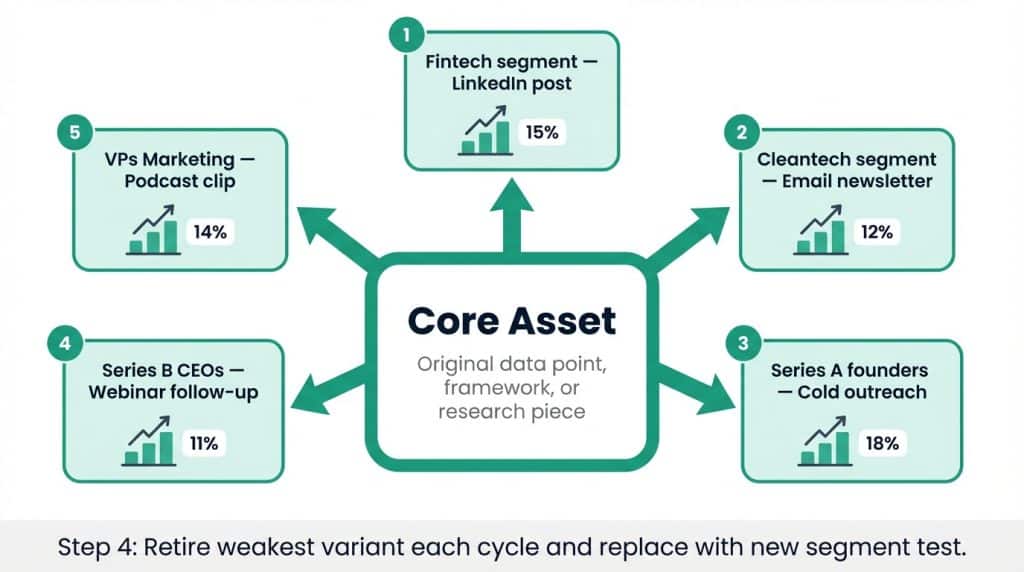
The scaling challenge is real. Producing personalised content at volume sounds expensive. But Coca-Cola solved this with a principle worth borrowing: modular content systems. They create a core asset (the campaign idea) and produce variations efficiently from that core. For B2B founders, this means building templates with personalization slots, not writing from scratch each time.
A framework that works at Series A and scales to Series C:
- Create one “core asset” (an original data point, framework, or research piece) with broad ICP relevance
- Build 5-7 variations of the distribution layer, each targeting a specific segment or context
- Track which variation pulls highest engagement in each channel and double down
- Retire the weakest variant each cycle and replace it with a new segment or format test
How Coca-Cola Thinks About Content Distribution
Quick answer: Earn your audience through distribution partnerships before building owned channels. Coca-Cola’s franchise model (225 bottling partners in 200+ countries) is the template. In B2B, this means digital PR and content partnerships first.
The distribution pillar of the Coca-Cola marketing strategy is a franchise model. They create the product centrally and rely on 225 independent bottling partners worldwide to execute locally. This asset-light approach gives them global scale with localized market penetration.
The content equivalent is a distribution partnership model. Coca-Cola doesn’t try to be everywhere on its own. They build partnerships that extend reach without proportionally extending cost.
For B2B tech founders, the direct analogy is digital PR combined with content partnerships. Building relationships with publications, podcasts, and communities where your ICP already spends time, rather than trying to grow a proprietary audience from scratch.
From 500+ interviews on the Predictable B2B Success podcast, the founders who build the pipeline fastest through content are consistently the ones who prioritize earned distribution (guest posts, podcast appearances, co-authored research) over owned distribution (their own blog traffic) in the early stages. Owned distribution compounds over time, but earned distribution activates faster and produces authority signals that owned channels cannot replicate.
Earned distribution through digital PR and partnerships compounds faster at the seed stage than a blog that nobody reads yet.
Building content that earns attention and drives long-term growth is a repeatable process, not a talent lottery.
Coca-Cola’s $4.3 billion budget spans both traditional and digital channels. Their Coca-Cola digital marketing strategy now directs approximately 65% of that spend to digital channels, up from under 30% in 2019. Founders at the seed stage don’t have that. But the sequencing principle holds: earn your audience first, then build the infrastructure to retain them.
What Coca-Cola’s Brand Consistency Teaches Funded Startups
Quick answer: A 2016 Demand Metric study found consistent brand presentation is associated with an average 23% revenue lift. Coca-Cola has maintained the same visual identity since 1887. For B2B founders, brand consistency is not aesthetic preference; it is a revenue decision.
Coca-Cola has used the same red and white colour scheme since 1887. The contoured bottle shape has been legally protected since 1915. The script logo hasn’t changed in core form in over a century. This consistency isn’t inertia. It’s a deliberate strategy to build instinctive recognition.
Research cited by Coca-Cola’s own team shows that brand consistency across touchpoints is associated with an average 23% revenue lift. The mechanism is memory. Consistent brands occupy permanent neural real estate. Inconsistent brands require buyers to re-evaluate every time they encounter them.
Most funded B2B tech startups are chronically inconsistent. The website says one thing, the LinkedIn content says another, the founder’s email signature links to a landing page that hasn’t been updated since the Series A deck. Every inconsistency creates friction. Every piece of friction is a reason for a prospect to mentally exit.
Brand consistency in a funded startup context doesn’t require a brand guidelines document the size of a legal brief. It requires three things: a clear positioning statement that everyone on the team knows, a content voice that’s identifiable across every format, and a commitment to updating all touchpoints when positioning evolves.
A cleantech founder I worked with had a positioning problem that was costing them at the top of the funnel. Their website said “sustainability software for enterprises.” Their LinkedIn content led with founder journey stories. Their sales deck led with ROI calculators. Three different stories for the same company, all going to the same ICP. We stripped it back to one core message and ran it consistently across every channel for 90 days. Inbound demo requests increased by 40% without changing a single ad.
“Coca-Cola doesn’t re-invent its brand every quarter. Funded startups shouldn’t either. Consistency isn’t boring. It’s compounding.” — Vinay Koshy, Founder, Sproutworth
How Coca-Cola Uses AI to Scale Content Without Scaling Headcount
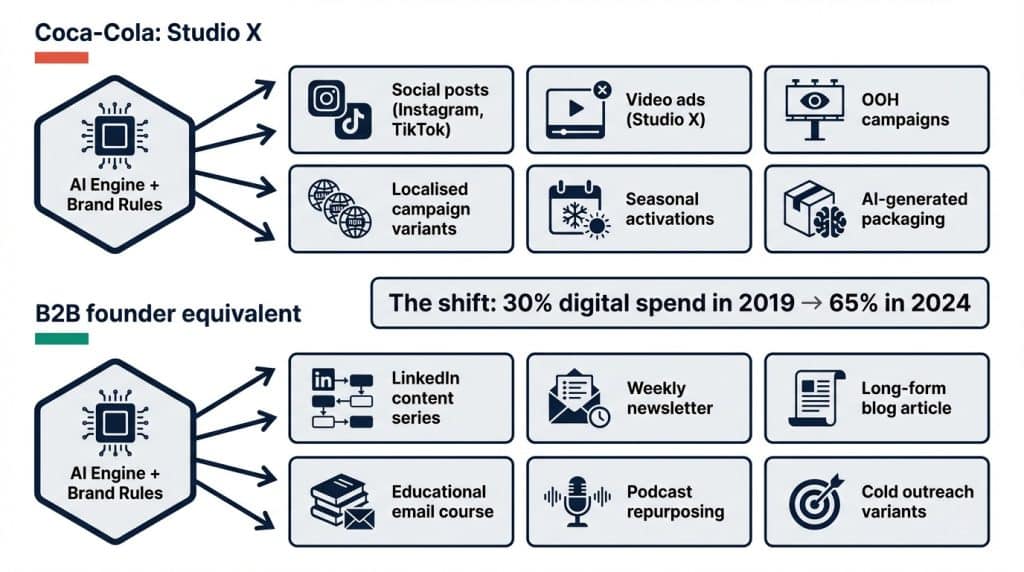
Quick answer: Coca-Cola shifted from 30% to 65% digital media spend between 2019 and 2024, powered by Studio X, their in-house AI content engine. The lesson for B2B founders: build AI-assisted content systems before content demand outpaces your capacity to produce it manually.
In 2023, Coca-Cola partnered with WPP to create Studio X: an in-house digital marketing engine operating from nine locations globally. The mandate was to create content faster, more cost-effectively, and with deeper personalisation than their previous agency model allowed.
According to Coca-Cola’s published growth strategy, its digital media mix went from under 30% of total spend in 2019 to approximately 65% in 2024. Studio X is the infrastructure that made that shift operationally possible.
Project Fizzion and the Create Real Magic campaigns
In 2025, they went further. Project Fizzion, developed with Adobe, is an AI-powered design system that generates on-brand visuals for global campaigns significantly faster than manual production. The system uses Coca-Cola’s internal brand rules (called StyleIDs) to ensure every social post, ad, and packaging design is consistent without requiring manual review at every step. The 2024 Coca-Cola Christmas ad was the first to be created with generative AI, produced faster and at a lower cost than the prior year’s equivalent.
For B2B tech founders, this is the most directly replicable lesson in the entire Coca-Cola marketing strategy breakdown. Coca-Cola didn’t wait until they had a $4.3 billion budget to build an AI content infrastructure. They built it because content demand outpaced human production capacity, exactly the problem most Series A and Series B companies are hitting right now.
A pattern I see consistently: funded founders who build AI-assisted content workflows early compound their content advantage. LinkedIn posts, newsletters, educational email courses, and podcast repurposing: these compound fastest when systematised early. The ones who treat content as a manual, from-scratch exercise every time fall further behind as competitors automate the repeatable parts and redirect human effort to strategy and editorial judgment.
Coca-Cola’s Content 2020 playbook, the document from which the liquid-and-linked framework originates, was built on exactly this insight: content volume requirements would outpace traditional production models. The answer wasn’t more agencies. It was a better system. That was true for them in 2011. It’s true for funded B2B tech founders in 2026.
What this means for B2B tech founders
The consumer-facing side of the Coca-Cola AI marketing strategy is equally instructive. In March 2023, Coca-Cola launched “Create Real Magic”: a platform built with OpenAI and Bain & Company that let consumers generate original artwork using GPT-4 and DALL-E against Coca-Cola’s archival brand assets. That same year, they released Y3000, a limited-edition flavour co-created with generative AI that sold out almost instantly. These weren’t gimmicks. They were the consumer-facing output of the same AI infrastructure being built internally through Studio X and Project Fizzion.
The pattern for B2B founders: Coca-Cola built the internal AI operations system first (Studio X), then extended it outward into consumer-facing campaigns. Most funded startups try to do this in reverse; they chase a visible AI campaign before building the underlying content operations infrastructure that makes it sustainable.
“Coca-Cola didn’t build Studio X to replace creativity. They built it to protect creative capacity for the decisions that actually require human judgment.” — Vinay Koshy, Founder, Sproutworth
What Coca-Cola’s Sustainability Strategy Teaches B2B Founders About Brand Narrative
Quick answer: Define your category standard: don’t just meet industry norms. Coca-Cola turned one of the hardest sustainability narratives in consumer goods into a forward-facing innovation story by owning specific, measurable progress rather than issuing vague commitments.
Coca-Cola has a sustainability problem that most brands would consider insurmountable. Their core product comes in single-use plastic packaging, they are one of the world’s largest producers of plastic waste, and their product category has been linked to health concerns for decades.
Their response is worth studying. Rather than leading with defensive PR, they embedded sustainability into the brand narrative as a forward-facing innovation story. The PlantBottle uses partially plant-based materials. The LitePac Top eliminates shrink film from multipack PET bottles. Bottle weight dropped from 27 grams in 2013 to 18.5 grams by 2025. Each is positioned not as problem-solving but as leadership.
The positioning is deliberate: “We’re defining what sustainable packaging looks like in our category.” That’s a fundamentally different story from “we’re working to reduce our environmental impact.” One positions them as the standard. The other positions them as behind it.
Applying the sustainability narrative to B2B
For B2B tech founders, especially those building in cleantech and environmental services, this distinction is commercially critical. There’s a consistent gap I notice between founders who are genuinely building sustainable technology and how they talk about it publicly. They lead with the problem they’re solving rather than the standard they’re setting. A strong go-to-market strategy anchors the narrative in what you’re defining, not what you’re defending against. The result is content that reads as reactive rather than authoritative.
Coca-Cola’s sustainability narrative framework, translated to B2B:
- Define the category standard, don’t just meet it. “The most carbon-efficient infrastructure management platform in this category” positions differently from “we help companies reduce their carbon footprint.”
- Make the innovation story specific and measurable. Coca-Cola cites bottle weight in grams and tracks it year over year. Specificity signals credibility in a way that broad claims never will.
- Embed sustainability into the product narrative, not the CSR page. If your environmental story lives in a separate section of your website, it’s a footnote. If it lives in your product positioning, it’s a differentiator.
The broader lesson applies to any B2B tech company navigating a difficult narrative. Legacy category perceptions, competitive accusations, market scepticism about a new category: Coca-Cola handles harder versions of all of these than most startups will ever face. They don’t apologise. They reframe.
The brand that defines the category standard owns the conversation. The brand that meets industry norms follows it.
Reframing difficult narratives is a core element of both the Coca-Cola competitive advantage and the broader Coca-Cola marketing strategy. Their brand doesn’t just survive difficult narratives; it grows stronger through them by owning the innovation story rather than defending against the criticism.
| Coca-Cola principle | B2B tech founder equivalent | Stage |
|---|---|---|
| Liquid and linked content | Every content piece must spread AND connect to a pipeline outcome | All |
| 4Ps as one system | Pricing, channel, and positioning tell the same story before promotion begins | Seed, A |
| Single emotional promise | Pick one emotional driver (fear, recognition, certainty) and defend it | All |
| Contextual segmentation | Tailor content to consumption context, not just buyer firmographic | A+ |
| Educational content platform | Build content that makes prospects smarter before a sales call happens | A, B |
| Franchise distribution | Earn distribution through digital PR before investing in owned audience | Seed, A |
| Studio X AI engine | Build AI-assisted content workflows before demand outpaces capacity | A+ |
| Sustainability as innovation | Define the category standard: don’t just meet industry norms | B, C |
💡 CEO Takeaway
- Apply the liquid-and-linked test to every content piece before publishing. If it doesn’t pass both, revise or kill it.
- Align your 4Ps before you spend on promotion. Pricing, distribution, and product positioning need to tell the same story. Promotion amplifies what’s already there. It doesn’t fix incoherence.
- Pick one emotional driver for your brand narrative and defend it. Fear of falling behind, desire for peer recognition, or need for certainty. One. Not all three.
- Build content for consumption context, not just buyer profile. LinkedIn scrolling, morning email, board prep: each needs a different frame.
- Lead B2B relationships with education, not sales collateral. Coca-Cola Lens is a $4B brand proving what the best seed-stage founders already know.
- Build AI-assisted content systems before you feel the pressure to. Coca-Cola built Studio X when content demand outpaced production capacity. Don’t wait until you’re behind to build the infrastructure.
- Earn distribution before building owned audience. Guest appearances, digital PR, and co-authored research compound faster at early stage than a blog that nobody reads yet.
- Define your category standard; don’t just meet industry norms. Especially in cleantech and ESG-adjacent B2B: the narrative difference between “reducing impact” and “setting the standard” is the difference between a footnote and a market leader.
Frequently Asked Questions
What is Coca-Cola’s marketing strategy in simple terms?
The Coca-Cola marketing strategy combines emotional brand positioning, contextual audience segmentation, and globally consistent messaging with locally adapted execution. It engineers content to spread without paid amplification (“liquid” content) while tying every campaign to a specific business objective (“linked” content). Core principles are budget-agnostic, they apply at $500K ARR as effectively as at $4.3 billion in annual spend.
What are the key elements of the Coca-Cola marketing strategy?
The Coca-Cola marketing strategy has six core elements: a single emotional brand promise (happiness), contextual segmentation by lifestyle and consumption context, the liquid-and-linked content framework, a franchise distribution model across 225 bottling partners in 200+ countries, 130+ years of brand consistency, and personalisation campaigns like “Share a Coke” that make mass-market products feel individual.
How can B2B companies apply Coca-Cola’s marketing strategy?
B2B companies apply the Coca-Cola marketing strategy by using the liquid-and-linked content framework, building educational content platforms instead of sales collateral, and segmenting by consumption context rather than deal size. Earn distribution through partnerships and digital PR before investing in owned channels. CokeSolutions.com generates 18,000 leads per year at a 44% conversion rate using this approach.
What is Coca-Cola’s target market and segmentation strategy?
Coca-Cola segments by lifestyle, behaviour, and consumption context rather than demographics. Campaigns target specific moments: the shared meal, the afternoon break, the celebration. Each gets distinct messaging while the core brand promise stays consistent. For B2B founders, the lesson is contextual segmentation: the same buyer needs different content depending on where, when, and why they encounter your brand.
What is Coca-Cola’s marketing mix (4Ps)?
Coca-Cola’s 4Ps marketing mix operates as one interconnected system. Product: a consistent core formula with 500+ portfolio brands including Coke Zero and Smartwater. Price: value-based, varying by market and context. Place: 225 independent bottling partners across 200+ countries. Promotion: emotional storytelling that amplifies a brand promise already set by the other three Ps. Each decision reinforces the others rather than operating independently.
What is the “liquid and linked” content framework from Coca-Cola?
The liquid-and-linked framework, from Coca-Cola’s Content 2020 playbook, sets two content requirements. Liquid content spreads without paid amplification because people find it useful or emotionally resonant. Linked content ties directly to a business objective, pipeline, authority, or retention, not just entertainment. Content passing both tests builds brand and revenue simultaneously. Content failing either is a resource drain.
What is Coca-Cola’s competitive advantage in marketing?
Coca-Cola’s marketing competitive advantage is 130+ years of consistent emotional brand positioning, a franchise distribution network across 200+ countries, and the ability to reframe difficult narratives as innovation leadership stories. Instinctive brand recognition means competitors must spend exponentially more to achieve equivalent mental recall, a structural moat no campaign budget alone can replicate.
How does Coca-Cola use social media in its marketing strategy?
Coca-Cola’s social media strategy centres on user-generated content, influencer partnerships, and contextual storytelling over product promotion. “Share a Coke” was engineered to make the product the content. Digital media now accounts for 65% of Coca-Cola’s total marketing spend, up from under 30% in 2019. Studio X produces platform-specific content across Instagram, TikTok, Facebook, and YouTube at scale without sacrificing brand consistency.
What is Coca-Cola’s brand strategy?
Coca-Cola’s brand strategy rests on three pillars: a single emotional promise (happiness), visual consistency across every touchpoint for 130+ years, and localised execution within a globally consistent identity. Every campaign reinforces the same core emotional truth while adapting culturally, ensuring relevance across 200+ countries without diluting the brand. The result is a brand that feels simultaneously universal and personal.
What is Coca-Cola’s pricing strategy?
Coca-Cola uses value-based pricing that varies by market and context. A convenience-store bottle and a restaurant glass carry different prices for the same product, the context signals the value. Tiered pricing covers developing economies with affordable packaging and premium markets with limited-edition variants. Price is a positioning signal, not just a revenue mechanism.
What is the “Create Real Magic” Coca-Cola marketing campaign?
“Create Real Magic” (2023) was Coca-Cola’s consumer AI platform built with OpenAI and Bain & Company using GPT-4 and DALL-E. Consumers generated original artwork from Coca-Cola’s brand archive. Revenue grew 5% in Q1 2023 and 6% in Q2. It is the consumer-facing output of Coca-Cola’s broader AI infrastructure, including Studio X and Project Fizzion.
What Can B2B Tech Founders Actually Take From the Coca-Cola Marketing Strategy?
Coca-Cola has been studying what makes people share, remember, and buy for over a century. The frameworks they’ve developed (liquid and linked, contextual segmentation, and earned distribution first) aren’t consumer-brand secrets. They’re audience psychology principles that apply anywhere buyers are human beings making emotionally-informed decisions.
The B2B founders who apply the Coca-Cola marketing strategy principles grow fastest, and it’s not because of budget. It’s because they understand that every element of the Coca-Cola marketing strategy is, at its core, a lesson in audience psychology. They’re the ones who understand that their content is always competing for attention against everything else their ideal buyer is thinking about. Coca-Cola built a $270 billion company by making the competition unfair in its favor. The same approach works at $270 million ARR, or $2.7 million ARR, if you apply the principles with discipline.
The Coca-Cola marketing strategy rewards founders who commit to its principles for years, not quarters. If you’re building content systems for your founding team and want your content to actually reach and convert the right buyers, this is the kind of strategic work I do at Sproutworth for funded B2B tech companies.
Related Resources
- The Importance of Storytelling in Your Content Strategy
- Branded Content: Understanding, Crafting and Maximising Success
- B2B Buyer Psychology: What Fortune 100 Companies Know That Founders Don’t
- Storytelling in Marketing: Key Strategies and Examples
- B2B Growth Marketing: Building High-Performing Tech Brands
