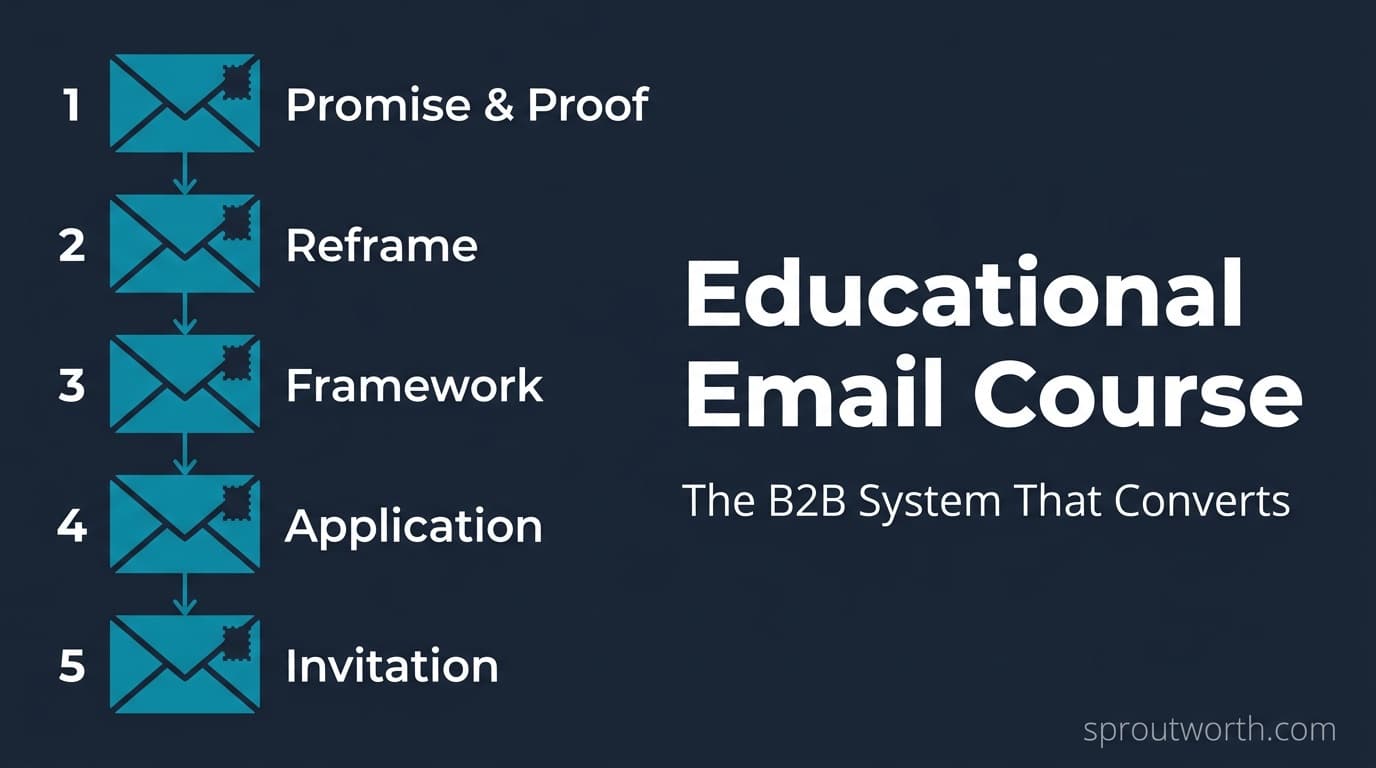
An educational email course is a structured sequence of 5 to 10 automated emails that teaches your B2B buyer something specific and valuable. Funded founders who build these see first email open rates above 40% and sales-cycle compression of up to 40%, per Creator Science and MailerLite’s 2025 data. This post covers the five-email sequence structure, ROI measurement framework, and topic selection process used by Series A and Series B companies.
Most B2B founders treat their email list like a bulletin board. They send a company update, maybe a case study, and then wonder why replies dry up after the first send. An educational email course is a completely different mechanism.
When I work with Series A and Series B founders on their content systems, educational email courses consistently outperform every other lead-nurturing tactic they try. Not because email is inherently magical. But teaching builds trust in a way that pitching never does. And trust is what closes deals at the $50K to $500K contract level.
I have seen this pattern across 500+ interviews on the Predictable B2B Success podcast and in the ghostwriting work I do for funded founders every week.
Table of Contents
What Is an Educational Email Course?
An educational email course is a finite, structured sequence of 5 to 10 emails that delivers a specific transformation for a specific reader, automatically delivered over days or weeks. Unlike a newsletter, it has a defined start and end. Unlike cold outreach, it earns attention by teaching rather than requesting it. B2B tech companies use educational email courses to build trust with prospects who are research-ready but not yet ready to buy.
The mechanism is deliberate. Someone signs up to learn something concrete. You teach them across a short, focused sequence. They come away with a skill or insight they did not have before. In the process, they form a clear association between that value and you.
In sales cycles with long lead times and multiple decision-makers, that trust-building window is where deals are actually won.
“An educational email course is not a lead magnet. It is a relationship-building system that positions you as the most credible voice in the room before the sales conversation even starts.”
This is distinct from drip email sequences, which are product-focused, and newsletters, which are ongoing rather than topic-contained. The educational email course is a finite, high-value experience designed around a single transformation for a single reader.
Key benchmarks for educational email courses:
- Opt-in rates: 30 to 70% (vs 5 to 20% for a standard newsletter sign-up)
- Open rates on Email 1: 40 to 55% (vs 15 to 25% for cold outreach)
- Completion rates for well-structured five-email courses: 50 to 65%
- Sales cycle reduction for buyers who complete a course before a demo: up to 40%
Sources: Creator Science, Inbox Collective, MailerLite 2025 Benchmark Report
Why Do Educational Email Courses Outperform Cold Outreach in B2B?
Educational email courses outperform cold outreach because they earn attention rather than demanding it. A subscriber who opts into a course has self-identified as someone who wants to solve the exact problem you address. Cold email open rates in B2B average 15 to 25%. Educational email courses with a specific promised outcome consistently see first-email open rates above 40%, according to Creator Science’s analysis of email-based course performance.
Cold email is an interruption. An email course is a voluntary learning relationship.
Creator Science’s analysis documented a 40% opt-in rate from a single course landing page and an average open rate of 71% across the email sequence. Those are benchmarks cold outreach cannot approach. Inbox Collective’s email course research corroborates the engagement advantage.
The reason is intent. Someone who opts into “The 5-Day B2B Pipeline Playbook” course has self-identified as someone who wants to solve a pipeline problem. That signal of intent is worth more than any demographic filter you can build in a CRM.
A pattern I notice across funded B2B tech companies is that their outbound motion burns through lists faster than their reputation can keep up. They generate meetings. But they do not generate trust.
The prospect who books a demo from a cold sequence is already shopping three competitors. The prospect who completes your educational email course has been on your mind for 5 days. That is a fundamentally different buyer.
MailerLite’s 2025 email marketing benchmark report shows the average open rate across all industries is now 43.46%, driven in part by Apple Mail Privacy Protection. Education-focused sequences with specific promised outcomes continue to outperform the average.
Note: Open rates alone are increasingly unreliable as a metric. Completion rate and click-through rate are the more meaningful signals for educational email courses.
Educational Email Course vs Newsletter vs Cold Email: A Direct Comparison
An educational email course achieves something neither a newsletter nor a cold email sequence can: it converts passive interest into active engagement, then maps that engagement to the pipeline. The subscriber who opens all five emails reveals something a cold outbound contact never could. That behavioral signal is what makes educational email courses the strongest lead-qualification tool in B2B email marketing.
A newsletter keeps you front of mind across a broad audience. Cold email gets you into calendars by interrupting people who did not ask to hear from you. An educational email course does something neither format can.
| Educational Email Course | Newsletter | Cold Email Sequence | |
|---|---|---|---|
| Structure | Finite (5 to 10 emails, defined endpoint) | Ongoing, no endpoint | Finite (3 to 7 emails) |
| Subscriber intent | High (opted in for a specific outcome) | Medium (general interest) | None (unsolicited) |
| Typical opt-in rate | 30 to 70% | 5 to 20% | N/A |
| Typical open rate (Email 1) | 40 to 55% | 20 to 30% | 15 to 25% |
| Trust built per touchpoint | High (teaching creates credibility) | Medium (informing builds familiarity) | Low (interruption creates resistance) |
| Lead qualification signal | Strong (engagement reveals intent) | Weak (passive consumption) | None |
| Sales cycle impact | Shortens cycle (buyer arrives pre-educated) | Minimal direct impact | Minimal direct impact |
| Runs on autopilot | Yes, after initial build | Requires weekly effort | Yes |
| Time to build | 8 to 15 hours (or delegate) | Ongoing, no fixed build time | 3 to 6 hours |

The table reveals the core advantage. An educational email course is the only format that combines high subscriber intent, strong engagement signals, and autopilot delivery.
“An educational email course is the only email format that delivers high opt-in rates, autopilot delivery, and lead-scoring data simultaneously. That combination is not available from any other single channel.”
One implication most B2B founders miss: these three formats are not mutually exclusive. An educational email course works best as the entry point. A newsletter sustains relationships with graduates after they finish it. Cold email can reach prospects who have not yet encountered your educational content. The sequencing matters.
Most founders lead with cold email, even though data consistently shows that leading with the course produces a warmer pipeline and shorter sales cycles. For a deeper comparison on this specific question, see my breakdown of educational email course vs lead magnet for B2B.
The Anatomy of an Educational Email Course That Converts
A high-converting educational email course has four structural elements: a specific promised outcome, a single reader focus, a progressive sequence, and behavioral engagement signals mapped back to your CRM. Missing any one of these separates a course that converts from one that just teaches. Most email courses that fail share one problem: they send information when they should engineer transformation.
1. A Specific Promised Outcome
The course name must promise a concrete result. “Understanding B2B Content Marketing” is weak. “How to Build a B2B Pipeline Without a Sales Team in 5 Days” is a promise. The more specific the outcome, the higher the opt-in rate and the more qualified the subscriber.
2. One Reader, One Problem
The biggest mistake I see in educational email courses built for tech companies is trying to speak to too wide an audience. If your ICP is the CTO of a Series B cleantech company, your course should speak to exactly that person. Generic content gets generic engagement.
3. A Progression, Not a Playlist
Each email should build on the last. The reader should feel movement. By email three, they should know something they did not know in email one. By the final email, they should have a new capability or a changed perspective. This is what separates an educational email course from a newsletter archive.
4. Behavioral Signals as Pipeline Intelligence
Educational email courses are lead qualification tools, not just trust-building tools. Every click is a data point. Every re-open is a signal. Subscribers who engage with 3 or more emails in your sequence demonstrate buying intent. Those are the prospects worth prioritizing for outreach.
“Your educational email course is also your most accurate lead-scoring mechanism. The subscribers who consume every email are telling you they have the problem you solve.”
When I help founders design their educational email course content, we always map the engagement actions back to the CRM. An open email four about “measuring content ROI” tells you something specific about where that prospect is in their buying journey. Cold sequences cannot give you that level of signal. For the broader framework behind this approach, see CEO content strategy for B2B pipeline.
How to Choose the Right Topic for Your B2B Email Course
The right educational email course topic sits at the intersection of three things: what your ideal buyer urgently needs to know, what you are uniquely positioned to teach, and what connects naturally to the problem your product or service solves. For funded B2B tech companies in 2026, specificity is the deciding factor. “How to build an email list” loses to “How Series A fintech founders build an email list before their first sales hire” every time.
For funded B2B tech companies, that often looks like one of three options:
- A framework your company uses internally that solves a common industry problem
- A counterintuitive insight from your data that challenges how most buyers currently operate
- A step-by-step process that leads buyers to appreciate the complexity of what you solve
The third option is particularly powerful. A Series B data infrastructure company I work with created a seven-day course called “How to Audit Your Data Pipeline Before Your Series C.” It teaches real, actionable steps. And every step reveals a complexity that their platform handles automatically. The course is genuinely educational. It also creates a pipeline from people who finish it and realize how much work they have ahead of them.
The topic should not be about your product. It should be about your buyer’s problem. Your product enters the conversation naturally once trust is established.
For topic validation, run this test: could someone complete your course without your product? If the answer is yes, the topic is right. Paradoxically, giving genuine value without requiring a purchase is exactly what makes people want to buy.
“The right educational email course topic is complete without your product. That is exactly what makes prospects want to buy.”
The 5-Email Sequence Structure Funded Founders Use
For B2B educational email courses, a five-email sequence delivered over five to seven days is the most effective starting structure. It is long enough to build genuine trust and short enough to maintain completion rates above 60%. This sequence architecture delivers one transformation across five progressive emails: Promise and Proof, Reframe, Framework, Real-World Application, and Next Step.

Email 1: The Promise and the Proof
Open with the specific outcome this course will deliver. Then prove you are qualified to deliver it. Keep this under 250 words. End with a concrete action the reader can take today, even before Email 2 arrives. This first email sets the completion expectation for everything that follows.
Email 2: The Reframe
Challenge a belief your reader holds that is holding them back from solving the problem you address. This is the email that earns trust. When someone reads something that articulates a belief they have never quite named, they forward it. They share it. They reply.
Research into B2B email course engagement consistently shows that reframe-style emails generate significantly more organic forwarding and replies than any other email in the sequence, as documented by Double Your Freelancing’s guide to email course creation.
Email 3: The Framework
This is your core intellectual contribution. A model, a process, a checklist. Something the reader can use immediately. Name the framework. Give it a title. This is what gets screenshotted, saved, and referenced. It is also the email that gets cited if your content ever earns coverage in industry publications.
Email 4: The Real-World Application
Walk through how a company like your reader’s applies the framework from Email 3. Use a specific, unnamed scenario. “A Series A fintech company we worked with” is both specific and protected. Make the scenario detailed enough to be believable and generalized enough to be relatable. This email converts more readers to the pipeline than any other in the sequence.
Email 5: The Next Step
Summarize what the reader now knows. Acknowledge what they have accomplished by completing the course. Then, and only then, introduce a natural next step. This is not a sales pitch. It is a logical extension: “Here is where most companies at your stage go from here, and here is one resource that helps.”
Double Your Freelancing’s comprehensive email course guide documents that courses ending with a clear, value-first next step see three to five times higher response rates than those ending with a generic call to action or no action at all.
How to Measure ROI From Your Educational Email Course
Measure educational email course ROI through four metrics: completion rate, high-intent engagement cohort (subscribers who open four or more emails), pipeline attribution in your CRM, and cost per engaged prospect compared to your demo cost-per-lead. These four numbers build the board-ready ROI case that “brand awareness” cannot. Buyers who complete an educational email course arrive at demos with up to 40% of their due diligence already done, according to aggregate data from MailerLite’s 2025 benchmark analysis.
Funded founders need content to justify themselves. “Brand awareness” is not a board metric. Here is how to measure what actually matters.
Completion Rate
Track what percentage of subscribers complete all five emails. Above 50% is strong. A score below 30% signals a problem, usually in Email 1 (weak promise) or Email 3 (too abstract). This metric tells you whether your course delivers on its promise.
High-Intent Engagement Rate
Identify subscribers who opened four or five of your five emails. This cohort is your warmest pipeline. Campaign Monitor’s research on triggered and behavior-based email sequences shows they consistently outperform broadcast campaigns by more than 150% on click-through rate, reinforcing why engagement-based segmentation is the right way to think about course completers.
Pipeline Attribution
Tag every CRM contact who completed your course. Track whether deals closed in the last 90 days included contacts who went through your course. Even in long B2B sales cycles of 6 to 18 months, this attribution starts to show meaningful patterns within 2 to 3 quarters.
Cost Per Engaged Prospect
Divide the total course creation and distribution cost by the number of high-intent engagements (4 or more opens). For most B2B founders, this comes in at a fraction of their cost per inbound demo. That is the ROI case you bring to your board.
A pattern I see consistently with Series B companies: the educational email course starts paying for itself not through direct conversions, but through shorter sales cycles. Buyers who have already spent five days thinking are already 60% of the way through their own due diligence. That cycle compression is worth mapping precisely.
How to Build Your Course From Content You Already Own
Most B2B tech CEOs assume building an educational email course means starting from a blank page. It rarely does. If you have been running a podcast, writing LinkedIn posts, or speaking at industry events, you already have 60-70% of the raw material for a complete five-email course. The work is in identifying the transformation arc and sequencing existing content into a progressive learning experience, not generating something new.
After 500+ episodes of the Predictable B2B Success podcast, I have watched this pattern repeatedly. Founders have more expertise than they think and less time than they need. The fastest path to a converting course is not original research. It is a structured extraction of what they already know.
Here is how the repurposing process works in practice.
Step 1: Audit Your Existing Content
Pull your last 20 LinkedIn posts, your most downloaded podcast episodes, and any talks you have given in the past 18 months. Look for the five to seven topics that appear most frequently. These are your instinctive areas of depth. They are also almost certainly your audience’s most pressing questions.
Step 2: Map to a Transformation
From those recurring topics, identify one through-line. What singular shift does a prospect need to make before they are ready to buy from you? That shift is your course arc. Each existing piece of content becomes a step in that journey.
Step 3: Convert, Do Not Recreate
A 2,000-word LinkedIn post becomes Email 3. A podcast transcript serves as the framework for Email 2. The keynote conclusion becomes the next step for Email 5. You are not writing from scratch. You are curating and resequencing expertise that already exists and is already proven.
This approach cuts course creation time by 60 to 70%, based on my experience working with B2B executives. It also produces better courses. The content that has already resonated with your audience is the content most likely to resonate again, delivered in a more structured format.
“The fastest path to an educational email course is not writing new content. It is finding the connective tissue between the content you have already created and the transformation your buyer needs to make.”
For founders who want to understand how this fits into a broader content system, the B2B SaaS content strategy framework covers the full five-pillar approach, including educational email courses as a core distribution mechanism.
Why Time-Poor CEOs Delegate Course Creation
Most B2B tech CEOs have the knowledge to build a compelling educational email course. Almost none of them have the time to write it. The bottleneck is never ideas. It is turning ideas into structured, well-written email sequences that sound like the CEO wrote them. Ghostwriting educational email courses for tech executives is the model that resolves this: a 60-minute recorded conversation extracts the frameworks, stories, and opinions, while the writing, structuring, and sequencing are delegated.
When I ghostwrite educational email courses for tech executives, the process starts with a 60-minute conversation where I extract the frameworks, stories, and opinions that already live in the CEO’s head. Everything that makes the course credible and unique comes from them. The writing, structuring, and sequencing are what I bring.
The result is a course that reads with genuine authority because it is built on genuine expertise. Not a generic template. Not a repurposed blog post. A focused, tight sequence that sounds exactly like the CEO thinks.
For delegation to work, the CEO needs to contribute:
- One 60-minute recorded conversation covering the core topic and its unique frameworks
- Two or three unnamed real client stories that illustrate the transformation
- Their honest opinion on what most companies get wrong in this space
From that raw material, a skilled ghostwriter can produce a five-email course that the CEO can send with full confidence. The intellectual contribution is 100% the CEO’s. The execution is delegated.
This is also the model that scales. Once the first course is built and converted, the same CEO can add a second course targeting a different stage of the buyer journey, or a different persona within the buying committee. Each course feeds the pipeline independently and compounds over time.
How to Get Subscribers Into Your Educational Email Course
Building the course is step one. Getting the right people into it is step two, and most founders underinvest here. You do not need a paid ads budget or a massive existing audience to drive qualified opt-ins. You need three things: a specific promised outcome, a landing page that clearly states it, and two or three distribution channels that reach your ICP. A single LinkedIn post from a founder with 2,000 or more connections regularly drives 50 to 200 opt-ins within 48 hours, according to Kit’s 2024 State of the Creator Economy Report.
LinkedIn is the highest-leverage channel. A single post that frames the course as a specific solution to a specific problem regularly drives 50 to 200 opt-ins within 48 hours for founders with an engaged audience of 2,000 or more connections. The post does not need to be polished. It needs to name the problem precisely and make the value proposition specific.
For more on making LinkedIn work as a distribution engine, see B2B growth marketing strategies for funded tech companies.
Your podcast is a distribution asset. If you host or guest on podcasts, a verbal CTA at the end of an episode converts well because the listener has already spent 30 to 60 minutes trusting you. That warm relationship is exactly the audience your course is built for.
Your existing email list converts fastest. If you have any existing subscribers, even a small list of 500 to 1,000 people, an announcement email to that list will out-convert any paid channel. These are people who have already decided you are worth reading.
According to Kit’s 2024 State of the Creator Economy Report, 27% of creators ranked email as their highest-engagement channel, making it the top-ranked format ahead of all social platforms.
What Email Automation Tools Work Best for B2B?
No competitor in the educational email course space publishes a clear tool comparison for B2B tech founders. Here is what actually matters at each stage of company growth.
| Tool | Best for | B2B CRM sync | Automation depth | Cost at 1,000 subscribers |
|---|---|---|---|---|
| Kit (formerly ConvertKit) | Founders starting from zero; fastest to launch | Via Zapier or native integrations | Solid for sequences; limited lead scoring | ~$29/month |
| ActiveCampaign | Series A+ with complex segmentation needs | Native CRM or Salesforce/HubSpot sync | Deep behavioral automation and lead scoring | ~$49/month |
| HubSpot | Companies already running HubSpot CRM | Native, full-funnel attribution built in | Robust; best attribution across all touchpoints | ~$45–$800/month (tier-dependent) |
The tool decision comes down to one question: where does your sales team live? If they live in HubSpot, keep the course there. Full-funnel attribution is worth the complexity. If you are pre-CRM or early-stage, Kit gets you running in a day, and the data gap is manageable. ActiveCampaign sits between the two: more automation power than Kit without HubSpot’s full-stack cost.

Landing Page Formula: What Actually Converts B2B Subscribers
The landing page needs one thing above everything else: a headline that states the specific outcome the subscriber will achieve. The formula that consistently moves opt-in rates from 5% to 40% follows this structure: [Time-bound] + [Specific outcome] + [For whom]. Not “learn about email marketing.” Something like “Get five frameworks for building a B2B pipeline without a sales team, delivered in five days.” The more specific the recipient and the outcome, the higher the opt-in rate. Generic courses get generic conversions.
💡 CEO Takeaway: 5 Actions to Start This Week
- Audit your existing content for recurring topics. Your course already exists in fragmented form across LinkedIn posts, podcast episodes, and talks. Collect the top five themes before building anything new.
- Define one transformation your ideal buyer needs to make before they buy from you. That transformation is your course arc. Everything else is sequenced around it.
- Build a five-email sequence using the Promise-Reframe-Framework-Application-Next Step architecture. Five emails over five to seven days is the strongest starting structure for B2B.
- Map engagement to your CRM from day one. Tag every subscriber by email opens and flag anyone who opens four or more emails as a high-intent contact for follow-up.
- Start distribution with your existing list, not paid ads. Even 500 subscribers will produce meaningful data on whether your topic and promise are landing before you scale.
Frequently Asked Questions
An educational email course is a structured sequence of 5 to 10 automated emails that teach subscribers something specific and valuable over a set period. Unlike a newsletter, it has a defined beginning and end. Unlike cold outreach, it builds trust through teaching rather than requesting attention. B2B companies use educational email courses to nurture leads who are research-ready but not yet ready to buy.
For most B2B educational email courses, a five-email sequence over five to seven days is the most effective structure. This is long enough to build genuine trust and demonstrate expertise, and short enough to maintain completion rates above 50%. Shorter sequences of three emails work for simpler topics. Longer sequences of seven to 10 emails work well for complex B2B buying decisions where buyers need more reassurance before taking action.
An educational email course is finite: it has a specific start date, a defined topic, and a clear endpoint. A newsletter is ongoing and covers a broad range of topics over time. Subscribers join an educational email course to learn one specific thing. They subscribe to a newsletter for ongoing value. Educational email courses also achieve higher opt-in conversion rates because they promise a specific, time-bound outcome rather than general-interest content.
Educational email courses with a specific promised outcome typically see open rates of 35% to 50% in the early emails, well above the B2B email marketing average of 15% to 25%. Completion rates above 50% are considered strong. Given the impact of Apple Mail Privacy Protection on open rate data, track completion rate and click-through rate as your primary performance signals. A course topic framed around one precise outcome for one specific audience dramatically outperforms a generic topic.
Yes, and for most B2B tech CEOs, outsourcing the writing while contributing the ideas and frameworks is the most practical approach. The process typically starts with a recorded 60-minute conversation where the CEO shares their expertise, client stories, and opinions. A ghostwriter then structures and writes the sequence, ensuring it reads with genuine authority while requiring minimal time from the executive. The intellectual contribution stays with the CEO; the execution is delegated.
Yes, and this is often the fastest approach for B2B tech founders. Podcast episodes, LinkedIn posts, and keynote talks contain the expertise the course needs. The work is in identifying the transformation arc, sequencing the existing material into a logical progression, and converting the format into email-length lessons. Most founders find that 60 to 70% of a five-email course can be built from content they have already created and validated with their audience.
Educational email courses consistently outperform ebooks as B2B lead magnets. Courses achieve 30 to 70% opt-in rates and maintain engagement across 5 to 10 touchpoints. Ebooks are downloaded once and rarely re-read. The course format also generates behavioral engagement data on who opened which lessons, making it a stronger lead-qualification tool for funded B2B founders. For a detailed breakdown, see the comparison of educational email course vs lead magnet for B2B.
For most B2B tech founders, you need an email automation platform and a simple landing page. The three most used platforms are Kit (best for early-stage founders who need simplicity), ActiveCampaign (best for Series A+ companies needing deep behavioral automation and lead scoring), and HubSpot (best for companies already running HubSpot CRM, where full-funnel attribution matters). The tool matters less than the sequence logic. If you have no CRM yet, Kit is the fastest path to launch. If attribution across your sales funnel is critical, HubSpot is the right infrastructure.
For B2B educational email courses, 300 to 500 words per email is the optimal range. This is long enough to deliver a complete, actionable insight and short enough to respect a time-poor executive’s inbox. Email 1 (Promise and Proof) can run slightly shorter, around 200 to 300 words. Email 3 (Framework) often runs longer, up to 600 words, because it is the core intellectual contribution of the course. Avoid anything over 700 words per email, as completion rates drop significantly at that length and the email risks feeling like a blog post rather than a focused lesson.
Conclusion
The B2B founders who build educational email courses are not doing something exotic. They are doing what every trusted advisor does: they teach before they sell. The result is a warmer pipeline, shorter sales cycles, and a repeatable system that keeps working after the course is built.
The behavioral data an educational email course generates is more useful than most paid advertising campaigns you could run at the same cost. Every open, every click, and every completion tells you something specific about where that buyer is in their journey. Cold sequences cannot give you that resolution.
The four metrics that matter: completion rate, high-intent engagement cohort, pipeline attribution, and cost per engaged prospect. Those four numbers turn a content asset into a board-ready ROI case.
Most B2B CEOs already have the raw material. The work is in structuring what exists, not generating something new. For founders who want a course that sounds like them and converts from day one, this is the kind of work I do at Sproutworth: from framework extraction to sequence writing to delivery setup.
Last Updated: May 2026