How to Balance AI Automation and the Human Element to Drive Business Growth

Balancing AI automation and the human element requires identifying your biggest operational bottleneck first. AI futurist Garik Tate argues most companies implement AI backwards — adding tools before diagnosing constraints — which is why MIT’s State of AI in Business 2025 found that 95% of generative AI pilots produced no measurable return. The fix: apply Eli Goldratt’s Theory of Constraints before touching a single automation tool. Define the bottleneck. Then deploy AI there.

Quick Answer

To use AI automation for business growth, apply the Theory of Constraints: identify your biggest operational bottleneck, confirm its inputs and outputs are clearly definable, then deploy AI there. AI handles volume and consistency at clearly defined stages; humans retain judgment everywhere full context matters. Targeted deployment — not broad AI adoption — is what produces measurable results.

Watch the episode

About Garik Tate

Garik Tate is an AI futurist, investor, and AI strategy consultant whose work sits at the intersection of AI, IQ, and EQ. As CEO of Valhalla, he helps companies grow their profits using AI and positions them for acquisition at premium valuations. With over a decade building and scaling businesses in software development, outsourcing, and publishing — and having led organizations to 75 employees — Garik brings a practitioner’s lens to AI strategy. His entry point into AI came from a Gabe Newell interview in which the Valve founder described programming as “teaching the dumbest thing in the world how to be smart.” That framing defined his career.
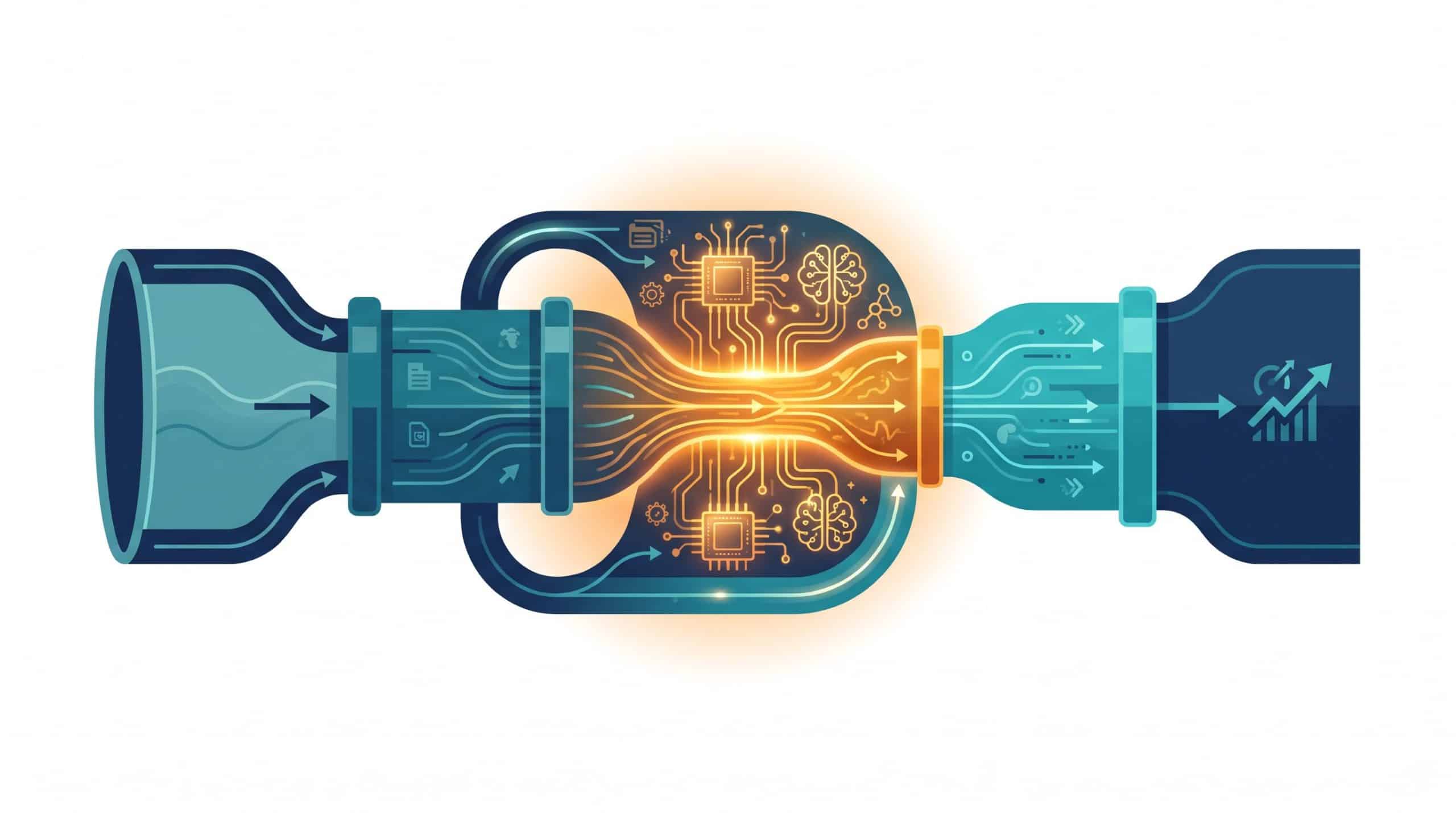
Diagram showing Eli Goldratt's Theory of Constraints applied to AI automation in B2B operations
Applying the Theory of Constraints to AI automation identifies the single highest-value bottleneck to address first.

The Theory of Constraints: The Foundation for AI Automation That Works

MIT’s State of AI in Business 2025 found that 95% of generative AI pilots produced no measurable return. The reason is almost always the same: businesses apply AI where it is easy to apply, not where it would have the highest impact. They treat symptoms instead of constraints.

Garik Tate’s answer to this is Eli Goldratt’s Theory of Constraints, from his book The Goal. The core principle: your business performs at the level of its biggest constraint. Remove a bottleneck upstream of your worst constraint and you don’t improve the system — you add more pressure to the already-overloaded point. The system gets worse, not better.

Applied to AI: “Look at the business holistically and find the areas in the business that are the biggest bottlenecks and see how to add AI there,” Garik says. “If you can do that, you can triple a business’s bottom line.”

“The approach that we like to take is to look at the business holistically and find the areas in the business that are the biggest bottlenecks and seeing how to add AI there.” — Garik Tate, AI futurist and CEO of Valhalla

How to Identify Your Biggest Constraint

Garik uses two approaches in practice to surface the real constraint before reaching for any tool:

The funnel percentages method. Map every stage of your sales or operational journey as a conversion rate. If you send outreach to 100 prospects and 50 open, 30 book a call, 20 show up, and you close 5 — each stage has a percentage. Find the lowest number and ask: if I improved this by 10%, what happens to revenue? That is the bottleneck to address first.

The delays method. Look for where things take days or weeks longer than they should. Long delays reveal where human capacity is maxed out — and where AI or automation can absorb the load without requiring the process to be rebuilt from scratch.

Direct Answer: How to find AI automation opportunities in your business. Map your operations as a series of conversion rates or time-to-completion metrics. The stage with the lowest rate or the longest delay is your biggest constraint. That is where to apply AI first — not where it is technically easiest to implement. Businesses that skip this diagnostic step are in the 95% of AI implementations that fail to produce meaningful results.

The Inputs/Outputs Test: The Filter That Determines What AI Can Handle

Once you have found the bottleneck, the next question Garik asks is simple: can this problem be reduced to clear inputs and outputs?

“The reason why AI suffers a lot in a lot of circumstances is that the inputs are not as simple as we think,” he says. His example: an AI accountant sounds compelling until you realize that a real accountant conversation includes goals, risk tolerance, life context, and unstated assumptions — none of which are in a P&L statement. Strip that context and AI output looks right but lands wrong.

The inputs/outputs test acts as a filter. If you can define in writing what information enters the process and what result should come out, AI can handle that process reliably. If you cannot define both, human judgment is still required at that stage — and adding AI without that clarity produces inconsistent output at higher volume, which makes the problem worse.

Two Processes That Pass the Test

HR policy chatbot. Input: a written employee question. Output: a policy-grounded answer. Data: company documentation. “You can build a chatbot that has access to all your company’s policies and what’s called a knowledge base,” Garik explains. “When the user asks a question, it can find the part of your knowledge base that answers it, feed that to ChatGPT, and ChatGPT writes a custom solution.” Input clear. Output clear. Strong AI candidate.

Personalized SDR outreach. Input: a prospect’s LinkedIn profile. Output: a personalized cold outreach message. Data: pulled via a scraping tool like PhantomBuster. “The input’s clear — you’re seeing their roles and responsibilities,” Garik says. “The output is the cold outreach message.” Human SDRs set strategy and review messaging. AI handles the drafting at scale. The World Economic Forum projects that AI adoption will create 97 million new jobs globally as roles shift toward this kind of human-AI collaboration — humans doing what requires full context, AI doing what has clear inputs and outputs.

Direct Answer: The inputs/outputs test for AI implementation. Write down what enters a process (input) and what should come out (output), in plain language. If you can define both clearly, the process is a strong candidate for AI automation. If you cannot, the process needs more human structure before it is ready for AI. Businesses under $100M in revenue should treat AI as a specific problem-solver, not a data mining platform — define the problem first, pick the tool second.

Human-in-the-Loop: Where Automation Ends and Judgment Begins

The practical model for balancing AI automation with the human element is called human-in-the-loop AI — where AI prepares decisions, surfaces risks, and executes clearly defined steps, while humans review context and make the final call at decision points that require judgment.

Garik’s VA company case study illustrates this precisely. Automated messaging sequences handled routine touchpoints throughout the recruitment funnel. Every applicant was auto-assigned to a recruiter. Anyone not contacted within two weeks surfaced automatically in a follow-up report. But the actual hiring decisions — assessing cultural fit, evaluating ambiguous resumes, having sensitive conversations with candidates — stayed with human recruiters.

This split is not determined by job category or seniority level. It is determined by where in the process full human context is required and cannot be replaced by a clear input. Everything that can be clearly specified can be automated. Everything that requires reading between the lines stays human.

Human-in-the-loop AI workflow showing automated processes handing off to human decision makers at key judgment points
Human-in-the-loop AI: automation handles clearly defined inputs and outputs; humans retain judgment at every decision requiring full context.

The Riskiest Assumption Test: A Better Alternative to the MVP

For B2B companies building AI-enabled products or services, Garik recommends replacing the MVP mindset with the Riskiest Assumption Test — or RAT. The difference is significant in practice.

An MVP attempts to ship a minimum version of everything. A RAT narrows the build to the single biggest assumption — the one that, if wrong, would kill the idea. Build only enough to test that assumption. Get real data. Then ask what the next riskiest assumption is. Repeat.

“What is your riskiest assumption? Build something that tests that first. Can we connect with the API? That’s our first assumption that’s really risky. Yes we can. What’s the next risky assumption? Will people pay for this? Let’s create a landing page that accepts credit cards,” Garik explains.

This approach is especially relevant for AI product development. “Every single day new AI products have come out that are really just a wrapper around ChatGPT,” Garik says. “You’re not really building anything — you’re just putting a wrapper around this thing that already existed.” The RAT forces teams to identify the actual core value before building — and tests that value before investing further.

Domain-Driven Design: Alignment Before Automation

Most AI implementations fail at the team level before they fail technically. A core reason is language inconsistency — teams using different words for the same concepts create invisible confusion that compounds across every sprint and every AI prompt.

Garik’s company uses Domain-Driven Design (DDD) to address this before touching any tooling. The approach maps the user journey step-by-step — not at a high level, but every discrete action — and identifies the back-end consequences of each step. This happens on a whiteboard with color-coded Post-it notes before a line of code is written.

The critical discipline: “If you’re going to call the user a ‘user,’ always use that word. Not then also calling them a ‘customer’ or a ‘client.’ If you want to call this page the ‘dashboard,’ don’t call it the ‘reporting page’ later on.” Consistent terminology forces shared mental models. Shared mental models are the prerequisite for inputs to be clearly defined — which is what makes any AI or automation layer work reliably.

The Product Blueprint Sprint (PBS) — Garik’s proprietary method combining design sprint and domain-driven design — turns this into a structured engagement. Teams map user journeys, define terminology, identify core value, and build a roadmap before writing the first line of code. The output is shared mental clarity, not just a document.

AI and Marketing Personalization: What’s Actually Happening

The most significant shift AI is driving in marketing is not content volume. It’s personalization at a scale that was previously only accessible to large teams with large budgets.

Garik’s prediction: “By the 2028 presidential election, every single person will get an AI-written message tailored to their demographic and the concerns they have, with a custom message from the presidential candidate of choice.” Political campaigns lead this trend because the stakes are high enough to justify the investment. Marketers follow. The B2B SDR outreach example using LinkedIn data and PhantomBuster is already available today — and it passes the inputs/outputs test cleanly.

Direct Answer: How AI changes B2B marketing personalization. AI enables individually tailored outreach at mass scale by pulling from prospect LinkedIn profiles, company news, or behavioral signals and generating customized messages for each target. The businesses winning with this approach are using AI to increase message quality and relevance, not just volume. As AI-generated content becomes ubiquitous, audiences are developing stronger filters. Personalization depth will determine response rates — not outreach quantity.

The Social Contract Problem: Why AI Outreach Is Already Backfiring

Every time mass communication gets cheaper, the audience builds a defense. Email got cheap: spam filters emerged. Display advertising got cheap: ad blockers emerged. AI-generated content at scale is triggering the same response.

“There was a social contract,” Garik says. “You put in the effort to write this; I’m putting my limited attention to reading it. But now if I read something that was written by AI, my response is generally anger. The social contract was not held here.”

He points to YouTube as an early signal: when ChatGPT launched, channels made their “this video was written by AI” content. Those videos are gone now. The audience didn’t reward transparency. They stopped watching.

The practical implication for B2B outreach: using AI to generate more messages faster reduces response rates as audiences adapt their filters. The winning use of AI in outreach is making individual messages significantly more specific and valuable — not faster and more abundant. “Keeping your copy shorter, punchier, adding even more value” is the direction Garik points to. The competition for attention is intensifying. Standards are rising.

Case Study: Tripling Recruitment Speed with No-Code Automation

To ground the Theory of Constraints framework in a concrete outcome, Garik shares a case study from a VA company he supported — one with strong fundamentals, strong VAs, good training, and solid retention, but a recruitment bottleneck that was costing them clients.

The company expected 95-99% recruitment success within two months. They were hitting 50-60%, with timelines stretching to three months. Clients were dropping.

The diagnosis: The constraint was not applicant volume. Enough candidates were applying. The problem was drop-off during the process — emails getting missed, applicants falling through the cracks, no systematic accountability for follow-up. The inputs/outputs were clear. The automation layer was missing.

The intervention: Make.com integrated with a Notion database. Pressing a button in Notion triggered an automated messaging sequence. Every applicant was auto-assigned to a recruiter. Anyone not contacted within two weeks surfaced automatically in a report. Human recruiters saw exactly who needed attention and when.

The result: Recruitment speed tripled. The business has grown to roughly 3x its previous baseline. The core intervention was automation, not complex AI. “A lot of that is just block and tackle of automation,” Garik says. The AI layer — drafting responses to applicant questions, scoring resumes — came after the foundational automation was in place and working.

The lesson: automation and AI are not the same thing. Automating a broken process is a prerequisite to AI adding value. Get the workflow solid first. Then layer intelligence on top of structure, not instead of it.

Recruitment automation workflow showing how Make.com integration tripled VA company hiring speed
Make.com automation integrated with Notion tripled recruitment speed by eliminating manual follow-up gaps in the hiring pipeline.

The AI Arms Race: Strategic Implications for Business

Garik’s broader view of AI’s trajectory draws on a concept from security: arms races between competing intelligent systems. As AI-generated content becomes ubiquitous, detection systems emerge. Detection systems improve; AI generators adapt; the cycle continues.

OpenAI quietly abandoned its AI text detection project in 2023. The playing field for text detection is not complex enough to sustain an ongoing race — AI writers adapted faster than detectors could. Video deepfakes operate on a much larger and more complex playing field, so that arms race is likely to persist far longer and may never resolve in favor of detectors.

For business strategy, the implication is this: some AI detection equilibria will stabilize and some will remain permanently dynamic. Build your content strategy and outreach with that distinction in mind. “Some areas will stabilize and others will be continuously dynamic,” Garik says.

His overall framing cuts through the complexity: “The thing you should be putting all your focus on is just make sure you’re providing so much value that the system is benefiting you rather than not. The name of the game is to actually provide the value.”

Frequently Asked Questions

What is the best framework for implementing AI automation in a B2B business?

The most effective framework combines Eli Goldratt’s Theory of Constraints with an inputs/outputs test. First, identify the biggest bottleneck in your operations using funnel percentage analysis or by finding the processes with the longest delays. Then apply the inputs/outputs test: can you define in plain language what information goes in and what result should come out? If yes, that process is a strong candidate for AI automation. MIT’s State of AI in Business 2025 found that 95% of generative AI pilots produced no measurable return, and and most failures stem from adding AI where it is convenient rather than where it would remove the actual constraint on growth.

How do you balance AI automation with the human element in business?

Use the human-in-the-loop model: AI handles volume and consistency at process stages where inputs and outputs are clearly defined; humans retain judgment at every stage where full context, relationships, or unstated assumptions determine the right outcome. The split is not determined by job category — it is determined by whether the inputs can be fully specified. Garik Tate’s VA company case study illustrates this: automated messaging sequences handled routine touchpoints throughout recruitment, but human recruiters made every hiring decision. The World Economic Forum projects this collaboration model will create 97 million new job categories globally as AI handles defined tasks and humans focus on complex judgment.

What is a Riskiest Assumption Test (RAT) and how does it differ from an MVP?

A Riskiest Assumption Test (RAT) builds the minimum needed to test the single biggest assumption in a business idea — the one that, if wrong, would kill the concept. An MVP builds the smallest complete version of the product. The RAT is more focused: it asks “what do we need to know first?” and builds only enough to answer that question. Once confirmed, it moves to the next riskiest assumption. For B2B companies building AI-enabled products, this prevents teams from building full solutions around assumptions that early testing would have disproved quickly.

How is AI changing personalization in B2B marketing?

AI enables individually tailored outreach at scale by pulling structured inputs — LinkedIn profiles, company news, behavioral signals — and generating customized messages for each prospect. Tools like PhantomBuster make this accessible today for B2B SDR teams. The businesses winning with AI personalization are using it to increase message relevance and specificity, not just sending volume. As AI-generated outreach becomes more common, prospect filters will strengthen. Generic AI outreach at scale will produce diminishing returns; hyper-specific AI-assisted outreach anchored in genuine value will outperform.

What no-code tools work for AI automation in small and mid-size businesses?

Make.com (formerly Integromat) and Zapier are the most accessible no-code automation platforms for SMBs. Make.com offers more flexibility for multi-step conditional workflows; Zapier has a simpler interface for straightforward integrations. Both connect to databases like Notion and Airtable, CRMs, and communication tools. In Garik Tate’s VA company case study, Make.com integrated with Notion to automate applicant messaging sequences and surface follow-up gaps automatically. The tool choice is secondary — first define the process logic: what triggers the action, what should happen at each step, and what should surface for human review.

Why do most AI implementations fail to deliver business results?

MIT’s State of AI in Business 2025 found that 95% of generative AI pilots produced no measurable return. The most common cause is treating symptoms instead of constraints — adding AI to processes that are easy to automate rather than to the actual bottleneck limiting business performance. Other failure modes include applying AI to processes where inputs cannot be clearly defined (producing inconsistent output), automating upstream of a worse bottleneck (adding pressure to the real problem), and using AI to generate more volume without improving quality (which triggers audience defense mechanisms faster). The businesses that see real ROI from AI start with constraint identification, not tool selection.

The Practical Path Forward for B2B Companies

Garik Tate’s framework is not a technology framework. It is a thinking framework that determines where technology belongs. Identify the constraint. Test the inputs/outputs. Build to the RAT. Keep terminology consistent across the team. Then layer AI onto the specific process that passes both tests.

The companies that will extract the most value from AI automation are not the ones adopting it broadest or fastest. They are the ones most honest about where their operations actually break down — and disciplined enough to address that specific constraint before reaching for the next tool.

As AI becomes a standard input in business operations, the human element does not diminish — it shifts. Judgment about where to apply AI, what the output should look like, and what the customer actually needs remains irreducibly human. The balance is not achieved by using more or less AI. It is achieved by deploying it precisely where the inputs and outputs are clear, and trusting humans everywhere else.

If your B2B company is working through content and authority strategy as part of an AI-era growth plan, that’s an area we work on at Sproutworth. Happy to think it through with you.

Author

  • Vinay Koshy

    Vinay Koshy is the founder of Sproutworth and host of the Predictable B2B Success podcast. He ghostwrites educational email courses, newsletters, and LinkedIn content for funded B2B tech founders at seed through Series C. His work spans nonprofits, SaaS companies, and digital agencies, with a focus on content that builds genuine buyer trust before the sales conversation begins.

    View all posts