

Last updated: March 2026
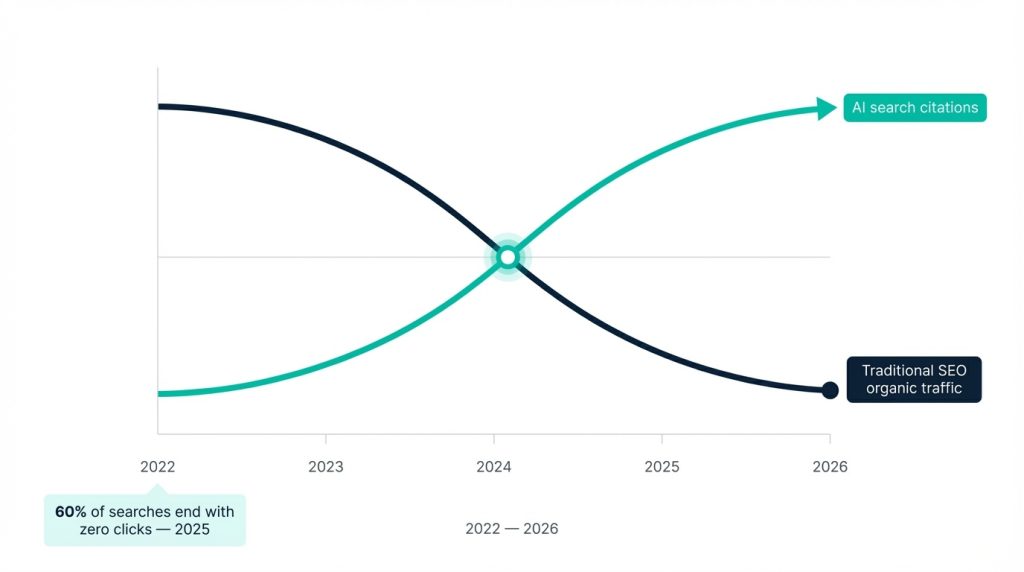
60% of all searches now end without a click. Most B2B tech CEOs I speak with are still optimizing for a search engine that no longer controls their buyers’ first impression. While they’ve been chasing page-one rankings, their prospects have quietly shifted to asking ChatGPT, Perplexity, and Google’s AI Overview for vendor shortlists. If your brand isn’t cited in those answers, you don’t exist in that buying moment.
Generative engine optimization (GEO) is the discipline that fixes that. This guide covers what generative engine optimization is, why it matters specifically for seed-to-Series C B2B tech companies, and the six strategies that actually move the needle in 2026. If you’ve already built a solid thought leadership strategy but aren’t seeing AI citation results, GEO is likely the missing layer.
Quick Answer: Generative engine optimization (GEO) is the practice of structuring and building authority around your content so AI platforms like ChatGPT, Perplexity, and Google AI Overviews select it as a cited source when generating answers. For B2B tech companies, GEO determines whether your brand enters a buyer’s consideration set before a sales conversation ever begins.

Table of Contents
What Is Generative Engine Optimization?
Generative engine optimization (GEO) is the practice of structuring content and building authority, so AI platforms like ChatGPT, Perplexity, and Google AI Overviews select it as a cited source when generating answers. Unlike traditional SEO, GEO targets inclusion inside the AI-generated answer itself. B2B tech companies use generative engine optimization to enter the buyer’s consideration set before a sales conversation begins.
The term was formally introduced in a 2024 research paper by teams from Princeton University, Georgia Tech, the Allen Institute for AI, and IIT Delhi, presented at the ACM SIGKDD Conference. Their study demonstrated that the right GEO techniques can increase content visibility in generative engine responses by up to 40% (ACM SIGKDD 2024).
As lead researcher Pranjal Aggarwal noted at the time of publication: “With generative engines here to stay, we must ensure the creator economy is not disadvantaged.” That concern applies directly to funded B2B tech brands whose buyers are increasingly making shortlist decisions inside AI interfaces rather than search results pages.
“GEO doesn’t just change how you rank. It changes whether you’re in the conversation at all when your ideal buyer is making a decision.” – Vinay Koshy, Founder, Sproutworth
Why Traditional SEO Alone Is No Longer Enough for B2B Pipeline
Here’s a pattern I notice consistently across funded B2B tech companies: they invest heavily in SEO, hit page one for their target keywords, and still get outrun by competitors who show up in AI-generated answers for the same buyer queries. Understanding why is the first step in any serious generative engine optimization strategy.
The data makes clear why. According to research compiled by Incremys, over 50% of Google searches now show an AI Overview, and 60% of all searches ended without a click in 2025 (Incremys, 2026). When an AI Overview appears, the number-one traditional organic result loses nearly 35% of its clicks according to the same analysis.
For B2B specifically, this is a pipeline problem, not just a traffic problem. And it’s exactly why thought leadership content built purely for search rankings is no longer sufficient.
A 2025 Forrester report found that 89% of B2B buyers now use generative AI as a key source during self-guided research throughout their purchasing journey (Profound/Forrester, cited in TryProfound 2025). These are your buyers. They’re asking ChatGPT which newsletter ghostwriting agencies work with Series B founders. They’re asking Perplexity which digital PR services have experience with cleantech companies. If your content isn’t structured to be cited in those answers, your competitors who have invested in GEO will be recommended instead.
A Series B SaaS marketing team profiled by Enrich Labs found that AI-driven traffic represented only 1.2% of their organic sessions despite strong traditional SEO performance. Their audit revealed a structural issue: their content was formatted for keyword density rather than for answer extraction (Enrich Labs, 2026). That gap between SEO performance and AI visibility is exactly where most funded B2B tech companies sit right now.
“Ranking #1 on Google and being invisible to AI search are not mutually exclusive. In 2026, you can have both problems at once.” – Vinay Koshy
How Generative Engines Actually Select Content to Cite
Understanding how generative engines decide what to pull is the foundation of any GEO strategy. These systems use a process called Retrieval-Augmented Generation (RAG): the AI retrieves relevant content from the web in real time, then synthesizes an answer using that content as its source material.
What gets selected in generative engine optimization comes down to five signals:
1. Direct answerability. Content that opens with a clear, concise answer to the query gets extracted first. AI engines are looking for the sentence or paragraph that directly resolves the question. Burying your answer in the third section of a 3,000-word post is an SEO habit that actively hurts GEO performance.
2. Structural clarity. Headers, numbered lists, definition blocks, and FAQ sections make content easier for AI to extract specific passages. The Princeton/Georgia Tech study specifically identified structured formatting as among the top techniques for improving generative engine visibility.
3. Citational density. Content that cites other authoritative sources is modeled after the behavior AI engines use in their own responses. When you reference named studies, data points with sources, and expert quotes, you signal to the AI that your content is credible and citation-worthy.
4. E-E-A-T signals. Experience, expertise, authoritativeness, and trustworthiness remain core signals. For B2B content, this means author credentials, specific client scenarios, and named frameworks. After 500+ interviews on the Predictable B2B Success podcast, I’ve seen how the founders who establish clear expertise in their content consistently outperform those who publish generic thought leadership.
5. Recency and freshness. AI engines weigh recent content for time-sensitive queries. Articles with visible update dates, current statistics, and fresh examples consistently outperform evergreen content that hasn’t been touched in 18 months.
How Does Generative Engine Optimization Differ from SEO and AEO?
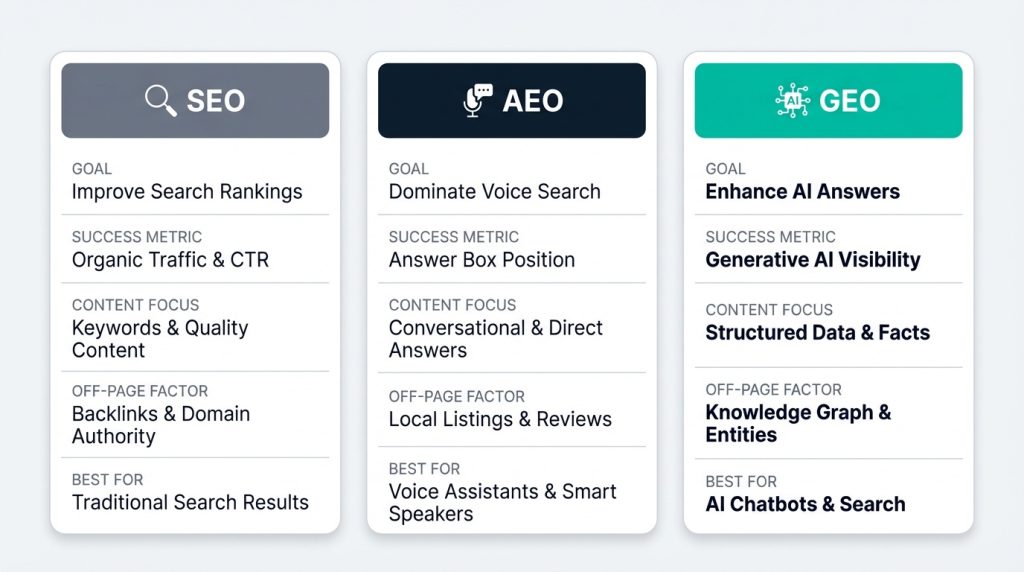
These three terms are increasingly used interchangeably, but the distinctions matter when you’re allocating time and resources toward generative engine optimization versus your existing SEO and content programs.
| SEO | AEO | GEO | |
|---|---|---|---|
| Goal | Rank in search results | Appear in featured snippets and AI responses | Be cited across multiple AI platforms |
| Success metric | Keyword rankings, organic traffic | Zero-click visibility, snippet inclusion | Citation frequency, AI referral traffic |
| Content focus | Keywords, backlinks, technical health | Answer-first formatting, FAQ structure | Semantic depth, citational density, topical authority |
| Off-page factor | Backlinks | Brand authority | Third-party mentions, earned media, digital PR |
| Best for | Driving traffic to your site | Capturing featured snippet and voice search | Influencing AI-generated buyer research |
Traditional SEO optimizes web pages to rank in search engine results pages. Success is measured by keyword rankings, organic traffic, and click-through rates. The goal is to get a user to click your blue link over the nine others on the page.
Answer Engine Optimization (AEO) structures content so it appears directly in AI-generated responses and featured snippets. It’s tightly focused on zero-click visibility: being the source that Google’s AI Overview or a voice assistant reads aloud. AEO and GEO overlap significantly, which is why many practitioners treat them as a combined discipline.
Generative engine optimization (GEO) takes a wider view. It engineers content to be cited across multiple AI platforms simultaneously, with a focus on semantic relevance within vector-based retrieval systems. GEO also includes off-page factors: third-party mentions, digital PR placements, and external citations that signal to AI systems your brand is a recognized authority in its space.
For B2B tech companies at seed through Series C, the practical implication is this: your strategy needs to be built for all three. Content that earns GEO citations reinforces AEO visibility, and both compound on the SEO foundation you’ve already built. The key insight from BOL Agency’s 2026 analysis is that 99% of AI Overview citations come from the organic top 10, indicating that strong SEO remains the prerequisite (BOL Agency, 2026). Generative engine optimization doesn’t replace SEO. It layers on top of it.
6 Generative Engine Optimization Strategies That Move the Needle for B2B Tech Companies
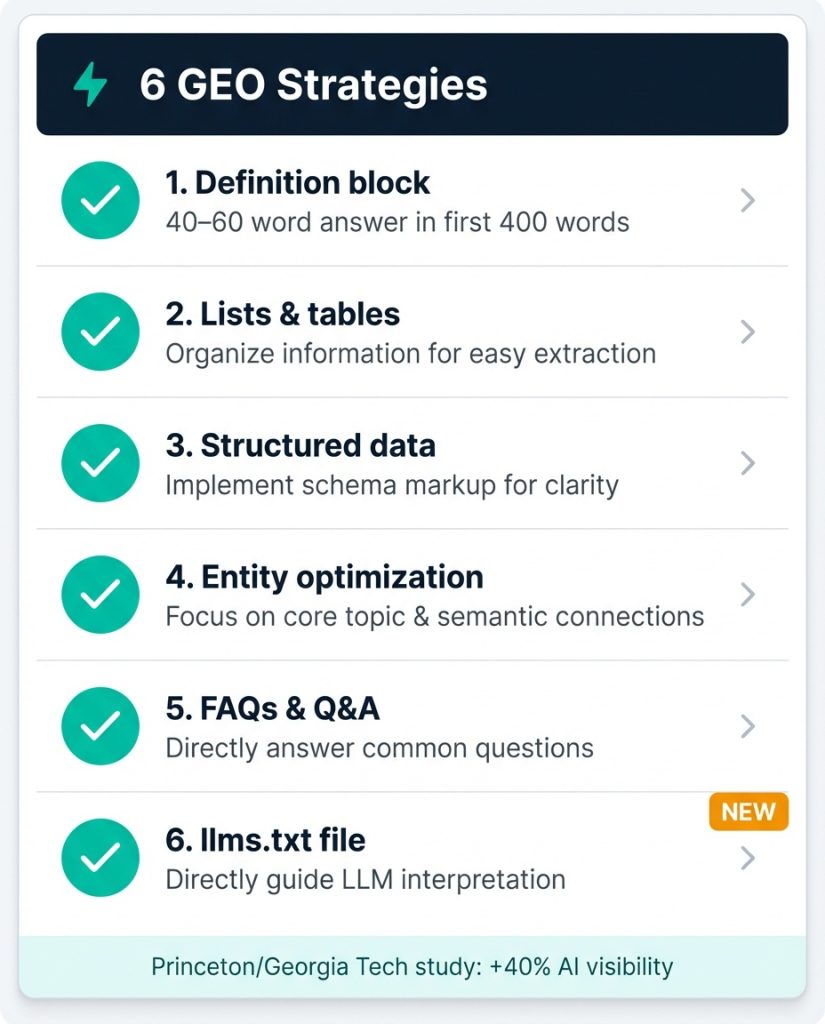
These are the tactics I recommend to the funded founders I work with, based on what the research shows and what I see working across content operations in the B2B tech space.
1. Lead with a direct definition block
Every piece of content targeting a high-intent query needs a clear, 40-60-word definition of the primary topic within the first 400 words. AI engines pull these verbatim. Format it as its own callout block with a question-style heading and write the answer as a complete, self-contained paragraph. This single structural change is one of the highest-leverage adjustments you can make to existing content for generative engine optimization.
2. Build citational density into every article
The Princeton/Georgia Tech GEO study identified including citations, statistics with sources, and expert quotations as the top three techniques for boosting AI visibility, each contributing to a 40% increase. This means every substantive claim in your content needs a named source with a URL. Not vague references to “studies show” but specific, attributable data: “According to Incremys’ January 2026 analysis, GEO techniques improve visibility in generative engines by an average of 40%.”
A pattern I see with cleantech and B2B SaaS founders is that they have genuinely novel insights from their own operations but don’t externalize them with data. An unnamed internal benchmark with no methodology carries zero weight with an AI engine. A published result, even from a small sample, cited correctly, signals credibility.
3. Structure content for extraction, not just reading
FAQ sections are the single highest-impact structural element for generative engine optimization. Questions written exactly as a buyer would type them into ChatGPT, paired with complete 40 to 60-word answers in natural sentences, give AI engines a perfectly formatted extraction target. Every page targeting a core keyword should have four to five of these.
Similarly, use numbered lists for sequential processes, bullet points for feature or benefit summaries, and comparison tables for versus-style queries. GenOptima’s March 2026 analysis found that 74% of all AI citations came from structured list-format content (GenOptima, 2026).
4. Develop topical authority through content clusters
AI engines don’t just evaluate individual pages. They assess the breadth and depth of a site’s coverage on a topic. A single GEO-optimized article in a sea of unrelated content performs far worse than the same article inside a cluster of related, interlinked pieces.
For B2B tech founders, this means mapping out your core authority area and building a cluster of supporting content around it. If your primary topic is AI search visibility, you need adjacent pieces on content performance, digital PR for B2B, and authority building, all internally linked in a logical hierarchy. This is how you repurpose content for AI visibility across an entire topic cluster, not just one article.
5. Build third-party mentions through earned media
This is where generative engine optimization diverges most sharply from traditional SEO content strategy. AI engines don’t just crawl your own site. They pull from the broader web, and they weigh sources that appear consistently across multiple trusted publications. According to DOJO AI’s 2026 GEO guide, 65% of AI Overview sources come from publishers, review sites, and community content, not from the brand’s own website (DOJO AI, 2026).
This is why digital PR is not a complementary tactic to GEO. It’s a core input. A funded B2B tech brand with strong on-page GEO but no third-party mentions is invisible to the systems that determine AI citations. Start building your earned media program in parallel with your content cluster work.
6. Add an llms.txt file to your site
This is the most underused GEO tactic in 2026, and it’s completely free to implement. An llms.txt file is a plain-text Markdown file placed at the root of your domain (yoursite.com/llms.txt) that tells AI crawlers which content on your site is a priority for indexing and citation. It includes your site name, a short description of what you publish, and links to your most important pages with brief context for each.
Think of it as a robots.txt for AI engines. While robots.txt tells crawlers what not to index, llms.txt actively guides AI systems toward your best, most citable content. For a seed-to-Series B B2B tech brand with a growing content library, this file takes 30 minutes to create and can meaningfully influence how AI engines prioritize your content in retrieval. A content performance audit to identify your top-performing pages is a good starting point for deciding which URLs to include.
Digital PR Is the Hidden GEO Accelerator Most Founders Overlook
A conversation I had with a Series A founder recently stuck with me. She had invested 6 months in building a content hub targeting AI search visibility using generative engine optimization principles. The content was well-structured and cited well. But her brand still didn’t surface when buyers queried ChatGPT for solutions in her category. The reason: her brand had almost no third-party mentions.
AI engines learn which brands are authoritative in a space partly by reading what other authoritative sources say about them. If the publications, newsletters, and trade sites that cover your category have never mentioned your company, the AI has almost no signal to draw on when deciding whether to include you in an answer.
Digital PR builds those signals. Earned placements in relevant publications, backlinks from authoritative domains, podcast appearances, and guest contributions create the external citation network that signals to AI engines that your brand belongs in the conversation. Corporate Ink’s 2025 B2B GEO playbook noted that, specifically in the tech industry, journalism content is cited more than in other industries, making earned media especially high-leverage for B2B tech brands (Corporate Ink, 2025).
First Page Sage’s 18-month analysis of 127 B2B companies implementing GEO strategies found that generative engine optimization customer acquisition costs have declined 37.5% from initial levels as methodologies have matured. Their data also showed that early adopters maintain significant competitive advantages that compound over time (First Page Sage, 2026). The window for being an early mover in your category is not indefinitely open.
How to Measure Your GEO Performance
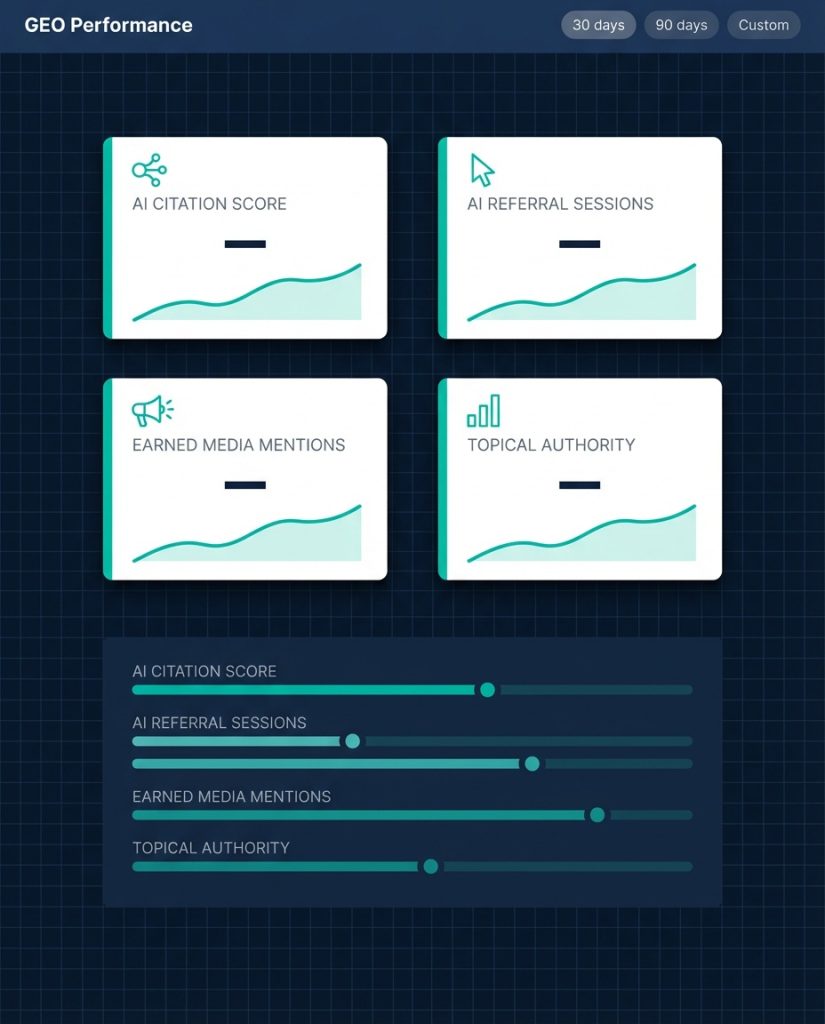
GEO tracking is still maturing, but early measurement frameworks are available. The starting point is monitoring your brand’s citation presence across the major platforms. Tracking B2B growth marketing outcomes from AI-referred sessions separately from organic search gives you the clearest signal of whether your generative engine optimization efforts are translating into pipeline.
Manual citation testing: Run 20 to 40 buyer-intent prompts across ChatGPT, Perplexity, and Google AI Overview each month. These should mirror how your ICP actually queries AI tools: “best newsletter ghostwriting services for B2B tech founders,” “how do Series B companies build thought leadership,” “what is the ROI of digital PR for startups.” Track whether your brand appears, how prominently, and what claims the AI makes about you.
AI referral traffic in GA4: Configure GA4 to capture referral traffic from AI platforms. These sessions, while small today, are the leading indicator of GEO effectiveness. According to Previsible’s 2025 research, AI-referred traffic converted at 14.2% compared to Google’s 2.8% (Security Boulevard, 2026). The quality of these visitors justifies tracking them carefully.
Citation velocity from earned media: Track the rate at which authoritative external sources mention your brand. This is a lagging indicator of GEO authority that tends to show up in AI citations two to four months after the earn.
Topical authority signals: Monitor your organic rankings for cluster keywords, not just primary targets. Broad topical authority, measured by how many related queries your site appears for, is highly correlated with generative engine optimization citation rates.
For funded B2B tech companies at Series A and above, tools like Profound (which tracks brand mentions across ten AI engines) provide more systematic measurement. For seed-stage founders, manual testing across three to five core buyer prompts monthly is a practical starting point that costs nothing.
💡 CEO Takeaway
- Audit your AI citation presence now. Run your top 20 buyer-intent queries through ChatGPT, Perplexity, and Google AI Overview. If your brand doesn’t appear, you have a GEO gap.
- Update your highest-traffic content first. Add a direct definition block within the first 400 words, a structured FAQ section, and verifiable statistics with named sources.
- Build a content cluster around your core topic. One GEO-optimized article inside a topical cluster outperforms ten unrelated posts every time.
- Treat digital PR as a GEO input. Earned third-party mentions are the off-page citation signals AI engines use to validate whether your brand belongs in an answer.
- Add an llms.txt file today. It takes 30 minutes and actively guides AI crawlers toward your most citable content.
- Track AI referral traffic in GA4. Even at low volume, these sessions convert at significantly higher rates than traditional organic traffic.
Frequently Asked Questions
What is generative engine optimization in simple terms?
Generative engine optimization (GEO) is the practice of optimizing your content so AI platforms like ChatGPT, Perplexity, and Google AI Overviews select it as a cited source when generating answers. Instead of competing for a ranked position in a list of search results, GEO positions your brand inside the AI-generated answer itself, giving you visibility at the moment your buyer is researching.
How is generative engine optimization different from SEO?
Traditional SEO optimizes web pages to rank in search engine results, with success measured by keyword rankings and organic traffic. Generative engine optimization focuses on being extracted and cited by AI systems, with success measured by citation frequency, AI referral traffic, and brand mention rates across generative platforms. Strong SEO is still a prerequisite for GEO since most AI citations come from sites already ranking in the organic top ten, but GEO adds content structure and authority signals beyond what SEO alone requires.
How long does it take to see results from generative engine optimization?
Early citation results from newly optimized content can appear within three to five business days on platforms like Perplexity that have fast crawl cycles. Sustained, consistent AI citation authority typically develops over three to six months as content clusters build topical depth and third-party mentions accumulate. First-mover advantage is real: the companies building GEO authority in 2026 are establishing citation histories that will compound as AI search adoption continues to grow.
Do B2B companies need a dedicated GEO strategy or is it part of content marketing?
Generative engine optimization is best understood as an evolution of your existing content marketing and SEO strategy, not a separate function. The same content that performs well for SEO should be structured to perform for GEO. The key additions are answer-first formatting, citational density, structured FAQ sections, an llms.txt file, and an earned media component through digital PR. For funded B2B tech companies at seed to Series C, integrating GEO principles into your existing content workflow is the most efficient path.
What content types perform best for generative engine optimization?
According to GenOptima’s March 2026 analysis of 449 AI citations across six platforms, structured list-format content (ranked guides, comparison articles, and step-by-step frameworks) generated 74% of all AI citations. FAQ sections, clear definition blocks, and content with verifiable statistics and named expert quotes also perform consistently well. Long-form pillar content that covers a topic comprehensively outperforms shorter articles at establishing topical authority, a key input to GEO citation rates over time.
Conclusion
B2B buyers don’t browse vendor lists the way they used to. They ask AI engines, get a synthesized answer, and form their shortlist before your sales team ever enters the picture. Generative engine optimization is about making sure your brand is in that answer.
The mechanics are learnable: direct definition blocks, citational density, structured FAQs, topical content clusters, an llms.txt file, and earned media to build the third-party citation network AI engines draw from. The window to establish first-mover GEO authority in most B2B tech niches is still open, but it’s narrowing fast.
If you’re building content systems to support your executive team and want your brand cited in AI-generated answers your buyers are already using, this is exactly the kind of work I do at Sproutworth.
Related Resources
- How to Build a Thought Leadership Strategy That Drives B2B Growth
- How to Repurpose Content to Drive Business Growth
- Content Performance: Key Metrics and Strategies for Success
- B2B Growth Marketing: Building High-Performing Tech Brands
