LLMSEO: How B2B Tech Companies Get Named by ChatGPT in 2026

LLMSEO is the practice of optimizing your content so that large language models cite your brand in their answers. AI referrals from ChatGPT convert at 15.9% compared to 1.76% for Google organic, according to a Seer Interactive case study. For funded B2B tech companies, that conversion gap is the entire business case. This post covers what LLMSEO is, how LLMs select sources, and the five moves that drive AI citations in 2026.

What Is LLMSEO?

LLMSEO (also called LLM SEO or LLMO) is the discipline of making your brand and content citable by large language models such as ChatGPT, Claude, Gemini, and Perplexity. Traditional SEO targets a ranked position on a results page. LLMSEO targets the synthesized answer, the one response a user receives when they ask an AI assistant a buying question. Being named in that answer is the new first-page placement.

The mechanism differs from Google ranking in one critical way. An LLM citation positions your brand as an authoritative source before the buyer has clicked anything. Traditional SEO earns a click if your title is compelling enough. LLMSEO earns a recommendation. For B2B buyers who now open ChatGPT or Perplexity to shortlist vendors, being cited means being on the shortlist.

The term LLMSEO is increasingly used alongside GEO (Generative Engine Optimization) and AEO (Answer Engine Optimization). They overlap, but LLMSEO is the most technically specific. It focuses on the mechanics of how LLM-based assistants retrieve, vectorize, and ground their answers, not just how AI Overviews work on Google.

The Business Case for LLMSEO in B2B Tech

LLMSEO is not a future-state project. The numbers already justify action in 2026.

LLM-referred traffic grew 527% year over year across tracked properties in 2025, rising from roughly 17,000 to 107,000 sessions over a comparable period, according to Semrush’s 2025 AI search traffic study. Separate data from Marketer Milk’s LLM SEO guide corroborates the finding that AI referral traffic is growing 165x faster than traditional organic traffic. Despite that growth, AI referrals still represent less than 1% of total web traffic, which means the competition for LLM citations is lower now than it will ever be.

The conversion data makes the stronger argument for B2B teams. ChatGPT referrals convert at 15.9%, Perplexity at 10.5%, and Claude at 5%, compared to Google organic at 1.76%, according to a Seer Interactive client case study. These are small-volume, high-intent visitors, exactly the profile that matches a funded B2B tech buyer evaluating a shortlist.

For B2B tech specifically, AI sessions concentrate on industry pages, tools pages, and pricing pages, the highest-intent pages in any B2B funnel. A strategy that gets your brand cited on those query types is pipeline optimization, not just visibility work.
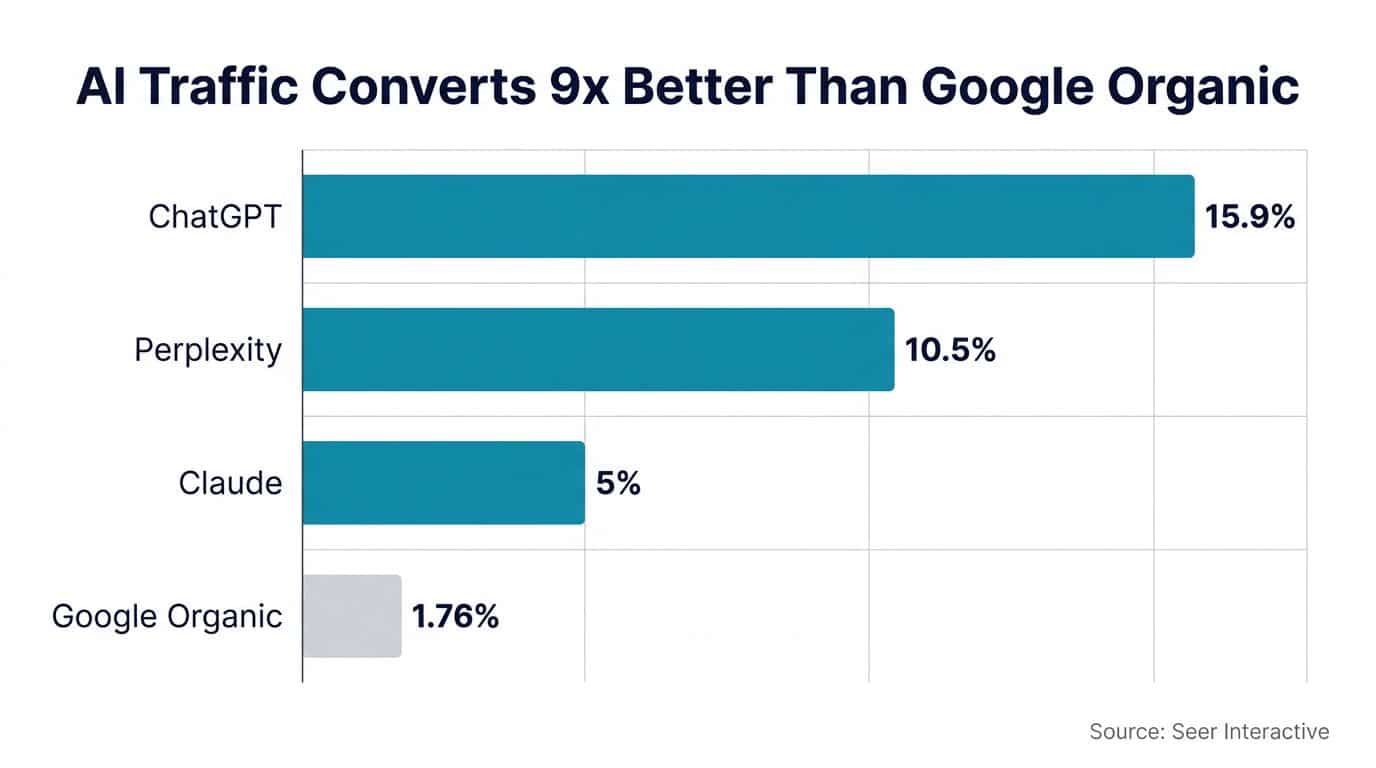
Bar chart comparing ChatGPT 15.9% conversion rate versus Google organic 1.76% for B2B tech companies

There is also a window argument. The LLM citation competition is currently lower in structure than it will be in 2027. Most B2B content teams are still optimizing exclusively for Google rankings. The companies that build LLMSEO content infrastructure now will hold citation positions that become much harder to displace once the channel matures.

How LLMs Actually Select Content to Cite

LLMs select content to cite based on three factors: passage-level clarity, entity authority, and source trust signals. A page that answers a specific question directly in its opening paragraph is significantly more likely to earn a citation. Naming your brand consistently across the web and carrying verifiable authority markers, such as cited data and named authors, compounds that advantage. Understanding these mechanics is the prerequisite for any strategy that works.

LLMs do not rank pages the way Google does. They retrieve passages, short text segments that can stand alone as answers, then synthesize a response from multiple sources. The implication is that passage-level writing matters more than page-level keyword optimization. A 3,000-word post that buries its clearest claim in paragraph 14 will lose a citation to a 900-word post that answers the question directly in paragraph 2.

The data supports this. Approximately 44.2% of all LLM citations come from the first 30% of a page’s content. The practical implication: your most citable claim needs to lead, not build toward.

Modern AI tools do not rely solely on training data. When a user submits a query, most LLMs perform live web retrieval through a process called Retrieval-Augmented Generation (RAG). The model breaks the user’s question into shorter sub-queries, sometimes called fan-out queries, and searches for each one separately. If someone asks ChatGPT, “What is the best content strategy for a B2B SaaS company?”, it may run three separate sub-queries: “B2B SaaS content strategy 2026,” “content marketing for SaaS CEOs,” and “B2B content ROI data.” Your page needs to answer each of these directly, not just the full prompt.
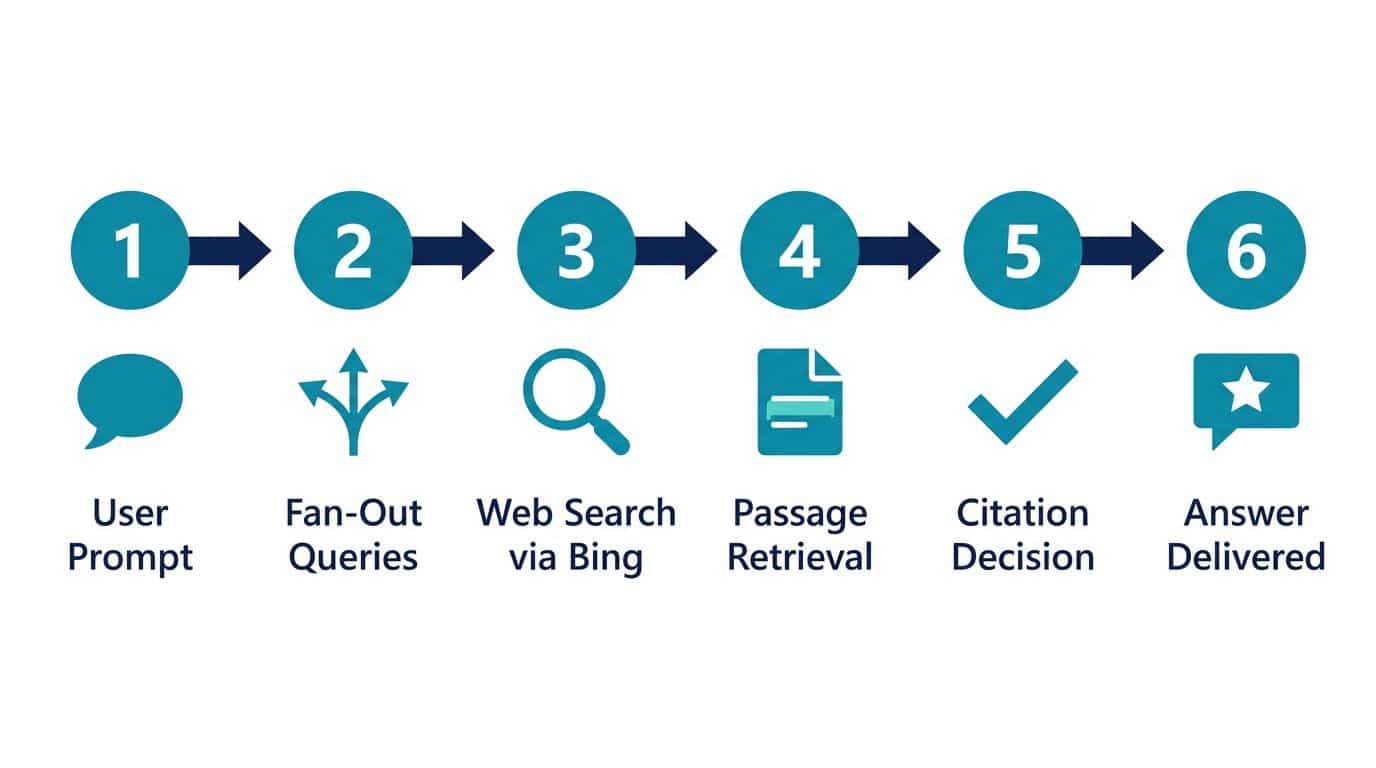
Step-by-step diagram showing how large language models use retrieval-augmented generation to find and cite B2B content

ChatGPT runs live retrieval primarily through Bing. Perplexity uses its own crawler. Google AI Overviews pull from Google’s index. Getting your pages indexed by both Google and Bing is not optional in an LLMSEO program.

LLMs also weigh entity clarity. A brand defined consistently across its site, third-party mentions, directories, and community platforms is easier for a model to resolve. Consistent positioning raises citation probability. Inconsistent positioning, different descriptions on your About page, your LinkedIn company page, and your PR mentions, fragments your entity signal and reduces citation probability.

Finally, LLMs favor sources with verifiable authority signals: external mentions, named experts, cited data, and clear authorship. The E-E-A-T framework that Google uses for quality signals is also how LLMs assess trust. Any approach that skips brand authority is incomplete.

LLMSEO vs SEO vs GEO: Key Differences

LLMSEO, traditional SEO, and GEO are related disciplines with distinct goals. The table below shows the key differences.

Dimension Traditional SEO GEO LLMSEO
Target Search engine rankings Generative AI outputs LLM-based assistants
Optimization unit Page Passage/topic Passage + entity
Success metric Rankings, organic traffic AI mention rate Citation rate, conversion
Key signal Backlinks, keywords Semantic relevance Entity clarity, authority
B2B buyer moment Discovery Research Shortlisting

Traditional SEO targets ranked positions in search engine results pages. Success is measured by organic sessions, rankings, and click-through rate. It optimizes for Google’s crawler and its PageRank-style authority signals. Traditional SEO remains important but is increasingly decoupled from AI visibility. A large majority of LLM citations come from pages that do not rank in Google’s top 100 for the same query. Ranking well does not guarantee LLM citation.

GEO (Generative Engine Optimization) is the broader practice of being referenced across generative AI outputs, including ChatGPT, Perplexity, Google AI Overviews, and Bing Copilot. GEO emphasizes semantic passage retrieval and cross-platform citation rates. Our GEO guide for B2B tech covers the framework in depth.

LLMSEO is the most technically specific term. It focuses on optimizing for LLM-based assistants and their retrieval mechanics, including passage-level writing, entity clarity, llms.txt files, and crawlability by AI-connected crawlers. Where GEO is the strategy, LLMSEO is often the execution layer.

For B2B tech, AI citation and top-10 organic listings overlap in fewer than a quarter of cases, according to SEOProfy’s 2026 AI statistics analysis. More than three-quarters of LLM-cited sources are not traditional top-10 performers. Running SEO and this discipline as parallel tracks is not redundant. They serve different discovery paths in the same buying journey.

Five-step visual framework showing LLMSEO tactics for B2B tech companies to earn AI citations

5 LLMSEO Tactics for B2B Tech Companies

A working LLMSEO program for a B2B tech company comes down to five moves.

1. Write for passage retrieval, not page ranking. Every section of your content should contain a self-contained, 40 to 80-word answer to a specific question. Write as if each paragraph could be extracted and quoted without surrounding context. This is the structural foundation of any LLMSEO program.

2. Front-load your clearest claims. Given that roughly 44% of LLM citations pull from the first third of a page, your most citable content must lead. Open every post with a direct answer to the title question before adding context or nuance. The BLUF (Bottom Line Up Front) paragraph structure is the native opening format for content that earns citations.

3. Build entity clarity across every surface. Your brand description, ICP, category positioning, and key claims need to read the same way on your website, LinkedIn company page, founder bio, podcast guest appearances, and any third-party coverage. LLMs synthesize from multiple sources. Inconsistency across those surfaces creates entity confusion that reduces citation probability.

4. Earn mentions on sources LLMs trust. Digital PR, getting your brand and expert voice cited in authoritative publications, is the off-page component of an LLMSEO strategy. LLMs’ weight consensus. A claim that appears across multiple trusted sources is more likely to surface in a cited answer than one that only lives on your own domain. This is where B2B content distribution strategy intersects directly with LLM visibility.

5. Implement structured data and technical hygiene. LLMSEO requires that AI crawlers be able to read your content. Use the FAQ schema, the Article schema with author markup, and clean heading hierarchies. Confirm your key pages are indexed in Google Search Console and Bing Webmaster Tools. Prefer server-side rendering for content-heavy pages so LLMs that do not execute JavaScript can access your full text. Our AEO Agency guide covers the technical layer in detail for teams implementing this alongside existing SEO.

How to Measure Your LLMSEO Performance

Measuring LLMSEO performance requires four metrics absent from standard dashboards. Track citation frequency across LLM platforms, AI referral traffic in GA4, branded search lift, and AI session penetration by page type. Each metric is accessible today without specialist tooling, using a combination of manual prompt audits and existing analytics filters.

Track citation frequency by querying ChatGPT, Perplexity, Claude, and Gemini with the buyer questions your ICP is most likely to ask. Note whether your brand is named, linked, described correctly, or absent. Do this monthly for a set of 10-15 core queries and track changes over time. This is a manual audit today; dedicated LLMSEO tracking tools are emerging, but not yet standardized.

Monitor AI referral traffic in GA4 by filtering sessions from known LLM-origin referrers: chat.openai.com, perplexity.ai, claude.ai, gemini.google.com. Segment by landing page to identify which content attracts LLM-referred visitors and which page types convert.

Watch the branded search lift. Even in a zero-click environment, LLM citations drive users to search your brand name directly. A rise in branded query volume that correlates with increased AI citation exposure is a measurable downstream signal.

Audit AI penetration by page type. AI sessions focus primarily on industry, tools, and pricing pages. If your pricing and solution pages are not among your most LLMSEO-optimized assets, that is the gap to close first.

Dashboard showing four LLMSEO measurement metrics — citation frequency, AI referral traffic, branded search lift, and AI session penetration

Dedicated LLMSEO tracking tools are emerging. Profound, Conductor, and Semrush’s AI Overviews tracker each offer citation monitoring across multiple LLMs, according to Search Engine Land’s 2026 LLM optimization tracking guide. For teams not ready for dedicated tooling, a spreadsheet of monthly prompt audits across ChatGPT, Perplexity, and Gemini is sufficient. It establishes a baseline and tracks directional progress.

A consistent LinkedIn content program also compounds results over time. LLMs index and weight posts from named experts. Consistent LinkedIn marketing by your founders and subject-matter experts builds the entity authority signals that make LLM citations more likely over time.

5 Common LLMSEO Mistakes B2B Companies Make

1. Optimizing only for Google rankings. The most common LLMSEO mistake is assuming that ranking in Google’s top 10 automatically earns LLM citations. Data shows the two surfaces are largely decoupled. Treating LLMSEO as a byproduct of SEO leaves the majority of the citation opportunity unaddressed.

2. Burying the direct answer. Writing posts that build context for three paragraphs before stating the key claim is the opposite of what LLMs reward. If your clearest sentence is at the bottom of the section, it will not be cited. Front-load the answer.

3. Inconsistent entity definition. A brand that describes itself differently on its homepage, LinkedIn About section, and press releases creates entity confusion for LLMs. Models that cannot confidently resolve what your company does are less likely to recommend it.

4. Ignoring Bing indexing. ChatGPT’s live retrieval runs primarily through Bing, not Google. Most B2B content teams optimize exclusively for Google and have never opened Bing Webmaster Tools. If your key pages are not indexed by Bing, they are invisible to ChatGPT’s live web search.

5. Tracking only traffic, not citations. AI-referred traffic is small in volume but high in intent. Measuring LLMSEO success solely by GA4 sessions overlooks pipeline influence. A CEO who sees your brand named by ChatGPT and then searches your brand name is an LLMSEO success that shows up as a branded search, not as a referral click.

Frequently Asked Questions

What does LLMSEO stand for? LLMSEO stands for Large Language Model Search Engine Optimization. It is the practice of optimizing your content so that LLMs such as ChatGPT, Claude, Gemini, and Perplexity cite your brand in their generated answers. An LLMSEO strategy differs from traditional SEO in that it targets AI citations rather than search engine rankings.

How long does LLMSEO take to produce results? LLMSEO results appear within 60 to 90 days of implementing structural content changes, based on observed citation behavior across B2B content programs. The fastest wins come from front-loading citable answers in existing high-traffic posts and adding FAQ schema. Brand entity clarity across third-party surfaces takes longer, usually three to six months of consistent output.

Does LLMSEO replace traditional SEO? No. An LLMSEO program runs alongside SEO, not instead of it. Traditional SEO still drives the majority of inbound traffic for most B2B sites. LLMSEO captures the AI-assisted research phase of the buying journey, which is increasingly where shortlisting happens. The two disciplines share content quality signals but serve different discovery paths.

Is LLMSEO the same as GEO or AEO? LLMSEO, GEO, and AEO overlap but are not identical. LLMSEO focuses specifically on LLM-based assistants and their technical retrieval mechanics. GEO is the broader category covering all generative AI outputs. AEO focuses on being the direct answer in answer engines, including featured snippets and voice results. In practice, a B2B content program that executes on LLMSEO will cover most of the GEO and AEO requirements simultaneously.

What content type performs best for LLMSEO? Structured guides with question-led headings, self-contained paragraphs, schema-based FAQ sections, and cited data perform best for LLMSEO. Case studies and product comparison content also attract citations on high-intent buying queries. Content that explains a concept clearly, provides a specific number or named outcome, and names the brand consistently throughout outperforms generic listicles that lack entity signals.

Related Resources

Conclusion

LLMSEO is a distinct acquisition and influence channel for funded B2B tech companies in 2026. ChatGPT referrals convert at a rate nine times higher than Google organic. LLM citation competition is lower now than it will be in 12 months. The five moves are executable without having to rebuild your content strategy from scratch: passage-level writing, front-loaded claims, entity clarity, digital PR, and technical hygiene.

The starting point is a simple audit: ask ChatGPT and Perplexity the questions your buyers are asking. If your brand is absent from those answers, the LLMSEO gap becomes visible and can be closed. Building the content infrastructure that earns those citations is what we do at Sproutworth.

Author

  • Vinay Koshy

    Vinay Koshy is the founder of Sproutworth and host of the Predictable B2B Success podcast. He ghostwrites educational email courses, newsletters, and LinkedIn content for funded B2B tech founders at seed through Series C. His work spans nonprofits, SaaS companies, and digital agencies, with a focus on content that builds genuine buyer trust before the sales conversation begins.

    View all posts