
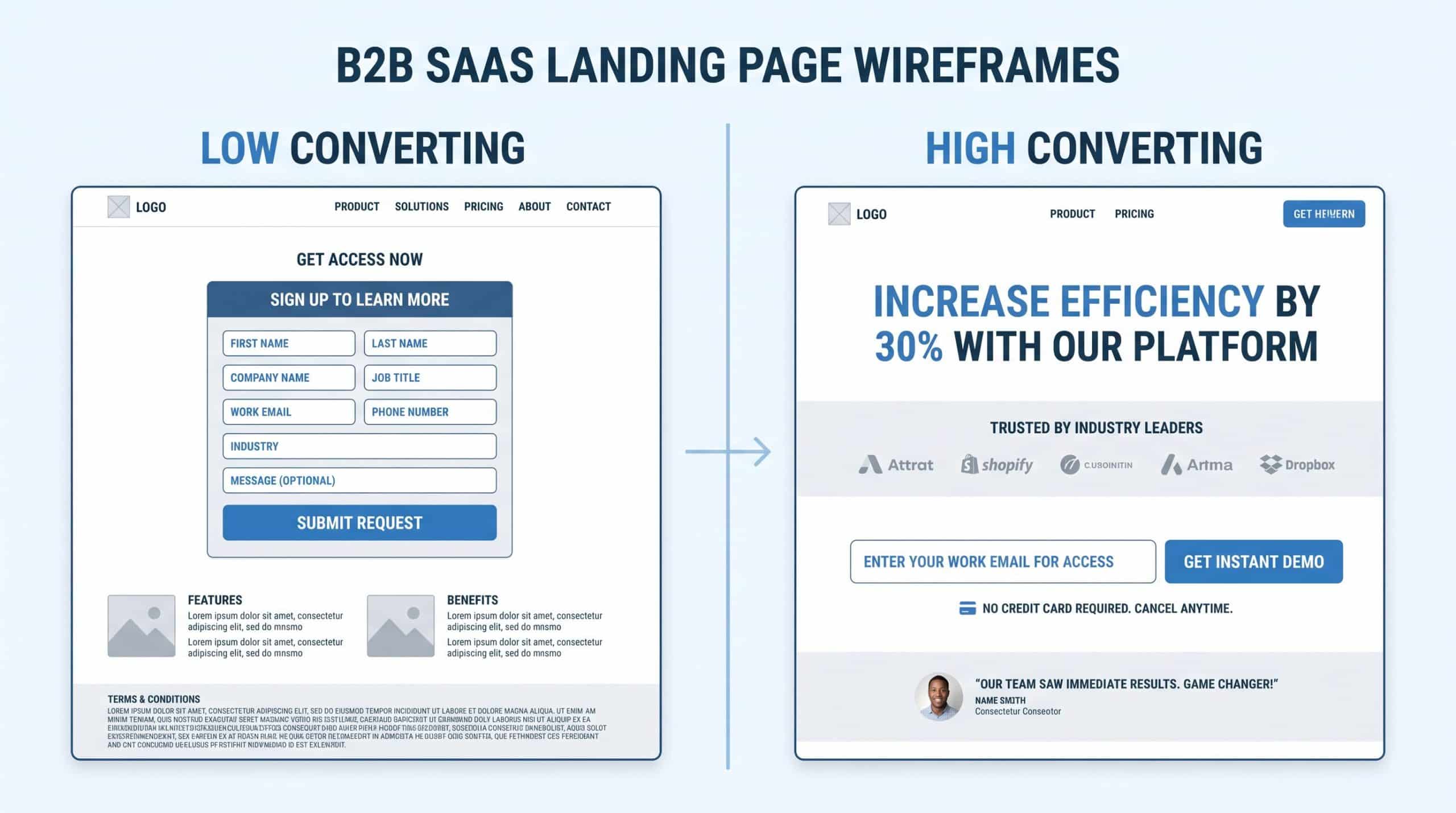
The best B2B landing page examples share three traits that most marketers overlook: they lead with credibility before asking for contact details, they target one outcome per page, and they write headlines that focus on the buyer’s problem rather than the vendor’s product. B2B buyers evaluate multiple vendors simultaneously, carry complex internal approval requirements, and distrust friction-heavy forms. The examples in this guide break down what each page does right, the specific conversion principles at work, and how to apply the same thinking to your own pages.
Quick Answer: What Are the Best B2B Landing Page Examples?
The highest-converting B2B landing pages in 2026 use click-through models for high-value services, place social proof adjacent to the form, limit form fields to five or fewer, and open with headlines that name the buyer’s problem. Top performers hit double-digit conversion rates; the median SaaS landing page converts at 3.8%. The examples below span SaaS, consulting, technology, finance, and professional services, with conversion principles applied to each.
Why B2B Landing Pages Are Different From B2C
B2B landing pages operate under constraints that B2C marketers rarely face. The sales cycle is longer. Multiple stakeholders are involved in purchase decisions. The buyer is often a professional evaluating three to five competing solutions simultaneously. And the cost of a wrong choice is high enough that decision-makers default to caution rather than action.
These constraints create specific requirements for B2B landing page design that differ from B2C best practices in four key ways.
B2B vs B2C Landing Page Differences: B2B pages need to establish authority before asking for commitment, because trust is the primary conversion variable. They need shorter forms, because B2B buyers will abandon longer forms at higher rates than consumer audiences. They need outcome-driven headlines (not feature-driven), because B2B decision-makers evaluate tools based on business impact. And they need social proof that is specific to the buyer’s industry, because peer validation from relevant companies carries far more weight than generic testimonials.
B2B Landing Page Conversion Benchmarks for 2026
Before reviewing the examples, grounding the analysis in current data helps distinguish a good landing page from a merely adequate one.
- The median SaaS landing page converts at 3.8%
- Top-performing B2B pages reach 10% or higher
- Pages with five or fewer form fields convert significantly better than longer forms
- Mobile traffic accounts for 40%+ of B2B research sessions, even for enterprise products
- Click-through page models consistently outperform direct lead-gen forms for high-value B2B services
These figures come from Unbounce’s Conversion Benchmark Report, which tracks conversion data across thousands of B2B campaigns. WordStream’s landing page research further shows that the top 25% of landing pages convert at 5.31% or higher, underscoring the gap between median and top performance.
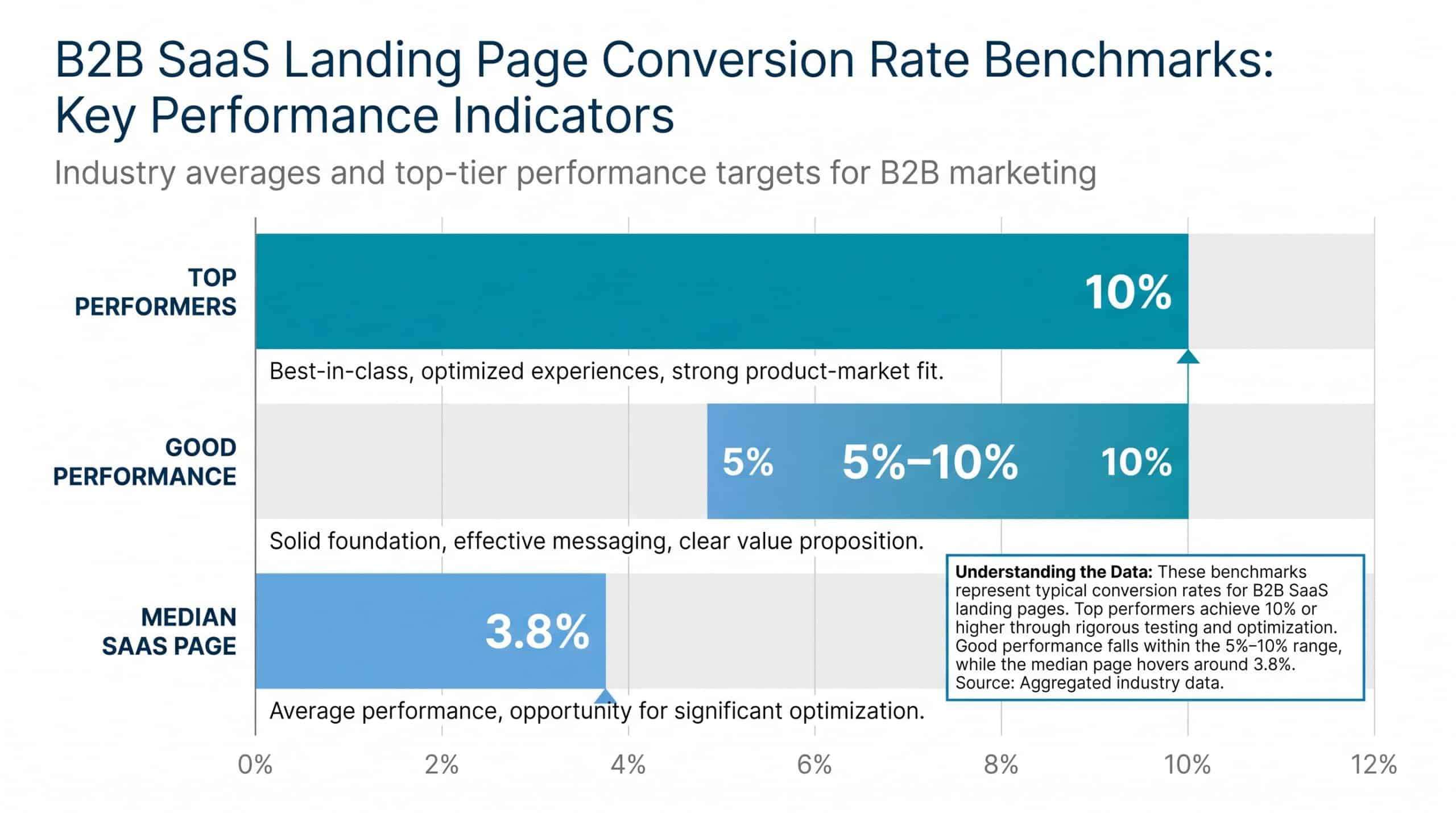
These benchmarks matter because they define what “high-converting” means in B2B. A 5% conversion rate is exceptional for an enterprise SaaS landing page targeting VP-level buyers. A 5% rate for a low-cost SMB tool would suggest significant room for improvement.
15 B2B Landing Page Examples That Drive Conversions
1. HubSpot: The Authority Play
This B2B landing page example from HubSpot’s CRM demonstrates one of the most studied principles in B2B conversion: authority first, form second. Every HubSpot landing page leads with recognizable customer logos from Fortune 500 companies before the visitor encounters any form field. The headline focuses on a specific business outcome (“Grow better with HubSpot”) rather than a product feature. The form itself asks for minimal information at the initial conversion point, with progressive data collection handled through subsequent interactions.
Conversion principle at work: Social proof from recognizable companies reduces perceived risk, which is the primary objection B2B buyers have before sharing contact details. When a decision-maker sees that competitors or aspirational companies use the same tool, it activates peer validation before they’ve read a single feature description.
2. Salesforce: Outcome-Led Headlines
Salesforce B2B landing page examples consistently open with a problem statement, not a product statement. Rather than leading with “Salesforce CRM,” their acquisition pages open with the buyer’s situation: “Sell smarter. Close faster.” This distinction matters more than most marketers realize. When the headline names a business outcome the buyer already wants, it signals that the page understands the buyer’s context, which keeps the visitor reading rather than bouncing to compare options.
Salesforce also uses a tiered trust architecture. Customer logos appear first. Case study metrics (“40% increase in revenue from existing customers”) appear second. Product features appear last. This sequence mirrors the actual decision process a B2B buyer uses: trust first, proof of outcome second, product evaluation third.
3. Slack: Minimal Form, Maximum Conversion
Among the most studied B2B landing page examples, Slack’s acquisition pages demonstrate how form length directly affects conversion rate. The primary landin