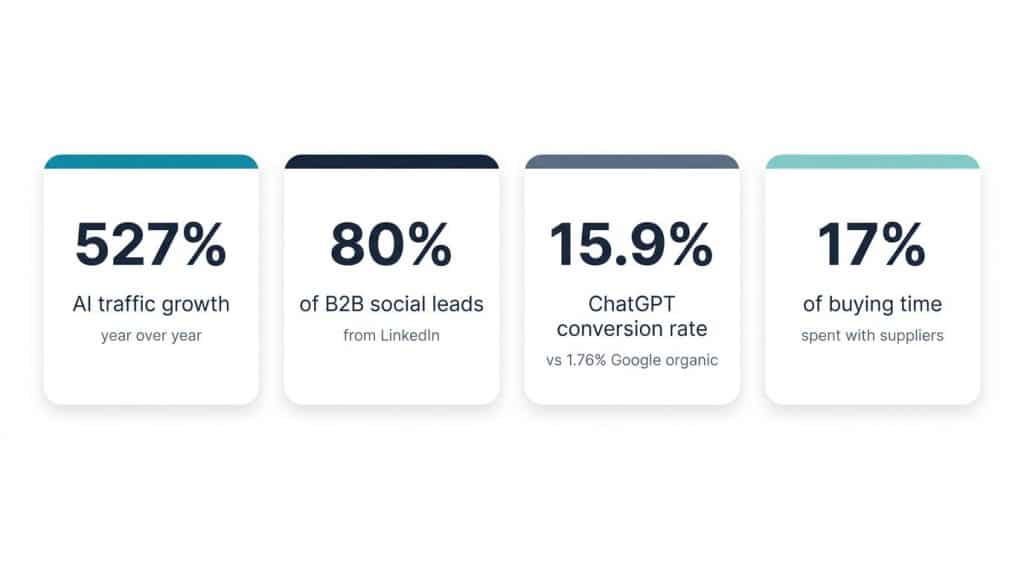
B2B LinkedIn marketing with AI uses artificial intelligence to automate outreach and personalize messaging while analyzing platform performance. AI-referred traffic grew 527% year over year. LinkedIn drives 80% of B2B social leads. For funded B2B tech CEOs, the question is no longer whether to use AI on LinkedIn. It is which tools actually move pipeline without damaging relationships.
Why AI Changes B2B LinkedIn Marketing
Most B2B LinkedIn marketing advice treats the platform as a manual craft. Post three times a week. Send personalized DMs. Engage in comments. Build relationships over months. That advice remains valid as a foundation for any B2B LinkedIn marketing program. But it ignores a shift that has already happened on the other side of the transaction.
Your buyers now use AI to research their purchasing decisions. Seer Interactive found that ChatGPT-referred traffic converts at 15.9%, nearly 9 times Google organic’s 1.76%. Meanwhile, B2B buyers spend only 17% of their total buying time meeting with suppliers, according to Gartner research. The window for getting their attention on LinkedIn is narrower than ever, and the tools available to reach them have evolved faster than most strategies have adapted.
The right approach to B2B LinkedIn marketing with AI does not replace understanding a prospect’s problem or the need to build genuine professional relationships. It makes that work scalable. AI tools handle repetitive tasks like data enrichment, sequence management, and personalization at scale so your B2B LinkedIn marketing team gets more time for strategic work.
A well-implemented B2B LinkedIn marketing program with AI starts by identifying the bottleneck in your current pipeline. If outreach volume is the problem, automation tools provide the fix. If message quality is the issue, AI personalization engines close the gap. If content cadence holds you back, AI writing assistants fill the schedule. Each tool solves one specific constraint in your B2B LinkedIn marketing approach, and the best results come from matching the tool to the constraint.
Tool 1: SalesRobot: AI Outreach That Actually Personalizes
SalesRobot has become the most frequently recommended AI tool for LinkedIn outreach personalization in 2026. Unlike earlier automation tools that sprayed identical connection requests and hoped for replies, SalesRobot uses AI to analyze a prospect’s profile, recent activity, and shared connections before generating a personalized message.
The difference shows in reply rates. Standard LinkedIn automation tools see connection acceptance rates in the 20-30% range. SalesRobot’s AI-personalized approach pushes that toward 50 percent or higher for ICP-targeted campaigns.
For B2B tech CEOs running outreach personally, SalesRobot’s value is time. A seed-stage founder can set up a campaign in 15 minutes that would otherwise take 2 hours of manual profile research and copywriting. The AI handles the personalization variables. The founder reviews and approves. The result is more conversations with fewer hours invested.
A B2B LinkedIn marketing with AI program using SalesRobot typically runs 30 to 50 personalized connection requests per day. At a 50 percent acceptance rate and a 20 percent reply rate on follow-ups, that produces 3 to 5 new conversations daily. Over a month, that is 60 to 100 warm conversations without a single cold email.
Tool 2: Overloop: Multichannel Sequences That Connect LinkedIn to Email
Overloop solves a specific problem in B2B LinkedIn marketing: the single-channel limitation shared by most outreach tools. Most LinkedIn automation tools send connection requests and follow-ups within the platform. But if a prospect ignores LinkedIn for a week, which most executive buyers do, the sequence stalls. Overloop automates B2B LinkedIn marketing across both email and LinkedIn.
Overloop builds sequences that move between LinkedIn and email automatically. A prospect who accepts a connection request but does not reply to the follow-up DM gets an email three days later referencing the LinkedIn interaction. The continuity feels natural because the AI adjusts the messaging based on which channel the prospect most recently engaged with.
For Series A and Series B companies with multiple SDRs, Overloop’s team management adds another layer. Campaigns can be shared across reps with consistent messaging while each rep’s LinkedIn account remains the sending identity. The AI enforces sending limits to avoid flagged accounts while maintaining momentum.
This multichannel approach is where B2B LinkedIn marketing with AI outperforms single-channel manual outreach. A prospect who missed your LinkedIn message might catch the email follow-up. A prospect who ignored the email might engage with a LinkedIn comment. The AI tracks both surfaces and chooses the next touchpoint based on past behavior. For any B2B LinkedIn marketing team managing more than 50 prospects at a time, this orchestration layer alone justifies the investment in the tool.
Tool 3: Apollo.io: Prospecting With AI Data Enrichment
Apollo.io combines a B2B contact database with AI-powered enrichment and multichannel outreach in a single platform. For B2B LinkedIn marketing with AI, this integration matters because it eliminates the data transfer step that slows down most outreach workflows. Apollo pulls LinkedIn profile data directly into contact records, then enriches them with company firmographics, technographic signals, and intent data. A comprehensive B2B LinkedIn marketing with AI stack almost always includes Apollo or a similar enrichment layer.
The AI enrichment layer is what separates Apollo from a traditional contact database. When a prospect changes jobs, gets promoted, or shares content that signals buying intent, Apollo surfaces that change in the outreach queue. A Series A CRO can wake up to a list of five target accounts where the decision maker just engaged with LinkedIn content about the problem their product solves.
This changes the cadence from batch-and-blast to event-triggered outreach. Instead of sending 500 identical InMails to a purchased list on Monday morning, the AI identifies the 15 prospects who just signaled interest and surfaces them for personalized outreach. The same weekly volume yields higher conversion because the timing aligns with buyer readiness. This event-triggered model is the next evolution of B2B LinkedIn marketing with AI, moving from volume-based to signal-based outreach.
In a B2B LinkedIn marketing setup with AI, Apollo serves as the data backbone. It feeds enriched prospect lists into outreach tools. It tracks engagement signals that determine when to reach out. And it syncs results back to the CRM so the sales team sees the full picture of LinkedIn-sourced pipeline activity.
Tool 4: Taplio: AI Content Creation for LinkedIn
Taplio builds AI content creation directly into a LinkedIn-first workflow. For busy B2B tech CEOs, this solves the most common content objection: time. The tool analyzes your past content performance, your ICP’s content consumption patterns, and trending topics in your industry to suggest post ideas and draft complete content.
A CEO using Taplio as part of their B2B LinkedIn marketing AI stack can go from a blank screen to a published post in under 10 minutes. The AI generates a first draft based on a topic prompt, your past voice patterns, and hooks that performed well historically. The CEO edits and publishes. It replaces what used to be a 45-minute writing session with a five-minute review, which is why Taplio appears in nearly every B2B LinkedIn marketing with AI stack that includes content creation.
Taplio’s analytics also tie content performance to profile activity. CEOs can see whether publishing a specific post type increased profile views, connection requests, or inbound DMs. This data loop turns LinkedIn content from an amorphous brand-building activity into a measurable pipeline input.
There is one rule that applies to any B2B LinkedIn marketing approach using AI for content: the CEO must edit every post before publishing. Taplio generates drafts that are structurally sound but lack the specific lived experience that builds trust. The founder’s edit adds the real story, the specific number, the honest take that makes content worth reading. The best B2B LinkedIn marketing with AI setups use Taplio for the first draft and human judgment for the final version.
How to Choose Your AI Stack by Stage
Seed-stage founders should start with one tool for their B2B LinkedIn marketing with AI stack. Pick either SalesRobot for outreach or Taplio for content. The goal at seed is signal and learning, not pipeline volume. A single AI tool that saves five hours per week while the founder learns what messaging resonates is the right investment.
Series A companies need two or three tools for their B2B LinkedIn marketing with an AI stack. Add Apollo.io for prospecting and enrichment alongside either SalesRobot or Overloop for sequences. At this stage, the goal is proving a repeatable acquisition motion. The data from Apollo feeds the targeting. The sequence tool executes the outreach. Series A teams that get B2B LinkedIn marketing with AI right at this stage set the foundation for scalable pipeline generation.
Series B companies can run a full stack. Apollo for data. Overloop or LaGrowthMachine for multichannel sequences. Taplio for content. Expandi for safe automation at scale. At this stage, LinkedIn is a category-narrative channel supporting enterprise deals. The full stack lets the marketing team focus on strategy while the tools execute the tactical layer.
A stage-appropriate B2B LinkedIn marketing strategy with AI prevents the most common mistake: overinvesting in automation before the messaging is proven. Seed founders who buy a full five-tool stack before they know their ICP waste money and burn accounts. Tool adoption should follow signal, not precede it.

| Tool | Outreach | Content | Data | Best Stage | Starting Price |
|---|---|---|---|---|---|
| SalesRobot | AI personalization | No | No | Seed / Series A | ~$50/mo |
| Overloop | Multichannel sequences | No | No | Series A / B | ~$80/mo |
| Apollo.io | Sequences + sync | No | AI enrichment + intent | Series A / B | ~$50/mo |
| Taplio | No | AI drafting + analytics | Content performance | Seed / Series A | ~$40/mo |
This comparison shows why choosing a B2B LinkedIn marketing tool starts with identifying your primary channel need. A seed-stage founder who needs content cadence picks Taplio. A Series A CRO who needs pipeline velocity picks SalesRobot or Overloop. A Series B marketing team that needs data enrichment picks Apollo.io as the backbone.
How the 2026 Algorithm Changes Affect AI Tool Use
LinkedIn’s 2026 algorithm update shifted the rules that matter for B2B LinkedIn marketing with AI. Conversational posts between 1,300 and 3,000 characters now perform 38% better than shorter updates. The old link penalty is gone: including 3 or more useful links in a post body boosts performance by 236%. But hashtag stuffing is penalized: more than 3 hashtags drops reach, so stick to 1 or 2 highly relevant tags placed early in the post.
These changes directly affect which AI tools deliver results. Taplio drafts posts at the right length. SalesRobot and Overloop sequences must avoid automated comment spam, which the algorithm now penalizes aggressively. Apollo.io’s intent signals become more valuable because the algorithm rewards relevance over volume. Any B2B LinkedIn marketing with AI program that ignores these 2026 algorithm signals will underperform regardless of tool quality.

For example, an overloop sequence that sends 50 automated connection requests per day with generic messaging will see its acceptance rate decline as LinkedIn’s algorithm detects the pattern. A SalesRobot campaign that personalizes each request using AI profile analysis stays within the algorithm’s quality thresholds and maintains steady acceptance rates. The same tool used differently produces completely different results. Understanding how LinkedIn’s algorithm evaluates activity matters more than which tool you choose.
Where Human Strategy Still Beats AI

AI tools for B2B LinkedIn marketing consistently fail in three places, even as the technology improves. Understanding these limits is essential before you commit to any tool stack, because the most expensive mistake a funded startup makes is automating a broken strategy rather than fixing the fundamentals first. Here are the three gaps no AI tool on the market has closed in 2026.

First, AI cannot build genuine relationships. An AI can send a personalized connection request referencing a prospect’s recent post. It cannot have a 20-minute conversation about the prospect’s business challenges, remember the details six months later, and bring up a relevant case study unprompted. That human memory and judgment are what convert a LinkedIn connection into a pipeline opportunity and why no B2B LinkedIn marketing with AI effort succeeds without human relationship skills.
Second, AI cannot read a room. Automated sequences lack the context awareness to slow down when a prospect engages deeply, or speed up when a window closes. A human sales leader senses when a prospect is three conversations away from a close, not three months from ready. AI still misses that signal, which is why the most effective B2B LinkedIn marketing with AI programs keeps a human in the loop for every significant conversation.
Third, AI-generated content lacks the specific lived experience that builds trust. A post about three ways to personalize LinkedIn outreach written by an AI trained on generic B2B content reads differently than a post from a founder describing the exact moment a personalized message turned a cold prospect into a closed deal. The specific detail, the real story, is what earns engagement and replies.
The winning approach in 2026 is not fully automated LinkedIn marketing. It is B2B LinkedIn marketing with AI augmentation where the tools handle the rote work and the human handles the relationship work. The companies that invest in B2B LinkedIn marketing with AI as a human-AI partnership, not a replacement, will see the strongest pipeline results.
Frequently Asked Questions
Is AI-powered LinkedIn outreach against LinkedIn’s terms?
LinkedIn restricts automated activity that simulates human behavior. Most reputable AI tools for B2B LinkedIn marketing operate within these limits by enforcing send caps, requiring human review before sends, and using individual accounts rather than bot profiles. Always audit a tool’s compliance approach before committing to a contract.
How much do AI LinkedIn tools cost for a B2B startup?
Individual tools range from $30 to $100 per month per user for core features. Full-stack setups covering data enrichment, outreach sequences, and content creation run $200 to $500 per month for a single user at Series A stage. At Series B, with multiple seats and advanced features, budgets of $1,000 to $3,000 per month are common.
Can AI tools replace a LinkedIn ghostwriter or content strategist?
No. AI content tools generate first drafts and suggest topics. They do not produce the strategic positioning, category insight, or authentic voice that makes a CEO’s LinkedIn presence compelling. Most B2B tech companies using AI content tools pair them with a human strategist who selects the angles, edits the drafts, and ensures the content reflects real expertise. For B2B LinkedIn marketing with AI, the best results come from the tool and human working together, not the tool replacing the human. This human-strategist model is what separates high-performing B2B LinkedIn marketing programs from average ones.
Which tool should I start with as a first-time user?
Start with the channel where you feel the most time pressure. If you are spending two hours per day on manual outreach, begin with SalesRobot or Overloop. If you know you should be posting content but never find the time, start with Taplio. Adding a second tool after the first one, once it becomes routine, keeps the learning curve manageable.
How do you measure whether AI LinkedIn tools are working for B2B LinkedIn marketing?
Track three metrics: connection acceptance rate, reply rate on follow-up messages, and number of qualified conversations started per month. Before adding AI tools, establish a baseline for each metric over 30 days. After implementation, compare monthly. If none of the three metrics improve within 60 days, the tool is not solving the right problem.
Build a LinkedIn Stack That Matches Your Stage
AI tools for B2B LinkedIn marketing are not a replacement for strategy. They are a force multiplier for strategy that already works. Seed-stage founders should pick one tool and learn how LinkedIn outreach works before scaling their B2B LinkedIn marketing effort. Series A companies should build a two- or three-tool stack that proves repeatability. Series B organizations should invest in the full stack while keeping human judgment at the center of every relationship.
The companies that win on LinkedIn in 2026 will not be the ones with the most sophisticated automation. They will be the ones that use AI to free up their best people to have better conversations with the right buyers.
For a complete B2B LinkedIn marketing strategy covering tactical fundamentals before adding AI, read the guide to B2B LinkedIn marketing strategy. For founder personal presence, the LinkedIn content strategy for B2B founders guide covers stage-specific content planning. The multichannel cold outreach playbook covers the LinkedIn and email integration that Overloop automates.
Related Resources
- B2B LinkedIn Marketing Strategy: 9 Tactics for Qualified Pipeline – Our comprehensive guide to LinkedIn fundamentals before adding AI tools
- LinkedIn Content Strategy for B2B Founders: 2026 Guide – Stage-specific content planning for funded startup founders
- Multichannel Cold Outreach: How LinkedIn + Email Gets 50% More B2B Replies – The outreach playbook Overloop automates
- AI Tools for B2B Marketing: 10 That Actually Move Pipeline – Broader AI tool ecosystem beyond just LinkedIn
References
[1] Semrush, “AI SEO Statistics: How AI Search Is Changing SEO,” 2025. https://www.semrush.com/blog/ai-seo-statistics/ [2] Dux-Soup, “B2B Lead Generation Report 2025.” https://www.dux-soup.com/blog/b2b-lead-generation-report-2025 [3] Seer Interactive, “6 Learnings About How Traffic From ChatGPT Converts,” 2025. https://www.seerinteractive.com/insights/case-study-6-learnings-about-how-traffic-from-chatgpt-converts [4] Gartner, “The New B2B Buying Journey.” https://growthmethod.com/gartner-b2b-buying-journey/ [5] SBL.so, “Best LinkedIn Automation Tools for B2B Sales in 2026.” https://sbl.so/linkedin/best-linkedin-automation-tools-b2b-sales/ [6] Overloop, “8 Best AI LinkedIn Outreach Tools,” 2026. https://overloop.com/blog/8-best-ai-linkedin-outreach-tools [7] LinkedIn Marketing Solutions, “B2B Marketing on LinkedIn.” https://business.linkedin.com/marketing