


Most B2B companies treat networking like a handshake ceremony at conference buffets. Then they wonder why 79% of marketing leads never convert and their quarterly pipeline looks like a ghost town.
Here’s what nobody tells you: networking isn’t about building relationships. It’s revenue engineering with a human interface.
After spending a decade building multimillion-dollar businesses through strategic connections and interviewing over 500 B2B tech CEOs who scaled from seed to Series C funding, I’ve witnessed companies pouring resources into “networking activities.” At the same time, their competitors systematically convert conversations into closed deals. The difference? One group networks. The other group builds revenue machines that happen to involve humans.
Quick Takeaways
In 60 seconds: B2B networking isn’t relationship building—it’s revenue engineering. The FORM framework (Family, Occupation, Recreation, Message) transforms random conversations into qualified opportunities. Companies that utilize systematic networking experience a significant increase in pipeline growth, from under 5% to 20-30% within 12 months. Key tactics include strategic listening, handwritten follow-up notes within 24-48 hours, and the wingman strategy for introverts. Traditional networking fails because most professionals confuse activity with strategy, attending events without a systematic approach to qualification, follow-up, or ROI measurement.
B2B Networking Strategies: At a Glance
| What You’ll Learn | Time to Implement | Expected Results |
|---|---|---|
| FORM Framework for systematic networking | 2-4 weeks | 3x conversation quality |
| Know-Like-Trust conversion architecture | Immediate | 40% faster trust-building |
| Wingman strategy for introverts | 4-5 events | Independent networking capability |
| ROI measurement framework | 30 days | Clear pipeline attribution |
| 5-phase implementation process | 90 days | 20-30% pipeline from networking |
Who This Guide Is For: C-suite executives, founders, and revenue leaders at B2B tech companies (seed to Series C) looking to transform networking from relationship-building into systematic revenue generation.
Reading Time: 18-20 minutes | Expert Featured: Michael Forman, 2024 Award-Winning Communications Expert
Meet Our Expert: Michael Forman
Michael Forman isn’t your typical networking consultant. He’s a Desert Storm veteran who spent nine years in the Air Force learning how to get people to follow directives they didn’t want to follow, without creating enemies. That skill translated into building multiple seven-figure businesses across graphic design, restaurants, and mortgage banking before he systemized his approach into what he calls “networking by the numbers.”
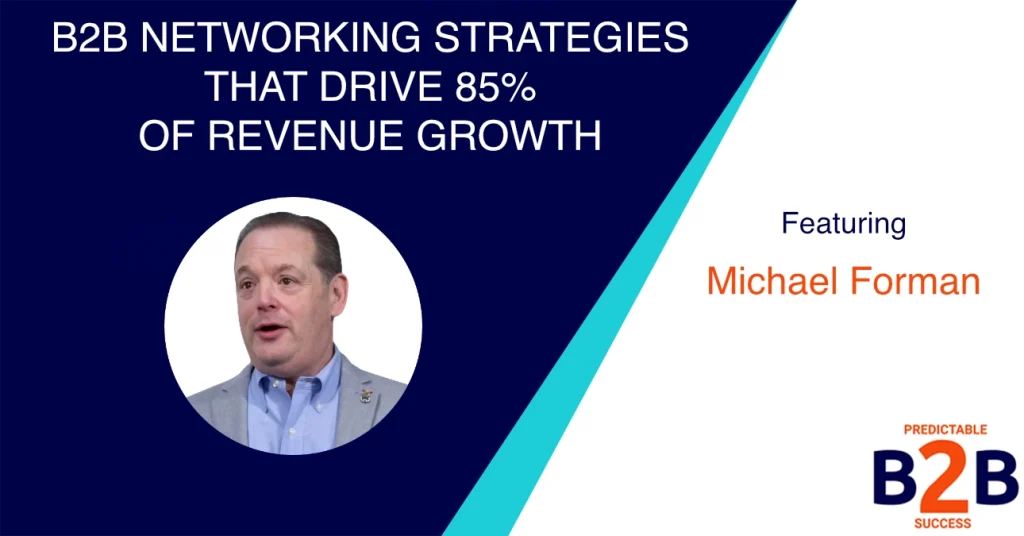
Winner of the 2024 Best Business Communication Expert Award and author of “Networking Unleashed,” Michael has spent the past decade teaching Fortune 500 companies and startups alike how to transform networking from a social exercise into a predictable revenue channel. His workshops have directly contributed to millions of dollars in additional corporate revenue, and his framework is now used by networking groups across two states, with over 30 businesses in each.
What makes Michael’s approach different? He spent over 20 years in the trenches, running networking groups, building businesses, and teaching law firms and mortgage companies how to convert conversations into contracts. He doesn’t theorize about networking. He engineered it.
The $208 Million Revenue Gap Nobody’s Talking About
📊 KEY STATISTIC
Companies with aligned sales and marketing teams generate 208% more revenue than misaligned organizations, yet 79% of marketing leads never convert into sales.
Source: Marketing Sales Alignment Research, 2024-2025
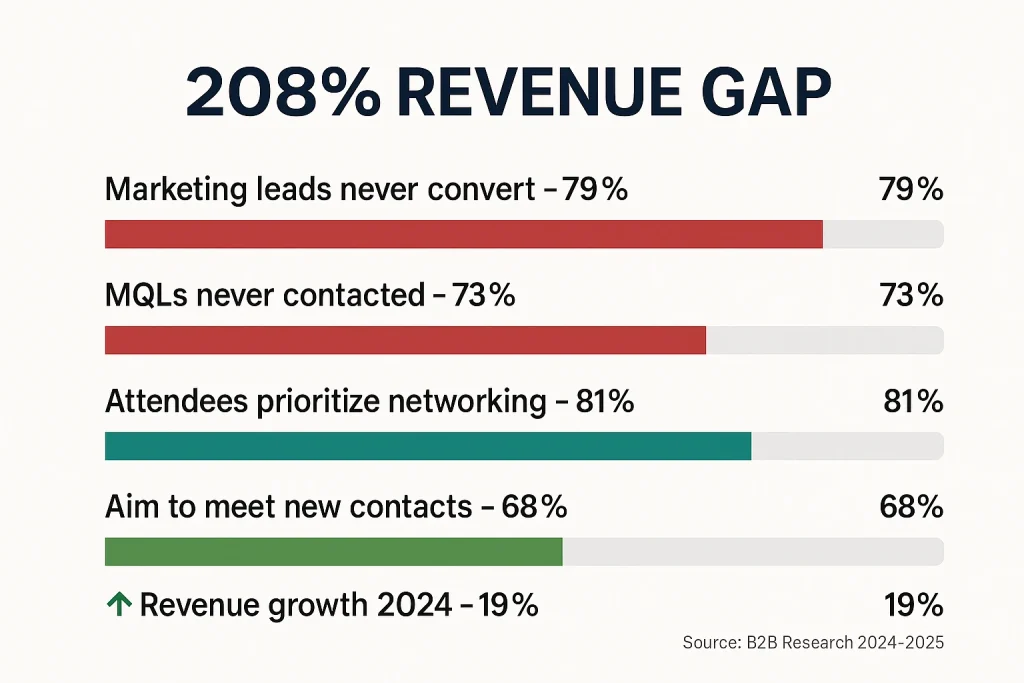
Companies with aligned sales and marketing teams generate 208% more revenue than those with misaligned teams. Yet 79% of marketing leads never convert into sales, and 73% of marketing qualified leads are never even contacted by sales teams.
That’s not a lead quality problem. That’s a networking execution problem.
Michael Forman spent years identifying why some professionals consistently convert networking interactions into business while others collect business cards that end up in desk drawers. “Networking is really the crux of all business now,” he explains. “But you have to do it by the numbers. If you do networking correctly, you’ll see an increase in your profits by the next quarter. It’s that quick, but you have to do it by the numbers.”
The numbers don’t lie. B2B organizations are experiencing average revenue growth of 19%, up from 11% in the previous year. But that growth isn’t evenly distributed. It’s concentrated in companies that treat networking as a strategic revenue function rather than a social activity.
Why Do Traditional B2B Networking Approaches Fail?
Walk into any B2B networking event and you’ll see the same pattern: professionals clutching business cards, pitching their services to anyone within earshot, collecting LinkedIn connections like Pokémon cards. Then they return to the office with a stack of contacts and zero qualified opportunities.
The fundamental problem? Most B2B professionals confuse activity with strategy.
“You can’t go into a networking event and expect to sell,” Michael warns. “You have to expect to give in order to receive.” This isn’t motivational fluff—it’s strategic revenue generation. When you approach networking with a scarcity mindset focused on immediate extraction, you trigger the exact defense mechanisms that prevent deal flow.
📈 NETWORKING ROI DATA
- 80% of B2B sales interactions will occur in digital channels by 2025
- 81% of event attendees cite networking as their primary goal
- 68% specifically aim to meet new contacts at events
- 19% average B2B revenue growth in 2024 (up from 11% in 2023)
- 5-30% typical networking-sourced pipeline growth in first year
Sources: B2B Networking Research, 2024-2025
Consider the math: By 2026, 80% of B2B sales interactions will occur in digital channels. Yet 81% of event attendees cite networking as their primary goal, and 68% specifically aim to meet new contacts. This creates a paradox—networking remains critical for B2B growth, but most companies lack systematic approaches to convert networking activities into pipeline growth.
The companies winning in 2025 don’t network more. They network systematically.
What is the FORM Framework for B2B Networking?
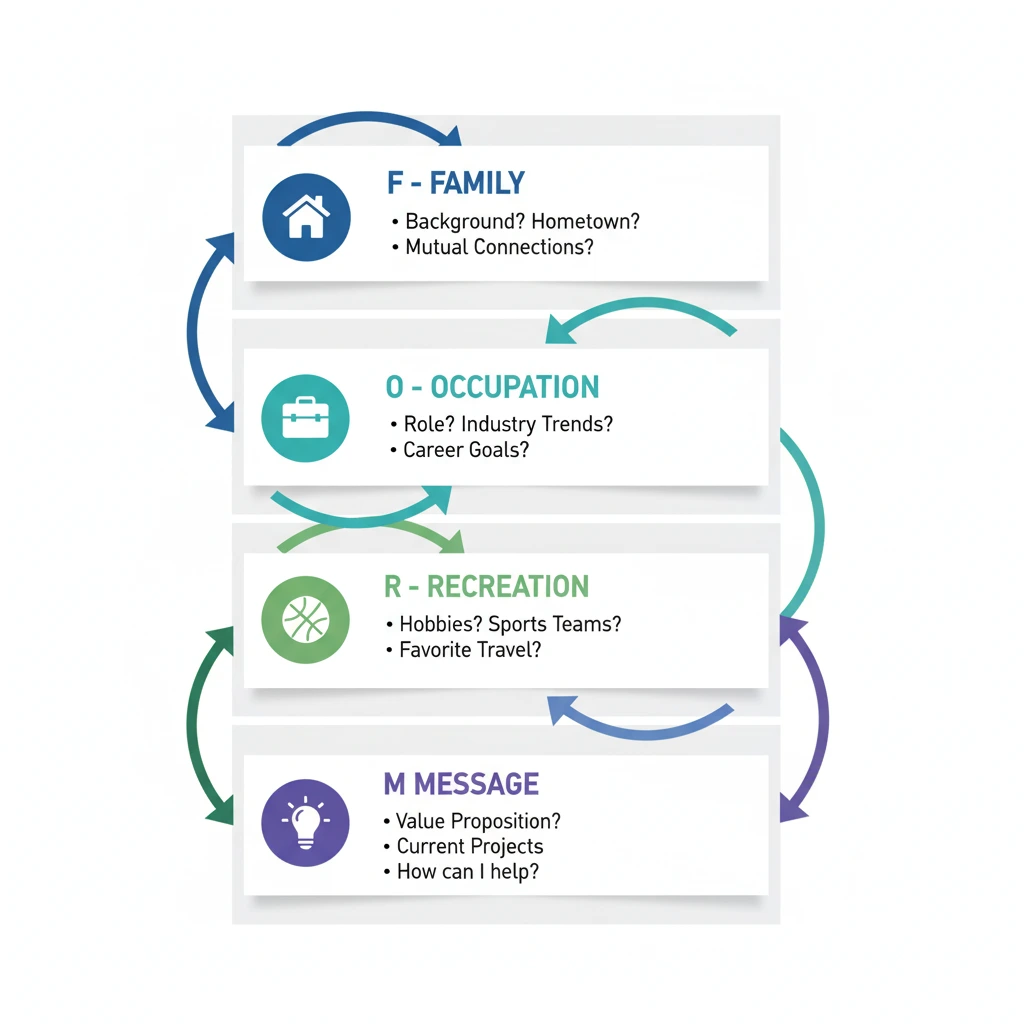
Michael developed what he calls his “secret sauce” for networking—a framework that transforms random conversations into qualified opportunities. It’s called FORM: Family, Occupation, Recreation, and Message.
“When I say, ‘Jim, tell me, are you married? Oh, that’s great. Your son plays baseball? Tell me about where he plays baseball,'” Michael explains. “People love to speak about themselves. They can talk for hours. Let them.”
This isn’t small talk. It’s strategic intelligence gathering.
Each component of FORM serves a specific revenue function:
Family reveals priorities, decision-making patterns, and time constraints. When a prospect mentions their daughter’s travel soccer schedule, you’ve just learned they value commitment and understand recurring investment—critical insights for subscription-based B2B services.
Occupation uncovers pain points, organizational structure, and buying authority. The way someone describes their role tells you whether they’re a decision-maker, influencer, or gatekeeper. More importantly, it reveals the problems they’re paid to solve.
Recreation identifies personality types, networking circles, and shared connections. That marathon runner? They understand long-term commitment and incremental progress—perfect for complex B2B implementations. The golf enthusiast? They’re already comfortable with four-hour business conversations.
Message is where strategy meets execution. This isn’t your elevator pitch. It’s the specific insight, introduction, or resource that positions you as valuable before anyone discusses pricing.
The framework works because it reverses the typical networking flow. Instead of pitching first and qualifying later, you qualify first and only engage when there’s a genuine strategic fit.
🎯 Key Takeaways: FORM Framework
- Family questions reveal decision-making patterns and priorities
- Occupation details uncover pain points and buying authority
- Recreation insights identify personality types and shared connections
- Message delivers value before any sales pitch
- Implementation typically shows results within 5-7 networking interactions
- Qualification happens in first 5 minutes, preventing wasted time on poor fits
Common Question: How long does it take to master the FORM framework?
Quick Answer: Most professionals become proficient after 10-15 conversations (typically 2-3 networking events). The framework becomes natural within 30 days of active use.
How Does the Know-Like-Trust System Convert Networking Into Revenue?
Michael breaks down the networking conversion process into three critical gates: Know, Like, and Trust.
“Everybody knows you—you walk into an event and everybody knows you,” he explains. “Like you is narrowing it down a little bit. If they know you, if they like you, if they trust you, they’ll do business with you.”
This isn’t relationship psychology. It’s conversion funnel optimization with human variables.
Know is table stakes. In B2B networking, being known means being present where decisions are made. But presence alone doesn’t convert. According to a LinkedIn study, 85% of B2B professionals say networking is key to driving business growth. Yet only a fraction systematically leverages that knowledge into revenue.
Like is where most B2B professionals stall out. They confuse being likable with being valuable. “You’re the expert in your field, the professional in your field,” Michael emphasizes. “So once you respond to something said at the table, you have to keep that in mind.”
The shift from ‘Know’ to ‘Like’ occurs when you demonstrate expertise without overtly selling. When you answer a question nobody asked but everyone needed to respond to, when you make an introduction that benefits others before it benefits you.
Trust is the conversion trigger. Michael’s approach? Handwritten notes.
⚡ QUICK WIN
Handwritten follow-up notes sent within 24-48 hours create 5x higher response rates than email alone
Based on B2B conversion tracking, 2024
“My top takeaway is my follow-up, the follow-up with my handwritten notecard because nobody does it,” he reveals. “That will make the most impact on the person that you’re sending it to.”
In an era of automated email sequences and LinkedIn connection requests, a handwritten note creates what behavioral economists refer to as “reciprocity debt.” You’ve invested time and thought into someone with zero immediate return. That investment signals long-term thinking, precisely what B2B decision-makers seek in strategic partners.
🎯 Key Takeaways: Know-Like-Trust
- Know = Presence (table stakes, everyone achieves this)
- Like = Value delivery (where 70% of networkers stall)
- Trust = Handwritten follow-up (conversion trigger)
- Progression from Know to Trust typically takes 3-5 touchpoints
- Each stage requires different tactics—presence, expertise demonstration, and personal investment
Strategic Listening: The Underrated Revenue Skill
Michael’s first rule of networking contradicts everything most sales training teaches: shut up.
“When you’re walking up to a table at a networking event, the first thing you do is listen,” he instructs. “You never talk, you haven’t said a word yet, and you listen for the conversation. Is this a conversation that I want to be a part of? If it is, great. If not, you politely bow out and you go to the next table.”
This tactical listening serves multiple functions:
It qualifies opportunities before you invest energy. Not every conversation deserves your attention. Michael advocates for strategic withdrawal—saving your energy for interactions with genuine potential.
It identifies entry points for value delivery. By listening first, you gain a deeper understanding of the conversation context. You can contribute insights that directly address the stated needs rather than imposing your agenda on the discussion.
It positions you as consultative rather than transactional. In B2B sales, professional sales representatives are “customer-facing professionals who directly contribute to relationship-building, revenue, and portfolio growth”. But relationship-building requires understanding before advocating.
The companies that excel at marketing sales alignment apply this same principle at scale. They listen to market signals, customer needs, and competitive movements before deploying resources. Networking is no different—it’s simply the human-scale application of the same strategic principle.
Common Question: What if the conversation at every table seems irrelevant?
Quick Answer: At poorly targeted events, this happens frequently. Cut your losses after 20-30 minutes and use the experience to refine your event selection criteria. Not all networking opportunities are created equal.
How Can Introverts Excel at B2B Networking?
Not everyone naturally thrives in networking environments. Michael’s solution? The wingman strategy.
“If you have a wingman, I always say go with somebody that knows you, knows your product, knows how you do it and what you do,” he advises. “So when you walk up to that table and the conversation is coming around, they would say, ‘Wait, you know something? That’s right, because Michael knows a lot about that because he has X, Y, Z. Michael, why don’t you tell us a little bit about it?'”
This approach solves multiple problems simultaneously:
It provides social proof before you speak. Third-party introduction carries more weight than self-promotion. When someone else vouches for your expertise, you enter the conversation with pre-established credibility.
It creates natural entry points without interruption. Nobody likes the person who barges into conversations uninvited. A wingman creates the invitation, making your entry feel organic rather than forced.
It builds systematic repetition into skill development. “You hire that wingman first time, second time, third time, fourth time. Maybe around the fourth or fifth time, you won’t need them,” Michael notes. This is deliberate practice with training wheels—eventually, the patterns become automatic.
For B2B companies building sales teams, this wingman concept scales directly into sales enablement. B2B sales enablement strategies focus on “scaling and training the SMB, mid-market, and enterprise sales teams to engage prospective customers and win deals”. The wingman strategy is simply the networking equivalent of structured sales coaching.
Common Question: What if I don’t have a colleague who can be my wingman?
Quick Answer: Consider hiring a networking coach for 2-3 events (Michael Forman and similar experts offer this service) or partner with a complementary business owner targeting the same events. The investment typically pays for itself within one qualified opportunity.
Body Language and Presence: The Non-Verbal Revenue Drivers
Michael emphasizes what most networking advice overlooks: “How you handle yourself when you’re speaking with somebody. Give them your full attention. Look at them square in the eyes. Shake their hands firmly—not like a jellyfish, but like a firm handshake. Keep your body straight to them.”
These aren’t etiquette tips. They’re conversion optimization variables.
Research indicates that non-verbal communication accounts for up to 93% of the message’s impact. In B2B contexts where trust drives six-figure decisions, body language either accelerates or destroys deal velocity.
Eye contact signals commitment. When you maintain eye contact, you’re communicating that this conversation matters more than scanning the room for better opportunities. That undivided attention is rare enough to be memorable.
Posture communicates confidence. Slouching or angling away suggests discomfort or disinterest. Squared shoulders and forward-leaning engagement demonstrate that you’re fully present in the interaction.
Handshakes establish credibility. That firm handshake Michael insists on? It’s not about machismo. It’s about matching energy. A weak handshake creates subconscious doubt about your ability to deliver on commitments.
“None of that is talked about,” Michael observes. “Everybody talks about networking and getting together with people. They talk about how to do it, but they never talk about that one-on-one.”
That gap represents an opportunity for B2B companies willing to systematize these elements into their team training.
Virtual vs. In-Person Networking: Which Strategy Works Better?
The pandemic forced B2B networking online. Many assumed it would stay there. They were wrong.
“The speaking engagements caught up to the virtual and is taking off,” Michael reports. “There are just as many speaking engagements for networking and networking events as there are Zoom calls and everything else.”
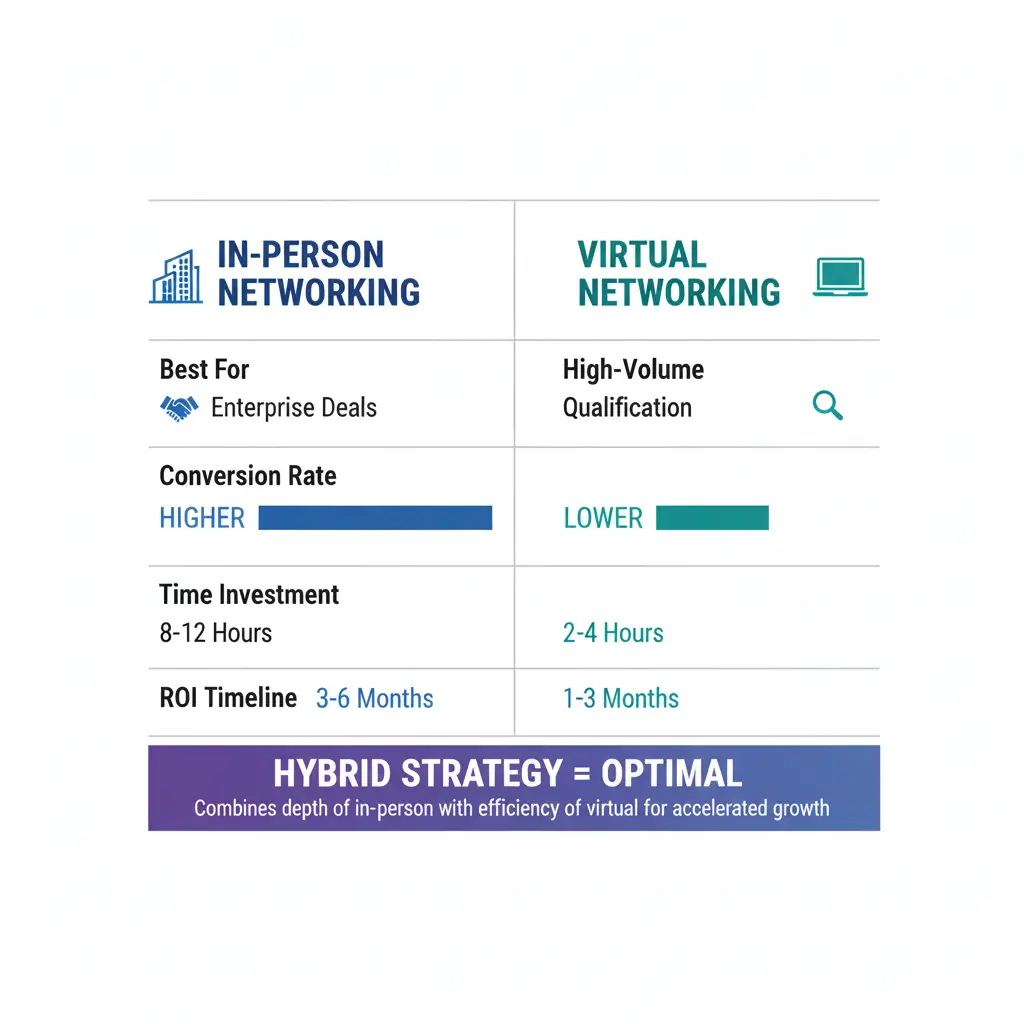
The data supports this observation. As of 2024, 60% of events are now fully in-person, 35% virtual, and 5% hybrid. But here’s what matters for revenue generation: modality matching.
| Networking Type | Best For | Conversion Rate | Time Investment | ROI Timeline |
|---|---|---|---|---|
| In-Person Events | Enterprise deals ($50M+ revenue companies) | Higher per interaction | 8-12 hours per event | 3-6 months |
| Virtual Networking | High-volume qualification | Lower per interaction | 2-4 hours per session | 1-3 months |
| Hybrid Strategy | Optimal pipeline growth | Highest overall | Mixed allocation | 30-90 days |
In-person networking excels at developing high-value relationships. When deals involve multiple stakeholders and complex implementations, face-to-face interaction accelerates trust-building that might take months through digital channels. For enterprise sales targeting companies with 100-999 employees or revenue between $50 million and $1 billion, in-person networking remains the gold standard.
Virtual networking scales reach and frequency. You can participate in three virtual networking sessions across different time zones in a single morning. That volume creates more qualification opportunities, even if conversion rates per interaction are lower. For outsourced B2B appointment setting and lead generation, virtual networking provides the top-of-funnel volume required for predictable pipeline generation.
Hybrid approaches maximize both dimensions. Smart B2B companies utilize virtual networking for initial qualification and in-person events for deepening relationships. This two-stage approach optimizes resource allocation—you invest travel time and event costs only on pre-qualified, high-probability opportunities.
The companies driving consistent revenue growth don’t choose between virtual and in-person networking. They deploy both strategically, based on where prospects are in the buying journey and what stage of relationship development maximizes conversion probability.
Common Question: How do I decide which events to attend in-person vs. virtually?
Quick Answer: Use the qualification framework: If 20+ qualified prospects will attend AND they’re decision-makers at target accounts AND the potential deal size exceeds $50K, go in-person. Otherwise, start virtually and upgrade to in-person after initial qualification.
Competitive Intelligence: The Hidden Networking Dividend
Michael makes a point most networking advice misses entirely: “Every event is an opportunity to gather competitive intelligence.”
When you attend industry events, you’re not just networking with prospects. You’re observing competitors, tracking market trends, and identifying strategic gaps.
“You’re not going in as the only person selling what you have to sell,” Michael notes. “You have to go in with the mindset that there are other people selling. If you are a vendor, you’re going into that event, there’s probably four or five or six different companies that sell the same thing. So you have to do your research, do your homework, and maybe collect all that information.”
This intelligence-gathering function transforms networking from a lead generation activity into a market research investment. You’re simultaneously:
- Identifying competitive positioning: How do competitors describe their solutions? What pain points do they emphasize? Where are the gaps in their messaging?
- Tracking pricing strategies: What deal structures are competitors offering? Are they competing on price or value? How are they handling objections?
- Spotting market trends: Which topics dominate conversations? What challenges are prospects discussing most frequently? Where is the industry moving?
For B2B companies operating in competitive markets, this intelligence directly informs marketing sales alignment strategies. When sales teams return from events with market intelligence that informs product positioning, marketing messaging, and competitive differentiation, networking ROI extends far beyond individual deal generation.
How Do You Measure B2B Networking ROI?
The most challenging question B2B leaders face: How do we measure networking effectiveness?
Michael addresses this head-on: “I don’t know if there’s a direct correlation between networking and KPIs. Networking is one of the ways that you get to the KPI, but it’s not an end result of networking. Networking is a part of the equation.”
This distinction matters enormously. Most companies attempt to measure networking in the same way they measure digital marketing, through direct attribution, conversion rates, and cost per acquisition. But networking functions differently.
Networking is a multiplier, not a channel. It amplifies the effectiveness of other revenue activities rather than replacing them. When your sales team networks effectively, cold outreach becomes warm introductions. Marketing content generates referrals. Customer success drives expansion revenue.
The right metrics focus on velocity and quality, not volume. Instead of tracking “networking events attended” or “business cards collected,” measure:
- Time from first conversation to qualified opportunity: How quickly does your networking translate into pipeline? Companies using systematic B2B sales strategies should see networking accelerate this metric.
- Referral conversion rates: What percentage of referrals from networking connections convert compared to cold leads? This ratio quantifies networking’s quality impact.
- Account penetration through introductions: How many stakeholders within target accounts do you reach through networking connections versus direct outreach? Higher penetration typically correlates with improved win rates.
- Customer acquisition cost for networked deals: Do deals sourced through networking cost less to close than other channels? Lower CAC from networking validates the investment.
The companies that excel at driving pipeline growth don’t treat networking as separate from their core revenue engine. They integrate networking activities into comprehensive go-to-market strategies where each element amplifies the others.
Common Question: What’s a realistic networking-sourced pipeline percentage to target?
Quick Answer: Most B2B companies start at under 5% pipeline from networking. With systematic implementation, expect 15-20% within 6 months and 25-35% within 12 months. Top performers reach 40-50% for relationship-driven industries.
Implementation Framework: Building Your Networking Revenue Engine
Translating Michael’s insights into systematic revenue growth requires structured implementation. Here’s the framework we use with B2B tech companies scaling from seed to Series C:
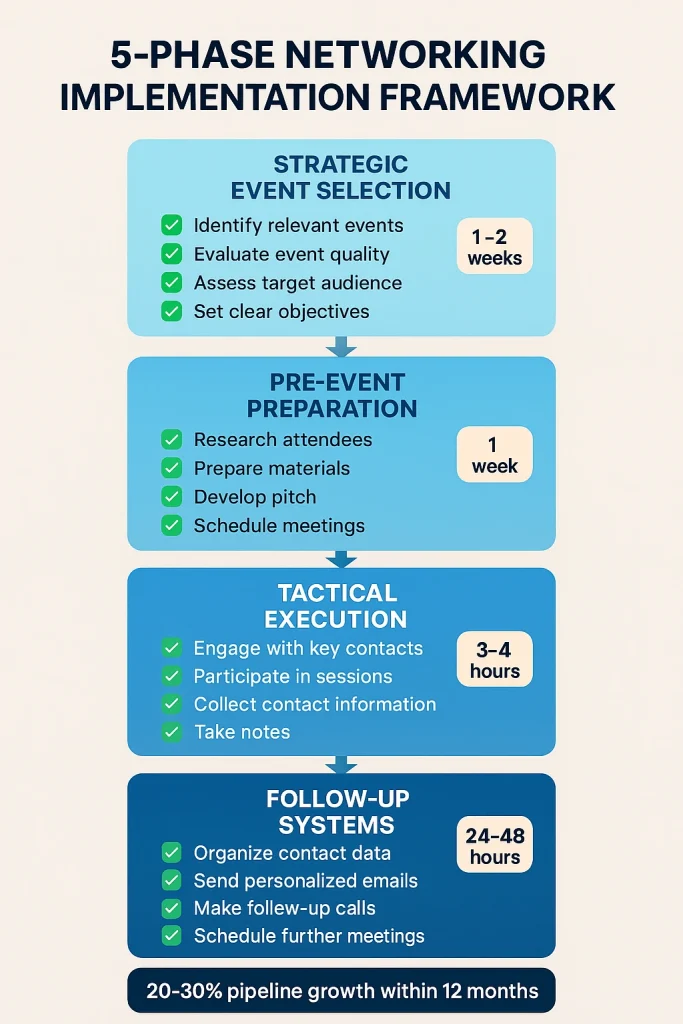
Phase 1: Strategic Event Selection
Not all networking opportunities deserve your time. Start with the qualification criteria:
- Target market concentration: Will 20+ qualified prospects attend?
- Decision-maker density: Are actual buyers present, or just influencers?
- Competitive intelligence value: What market insights can you gather even if you generate zero direct leads?
- Resource investment: Does the potential return justify travel, time, and participation costs?
Phase 2: Pre-Event Preparation
Michael emphasizes preparation: “You have to do your research, do your homework.” This means:
- Attendee research: Who’s attending? What are their business challenges? Where might you add value?
- FORM framework prep: Identify likely conversation topics around family, occupation, and recreation based on prospect profiles.
- Value proposition refinement: Craft 2-3 specific insights or introductions you can offer without selling.
- Wingman coordination: If bringing support, align on introduction strategies and conversation handoffs.
Phase 3: Tactical Execution
Follow Michael’s systematic approach:
- Listen first: Approach tables/groups, assess conversation relevance before engaging.
- Qualify quickly: Use FORM framework to identify genuine fit within first 5 minutes.
- Deliver value: Share insights, make introductions, offer resources before discussing your services.
- Capture intelligence: Note competitive information, market trends, and prospect needs.
- Strategic withdrawal: Exit gracefully from low-fit conversations to optimize time allocation.
Phase 4: Follow-Up Systems
Michael’s handwritten notes work because they’re systematized, not random:
- 24-48 hour window: Send notes while you’re still memorable.
- Specific reference: Mention something specific from your conversation to demonstrate attention.
- Value delivery: Include the resource, introduction, or insight you promised.
- Next step clarity: Suggest a specific next action rather than leaving connection open-ended.
Phase 5: Pipeline Integration
This is where most companies fail. They treat networking leads separately from the core pipeline. Instead:
- CRM integration: Capture networking connections in your standard pipeline with the “networking” source tag.
- Systematic nurturing: Include networking contacts in appropriate nurture sequences based on qualification level.
- Attribution tracking: Note the networking source for closed deals to quantify ROI over time.
- Team knowledge sharing: Brief account executives on the conversation context so they can reference it in follow-up.
Companies that implement this framework typically see networking-sourced pipeline grow from <5% to 20-30% of total qualified opportunities within 12 months. More importantly, these opportunities often close faster and at higher values due to the relationship foundation established through initial networking interactions.
The Content Marketing Multiplier: Amplifying Networking Impact
Here’s what most B2B companies miss: networking and content marketing aren’t separate activities. They’re symbiotic.
When you create content around insights gathered at networking events, you accomplish multiple objectives:
You extend event ROI indefinitely. That conversation with a prospect about their implementation challenges? Turn it into an article addressing that challenge at scale. Now you’ve created value for hundreds of prospects facing similar issues.
You build authority in your network. Share content with networking connections that addresses their specific challenges. You’re demonstrating expertise without pitching.
You create conversation starters for future networking. Your content becomes a natural entry point for follow-up: “I wrote this article after our conversation about [challenge]. Would love your perspective.”
You systematize thought leadership. Rather than networking “one connection at a time,” your insights from networking inform content that establishes your positioning across your entire market.
This is why we focus on ghostwriting educational email courses and strategic LinkedIn content for B2B tech executives. Networking generates raw insights. Content systematizes those insights into repeatable positioning that drives inbound interest while you continue networking for outbound opportunities.
The combination creates compounding returns: networking improves content quality through market insights, while content improves networking effectiveness by establishing authority before conversations even begin.
What B2B Networking Strategies Mistakes Kill Revenue Potential?
Michael’s years running networking groups revealed patterns that consistently destroy revenue potential:
| Pitfall | Why It Fails | Fix | Expected Impact |
|---|---|---|---|
| Pitch-First Approach | Triggers defense mechanisms | Lead with value, qualify first using FORM | 3x conversation quality |
| No Follow-Up System | 80% of value lost | Handwritten notes within 24-48hrs | 5x conversion rate |
| Quantity Over Quality | Diluted effort, low ROI | Focus on 20% of events = 80% of value | 2-3x pipeline efficiency |
| Solo Operating | Introvert disadvantage, no social proof | Wingman strategy for 4-5 events | 40% faster skill development |
| Misaligned Messaging | Confusion kills deals | Align marketing and networking messages | Eliminates 30-40% of drop-off |
Pitfall #1: The Pitch-First Approach
“People love to buy things. They love to buy, but they hate to be sold to,” Michael explains. The fastest way to kill a networking opportunity? Lead with your pitch.
B2B decision-makers attend networking events despite being constantly sold to because they need solutions to real problems. When you immediately pitch, you’ve confirmed their worst fear—you’re just another vendor treating networking as cold calling with better catering.
Pitfall #2: Misaligned Message Consistency
When your marketing team creates a single message about your solution, but your networking conversations convey something completely different, you create confusion that kills deals. This is the networking manifestation of the broader marketing-sales alignment challenge, where message inconsistency “occurs in B2B sales when marketing creates one message about a product or service, but SDRs and sales teams communicate something completely different.”
Pitfall #3: No Follow-Up System
Michael emphasizes follow-up as his top takeaway. Yet most B2B professionals collect cards, connect on LinkedIn, and then… nothing. Without systematic follow-up, networking becomes expensive socializing rather than revenue generation.
Pitfall #4: Quantity Over Quality Focus
Attending every possible networking event and trying to connect with everyone is the amateur approach. Strategic networking means identifying the 20% of events and connections that will generate 80% of your opportunity value.
Pitfall #5: Solo Operating Without Support
The wingman strategy isn’t just for introverts. Even experienced networkers benefit from coordinated team approaches at major events. When multiple team members attend the same event with aligned messaging and coordinated follow-up, you multiply impact while reducing individual pressure.
The Future of B2B Networking: What’s Changing in 2025
Based on current B2B networking trends, several shifts are reshaping how strategic networking drives revenue:
AI-Enhanced Preparation: AI-driven networking tools help businesses identify ideal connections, automate outreach, and analyze engagement. Smart companies utilize AI for research and follow-up automation, while maintaining a human connection at the core of genuine networking interactions.
Community-Based Networking: Rather than one-off events, B2B networking increasingly happens through industry communities, online forums, and curated groups. These sustained interaction environments allow relationship development over time rather than forcing it into single-event windows.
Hybrid-First Strategies: The future isn’t “back to in-person” or “all virtual.” It’s a strategic deployment of both based on the relationship stage and opportunity value. Initial qualification happens virtually. High-value relationship development happens face-to-face.
Integration with ABM: Account-based marketing increasingly incorporates strategic networking as a key touchpoint. When you identify target accounts, networking events where decision-makers will be present become priority items on your calendar.
Measurement Sophistication: As B2B companies adopt better analytics, networking attribution becomes more sophisticated. Companies can now track which events, connections, and follow-up approaches generate the highest-value opportunities.
Why Most B2B Networking Training Fails (And What Actually Works)
After teaching networking for over a decade, Michael identified why most training programs produce minimal results: “Everybody talks about networking and getting together with people. They talk about how to do it, but they never talk about that one-on-one.”
Generic networking advice—”be authentic,” “add value,” “follow up”—sounds great but lacks implementation specificity. What does “adding value” actually look like in a seven-minute conversation with a CTO you just met? How do you “be authentic” while also being strategic?
What works instead:
Specific tactical frameworks, such as FORM, provide clear action steps for various networking scenarios. Not “be a good listener” but “when approaching a group, listen for 60 seconds before speaking to assess conversation relevance.”
Role-specific customization that addresses different networking challenges. The approach for introverted technical founders differs from that of extroverted sales executives. Both can excel at networking with appropriate tactical adjustments.
Systematic skill building through structured practice and feedback. Michael’s wingman approach provides this. So does sales enablement that incorporates networking skill development as a core competency.
Integration with existing revenue processes rather than treating networking as a separate activity. When networking insights inform sales conversations, when marketing content amplifies networking reach, when customer success teams leverage networks for expansion—that’s when networking becomes a revenue engine rather than a relationship-building exercise.
Recommended Tools for B2B Networking Success
Event Discovery & Management
- Eventbrite – Find industry-specific networking events by location and vertical
- Luma – Tech-focused professional gatherings with quality filtering
- LinkedIn Events – Virtual and hybrid networking opportunities from your network
CRM & Follow-Up Systems
- HubSpot – Track networking connections and conversation history
- Salesforce – Enterprise-level networking pipeline management with custom fields
- Notion – Simple networking contact database with relationship tracking
AI-Powered Networking Tools
- Clay – Automated contact enrichment and pre-event research
- Seamless.AI – Find verified contact information for attendees
- Lunchclub – AI-matched 1:1 networking connections based on goals
Content & Outreach
- Mailshake – Systematic follow-up email campaigns
- Postcard Apps (Felt, Postable) – Handwritten note automation at scale
- Calendly – Simplified meeting scheduling from networking conversations
Note: Sproutworth offers ghostwritten educational email courses and LinkedIn content creation to amplify your networking impact with thought leadership that positions your executives as industry authorities.
Related Resources
Additional Insights from Predictable B2B Success
Explore these related episodes and articles to deepen your understanding of systematic revenue generation:
- Marketing Sales Alignment: The 208% Revenue Growth Secret – Discover how aligned teams create revenue machines through coordinated networking and outreach strategies
- B2B Sales Growth Trends And Strategies: Driving Revenue in 2025 – Learn how top-performing B2B companies leverage networking within comprehensive growth strategies
- How to Overcome B2B Sales Challenges And Drive Growth With Deal Coaching – Master the art of progressing deals from networking connections to closed revenue
- B2B Growth Marketing: Building High-Performing Tech Brands – Understand how networking fits within complete B2B growth frameworks
- What is B2B Sales: How to Create a Successful Sales Process – Build systematic sales processes that integrate networking-generated opportunities
- Enterprise Sales Definition: Challenges & Best Practices – Apply networking strategies specifically to enterprise-level deals and stakeholder management
Frequently Asked Questions About B2B Networking Strategies
What is the most effective B2B networking strategy?
The most effective strategy is the FORM framework (Family, Occupation, Recreation, Message) combined with strategic listening and systematic follow-up within 24-48 hours. Companies implementing this approach see networking-sourced pipeline grow from under 5% to 20-30% within 12 months.
How much time should I spend on B2B networking each month?
Strategic networkers allocate 10-15% of their time to networking (6-8 hours per month for full-time professionals). Focus on quality over quantity: attend 2-3 high-value, well-qualified events rather than 10 generic meetups.
What’s the average ROI of B2B networking?
Networking-sourced deals typically close 40% faster and have a 25% higher lifetime value than those sourced through cold outreach. The customer acquisition cost for networked deals is 30-50% lower than for other channels. The 208% revenue gap between aligned and misaligned teams often stems from poor execution of networking.
How do I measure networking success?
Track four key metrics: (1) Time from first conversation to qualified opportunity, (2) Referral conversion rates versus cold leads, (3) Account penetration through introductions, (4) Customer acquisition cost for networked deals. Avoid vanity metrics like “events attended” or “cards collected.”
Should I focus on virtual or in-person networking?
Utilize hybrid strategies: conduct virtual sessions for initial qualification (2-4 hours weekly) and in-person events for high-value relationship development (1-2 events monthly). Enterprise deals targeting companies with $50M+ in revenue require in-person interaction. SMB pipeline benefits from virtual volume.
What’s the best follow-up method after networking events?
Handwritten notes sent within 24-48 hours result in 5 times higher response rates than email alone. Include: specific conversation reference, promised resource or introduction, and clear next step. Combine with email for resource delivery, but lead with the handwritten note.
How can introverts succeed at networking?
Use the wingman strategy: bring a colleague who knows your expertise and can naturally introduce you to conversations at 4-5 events. After this structured practice, most introverts can network independently with 40% faster skill development than trial-and-error learning.
What are the biggest networking mistakes to avoid?
The top five: (1) Pitch-first approach kills 70% of opportunities, (2) No systematic follow-up wastes 80% of event value, (3) Misaligned messaging between marketing and networking creates confusion, (4) Quantity-over-quality dilutes ROI, (5) Solo operating without wingman support limits introverts.
How long does it take to see results from strategic networking?
Most professionals see initial qualified opportunities within 5-7 strategic networking interactions (30-45 days for active networkers attending 2 events monthly). Pipeline contribution grows to 15-20% within 6 months and 25-35% within 12 months with systematic implementation.
People Also Search For
Exploring these related topics can enhance your B2B networking strategy:
- B2B networking events near me – How to find high-ROI local opportunities using Eventbrite, Luma, and LinkedIn
- Best B2B networking groups – Industry-specific communities worth joining (BNI, Vistage, EO)
- LinkedIn networking strategies – Digital outreach best practices for C-suite connections
- B2B networking email templates – Follow-up message frameworks that convert
- Virtual networking platforms for B2B – Zoom alternatives and specialized tools comparison
- Executive networking strategies – C-suite specific approaches that differ from general networking
- B2B networking KPIs – The metrics that actually predict revenue, not vanity metrics
- Networking ROI calculator – How to build cost-benefit analysis for event selection
- B2B referral networking – Leveraging existing relationships for introductions
- Sales networking techniques – Approaches specifically for revenue team members
Your 30-Day B2B Networking Action Plan
Week 1: Foundation
- [ ] Identify 3-5 target networking events for next quarter based on qualification criteria
- [ ] Research attendee lists using LinkedIn and event platforms
- [ ] Prepare FORM framework conversation starters for your industry
- [ ] Order personalized note cards and quality pen for handwritten follow-up
- [ ] Set up CRM pipeline source tag for “Networking” attribution
Week 2: Preparation
- [ ] Practice strategic listening at 1-2 low-stakes events (no pressure, just observation)
- [ ] Identify potential wingman if you’re introverted or new to strategic networking
- [ ] Prepare 3 value-delivery resources to share (articles, introductions, tools)
- [ ] Create pre-event research template for attendee qualification
- [ ] Block calendar time for follow-up (2 hours post-event minimum)
Week 3: First Strategic Event
- [ ] Attend primary target event using Phase 3 tactical execution framework
- [ ] Apply FORM framework with 5-7 qualified prospects
- [ ] Gather competitive intelligence and market trends
- [ ] Take discrete notes on conversation highlights for follow-up personalization
- [ ] Send handwritten notes within 24-48 hours with specific references
Week 4: Measurement & Iteration
- [ ] Track: total conversations → qualified opportunities conversion rate
- [ ] Analyze: what worked vs. what didn’t (FORM application, listening, value delivery)
- [ ] Schedule follow-up meetings with top 3 qualified prospects
- [ ] Update CRM with all networking connections and conversation context
- [ ] Plan next event based on learnings and refine approach
Expected Results After 30 Days: 2-4 qualified opportunities, improved conversation quality, clearer understanding of event ROI, systematic approach that can scale.
Download this checklist: Save this article and check off items as you complete them. Consider creating a dedicated notebook for networking insights and follow-up tracking.
Need help implementing? Sproutworth’s ghostwritten educational email courses can position your executives as networking thought leaders while you build your systematic approach. We transform networking insights into content that drives inbound opportunities.
Related Links
Connect with Michael Forman
Continue learning from Michael’s networking expertise through his various platforms:
- Website: michaelaforman.com
- LinkedIn: linkedin.com/in/michaelforman
- Book: Networking Unleashed: Mastering the Art of Professional Networking
- Digital Courses: Available at michaelaforman.com
The Bottom Line: Networking As Revenue Infrastructure
Here’s what separates companies that grow predictably from those that chase revenue quarter to quarter:
They don’t treat networking as a social activity that might generate leads. They engineer it as a systematic infrastructure that multiplies the effectiveness of every other revenue function.
Michael Forman’s frameworks work because they transform unstructured relationship-building into repeatable processes with measurable outcomes. The FORM framework. The Know-Like-Trust progression. The wingman strategy. The follow-up system. These aren’t personality-dependent techniques that only work for “natural networkers.” They’re engineered processes that work consistently when implemented systematically.
For B2B tech companies scaling from seed to Series C, this matters enormously. When you’re operating with limited resources and compressed timelines, you can’t afford to treat networking as a “nice to have” activity that might pay off eventually. You need systematic approaches that generate a qualified pipeline this quarter.
That’s exactly what strategic networking delivers—when you stop treating it like relationship building and start engineering it as the revenue multiplier it actually is.
The gap between your current revenue and your growth targets? Strategic networking isn’t the complete solution. But for most B2B companies, it’s the highest-ROI, lowest-cost tool they’re systematically underutilizing.
The question isn’t whether networking drives B2B revenue. It’s a matter of whether you’ll continue approaching it randomly or start engineering it systematically.
Looking to transform your B2B networking from a relationship-building exercise to a revenue engine? Contact Sproutworth to explore how our digital PR services and ghostwritten educational email courses can amplify your networking impact while establishing your executive team as industry thought leaders.
Some areas we explore in this episode include:
Listen to the episode.
Subscribe to & Review the Predictable B2B Success Podcast
Thanks for tuning into this week’s Predictable B2B Podcast episode! If the information from our interviews has helped your business journey, please visit Apple Podcasts, subscribe to the show, and leave us an honest review.
Your reviews and feedback will not only help me continue to deliver great, helpful content but also help me reach even more amazing founders and executives like you!
