
A customer engagement strategy is the operating system that turns product usage into recurring revenue. For funded B2B tech CEOs, it is the difference between needing constant capital and having expansion revenue fund the next hire. In 2026, AI and PLG have compressed time-to-value, changing engagement mechanics faster than most playbooks. Here is what the top 10% of SaaS companies do differently, starting with how demand generation feeds the engagement pipeline.
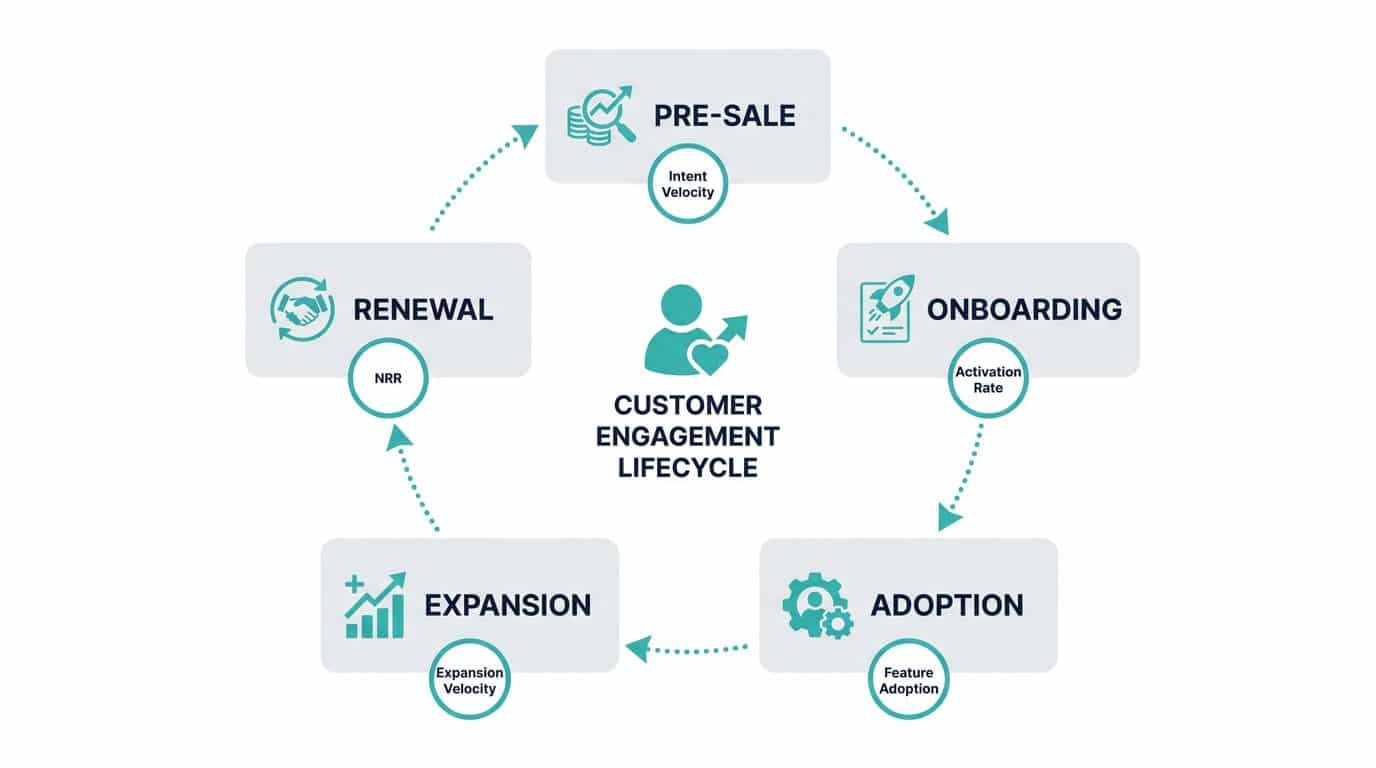
Table of Contents
Why Customer Engagement Is the New Growth Engine
Most funded startups treat customer engagement as a retention problem. That is the most expensive mistake in any customer engagement strategy. Fix churn, protect MRR, move on. That frame misses the real leverage. A customer engagement strategy designed around lifecycle stages, not reactive churn signals, is what separates companies that scale efficiently from those that burn cash on replacement revenue.
A proper customer engagement strategy drives three financial outcomes that matter more than churn rate alone. First is NRR acceleration. Engaged customers expand 2.3x faster than passive ones, according to Gartner research on buying committee behavior. Second is CAC payback compression. An activated customer starts producing value in weeks rather than quarters, shortening the payback cycle that determines your runway. Third is predictable revenue. Engaged accounts renew at higher rates, which means your board projections actually mean something.
The shift from retention playbook to growth engine is the first step in building a durable customer engagement strategy that funds itself through expansion. Rethink engagement as a lifecycle, not a campaign.
The B2B SaaS Customer Lifecycle and Engagement Blueprint
Top-performing SaaS companies do not run one customer engagement strategy. They run five customer engagement strategies, one for each phase of the customer lifecycle. The mistake most founders make is applying an onboarding playbook to an expansion conversation, or treating a renewal signal with the same automation as an activation trigger.
Pre-Sale and Evaluation
Engagement starts before the contract is signed. An effective customer engagement strategy begins at the evaluation stage, not after the deal closes. A customer engagement strategy that starts at signature misses the best window to build trust with the buying committee. The buying committee is multi-threading research across G2, LinkedIn, and peer conversations. Your job is not to sell them. It is to be present in enough contexts that when they evaluate, your company is the safe choice.
The metric that matters here is intent signal velocity: how fast a prospect moves from first touch to closed-won. The longer the evaluation, the more likely a competitor is to enter the frame. Accelerate it with targeted content during the evaluation period: case studies for the economic buyer, implementation docs for the champion, ROI calculators for the CFO.
Onboarding (Days 0-90)
The first 90 days determine whether a customer expands or churns. B2B buyers spend only 17% of their total buying time meeting with potential suppliers, according to Gartner research on the B2B buying journey. That means onboarding is not a handoff from sales to CS. It is the moment the customer actually starts using the product. A customer engagement strategy that ignores onboarding is a churn plan.
The play: time-to-first-value under five minutes for self-serve, under 48 hours for enterprise. If a new user cannot reach their first “aha moment” within those windows, engagement decays faster than any outreach can recover it. A customer engagement strategy built for onboarding deliberately compresses this window.
Guided onboarding flows with in-app checklists beat email-based onboarding by 4x on activation rates. Every step should produce a measurable engagement action: completing a profile, running a first report, inviting a teammate.
Adoption and Ongoing Value
After onboarding, engagement shifts from assistance to habit formation. The customer does not need more tutorials. They need to see the product working for them. A customer engagement strategy for the adoption phase should prioritize value demonstration over education.
The framework that works here is the value realization cadence. This is where a customer engagement strategy shifts from reactive support to proactive value delivery. A structured month-by-month plan where each touchpoint maps to a specific milestone the customer cares about. Month 1: first ROI snapshot. Month 2: advanced feature exploration. Month 3: integration with their existing stack.
In-app nudges and triggered emails around feature adoption convert at 3x the rate of broadcast campaigns because they arrive when the user is already in a learning posture. The key is behavioral triggers, not calendar-based.
Expansion and Upsell
Expansion is not a separate motion from engagement. It is the natural outcome of a customer who has continuously seen value. The companies that nail this do not have a separate upsell team. They have a CS team that runs quarterly business reviews focused on outcomes rather than feature adoption. This structure is what makes a customer engagement strategy produce revenue, not just activity.
A mature customer engagement strategy uses behavioral signals, not calendar dates, as expansion triggers: when a power user maxes out their plan, when a team hits 90% usage on a core feature, when a champion changes roles and brings the product to a new department. These signals predict expansion intent better than any survey.
Renewal and Churn Prevention
Churn is rarely a sudden event. It is a slow decay of engagement that compounds over 3-6 months before the customer cancels. The leading indicator is a decline in logins, feature usage, or support ticket volume. A customer engagement strategy that only tracks churn after it happens has already lost the window to intervene. Every customer engagement strategy needs a churn risk scoring system that flags declines early, before the customer has mentally exited.
The fix is a churn risk score that combines engagement data, support history, and account demographics. Accounts that cross the risk threshold get a save play: targeted outreach from a senior CSM, a custom success plan, or an executive business review. A complete customer engagement strategy plans for this intervention before churn risk materializes, not after.
7 Customer Engagement Plays That Protect Your NRR
The lifecycle framework provides structure. These seven customer engagement plays provide the tactical execution that the top 10% of SaaS companies deploy. Here is how each play maps to the lifecycle stage:
| Lifecycle Stage | Primary Plays | Key Metric | Best Channel |
|---|---|---|---|
| Pre-sale | Play 6 (Buying Committee), Play 2 (Verified Data) | Intent signal velocity | LinkedIn + email |
| Onboarding (0-90 days) | Play 5 (Product-Led), Play 1 (Segmentation) | Activation rate | In-app + email |
| Adoption | Play 4 (Behavioral Triggers), Play 3 (Multi-Channel) | Feature adoption rate | In-app |
| Expansion | Play 4 (Behavioral Triggers), Play 2 (Personalization) | Expansion velocity | Phone + email |
| Renewal | Play 7 (Closed-Loop), Play 1 (Segmentation) | NRR | Executive QBR + email |
Play 1: Account-Based Segmentation by ICP Fit
Not every customer should receive the same level of engagement. A segmented customer engagement strategy accounts for these differences. Segment your book of business by ICP fit first, then by revenue tier. A highly fit account at $10K MRR has more expansion potential than a poor-fit account at $50K MRR.
Apply different engagement models to each segment. Strategic accounts get executive sponsors and quarterly business reviews. Standard accounts get automated value realization cadences. Self-serve accounts receive product-led growth flows without human touch until they signal readiness.
81.3% of B2B marketers document their content strategy, according to Content Marketing Institute research on B2B content marketing benchmarks, while AI search traffic grew 527% year over year according to Semrush. The same documentation discipline applied to your customer engagement strategy separates top performers from the rest.
Play 2: Verified-Data Personalization
Personalization has a bad reputation because most of it is superficial, first-name tokens in emails that were clearly batch-sent. Verified-data personalization uses role, company events, tech stack signals, product usage patterns, and funding activity to tailor every touchpoint.
The difference is material. A CSM who references a customer’s recent funding round, product usage trend, and team growth in the same conversation is 3x more likely to identify an expansion opportunity than one who opens with “just checking in.”
Play 3: Multi-Channel Cadences Coordinated by Stage
Email alone does not drive engagement. An effective multi-channel customer engagement strategy coordinates across surfaces. In-app, LinkedIn, phone, and customer community channels must be coordinated into a cadence calibrated to the lifecycle stage.
The pattern that works for a multi-channel customer engagement strategy: in-app for behavioral triggers, email for content delivery, LinkedIn for executive-level awareness, phone for critical moments. Each channel has a specific job, and they should never fire simultaneously. A customer who just used a new feature does not need an email about it.
Play 4: Behavioral and Intent-Triggered Plays
Calendar-based engagement is dead. A trigger-based customer engagement strategy ties every action to a signal. Every engagement action should tie to a specific customer behavior or intent signal. Common triggers: a visit to the pricing page, a usage drop over 14 days, a feature adoption milestone, a support ticket escalation, a funding announcement on Crunchbase.
When the trigger fires, the play executes automatically. Usage drop triggers a re-engagement sequence led by CS. A funding announcement triggers an expansion outreach from the account executive. The automation covers the predictable edge cases, leaving the CS team to focus on judgment calls.
Play 5: Product-Led In-App Engagement
For PLG products, the product is the primary engagement channel. A product-led customer engagement strategy replaces human touchpoints with in-app guidance, checklists, and milestone celebrations that keep users moving toward activation without requiring a human touch.
The metric is activation rate, the percentage of new users who reach the defined “aha moment” within the first 14 days. Companies that optimize activation rates see 50% higher D30 retention than those focused on signups alone, according to data from Seer Interactive.
Play 6: Buying Committee Engagement
Most customer engagement targets the point of contact who signed the contract. But renewal and expansion decisions are made by a committee that includes the economic buyer, the implementation lead, and sometimes procurement.
Mapping the committee is the step most customer engagement strategy frameworks skip. Tailoring engagement to each stakeholder is a high-leverage play. The economic buyer gets ROI benchmarks and business case templates. The implementation lead gains access to best practices and the community. The end users get feature tips and feedback channels. When every committee member has a reason to stay, the renewal conversation shifts from “why renew” to “how much to upgrade.”
Play 7: Closed-Loop Measurement and NRR Attribution
The seventh play is the one that makes the other six measurable. A closed-loop measurement system tracks engagement actions through to revenue outcomes. Which play produces the most expansion opportunities? Which segment responds best to which channel? What engagement pattern precedes churn? A customer engagement strategy without this is a series of well-intentioned guesses.
NRR attribution is the definitive metric for any customer engagement strategy. If your engagement program is not improving NRR, it is cost, not investment. Map every engagement action, email, call, and in-app event to a specific revenue outcome (expansion, renewal, churn reversal). Plays that do not correlate with NRR improvement are deprecated.
How to Measure Engagement Performance in B2B SaaS
The metrics that matter to a CEO differ from the metrics that matter to a CS manager. A customer engagement strategy scorecard for the executive team focuses on revenue outcomes rather than activity counts. Without the right customer engagement strategy metrics, you cannot tell whether your program is producing retention or just reports. Here is the CEO scorecard:
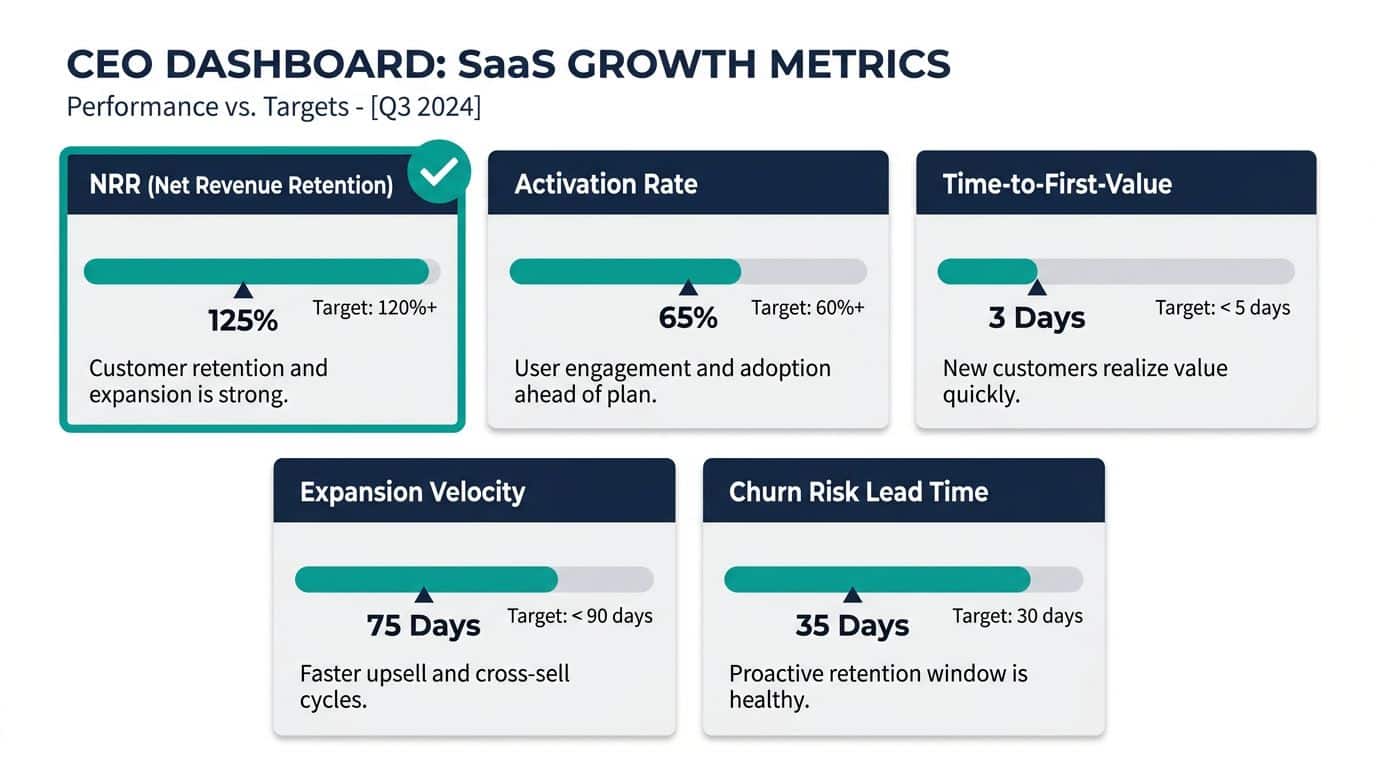
| Metric | What It Measures | Target for Funded B2B SaaS |
|---|---|---|
| Net Revenue Retention | Revenue retained + expanded from existing customers, excluding new logos | 120%+ (top quartile) |
| Activation Rate | % of new users who reach the “aha moment” within 14 days | 60%+ |
| Time-to-First-Value | Days from first login to first recognized outcome | Under 5 days (self-serve), under 30 days (enterprise) |
| Expansion Velocity | Days from first value to first upsell | Under 90 days |
| Churn Risk Identification Lead Time | Days between risk identification and cancellation request | 30+ days |
These five metrics form a dashboard that tells you whether your customer engagement strategy is producing revenue or just activity. If your customer engagement strategy cannot move these numbers, it is not a strategy. It is a schedule.
Common Customer Engagement Mistakes Funded Founders Make
Three mistakes recur among funded startups that struggle with engagement. Building a customer engagement strategy without avoiding these errors wastes months of effort.
Mistake 1: Treating engagement as a CS-only function. When a customer engagement strategy lives only in the CS team, it becomes reactive, responding to churn signals rather than engineering growth. A customer engagement strategy owned by one department is incomplete. The best strategies are co-owned by CS, Product, and Marketing.
Mistake 2: Building a playbook before defining the lifecycle. Founders start building a customer engagement strategy before they have mapped their customer lifecycle. They jump to tactics (email sequences, in-app guides) without mapping which lifecycle stage they are optimizing. A tactic that works for onboarding will fail for expansion. The lifecycle must come first.
Mistake 3: Measuring activity instead of outcomes. The number of emails sent, calls completed, and in-app tours triggered are activity metrics. They do not predict NRR. An outcome-based customer engagement strategy measures expansion revenue, churn reversal, and activation rate instead. Switch to outcome metrics, or your team will optimize for busy work.
The Tech Stack for Operationalizing Customer Engagement
A modern customer engagement strategy stack requires four layers. First, product analytics (Amplitude, Mixpanel) to track in-app behavior and usage patterns. Second, CRM (Salesforce, HubSpot) for account hierarchy and contact data. Third, an engagement platform (Intercom, Customer.io) to orchestrate multi-channel cadences and behavioral triggers. Fourth, an intent data provider (Bombora, 6sense) to surface account-level buying intent signals.
The key is integration. If product analytics does not feed the engagement platform, every play is flying blind. If CRM data does not enrich the segmentation model, accounts get the wrong treatment. Integration is what makes engagement operational.
The right stack depends on your stage. Seed-stage companies can start with product analytics plus an email engagement tool. Series A companies add CRM integration and basic behavioral triggers. Series B and above require the full four-layer stack, including intent data and closed-loop attribution. Trying to run a Series B engagement strategy on a seed-stage toolset creates process debt. Trying to buy a seed-stage toolset for a Series B operation creates data silos. Match the stack to the lifecycle stage.
Frequently Asked Questions
What is the difference between customer engagement and customer success? Customer engagement is the set of behaviors and interactions a customer has with your product and brand. A customer engagement strategy is built on these behaviors. Customer success is the organizational function responsible for ensuring customers achieve their desired outcomes. Engagement is what you measure. Success is what you deliver.
How often should we engage existing customers? There is no universal frequency, but the research shows that a behavior-triggered customer engagement strategy outperforms fixed-interval campaigns. A customer who logged in today needs different engagement than one who last logged in 30 days ago. Let behavior, not calendar, set the rhythm.
What engagement tactics work best for B2B SaaS? Account-based segmentation, multi-channel cadences, and behavioral triggers are the three highest-impact tactics, according to benchmark analysis. The common thread is specificity. Engage accounts differently based on fit and behavior.
Can AI automate customer engagement? AI handles the predictable edge cases: behavioral triggers, content personalization at scale, and churn risk scoring. It cannot replace the judgment call in a save play or the relationship building in a quarterly business review. The winning stack uses AI for the programmatic work and humans for the judgment.
What is a good NRR target for B2B SaaS? For funded B2B SaaS companies, 120% NRR is the top-quartile benchmark. Companies with NRR below 100% are losing existing revenue faster than they acquire new logos, a signal that their customer engagement strategy needs reworking before pursuing new logo acquisition.
Conclusion
Customer engagement strategy in 2026 is not a retention tool. It is a revenue acceleration engine. Funded B2B tech CEOs who build their customer engagement strategy around the customer lifecycle, segmented by account fit, triggered by behavior, and measured by NRR, will fund their growth from existing customers rather than their next fundraise.
The seven customer engagement plays in this article form a starting point. Pick the customer engagement play that addresses your biggest metric gap. Run it for 90 days. Measure the impact on NRR. Then add the next.
Start with the one metric that would change your board conversation if it moved 10%. For most funded B2B tech companies, that is activation rate. Compress time-to-first-value and watch every downstream metric improve. Building a customer engagement strategy this way, starting small and iterating, is the approach that actually sticks. The engagement strategy that wins in 2026 is not the most sophisticated one. It is the one that actually gets executed. A customer engagement strategy that generates revenue beats a perfect strategy that sits on the shelf.
Sproutworth helps funded B2B tech companies build customer engagement content and ghostwrite thought leadership. If your engagement strategy includes LinkedIn outreach and educational content for buying committees, we can help craft the messaging that converts engagement into pipeline.
Related Resources
- B2B Demand Generation Strategy: How Funded Startups Build a Pipeline
- CEO Newsletter: The Format That Turns Subscribers Into Sales Conversations
- Multichannel Cold Outreach: How LinkedIn + Email Gets 50% More B2B Replies
