
Last Updated: July 2026
Ecommerce conversion rate optimization for ecommerce averages 1–3% across categories. Standard fixes do not close the gap for high-ticket stores. Baymard Institute data shows 39% of cart abandoners cite price as the primary barrier, yet most merchants respond with discount codes that train buyers to wait for the next sale. For products priced at $500 and above, AI-powered price negotiation converts these buyers during the browsing session without eroding margins.
Most ecommerce stores convert under 3% of visitors because CRO tools address UX friction, not price. Mansoor Osmani, founder of DBargain, identifies two types of price-sensitive abandoners: budget-limited buyers who cannot afford the product, and price-motivated buyers who can afford it but want to negotiate. Discount codes convert only the first group and train the second to wait for the next sale.
About Mansoor Osmani
Mansoor Osmani is Founder of DBargain and President of CLCI, a business consulting firm specializing in commercial strategy. He built DBargain to solve a problem he observed repeatedly across high-consideration retail categories. The buyers abandoning product pages without converting are not, in most cases, priced out of the product. For ecommerce merchants, that distinction changes which problem is actually worth solving. Most CRO playbooks improve the path to purchase; Osmani’s work on AI price negotiation mechanics for Shopify merchants addresses the pricing conversation those playbooks skip entirely.
Watch the Episode
Table of Contents
What Is Ecommerce Conversion Rate Optimization?
Ecommerce conversion rate optimization is the practice of increasing the percentage of site visitors who complete a purchase, without necessarily increasing traffic. It encompasses every change a merchant makes to improve the buying experience, from checkout flow and page speed to pricing mechanics and post-abandonment recovery.
The standard formula for ecommerce conversion rate is:
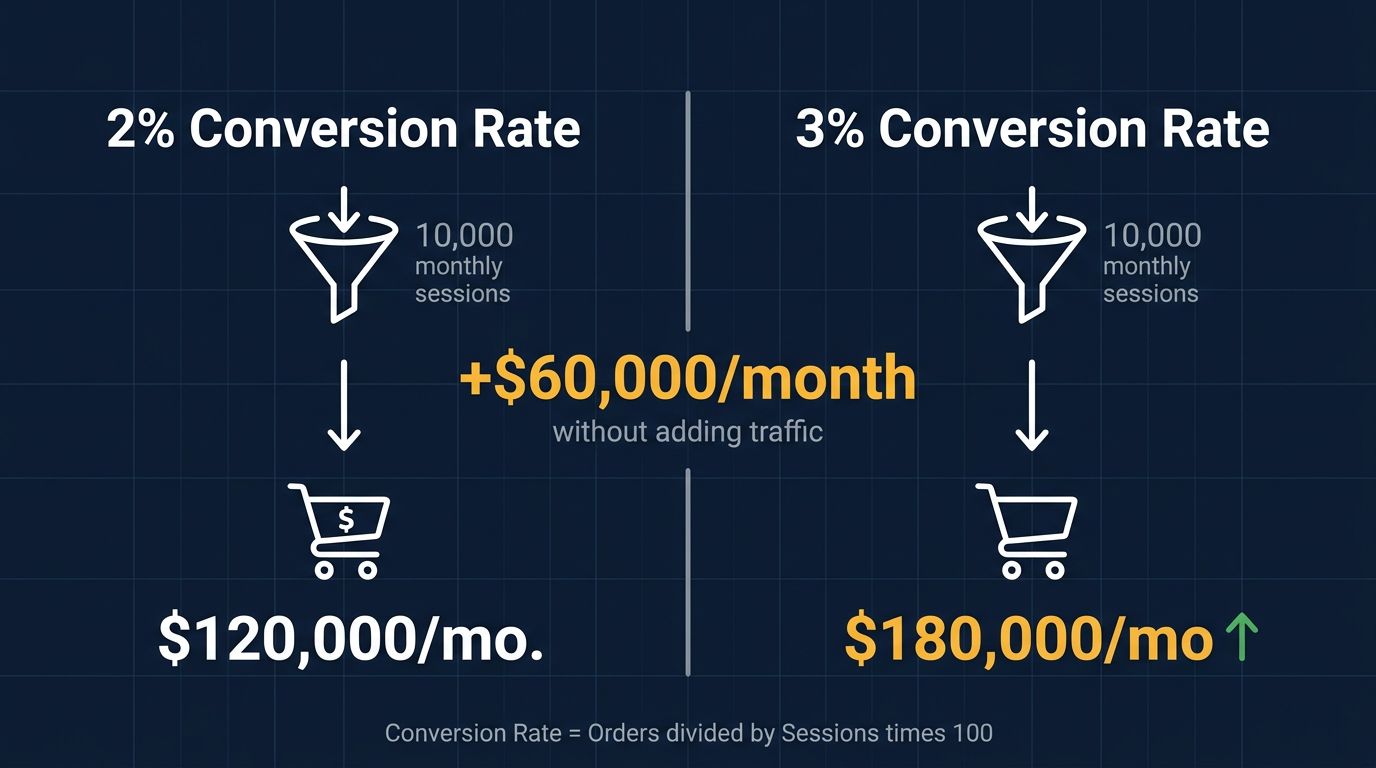
Conversion rate = (Number of orders / Number of sessions) × 100
A store with 10,000 monthly sessions and 200 orders has a 2% conversion rate. Each percentage point improvement at that traffic level adds 100 orders per month. For a $600 average order value, increasing conversion rate from 2% to 3% is worth $60,000 in additional monthly revenue without spending an extra dollar on traffic.
Most B2B content marketing coverage of ecommerce CRO focuses on the top of that formula: more sessions through better SEO, paid media, or referral. The denominator, what percentage of those sessions actually convert, receives less strategic attention, particularly for high-ticket stores where the conversion levers are fundamentally different from commodity retail. In working with B2B founders building ecommerce tools, I find the denominator question is almost always the one their customers cannot answer.
Conversion rate optimization for ecommerce becomes a different discipline above the $500 price threshold. Standard CRO tools (checkout optimization, page speed, trust signals) address friction in the path to purchase. For high-ticket categories, the primary barrier is rarely the path. It is the price.
What Is a Good Ecommerce Conversion Rate?
A good ecommerce conversion rate is 2–4% for most product categories, though vertical benchmarks vary significantly. Food and beverage reaches 6.51%; luxury goods and original art average 1.3%. The 2–4% figure also masks the real ceiling for high-ticket stores: fixing checkout UX will not push a luxury goods store from 0.8% to 2%, because the barrier is price, not process.
| Product category | Typical conversion rate | Price sensitivity driver |
|---|---|---|
| Food and beverage | ~6.51% | Low price point, repeat purchase |
| Health and beauty | 3–5% | Moderate price, high intent |
| Apparel and accessories | 2–4% | Mid-range, style preference |
| Home and garden | 1.5–3% | Higher price, research phase |
| Consumer electronics ($200–$500) | 1–2.5% | Price comparison behavior |
| Luxury goods and original art | ~1.3% | High price, negotiation expectation |
| High-ticket outdoor equipment ($500+) | 0.5–1% | Infrequent purchase, high scrutiny |
Source: Dynamic Yield Ecommerce Benchmarks, which tracks real-time category conversion rates across thousands of ecommerce sites. Dynamic Yield reports a global average ecommerce conversion rate of 3.58% as of 2024, with Food and Beverage reaching 6.51% and Luxury and Jewelry at 1.3%. Yotpo’s ecommerce benchmarks confirm the lower rates for high-price-sensitivity categories.
Mansoor Osmani of DBargain argues that the 1–3% average is not an industry constant. It is a structural consequence of fixed-price models that exclude price-motivated buyers from converting in the browsing session. Those buyers do not disappear; they wait for a sale, negotiate via live chat, or switch to a competitor that accommodates the conversation.
The practical implication: a luxury art store converting at 0.8% is not underperforming its checkout UX. It is underperforming its pricing mechanics. Improving the checkout from confusing to functional will not move the rate to 2%. Introducing a pricing conversation mechanism might.
Why Ecommerce Conversion Rates Stay Low (Even After You Fix the Checkout)
The average ecommerce store converts 1–3% of visitors, and for consumer electronics and luxury goods, the rate often falls below 1.5%. Mansoor Osmani of DBargain frames the gap plainly: 97 of every 100 product page visitors leave without buying. Standard CRO tools address why those visitors struggle to check out. They do not address why those visitors decide the price is not worth paying.
What I consistently hear from B2B founders building tools in the ecommerce space is that this number comes as a shock. They assume poor conversion means broken checkout. Mansoor’s argument is that the checkout is often fine. The problem is upstream.
Most merchants respond by fixing what they can measure. Most shorten checkout flows, reduce page load times, and add trust signals. These improvements work for stores where the primary barrier is friction in the buying experience.
For products priced at $500 and above, the barrier is different. The visitor has often already decided they want the product. The unresolved question is whether the listed price is one they are willing to pay.
Yotpo’s ecommerce benchmarks confirm conversion rates below 1.5% for consumer electronics, a high-price-sensitivity category. For these shoppers, conversion rate optimization for ecommerce improves the path to purchase. The path itself is not the obstacle.
Baymard Institute’s research, drawn from more than 50 usability studies, identifies extra costs as the single largest cart abandonment driver, cited by 39% of abandoners, ahead of forced account creation and slow delivery. For high-ticket ecommerce stores, optimizing the checkout while leaving pricing mechanics unchanged means most CRO effort is directed at a fraction of the actual problem. That is not a process signal. It is a price signal.
The Standard Ecommerce Conversion Rate Optimization Checklist (And Its Ceiling for High-Ticket Stores)
Every ecommerce conversion rate optimization (CRO) guide starts from the same foundational checklist: simplified checkout, sub-two-second page loads, mobile optimization, quality product photography, and systematic A/B testing on key page elements. For most stores, these interventions work. They address friction in the path to purchase, and friction is a real and measurable conversion barrier.
The Baymard Institute estimates that 18% of US shoppers have abandoned checkout specifically because of poor UX design. Fullstory’s 2025 Digital Product Benchmark Report confirms that mobile conversion rates are roughly half those on desktop. According to Statista, 78% of retail site visits came from smartphones in Q3 2025, yet mobile conversion rates consistently lag desktop by 40–50%. The data confirms these friction points are real and recoverable.
The ceiling arrives when the product costs $500 or more. A buyer who has spent two minutes on a product page is not stopped by a confusing form field. They are stopped by the price.
| CRO tactic | Effective for standard stores? | Effective for high-ticket ($500+)? |
|---|---|---|
| Checkout simplification | Yes; removes process friction | Limited; price tension remains |
| Page speed optimization | Yes; reduces bounce | Limited; committed browsers stay |
| Mobile UX improvement | Yes; closes mobile conversion gap | Partial; intent is often research |
| Exit-intent discount coupon | Yes; recovers some abandoners | Problematic; trains future delay |
| AI price negotiation | N/A; overkill below $500 | Yes; converts price-motivated buyers |
The standard toolkit has a high floor and a real ceiling. Merchants who hit that ceiling need a different instrument, not more of the same.
The Discount Treadmill: Why Coupons Make Your Conversion Rate Problem Worse
Discounting to rescue a sale is the most common CRO intervention for low-converting ecommerce stores. It is also the intervention most likely to compound the problem it is meant to solve. Mansoor Osmani calls this pattern the discount treadmill. When I bring this framing to founders evaluating CRO tools, they recognize it immediately: their stores have been on the treadmill for months.
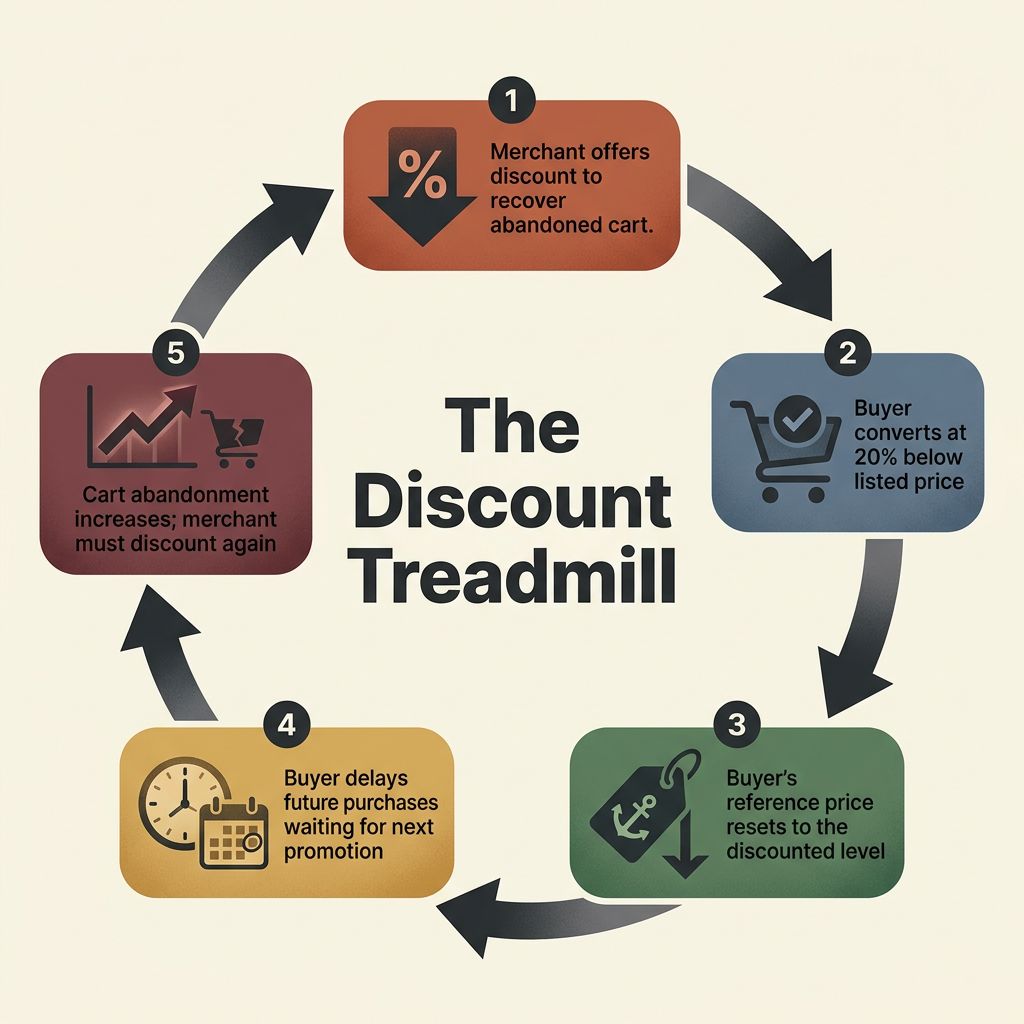
A merchant offers 20% off to recover an abandoning shopper. The shopper converts, but their new price anchor sits 20% below the listed price. Every future visit to that store begins from that lower reference point.
JCPenney tested the inverse in 2012. Under CEO Ron Johnson, the retailer replaced promotional pricing with everyday “fair and square” prices. Sales fell 25% in the first year: buyers had been trained to expect the deal, and the listed price felt wrong without it.
Mansoor reads this as evidence that buyers do not primarily want a lower price. They want the experience of obtaining one. A negotiated outcome delivers that experience without training the market to expect a discount.
Promotional pricing research identifies this pattern as reference price erosion. Repeated exposure to discounts causes consumers to treat the sale price as the product’s true value, reducing their willingness to pay the listed price in future sessions. For a high-ticket product priced at $1,200, a 20% recovery coupon costs $240 in margin per transaction. Each discount cycle lowers the sustainable price floor the merchant can hold.
The Two Types of Price-Sensitive Buyers (And Why Only One Needs a Discount)
Price-sensitive ecommerce shoppers split into two distinct groups, and Mansoor Osmani of DBargain argues that treating them identically is the core mistake most merchants make. The first group cannot afford the product at any realistic price. The second can afford it but wants the experience of negotiating a better outcome. Only one group responds to a discount in a way that benefits the merchant’s margin and long-term customer value.
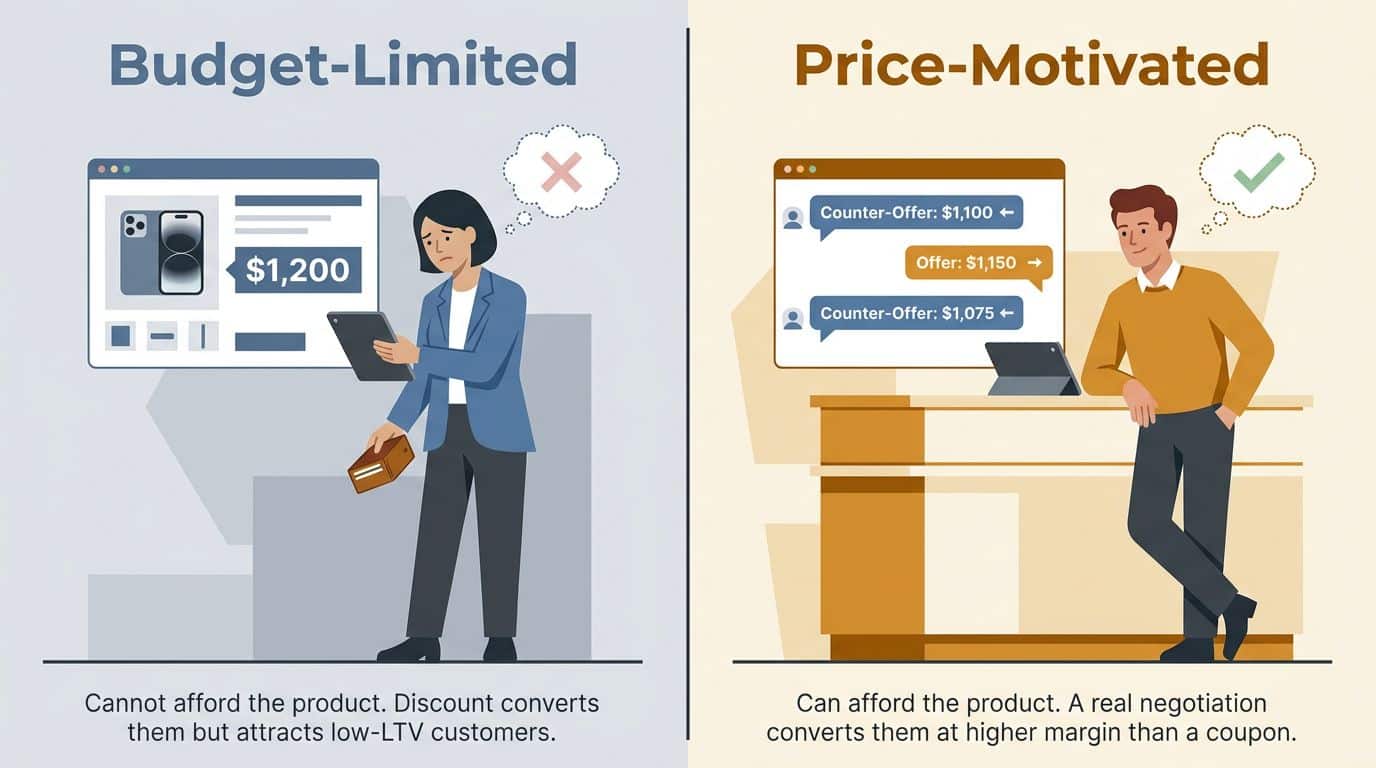
The first type is budget-limited. The listed price is genuinely beyond what they will pay, regardless of how much they want the product. A discount can convert this buyer, but it attracts customers whose long-term value is lower, because their constraint is financial rather than psychological.
The second type is price-motivated. These buyers can afford the product, but they want the experience of not having paid retail. Buying at below the listed price is how many buyers determine whether a purchase was a good outcome. A discount code gives them a lower number; it does not give them the experience of having negotiated.
Mansoor encountered this directly at a Mercedes-Benz showroom in Jeddah. A buyer negotiating a $500,000 car asked for the final price in Arabic: “akher kalam.” The car was within his means; the negotiation was how he determined the outcome was fair.
Standard ecommerce treats both types identically. An exit-intent popup offers a 10% coupon to every hesitant visitor. The price-motivated buyer takes the coupon but has lost the experience the merchant could have offered instead. They convert at a lower margin than they would have accepted in a real negotiation.
How AI Price Negotiation Converts High-Ticket Shoppers in Real Time
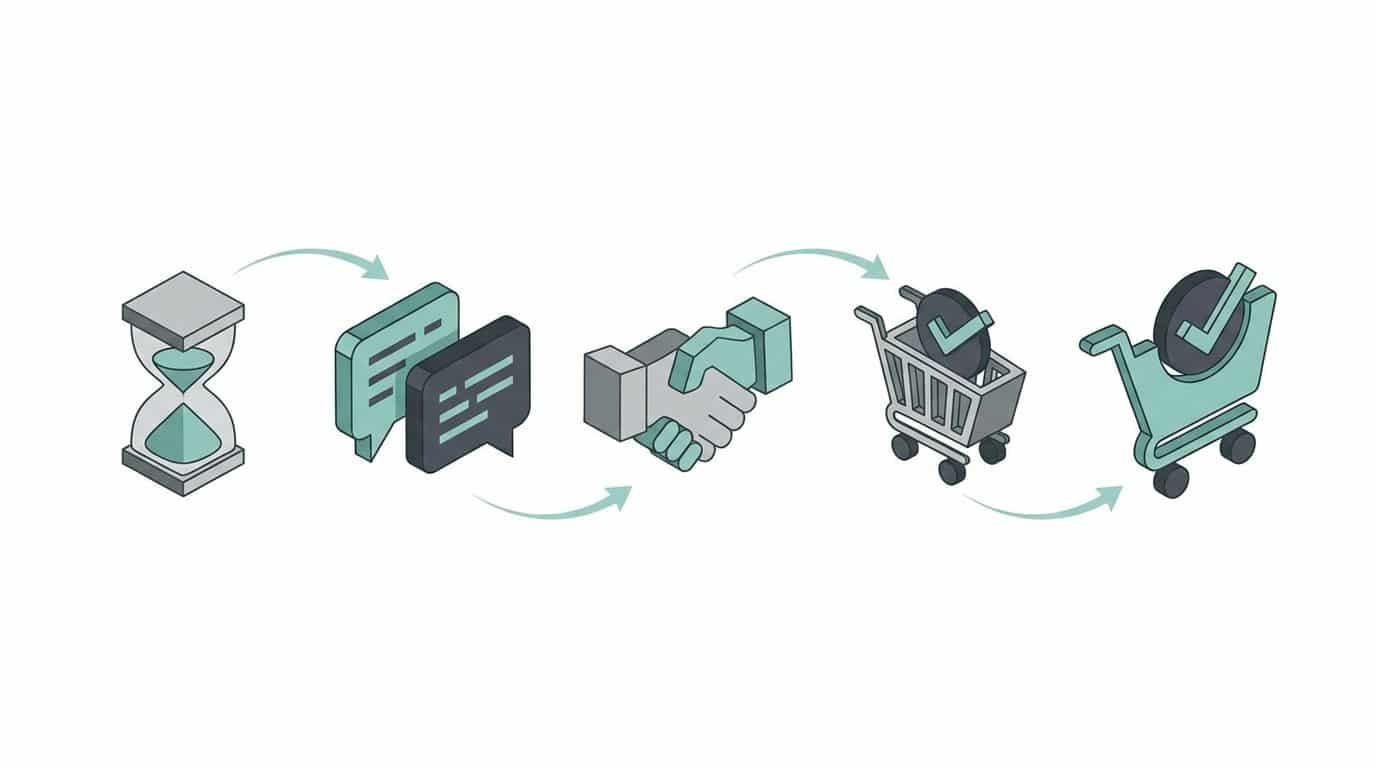
The DBargain negotiation flow begins with a timer, not a pop-up. Once a visitor reaches the configured dwell threshold without proceeding to checkout, the system activates. Mansoor Osmani sets this trigger at 30 to 50 seconds, a window that signals interest without purchase commitment.
The AI makes an opening offer of approximately 5%, with an explicit invitation to counter. The merchant has configured two parameters in advance: a maximum discount ceiling and a maximum number of negotiation rounds. The ceiling and round limit are both hidden from the buyer; the AI operates within both without revealing either.
The iteration count is randomized per session. One buyer might receive five rounds, another only three. Buyers who compare experiences discover the asymmetry, which makes each negotiation feel personal rather than scripted. Mansoor identifies this randomization as a deliberate gamification design, not a side effect; the variation generates organic word-of-mouth.
The final round carries a deliberate signal. The AI prompts the buyer: “This is your last chance to make a good bid.” The explicit framing raises the stakes and prompts a more serious final offer.
If the buyer’s final offer meets the merchant’s hidden floor, checkout triggers automatically. Mansoor describes the close: the AI delivers “Congratulations, you have bought the product” and routes the session to checkout. If the offer falls below the floor, the session closes without friction and without disclosing the limit.
Gary Smith runs a luxury art store in the United States and was among DBargain’s first users. He reports that buyers who complete the negotiation process convert and do not request refunds. The purchase feels earned rather than impulsive, which changes post-purchase satisfaction in ways a coupon cannot replicate.
Smith’s store saw the negotiation mechanic outperform exit-intent discount popups across his highest-margin pieces. Buyers settled well below his ceiling. The absence of refund requests indicated the negotiated price anchored differently than a coupon price: a buyer who negotiated believes they won; a buyer who received a coupon wonders if they should have waited for a better one.
Nibble, a UK-based AI price-negotiation platform with comparable mechanics, has published case studies showing a 15–40% increase in conversion among hesitant shoppers across fashion and homeware categories. No independent audit of these figures exists, but the direction of effect is consistent with what Osmani observes at DBargain: the negotiation mechanism converts buyers that a static coupon would not.
Is AI Price Negotiation Right for Your Ecommerce Store?
AI price negotiation delivers the clearest return in a specific context. The product must be high-ticket, carry meaningful margin, and attract buyers who expect prices to be negotiable. Mansoor Osmani identifies the clearest-fit categories as luxury goods, original art, diamonds, high-end outdoor equipment, and made-to-order fashion.
| Product category | Margin available | Buyer expects to negotiate? | AI negotiation fit |
|---|---|---|---|
| Original art / luxury goods | High (40%+) | Yes | Strong |
| High-end outdoor equipment | Medium-high (25–40%) | Often | Strong |
| Made-to-order fashion | High (35%+) | Increasingly | Strong |
| Consumer electronics ($500+) | Medium (15–25%) | Rarely | Moderate |
| Commodity products | Low (<15%) | No | Poor |
| Subscription SaaS / services | Varies | In B2B, yes | Emerging |
The model fits less well for commodity products with thin margins or categories where fixed pricing is a strong social norm. Mansoor recommends a minimum product price of $500, where available margin exceeds the cost of running the negotiation, and the buyer’s psychological expectation of a deal is more realistic.
For Shopify merchants evaluating the tool, a conservative starting configuration reduces risk. Set the dwell trigger to 90 to 120 seconds to capture highly hesitant visitors rather than casual browsers. Limit initial deployment to the five highest-margin SKUs and review accepted discounts after 30 days.
The ceiling setting is the most consequential configuration decision. Set it too high, and the average accepted price resembles a blanket discount. A tighter ceiling preserves the negotiation experience while protecting the price floor. Mansoor notes that buyers frequently settle well below the maximum. Merchants who set a 30% ceiling typically see buyers close at 10–15%, preserving the sale at a fraction of the coupon cost.
How to Improve Ecommerce Conversion Rate: A Tiered Approach
Not every CRO problem has the same solution. The right intervention depends on the product price point, the margin structure, and the buyer’s underlying hesitation. Treating all conversion problems with the same toolkit (checkout optimization, page speed, trust badges) is why so many merchants run A/B tests for six months and shift conversion by half a percentage point.
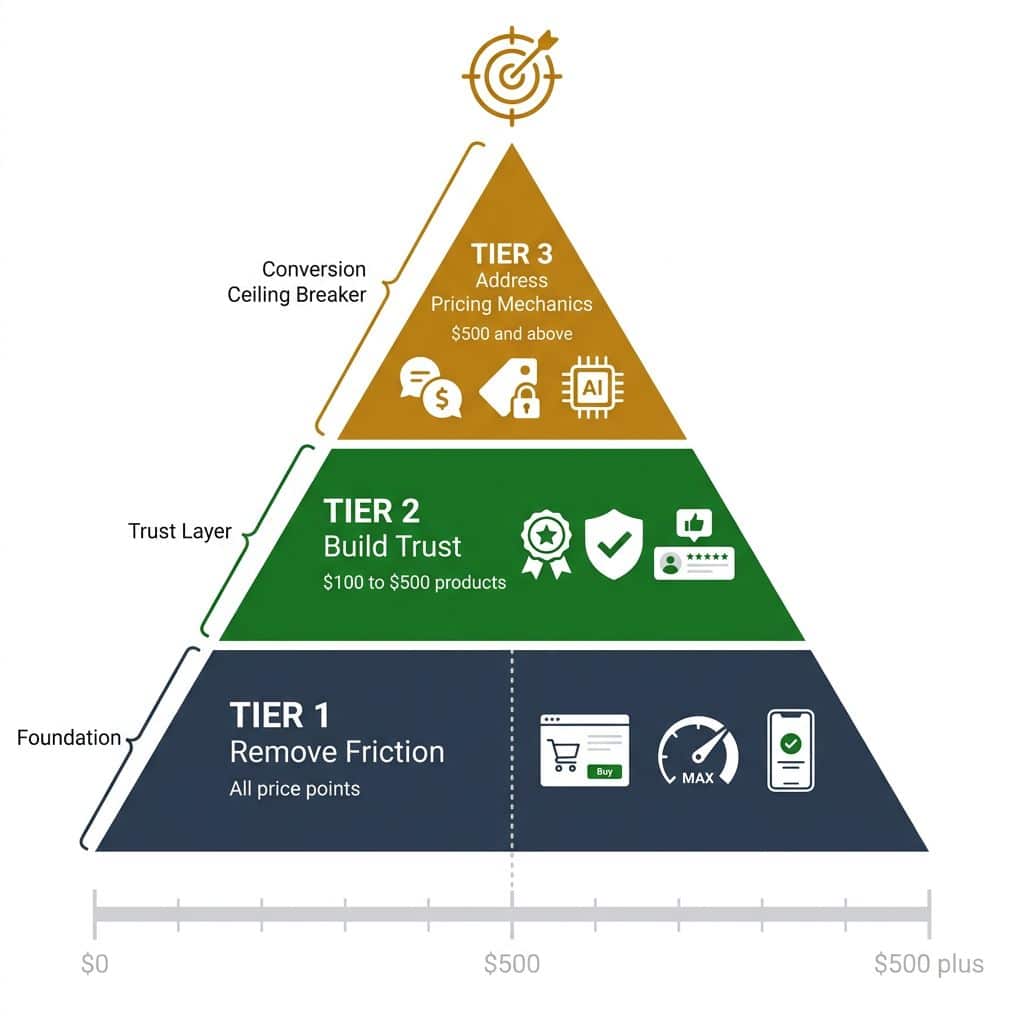
The clearest framework from Mansoor Osmani’s work is a three-tier approach, organized by price point and buyer psychology.
Tier 1: Remove friction (all price points)
Standard CRO tools (Hotjar for behavior analytics, Optimizely for A/B testing, Shopify’s native checkout) address process friction. They work when the buyer wants to purchase, but something in the checkout experience stops them. If your abandonment happens at checkout rather than on the product page, this is the right starting point. The gains are real, and the implementation is low-risk.
Tier 2: Build trust (mid-range, $100–$500)
For mid-range products where the buyer is comparing options, social proof and reviews move conversion. Yotpo, Okendo, and similar platforms surface verified reviews at the point of purchase. This tier addresses hesitation rooted in uncertainty rather than price: “Is this store legitimate? Will I regret this?” Adding 40+ verified reviews to a $250 product page typically lifts conversion 10–20%, according to published Yotpo benchmark data.
Tier 3: Address pricing mechanics ($500 and above)
For high-ticket products, Tiers 1 and 2 improve conversion at the margins. The structural barrier is the price itself, and the buyer is not blocked by friction or uncertainty but by the absence of a negotiating mechanism. This is where AI price negotiation tools operate.
| Tool | Category | Best for | Price point |
|---|---|---|---|
| Hotjar | Behavior analytics | Identifying drop-off points | All |
| Optimizely | A/B testing | Checkout and landing page optimization | All |
| Nibble | AI negotiation | Fashion, homeware, mid-to-high ticket | $100–$2,000 |
| DBargain | AI negotiation | Luxury goods, art, high-margin SKUs | $500+ |
The practical starting point for a Shopify merchant is to identify which tier their abandonment falls into before choosing a tool. A store with high product-page dwell time and low add-to-cart rates has a Tier 3 problem. A store with high add-to-cart and low checkout completion has a Tier 1 problem. Deploying an AI price-negotiation tool at a store with a checkout UX problem will not yield results.
In conversations with ecommerce operators on the Predictable B2B Success podcast, the most common mistake I observe is deploying Tier 2 and Tier 3 tools before resolving Tier 1 problems. Mansoor’s diagnostic question is simple: where in the funnel does the session end? Product page exits are a pricing signal. Checkout exits are a friction signal.
Frequently Asked Questions
What is a good conversion rate for ecommerce?
A good ecommerce conversion rate is generally 2–4% across most product categories, though this varies significantly by vertical. Consumer electronics and luxury goods typically fall below 1.5%, while food and beverage can reach 5–6%. These benchmarks reflect the performance of fixed-price stores, not a ceiling for what is achievable. Mansoor Osmani of DBargain argues that the 1–3% average is not an industry constant but a structural consequence of pricing models that exclude the majority of hesitant buyers from completing a purchase.
Why doesn’t discounting fix cart abandonment for high-ticket ecommerce stores?
Discounting fails to fix cart abandonment for high-ticket stores because it treats the symptom rather than the structural cause. Most price-hesitant visitors to high-ticket stores are not priced out: they want the experience of negotiating a better outcome. A discount code delivers a lower price but removes the psychological mechanism that makes the buyer feel the purchase was earned. Mansoor Osmani of DBargain identifies a second problem: repeated discounting trains buyers to delay future purchases until another promotion appears, compounding the abandonment cycle with every offer.
What is the discount treadmill in ecommerce?
The discount treadmill is the cycle in which a merchant offers promotional pricing to recover abandoned carts, which trains buyers to expect discounts, which causes more buyers to delay purchases until a promotion appears, which in turn requires the merchant to offer discounts more frequently to hit the same conversion numbers. JCPenney’s 2012 attempt to eliminate promotional pricing in favor of everyday low prices led to a 25% sales collapse in the first year: customers had been conditioned to need the deal, not just the price. Each discount cycle erodes the sustainable price floor the merchant can hold.
How does AI price negotiation improve ecommerce conversion rates for high-ticket products?
AI price negotiation improves ecommerce conversion rates for high-ticket products by intervening in real time, before a hesitant buyer leaves the product page. DBargain, built by Mansoor Osmani, triggers a negotiation interface after a buyer has spent 30 to 50 seconds on a product page without proceeding to checkout. The AI conducts a back-and-forth negotiation within a merchant-defined discount ceiling, randomizes the number of rounds per session to create a sense of personalization, and triggers checkout automatically when the buyer’s final offer meets the merchant’s floor. The buyer never sees the ceiling; the merchant never exceeds the configured limit.
What is the best way to increase ecommerce conversion rates without running discounts?
The most effective approach to raising ecommerce conversion rates without discounting is to address the actual reason hesitant buyers leave: unresolved price tension. For high-ticket products priced at $500 or above, the standard CRO toolkit (checkout optimization, page speed, trust signals) addresses friction, not price. Real-time AI price negotiation offers a structural alternative: it converts price-motivated buyers by giving them a negotiation experience rather than a blanket coupon, preserving brand perception and protecting margins while recovering sales that would otherwise be permanently lost.
How does DBargain work on Shopify?
DBargain installs on Shopify as an app and activates when a buyer dwells on a product page for more than a configurable time without proceeding to checkout. Merchants set two parameters: the maximum discount percentage they are willing to concede and the maximum number of negotiation rounds. Both stay hidden from buyers. The AI negotiates in real time within those parameters, randomizes the round count per session, and routes successful negotiations directly to the checkout. Mansoor Osmani reports an onboarding time of 10 to 15 minutes for most Shopify stores.
Can AI price negotiation work for B2B SaaS pricing pages?
AI price negotiation works for B2B SaaS pricing pages, particularly for enterprise plans where the gap between list price and what the buyer will pay is meaningful. The mechanism differs slightly: rather than a consumer-style negotiation pop-up, the application would be a structured “make an offer” interface on the pricing page that captures price-sensitive enterprise prospects before they abandon or enter a full sales process. Mansoor Osmani describes this as a qualifying function: surface the buyer’s price expectation early rather than discovering it at contract stage after weeks of sales effort.
What factors affect ecommerce conversion rates?
Ecommerce conversion rates are shaped by four primary factors: product price point, checkout friction, traffic quality, and pricing mechanics. Price point has the largest structural effect. Luxury and high-ticket categories average below 1.5% because buyer hesitation is rooted in price rather than process. Traffic quality determines whether visitors have purchase intent when they arrive. Checkout friction determines whether intent converts. Pricing mechanics, the least-addressed factor, determine whether price-hesitant buyers with sufficient means actually complete a purchase or abandon permanently.
Conclusion
Mansoor Osmani’s central finding is that the ecommerce conversion rate problem is structural, not tactical. Fixed prices do not fail because buyers cannot afford the product. They fail because the store offers no mechanism for price-motivated buyers to feel that the outcome was worth the cost.
For B2B tech founders building tools for ecommerce merchants, this reframes the CRO opportunity. Most optimization tools improve the path to purchase; the larger gap lies in the pricing conversation, which every current tool either ignores or replaces with a coupon. The Nibble data and Osmani’s early DBargain results point in the same direction: real-time negotiation mechanics convert a category of hesitant buyer that the standard CRO toolkit structurally misses.
If you want to build search authority in the ecommerce space from your podcast, Sproutworth’s podcast-to-article service converts episode transcripts into LLMSEO-ready articles that reach the B2B tech founder audience described in this piece.
The question is not whether ecommerce stores should negotiate with price-hesitant buyers. Effective conversion rate optimization for ecommerce at the $500-plus price point is not a checklist problem. It is a pricing mechanics problem. The question is whether merchants address it seasonally with a coupon or in real time with the buyer.
Related Resources
- How B2B Content Marketing Drives Inbound Pipeline
- What Is Answer Engine Optimization?
- Podcast-to-Article Content Service
- B2B SEO Strategy for Funded Startups
Related Links
Some topics we explore in this episode include:
- Why do so many CRM systems end up as expensive, unused databases?
- What’s stopping B2B companies from unlocking the profit power of customer retention?
- How can you launch impactful customer marketing with zero new budget or headcount?
- Are your AI initiatives really driving ROI—or just shiny distractions?
- Why is clean, structured data the game-changer for successful AI adoption?
- Can your service catalog withstand a data-driven audit to assess true market fit?
- What can failed AI and service launches teach you before your next big bet?
- Will your organization’s approach to AI adoption accelerate—or block—innovation?
- How are AI-driven search engines rewriting the rules of B2B demand generation?
- What will agencies need to do to stay indispensable as clients build their own AI solutions?
Listen to the episode
Subscribe to & Review the Predictable B2B Success Podcast
Thanks for tuning into this week’s Predictable B2B Podcast episode! If the information from our interviews has helped your business journey, please visit Apple Podcasts, subscribe to the show, and leave us an honest review.
Your reviews and feedback will not only help me continue to deliver great, helpful content but also help me reach even more amazing founders and executives like you!
